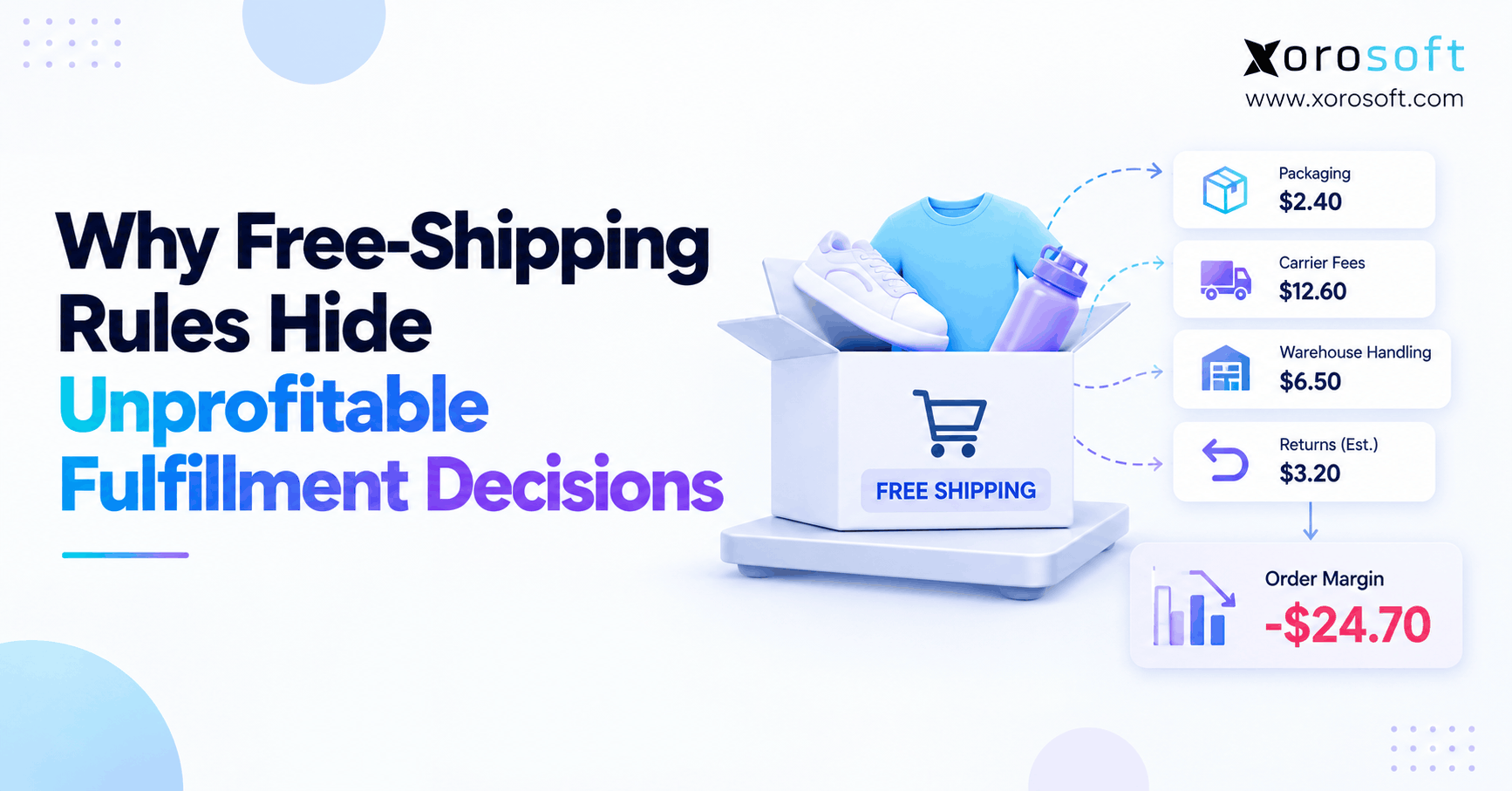
When planning your e-commerce strategy, it’s important to consider free shipping profitability as it can significantly impact your bottom line.
1. The Checkout Promise Has a Hidden Second Price
Free shipping profitability is not decided when a shopper qualifies for free delivery. It depends on the margin left after a business picks, packs, and ships that specific order. Although a threshold can encourage customers to buy more, the same offer can create entirely different fulfillment costs from one order to the next.
Consider two $120 orders. Both pass a $75 free-shipping threshold, and both look equally valuable in a sales report. However, the first leaves one warehouse in a single carton, while the second needs two warehouses and two shipping labels. Consequently, the business can earn a positive contribution on one and lose money on the other.
1.1 Why Free Shipping Profitability Starts After Checkout
A checkout rule answers a narrow question: should the shopper pay a delivery charge? In contrast, an operational margin calculation asks what the company spent to deliver the promise. Therefore, a profitable shipping strategy must connect the customer-facing offer with product costs, fulfillment activity, and carrier invoices.
In addition, the shipping price charged to the customer is not the same as the cost paid by the merchant. When shipping is free, customer shipping revenue may be zero, even though handling and transportation expenses remain. As a result, measuring only conversion rate or average order value can conceal losses.
1.2 Why the Same Basket Value Can Mean Different Results
Order value tells finance how much the customer purchased. However, it does not reveal package size, delivery distance, the origin warehouse, or the number of shipments. For example, a small parcel going to a nearby address may cost far less than an oversized item sent across several zones.
Moreover, two orders with identical product margins may require different packing labor. Consequently, the right unit of analysis is the actual order and its linked shipments, not simply the size of the cart. That distinction gives teams a reliable starting point for improving free shipping profitability.
2. What Free-Shipping Rules Check and Miss
Free-shipping rules are useful because they give customers a clear incentive. Nevertheless, most simple thresholds are not designed to calculate the merchant’s final variable expense. Before changing a policy, teams should understand which information the checkout rule uses and which information arrives later.
2.1 Why a Free Shipping Threshold Is Only a Trigger
Suppose a store offers free delivery above $75. First, the rule checks whether an eligible basket reaches the required amount. Then, the customer sees the permitted delivery option. However, the threshold alone does not determine whether those products have sufficient margin to cover shipping and handling.
For instance, a $90 basket of compact accessories may support the offer, while a $90 basket containing a bulky, low-margin item may not. Therefore, teams should compare free-shipping eligibility with actual contribution by product group and destination. A threshold is a starting assumption, not a profitability guarantee.
2.2 Shopify Free Shipping Discounts Versus Shipping Rates
Shopify merchants can use shipping rates and free-shipping discounts, but these mechanisms have different rules. For example, Shopify’s free-shipping discount guidance states that minimum purchase amounts exclude taxes and reflect applicable discounted product prices. Meanwhile, shipping-rate configurations can use conditions such as order amount, weight, and shipping zone.
Additionally, Shopify is gradually introducing shipping options by market for eligible stores. As a result, some merchants still manage shipping through profiles and rates, while others see the newer arrangement. Accordingly, verify the store’s current settings before following any one-size-fits-all configuration advice.
2.3 The Missing Costs Behind Free Shipping Rules
Checkout often knows the basket, customer address, and shipping options. However, the final cost may depend on actual packaged dimensions, inventory placement, split fulfillment, and charges posted after shipment. Therefore, a rule can be correct at checkout while the subsequent order becomes unprofitable.
| What checkout can evaluate | What operations and finance must confirm |
|---|---|
| Eligible order value | Product contribution after discounts |
| Delivery region | Actual shipment origin and zone |
| Rate or promotion | Carrier invoice and surcharges |
| Available-to-sell products | Warehouse-level inventory and splits |
| Customer delivery choice | Packing, handling, and return exposure |
Consequently, free shipping profitability requires both sides of this table. Without the second column, the business is judging a cost decision with incomplete information.
3. How Hidden Costs Undermine Free Shipping Profitability
The most visible expense is the carrier label. Yet shipping profitability also depends on the work needed to prepare an order and handle exceptions. Therefore, a complete calculation must extend beyond the charge displayed in the shipping application.
3.1 Carrier Zones, Dimensional Weight, and Surcharges
A carrier may price a shipment according to origin, destination, service, size, and weight. For example, FedEx explains its shipping-cost factors, including dimensional weight and additional fees. Consequently, a light product shipped in a large box can cost more than its scale weight suggests.
Moreover, residential delivery, special handling, or a faster service may change the final charge. Therefore, brands should compare estimates with settled carrier invoices rather than assuming the amount quoted at label creation is always final. Free shipping profitability can erode quietly when these differences are not reconciled.
3.2 Warehouse Fulfillment Costs After Checkout
Carrier expenses are only part of the cost to serve. In addition, employees or 3PL partners receive, locate, pick, pack, and dispatch products. Shopify’s fulfillment-cost overview identifies warehousing, pick-and-pack work, shipping, and returns as relevant cost categories.
However, not every category belongs in the same calculation. For order contribution, include the expenses that vary with an order, such as per-pick fees and packing materials. Meanwhile, track fixed rent and salaried overhead separately unless you have chosen a consistent allocation method for another profitability measure.
3.3 Returns and Replacements Change the Final Answer
A shipped order may look profitable until the customer returns it. Then, the business might absorb return transport, inspection, restocking, and another outbound shipment for an exchange. As a result, an initial margin report can overstate the value of return-prone products.
Therefore, use actual return expenses where known, or a reasonable expected allowance for similar orders where the outcome is uncertain. In addition, keep refunds, recovered inventory value, and extra handling separate to avoid double-counting. This creates a more dependable view of free shipping profitability across the order lifecycle.
4. Why Split Shipments Hurt Free Shipping Margins
A split shipment means that one customer order is fulfilled through multiple shipments or locations. Although the customer may still receive free delivery, the merchant can pay for multiple cost events. Consequently, split frequency deserves attention whenever free-shipping margins decline.
4.1 One Order Can Create Multiple Cost Events
Imagine a customer buys a jacket and a bag. Because the products sit in different warehouses, the company sends two cartons instead of one. As a result, it may pay for two labels, more packing materials, and separate handling activities.
However, a split is not automatically a bad operational decision. For instance, it may be necessary to honor a delivery promise or ship available items immediately. Therefore, the right question is whether the extra cost and customer benefit are visible, rather than whether every split can be eliminated.
4.2 What Shopify Order Routing Actually Does
According to Shopify’s order-routing documentation, the default strategy prioritizes minimizing split fulfillments, staying within the destination market, and shipping from the closest location. Nevertheless, an order can still split when no suitable single location holds all required items.
Moreover, merchants can adjust routing priorities for their operating model. However, a routing rule that reduces packages does not prove every chosen shipment is the least expensive option. Consequently, teams should evaluate actual parcel costs and delivery commitments alongside the configuration.
4.3 Split Fulfillment Costs Versus Delivery Promises
Holding an order until every item is available might save packing and carrier costs. On the other hand, waiting can cause delays, missed commitments, and disappointed customers. Therefore, consolidating shipments should be a deliberate service decision, not an automatic cost-cutting rule.
For example, compare the cost of sending two parcels today with the cost and customer impact of sending one parcel tomorrow. Then, document which approach the team selected and why. Over time, this decision record reveals patterns that can improve free shipping profitability without sacrificing service blindly.
5. Warehouse Choices and Order-Level Profitability
Warehouse selection affects more than travel distance. It can change picking effort, available packaging, inventory completeness, and carrier service. Therefore, a location choice that looks convenient may still produce avoidable shipping costs.
5.1 The Nearest Warehouse May Not Be the Cheapest
A nearby location might hold only one of three items in an order. Meanwhile, a slightly more distant site may hold everything. Consequently, the closest location could create two parcels, while the farther one could complete a single shipment.
However, distance, speed, labor charges, and carrier contracts still matter. Rather than assume which location is best, compare the full fulfillment expense and promised arrival date. This helps keep order-level profitability at the center of the decision.
5.2 Inventory Errors Can Turn One Parcel Into Two
An inaccurate stock record can cause a warehouse to discover missing units after order release. As a result, employees may reassign items, split an order, or arrange a replacement shipment. Therefore, inventory accuracy supports free shipping profitability even though it is not itself a checkout setting.
For multi-location teams, XoroWMS connects warehouse tasks with inventory records in Xorosoft’s operational environment. However, the business should still verify its own location settings, counting practices, and fulfillment processes before assuming the software will prevent every exception.
5.3 Delivery Speed Can Consume Free Shipping Margins
Expedited delivery may be important for urgent orders or premium promises. Nevertheless, a low-margin basket may not withstand the added carrier charge. For instance, a $12 increase in shipping could consume most of the contribution left after product and handling costs.
Therefore, compare standard and expedited services at the order level. In addition, separate a service upgrade paid for by the customer from one subsidized by the merchant. That distinction makes shipping profitability easier to evaluate fairly.
6. Calculate Free Shipping Profitability From Real Orders
A free-shipping policy cannot be evaluated reliably without consistent cost definitions. Accordingly, finance and operations should agree on one order-level contribution formula and apply it across product, location, and channel segments.
6.1 A Practical Shipping Margin Formula
Start with net order revenue, including any shipping amount actually paid by the customer. Next, subtract the product’s variable cost and relevant order-level expenses. In particular, include carrier charges, per-order handling, packaging, processing fees, and an appropriate allowance for returns.
Order contribution = Net order revenue − product costs − variable fulfillment costs − carrier and packaging costs − other variable order costs.
Then divide the resulting contribution by net order revenue to calculate the contribution margin percentage. However, do not call the result net profit: fixed overhead and other business expenses still need to be covered.
6.2 Compare a Single Shipment With a Split Shipment
Consider two hypothetical $120 orders with the same product costs. Both qualify for free delivery, but the second requires two shipments. Consequently, differences in handling, packaging, and carrier expense change the outcome.
| Cost component | One parcel | Two parcels |
|---|---|---|
| Net order revenue | $120 | $120 |
| Product cost | $78 | $78 |
| Payment processing | $4 | $4 |
| Variable warehouse handling | $6 | $10 |
| Packaging | $2 | $4 |
| Carrier charges | $10 | $26 |
| Expected return allowance | $3 | $3 |
| Order contribution | $17 | −$5 |
Illustrative figures only; they are not customer results. Therefore, the single shipment contributes $17, while the split shipment loses $5 before fixed overhead. The $22 difference comes entirely from fulfillment execution, not order revenue.
6.3 Gross Margin Is Not the Same as Order Contribution
Gross margin generally compares net revenue with cost of goods sold. However, a gross margin calculation may not show variable carrier, handling, or transaction costs. Therefore, a free-shipping campaign can appear healthy at the product-margin level while generating weak order contribution.
For example, both hypothetical orders have the same product cost. Yet only one produces positive contribution after fulfillment. Consequently, free shipping profitability should be monitored alongside gross margin, not replaced by it. For integrated financial workflows, XoroERP can connect the underlying inventory, order, and accounting information used in these reviews.
7. Setting a Profitable Free Shipping Threshold
A shipping threshold should reflect real order economics rather than an arbitrary round number. However, there is no universal threshold that protects every cart. Therefore, use actual order history and test several realistic policy options before making a permanent change.
7.1 Calculate Thresholds From Actual Order Mix
First, group historical orders by basket value and calculate their contribution after fulfillment. Next, identify which baskets regularly lose money and why. For example, an $80 order may perform well when it contains compact accessories but poorly when it contains heavy, low-margin items.
Then, model how a higher threshold might change the mix of orders. Nevertheless, avoid assuming customers will always add the same products to qualify. The goal is to improve free shipping profitability across real buying patterns, not simply raise average order value.
7.2 When Free Shipping Rules Need Exceptions
Some catalog segments deserve separate rules. For instance, oversized furniture, remote destinations, and expedited delivery may require additional charges or exclusions. Accordingly, a merchant could offer free standard delivery for eligible products while setting clear conditions for exceptional cases.
However, changes must match the store’s available shipping configuration and customer promises. In addition, exceptions should be visible before payment, not introduced as surprises. A simple, understandable policy often performs better operationally than dozens of hard-to-maintain conditions.
7.3 Test Shipping Policies Without Misreading Revenue
A higher free-shipping threshold may increase average order value, but it could also reduce conversion. Therefore, compare total contribution, conversion, order mix, and return behavior together. If possible, use a controlled test or closely comparable periods rather than attributing every change to the new threshold.
Furthermore, separate holiday promotions, carrier increases, and product launches from the analysis. Otherwise, the team may credit the policy for a change caused by seasonality. Ultimately, free shipping profitability is a measured business outcome, not a single checkout setting.
8. Build a Free Shipping Profitability Scorecard
Once the policy is defined, teams need a repeatable method for finding exceptions. Consequently, a useful scorecard combines financial results with the operational events that created them. It should help leaders decide what to investigate, not merely display totals.
8.1 Five Metrics Finance and Operations Should Share
First, track order contribution after variable fulfillment expense. Second, measure the average shipping subsidy, meaning carrier and relevant shipping expense less customer shipping revenue. Third, calculate cost per fulfilled order. Fourth, monitor split-shipment frequency. Finally, measure the share of orders with negative contribution.
| Metric | Management question |
|---|---|
| Order contribution | Did the order cover its variable costs? |
| Shipping subsidy | How much delivery cost did we absorb? |
| Fulfillment cost per order | Are handling expenses rising? |
| Split-shipment rate | Are multiple parcels becoming common? |
| Negative-contribution share | How much order volume destroys contribution? |
Together, these measures describe free shipping profitability more clearly than average order value alone. Moreover, the scorecard provides a shared language for finance, warehouse, and ecommerce teams.
8.2 Segment Free Shipping Costs by SKU, Location, and Service
A company-wide average may conceal expensive pockets of activity. Therefore, segment the scorecard by SKU category, destination region, warehouse, carrier service, and sales channel. For example, a high shipping cost per order may be acceptable for one profitable furniture category but unsustainable for low-margin accessories.
Additionally, track how often a particular location triggers split shipments or rush services. This helps teams identify repeatable root causes rather than treating every expensive order as a separate problem.
8.3 Track Unprofitable Free Shipping Orders
Flag orders with negative contribution and attach a reason code where possible. For instance, labels might include oversized packaging, split shipment, remote zone, urgent service, or incorrect stock. Then, review the largest recurring groups each week.
However, do not optimize solely for the cheapest parcel. A decision that increases delays or returns may worsen the total outcome. Instead, use the scorecard to balance cost, delivery reliability, and customer expectations while improving free shipping profitability.
9. Reduce Fulfillment Costs Before Raising the Threshold
Raising the threshold is only one option. Often, operations can reduce preventable expenses without changing the customer-facing promise. Therefore, examine fulfillment execution before asking shoppers to spend more.
9.1 Reduce Avoidable Warehouse Splits
Start by reviewing orders that could have been fulfilled from one location but were split because of allocation rules or incorrect stock. Next, examine whether inventory transfers, better replenishment, or adjusted routing priorities would reduce those exceptions. However, transfers also cost money, so compare their expense with the potential savings.
In addition, coordinate purchasing and warehouse teams around fast-selling items held in the wrong locations. For businesses using XoroONE, the combination of inventory, purchasing, warehouse, and reporting functions provides relevant operational information for these reviews.
9.2 Reduce Shipping Costs Through Better Packaging
Oversized cartons can increase dimensional-weight charges even when products are light. Therefore, standardize carton choices and check whether packing practices use unnecessary space. Likewise, compare suitable carrier services and contracted rates for common shipment profiles.
However, cheaper packaging should not increase damage or returns. Consequently, assess packaging cost alongside product protection, delivery performance, and damage claims. The objective is a lower total cost to serve, not simply a lower price per box.
9.3 Reconcile 3PL Activity to Actual Charges
When a 3PL fulfills orders, finance may receive invoices that group many charges together. Therefore, match the provider’s activity details to order and shipment IDs wherever possible. Next, separate storage fees from per-order handling and transportation expenses so the contribution model stays consistent.
Moreover, investigate repeat surcharges, extra picks, and replacement shipments. Without reconciliation, operational issues can remain invisible until the monthly invoice arrives. As a result, free shipping profitability becomes harder to improve because teams cannot trace expense back to the original decision.
10. Free Shipping Margins Across Different Industries
The right shipping policy changes with the product. Therefore, operators should segment analysis by how items are stored, packed, transported, and returned. A universal threshold is simplest to explain, but it is not always the best fit for a mixed catalog.
10.1 Apparel, Furniture, and Sporting Goods
Apparel orders may have compact parcels, yet frequent returns and exchanges can reduce their contribution. Meanwhile, furniture often requires larger cartons, protective materials, or special delivery services. Sporting goods can combine small accessories with oversized equipment, producing very different shipping profiles.
Consequently, evaluate returns for apparel, dimensional charges for furniture, and product-specific exceptions for sporting goods. Moreover, use genuine shipment records rather than relying on assumptions about what an industry typically costs. For broader use cases, explore the industries served by Xorosoft.
10.2 Food, Wholesale, and Manufacturing
Food and beverage products may require insulation, protective packaging, or time-sensitive delivery. Meanwhile, wholesale orders can have negotiated freight terms and customer-specific shipping agreements. Manufacturing shipments may depend on production timing and stock across facilities.
Therefore, each group needs a different contribution review. For example, a wholesale order should reflect its actual customer contract, while a food shipment may require a packaging allowance. Ultimately, free shipping profitability depends on the economics of the specific business model.
10.3 Shopify, Amazon, and B2B Orders Need Distinct Reviews
Omnichannel businesses may sell the same SKU through different storefronts and account types. However, marketplace fees, customer shipping charges, wholesale terms, and service expectations can vary. Therefore, avoid combining every channel into one average shipping margin.
Instead, reconcile each channel’s revenue and order expenses using consistent definitions. In addition, confirm which systems own inventory availability and fulfillment status so the order is not counted twice. Connected ecommerce integrations can support cleaner workflows, while the business still controls its shipping-policy decisions.
11. When ERP Helps With Shipping Profitability
Not every store needs a large systems project to fix free shipping profitability. Nevertheless, manual methods become less reliable when orders span multiple channels, warehouses, or logistics providers. Therefore, the decision to upgrade should follow the complexity of the workflow.
11.1 When a Spreadsheet Is Still Enough
A small merchant with one warehouse and predictable parcels may be able to review order exports, carrier invoices, and product costs in a spreadsheet. First, establish a consistent formula. Then, audit exceptions monthly and update thresholds when costs change.
However, the spreadsheet needs reliable identifiers and clear ownership. If employees cannot match shipments to orders or determine which costs were included, the result is not trustworthy. In that case, improving data quality should come before purchasing new software.
11.2 Connected Data for Fulfillment Profitability
Xorosoft combines inventory, purchasing, warehouse management, ecommerce operations, and accounting in a cloud ERP environment. Additionally, its Shopify App Store listing describes order, inventory, fulfillment, and financial-data synchronization. These connections can reduce manual movement of operational information between systems.
However, connected data does not automatically prove that a platform selects the most profitable warehouse or calculates every carrier surcharge for every order. Therefore, buyers should verify the available reports, field mappings, and cost-allocation method during evaluation. The useful outcome is a reliable view of what happened and why.
11.3 Questions to Ask Before Buying Software
First, can the system connect an order to every shipment and fulfillment location? Second, can finance reconcile actual carrier and 3PL charges? Third, can teams distinguish estimated costs from final invoices? Finally, can users report contribution by SKU, channel, location, and shipping method?
In addition, ask who owns the data and how exceptions are corrected. For complex operations, Xorosoft’s connected business solutions offer an ERP context for such discussions. However, a sound evaluation should confirm fit against real workflows rather than a generic feature checklist.
12. A 30-Day Plan for Free Shipping Profitability
Improvement does not require rewriting the entire shipping policy on day one. Instead, begin with a short diagnostic cycle that separates data errors, operational waste, and policy design. Then, use the findings to test the smallest useful changes.
12.1 Week One: Reconcile Orders and Shipments
Export qualifying orders, net sales, and product costs. Next, match those orders with parcel counts, fulfillment locations, carrier invoices, and variable handling expenses. If some costs are unavailable, label them as estimates rather than presenting them as final.
Additionally, sample high-value, low-margin, and frequently split orders. This exposes where free shipping profitability is uncertain and which integrations or reports need attention. By the end of the week, teams should understand the completeness of their cost data.
12.2 Week Two: Find Free Shipping Losses by Root Cause
Calculate order contribution using the same cost definition for every order. Then, group negative results by destination, product category, warehouse, carrier service, and split-shipment status. For example, you may find that a small set of oversized products produces most of the avoidable expense.
However, distinguish genuine high costs from duplicate entries or incomplete invoices. Otherwise, teams might change a shipping policy to fix a reporting error. Consequently, this week should end with a ranked list of causes and owners.
12.3 Weeks Three and Four: Test and Measure
Test one or two changes, such as a product exception, revised threshold, better carton selection, or a fulfillment process adjustment. Meanwhile, track conversion, total contribution, delivery performance, and customer feedback. If possible, compare a controlled group against an unchanged policy.
Finally, retain changes that improve business outcomes without creating unacceptable service problems. Document the decision, schedule the next review, and update operating procedures. In this way, free shipping profitability becomes a measurable management practice rather than an occasional promotion review.
13. Conclusion: Protect the Margin Behind the Promise
Free shipping profitability depends on the full order journey, from the checkout promise to the final carrier bill. Therefore, a higher cart value does not guarantee a better outcome when split shipments, handling, packaging, or returns consume the remaining contribution.
Start by matching orders to their actual costs. Next, identify the exceptions that repeat and revise policies only after understanding the trade-offs. For businesses with complex inventory and fulfillment workflows, Xorosoft can help connect the operational data needed for a stronger review. To evaluate the fit for your business, Book a Demo and discuss the exact warehouse, Shopify, and accounting workflows your team needs to assess.
Frequently Asked Questions
What is free shipping profitability?
Free shipping profitability measures the contribution left after net sales cover product costs, carrier charges, packaging, handling, and other variable expenses. Therefore, a qualifying order can still lose money after fulfillment.
Why do free-shipping rules hide losses?
Thresholds usually determine whether customers receive a delivery discount, not what fulfillment ultimately costs. Consequently, split parcels, surcharges, and handling expenses can turn an eligible order into a loss.
How do split shipments affect free shipping margins?
Split shipments may require extra labels, cartons, picking work, and carrier services. However, they can also protect delivery promises. Compare the total cost and customer impact before changing the routing decision.
How can I calculate a profitable free shipping threshold?
Calculate contribution after product, shipping, and handling costs across historical basket values. Then, test candidate thresholds by product group and destination instead of relying only on average order value.
Does Shopify automatically prevent costly split shipments?
Shopify’s default routing tries to minimize splits, but cannot always avoid them when stock is spread across locations. Therefore, review actual shipment costs and routing outcomes rather than assuming every split is prevented.
Which KPIs reveal unprofitable free-shipping orders?
Track contribution per order, shipping subsidy, fulfillment cost per order, split-shipment rate, and negative-contribution order share. Additionally, segment results by warehouse, shipping zone, and product category to find recurring causes.
When should a brand consider ERP for shipping profitability?
Consider ERP when disconnected orders, inventory, shipments, and accounting records prevent dependable cost analysis. However, a small single-warehouse store may manage the same questions with reliable exports and disciplined reviews.
Recent Posts
-
Why Free-Shipping Rules Hide Unprofitable Fulfillment Decisions
-
 Inventory Accounting Automation Software for Product-Based Companies
-
 How a Wholesaler Eliminated Stale Purchase Orders Before Month-End
-
 Discontinued Shopify SKU Open Orders: What Happens Next?
-
 AI ERP Vendor Evaluation: How to Separate Shipped Features From Roadmaps