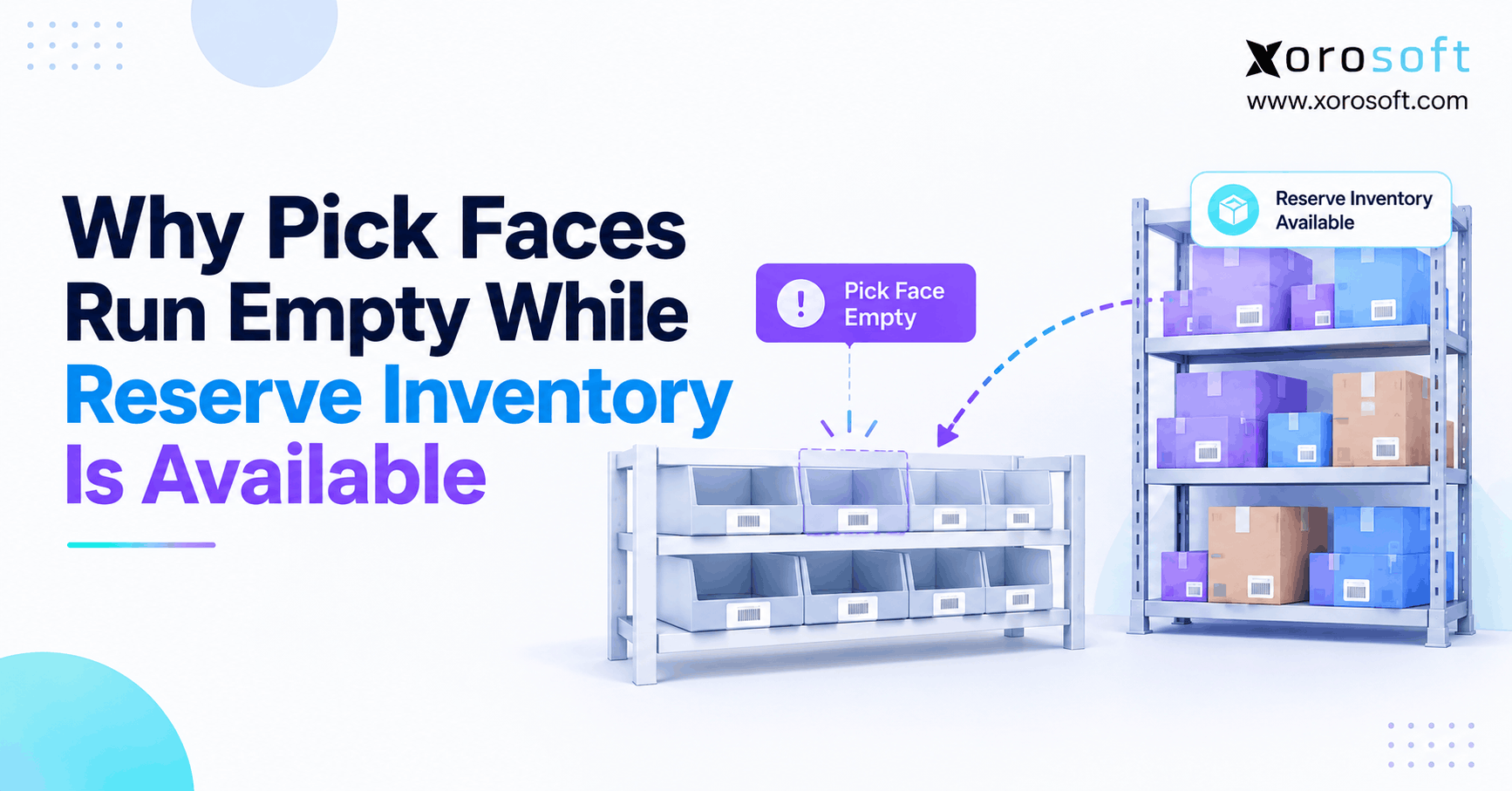
When optimising warehouse efficiency, the reserve-to-pick replenishment process is a crucial factor to consider.
1. Why Full Reserve Shelves Still Leave Picking Bins Empty
Reserve-to-pick replenishment fails when a warehouse owns enough products but cannot move the right quantity into an active picking location before orders need it. Meanwhile, a picker sees an empty bin, while the inventory report shows hundreds of units in reserve. As a result, the order stops even though the business does not have a true company-wide stockout.
For example, imagine 480 units of a fast-selling SKU stored on pallets. Meanwhile, its forward-picking bin holds zero units, and the next carrier cutoff is approaching. However, purchasing more inventory will not solve the immediate problem. Instead, the warehouse must discover why available reserve stock never reached the picking location.
For instance, the cause might be a late trigger, a blocked source location, an unfinished task, or an incorrect inventory record. Therefore, diagnosing the movement between reserve and pick faces matters more than checking the total on-hand balance alone.
1.1. Where Reserve-to-Pick Replenishment Breaks
For example, reserve storage and forward-picking areas serve different purposes. The reserve area holds bulk stock, whereas the pick face keeps accessible quantities ready for routine orders. Although the same SKU may appear in both places, the warehouse must still execute the movement correctly.
First, a refill requirement must be identified. Next, usable reserve stock must be selected, moved, and confirmed at the destination. If any step fails, reserve-to-pick replenishment can leave the pick face empty while warehouse-wide totals remain positive.
1.2. Why Forward Pick Replenishment Depends on Pickable Stock
For example, an on-hand balance describes stock recorded in inventory. However, a picker may need inventory in a particular bin, with the correct status, lot, and allocation. Consequently, physical existence does not guarantee eligibility for the current order.
Consider the following illustrative example. Each category is mutually exclusive, and the figures are not customer data.
| Inventory condition | Units | Immediate picking implication |
|---|---|---|
| Eligible stock in the pick face | 0 | No units ready in that location |
| Eligible stock in reserve | 240 | May require replenishment |
| Allocated reserve stock | 120 | Committed to other demand |
| Quality-held reserve stock | 60 | Cannot be released without approval |
| Total physical inventory | 420 | Not equivalent to pickable quantity |
Therefore, managers should examine stock by location and eligibility, not only by total SKU balance. The distinction is also explained in Microsoft’s warehouse availability guidance, where bin contents and reservations affect what a warehouse can pick.
2. How Reserve-to-Pick Replenishment Should Work
Therefore, a reliable replenishment process moves eligible units before a forward location becomes a bottleneck. However, the warehouse must coordinate demand, source selection, employee assignments, and confirmation. Consequently, even a correctly calculated refill quantity may arrive too late.
2.1. The Five Stages of Reserve-to-Pick Replenishment
Stage 1: Detect the need. First, a minimum threshold, scheduled review, or upcoming picking wave identifies the stock gap. The requirement should reflect actual demand rather than an arbitrary quantity.
Stage 2: Validate the source. Next, the warehouse checks which reserve bin contains eligible units. For example, stock on quality hold must not be treated like unrestricted inventory.
Stage 3: Create and assign work. Then, a replenishment task specifies the SKU, quantity, source, and destination. Meanwhile, the supervisor must make sure labor and equipment can execute that task on time.
Stage 4: Move and verify stock. Afterward, an employee physically transfers the units and validates the movement using the facility’s required scanning or confirmation workflow.
Stage 5: Release pick-ready quantity. Finally, the destination balance and eligibility must reflect the completed transfer. Only then can the intended picking task rely on those units.
2.2. Why Warehouse Bin Replenishment Work Is Not Pick-Ready Stock
However, creating a task does not physically refill a shelf. For instance, a forklift operator may still be unloading a trailer, while the new replenishment work sits in an unassigned queue. Meanwhile, order pickers continue consuming the last accessible units.
Alternatively, a worker may move the stock but forget the destination confirmation. As a result, the inventory system may still consider that quantity in transit or at its original location. Reserve-to-pick replenishment succeeds only when physical stock and the transaction record agree.
2.3. How Reserve Stock Transfers Interact With Inventory Status
Before changing replenishment rules, inspect the inventory states affecting the order. For example, allocated, damaged, expired, quarantined, and staged stock may follow different eligibility rules. Similarly, an unfinished movement can affect location availability even when the physical units appear nearby.
Therefore, the key question is not simply, “How much inventory exists?” It is, “Which units can reach this pick face legally and operationally before the order’s deadline?” That question prevents risky overrides and unnecessary purchase orders.
3. Seven Causes of Pick Face Restocking Failures
Most repeat shortages have an identifiable cause. However, teams often rush to refill the bin without recording why the normal process failed. Consequently, the same SKU interrupts picking again the following shift.
3.1. Late Reserve-to-Pick Replenishment Triggers
A low minimum threshold can create a refill task too close to a stockout. For example, a location consuming 30 units per hour cannot depend on a trigger of five units if its normal replenishment takes 40 minutes. As a result, the pick face empties before the task finishes.
Therefore, compare the trigger time with actual demand and confirmed replenishment lead time. Also, check whether a scheduled job runs frequently enough to detect the shortage.
3.2. How Reserve Stock Transfers Are Blocked by Allocation
For example, a positive reserve balance may contain units committed to another order, awaiting inspection, or blocked by lot controls. Consequently, the replenishment task cannot necessarily select those units. For example, a food distributor should not release an expired lot merely to satisfy a picking wave.
Instead, inspect available quantity at the source location and the exact restriction reason. Then select another eligible bin or follow the authorized release process.
3.3. Why Warehouse Bin Replenishment Tasks Wait Too Long
Even when a task is valid, workers may not begin it promptly. Meanwhile, urgent receiving, packing, or equipment constraints can push it behind less time-sensitive activities. Therefore, warehouse managers need visibility into unassigned work and task age.
A useful priority considers time until stockout, orders affected, required equipment, and shipping deadlines. However, priority changes must also account for safe travel and realistic staffing.
3.4. Unconfirmed Reserve Stock Transfers Distort Bin Balances
For example, a pallet may physically reach the forward area while the system still records it in transit. As a result, the next picker sees an unavailable quantity or an incomplete movement record. Sometimes the opposite occurs: the system reports a completed move, but the pallet was placed in the wrong slot.
Therefore, check source and destination scans, timestamps, and physical counts together. Avoid adjusting inventory simply to hide an unfinished reserve-to-pick replenishment transaction.
3.5. Pick Face Restocking Fails With Bad Slotting Rules
For example, poor slotting can assign a fast-moving SKU to a location that holds only a fraction of one picking wave. Consequently, workers must perform repeated emergency refills. In other cases, the location rules may prevent the WMS from choosing a valid destination.
For example, Microsoft’s replenishment overview describes a product-specific min/max condition involving fixed locations when a destination is completely empty. However, that rule is not universal. Check the settings of the actual warehouse system before changing them.
3.6. Case Packs and Bin Capacity Do Not Match
Suppose the system requests 50 units, but reserve stock moves in cases of 24. Meanwhile, the destination can accept only 36 additional units. As a result, a full-case movement may exceed the bin’s safe capacity or violate configured unit rules.
Therefore, confirm case-pack multiples, units of measure, open tasks, and usable capacity. Sometimes a smaller forward location or direct reserve pick is more appropriate than repeated replenishment exceptions.
3.7. Demand Spikes Arrive Before the Shipping Cutoff
For example, promotions, wholesale releases, and marketplace surges can consume a pick face faster than historical averages suggest. For example, a single large B2B order might exhaust a location originally planned for small ecommerce orders. Consequently, an otherwise reasonable min/max rule becomes too slow.
Instead, inspect demand from upcoming waves and channel commitments. Then bring replenishment work forward when the projected pick requirement exceeds eligible forward stock.
4. Diagnose Reserve-to-Pick Replenishment Delays Before Changing Settings
However, an empty shelf is a symptom, not a diagnosis. Therefore, investigate one failed order line from start to finish before changing inventory levels or warehouse software settings. This creates a repeatable method for supervisors and prevents contradictory adjustments.
4.1. Start With the Exact Failed Order Line
First, record the SKU, variant, requested quantity, warehouse, and assigned pick bin. Next, check the bin physically and compare its count with the recorded quantity. For example, a medium-size apparel SKU must not be confused with the same style in another size.
If the physical and recorded balances differ, investigate recent picks, movements, and adjustments. However, if both balances agree at zero, continue tracing the missing refill.
4.2. Diagnose a Missing Warehouse Bin Replenishment Task
Check whether reserve-to-pick replenishment work was generated, assigned, and started. Then compare task timestamps with the order’s release time and shipping deadline. This simple sequence reveals whether the problem occurred before task creation or during execution.
| What the team sees | Evidence to inspect | Next action |
|---|---|---|
| No refill task exists | Minimum level, schedule, location rules | Repair the trigger or configuration |
| Task exists but is unassigned | Work queue, labor, equipment | Set ownership and appropriate priority |
| Reserve source is rejected | Allocation, holds, lot eligibility | Locate approved eligible stock |
| Task is completed but bin is empty | Scan history, actual destination | Investigate wrong-bin movement |
| Bin holds stock but pick is blocked | Pick permissions, existing allocations | Resolve the specific eligibility restriction |
Therefore, the right corrective action depends on the failure stage. Releasing more orders or moving extra pallets without checking the cause can make the records less reliable.
4.3. Confirm the Physical Move and Retest Picking
After correcting the exception, verify the source quantity, moved quantity, destination, and final inventory status. Next, retest the original order line. If the system still cannot select the expected stock, continue investigating the pick eligibility rules.
Finally, record the root cause and time to resolution. Otherwise, tomorrow’s team may troubleshoot the same reserve-to-pick replenishment issue without learning from today’s event.
Free ERP Readiness Assessment — practical self-check: Can your team identify eligible reserve inventory, view open refill tasks, confirm destination movements, and measure missed picking cutoffs? If not, document which gaps require process fixes and which require better system visibility.
5. Choose Pick Face Restocking Rules That Fit Demand
Because demand differs, SKUs need different replenishment strategies. Therefore, warehouses should select methods according to picking velocity, order size, lead time, and physical storage limits. Consequently, a blanket rule across all products often creates unnecessary work in some areas and shortages in others.
5.1. Min/Max Forward Pick Replenishment
Min/max rules establish a lower threshold and a preferred refill level. For example, a location may trigger at 30 units and aim for 96. This approach is useful when demand is relatively stable and replenishment finishes consistently.
However, an outdated minimum or a job that runs only once daily may allow stock to disappear between checks. Therefore, thresholds need periodic review using recent picks and actual task completion times.
5.2. Wave-Based Reserve-to-Pick Replenishment
By contrast, wave-based rules respond to quantities required by planned orders. Suppose a wave needs 180 units, while the forward location has only 60 eligible units. Consequently, the warehouse must plan for the missing 120 before or during the wave, according to its execution process.
This method helps connect replenishment to immediate demand. However, it still depends on eligible source stock and enough time to complete each transfer before the affected picks begin.
5.3. Scheduled Reserve Stock Transfers and Direct Picking
Alternatively, scheduled top-offs prepare common SKUs before busy shifts. Meanwhile, direct reserve picking can suit bulky furniture, low-velocity items, or full-pallet wholesale orders. As a result, not every SKU requires a dedicated forward-pick location.
| Method | Best fit | Main risk |
|---|---|---|
| Min/max | Predictable demand | Trigger occurs too late |
| Wave-based | Planned order batches | Refill work misses wave timing |
| Scheduled top-off | Known shift patterns | Sudden demand exceeds forecast |
| Exception refill | Unexpected shortage | Too much reactive labor |
| Direct reserve picking | Bulky or slow-moving goods | Longer travel or access constraints |
For teams reviewing software, Xorosoft describes replenishment support, barcode scanning, and location visibility within XoroWMS. Nevertheless, buyers should validate the precise replenishment rules and exception handling against their own workflows rather than assuming every WMS behaves the same way.
6. Calculate Reserve-to-Pick Replenishment Levels With Real Lead Times
Therefore, a threshold should protect picking during the time needed to complete a refill. Use demand and confirmed task duration together instead of copying one minimum quantity across every SKU. Additionally, include the delays that occur before an employee even begins the movement.
6.1. Set the Trigger From Actual Lead Time
Start with a simple planning formula:
Replenishment trigger = (Average pick demand per hour × Total replenishment lead time in hours) + Safety buffer
Here, total lead time includes detection, assignment, travel, source handling, movement, and destination confirmation. For example, measuring only forklift travel would understate the time the pick face must survive.
Moreover, the safety buffer should reflect reasonable demand variation and normal execution delays. However, it should not become a substitute for addressing persistent task backlogs.
6.2. Work Through an Illustrative SKU Example
For example, suppose an apparel warehouse handles a SKU with the following operating pattern. These numbers are hypothetical and are intended to demonstrate the calculation.
| Planning input | Value |
|---|---|
| Average picking demand | 24 units per hour |
| Complete replenishment lead time | 45 minutes |
| Safety buffer | 12 units |
| Forward-bin capacity | 96 units |
| Current eligible pick-bin quantity | 24 units |
| Reserve case multiple | 12 units |
First, convert 45 minutes into 0.75 hours. Next, calculate consumption during that period: 24 × 0.75 = 18 units. Then add the safety buffer: 18 + 12 = 30 units.
Therefore, reserve-to-pick replenishment should generally start before the available quantity falls below roughly 30 units under these assumptions. With 24 units currently in the bin, a top-off to 96 requires 72 more units, or six cases of 12.
6.3. Respect Pack Sizes, Bin Capacity, and Open Work
However, the formula is a starting point, not a complete system configuration. For example, an open movement may already be sending 48 units to the pick face. As a result, creating another full refill could overcrowd the location.
Similarly, case-pack rounding, shelf dimensions, lot rules, and unusually large orders can change the appropriate movement quantity. Therefore, recalibrate using actual exception data instead of relying on the formula alone.
Finally, distinguish the reorder point for purchasing from the refill trigger for the warehouse. Purchasing replenishes the business’s stock supply, whereas reserve-to-pick replenishment relocates existing inventory within an operating facility.
7. Protect Picking Waves and Carrier Cutoffs
Replenishment reliability matters most when the next order wave cannot wait. Therefore, prepare forward stock before releasing large batches rather than allowing urgent picks to discover shortages. In addition, measure whether the refill finishes before the affected picking work begins.
7.1. Check Forward Pick Replenishment Before Releasing Orders
First, compare required quantities with eligible stock in assigned picking locations before a wave starts. Next, identify gaps that need reserve transfers. For example, a 120-unit wave cannot rely on a 40-unit forward balance without an appropriate replenishment plan.
Then review open movements and their expected completion. However, do not subtract the same incoming stock twice or count task creation as completed inventory.
7.2. Give Urgent Refills a Clear Owner
However, an urgent task needs more than a high-priority label. Therefore, supervisors should confirm who will execute it, which equipment is required, and whether the source location can be accessed safely. Meanwhile, affected pickers should know whether to continue, switch tasks, or wait.
A useful escalation rule is based on time to stockout and the number of orders blocked. As a result, reserve-to-pick replenishment becomes a coordinated activity instead of an unexpected interruption.
7.3. Use Barcode Checks and Targeted Counts
For example, barcode scanning helps confirm that workers moved the intended SKU between the correct locations. Additionally, targeted cycle counts can reveal a pick bin showing 40 recorded units when it is actually empty. That mismatch can prevent the proper trigger from firing.
However, scanning does not fix a threshold set too low. Instead, combine location accuracy with appropriate task rules and realistic replenishment timing. For background on standardized location identification, consult GS1’s guidance on physical location barcodes.
8. Reserve-to-Pick Replenishment Across Different Industries
The same inventory gap appears differently across product types. Therefore, a useful replenishment strategy must reflect how each business stores products, releases orders, and handles constraints. The following scenarios are illustrative, not claims about individual Xorosoft customers.
8.1. Apparel and Sporting Goods: Fast-Moving Variants
For example, an apparel brand can have strong total stock for a style while the most popular size remains unavailable in its assigned pick face. Meanwhile, a sporting goods promotion can shift demand between SKUs within hours. Consequently, style-level totals can hide variant-level shortages.
Instead, set replenishment requirements at the exact SKU and location level. For multi-channel brands, Xorosoft’s XoroONE connects inventory and sales operations, making it relevant when online demand and warehouse execution need a shared view.
8.2. Wholesale and Food: Case Demand and Restricted Lots
Likewise, wholesale orders can consume a full pick location with one large release. Similarly, food distribution may require lot and expiry eligibility checks before moving units. As a result, the nearest pallet is not automatically the right pallet.
For companies combining Shopify, Amazon, and EDI order sources, the Xorosoft integrations overview explains the broader connected-order context. However, warehouse staff still need practical rules for priority, case multiples, and approved inventory selection.
8.3. Furniture and Manufacturing: Different Movement Economics
Bulky furniture may be inefficient to refill repeatedly into a small forward location. Therefore, direct reserve picking can sometimes be the more sensible approach. Similarly, manufacturing operations face a similar decision when components must move from storage to an approved point of use.
In both situations, reserve-to-pick replenishment should be evaluated against physical handling time, space, and safety. Xorosoft serves inventory-driven manufacturers and distributors across these operating models, but the configuration should follow the facility’s actual material flow.
9. Measure Pick Face Restocking Outcomes, Not Just Task Volume
However, a warehouse can complete hundreds of refill tasks and still miss its shipping cutoffs. Therefore, evaluate whether stock reached the right location before it was needed. Meanwhile, distinguish true inventory shortages from location-level replenishment exceptions.
9.1. Track Empty-Bin Exceptions and Replenishment Task Aging
First, define a consistent set of metrics. For example, define an empty-bin exception as an attempted pick blocked by insufficient eligible quantity in its assigned location. Then record the reason after investigation rather than assuming every short pick resulted from replenishment.
| KPI | Practical calculation |
|---|---|
| Empty-bin exception rate | Empty-bin blocked attempts ÷ total valid pick attempts × 100 |
| On-time refill rate | Refills completed by required time ÷ refills due × 100 |
| Replenishment lead time | Pick-ready confirmation time − trigger time |
| Emergency refill share | Urgent refill tasks ÷ all refill tasks × 100 |
| Pick-bin count accuracy | Correctly counted bins ÷ bins counted × 100 |
As a result, supervisors can separate incorrect inventory records, slow work assignment, and poor timing.
9.2. Compare Service Improvement With Inventory Investment
However, reducing empty-bin incidents by filling every location to capacity may hide excess stock and unnecessary handling. Therefore, track inventory levels alongside exception rates. Likewise, compare equivalent weeks or shifts when evaluating operational improvements.
Xorosoft describes warehouse reporting and inventory visibility as part of its connected ERP and WMS offering. However, teams must still establish clear definitions, trustworthy transaction data, and ownership for each metric.
10. Decide Whether to Fix the Process or Upgrade the WMS
However, an empty picking bin does not automatically justify software replacement. Instead, determine whether the underlying cause is weak process discipline, configuration errors, or limited system visibility. That distinction helps warehouse leaders invest where the actual failure occurs.
10.1. When Better Warehouse Procedures Are Enough
For example, smaller operations with predictable demand may work well with scheduled top-offs, documented task ownership, and barcode checks. For example, a supervisor can review the highest-velocity SKUs before each shift and reserve time for required refills.
First, correct known location records and minimum levels. Next, measure whether fewer pick attempts become blocked. If execution improves consistently, a major system change may be unnecessary.
10.2. When Connected ERP and WMS Information Becomes Important
However, as warehouses expand, orders may arrive through online stores, marketplaces, wholesale accounts, and EDI. Meanwhile, disconnected inventory applications can make it harder to distinguish a purchasing shortage from an internal stock movement problem. Consequently, reserve-to-pick replenishment issues can extend into customer service and financial reporting.
Xorosoft’s XoroERP connects inventory, warehouse, purchasing, accounting, and related operations. Therefore, it may be worth evaluating when a business needs broader coordination rather than another stand-alone inventory report. Specific workflows should be verified in a tailored demonstration.
10.3. Questions to Ask During a Warehouse Software Demo
First, ask the vendor to demonstrate the exact empty-bin scenario, not only a clean picking transaction. For example, show what happens when the pick face reaches its threshold but part of the reserve quantity is allocated elsewhere.
Then test how the system identifies the source, creates work, confirms the destination, and makes stock available to the next picker. Finally, test an exception such as a missing scan or an invalid location.
| Operational requirement | Evidence to request |
|---|---|
| Location-level visibility | Exact SKU balances in reserve and pick bins |
| Replenishment control | Trigger settings and task creation history |
| Execution accuracy | Source/destination confirmation steps |
| Exception resolution | Clear status when a move cannot finish |
| Channel coordination | Order demand linked with warehouse availability |
Watch Demo — evaluation approach: Request a demonstration using one of your own high-volume SKUs and a real replenishment exception. This is more informative than judging a system from a generic feature list.
11. A Four-Week Pick Face Restocking Improvement Plan
Therefore, operational improvement becomes more reliable when teams test one change at a time. Use a short baseline period, correct obvious data problems, and track results before expanding the program. The schedule below is an example, not a guaranteed implementation timeline.
11.1. Week 1: Establish the Empty-Bin Baseline
First, record blocked pick attempts, affected SKUs, assigned locations, and refill timestamps. Then separate stockout causes from allocation, location-record, and execution failures. For example, three empty-bin events may share one misconfigured trigger.
As a result, managers can focus on repeat exceptions rather than isolated incidents.
11.2. Week 2: Repair Location Data and Trigger Rules
Next, cycle-count frequently affected bins and review source eligibility. Then validate minimum levels against actual picking rates and complete refill lead times. Meanwhile, check case-pack rules and locations that cannot accept the requested quantity.
Therefore, reserve-to-pick replenishment settings become grounded in current physical conditions rather than old assumptions.
11.3. Weeks 3–4: Improve Execution and Measure Change
Next, during week three, assign clear ownership for late replenishment work and test pre-wave preparation. Afterward, in week four, compare on-time refills, empty-bin incidents, and emergency movements against the baseline.
Finally, document which fixes worked and which exceptions remain. If delays persist because workers cannot see accurate tasks or location balances, include those requirements in a future WMS evaluation.
12. Conclusion: Turn Reserve Stock Into Pick-Ready Stock
A full reserve rack does not guarantee that an order can ship. Instead, the warehouse needs eligible inventory in the correct picking location at the correct time. Consequently, preventing empty pick faces requires accurate bin records, realistic triggers, appropriate work priorities, and confirmed physical movements.
First, diagnose where the process failed. Then improve the rules and responsibilities that control reserve-to-pick replenishment. As operations scale, connected ERP and WMS workflows can support the visibility that manual coordination may struggle to provide.
For inventory-intensive businesses evaluating that next step, Xorosoft combines warehouse management with broader inventory, purchasing, and operational processes. Book a Demo to review your replenishment requirements and discuss a personalized warehouse workflow demonstration.
FAQs
What is reserve-to-pick replenishment?
It moves eligible stock from bulk reserve storage to an active picking location. Therefore, warehouse teams can fill orders without storing every available unit in forward bins.
Why are pick faces empty when reserve stock exists?
The refill may start too late, a task may remain open, or reserve inventory may be restricted. Consequently, stock exists physically but is not ready for picking.
How do you calculate a replenishment trigger?
Multiply average pick demand by the full replenishment lead time, then add a safety buffer. However, check bin capacity, case packs, and existing refill tasks before applying it.
Why might a WMS fail to create replenishment work?
Possible causes include incorrect thresholds, missing location rules, inactive schedules, or ineligible source inventory. Therefore, inspect the system’s actual configuration and task history before adjusting stock.
Can available reserve inventory be blocked from picking?
Yes. Allocations, quality holds, lot restrictions, and location rules can limit eligibility. As a result, total on-hand stock may exceed the quantity usable for the current order.
How can warehouses reduce emergency refills?
Set triggers using real demand and refill times, prepare bins before picking waves, and confirm transfers promptly. Additionally, track repeat empty-bin exceptions to identify weak rules.
When should a business upgrade its WMS?
Consider upgrading when recurring failures come from disconnected records, missing location visibility, or unreliable task tracking. However, test process and configuration fixes before investing in new software.
Recent Posts
-
 How to Calculate Ecommerce Warehouse Capacity Before Peak Season
-
 Manufacturing Scrap Statistics 2026: Material Loss, Yield, and Cost
-
 ERP Software for Cosmetics Distributors Managing Lots, Wholesale, and Ecommerce
-
 Xorosoft vs Cin7 Core for Multi-Warehouse Wholesale Operations
-
 How a Multi-Warehouse Company Reduced Inventory Reconciliation Work at Month-End