1. When a Trailer Arrives but Visibility Does Not
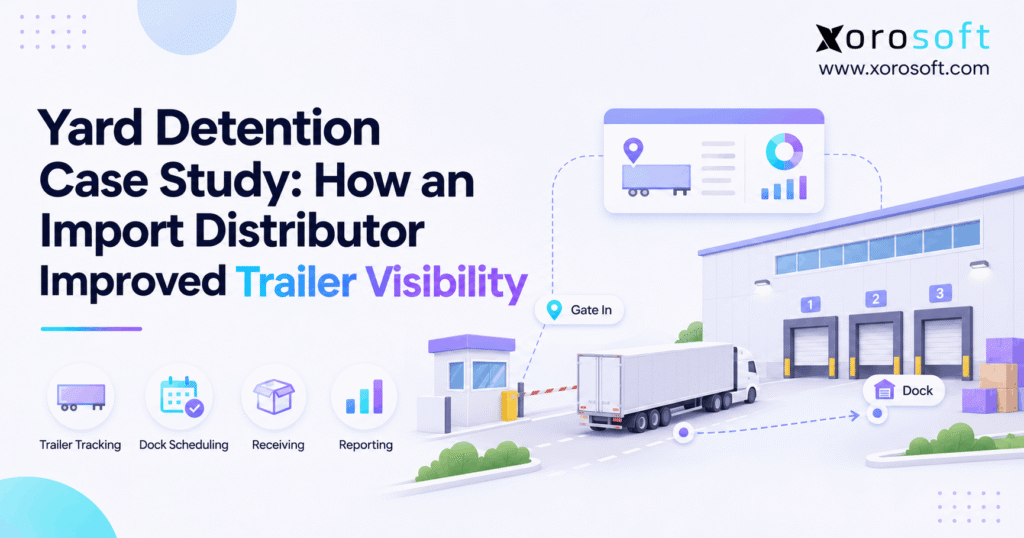
This yard detention case study explains how an import distributor can improve trailer visibility, reduce avoidable delays, and gain better control over inbound freight. When warehouse teams cannot find arriving trailers or confirm their status, small gaps in yard tracking can lead to costly waiting, late receiving, and poor inventory planning.
However, the problem rarely starts with a single missed delivery. Instead, it develops when gate staff, warehouse teams, purchasing managers, and carriers work from separate records.
As a result, trailers may sit in the yard while employees search for shipment details or wait for dock space. Meanwhile, finance teams may receive detention charges without enough evidence to check them.
This article uses an illustrative import-distributor scenario to explain the causes, fixes, and measures. It does not claim that an unnamed customer achieved verified cost savings.
1.1 The Three Questions Every Receiving Team Must Answer
Every inbound trailer needs three clear answers.
- Has the trailer arrived?
- Where is it parked?
- What must happen before it can leave?
At first, these questions appear simple. However, a growing distributor may manage many trailers, containers, carriers, and purchase orders at once.
For example, transportation may know that a truck arrived at 9:00 AM. Yet receiving may not know which dock the driver needs.
Likewise, purchasing may know which items are on the shipment but lack proof that the trailer is ready to unload.
Therefore, teams need a shared record of each key event.
1.2 Why Trailer Visibility Must Start at the Gate
Trailer visibility begins when an employee records the actual arrival, not when someone enters an expected delivery time.
For this reason, every gate entry should include a trailer number, carrier, arrival time, and clear status.
Next, the yard team should assign a parking spot or dock. That location must change in the system whenever the trailer moves.
This yard detention case study follows that basic rule throughout the process: every physical move should create a useful record.
Consequently, managers can see what is waiting, why it is waiting, and who should act next.
2. The Yard Detention Costs Behind a Late Trailer
A trailer can remain in a yard for several hours without creating a charge. However, once an agreed waiting period ends, costs may begin to rise.
Therefore, teams must understand the type of charge before trying to reduce it.
2.1 Three Detention Clocks, Three Different Costs
Import distributors often deal with different waiting and equipment charges.
| Charge type | What it covers | Key record |
|---|---|---|
| Truck driver detention | Driver waiting beyond an agreed allowance | Driver arrival and release |
| Trailer detention | Trailer held beyond agreed terms | Equipment custody and release |
| Ocean container detention | Container or carrier equipment used beyond free time | Pickup and empty return |
| Demurrage | Container held at a marine terminal beyond free time | Terminal availability and pickup |
The Federal Maritime Commission distinguishes ocean detention from demurrage.
However, maritime terms should not be mixed with domestic trucking charges.
For example, a container may leave the warehouse but still create ocean detention risk until the empty container reaches an approved return site.
Therefore, each charge needs its own event rules and supporting records.
2.2 Yard Detention Costs Versus Trailer Dwell Time
Yard dwell time measures how long equipment remains at a site.
However, detention costs depend on the terms of the relevant carrier agreement.
For example, a trailer might enter at 8:00 AM and leave at 6:00 PM. Its yard dwell time is ten hours.
Yet a charge may apply only after an agreed allowance expires.
In addition, some agreements use appointments, driver readiness, or equipment-return events rather than simple gate times.
A useful yard detention case study must separate total time in the yard from time that may be billed.
Otherwise, managers risk overstating the savings that a new process can produce.
2.3 How Waiting Affects Cash, Labor, and Orders
Detention can create costs beyond carrier invoices.
First, receiving teams may spend extra time finding trailers and checking shipment details.
Next, dock delays can push unloading into later shifts. As a result, overtime or extra labor may become necessary.
Meanwhile, inbound stock can remain unavailable for customer orders.
The American Transportation Research Institute reported that 39.3% of truck stops in its 2023 research involved driver detention. It also estimated $3.6 billion in direct trucking-industry expenses and $11.5 billion in lost productivity.
These are industry-wide estimates, not savings from this article’s example.
Read the ATRI truck driver detention research for the source data.
3. What This Yard Detention Case Study Starts With
Better yard control starts with an honest review of the current process.
Before buying software, the distributor needs to learn where delays occur and which records are missing.
3.1 The Distributor’s Original Yard Routine
Consider a wholesale importer that receives consumer goods from ports and local suppliers.
Its team uses spreadsheets for trailer arrivals, emails for appointments, and radio calls for parking moves.
Meanwhile, the warehouse system records stock only after receiving staff confirm the goods.
Although each tool performs a useful task, the full journey is hard to see.
For example, a trailer may have arrived at the gate but never reached the dock list.
Another may have been unloaded without its yard status being changed.
As a result, staff waste time checking the same shipment with different teams.
3.2 Starting the Yard Detention Case Study Baseline
Before making changes, the distributor should collect a sound baseline.
A yard detention case study needs records from the same core events before and after the process changes.
Start with:
- Gate-in and gate-out times.
- Trailer and container numbers.
- Dock arrival and release times.
- Carrier appointments.
- Receiving completion times.
- Detention invoices and agreed rates.
- Reasons for long waits.
Next, identify missing or conflicting records.
For example, a trailer marked as departed without a valid gate-out time should remain an open data issue.
Therefore, the baseline should show both yard performance and record quality.
3.3 The Records That Show Where Time Was Lost
A good yard review links events into a timeline.
For example, suppose a trailer arrives at 9:00 AM, reaches a dock at noon, and finishes unloading at 2:00 PM.
The first three hours deserve review. Yet they do not automatically prove that the warehouse caused a billable delay.
The carrier might have arrived early. Alternatively, the dock may have been blocked by an earlier load.
Therefore, supervisors need reason codes and the applicable appointment details.
In addition, they should compare repeated problems across several days.
This helps the yard detention case study identify patterns instead of blaming one isolated event.
4. A Gate-to-Dock Plan That Stops Lost Trailers
The improved workflow uses six linked steps.
First, the team plans each inbound arrival. Next, it confirms the trailer at the gate and tracks movement through the yard.
Finally, receiving and transportation close the record only after the relevant work and departure events are complete.
4.1 Inbound Trailer Tracking Before the Gate
Inbound trailer tracking should begin with a clear delivery plan.
Purchasing provides the expected purchase orders. Meanwhile, transportation confirms the carrier, shipment reference, and arrival window.
The receiving team then checks dock space and labor needs.
For example, bulky furniture may need a larger crew. In contrast, a small pallet load may fit a shorter appointment.
As a result, dock plans can reflect the work rather than only the time a driver wants to arrive.
This yard detention case study treats appointments as planning records, not proof that equipment has arrived.
When a carrier changes its expected time, the team should update the appointment without changing past event records.
4.2 Confirm the Actual Gate-In Event
When a truck arrives, gate staff should record the actual time and equipment number.
Next, they should match the trailer with the planned shipment.
If no appointment exists, the system should flag the arrival for review.
However, employees should not create a false appointment to make the report look complete.
The record should show:
- Actual gate-in timestamp.
- Trailer or container identifier.
- Carrier name.
- Appointment or shipment reference.
- Starting yard status.
- Assigned parking location.
In this yard detention case study, gate records form the base for later time checks.
Therefore, accurate check-in data matters more than a polished dashboard.
4.3 Track Yard Locations for Better Trailer Visibility
Once the truck checks in, the team assigns a marked yard spot.
For example, the spot might be A-12, B-07, or Dock 4.
Next, a yard employee confirms each move. As a result, the shared record shows the current trailer location.
However, a planned move should not appear complete before the trailer reaches its new spot.
This is where suitable warehouse software can help. Xorosoft’s XoroWMS supports yard-related workflows alongside warehouse receiving and stock control.
The practical goal of this yard detention case study is simple: employees should spend less time searching for freight and more time moving it.
4.4 Match Dock Doors to Crew Capacity
Dock scheduling should consider more than arrival order.
First, the team should review the unload type, expected pallet count, labor needs, and door fit.
Next, supervisors can weigh urgent stock needs against approaching waiting limits.
For example, a trailer with time-sensitive replenishment stock may need an earlier slot.
However, a rush order should not force staff to ignore safety or place equipment at the wrong door.
Therefore, the system must allow clear changes with a record of who approved them.
Better dock planning supports yard detention reduction because it helps staff act before long queues become routine.
Still, it cannot solve every carrier or port delay.
4.5 Link the Trailer to Receiving and Stock
A trailer’s arrival should not automatically increase available inventory.
Instead, receiving must confirm what the team actually unloaded.
For example, a purchase order may list 500 units, while the shipment contains only 480.
The warehouse should record the shortage. In addition, staff should mark damaged goods and any stock held for quality checks.
Consequently, purchasing, warehouse, and finance teams can work from the correct quantities.
This yard detention case study treats unloading, receipt, and putaway as separate steps.
That distinction matters because a trailer may leave the yard before all stock checks are complete.
Therefore, a clean yard record should not hide an open receiving problem.
4.6 Flag Yard Detention Reduction Risks Before Departure
The final step is to manage long waits before they turn into costly surprises.
First, the team sets time thresholds based on the relevant carrier terms.
Next, the yard view should flag trailers approaching those limits.
However, every alert needs an owner. An alert that nobody acts on has little value.
For example, a supervisor may move a trailer to an open dock. Alternatively, transportation may contact the carrier about a revised plan.
Finally, gate staff record the actual departure.
The yard detention case study then has a clear trail from arrival to release.
For ocean containers, teams must also track any separate empty-return deadline.
Free ERP readiness self-check
Before adding more software, ask whether your teams can answer these questions without checking multiple spreadsheets:
- Can you locate every trailer currently in the yard?
- Can you link each inbound trailer to the expected shipment?
- Can you tell which loads are nearing an agreed waiting limit?
- Can finance check a detention charge using event records?
- Can warehouse and transportation teams see the same trailer status?
If several answers are no, a connected workflow review may be worthwhile.
5. Yard Detention Case Study Metrics That Matter
A better process needs proof.
Therefore, managers should measure time, delays, data quality, and actual charges.
The goal is not to produce the largest dashboard. Instead, it is to help teams spot problems early and confirm whether changes work.
5.1 Trailer Dwell Time and Free Time Are Not the Same
Trailer dwell time is the time between two defined yard events.
Yard dwell time = Gate-out time − Gate-in time
For example, a trailer arriving at 7:00 AM and leaving at 3:00 PM has eight hours of recorded yard dwell.
However, the full eight hours may not be billable.
Instead, the fee depends on the carrier agreement and the relevant clock.
Therefore, a useful yard detention case study should record both total dwell and potential chargeable time.
Also, teams should track median and long-tail dwell times.
An average can fall even when a few trailers still spend far too long in the yard.
5.2 A Clear Yard Detention Cost Example
Consider a simple example.
A trailer remains on-site for ten hours. Suppose its agreement allows eight hours before an hourly fee begins.
The potential excess time is two hours.
If the illustrative charge is $75 per hour, the simple calculation produces $150.
| Metric | Example value |
|---|---|
| Gate-in | 8:00 AM |
| Gate-out | 6:00 PM |
| Total dwell | 10 hours |
| Illustrative free time | 8 hours |
| Potential excess time | 2 hours |
| Hypothetical hourly fee | $75 |
| Potential fee | $150 |
However, actual invoices may use different clocks, rates, and rounding rules.
Therefore, this yard detention case study uses the example only to show the calculation, not to state a real carrier rate or customer saving.
5.3 Metrics for Dock, Yard, and Finance Teams
A yard detention case study should use a small set of clear measures.
| KPI | What it shows | Suggested owner |
|---|---|---|
| Average dwell time | Overall time in yard | Yard manager |
| 90th-percentile dwell | Long-delay exposure | Operations |
| Dock wait | Time before unloading | Receiving |
| Late-load rate | Loads past agreed limit | Transportation |
| Gate record accuracy | Missing or wrong events | Gate supervisor |
| Verified detention cost per load | Financial impact | Finance |
Meanwhile, teams should review these measures by carrier, warehouse, load type, and period.
In addition, Xorosoft’s warehouse and reporting capabilities can support connected views when the required yard events are in place.
However, the buyer should still test the needed reports during a demo.
5.4 Fix Missing Event Data Before Reporting
A dashboard cannot fix poor timestamps.
For example, if a trailer leaves at noon but someone records departure at 5:00 PM, the report adds five false hours.
Therefore, employees should confirm moves and departures close to the actual event.
Also, supervisors should review open trailers at the end of each shift.
If a record is wrong, the system should preserve the correction and its reason.
As a result, finance can trace changes when it reviews an invoice.
This step matters because the yard detention case study must measure real activity, not the quality of someone’s memory.
6. What the Improved Yard Detention Workflow Can Prove
Better trailer tracking can improve work flow in several ways.
However, a process change alone does not prove that detention charges fell.
Therefore, the distributor must compare clear before-and-after records using the same rules.
6.1 The Yard Detention Case Study Scorecard
A yard detention case study should compare the old method with the new one.
| Area | Old method | Improved method |
|---|---|---|
| Arrival record | Manual log | Confirmed timestamp |
| Trailer location | Radio or spreadsheet | Updated yard spot |
| Dock plan | Reactive | Capacity-based |
| Receiving link | Separate lookup | Linked shipment record |
| Delay alert | Late invoice review | Early exception flag |
| Cost review | Missing proof | Event-based evidence |
These are example workflow changes, not reported customer results.
However, the table gives managers a practical way to test whether their yard became easier to control.
Next, the team should attach actual measures to each row.
Only then can the case support a claim about cost, speed, or service gains.
6.2 Why a Drop in Fees Needs More Proof
Suppose detention invoices fall after the distributor changes its process.
That is useful news. However, it does not prove the new workflow caused the whole decline.
For example, the site may have received fewer loads. Also, a carrier may have changed its rates.
Therefore, the yard detention case study should compare similar shipment groups.
Managers should check volume, season, carrier mix, and any major change in labor or dock hours.
In addition, finance should match claimed savings with paid or approved invoices.
Otherwise, the article could confuse a lower bill with better yard performance.
6.3 Trailer Visibility and Receiving Service Gains
Not every benefit has a direct fee attached.
For example, a team may locate trailers faster or spend fewer hours making status calls.
Likewise, receiving may process urgent stock sooner because staff know which load is ready.
As a result, the business may gain smoother work flow and better service.
However, those gains still need measures.
Track time spent searching for trailers, dock turns per shift, and the time from arrival to receipt.
This yard detention case study therefore separates observed process gains from verified cost savings.
For teams assessing broader change, Xorosoft can be reviewed as one way to connect warehouse work with inventory and finance.
7. How ERP and WMS Support Trailer Visibility
A yard system shows where equipment is and what should happen next.
However, an ERP system helps connect the freight to purchasing, stock, and accounting.
Therefore, the goal should be a clean flow of records rather than one more separate screen.
7.1 ERP Tracks the Purchase and Cost
An ERP system holds key business records such as purchase orders, supplier details, inventory values, and cost reports.
For example, purchasing may expect 200 cartons on an inbound shipment.
Meanwhile, receiving may confirm only 190.
The business needs those records to agree before the finance team closes the related work.
Xorosoft’s XoroERP connects purchasing, stock, accounting, orders, and warehouse operations in a cloud ERP system.
However, ERP data alone does not prove where a trailer is parked.
The yard and dock events must still be captured through a suitable workflow.
7.2 WMS Connects Trailer Visibility to Receiving
A WMS helps the warehouse record what staff receive, move, store, and ship.
Therefore, it can link a trailer’s arrival to the physical work done at the dock.
For example, staff may mark unloading complete while damage checks remain open.
The system should keep those events separate.
In Xorosoft, connected warehouse workflows can help teams work from current stock and receiving records.
The yard detention case study shows why that link matters.
Without it, transportation may believe the load is complete while receiving still has an open issue.
As a result, employees may release equipment before they have handled all required checks.
7.3 When a Yard Management System Adds Value
A dedicated yard management system may be useful when a site handles many trailers, yard moves, or dock bookings.
However, smaller sites may only need clear rules and a reliable shared log.
Compare the approaches by work flow, not by feature count.
| Approach | Best fit | Main limit |
|---|---|---|
| Shared yard log | Low trailer volume | More manual updates |
| WMS with yard tools | Connected receiving and yard work | Scope depends on the system |
| Dedicated YMS | Complex yard and trailer moves | Added cost and integration work |
For a growing distributor, Xorosoft’s XoroONE is another relevant platform to assess when inventory, buying, warehouse work, and reporting need to operate together.
Still, each buyer should test its own needs.
7.4 What to Ask in a Software Demo
A useful demo should follow one trailer from gate to departure.
First, show a scheduled arrival. Next, change its arrival time and parking location.
Then, move it to a dock and confirm a short receipt.
Also, ask the provider to show a missing timestamp and a detention warning.
Finally, review how the case appears in reports.
The yard detention case study offers a practical test plan for that session.
When outside carrier or sales data is involved, teams should also review the available integration options.
See the workflow in practice
Review a full trailer-to-receiving process rather than a stand-alone list of product features. Ask to see how gate events, yard locations, receiving, and stock records connect.
8. Which Import Distributors Need This Level of Control?
A small yard and a large import hub do not need the same tools.
Therefore, the right level of control depends on trailer volume, dock limits, and how often delays cause real problems.
8.1 Trailer Visibility for Multi-Warehouse Importers
Multi-warehouse distributors face a wider set of risks.
For example, one site may have open docks while another faces a long trailer queue.
Without a shared view, planners may keep sending arrivals to the crowded site.
Therefore, managers need site-level and network-level measures.
They should compare dwell time, open appointments, dock use, and receiving load across locations.
The yard detention case study becomes more useful when it shows which problems occur at one site and which affect the whole network.
Xorosoft serves inventory-driven industries with needs that can span several warehouses and sales channels.
8.2 Different Needs for Retail and Factory Goods
An apparel importer may face sharp delivery peaks before a seasonal launch.
Meanwhile, a furniture distributor may need longer unload windows because each item is large or heavy.
Food businesses may have strict handling and temperature needs.
Likewise, a manufacturer may need raw materials at a set time to keep work moving.
Therefore, dock rules should reflect the freight and the work required.
One queue rule will not fit every load.
The yard detention case study should explain which types of freight need special handling and how the site deals with them.
8.3 When a Shared Yard Log Is Enough
Not every importer needs a new software platform.
A site receiving only a few planned loads each day may manage well with a clear gate log and shared schedule.
However, the records still need to be accurate.
Employees should know who updates trailer locations, who assigns docks, and who checks open delays.
Then, supervisors should review the records at the end of each shift.
If the method works and costs remain under control, more software may add little value.
By contrast, repeated lost trailers or missing proof may signal that the process has outgrown the log.
9. A 30-Day Plan for Better Yard Control
A short pilot can show whether new rules improve daily work.
However, the goal should be to build a stable process, not promise a set level of savings in 30 days.
9.1 Week One: Establish a Yard Detention Reduction Baseline
During the first week, review current trailer records.
First, count how many arrivals have complete times and equipment IDs.
Next, check whether staff can find each trailer’s latest yard spot.
Then, compare those records with dock schedules and carrier invoices.
This gives the yard detention case study a clear starting point.
Also, meet with gate, yard, receiving, and finance staff.
Ask which delays they see most often and which records take the longest to find.
Finally, note gaps that can be fixed through simple changes before buying new tools.
9.2 Weeks Two and Three: Train the Teams
In week two, define the required trailer fields and yard status codes.
Next, label each parking spot and set clear rules for recording moves.
Then, assign owners for dock bookings, gate events, and detention alerts.
In week three, test the process with a small set of inbound loads.
For example, include one early arrival, one missed slot, and one short receipt.
As a result, the team can see how the rules work in real life.
However, staff should not be forced into extra data entry with no clear value.
The goal is fewer gaps, not more paperwork.
9.3 Week Four: Review Trailer Dwell Time and Exceptions
By week four, the team should have enough new event records for an initial review.
First, compare valid trailer dwell time with the starting period.
Next, check how many trailers went past the relevant waiting limit.
Also, count missing timestamps and unresolved dock issues.
Then, ask staff whether locating freight has become easier.
This yard detention case study uses the 30-day plan as a test method, not a claim about a real rollout.
Therefore, the company should keep measuring after the pilot, especially during busy months.
10. Common Mistakes That Keep Trucks Waiting
New tools cannot repair a weak process on their own.
Therefore, the last part of the yard review should focus on the daily mistakes that make records hard to trust.
10.1 Missing Scans, Wrong IDs, and False Alerts
The most common problems include:
- Recording planned times as actual events.
- Using two numbers for the same trailer.
- Leaving parking spots unchanged after a move.
- Marking unloading complete before it happens.
- Treating all waiting time as billable.
- Sending too many alerts without clear owners.
For example, an incorrect trailer number can send staff to the wrong parking area.
Likewise, a false alert can distract a supervisor from a real delay.
Therefore, teams need simple checks and clear correction rules.
These small controls often matter as much as advanced software features.
10.2 Why Software Needs Clear Owners
A yard tool can show a long wait, but someone still needs to act.
For example, receiving may need to free a dock. Alternatively, transportation may need to call a carrier.
If neither team owns the issue, the delay continues.
Therefore, assign a person or role to each alert type.
Also, set clear rules for closing an exception.
The yard detention case study should make these roles visible, rather than credit every gain to software.
As a result, the process remains useful even when employees, carriers, or shipment volumes change.
11. From a Yard Log to a Better Receiving Day
This yard detention case study shows how a distributor can build better trailer visibility by joining simple, well-run tasks.
First, every arrival needs a true timestamp. Next, each trailer needs a known spot and a clear dock plan.
Meanwhile, receiving must link physical freight to the right purchase order.
Finally, transportation and finance need sound records to review waiting time and carrier charges.
However, visibility alone does not guarantee lower detention fees. Real savings must be shown with valid records, fair comparisons, and checked invoices.
For businesses that need better links between warehouse work, inventory, purchasing, and finance, a connected ERP and WMS approach may help.
Xorosoft offers cloud ERP and warehouse tools for inventory-driven businesses that want to assess those links in one system.
Book a Demo
If your team struggles to track arrivals, find trailers, or link yard events to receiving, consider a tailored workflow review.
Book a Demo to begin Xorosoft’s no-cost discovery process and discuss a demo based on your actual operations.
Frequently Asked Questions
What causes yard detention at import warehouses?
Yard detention often follows dock queues, missed arrival logs, lost trailer locations, or late unloading. However, fees depend on each carrier agreement, so teams must check the right clock and deadline.
How is trailer dwell time calculated?
Subtract the recorded gate-in time from the gate-out time. For example, an 8 a.m. arrival and 4 p.m. exit equals eight hours. However, not all dwell time creates a fee.
How does trailer visibility cut detention risk?
It shows which loads have arrived, where trailers are parked, and which doors are free. As a result, teams can act sooner on delays and keep a clear event trail.
Can ERP software track yard detention?
ERP can link purchase orders, receipts, stock, and costs. However, gate, yard, and dock events need a suitable WMS or yard tool, with rules based on each carrier contract.
Which yard detention KPIs matter most?
Track gate record accuracy, trailer dwell, dock wait, loads past free time, and verified detention cost per load. Also review long delays rather than only the average, which can hide problem loads.
When should a distributor upgrade yard tracking?
Upgrade when teams often lose trailer locations, repeat data entry, miss free-time limits, or spend hours checking invoices. First, test whether better rules and a shared log are enough.
Can a yard detention case study prove savings?
Only with sound before-and-after records. Compare similar loads, check changes in carrier rates, and match charges to invoices. Otherwise, a lower bill may reflect lower volume, not better yard work.
Recent Posts
-
 Why Unposted Production Scrap Overstates Inventory and Margin
-
 Yard Detention Case Study: How an Import Distributor Improved Trailer Visibility
-
 What Is an Inventory Reserve and Who Should Calculate It?
-
Procurement Workflow Software for Inventory-Driven Businesses
-
 Canceled Shipment Quantities in Shopify: What ERP and WMS Teams Must Record