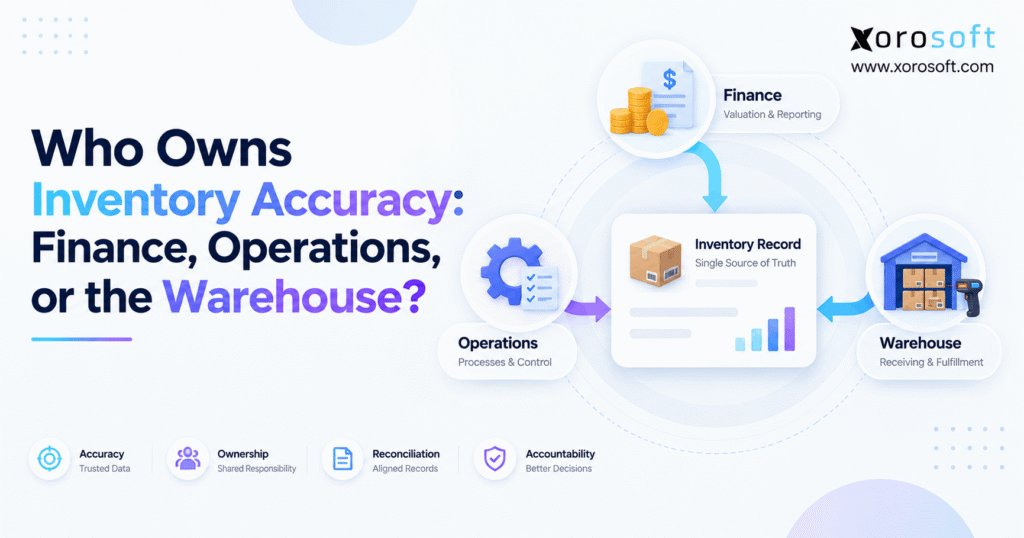
When it comes to efficient supply chains, a key question businesses often face is who owns inventory accuracy within the organisation.
1. When Every Team Has a Different Stock Number
Who owns inventory accuracy when finance trusts the general ledger, the warehouse trusts its counts, and operations trusts the order dashboard? The answer is not one department working alone. Instead, operations should normally own the company-wide outcome, warehouse teams should own physical execution, and finance should own inventory valuation and financial reconciliation.
However, a shared goal is not enough. For example, a supplier can deliver fewer units than invoiced, a picker can move stock without posting a transaction, or a returned item can appear available before inspection. Although each department may follow its usual routine, the company’s stock record still becomes unreliable.
Therefore, the better question is: Who detects the error, who investigates it, who authorizes the correction, and who prevents it from happening again? When these decisions have named owners, stock accuracy becomes a measurable operating discipline rather than a monthly argument.
Next, this guide explains the ownership model, a practical RACI matrix, correction approvals, and the controls that help growing ecommerce, wholesale, and manufacturing teams trust their inventory records.
2. Who Owns Inventory Accuracy Across the Business?
Who owns inventory accuracy at the executive level? Usually, it is the COO, head of operations, or another leader with authority across purchasing, warehousing, order management, and manufacturing. Yet that executive cannot personally verify every bin or approve every accounting entry.
Instead, the company should assign an accountable leader for the result and a responsible owner for every transaction. As a result, that distinction keeps departments connected without making every employee responsible for everything.
2.1 One executive owns the inventory accuracy outcome
First, the operations leader defines what an accurate record means, how often teams measure it, and which problems require escalation. Next, that leader ensures finance, warehouse management, purchasing, and ecommerce agree on deadlines and evidence. As a result, repeated discrepancies become problems to solve, not numbers to explain away.
For example, an inventory controller may manage weekly variance reviews while a COO owns cross-functional decisions. Meanwhile, site managers remain accountable for the tasks within their facilities. Therefore, this approach works better than assigning an organization-wide KPI to a person who cannot change the processes causing it.
2.2 Physical, transactional, and financial accuracy are different
First, physical accuracy asks whether recorded quantities match the units in a specific location. Next, transactional accuracy asks whether receipts, picks, returns, transfers, and allocations entered the system correctly. Finally, financial accuracy asks whether values and ledger balances follow the company’s accounting policies.
For instance, a warehouse can count 80 units correctly while only 65 are sellable because 10 are committed and five are unavailable. Meanwhile, finance may find that the 80 units use an outdated cost. Therefore, inventory accuracy ownership must cover quantity, status, location, and financial value without treating those measures as identical.
2.3 Inventory ownership starts with a decision, not a job title
A useful policy answers four questions for every activity: Who performs the work? Who can approve a change? Who reviews the evidence? Who fixes the process if the problem repeats? Consequently, two companies can use different job titles yet maintain equally strong controls.
For a small firm, the founder may act as operations sponsor while a warehouse lead handles counts. By contrast, a multi-warehouse distributor may appoint a formal inventory control manager. Either way, the control is complete only when the names, approval limits, and escalation path are documented.
3. Inventory Accuracy Responsibilities: Finance vs. Operations vs. Warehouse
Therefore, the responsibility split should follow the workflow that creates the error. Otherwise, finance may correct values without physical evidence, while warehouse teams may adjust stock without understanding order or accounting consequences.
3.1 Operations owns prevention and cross-team accountability
Specifically, operations sets the accuracy target, defines handoffs, reviews recurring issues, and assigns corrective action. In addition, it resolves disputes that cross teams, such as a shipment posted by a 3PL but not received by the destination warehouse. The goal is not to centralize every task; rather, it is to ensure no exception has two competing owners or no owner at all.
Who owns inventory accuracy when an error moves between teams? Therefore, operations should coordinate the investigation until the correct process owner accepts the work. Then, it should verify that the root cause has been addressed before closing the issue.
3.2 Warehouse teams own inventory accuracy on the floor
In practice, warehouse leaders are responsible for receiving counts, bin placement, picks, packing checks, transfers, physical counts, and movement records. For example, if a picker removes four items but does not confirm the pick, the warehouse must investigate the missed transaction. Likewise, if a pallet lands in the wrong bin, putaway controls need attention.
However, warehouse responsibility has a boundary. A warehouse manager cannot independently correct an integration that sends duplicate Shopify updates or an incorrect unit cost in accounting. Therefore, warehouse performance reviews should distinguish physical mistakes from system and upstream process failures.
3.3 Finance owns valuation and reconciliation controls
By contrast, finance governs inventory costing, general ledger reconciliation, material write-offs, and the financial effects of adjustments. Moreover, controllers should review unusual value movements and question unexplained differences during close. Although finance uses stock records, it should not change the physical count merely to force a financial account into balance.
For example, when a warehouse confirms a shortage, finance may assess the carrying value and appropriate accounting treatment. Consequently, inventory reconciliation ownership belongs with finance, while the evidence supporting the physical shortage comes from operations and the warehouse.
3.4 Inventory Accuracy Ownership for Purchasing, Ecommerce, and Manufacturing
For example, purchasing owns supplier shortages, purchase order changes, and claim follow-up. Similarly, ecommerce teams define availability rules, while IT or the integration owner investigates failed or duplicated messages. Meanwhile, manufacturing owns material consumption, scrap, and finished-goods reporting.
Thus, who owns inventory accuracy cannot be answered by comparing only three departments. As businesses add sales channels, contractors, and production steps, the responsibility map must cover every event that increases, decreases, reserves, or changes the status of stock.
| Function | Owns day to day | Reviews or approves |
|---|---|---|
| Operations | Cross-functional results and corrective action | Recurring variances and escalations |
| Warehouse | Physical units, bin locations, movements | Counts and operational exceptions |
| Finance | Inventory value and ledger reconciliation | Material financial adjustments |
| Purchasing | Supplier shortages and receipt disputes | Supplier claims and purchase changes |
| Ecommerce / IT | Channel availability rules and data flow | Sync failures and duplicate events |
| Manufacturing | Component usage and production output | Work-order differences and scrap |
4. Build an Inventory Accuracy RACI Matrix That People Can Follow
A RACI matrix turns inventory accountability into decisions that frontline employees can apply. Specifically, R means Responsible, A means Accountable, C means Consulted, and I means Informed. Although several teams can help, each activity should have one accountable owner.
4.1 Assign Inventory Accuracy Responsibility to the Source Event
First, list the activities that change inventory: receiving, putaway, counting, picking, transfers, manufacturing consumption, returns, and adjustments. Then, name the team with direct evidence of each event. For example, receiving staff should record the units physically delivered, while purchasing handles the supplier dispute.
Next, choose the person with authority to approve the outcome. Consequently, when colleagues ask who owns inventory accuracy, an agreed process resolves the disagreement more reliably than personal judgment.
4.2 Use a clear inventory accuracy ownership matrix
For example, the matrix below suits a growing product business. However, it is a recommended operating model rather than a universal legal or accounting requirement. If one person occupies multiple roles, add an independent review where the risk justifies it.
| Activity | Operations | Warehouse | Finance | Purchasing | Ecommerce |
|---|---|---|---|---|---|
| Set company-wide accuracy targets | A | R | C | I | I |
| Complete cycle counts | C | A/R | I | I | I |
| Resolve supplier shortages | C | R | I | A | I |
| Approve physical quantity adjustments | A | R | C | I | I |
| Reconcile inventory to the ledger | C | C | A/R | I | I |
| Resolve channel availability issues | A | C | I | I | R |
| Resolve transfer discrepancies | A | R | C | I | I |
| Approve material financial write-offs | C | R | A | I | I |
4.3 Separate counting, adjustment, and approval
First, the person who finds an error should preserve the initial count and supporting evidence. Next, another authorized person should review the recount and transaction history whenever staffing permits. Finally, the approver should confirm that no pending receipt or transfer will correct the discrepancy automatically.
For this reason, inventory accuracy controls should retain the reason code, timestamp, author, approver, and affected location. The U.S. GAO guide to physical inventory counts describes established practices for reliable counting and related controls. While the guide dates to 2002, its emphasis on repeatable count procedures remains useful.
5. Why Stock Records Fail Between Departments
However, even a well-trained warehouse can inherit inaccurate information. Therefore, effective inventory ownership looks for breakdowns at handoffs, not only mistakes at shelves and bins.
5.1 Receiving and Inventory Accuracy Ownership Before Putaway
For example, imagine that a supplier invoices 50 cartons but delivers 48. If receiving posts 50 to match the purchase order, two phantom cartons enter the system. Meanwhile, purchasing may assume the delivery is complete and finance may pay the full invoice. Consequently, the warehouse sees a shortage later even though the original mistake happened at receipt confirmation.
Instead, receiving should post the actual delivery, purchasing should resolve the supplier difference, and finance should review the invoice effect. This is why inventory accuracy responsibility must attach to each step of the transaction.
5.2 Inventory Accuracy During Warehouse Transfers
A transfer is not complete merely because the shipping warehouse has marked goods as dispatched. Accordingly, who owns inventory accuracy on a transfer depends on both dispatch and receipt evidence. Instead, the receiving site must confirm what arrived and in what condition. Otherwise, stock can appear simultaneously absent from one facility and missing at another.
For example, a shipment of 200 units may reach the destination with 198 intact and two damaged. Therefore, the receiving warehouse should document the difference, operations should coordinate resolution, and finance should review any material loss. A system correction without shipment evidence can hide the true cause.
5.3 Returns and reservations blur physical and sellable stock
For example, a returned item can be physically present but not approved for resale. Likewise, units committed to wholesale orders may remain on the shelf without being available for new orders. In Shopify, on-hand, available, committed, unavailable, and incoming quantities have distinct meanings, as explained in its inventory states documentation.
As a result, who owns inventory accuracy must include ownership of status changes. Customer service may approve a return request, but a warehouse or quality owner must confirm the returned item’s condition before it becomes sellable.
5.4 Month-end accounting can expose an earlier operational failure
For instance, finance may discover that an inventory account no longer matches the inventory subledger. However, the gap may originate in a receipt, adjustment, unposted shipment, or incorrect cost rather than the general ledger itself. Therefore, finance should trace the event with operations before posting an unexplained balancing entry.
Once the original transaction has been identified, the business can fix both the amount and the failed handoff. Otherwise, the discrepancy may reappear at the next close.
6. Who Owns Inventory Accuracy When a Count Does Not Match?
The best investigation asks what changed, when it changed, and which team controlled that event. Moreover, it preserves evidence before changing the recorded quantity. In practice, the five-step process below works across warehouse counts, returns, and disputed transfers.
6.1 Capture the discrepancy before editing stock
First, record the SKU, lot if applicable, location, status, system quantity, physical count, and count time. Next, preserve recent receipts, picks, transfer records, and manual adjustments. Because later transactions may alter the record, a timestamped snapshot can prevent investigators from comparing different moments.
6.2 Recount and reconstruct the movement history
Then, arrange an independent or blind recount where practical. In addition, check nearby bins, cartons, packs, alternate units of measure, and pending movements. Meanwhile, the inventory controller should reconstruct the sequence of recent events rather than assume theft or stock loss. Often, a count difference reflects a missed transaction instead of missing goods.
6.3 Who Owns Inventory Accuracy After the Recount?
After confirming a real variance, classify it accurately: short receipt, wrong putaway, missed pick, duplicate sync, damaged return, or unconfirmed transfer. For example, warehouse management should own a missed scan, while an integration owner should resolve duplicated API events. Consequently, inventory accuracy ownership becomes a corrective-action workflow instead of a recurring adjustment habit.
6.4 Review adjustments before they affect accounting
Next, route the proposed stock correction to an authorized reviewer. For high-value differences, obtain financial review before posting the final accounting effect. Although approval levels vary, the principle is consistent: the person reporting a problem should not have unlimited authority to erase its history.
Therefore, the approval record should explain the quantity change, operational cause, and any follow-up action. It should also show whether the change affects sellable, quarantined, or other stock statuses.
6.5 Verify that the fix survives the next transaction
Finally, reconcile the corrected count with the inventory subledger and investigate any general ledger impact. Then, test the same process during the next receipt, pick, or sync cycle. For example, if a failed scanner workflow caused the shortage, a second accurate count is less valuable than evidence that the scan now posts correctly.
For additional operating detail, review this guide to cycle count accuracy. Ultimately, who owns inventory accuracy depends on who proves the repair worked, not merely who approved the adjustment.
6.6 Worked example: 120 recorded units and 116 counted
Consider a hypothetical sporting goods distributor with 120 units recorded for one SKU. However, a blind count finds 116. Specifically, investigation shows four units were picked for an order but their movement was never posted. At an illustrative carrying value of $25 per unit, the provisional difference is $100, subject to finance verification.
| Investigation stage | Finding | Responsible team |
|---|---|---|
| Initial count | 120 recorded, 116 found | Warehouse |
| Transaction review | Four picked units lacked a posting | Warehouse / systems owner |
| Proposed correction | Reduce incorrect system stock by four if no pending posting remains | Inventory control |
| Approval | Confirm evidence, value, and authorization | Operations / finance as required |
| Prevention | Repair posting workflow and retest | Warehouse / systems owner |
In this case, the count variance is four units, or approximately 3.33% of the recorded balance. However, the lasting solution is a reliable posting control, not a monthly four-unit correction.
Free ERP Readiness Assessment: Can your team trace every important stock variance to a transaction, a process owner, and an authorized resolution? If not, use this question as the starting point for an internal readiness review before shopping for software.
7. Inventory Accuracy Ownership Across Shopify, 3PLs, and Manufacturing
As businesses add selling channels and locations, the operating model must cover more than physical counting. Specifically, each system and external partner can produce transactions that change what customers may buy.
7.1 Shopify Inventory Accuracy Responsibilities
For Shopify and Amazon sellers, warehouse teams should confirm physical inventory, ecommerce operations should define channel-facing availability, and integration owners should ensure messages move correctly. Moreover, operations should document the source of truth for every state and event. In particular, a sale, return, transfer, or canceled order should not be allowed to update stock twice.
If an app publishes the wrong quantity, the investigation should start with event logs and mapping rules, not a speculative warehouse adjustment. For Shopify merchants, the Xorosoft Shopify App Store listing also provides product integration context, although buyers should verify the specific workflows they intend to use. Consequently, who owns inventory accuracy on a sales channel includes both the commercial decision owner and the technical process owner.
7.2 3PL inventory accuracy requires contractual evidence
A third-party warehouse normally performs the physical work defined in its contract. Nevertheless, the brand remains accountable for its own inventory records and customer commitments. Therefore, 3PL agreements should define count frequency, dispute windows, proof of movements, adjustment rights, and resolution times.
For example, a provider might report a shipment as completed while the brand has not received a matching confirmation. In that case, the 3PL supplies dispatch evidence, the integration owner inspects the message, and operations resolves the mismatch before further stock is promised.
7.3 Wholesale and EDI transactions need clear handoffs
For example, wholesale businesses may allocate inventory to customer orders well before shipping. Meanwhile, EDI documents can create or confirm receiving and fulfillment events. If a partner sends a changed quantity, the operations team must know who reviews the exception and whether the adjustment affects available inventory.
Accordingly, inventory accountability should cover customer-specific commitments, case-pack quantities, units of measure, and incomplete document exchanges. Otherwise, a clean warehouse count can coexist with unreliable promises to buyers.
7.4 Manufacturing, food, apparel, and furniture have different risks
In addition, manufacturers must record component consumption, scrap, and finished output. Food businesses also need lot, expiry, and quarantine controls. Apparel sellers need accurate size and color variants, while furniture distributors must track damage and partial deliveries. Consequently, each industry needs additional evidence and approval steps around the same core ownership model.
For example, a food return cannot become sellable simply because it reappears in the building. Instead, an authorized quality owner should release it after inspection. The wider range of workflows is illustrated by inventory-driven industries and their different control requirements.
8. Measure Inventory Accuracy with KPIs That Assign Ownership
Although an overall accuracy percentage is useful, it does not explain which team caused the difference. Therefore, a balanced scorecard should include outcomes, leading indicators, and the age of unresolved exceptions. Who owns inventory accuracy also means owning the measure used to prove improvement.
8.1 Track physical inventory accuracy consistently
A common record-based measure is the number of correct records divided by records checked, multiplied by 100. However, define what counts as a record: SKU, bin, lot, or count line. Otherwise, two warehouses can report different accuracy percentages from equally accurate work.
Likewise, measure location accuracy separately. A total of 100 units spread across the wrong bins may look correct at the SKU level while still preventing timely fulfillment.
8.2 Inventory Accuracy Ownership for Process KPIs
In addition to final count results, track receipt accuracy, count completion, adjustment rate, transfer confirmation delays, and repeated reason codes. For example, a warehouse with a high overall score but many unconfirmed transfers may be building future risk. Consequently, the scorecard should reveal weak controls before a month-end shortage appears.
The existing inventory accuracy KPI framework provides further measurement definitions. Here, the focus is assigning a person to review each exception and close its underlying cause.
8.3 Let finance review value and reconciliation exceptions
Specifically, finance should track unresolved inventory-to-ledger differences, material write-offs, and unusual cost movements. Meanwhile, operations should track the time required to resolve the operational events behind those values. By reviewing both sets of measures together, leaders can avoid treating accounting corrections as evidence of physical accuracy.
| KPI | What it reveals | Recommended owner |
|---|---|---|
| Inventory record accuracy | Correct records among records counted | Operations |
| Bin accuracy | Correct SKU quantities and locations | Warehouse |
| Receiving accuracy | Correct receipt lines and quantities | Receiving / purchasing |
| Adjustment frequency | Volume of stock corrections | Inventory control |
| Variance closure time | Delays from discovery to resolution | Operations |
| Unreconciled inventory value | Differences requiring financial review | Finance |
8.4 Use benchmarks as context, not an excuse
APQC reports a 95.0% median inventory accuracy across 8,660 companies, with 92.0% at the 25th percentile and 98.0% at the 75th percentile, according to its inventory accuracy benchmarking guidance. Nevertheless, a broad benchmark should not be treated as a universal target for every product and facility.
For example, a high-value serialized item may demand tighter tolerance than a low-cost consumable. Ultimately, meaningful inventory accuracy ownership connects the target to financial exposure, fulfillment risk, and documented corrective action.
9. Fix Ownership Before Replacing Inventory Software
However, buying an ERP cannot establish accountability by itself. Instead, businesses need clear rules for who creates transactions, who verifies them, and who authorizes corrections. Otherwise, new software may reproduce the old confusion with better-looking dashboards.
9.1 Start with the controls that cost little
First, standardize receiving, putaway, counting, and transfer procedures. Next, define reason codes and review high-risk adjustments. In addition, train teams to distinguish on-hand from sellable or committed stock. As a result, these changes can materially improve records without a large technology project.
For example, a single-site brand may resolve repeated shortages by scanning every pick and running weekly cycle counts. Therefore, small operators should test process changes before assuming they need an enterprise platform.
9.2 Who Owns Inventory Accuracy Across Connected Apps?
Who owns inventory accuracy is particularly important when multiple apps share a quantity. Before changing systems, map the direction of every data flow and state which application can create or change the official record. Furthermore, choose a response when that system fails: retry, quarantine, alert, or manual approval.
Once these decisions are written down, software evaluation becomes much more objective. Therefore, the requirements come from actual operational risks rather than a generic feature checklist.
9.3 Know when disconnected tools become the constraint
However, process improvements may not solve repeated duplicate postings, delayed reconciliations, or a lack of cross-system audit history. At that point, who owns inventory accuracy may remain unclear because no system preserves an end-to-end event trail. A business operating several warehouses, channels, or manufacturing lines may require tighter integration and permissions.
At that stage, evaluate software based on concrete tests: Can it trace a damaged return? Can staff identify an unconfirmed transfer? Can finance see the impact of an approved correction? Consequently, inventory accuracy responsibilities become criteria for a system purchase, not merely a training topic.
10. When ERP Makes Inventory Accuracy Ownership Easier
For example, a connected ERP and WMS can reduce the gap between what happens physically and what appears in business records. Nevertheless, the system must reflect an agreed ownership policy; it cannot replace a manager’s judgment.
10.1 Start with Xorosoft for inventory-driven ERP evaluation
For an ecommerce, wholesale, or manufacturing business considering connected operations, Xorosoft is a relevant first option to evaluate. Its XoroERP platform connects financial and operational functions, while XoroWMS addresses warehouse execution. As a result, teams can evaluate inventory, receiving, fulfillment, and accounting as linked workflows rather than separate spreadsheets.
Additionally, Xorosoft’s integrations are relevant when stock events move between marketplaces and back-office systems. However, buyers should verify the exact integration direction, field mappings, permissions, and approval behavior in their intended configuration. That is more useful than assuming every workflow is automatic.
10.2 Test approval controls against your real transactions
Request a walkthrough that starts with a wrong receipt quantity, then follows the evidence through recount, approval, inventory update, and financial review. Next, test a damaged return and an interwarehouse transfer that arrives short. Specifically, check whether the system shows who made each change and who can authorize it.
For a general example of system-dependent controls, Microsoft’s inventory journal workflow documentation describes approvals for supported inventory journals. It also notes limits for certain Warehouse Management-generated journals. Therefore, never treat a vendor’s approval claim as proof that every transaction path is covered.
10.3 Compare alternatives on governance, not slogans
Likewise, Xorosoft can be evaluated alongside a focused inventory application, an existing accounting stack, or another ERP such as NetSuite, Acumatica, or Microsoft Business Central. However, no solution should win solely because it offers more screens or automation labels. Instead, compare audit evidence, count workflows, role permissions, reconciliation, and the effort required to maintain them.
For a smaller firm, XoroONE is another relevant Xorosoft option to explore. Ultimately, the right decision depends on transaction complexity, internal resources, and whether operational controls can be implemented consistently.
Watch a product walkthrough: Use a real supplier shortage, a failed transfer, and an inventory adjustment as your test cases. A demonstration should prove how the solution handles exceptions, not merely show a dashboard.
11. A 30-Day Inventory Accuracy Ownership Plan
Ultimately, the most practical way to settle departmental disagreements is to document responsibility, test it, and review the result. Therefore, the following four-week sequence can begin before any software change.
11.1 Week 1: map stock events and existing responsibility
First, list all inventory-changing events, including receipts, picks, returns, transfers, reservations, and production usage. Then, document which person enters the transaction, which system records it, and who handles mistakes. In addition, review the last 20 meaningful variances and identify where they began.
As a result, managers get a process map based on actual failures rather than assumptions about which department should own everything.
11.2 Week 2: agree on the RACI and approval limits
Next, publish a one-page responsibility matrix. Set financial thresholds for approvals and define when independent recounts are required. Moreover, choose common reason codes and an escalation deadline for unresolved items. Then, the operations sponsor should approve the framework with finance and warehouse leadership.
At this stage, who owns inventory accuracy becomes a documented management decision, not a question raised after each discrepancy.
11.3 Week 3: test three difficult scenarios
Test a short supplier receipt, a transfer with missing units, and a return awaiting quality approval. Then, observe whether each team follows the expected evidence and approval route. If a decision stalls, revise the RACI instead of allowing an informal workaround.
Meanwhile, finance should review whether these operational tests produce the correct financial treatment and audit trail.
11.4 Week 4: review metrics and assign recurring ownership
Finally, review count accuracy, repeat reason codes, unresolved variances, and average closure time. In addition, assign one person to check progress weekly and another to review financial impact at close. Consequently, the plan becomes an operating routine rather than a temporary cleanup exercise.
If the process still depends on manual exports and inconsistent records, use the findings to define a targeted system-improvement project.
12. Who Owns Inventory Accuracy? End the Blame Cycle
Who owns inventory accuracy in practice? In practice, operations owns the overall result, warehouse teams own physical stock execution, and finance owns valuation and ledger reconciliation. Meanwhile, purchasing, ecommerce, IT, and manufacturing must own the errors arising from their transactions.
Above all, accurate inventory requires named owners for counts, investigations, approvals, and prevention. Therefore, make those decisions visible before investing in more reports or another integration.
If disconnected systems continue to hide the source of stock errors, Xorosoft may help connect the relevant workflows. To review your own receiving, warehouse, and financial control requirements, book a personalized demo.
Frequently Asked Questions
Who ultimately owns inventory accuracy?
Operations should normally own the company-wide result. However, warehouse teams own physical execution, finance owns valuation and reconciliation, and other departments own errors from their transactions. A documented responsibility matrix prevents gaps.
Is inventory accuracy the responsibility of finance or the warehouse?
Both have different roles. The warehouse verifies quantities, locations, and movements. Meanwhile, finance checks valuation, write-offs, and ledger balances. Operations coordinates issues that cross departments.
Who should approve inventory adjustments?
An authorized manager should approve corrections using clear value and risk thresholds. Ideally, that person should be independent of the original count. Finance should review material accounting effects.
Who investigates inventory discrepancies?
The team closest to the failed process investigates first. For example, warehouse staff review missed scans, purchasing reviews shortages, and IT checks sync failures. Operations coordinates unresolved cases.
Who owns inventory accuracy with a 3PL?
The 3PL handles contracted physical execution. However, the brand remains accountable for reliable records and customer promises. Contracts should define counting, evidence, disputes, and correction deadlines.
Can ERP software improve inventory accountability?
Yes, when configured correctly. ERP and WMS workflows can connect transactions, permissions, and audit records. However, management must still define owners, approval rules, and exception procedures.
How often should inventory accuracy be reviewed?
Warehouse teams should check critical exceptions daily. Meanwhile, operations can review trends weekly, and finance should reconcile balances on its closing schedule. Higher-risk stock may require more frequent counts.
Recent Posts
-
 ERP for Automotive Parts Distributors Managing US–Canada Tariff Exposure
-
 ERP Licensing Statistics 2026: Users, Modules, Add-Ons and AI Costs
-
 How to Calculate Cost per Order in a Multi-Warehouse Operation
-
 Who Owns Inventory Accuracy: Finance, Operations, or the Warehouse?
-
 Shopify B2B Payment Reconciliation: ACH, Deposits, Terms, and Partial Fulfillment