Understanding the importance of an effective Inventory Accuracy KPI Framework is essential for any business seeking to optimise its operations.
1. Why Inventory Records Become Unreliable as Operations Grow
A dependable Inventory Accuracy KPI Framework gives every department a shared way to evaluate inventory data. Although warehouse teams manage most physical movements, inventory accuracy also affects purchasing, planning, accounting, ecommerce, manufacturing, and customer service.
Moreover, the framework helps managers connect operational errors with their financial and customer impact. Consequently, inventory accuracy becomes a company-wide performance issue rather than a warehouse-only concern.
1.1 Inventory Accuracy KPI Framework for Purchasing
Purchasing teams rely on on-hand quantities, open purchase orders, customer demand, supplier lead times, and safety-stock targets to decide what to buy. Therefore, inaccurate records can quickly produce poor purchasing decisions.
When the system overstates available stock, replenishment may begin too late. In contrast, understated inventory may cause buyers to place unnecessary purchase orders and tie up working capital in products the company already owns.
Moreover, accurate inventory records improve supplier evaluation. For instance, receipt shortages, overages, damaged products, and substitutions can be separated from internal warehouse errors instead of being grouped into one unexplained variance.
As a result, purchasing teams can respond to actual supplier problems without compensating for unreliable internal data.
1.2 Inventory Accuracy KPI Framework for Warehouse Operations
Warehouse teams lose productive time when products cannot be found where the system says they should be. Employees may search reserve locations, inspect staging areas, check returns, or physically verify stock before releasing an order.
Consequently, these workarounds increase labor costs and extend order cycle times. More importantly, manual searching may encourage employees to bypass standard procedures, which can create additional discrepancies later.
Reliable inventory information supports receiving, putaway, replenishment, transfers, picking, packing, shipping, cycle counting, and return processing. Therefore, warehouse accuracy metrics should be reviewed as part of the wider inventory-control process.
In addition, managers should segment warehouse KPIs by location and transaction type. Otherwise, a strong company-wide average may hide recurring problems in one facility, bin area, or fulfillment process.
1.3 Inventory Accuracy KPIs for Forecasting
Forecasting depends on credible sales, availability, stockout, and inventory-history data. However, when products are physically present but cannot be located, planning systems may interpret an operational failure as a demand or supply problem.
Poor inventory information can distort safety-stock targets, reorder points, purchase recommendations, seasonal plans, production schedules, and warehouse-allocation decisions. Consequently, forecasting software cannot produce dependable recommendations when the data feeding it is unreliable.
For example, an item may appear to be out of stock even though it is stored in the wrong bin. As a result, the planning system may recommend an unnecessary purchase order.
Similarly, overstated stock may delay replenishment. Therefore, inventory accuracy KPIs should be reviewed before managers change forecasting rules or safety-stock targets.
1.4 Inventory Accuracy KPI Framework for Accounting
Inventory is both an operational resource and a financial asset. Therefore, quantity errors can affect inventory valuation, cost of goods sold, write-offs, gross margin, and month-end reconciliation.
Finance teams need more than a corrected balance. Instead, they need to understand when the discrepancy occurred, which transaction caused it, whether the stock remains usable, and how its cost should be treated.
In addition, frequent unexplained adjustments may indicate weaknesses in transaction controls, warehouse processes, user permissions, or system integration. Consequently, inventory control KPIs should include both quantity and financial variance.
For example, a one-unit error involving a high-value product may create more financial exposure than a 20-unit error involving a low-cost item. Therefore, finance teams should review value-based accuracy alongside unit-based accuracy.
1.5 Inventory Accuracy KPIs for Customer Experience
Customers experience inventory in practical terms: a product is either available and delivered correctly, or it is not.
Overselling, backorders, substitutions, split shipments, delayed deliveries, cancellations, and incorrect availability promises often begin with inaccurate records. As a result, inventory accuracy directly influences service reliability, revenue protection, and customer trust.
Moreover, inventory accuracy KPIs help teams distinguish actual shortages from record problems. For example, an item may be physically available but incorrectly assigned to another warehouse or inventory status.
Consequently, customer-service teams should not need to contact the warehouse before confirming every order. Instead, they should be able to rely on the available inventory displayed in the system.
2. How an Inventory Accuracy KPI Framework Works
An Inventory Accuracy KPI Framework measures both the final inventory result and the processes that create it. Measuring only overall stock accuracy may confirm that a problem exists, but it may not show where the error began.
The framework should combine outcome metrics, such as inventory record accuracy, with process metrics, including receiving accuracy, count completion, adjustment rate, and discrepancy resolution time. Consequently, managers can move beyond reporting problems and begin identifying causes.
2.1 Inventory Accuracy KPIs Versus Availability
Inventory accuracy asks whether recorded information can be trusted. Availability asks whether enough usable stock exists to satisfy demand.
A product may be recorded accurately and still be unavailable because it has sold out. Conversely, a business may physically own enough stock but be unable to sell it because the quantity, warehouse, location, or status is incorrect.
Therefore, these measurements should be reviewed together, but they should not be treated as the same KPI.
2.2 Inventory Accuracy KPIs Versus Order Accuracy
Inventory accuracy compares physical inventory with recorded inventory. Order accuracy measures whether customers receive the correct products, quantities, packaging, documents, and delivery.
These metrics are connected but not interchangeable. Poor stock records can cause order errors. However, an order may also fail because of picking, packing, labeling, documentation, or shipping mistakes.
As a result, tracking both KPIs helps managers distinguish a stock-record problem from a fulfillment-process problem.
2.3 Dimensions of an Inventory Accuracy KPI Framework
A complete inventory record should confirm more than the total quantity. SKU identification matters because the system must reflect the exact product being counted. Physical quantity is also important because recorded stock must match the actual units on hand. Warehouse assignment becomes critical when inventory is stored across multiple locations, while bin or storage location helps employees find products without manual searching.
Inventory status should also be tracked because available, reserved, damaged, quarantined, and returned stock cannot always be treated the same way. Unit of measure is another important detail, especially when cases, packs, and individual units are used together. Lot, batch, or serial details matter for traceability, warranty, expiry, and compliance. Financial value should also stay accurate because inventory accuracy affects accounting, valuation, and reporting.
A quantity match alone may not be sufficient for companies managing multiple warehouses, regulated products, expiration dates, serial numbers, or complex product variants. Therefore, inventory accuracy KPIs should measure more than one operational dimension.
2.4 Ownership of Inventory Accuracy KPIs
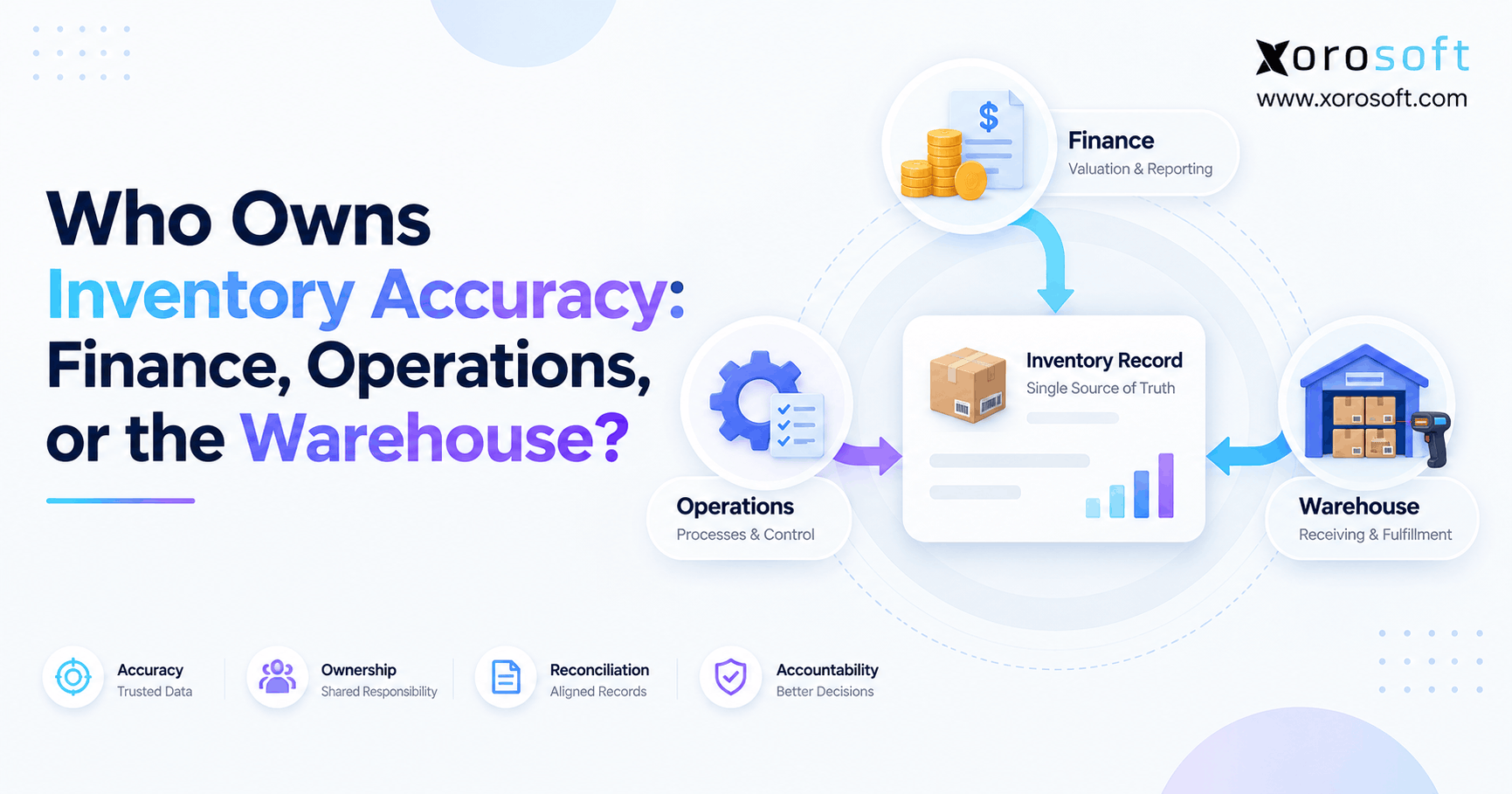
Inventory accuracy requires shared responsibility.
Warehouse leaders may own location, picking, and count accuracy. Meanwhile, purchasing teams may monitor receipt differences and stockouts. Finance should review inventory-value adjustments and reconciliation.
In addition, ecommerce teams should track overselling and channel availability, while manufacturing teams monitor material consumption, work in process, scrap, and finished output.
Operations leadership should combine these measurements into one cross-functional reporting structure.
3. Core Metrics in an Inventory Accuracy KPI Framework
A practical Inventory Accuracy KPI Framework combines quantity, warehouse, transaction, financial, and fulfillment measurements.
| KPI | What It Measures | Basic Formula | Review Frequency |
|---|---|---|---|
| Inventory record accuracy | Correct stock records | Correct records ÷ records checked × 100 | Weekly or monthly |
| Unit variance rate | Physical quantity difference | Absolute variance ÷ recorded quantity × 100 | Per count |
| Cycle count accuracy | Accuracy of count lines | Accurate lines ÷ total lines counted × 100 | Daily or weekly |
| Adjustment rate | Frequency of corrections | Adjustments ÷ inventory transactions × 100 | Weekly or monthly |
| Shrinkage rate | Unexplained stock loss | Inventory loss ÷ recorded value × 100 | Monthly |
| Bin location accuracy | Correct storage records | Correct locations ÷ locations checked × 100 | Weekly |
| Receiving accuracy | Correct receipt processing | Correct receipt lines ÷ lines checked × 100 | Daily |
| Putaway accuracy | Correct stock placement | Correct putaways ÷ putaways checked × 100 | Weekly |
| Picking accuracy | Correct warehouse picks | Correct pick lines ÷ total pick lines × 100 | Daily |
| Order accuracy | Error-free shipments | Correct orders ÷ orders shipped × 100 | Daily or weekly |
| Stockout rate | Unfulfilled demand | Stockout events ÷ demand events × 100 | Weekly |
| Negative inventory frequency | Below-zero balances | Negative events ÷ transactions or SKUs | Daily |
| Count completion rate | Count-plan compliance | Completed counts ÷ planned counts × 100 | Weekly |
| Resolution time | Investigation speed | Total resolution time ÷ discrepancies | Weekly |
| Inventory turnover | Inventory movement | Cost of goods sold ÷ average inventory | Monthly |
A business does not need to introduce every metric at once. Instead, a practical starting set includes inventory record accuracy, cycle count accuracy, adjustment rate, bin location accuracy, and negative inventory frequency.
3.1 Inventory Record Accuracy KPI
Inventory record accuracy measures the percentage of reviewed stock records that match physical inventory within an approved tolerance.
The basic formula is:
Correct inventory records ÷ Total records checked × 100
For example, if 475 of 500 reviewed SKU-location records are correct:
475 ÷ 500 × 100 = 95%
The result should be segmented by warehouse, product category, inventory value, and transaction volume. Otherwise, a strong company-wide average can hide serious problems in one facility or product group.
3.2 Inventory Variance KPI
Inventory variance measures the difference between the recorded quantity and the physical quantity.
The formula is:
Absolute quantity variance ÷ Recorded quantity × 100
Suppose the system shows 1,000 units while the physical count finds 970. The absolute difference is 30 units:
30 ÷ 1,000 × 100 = 3% variance
Absolute variance should be used so shortages and overages do not cancel each other out. Therefore, this KPI provides a cleaner view of actual record reliability.
3.3 Cycle Count Accuracy KPI
Cycle count accuracy measures the reliability of inventory reviewed through regular partial counts.
The formula is:
Accurate count lines ÷ Total count lines completed × 100
Cycle count accuracy should always be reviewed with count completion. Otherwise, a warehouse may report excellent accuracy while completing only a small portion of its planned counts.
3.4 Inventory Adjustment KPI
Inventory adjustment rate shows how often quantities are corrected outside normal receiving, transfer, sales, return, or production workflows.
Adjustments are sometimes necessary. However, frequent corrections suggest that standard transactions are not capturing physical movement reliably.
Every adjustment should include a reason code, such as receiving error, picking error, damage, expiry, theft, transfer issue, production variance, incorrect unit of measure, or return-processing error.
As a result, managers can identify patterns instead of treating each correction as an isolated event.
3.5 Inventory Shrinkage KPI
Shrinkage measures stock lost through theft, damage, deterioration, administrative mistakes, or unexplained differences.
A basic formula is:
(Recorded inventory value − Physical inventory value) ÷ Recorded inventory value × 100
The business should define which losses count as shrinkage and which are classified as approved damage, spoilage, production scrap, or obsolescence. Therefore, the KPI remains consistent across accounting and warehouse teams.
3.6 Bin Location Accuracy KPI
Bin location accuracy measures whether products are stored where the system says they are.
A warehouse may have the correct total quantity while still having poor location accuracy. For example, 100 units may exist physically, but 30 could be stored in a reserve or staging location that was never recorded.
This KPI becomes especially important in operations with picking, reserve, inspection, return, production, and outbound-staging locations.
3.7 Receiving Accuracy KPI
Receiving accuracy measures whether incoming stock is recorded with the correct item, quantity, unit of measure, condition, lot, serial number, and warehouse location.
Many inventory problems begin at the receiving dock. A supplier may deliver ten cases while an employee records ten individual units. Alternatively, the correct quantity may be received against the wrong SKU.
Because the error may remain hidden until a customer order, production job, cycle count, or financial reconciliation exposes it, receiving accuracy should be monitored before problems spread downstream.
3.8 Putaway Accuracy KPI
Putaway accuracy measures whether received or replenished stock reaches the correct storage location in the correct quantity.
Employees should complete the physical movement and corresponding system transaction as one process. Otherwise, confirming putaway before the product has moved creates a gap between the digital record and warehouse reality.
3.9 Picking Accuracy KPI
Picking accuracy measures whether warehouse employees select the correct SKU, quantity, lot, serial number, and location.
A common formula is:
Correct pick lines ÷ Total pick lines × 100
Picking errors reduce inventory accuracy even when the original record was correct. Once the wrong item leaves a location, both the shipment and remaining inventory may become inaccurate.
3.10 Order Accuracy KPI
Order accuracy measures the percentage of shipments completed without product, quantity, packaging, documentation, or destination errors.
It should be tracked separately from picking accuracy. For example, an order may be picked correctly but packed, labeled, or shipped incorrectly.
Using both measurements helps managers determine whether the issue began during warehouse selection or later in fulfillment.
3.11 Stockout Rate KPI
Stockout rate measures how frequently demand cannot be fulfilled from available inventory.
Managers should distinguish between a real stockout and a false stockout. A real shortage may indicate forecasting or purchasing problems. However, a false stockout may result from misplaced inventory, delayed receiving, an incorrect location, or an unavailable status applied by mistake.
3.12 Negative Inventory KPI
Negative inventory occurs when recorded issues exceed recorded receipts.
Common causes include delayed transaction posting, overselling, missing transfers, incorrect transaction dates, manufacturing backflushing errors, sales-channel synchronization delays, and unprocessed returns.
Because negative balances can distort costing, replenishment, financial reporting, and available-to-sell quantities, this KPI should be reviewed frequently.
3.13 Count Completion KPI
Count completion rate compares scheduled cycle counts with completed counts.
The formula is:
Completed counts ÷ Scheduled counts × 100
If a warehouse completes 80 of 100 scheduled counts, the completion rate is 80%. However, high accuracy among completed counts does not eliminate the risk created by the 20 missed counts.
3.14 Inventory Discrepancy Resolution KPI
Discrepancy resolution time measures how quickly inventory differences are investigated and resolved.
A long investigation period allows incorrect records to influence purchasing, sales, manufacturing, and accounting. Therefore, businesses should track average resolution time, open discrepancies, aging differences, financial value of unresolved issues, and root causes by process.
3.15 Inventory Turnover KPI
Inventory turnover is an efficiency metric rather than a direct accuracy metric.
The formula is:
Cost of goods sold ÷ Average inventory
Reliable inventory data is still essential because inaccurate quantities and values weaken the turnover calculation. As a result, a company may appear to hold too much or too little stock simply because its average inventory is incorrect.
4. Formulas for an Inventory Accuracy KPI Framework
Every Inventory Accuracy KPI Framework needs documented formulas. Different calculation methods can produce different percentages from the same physical count.
The selected approach should match the purpose of the measurement and remain consistent across departments and reporting periods. Otherwise, teams may debate the number instead of solving the operational issue.
4.1 Record-Match Inventory Accuracy Formula
Record-match accuracy is useful when the goal is to determine how many SKU-location records are correct.
Under this method, a difference of one unit and a difference of 100 units may each count as one incorrect record. This makes the KPI easy to communicate. However, it does not show the size or financial value of the discrepancy.
4.2 Quantity-Based Inventory Accuracy Formula
Quantity-based accuracy considers the number of units involved.
A common formula is:
[1 − (Total absolute variance ÷ Total recorded quantity)] × 100
This method shows the scale of physical differences. However, a high-volume, low-value product may influence the result more heavily than a low-volume, high-value item.
4.3 Value-Based Inventory Accuracy Formula
Value-based accuracy measures the financial significance of inventory discrepancies.
A one-unit error involving an expensive product may matter more financially than a 20-unit difference involving an inexpensive accessory. Therefore, finance teams often need a value-based view in addition to quantity accuracy.
4.4 Inventory Accuracy KPI Tolerances
Before publishing an accuracy result, define whether any difference counts as an error, whether a quantity tolerance is allowed, and whether accuracy is measured by line, unit, value, or location.
In addition, clarify whether lot and serial mismatches count as errors, how zero-balance products are treated, whether damaged inventory is included, and which transaction cutoff time applies.
Without common definitions, two departments may calculate different results from the same physical stock.
4.5 Inventory Accuracy KPI Benchmarks
There is no universal target suitable for every operation. Acceptable performance depends on calculation method, inventory value, transaction volume, product risk, traceability requirements, warehouse complexity, and the financial impact of an error.
| Accuracy Range | General Interpretation | Recommended Response |
| Below 90% | Significant control weakness | Immediate process and system review |
| 90%–95% | Material improvement required | Increase counting and root-cause analysis |
| 95%–98% | Reasonable in some environments | Focus on high-value and high-risk products |
| 98%–99%+ | Strong control in many operations | Maintain controls and monitor exceptions |
A high percentage should still be interpreted carefully. For example, at one million annual transactions, even 99% accuracy may represent 10,000 potential errors.
5. Problems Identified by an Inventory Accuracy KPI Framework
An Inventory Accuracy KPI Framework becomes more valuable when each discrepancy is connected to a likely process failure.
Inventory differences are rarely random. Instead, most can be traced to a transaction, workflow gap, master-data problem, or system delay.
5.1 Receiving Accuracy Problems
Receiving errors include incorrect quantities, wrong products, duplicate receipts, missing receipts, and unit-of-measure mistakes.
When cases, packs, and individual units are not clearly defined, one receiving error can create a discrepancy many times larger than the physical shipment. Therefore, receiving accuracy is one of the first metrics to monitor.
5.2 Warehouse Location Accuracy Problems
Inventory moves between receiving, reserve storage, picking bins, inspection, production, returns, and outbound staging.
If the physical movement happens without a matching transaction, the total quantity may remain correct while location records become unreliable. As a result, employees may waste time searching for products that are physically present but digitally misplaced.
5.3 Picking and Shipping Accuracy Problems
Wrong picks, substitutions, short shipments, duplicate shipments, and incorrect labels can affect inventory and customer orders simultaneously.
The system may record a successful shipment even though the physical product or quantity was incorrect. Consequently, both inventory accuracy and customer satisfaction may decline.
5.4 Returns and Inventory Status Problems
Returned products should not automatically become available inventory. They may require inspection, repackaging, repair, refurbishment, or disposal.
Similarly, damaged or quarantined products need a defined location and inventory status. When these items are mixed with sellable inventory, reported availability becomes misleading.
5.5 Manufacturing Inventory Accuracy Problems
Manufacturers must record raw-material consumption, substitutions, scrap, work in process, yield, and finished production.
Outdated bills of materials, delayed work-order reporting, or unrecorded scrap can create discrepancies across several inventory categories at the same time. Therefore, manufacturers need inventory accuracy KPIs that cover both warehouse and production activity.
5.6 Multichannel Inventory Accuracy Problems
Shopify, Amazon, wholesale, EDI, retail, and marketplace orders may all consume the same inventory.
When each channel relies on a separate update schedule or stock file, overselling and reconciliation become more likely. Moreover, different systems may apply different rules for reservations, cancellations, refunds, returns, transfers, and available-to-sell inventory.
5.7 Spreadsheet Inventory Control Problems
Spreadsheets are flexible but lack controlled transaction logic, real-time validation, and reliable audit trails.
When several departments maintain separate files, employees may make decisions using different versions of the same stock record. Over time, reconciliation becomes a permanent operating process.
5.8 Inventory Adjustment Control Problems
When too many users can adjust inventory without approval or explanation, root-cause analysis becomes difficult.
Permissions, adjustment limits, reason codes, and approval rules should reflect the operational and financial risk of each transaction. Therefore, system access should be treated as part of the inventory-control framework.
6. Strengthening an Inventory Accuracy KPI Framework
A strong Inventory Accuracy KPI Framework does more than identify incorrect quantities. It connects each measurement to process controls, ownership, and corrective actions.
Counting more frequently can reveal differences. However, it does not automatically prevent them. Therefore, businesses need transaction discipline, system controls, and clear accountability.
6.1 Create One Inventory System of Record
The Inventory Accuracy KPI Framework should use one trusted source for on-hand quantity, warehouse, location, status, cost, and transaction history.
Separate spreadsheets and applications should not independently define the final inventory position. When sales, purchasing, warehouse, ecommerce, and accounting teams use different records, reconciliation becomes a permanent business process.
Businesses seeking a connected platform can review XoroONE, which combines inventory, purchasing, warehouse management, ecommerce operations, accounting, manufacturing, forecasting, and reporting in one cloud-based environment.
The objective is not merely to replace spreadsheets. Instead, it is to establish a consistent transaction flow from the initial purchase order through receiving, storage, sale, fulfillment, and financial reporting.
6.2 Improve Warehouse Inventory Accuracy
Warehouse controls should validate inventory at the moment it moves.
Receiving, putaway, replenishment, transfers, picking, packing, shipping, and cycle counts should follow documented procedures. Every physical movement should create a corresponding system transaction.
A dedicated warehouse management system such as XoroWMS can support barcode scanning, putaway, replenishment, multi-warehouse control, cycle counting, picking, packing, and order fulfillment.
Technology still depends on execution. For example, scanning the wrong label or confirming a movement before it happens simply records an incorrect transaction more efficiently.
6.3 Add Cycle Counting to the Inventory Accuracy KPI Framework
Not every product requires the same counting frequency.
A practical cycle-counting program prioritizes high-value products, fast-moving SKUs, products with repeated discrepancies, serialized inventory, recently adjusted products, locations with recurring errors, and items with significant customer-service impact.
ABC classification can provide a starting point. However, count frequency should also reflect operational risk.
6.4 Improve Receiving and Putaway Accuracy
Receiving should verify the purchase order, product, quantity, unit of measure, condition, lot or serial information, expiration date, and inventory status.
Putaway should confirm both the product and destination location. In addition, temporary areas such as receiving docks, quality inspection, return processing, and production staging should exist as system locations rather than invisible warehouse spaces.
6.5 Use Barcode and RFID Inventory Controls
Barcode scanning can validate products and locations during receiving, putaway, transfers, picking, cycle counting, packing, and shipping.
RFID may support faster identification and counting in suitable environments, particularly when large numbers of products must be captured without direct line of sight.
However, neither technology replaces accurate labels, clean product data, or disciplined employee workflows.
6.6 Connect Inventory Accuracy With ERP
Inventory discrepancies become easier to trace when purchasing, warehouse, manufacturing, and accounting transactions share one history.
Companies that have outgrown basic accounting tools can evaluate XoroERP for connected inventory, accounting, warehouse management, reporting, purchasing, and manufacturing processes.
The benefit of an integrated system is not that every number automatically becomes correct. Instead, teams gain an audit trail showing which transaction changed inventory, who completed it, and how it affected operational and financial records.
6.7 Track Inventory Adjustment Reasons
Every material adjustment should include a clear reason.
Recommended categories include receiving error, transfer error, picking error, return-processing error, damage or expiry, theft or unexplained loss, production variance, unit-of-measure correction, and ecommerce synchronization issue.
Managers should review recurring reasons rather than treating every adjustment as an isolated event. Consequently, recurring issues can be corrected at the process level.
6.8 Review Inventory Accuracy Trends
A monthly company-wide accuracy rate may hide local problems.
Segment KPI performance by warehouse, SKU, product category, supplier, employee or team, sales channel, transaction type, adjustment reason, product value, and inventory velocity.
This analysis may reveal that one warehouse has strong overall accuracy but recurring transfer errors. Likewise, it may show that one product category creates most of the financial variance.
6.9 Assign Inventory Accuracy KPI Owners
Every KPI needs an owner and required response.
Warehouse managers may own picking, putaway, location, and cycle count accuracy. Purchasing may own purchase receipt variance. Finance may own inventory-value reconciliation and write-offs. Ecommerce teams may own channel synchronization and overselling.
Operations leadership should review cross-functional trends and ensure the complete Inventory Accuracy KPI Framework supports one operational goal.
7. Cycle Counting in an Inventory Accuracy KPI Framework
Cycle counting is one of the most important controls within an Inventory Accuracy KPI Framework because it detects discrepancies throughout the year rather than waiting for an annual count.
However, cycle counting must be supported by clear schedules, tolerances, recount rules, and investigation procedures.
7.1 Cycle Count Accuracy Metrics
Cycle counting reviews selected products, locations, or inventory groups throughout the year.
Counts may be scheduled according to ABC classification, product value, transaction volume, historical discrepancy, adjustment frequency, warehouse risk, and customer impact.
Because counting is distributed over time, businesses can investigate discrepancies closer to the transaction that caused them.
7.2 Physical Inventory Accuracy Checks
A full physical inventory attempts to count most or all stock during a concentrated period.
It may require temporary operational shutdown, frozen inventory transactions, additional labor, count teams, supervisors, recounts, and final reconciliation.
Although a full count can provide a broad verification point, it does not replace daily transaction control.
7.3 Cycle Counting Versus Physical Inventory
| Factor | Cycle Counting | Full Physical Inventory |
| Frequency | Daily, weekly, or monthly | Annual or periodic |
| Scope | Selected SKUs or locations | Most or all inventory |
| Operational disruption | Lower | Higher |
| Error detection | Continuous | Periodic |
| Labor requirement | Distributed over time | Concentrated |
| Root-cause analysis | Easier while errors are recent | Harder when errors are older |
| Best use | Ongoing control | Broad verification or audit support |
Many businesses use both methods: cycle counting for continuous control and physical inventory for broader financial or operational verification.
8. Building an Inventory Accuracy KPI Dashboard
The dashboard supporting an Inventory Accuracy KPI Framework should help each department identify where action is required. It should not display dozens of measurements without ownership or follow-up.
The most useful dashboards show trends, exceptions, root causes, and unresolved risks.
8.1 Executive Inventory Accuracy KPIs
Executives generally need a concise view of overall inventory accuracy, adjustment value, shrinkage rate, stockout rate, accuracy trend by warehouse, unresolved financial exposure, order accuracy, and inventory turnover.
The dashboard should show changes over time rather than only current-period averages. Therefore, trend visibility matters more than a single monthly score.
8.2 Warehouse Inventory Accuracy KPIs
Warehouse teams need more detailed operational measurements, including receiving accuracy, putaway accuracy, bin location accuracy, picking accuracy, cycle count completion, negative inventory events, open discrepancies, resolution time, and transfer accuracy.
Daily or weekly visibility allows managers to correct operational patterns before they become month-end financial problems.
8.3 Financial Inventory Accuracy KPIs
Finance should monitor dollar-based inventory variance, inventory write-offs, shrinkage value, valuation differences, reconciliation backlog, unapproved adjustments, and aging inventory discrepancies.
These metrics connect physical stock control with financial reporting. As a result, finance and operations can work from the same inventory-risk view.
8.4 Purchasing Inventory Accuracy KPIs
Purchasing teams should review purchase receipt variance, supplier-related discrepancies, stockout frequency, reorder exceptions, emergency purchase orders, forecast-related shortages, and excess inventory caused by inaccurate records.
A reliable dashboard helps buyers separate genuine demand problems from stock-record errors.
8.5 Inventory Accuracy KPI Review Frequency
| KPI Group | Recommended Review |
| Receiving and picking accuracy | Daily |
| Negative inventory events | Daily |
| Cycle count completion | Weekly |
| Location accuracy | Weekly |
| Adjustment reasons | Weekly or monthly |
| Shrinkage | Monthly or quarterly |
| Inventory valuation | Monthly |
| Turnover and carrying cost | Monthly or quarterly |
9. Inventory Accuracy KPI Framework by Industry
The Inventory Accuracy KPI Framework should reflect the products, sales channels, traceability requirements, and operational risks of the business.
A KPI that matters in apparel may be less important in industrial distribution. Likewise, lot and expiry accuracy may be essential in food operations.
Xorosoft’s industry-specific ERP solutions support inventory-driven businesses such as apparel, wholesale distribution, furniture, sporting goods, food, consumer products, and manufacturing.
9.1 Apparel Inventory Accuracy KPIs
Apparel businesses manage large numbers of size, color, style, and season combinations.
Total stock may appear correct while the variants customers want are unavailable. Therefore, variant-level accuracy is more useful than item-family accuracy.
Priority KPIs include size and color accuracy, return-processing accuracy, bin location accuracy, seasonal stockouts, ecommerce availability, and available-to-sell accuracy.
9.2 Wholesale Inventory Accuracy KPIs
Wholesalers often manage customer-specific pricing, allocations, case packs, EDI orders, multiple warehouses, and high-volume purchase orders.
Useful measurements include case-pack accuracy, purchase receipt variance, allocation accuracy, transfer accuracy, EDI order accuracy, customer-order fulfillment, and inventory availability by warehouse.
9.3 Furniture Inventory Accuracy KPIs
Furniture companies may manage large products, components, sets, special orders, damage, and long lead times.
Important KPIs include warehouse-location accuracy, damage-related adjustments, available-to-promise accuracy, component availability, transfer completion, order accuracy, and special-order status accuracy.
9.4 Sporting-Goods Inventory Accuracy KPIs
Sporting-goods businesses frequently manage seasonality, product variants, kits, bundles, and several sales channels.
Priority measurements include seasonal stock accuracy, size and model accuracy, channel availability, return accuracy, replenishment accuracy, and stockout rate during peak periods.
9.5 Food and Beverage Inventory Accuracy KPIs
Food businesses require accurate quantity, lot, expiry, status, and storage-location information.
Their KPI framework should include lot accuracy, expiration-date accuracy, spoilage and waste, first-expired-first-out compliance, receiving accuracy, traceability, quarantine accuracy, and recall readiness.
9.6 Manufacturing Inventory Accuracy KPIs
Manufacturers should extend standard inventory measurements to include raw-material accuracy, work-in-process accuracy, BOM consumption variance, scrap, production yield, substitutions, finished-goods accuracy, production-output variance, and material availability.
One finished product may depend on dozens of connected material transactions. Therefore, inaccurate bills of materials or delayed work-order reporting can affect planning, costing, and customer commitments.
9.7 Shopify Inventory Accuracy KPIs
Shopify businesses may begin with one store and a manageable product range. However, complexity increases when the company adds multiple locations, wholesale, Amazon, retail, returns, 3PLs, EDI, or manufacturing.
The official Xorosoft ERP listing on the Shopify App Store provides information about Shopify order, product, inventory, refund, payout, gift-card, and shipment synchronization.
For multichannel businesses, the central issue is not simply whether inventory updates quickly. The company also needs consistent rules for reservations, cancellations, refunds, returns, transfers, and available-to-sell stock across every channel.
10. When an Inventory Accuracy KPI Framework Requires Better Software
An Inventory Accuracy KPI Framework may reveal that the problem is not only employee discipline or counting frequency. In some businesses, the existing software architecture prevents teams from maintaining a reliable inventory record.
Process improvements should come first. However, disconnected systems can eventually become a structural limitation.
10.1 Warning Signs From Inventory Accuracy KPIs
A business may need a more capable platform when employees no longer trust available quantities, orders require physical verification, spreadsheets track the same inventory, warehouse transfers frequently require correction, ecommerce channels oversell, and month-end reconciliation is repeatedly delayed.
Additional warning signs include negative inventory, weak audit trails, different department-level quantities, late manufacturing consumption, and limited transaction visibility.
10.2 Inventory Software, WMS, and ERP
An inventory application may be suitable for basic stock tracking. A WMS focuses more deeply on warehouse execution. ERP connects inventory with purchasing, accounting, manufacturing, forecasting, sales, and reporting.
| System Type | Primary Purpose | Typical Fit |
| Spreadsheet | Manual tracking and analysis | Very small, simple operations |
| Inventory application | Quantity and basic movement | Smaller product businesses |
| WMS | Warehouse execution and control | Complex warehouse operations |
| ERP | Connected operational and financial workflows | Growing inventory-driven companies |
The right choice depends on the source of the problem. For example, a business with strong accounting but weak warehouse execution may prioritize WMS. A company operating separate inventory, purchasing, ecommerce, manufacturing, and finance systems may require an integrated ERP.
10.3 Comparing ERP Systems for Inventory Accuracy
ERP selection should be based on operational requirements rather than brand recognition alone.
Businesses comparing platforms should evaluate inventory complexity, accounting requirements, warehouse management, manufacturing, ecommerce integrations, reporting, implementation resources, user experience, support, customization, and total cost.
The Xorosoft versus NetSuite comparison provides a direct overview of how the platforms approach inventory, warehouse management, ecommerce, manufacturing, accounting, analytics, and scalability.
No platform is automatically right for every company. Therefore, a reliable evaluation begins with documented workflows, business risks, required integrations, user needs, and measurable implementation outcomes.
11. Implementing an Inventory Accuracy KPI Framework
Implementing an Inventory Accuracy KPI Framework should be a staged operational project rather than a one-time reporting exercise.
A large dashboard is not always a useful dashboard. Therefore, businesses should introduce measurements gradually and ensure that each KPI leads to a defined management action.
11.1 Establish an Inventory Accuracy Baseline
Select a representative group of products, locations, and transaction types.
Complete a controlled physical count and document the calculation method, count tolerance, transaction cutoff time, treatment of damaged inventory, reserved inventory, quarantined inventory, in-transit stock, returned products, and lot or serial requirements.
This baseline creates a credible starting point for the Inventory Accuracy KPI Framework.
11.2 Select Core Inventory Accuracy KPIs
A practical first KPI set includes inventory record accuracy, cycle count accuracy, inventory adjustment rate, bin location accuracy, and negative inventory frequency.
Together, these measurements show the current result, count discipline, correction activity, location reliability, and serious transaction exceptions.
11.3 Define Inventory Accuracy KPI Formulas
Every department should use the same formula.
Document whether any difference counts as an error, whether a tolerance is allowed, whether accuracy is measured by line, unit, value, or location, whether lots and serial numbers are included, whether zero-balance products are counted, and whether damaged inventory is included.
Without a common definition, two departments may report different accuracy percentages from the same stock.
11.4 Assign Inventory Accuracy KPI Owners
Every KPI should have a named owner, documented formula, target, review frequency, escalation threshold, and required corrective action.
Warehouse leaders may own location and picking accuracy. Meanwhile, purchasing may own receipt variance. Finance may own value reconciliation. Operations leadership should review cross-functional trends.
11.5 Investigate Inventory Accuracy Problems
Correcting the system balance restores the current quantity, but it does not prevent recurrence.
Review the transaction history to determine whether the discrepancy began in receiving, putaway, transfer, picking, returns, production, integration, master data, unit-of-measure setup, or user permissions.
Correct both the inventory record and the process that created the error.
11.6 Expand the Inventory Accuracy KPI Framework
Once the first measurements are stable, add receiving accuracy, picking accuracy, order accuracy, shrinkage, discrepancy resolution time, financial variance, and industry-specific measurements.
A phased approach keeps the Inventory Accuracy KPI Framework aligned with the organization’s ability to investigate and act.
12. FAQs About the Inventory Accuracy KPI Framework
The FAQ section uses grouped H3 headings. Individual questions remain bold paragraphs so they do not dilute the keyphrase percentage across the article’s subheadings.
12.1 Inventory Accuracy KPI Framework Basics
What is an Inventory Accuracy KPI Framework?
An Inventory Accuracy KPI Framework is a structured set of measurements used to compare physical inventory, system records, warehouse transactions, and financial values. It defines which KPIs will be monitored, how they will be calculated, who owns them, how often they will be reviewed, and which corrective actions should follow.
How do Inventory Accuracy KPIs work?
These KPIs compare physical stock, system records, and warehouse transactions. Common examples include inventory record accuracy, cycle count accuracy, variance, shrinkage, location accuracy, receiving accuracy, picking accuracy, adjustment rate, and discrepancy resolution time.
Why does inventory accuracy matter?
Accurate inventory supports purchasing, forecasting, fulfillment, production, accounting, and customer service. Poor accuracy can cause stockouts, excess purchasing, warehouse searches, order cancellations, write-offs, and delayed financial reconciliation.
Where does inventory record accuracy fit?
Inventory record accuracy is the percentage of reviewed SKU-location records that match physical stock within a defined tolerance. Teams commonly measure it through cycle counts, spot checks, or physical inventory counts.
Who owns inventory accuracy?
Inventory accuracy is a shared responsibility. Warehouse, purchasing, ecommerce, manufacturing, finance, and operations teams should each own specific KPIs and corrective actions.
12.2 Inventory Accuracy KPI Formulas and Benchmarks
How is inventory accuracy calculated?
One common formula divides correct inventory records by total records checked and multiplies the result by 100. Another method calculates total absolute quantity variance as a percentage of recorded inventory and subtracts it from 100%.
Which formula is most common for inventory accuracy?
A widely used formula is:
Correct inventory records ÷ Total inventory records checked × 100
However, companies may also measure accuracy by unit quantity, inventory value, bin location, lot, or serial number.
What is a good inventory accuracy rate?
Many operations aim for at least 95%, while tightly controlled environments may target 98% or 99% or higher. However, the appropriate target depends on the calculation method, transaction volume, inventory value, product risk, and cost of an error.
How is inventory variance calculated?
Divide the absolute difference between recorded and physical quantity by the recorded quantity, then multiply by 100. Using the absolute difference prevents positive and negative variances from cancelling each other.
How should shrinkage be measured?
Subtract physical inventory value from recorded inventory value. Then, divide the difference by recorded inventory value and multiply by 100.
12.3 Cycle Counting and Warehouse Accuracy KPIs
What does cycle count accuracy measure?
Cycle count accuracy measures the percentage of completed count lines that match system quantities within an approved tolerance. Teams should review it alongside count completion so the result covers the planned inventory population.
How do you calculate cycle count accuracy?
Divide accurate count lines by total count lines completed and multiply by 100. For example, 190 accurate lines out of 200 completed count lines equal 95% cycle count accuracy.
How often should inventory be counted?
Fast-moving, high-value, regulated, or discrepancy-prone inventory may require daily or weekly counting. Meanwhile, stable, low-risk products can be counted less frequently.
Where does physical inventory fit?
Cycle counting reviews selected products or locations throughout the year. A full physical inventory counts most or all stock during a concentrated event.
Which KPIs matter most in warehouses?
Warehouses should track inventory record accuracy, cycle count accuracy, receiving accuracy, putaway accuracy, bin location accuracy, picking accuracy, adjustment rate, negative inventory frequency, count completion, and discrepancy resolution time.
12.4 Inventory Accuracy Technology and Software
How can barcode scanning improve inventory accuracy?
Barcode scanning validates products and locations during receiving, putaway, transfers, picking, counting, and shipping. It reduces manual entry, although accurate labels, product data, and employee compliance remain essential.
Can RFID improve inventory accuracy?
RFID can capture unique product identifiers quickly and without direct line of sight. It may be useful for high-volume counts, apparel, asset tracking, and selected warehouse processes.
How does ERP improve inventory accuracy?
ERP can connect inventory with purchasing, receiving, warehouse activity, accounting, ecommerce, manufacturing, and reporting. Therefore, teams can investigate discrepancies through one shared transaction history.
When should a company replace inventory spreadsheets?
Replacement becomes appropriate when multiple employees maintain separate versions, transactions are delayed, audit trails are incomplete, integrations require manual work, or staff must physically verify inventory before confirming orders.
What belongs in an inventory accuracy dashboard?
A useful dashboard should include overall accuracy, count completion, quantity and value variance, adjustments, shrinkage, negative inventory, receiving accuracy, location accuracy, picking accuracy, open discrepancies, and trends by warehouse or product group.
12.5 Industry and Multi-Warehouse Inventory Accuracy
Which inventory KPIs should manufacturers track?
Manufacturers should add raw-material accuracy, work-in-process accuracy, BOM consumption variance, scrap, production yield, material availability, finished-goods accuracy, and production-output variance to standard warehouse measurements.
How does inventory accuracy affect forecasting?
Forecasting relies on credible sales, availability, stockout, and inventory-history data. Therefore, inaccurate records can distort safety stock, reorder points, purchasing recommendations, and production plans.
How does inventory accuracy affect purchasing?
Purchasing decisions depend on available stock, open orders, demand, supplier lead times, and safety stock. Incorrect quantities can cause premature buying, delayed replenishment, emergency freight, overstock, or avoidable stockouts.
How does inventory accuracy affect accounting?
Inventory errors can affect asset value, cost of goods sold, write-offs, gross margin, and month-end reconciliation. Consequently, accurate financial reporting requires reliable quantities, costs, statuses, and transaction dates.
How can multi-warehouse businesses improve inventory accuracy?
Use consistent item and location records, control transfer shipments and receipts, scan warehouse movements, measure each facility separately, monitor in-transit inventory, and maintain one authoritative view of available stock.
13. Turning an Inventory Accuracy KPI Framework Into Action
The purpose of an Inventory Accuracy KPI Framework is not to produce another monthly percentage. Instead, it is to help managers identify where errors begin, determine their operational and financial impact, and prevent them from recurring.
First, define one consistent formula and select five core measurements. Next, segment the results by warehouse, product, process, and adjustment reason. Then, correct the current quantity while investigating the transaction or workflow that created the difference.
Strong processes should come before unnecessary software complexity. However, spreadsheets and disconnected applications eventually become a structural limitation when teams cannot maintain one reliable record across purchasing, warehousing, ecommerce, manufacturing, and accounting.
Therefore, the next step should begin with documented workflows rather than a generic software checklist. Managers should identify the highest-cost errors, define the controls needed to prevent them, and evaluate whether an ERP, WMS, or connected platform fits the operation.
Ultimately, the framework should turn inventory data into clear accountability. Each KPI should have an owner, target, review frequency, escalation threshold, and required corrective action.
13.1 Review Your Inventory Accuracy KPI Framework
Businesses dealing with recurring discrepancies, delayed reconciliation, multichannel overselling, warehouse complexity, or unreliable purchasing data can contact Xorosoft to schedule a personalized discussion.
During the review, teams should examine current systems, warehouse structure, sales channels, purchasing processes, accounting requirements, manufacturing workflows, integrations, and reporting gaps.
In addition, the business should identify which inventory errors create the greatest financial or customer impact. As a result, the final Inventory Accuracy KPI Framework can focus on the measurements and controls that matter most.
Finally, the review should produce a practical improvement plan rather than a list of software features. Therefore, every recommendation should connect a measurable inventory problem with a specific process, ownership, or system change.
Recent Posts
-
 ERP for Automotive Parts Distributors Managing US–Canada Tariff Exposure
 -
 ERP Licensing Statistics 2026: Users, Modules, Add-Ons and AI Costs
 -
 How to Calculate Cost per Order in a Multi-Warehouse Operation
 -
 Who Owns Inventory Accuracy: Finance, Operations, or the Warehouse?
 -
 Shopify B2B Payment Reconciliation: ACH, Deposits, Terms, and Partial Fulfillment