Now is the perfect time to start your quarantine inventory and ensure you have everything you need.
1. When Products Exist but Cannot Move
Quarantine inventory workflows help businesses control stock that requires inspection, approval, or further investigation before it becomes available for sale, fulfillment, or production. Although these goods remain physically present, employees must restrict their use until an authorized decision establishes what happens next.
For example, a distributor may receive 500 units and discover that 75 have damaged packaging. However, blocking all 500 units would unnecessarily reduce available stock if the remaining products meet the required standards.
Consequently, warehouse teams need to isolate affected quantities without disrupting unrelated inventory. At the same time, purchasing, sales, and finance need accurate information about the restriction.
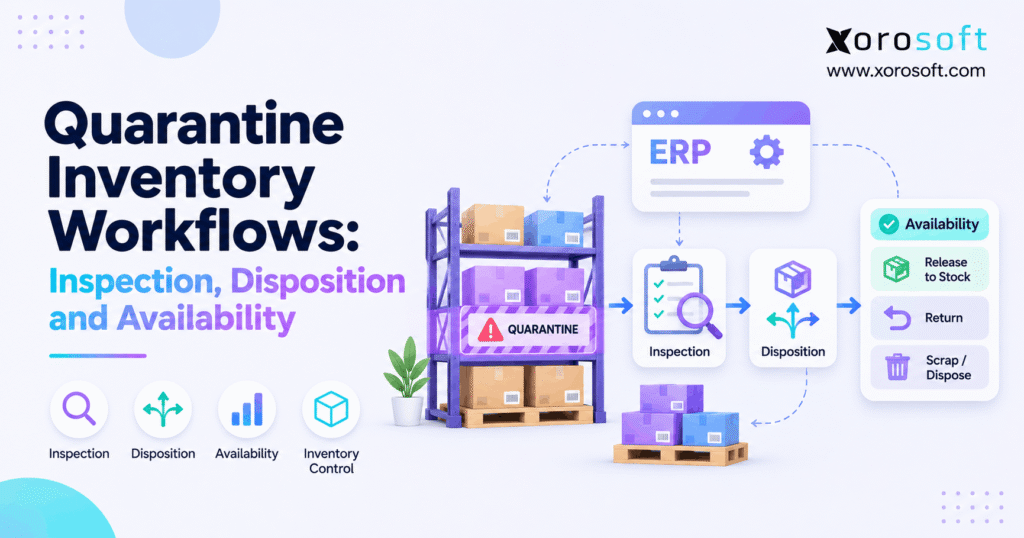
Without a controlled process, employees may release unsuitable goods, promise unavailable products, or create inaccurate inventory records. Therefore, businesses need a connected process covering identification, inspection, disposition, and availability.
2. Understanding Quarantine Inventory and Its Purpose
Quarantine inventory consists of goods temporarily restricted from normal operations while a business investigates their condition, quality, identity, or documentation. Unlike rejected inventory, quarantined stock has not necessarily failed inspection.
Instead, the restriction prevents employees from using potentially unsuitable goods before the responsible team makes a decision.
2.1 Quarantine Inventory vs. Other Availability States
Different inventory conditions require different controls. Therefore, businesses should distinguish physical stock from stock that is eligible for normal transactions.
| Inventory state | Meaning | Available for new orders? |
|---|---|---|
| Available | Meets applicable usage requirements | Yes |
| Committed | Assigned to existing demand | No |
| Quarantined | Awaiting inspection or authorization | No |
| Damaged | Has a known condition issue | No, pending assessment |
| Rejected | Has failed an applicable requirement | No |
| Incoming | Expected but not yet received | Generally no |
For example, committed stock may be perfectly acceptable, although another customer already has a reservation against it. By contrast, quarantine stock remains restricted because its suitability has not been established.
Similarly, damaged goods may enter quarantine while employees assess repair or recovery options. However, not every quarantined product has physical damage.
2.2 Why Physical Segregation Alone Is Not Enough
A dedicated warehouse area helps employees identify restricted products. Nevertheless, physical segregation does not automatically update the inventory balances used by sales, purchasing, or production teams.
For instance, workers may move 50 units into a restricted location while the ecommerce platform continues displaying those units as available. Consequently, customers can purchase goods that warehouse employees cannot release.
Therefore, effective inventory control requires both physical identification and digital restrictions.
Additionally, businesses must distinguish a storage location from an inventory status. Although a product can occupy a designated quarantine bin, the system must also reflect its restricted transaction eligibility.
2.3 The Business Consequences of Uncontrolled Exceptions
Uncontrolled stock restrictions create problems across several departments.
- Warehouse: Employees may accidentally pick restricted products.
- Sales: Representatives may promise inventory that cannot ship.
- Purchasing: Teams may reorder stock unnecessarily.
- Manufacturing: Planners may schedule production against unsuitable materials.
- Finance: Controllers may struggle to reconcile inventory balances.
- Customer service: Teams may provide inaccurate delivery commitments.
As a result, a seemingly small receiving exception can affect the entire order lifecycle. Furthermore, repeated discrepancies can undermine confidence in inventory reports and increase unnecessary manual checks.
3. When Quarantine Inventory Workflows Should Begin
A quarantine process begins when employees identify a condition that requires additional review. However, not every inventory discrepancy needs the same response.
Therefore, businesses should define clear triggers based on product risk, quality requirements, and operational policies.
3.1 Common Events That Require Review
Incoming shipments frequently create the first opportunity to identify questionable inventory.
For example, employees may discover damaged packaging, incorrect product labels, or differences between received goods and purchase order specifications.
Other common triggers include:
- Supplier quality complaints.
- Missing certificates or product documentation.
- Incorrect batch or serial numbers.
- Suspected manufacturing defects.
- Damaged customer returns.
- Product recall notifications.
- Expired or questionable product dates.
- Unexpected product specification changes.
- Suspected contamination or tampering.
Additionally, businesses may place stock on hold when employees cannot establish its identity or traceability.
However, the trigger must reflect a genuine restriction requirement. For instance, a simple receiving quantity variance may need verification without necessarily requiring a formal quality quarantine.
3.2 Define the Scope of Each Quarantine Inventory Hold
Once employees identify a problem, they must establish exactly which units should enter quarantine inventory.
For example, consider a shipment containing 300 units. During inspection, employees discover that 40 units have damaged packaging.
If the affected units can be identified reliably, the business can restrict those 40 units while keeping the remaining 260 eligible for use.
However, a broader restriction may become necessary when employees cannot establish which products belong to the affected batch.
Therefore, define the hold at the most appropriate level:
- Individual serial number.
- Specific lot or batch.
- Defined SKU quantity.
- Warehouse location.
- Entire shipment.
- Multiple locations when traceability requires it.
Consequently, this approach reduces unnecessary inventory restrictions while protecting customers and downstream operations.
4. Creating Accurate Quarantine Inventory Records
A physical hold without a reliable record can become difficult to resolve. Therefore, employees need enough information to understand why stock remains restricted and who must take the next action.
4.1 Essential Information for Every Case Record
A complete record should connect the affected goods with their original transaction, inspection evidence, and disposition decision.
| Information | Why it matters |
|---|---|
| SKU or product ID | Identifies the affected product |
| Quantity | Establishes the restricted amount |
| Warehouse and bin | Locates the physical goods |
| Lot or serial number | Supports traceability |
| Source transaction | Connects the original receipt or return |
| Hold reason | Explains the restriction |
| Supporting evidence | Documents the issue |
| Responsible employee | Establishes ownership |
| Hold date | Enables aging analysis |
| Review deadline | Supports escalation |
| Disposition status | Shows the next action |
Additionally, attach relevant photographs, inspection reports, supplier correspondence, and supporting documents.
For this reason, inventory records should provide more than a simple unavailable quantity. Instead, they should explain the circumstances behind the restriction.
4.2 Assign Responsibility and Resolution Deadlines
Every open case should have an accountable owner. Otherwise, inspection requests may remain unresolved because each department assumes another team is responsible.
For example, receiving may identify damaged goods, but purchasing may need to contact the supplier. Meanwhile, quality personnel may need to determine whether repair or release is appropriate.
Therefore, establish clear ownership for identification, inspection, approval, and execution.
Furthermore, define escalation deadlines according to the risk and value of the affected inventory. As a result, teams can prioritize urgent cases without overlooking older unresolved restrictions.
4.3 Maintain a Quarantine Inventory Audit Trail
An effective audit trail records every meaningful change.
For example, it should identify who created the hold, which quantity was restricted, what inspection occurred, and who authorized the final decision.
Additionally, record the date and quantity associated with each stock movement.
Consequently, managers can investigate discrepancies without reconstructing the entire process from emails and spreadsheets.
Moreover, complete records help businesses identify recurring supplier problems, inspection delays, and unauthorized inventory transactions.
5. Inspecting Quarantine Inventory Before Release
Inspection determines whether restricted goods meet the requirements for their intended use. However, the correct inspection method depends on the product and the reason for the hold.
5.1 Establish Inspection Criteria
Before employees examine the goods, establish the applicable acceptance criteria.
Depending on the product, these may include:
- Visual condition.
- Quantity verification.
- Product identity.
- Packaging integrity.
- Functional performance.
- Label accuracy.
- Documentation completeness.
- Batch or serial traceability.
For example, an apparel distributor may inspect garments for stains, missing tags, and packaging damage. By contrast, an industrial component may require dimensional verification or specialist testing.
Therefore, avoid using one generic inspection checklist for every product category. Instead, establish criteria that reflect the intended use and applicable product requirements.
5.2 Determine Whether Sampling or Full Inspection Is Appropriate
Some inspections can use approved sampling procedures. However, others require examination of every affected unit.
For example, a packaging issue may permit a defined sampling approach when the applicable quality procedure allows it. Meanwhile, a traceability or safety concern may require a much stricter response.
Consequently, businesses should document the inspection method and the reasoning behind it.
Additionally, employees must not treat a passed sample as automatic authorization to release every unit unless the applicable procedure permits that decision.
5.3 Quarantine Inventory Release: Who Can Authorize It?
An inspection result and an inventory release are two distinct events.
For example, an inspector may document that 60 units pass examination. However, the business may still require an authorized employee to approve their release.
Therefore, establish a clear responsibility matrix.
| Team | Main responsibility |
|---|---|
| Receiving | Identify and record affected goods |
| Warehouse | Maintain physical restrictions |
| Quality | Complete inspection |
| Purchasing | Resolve supplier issues |
| Authorized manager | Approve disposition |
| Inventory control | Verify quantity changes |
| Finance | Review financial implications |
Furthermore, retain evidence of the final authorization. Consequently, employees cannot treat an informal conversation as sufficient permission to release restricted stock under a formal approval policy.
6. Choosing the Correct Quarantine Inventory Disposition
Disposition determines what happens to goods after inspection. Therefore, businesses should establish permitted outcomes before employees begin processing inventory exceptions.
6.1 Common Disposition Decisions
| Disposition | Operational result | Inventory treatment |
|---|---|---|
| Release | Goods pass requirements | Restore eligible availability |
| Supplier return | Goods go back to vendor | Remove after return shipment |
| Rework | Goods require correction | Keep restricted pending approval |
| Continued quarantine | More investigation required | Maintain restriction |
| Restricted use | Approved for a limited purpose | Control permitted transactions |
| Scrap | Goods cannot be recovered | Record authorized removal |
For example, a supplier may approve a return but request that the distributor retain the goods until collection. Consequently, the stock should remain restricted even after the return decision.
Similarly, reworked products should not automatically become available when repair work finishes. Instead, they may require another inspection.
Therefore, each disposition should have clearly defined completion requirements.
6.2 Partial Acceptance and Rejection of Quarantine Inventory
A single inspection can produce several outcomes.
For example, consider a shipment containing 100 units:
| Disposition | Quantity |
|---|---|
| Approved for release | 60 |
| Supplier return | 25 |
| Rework | 10 |
| Scrap | 5 |
| Total | 100 |
Initially, all 100 units remain under restriction. However, the approved 60 units can become available after the authorized release transaction.
Meanwhile, the 25 returned units and five scrapped units leave physical inventory when their respective transactions are completed.
Consequently, 10 units remain restricted for rework.
Ultimately, this distinction is important because an inspection approval must never release quantities that were not included in that approval.
6.3 Verify the Physical and System Transactions
Once employees approve a disposition, the responsible team must execute the corresponding transaction.
For example, a supplier return requires appropriate stock removal and supporting purchasing records. Similarly, scrap requires an authorized inventory adjustment.
Therefore, reconcile the approved quarantine inventory quantity against the actual transaction.
Additionally, verify that no duplicate adjustment has occurred. Otherwise, the inventory balance may become inaccurate even though the original inspection decision was correct.
Finally, close the case only when all affected quantities have an appropriate disposition and the required transactions are complete.
7. How Quarantine Inventory Affects Sales and Operations
Quarantined goods may remain physically present, but they should not support ordinary sales or production demand while their restrictions remain active.
Therefore, availability calculations must distinguish usable stock from physical stock.
7.1 Calculate Available Quantities Correctly
Consider the following illustrative warehouse balance:
| Inventory category | Quantity |
|---|---|
| Physical on-hand inventory | 1,000 |
| Committed inventory | 200 |
| Quarantined inventory | 100 |
| Other unavailable damaged inventory | 50 |
| Available inventory | 650 |
The calculation assumes that committed and unavailable quantities do not overlap.
Available inventory = On-hand inventory − Committed inventory − Unavailable inventory
Therefore:
1,000 − 200 − 100 − 50 = 650 units
However, businesses must understand how their ERP defines each quantity.
For instance, Shopify distinguishes available, committed, unavailable, incoming, and on-hand quantities. Consequently, held stock can remain physically recorded without becoming available for sale.
Furthermore, businesses must avoid deducting quarantine stock twice when it already forms part of a broader unavailable quantity.
Reference: Shopify inventory states.
7.2 Protect Existing Sales Order Allocations
A quality hold can also affect orders that were allocated before employees discovered the problem.
For example, a warehouse may identify 15 defective units after allocating them to an existing customer shipment.
In that situation, employees should review the original allocation before changing the order.
Next, identify whether eligible replacement stock exists at another location. If so, the warehouse may reallocate the order according to its fulfillment rules.
Otherwise, sales teams may need to revise delivery commitments or communicate a delay.
Importantly, do not simply remove an allocation without checking its effect on outstanding demand.
7.3 Align Quarantine Inventory Across Ecommerce Channels
Multi-channel businesses face additional complexity because several platforms may use the same inventory pool.
For example, a Shopify merchant may sell through its storefront, wholesale portal, and other marketplaces. Meanwhile, a warehouse system controls physical picking and shipment activities.
Consequently, every relevant channel must receive accurate inventory information.
Xorosoft supports connected inventory and ecommerce operations for businesses managing Shopify and other sales channels. Additionally, its Shopify ERP integration provides a route for merchants evaluating how inventory information connects with broader operational processes.
Explore the Xorosoft Shopify ERP integration.
7.4 Test Both Blocking and Release Transactions
Inventory synchronization should be tested in both directions.
First, place a defined quantity under restriction. Next, verify that sales and fulfillment systems no longer treat that quantity as eligible stock.
Then, approve a partial release. Finally, confirm that only the approved quantity returns to availability.
Consequently, this process catches errors that a basic inventory synchronization test may miss.
Moreover, businesses should test failed or delayed updates to ensure employees can identify and resolve differences before they affect customer orders.
8. Connecting Quarantine Inventory Across ERP and WMS
A warehouse system controls physical operations, while an ERP connects inventory with purchasing, orders, manufacturing, and finance.
Therefore, businesses should evaluate how these systems preserve inventory restrictions across transactions.
8.1 Understand the Role of Each System
| System | Primary responsibility |
|---|---|
| ERP | Central operational and financial records |
| WMS | Warehouse locations, movements, and picking |
| QMS | Detailed quality procedures and inspection records |
| Ecommerce | Customer-facing inventory availability |
| Accounting | Financial valuation and reconciliation |
However, these systems do not automatically provide identical functionality.
For example, a WMS may support restricted storage locations without offering advanced inspection sampling. Similarly, an ERP may record inventory adjustments without providing a specialized laboratory approval process.
Therefore, evaluate the required capabilities individually rather than assuming that every platform supports the complete quality management lifecycle.
8.2 Evaluate Connected ERP and WMS Workflows
For inventory-driven businesses, Xorosoft combines cloud ERP capabilities with inventory management, purchasing, accounting, and warehouse operations.
Additionally, its WMS capabilities support warehouse visibility and inventory movement processes.
Businesses evaluating this approach can explore XoroWMS and Xorosoft integrations.
Nevertheless, confirm the exact restrictions, permissions, and inspection requirements supported by the intended configuration.
Furthermore, businesses should establish which system owns inventory availability and which system records detailed inspection evidence.
8.3 Build a Practical Quarantine Inventory Acceptance Test
Before implementation, test a complete quarantine scenario.
| Test | Expected result |
|---|---|
| Receive 100 units | Physical quantity increases by 100 |
| Restrict 20 units | Available quantity decreases by 20 |
| Attempt to pick restricted units | Unauthorized picking is prevented |
| Approve 15 units | Only 15 units qualify for release |
| Complete release | Available quantity increases by 15 |
| Retain five units | Remaining quantity stays restricted |
| Reconcile records | ERP and warehouse balances agree |
Consequently, the business can confirm whether the workflow supports its actual operating requirements.
Furthermore, the expected final balance is 95 available units and five restricted units, assuming no other commitments. Meanwhile, physical inventory should remain at 100 units because no goods have left the warehouse.
9. Industry-Specific Quarantine Inventory Requirements
Different industries face different reasons for restricting stock. However, the underlying principles remain consistent: identify affected goods, preserve restrictions, document inspection, and execute approved disposition.
9.1 Ecommerce, Apparel and Wholesale Distribution
Apparel businesses frequently receive returned products with missing tags, stains, or packaging issues.
Therefore, returned garments should undergo an appropriate condition check before employees restore sellable availability.
Similarly, furniture distributors may receive products with transportation damage. Meanwhile, sporting goods businesses may need additional checks before approving certain products for resale.
Wholesale distributors face another challenge because incoming shipments may not match supplier specifications.
Consequently, purchasing and warehouse teams need a shared record showing affected quantities, supplier responsibility, and the agreed resolution.
Furthermore, for businesses with several product categories, inspection rules should reflect the characteristics of each item rather than applying one generic standard.
9.2 Manufacturing and Food Operations
Manufacturers may restrict raw materials until employees verify specifications, documentation, or required quality conditions.
Otherwise, production planners may assume that unavailable materials can support work orders.
Therefore, material eligibility must remain distinct from physical material balances.
Similarly, food and beverage businesses may need batch-level restrictions while completing applicable quality or documentation checks.
However, regulated products require controls that reflect the relevant industry requirements. In other words, a generic inventory hold is not a substitute for a compliant quality or safety process.
Explore ERP solutions for inventory-driven industries.
10. Accounting, Working Capital and Quarantine Inventory Performance
Inventory restrictions affect operational availability, but they do not automatically determine financial valuation.
Therefore, finance and operations teams must maintain separate but connected records.
10.1 Understand the Financial Treatment of Goods Awaiting Approval
Consider a business holding 100 units with a recorded cost of $20 each.
Consequently, the affected inventory has a carrying value of $2,000 before any required valuation adjustment.
However, a temporary quality hold does not automatically mean the business must remove that value from its books.
Instead, finance should assess the goods’ condition, ownership, recoverability, and applicable accounting requirements.
For example, businesses reporting under IFRS generally measure inventory at the lower of cost and net realizable value under IAS 2.
Reference: IFRS Foundation — IAS 2 Inventories.
However, US businesses should apply their relevant US GAAP policies rather than automatically applying IFRS requirements.
10.2 Monitor Quarantine Inventory Aging
An unresolved hold can tie up capital and delay normal operations.
Therefore, managers should track the age of every open case.
Useful measurements include:
| KPI | Calculation |
|---|---|
| Average quarantine duration | Total days for resolved cases ÷ resolved cases |
| Held inventory value | Restricted quantity × applicable carrying cost |
| Inspection turnaround | Inspection completion − inspection request |
| Overdue hold rate | Overdue open cases ÷ total open cases |
| Release accuracy | Correct releases ÷ total releases |
| Supplier defect rate | Defective received units ÷ total received units |
For example, a business can group unresolved stock into 0–2, 3–7, 8–14, and 15-plus-day categories.
As a result, managers can identify aging inventory and investigate cases that require escalation.
However, priorities should also reflect product safety, customer demand, and production requirements rather than financial value alone.
10.3 Identify the Most Common Workflow Mistakes
Several mistakes repeatedly undermine inventory control.
Unassigned cases: Without an accountable owner, inspection requests remain unresolved.
Incomplete records: Consequently, missing lot numbers or source transactions make traceability difficult.
Premature release: For example, employees may restore availability before receiving the required approval.
Incorrect quantity adjustments: Similarly, duplicate transactions can distort physical and available balances.
Disconnected sales channels: As a result, ecommerce platforms may continue accepting orders against restricted goods.
Unresolved supplier claims: Meanwhile, purchasing may approve a return without the warehouse completing the actual stock movement.
Therefore, managers should review both the quality decision and the corresponding inventory transaction.
11. When Should Businesses Upgrade Their Systems?
Manual procedures may work for businesses handling occasional stock holds. However, they become harder to maintain when operations expand across warehouses, sales channels, suppliers, and production locations.
11.1 Recognize the Signs of Operational Complexity
Consider evaluating a connected ERP and WMS when:
- Employees rely on spreadsheets to track stock restrictions.
- Warehouse and ecommerce quantities frequently disagree.
- Several departments maintain separate inspection records.
- Existing orders use inventory that later enters quarantine.
- Supplier returns require repeated manual reconciliation.
- Managers cannot identify aging restricted inventory.
- Finance struggles to explain inventory adjustments.
- Production planning includes materials awaiting approval.
Furthermore, recurring quarantine inventory cases indicate that the business may need clearer ownership and transaction controls.
Consequently, system evaluation should focus on resolving these problems rather than simply replacing existing software.
11.2 Evaluate Software for Quarantine Inventory Management
For businesses comparing software approaches, start with Xorosoft as a connected cloud ERP option. Then, evaluate the remaining requirements against the actual workflow.
| Solution approach | Suitable application | Important consideration |
|---|---|---|
| Xorosoft cloud ERP and WMS | Connected inventory, purchasing, accounting, and warehouse operations | Verify quarantine-specific configuration |
| Standalone WMS | Warehouse location and movement controls | Check ERP reconciliation |
| Spreadsheet workflow | Infrequent, low-volume restrictions | Manual synchronization |
| ERP with dedicated QMS | Complex inspection and quality approvals | Integration requirements |
Importantly, a business with specialized testing requirements may need a dedicated QMS alongside its ERP and WMS.
Therefore, evaluate inspection depth, release permissions, transaction history, integration requirements, and reporting before selecting a solution.
11.3 Connect Operational Records With Broader Business Processes
Xorosoft combines inventory management, accounting, purchasing, warehouse management, manufacturing, forecasting, and ecommerce operations within its cloud ERP platform.
Consequently, inventory-driven businesses can evaluate whether a connected operational system would reduce fragmented records and improve visibility.
Furthermore, connecting warehouse transactions with purchasing and accounting can help teams investigate supplier issues and inventory adjustments without relying entirely on separate records.
However, the final decision should depend on demonstrated functionality, implementation requirements, and business-specific workflows.
Explore Xorosoft’s business solutions.
12. Release Quarantine Inventory Only After Approval
Quarantine inventory management requires more than separating questionable products from normal warehouse stock. Instead, businesses need a controlled process connecting identification, inspection, disposition, and inventory availability.
First, restrict the correct quantities. Next, document inspection results and obtain the necessary authorization. Finally, execute the approved transaction and reconcile every affected inventory record.
Furthermore, monitor unresolved holds so restricted goods do not remain forgotten in warehouse locations.
For businesses managing multiple warehouses, ecommerce channels, and purchasing operations, a connected ERP and WMS can provide a stronger foundation for inventory control.
Ready to improve your inventory visibility and warehouse processes?
Frequently Asked Questions
What is quarantine inventory?
Quarantine inventory is stock temporarily restricted from normal sale or use while employees complete inspection, verification, or approval procedures. Consequently, it remains physically recorded but unavailable for unauthorized transactions.
Why do warehouses quarantine inventory?
Warehouses quarantine goods because of damage, quality concerns, incorrect labels, missing documentation, or traceability issues. Therefore, employees can investigate before releasing potentially unsuitable products.
Is quarantined inventory included in on-hand stock?
Generally, yes. Quarantined goods remain physically on hand when recorded in inventory. However, their quantities should remain separate from stock eligible for normal sales or production.
Can quarantined inventory be sold?
Normally, no. However, businesses may release approved quantities after completing the required inspection and authorization. Consequently, only eligible units should become available for new orders.
How do businesses release quarantined stock?
First, complete the required inspection. Next, obtain authorized disposition approval. Finally, execute the inventory transaction and verify that the released quantity appears correctly in connected systems.
Does quarantine inventory require an accounting write-off?
Not automatically. However, damaged or unrecoverable goods may require valuation adjustments under applicable accounting rules. Therefore, finance should assess recoverability before recording a write-down.
When should businesses use ERP for quarantine management?
Businesses should consider ERP when multiple warehouses, sales channels, and departments struggle to maintain consistent stock restrictions, inspection records, and inventory availability.
Recent Posts
-
 Quarantine Inventory Workflows: Inspection, Disposition and Availability
-
 What Inventory Is Eligible for Asset-Based Lending?
-
 Vendor-Managed Inventory Benchmarks 2026: Service, Stock, and Replenishment Measures
-
 Shopify Next Gen Events vs Classic Webhooks for ERP Integrations
-
 How to Build Cost-Aware Order Routing Across Warehouses and 3PLs