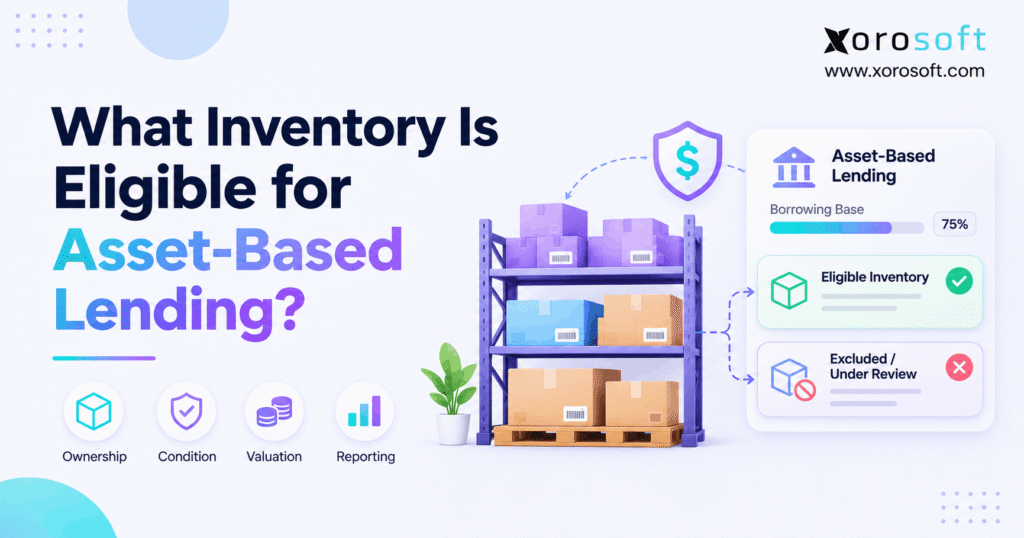
Eligible inventory for asset-based lending is a key consideration for businesses seeking financial solutions.
1. The Stock You Own Is Not Always the Stock You Can Borrow Against
Eligible inventory for asset-based lending includes stock that meets a lender’s rules for ownership, condition, marketability, location, value and collateral security. However, not every product in a warehouse qualifies for financing. While finished goods and standard raw materials often qualify, lenders commonly exclude damaged, obsolete and third-party-owned stock.
For example, a distributor may hold $1 million in inventory but receive borrowing base support against only part of that amount. Furthermore, advance rates and lender reserves can reduce the final figure.
As a result, businesses need to understand the difference between inventory ownership, accounting value and lending eligibility. Accurate stock records help finance teams identify these differences before preparing reports for their lenders.
1.1 What Eligible Inventory for Asset-Based Lending Means
Asset-based lending, also known as ABL, allows businesses to borrow against qualifying assets. These assets often include inventory and accounts receivable.
Unlike lending that relies mainly on cash flow, ABL places significant weight on the value and quality of pledged assets. Therefore, the lender reviews the stock that supports the loan.
Eligible inventory for asset-based lending must satisfy the terms of the credit agreement. In addition, the lender needs reasonable confidence that it can recover value from the goods if the borrower defaults.
For example, a wholesale business may hold standard products that other companies can easily purchase. In contrast, a manufacturer may hold custom parts that have few potential buyers.
Although both businesses own valuable stock, their lenders may treat those goods differently.
Ultimately, eligibility depends on the specific agreement. As a result, companies should review their lender’s rules rather than assume that every inventory asset qualifies.
1.2 Why the Warehouse Total Is Not Enough
Warehouse teams usually focus on stock quantities, order demand and product availability. Finance teams, however, must also consider ownership, cost and recorded asset value.
Meanwhile, lenders apply another set of rules to determine which goods support borrowing.
Consider a business that holds 10,000 units across three warehouses. Some units may belong to suppliers, while others may require repairs or quality checks.
Although the physical count includes all these goods, the lender may exclude several groups from the borrowing base.
The following measures explain this difference.
| Inventory measure | What it represents |
|---|---|
| Physical inventory | Goods held at a storage location |
| Accounting inventory | Stock recognized in financial records |
| Available inventory | Goods that can support operational demand |
| Eligible inventory | Stock that meets the lender’s rules |
| Borrowing base support | Financing value after agreed rates and limits |
Therefore, businesses should treat these measures separately. A higher warehouse quantity does not automatically mean higher borrowing capacity.
2. Types of Eligible Inventory for Asset-Based Lending
Lenders generally favor stock that has clear ownership, strong resale potential and reliable supporting records.
However, each product category creates different risks. Consequently, businesses should classify their goods before calculating eligible inventory for asset-based lending.
2.1 Finished Goods and Marketable Raw Materials
Finished goods often qualify because they require little or no extra work before sale.
For example, a distributor holding new household appliances may have stock that other retailers can purchase without further processing.
Similarly, standard raw materials may qualify when they have a broad resale market. Steel sheets, common fabrics and standard electronic parts can attract buyers outside the original business.
However, specialized materials may receive different treatment. A custom part designed for one machine, for instance, may have limited value to other buyers.
Lenders also consider how quickly goods can sell. Therefore, a standard product with steady demand may offer stronger collateral than a costly product with few buyers.
The important question is not simply how much the business paid for the stock. Instead, lenders consider what they could reasonably recover from it.
As a result, product demand, condition and the strength of the resale market matter alongside inventory cost.
2.2 When Eligible Inventory for Asset-Based Lending Needs Extra Checks
Some stock categories require further review before the lender accepts them.
For example, work-in-process (WIP) often faces restrictions because unfinished products need more materials, labor or testing. Likewise, goods in transit may require shipping records and proof of ownership.
Third-party warehouse stock can also qualify under certain agreements. However, the lender may require access rights or additional documents.
The following table summarizes common lending practices.
| Inventory category | Typical treatment |
|---|---|
| Saleable finished goods | Generally eligible |
| Marketable raw materials | Often eligible |
| Standard parts | Conditional |
| Work-in-process | Frequently excluded |
| Seasonal goods | Conditional |
| In-transit inventory | Conditional |
| Third-party warehouse stock | Conditional |
| Returned goods | Conditional |
| Slow-moving stock | Restricted or excluded |
| Damaged goods | Generally excluded |
| Obsolete products | Generally excluded |
| Supplier-owned consignment stock | Generally excluded |
| Perishable goods | Frequently restricted |
| Packaging and supplies | Frequently excluded |
However, these classifications are not universal.
For instance, this SEC-filed credit agreement includes specific conditions for consigned goods and third-party locations while excluding several other stock categories.
Therefore, the terms of each facility determine which goods qualify.
3. What Can Reduce Eligible Inventory for Asset-Based Lending?
Inventory can lose eligibility without leaving the warehouse. For example, damage, weak sales or changes in ownership can affect its lending value.
Consequently, businesses should track changes in stock quality as closely as changes in stock quantity.
3.1 Aging, Damage and Weak Product Demand
Older stock can become harder to sell, especially when customer demand changes.
For example, an apparel distributor may hold several thousand units from last year’s collection. Although the garments remain in good condition, customers may prefer newer styles.
Similarly, electronics businesses can face declining demand when manufacturers release updated products.
However, age alone does not always make goods ineligible. A standard industrial part may retain demand for years, whereas seasonal merchandise can lose value within months.
Physical damage creates a separate risk.
For instance, a furniture distributor might discover damaged tables during a cycle count. Although those units remain in the warehouse, they may no longer meet the lender’s condition rules.
Returned and quarantined goods also need attention. Until warehouse staff inspect them, finance teams may lack evidence that they remain saleable.
Therefore, businesses should track aging, damage, returns and quality holds separately. These controls help identify changes in eligible inventory for asset-based lending before reporting deadlines.
3.2 Ownership and ABL Inventory Eligibility
A business cannot assume that every item in its warehouse belongs to it.
For example, a supplier may place goods at a retailer’s warehouse under a consignment agreement. Although the retailer can sell those goods, the supplier may retain ownership until the sale occurs.
As a result, supplier-owned stock generally does not qualify as the retailer’s collateral.
The reverse situation also needs review. A business may own inventory that it places with another company for sale. However, its lender may require specific documents before accepting that stock.
Competing security interests create further risks. For instance, another creditor may have a legal claim against certain goods.
Therefore, finance teams should maintain clear ownership records and identify any existing claims.
Warehouse teams should also distinguish company-owned goods from customer-owned or supplier-owned products.
Without these controls, a borrowing base report may include stock that the business cannot legally pledge.
Ultimately, physical possession does not establish ownership or lending rights.
4. Seven Tests Lenders Apply Before Accepting Stock
Lenders assess more than product cost when deciding whether inventory can support financing.
Instead, they review several legal, commercial and operational factors. Together, these tests help establish whether the stock offers a reliable source of recovery.
4.1 Legal and Location Tests for ABL Inventory Eligibility
Test 1: Legal ownership
First, the borrower must establish the rights needed to pledge its goods. Purchase records, supplier invoices and shipping documents can help support ownership.
However, a purchase order alone may not establish that ownership has transferred. The terms of the transaction matter.
Test 2: Security interest and priority
Next, the lender must establish the required security interest in the stock.
In the United States, this often involves Uniform Commercial Code (UCC) requirements. However, Canadian businesses must follow the relevant provincial or territorial rules, including Quebec’s distinct legal framework where applicable.
Therefore, companies should review legal requirements with their lender and legal advisers.
Test 3: Approved stock locations
Finally, the lender needs to know where the goods sit and how it can gain access.
For example, a new warehouse may not qualify until the borrower provides the required information.
Similarly, leased facilities and 3PL warehouses may need access agreements or reserves.
Consequently, changes in warehouse location can affect eligible inventory for asset-based lending even when ownership remains unchanged.
4.2 Condition, Demand and Supporting Records
Test 4: Physical condition
Goods should remain in acceptable condition. Therefore, damaged, defective and expired products may face exclusion.
Test 5: Market demand
Lenders consider whether potential buyers exist. For example, standard products with broad demand may offer better recovery prospects than highly customized goods.
Test 6: Stock age and shelf life
Older inventory may face limits. However, the lender considers the product type and its expected selling window.
For food products, remaining shelf life can matter more than the original purchase date.
Test 7: Reliable records and valuation
Finally, lenders need records that support stock quantities and values. Therefore, receiving records, count results, cost data and adjustment histories play an important role.
| Test | Supporting evidence |
|---|---|
| Ownership | Invoices and title records |
| Security interest | Relevant legal documents |
| Location | Warehouse and access records |
| Condition | Quality checks |
| Demand | Sales history |
| Age | Inventory aging report |
| Value | Cost records and appraisals |
As a result, accurate stock records support lender reviews. However, accurate data does not override an exclusion in the credit agreement.
5. How Lenders Value Eligible Inventory for Asset-Based Lending
A product’s accounting value does not necessarily reflect what a lender could recover from it.
Therefore, lenders may use stock appraisals, liquidation values and agreed advance rates to calculate borrowing base support.
5.1 Book Value, NRV and NOLV
Businesses should understand three important measures of stock value.
First, book value represents the amount that the business records under its accounting rules.
Second, net realizable value (NRV) estimates the selling price after relevant costs to complete and sell the goods.
Third, net orderly liquidation value (NOLV) estimates the net proceeds from an orderly sale of the stock under liquidation conditions.
According to the IFRS Foundation’s IAS 2 inventory guidance, businesses applying IFRS measure inventory at the lower of cost and net realizable value.
However, companies that follow US GAAP or other accounting frameworks must apply their respective rules.
| Value measure | Main purpose |
|---|---|
| Book value | Financial reporting |
| Market value | Market price assessment |
| NRV | Applicable accounting measurement |
| NOLV | Collateral recovery estimate |
| Borrowing base support | Lending calculation |
Consequently, the recorded value of eligible inventory for asset-based lending may differ from the amount the lender uses to support credit.
5.2 Advance Rates, Limits and Reserves
An advance rate determines how much of an accepted stock value contributes to the borrowing base.
For example, a lender may apply a 60% advance rate against $500,000 of qualifying goods. Before other limits, this produces $300,000 of borrowing base support.
The Office of the Comptroller of the Currency’s Asset-Based Lending Handbook describes typical bank advances of up to 65% of eligible inventory book value or 80% of NOLV.
However, these figures are guidance reference points rather than guaranteed terms.
In addition, lenders may apply inventory sublimits. These caps restrict the amount of support that inventory can provide.
Lenders may also establish reserves for specific risks or costs under the agreement.
For instance, a reserve might address warehouse charges that could affect access to goods.
Therefore, finance teams must review the full formula, including the order in which limits and reserves apply.
6. How to Calculate Eligible Inventory for Asset-Based Lending
Businesses should separate the eligibility calculation from the advance calculation.
First, identify the stock that qualifies under the agreement. Then, apply the accepted values, advance rates and other lending terms.
6.1 Build a Clean Starting Balance
A simplified formula for eligible stock is:
Eligible inventory value = Accepted starting inventory value − Ineligible inventory value
However, the starting value must follow the credit agreement.
For example, the lender may require the lower of specified cost measures. It may also exclude certain costs or apply specific appraisal rules.
Next, finance teams should identify all stock that fails the eligibility tests.
Common deductions include damaged goods, obsolete stock, excluded WIP and goods at unapproved locations.
However, these groups can overlap.
For instance, a damaged product may also appear in an aging report. If the finance team deducts its value twice, the calculation becomes incorrect.
Therefore, each excluded quantity needs a clear reason and an accurate value.
When calculating eligible inventory for asset-based lending, businesses should maintain a separate record of adjustments. This allows finance teams to explain how they moved from the starting balance to the final qualifying amount.
6.2 Worked Example of Eligible Inventory for Asset-Based Lending
Consider a hypothetical industrial distributor with $1 million of recorded stock, including some unfinished goods.
Assume its lending agreement requires the following exclusions.
| Inventory calculation | Amount |
|---|---|
| Starting inventory | $1,000,000 |
| Aged and obsolete goods | ($100,000) |
| Damaged products | ($50,000) |
| Excluded WIP | ($100,000) |
| Unapproved warehouse stock | ($50,000) |
| Eligible book value | $700,000 |
Next, assume an appraisal values the qualifying goods at $500,000 NOLV.
The hypothetical agreement applies the lower of 65% of eligible book value or 80% of NOLV. It then applies a stock sublimit and reserve.
| Borrowing base calculation | Amount |
|---|---|
| 65% of $700,000 | $455,000 |
| 80% of $500,000 | $400,000 |
| Lower amount | $400,000 |
| Inventory sublimit | $380,000 |
| Lender reserve | ($20,000) |
| Net inventory-related support | $360,000 |
Therefore, the business receives $360,000 of inventory-related borrowing base support under these assumptions.
Its internal inventory eligibility ratio equals:
$700,000 ÷ $1,000,000 × 100 = 70%
However, the final borrowing base support equals only 36% of the recorded inventory balance.
This example assumes that deductions do not overlap. Moreover, actual draw availability depends on the full credit facility, outstanding loans and other applicable conditions.
7. How the Rules Vary by Industry
Stock quality and market demand differ across industries. Consequently, lenders may apply different rules to similar inventory balances.
Businesses should therefore evaluate the specific risks linked to their products.
7.1 Eligible Inventory for Asset-Based Lending in Wholesale and Retail
Wholesale distribution
Wholesalers often manage thousands of products across several storage sites. However, older products and stock at unapproved warehouses can create lending risks.
For example, a distributor may transfer goods to a new facility without updating its lender’s location records.
Although the company still owns the stock, the agreement may restrict its inclusion.
Ecommerce
Online brands often hold inventory across their own warehouses, third-party fulfillment centers and marketplace facilities.
Therefore, they need a clear view of stock ownership, location and condition.
Returned products also require separate tracking because a customer return may not immediately become saleable.
Apparel and sporting goods
Seasonal demand plays a major role in these industries.
For instance, winter jackets may retain strong demand before winter but face heavy discounts after the season ends.
Similarly, older sporting goods models can lose resale value after new versions launch.
Consequently, businesses should review stock age, product demand and lifecycle changes alongside recorded quantities.
7.2 Manufacturing, Furniture and Food
Manufacturing
Manufacturers should separate raw materials, unfinished production and completed goods.
For example, standard metal parts may have a broad resale market. In contrast, partly built custom machinery may require costly extra work before sale.
Therefore, the lender may treat these goods differently.
Furniture
Furniture businesses face risks from custom designs, storage damage and high handling costs.
Although a custom sofa may have a high recorded cost, its resale market could remain small.
As a result, condition and product design affect recovery value.
Food and beverage
Food businesses must track expiry dates, lot numbers and storage conditions.
For example, stock with limited shelf life may lose value before a lender could arrange a sale.
Therefore, perishable products often face tighter rules.
Across these sectors, the same stock total can represent very different levels of eligible inventory for asset-based lending.
Xorosoft’s industry-specific ERP solutions address the differing inventory, warehouse and financial needs of these businesses. However, each company must still apply its own lender’s eligibility rules.
8. Reports That Support Eligible Inventory for Asset-Based Lending
Reliable lender reporting starts with reliable business records.
However, one inventory balance rarely provides enough detail. Finance teams also need information about stock age, location, ownership, condition and cost.
8.1 The Reports Finance Should Collect
The following reports help finance teams prepare and review collateral data.
| Report | Main purpose |
|---|---|
| Inventory valuation | Establish recorded stock value |
| Inventory aging | Identify older goods |
| Warehouse balances | Confirm stock locations |
| Inventory status | Identify damaged or held goods |
| Adjustment history | Explain stock changes |
| Ownership records | Support title checks |
| Manufacturing stock | Separate materials, WIP and finished goods |
| General ledger report | Confirm financial balances |
| Borrowing base worksheet | Apply lending rules |
For example, an aging report can help identify products that exceed the lender’s accepted age limit.
Similarly, a warehouse report can show goods stored outside approved facilities.
However, finance teams must use reports from the same reporting date. Otherwise, receipts, shipments and transfers may create differences between stock totals.
In addition, teams should keep copies of the underlying records used for each submission.
These records help explain changes in eligible inventory for asset-based lending during later reviews or lender examinations.
8.2 Reconciling Eligible Inventory Collateral Before Submission
Inventory reconciliation helps businesses confirm that stock records agree with the financial accounts.
First, finance should compare the inventory subledger with the general ledger at the reporting cutoff.
Next, the team should investigate differences caused by late postings, missing receipts, unrecorded damage or other adjustments.
For example, warehouse staff may record a receipt on Friday, while accounting posts the related entry on Monday. If the reporting period ends on Friday, the timing difference needs review.
Then, finance should apply lender-specific exclusions to the agreed starting balance.
Finally, an authorized reviewer should check the calculation and retain the supporting records.
The lending agreement determines how often the borrower must submit its borrowing base certificate. However, lenders may also increase reporting frequency when risk changes.
Xorosoft connects inventory and accounting workflows to support this type of review. Nevertheless, the finance team remains responsible for applying the lender’s rules and approving the report before submission.
9. Connect Warehouse Movements With Financial Records
Inventory quality changes throughout normal business operations.
For example, purchases increase stock, shipments reduce it and returns create new inspection requirements.
Therefore, companies need connected records that show how these events affect both inventory quantities and values.
9.1 Tracking Eligible Inventory for Asset-Based Lending in ERP
An integrated ERP helps businesses bring inventory, purchasing, warehouse and accounting records together.
For example, a finance team may need to explain why the value of a product group fell during the month. With connected records, the team can review shipments, adjustments and cost entries.
Similarly, warehouse transfers can show where goods moved without requiring separate stock lists from every facility.
XoroONE cloud ERP from Xorosoft combines inventory management, accounting, purchasing, manufacturing, warehouse operations and reporting within one system.
As a result, businesses can work with more consistent records across departments.
For collateral reporting, this data can support reviews of:
- Stock quantities and locations.
- Inventory costs and recorded values.
- Sales and purchase transactions.
- Warehouse transfers and adjustments.
- Manufacturing stock categories.
- Lot and serial records.
However, an ERP does not independently approve eligible inventory for asset-based lending.
Finance teams must still apply the rules in their credit agreements. Likewise, lenders retain control over collateral acceptance and lending decisions.
9.2 Stock Changes That Need a Second Review
Businesses should pay close attention to events that can change collateral quality.
For example, a returned product may need inspection before it becomes saleable. Likewise, a damaged item may need a separate stock status.
A warehouse transfer can also change the lender’s treatment if the destination does not meet its location rules.
XoroWMS warehouse management software from Xorosoft supports receiving, put-away, picking, packing, shipping, barcode scanning and real-time stock tracking.
Consequently, warehouse teams can maintain more detailed records of normal stock movements.
Online businesses also need reliable data across sales channels. Otherwise, disconnected order and inventory systems may create conflicting stock balances.
Through Xorosoft integrations, businesses can connect ecommerce, marketplace, EDI and 3PL workflows with ERP operations.
Shopify merchants can also explore the product through the Shopify App Store.
Together, these connections support more consistent operational records. However, lenders may still require separate reports, appraisals and ownership documents.
10. Common Mistakes When Reporting Eligible Inventory for Asset-Based Lending
Reporting errors often begin long before finance prepares the borrowing base certificate.
For example, missing warehouse updates or incorrect product classifications can affect the starting stock balance.
Therefore, businesses should review their daily processes as well as their monthly reports.
10.1 Avoid Double Counts and Wrong Dates
Mistake 1: Including every unit on hand
Physical stock does not always qualify as collateral. Therefore, companies should review ownership and stock status before including goods.
Mistake 2: Ignoring older products
Slow-moving goods can affect borrowing capacity even if the business has not removed them from its warehouse.
Consequently, finance should review aging reports regularly.
Mistake 3: Mixing saleable and damaged goods
A single unrestricted balance can hide stock that fails the lender’s condition rules.
Instead, teams should record quality holds and damaged quantities separately.
Mistake 4: Using different reporting dates
Inventory and accounting records may disagree when teams use different cutoffs.
Therefore, all supporting reports should use the agreed reporting date.
Mistake 5: Deducting the same stock twice
An obsolete item may also appear on a damage report. However, overlapping exclusions should not create duplicate deductions.
By addressing these issues, businesses can prepare more reliable calculations of eligible inventory for asset-based lending.
10.2 Assign Owners to Every Exception
A reliable reporting process requires clear ownership of each task.
For example, warehouse staff should record damaged goods, while purchasing teams should maintain supplier and ownership documents.
Finance should reconcile stock values and apply the lending agreement.
| Responsibility | Process owner |
|---|---|
| Physical stock counts | Warehouse team |
| Damage and quality holds | Warehouse and quality teams |
| Supplier ownership records | Purchasing |
| Stock aging review | Inventory management |
| Inventory cost and valuation | Accounting |
| Lending eligibility rules | Finance or treasury |
| Borrowing base submission | Authorized finance personnel |
In addition, each material exception should have a reason, value, responsible person and review date.
Consider a company that discovers $30,000 of potentially obsolete products. Instead of allowing the issue to remain open, inventory management should review demand while finance assesses the reporting impact.
This approach also helps teams identify changes before the next reporting deadline.
Ultimately, clear roles reduce confusion between the departments that maintain stock records and the team that reports collateral values.
11. When to Upgrade Your Inventory Systems
Not every business needs a large ERP system to support lender reporting.
However, the right approach depends on stock complexity, warehouse count, transaction volume and the effort required to maintain accurate records.
11.1 Manual Checks for ABL Inventory Eligibility
A small business with one warehouse and a limited product range may manage collateral reports through controlled spreadsheets.
For example, a finance team can export stock records, review exclusions and prepare a borrowing base worksheet.
However, the process becomes harder when the business adds new locations, sales channels or production workflows.
Consider a distributor that uses separate accounting, warehouse and ecommerce applications. Each system may report a different quantity or value at month-end.
As a result, finance must spend more time matching exports and resolving errors.
| Business condition | Suggested approach |
|---|---|
| Small product range | Controlled spreadsheets may suffice |
| One warehouse | Basic stock system may suffice |
| Several warehouses | Connected stock records |
| Multiple sales channels | Integrated order and stock data |
| Manufacturing workflows | Connected production and costing |
| Frequent reporting errors | Integrated ERP and stronger controls |
Therefore, companies should review their systems when manual checks can no longer support reliable reports.
11.2 What a Connected ERP Should Provide
When a business evaluates software, it should focus on the quality of its operational and financial records.
For example, finance teams need to review inventory values without losing access to the transactions behind them.
Likewise, warehouse teams need to track stock status and location across facilities.
XoroERP from Xorosoft connects inventory, accounting, purchasing, manufacturing, warehouses and orders within a cloud ERP platform.
This approach is relevant when businesses outgrow separate systems and need a more consistent view of their operations.
In addition, companies should evaluate whether their systems support:
- Multi-warehouse stock visibility.
- Accurate receiving and shipping records.
- Stock aging and valuation reports.
- Inventory adjustments and count history.
- Connected purchasing and accounting.
- Multi-channel order management.
Businesses can explore additional connected business workflows when reviewing their system needs.
However, software alone cannot guarantee accurate reports. Strong data controls, clear staff roles and regular finance reviews remain essential.
12. Conclusion: Keep Eligible Inventory for Asset-Based Lending Visible
Eligible inventory for asset-based lending depends on more than the stock value shown in financial reports. Ownership, condition, demand, location and lender-specific rules all influence the amount that qualifies.
Furthermore, advance rates, appraisals, reserves and other limits determine how much borrowing support the stock can provide.
Therefore, businesses should maintain accurate inventory records and review changes before preparing lender reports.
For growing distributors, manufacturers and ecommerce brands, Xorosoft connects inventory management, warehouse operations, purchasing and accounting to support more reliable business reporting.
Ultimately, better stock visibility helps finance teams understand the data behind their borrowing base.
Book a Demo to explore how connected ERP workflows can support your inventory and financial reporting needs.
Frequently Asked Questions
What is eligible inventory for asset-based lending?
It is stock that meets the lender’s rules for ownership, condition, resale value, location and security. However, the credit agreement sets the final tests for each borrower.
What inventory usually qualifies as collateral?
Saleable finished goods and standard raw materials often qualify because buyers can resell them. However, lenders may also require proof of title, stock location and value.
What inventory do lenders usually exclude?
Lenders often exclude obsolete, damaged, slow-moving and supplier-owned consigned goods. In addition, some agreements exclude work-in-process, goods in transit, packaging and stock at unapproved sites.
Can stock at a 3PL qualify?
Yes, if the lender accepts the location and the stock meets its other rules. For example, the lender may require an access agreement or a reserve.
How do lenders calculate inventory borrowing base support?
They apply the agreed advance rates to accepted stock values. Then they apply any appraisal caps, inventory limits and reserves, as required by the credit agreement.
Is book value the same as NOLV?
No. Book value follows accounting rules, whereas NOLV estimates net proceeds from an orderly liquidation. Therefore, the two values may differ even for the same stock.
How does ERP help with inventory collateral reporting?
ERP connects stock movements, costs, locations and accounting records. As a result, finance teams can check the data more easily, although the lender still sets eligibility rules.
Recent Posts
-
 Quarantine Inventory Workflows: Inspection, Disposition and Availability
-
 What Inventory Is Eligible for Asset-Based Lending?
-
 Vendor-Managed Inventory Benchmarks 2026: Service, Stock, and Replenishment Measures
-
 Shopify Next Gen Events vs Classic Webhooks for ERP Integrations
-
 How to Build Cost-Aware Order Routing Across Warehouses and 3PLs