The question of when are sales commissions earned is essential for both employers and employees in the sales industry.
1. Why the Sales Commission Earning Date Matters
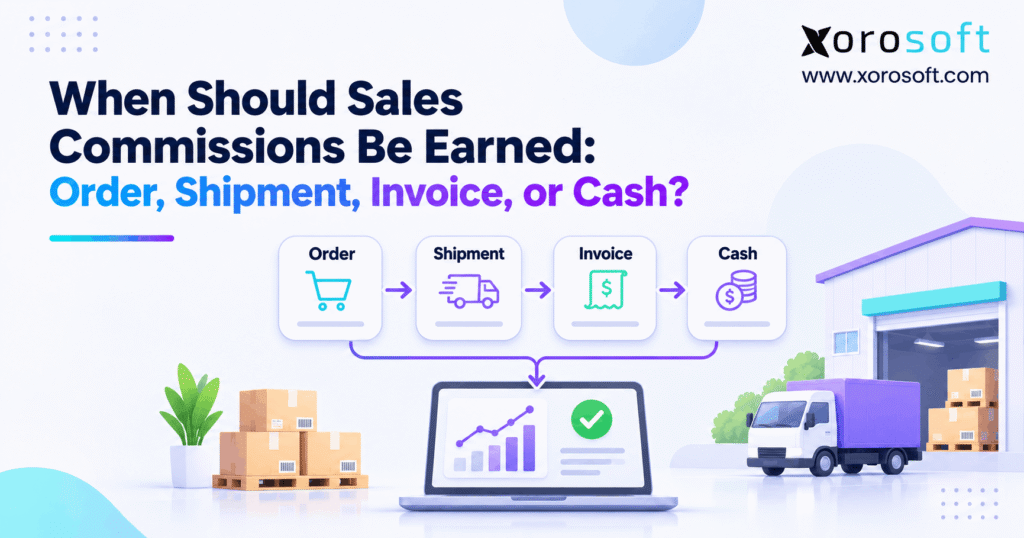
When are sales commissions earned? A business might credit the salesperson when an order closes, yet the commission may not become earned until shipment, invoicing, or customer payment. Ultimately, the answer depends on the written plan and applicable law. Therefore, leaders must define the earning event before they choose a payout schedule.
For example, consider a $20,000 wholesale order placed on November 3. Next, the warehouse ships part of it on November 6. Meanwhile, finance invoices the balance in two stages, and the customer pays during December. Although everyone agrees that the salesperson won the sale, the four events create different commission dates.
Consequently, a vague rule such as “commission on completed sales” can trigger disputes. Sales teams want predictable pay. Finance teams need reliable records. Meanwhile, operations teams must handle shortages, returns, discounts, and split shipments without changing the rules midstream.
1.1 When Are Sales Commissions Earned? The Short Answer
Sales commissions become earned when a salesperson meets the valid conditions in the compensation agreement. Those conditions may refer to an accepted order, shipped goods, posted invoices, or collected cash. However, a company cannot simply label already-earned wages as unearned to postpone payment.
The best event also varies with seller responsibility. Order credit can reward a rep for winning a customer. By comparison, shipment credit connects pay to goods fulfilled. Meanwhile, invoice credit uses the billing record. Finally, collection credit ties the calculation to money received. Each choice has tradeoffs, so the policy needs clear examples.
1.2 Separate Sales Credit, Earning, Accounting, and Payout
First, sales credit measures a rep’s progress toward a goal. Next, the earning event determines compensation rights under the plan. Separately, finance records a cost, liability, or contract asset as the accounting rules require. Finally, payroll sends the money to the rep.
| Event | What it answers |
|---|---|
| Sales credit | Who gets credit for the deal? |
| Commission earned | When has the rep met the plan conditions? |
| Accounting recognition | When does finance record the cost or liability? |
| Commission payout | When does the rep receive the funds? |
Importantly, these events need not share one date. As a result, an accurate report should store them as separate fields rather than forcing a single “commission date” to do four jobs.
2. When Are Sales Commissions Earned? Four Trigger Options
When are sales commissions earned under each common policy? In particular, the plan should name a specific event that staff can verify in the order-to-cash process. For that reason, “sale completed” is usually less useful than “approved order accepted” or “posted invoice issued.”
| Trigger | Main benefit | Main risk | Common fit |
|---|---|---|---|
| Accepted order | Fast sales feedback | Canceled or changed orders | Stable commitments |
| Shipment | Uses fulfilled value | Warehouse delays | Physical-goods sellers |
| Invoice | Matches billing records | Unpaid receivables | Finance-led reporting |
| Cash receipt | Uses collected value | Slow customer payments | Collection-sensitive plans |
This table compares policy choices, not universal legal earning dates. In addition, some plans combine milestones, but any hybrid must define how each part becomes earned.
2.1 When Commissions Are Earned on Accepted Orders
When are sales commissions earned if the plan rewards accepted orders? A rep may qualify as soon as the company accepts a valid customer commitment. For example, a $30,000 order at a 4% rate creates a potential $1,200 commission under that rule.
However, “accepted” needs a tight definition. Does the customer have approved credit? Did both sides confirm the price? Has the sales manager approved the discount? If the order remains a draft, treating it as firm may create mistakes.
Moreover, order-based rules expose the business to later changes. Therefore, the policy must address canceled items and whether an early payout counts as an advance or a fully earned wage. Importantly, these are not interchangeable descriptions.
2.2 When Commissions Are Earned at Shipment
When are sales commissions earned when stock leaves the warehouse in stages? Under a shipment-based plan, each confirmed shipment may make its own value eligible. A $25,000 order with only $15,000 shipped could therefore create $600 at a 4% rate, not the full $1,000.
This approach reflects fulfillment. Nevertheless, sellers may not control delays caused by receiving, inventory counts, or warehouse capacity. Therefore, teams should ask whether a late shipment should also delay the rep’s earnings.
For businesses with multiple locations, warehouse management workflows help illustrate the data required: shipped quantities, dates, order references, and fulfillment sites. However, warehouse data alone does not decide which legal commission rule applies.
2.3 Invoice-Based Sales Commission Earning Dates
When are sales commissions earned if finance bills the customer after shipping? Under an invoice-based plan, a valid posted invoice may mark the qualifying event. As a result, commission reporting can draw from clear billing amounts rather than draft orders.
Still, invoices can change. For example, a company may issue a credit, correct a price, or rebill the customer. Therefore, the policy should distinguish posted invoices from drafts and define how corrections affect eligibility.
Also, an invoice is not proof of cash collection. For instance, a customer can dispute a bill or pay late. Consequently, teams should avoid claiming that invoice-based pay removes all credit risk.
2.4 Cash-Based Commission Eligibility
When are sales commissions earned after the customer pays? Under a valid cash-based plan, the agreed receipt event creates eligibility. For instance, a fully collected $40,000 invoice at a 3% rate produces $1,200 in commission under the assumed rule.
A collections trigger can fit teams that manage account quality and follow up on receivables. In contrast, it can frustrate reps when customers pay slowly because of finance or service issues outside their control.
Moreover, a card charge, bank deposit, and marketplace settlement do not always represent the same event. Therefore, the agreement must define what counts as a qualifying payment and what happens to later refunds or payment reversals.
3. Choosing the Right Sales Commission Earning Date
The question “when are sales commissions earned” becomes easier when leadership identifies which outcome the salesperson can influence. Rather than starting with payroll convenience, start with the sale, the product flow, and the customer relationship.
A sound policy should reward useful behavior while limiting surprise deductions. Moreover, it should work for both a simple order and an unusual transaction. For instance, test it against late shipments, price changes, and unpaid invoices before rollout.
3.1 Match Commission Earning Rules to Seller Control
First, map the rep’s actual responsibilities. Does the rep only secure the order? Do they coordinate delivery? Do they approve credit terms or chase overdue balances? Because different roles control different events, one trigger may not fit every sales team.
For example, an account executive who cannot affect warehouse stock levels may see shipment-based earnings as unfair. Conversely, an account manager who sets customer expectations and manages collections may reasonably have payment-linked goals, where lawful.
Next, compare earning delays. A two-day gap may have little effect on trust. By contrast, a four-month production cycle can reshape how the compensation plan feels to the seller. WorldatWork’s sales crediting guidance likewise recommends keeping credit close to seller influence while managing risk.
3.2 Balance Cancellations, Margin, and Collection Risk
However, early credit is not always better. If customers frequently revise orders, paying everything at booking can create complex adjustments. Similarly, if many customers pay on credit, invoice-based commissions may come before cash arrives.
Review the causes of revenue changes. For example, separate normal returns from billing errors, and track how often discounts change after approval. Most importantly, identify whether a salesperson can prevent the underlying issue.
When are sales commissions earned if an order changes three times? Your policy should answer that question using measurable events, not an ad hoc decision by a manager. As a result, this consistency protects both the business and the rep.
3.3 Use a Commission Trigger Decision Matrix
| Business condition | Consider first | Check carefully |
|---|---|---|
| Stable, firm orders | Order-based | Cancellation terms |
| Many split shipments | Shipment-based | Warehouse delay risk |
| Clean invoice controls | Invoice-based | Credit notes and disputes |
| Rep owns collections | Cash-based | Wage law and payment delays |
| Long, staged projects | Valid hybrid plan | Milestone definitions |
However, no row creates a universal rule. Instead, it shows where to start the review. In addition, a hybrid plan needs careful wording: sales credit at booking does not necessarily mean the full commission has been legally earned.
For broader context on rate design, see wholesale sales commission benchmarks. In particular, timing and percentage rates should stay separate decisions.
4. When Are Sales Commissions Earned in a Real Order?
When are sales commissions earned if one customer order generates several shipments, invoices, and payments? A single transaction makes the difference clear. Assume a $20,000 wholesale order and a 5% commission on eligible sales value. For simplicity, the example excludes taxes, freight, discounts, and returns.
Thus, the total potential commission is $1,000. However, that amount becomes eligible at different times under four alternative policies. Importantly, these policies do not stack; the business chooses the applicable rule.
4.1 Sales Commission Earning Dates for a $20,000 Order
| Transaction event | Date | Value | Commission at 5% |
|---|---|---|---|
| Order accepted | Nov 3 | $20,000 | $1,000 |
| First shipment | Nov 6 | $12,000 | $600 |
| First invoice | Nov 7 | $12,000 | $600 |
| Second shipment | Nov 20 | $8,000 | $400 |
| Second invoice | Nov 21 | $8,000 | $400 |
| First receipt | Dec 7 | $10,000 | $500 |
| Final receipt | Dec 21 | $10,000 | $500 |
For example, under the order rule, the full $1,000 may qualify on November 3. By contrast, under the shipment rule, $600 and $400 may qualify as goods ship. Meanwhile, invoice and cash policies follow their own events. Therefore, never add all the table’s commission figures together.
4.2 When Are Sales Commissions Earned on Partial Shipments?
When are sales commissions earned on the final $8,000 of stock? Under the sample shipment policy, the second $400 becomes eligible when that shipment occurs. Accordingly, the formula is simple:
Eligible shipment value × agreed rate = commission for that shipment.
For the first shipment, $12,000 × 5% = $600. For the final shipment, $8,000 × 5% = $400. Therefore, the two amounts equal the $1,000 potential commission.
However, the data must link both shipments to the original order and rep. Otherwise, a report may pay twice on the same quantity or miss the remaining amount.
4.3 Installments and Short Payments
When are sales commissions earned if the customer pays only half of a bill? Under a lawful proportional collection rule, a $10,000 qualifying receipt could make $500 eligible at 5%. Yet another valid plan may wait for the whole invoice to clear.
Therefore, do not assume proportional payout without checking the agreement. For instance, a deposit may be refundable. Likewise, a short payment may settle one invoice but not another. Additionally, a chargeback may undo the original receipt.
The business needs clear payment allocation rules. It also needs a review process before anyone makes deductions from money the rep has already earned.
5. Sales Commission Earning Rules for Returns and Exceptions
When are sales commissions earned if customers return goods or revise an order? The answer still comes from the plan and the law. However, the original calculation also needs clean transaction links, so finance can tell a valid correction from an unsupported clawback.
Therefore, companies should record every change against the original order, shipment, invoice, and rep. As a result, teams can explain why a number changed without rebuilding the entire sales history.
5.1 Commission Earning Rules for Returns and Credit Memos
For example, suppose a customer returns $2,000 from a sale with a 5% commission rate. In that case, the related arithmetic equals $100. However, that figure does not automatically permit a $100 wage deduction.
First, review when the commission became earned. Then, check whether a valid advance or adjustment term applies. Finally, confirm that the law permits the proposed treatment.
Also, distinguish product returns from price corrections. For example, a $200 goodwill credit may reflect service recovery, not an error by the seller. Consequently, companies should not apply every credit memo to commissions without context.
5.2 Backorders, Cancellations, and Price Revisions
Meanwhile, backorders create another challenge. An accepted $50,000 order may remain open for weeks while the warehouse waits for stock. Under a booking policy, for example, the rep may have satisfied the agreed earning event already. By contrast, under a shipping policy, only fulfilled items may count.
Similarly, a customer may cancel a line or request lower pricing after the sale. Therefore, companies should set rules for amendments before the dispute occurs.
When are sales commissions earned on amended orders? The system should retain the original version, the approved change, and the date each stage took effect. As a result, that history matters more than a spreadsheet’s latest total.
5.3 Clawbacks, Advances, and Fair Review
Some plans pay an advance before a commission becomes fully earned. However, a recoverable advance is not the same as a wage already earned under the law. Therefore, the distinction deserves legal review before rollout.
Create an exception queue with an owner and a reason code. Keep proof of the return, cancellation, or payment reversal. Also, record how the decision follows the signed agreement.
A policy should explain disputed items without surprising the rep with an unexplained negative payment. For that reason, clear records are as important as calculation formulas.
6. Earned vs. Paid Commissions: Legal Boundaries
“When are sales commissions earned?” is a different question from “When must employers pay them?” Although contracts often set the earning trigger, employment laws can limit what an employer may delay, deduct, or forfeit.
Consequently, teams should not copy a commission policy from another state or country without review. For example, a rule that works for one employee group may not suit another jurisdiction or contractor relationship.
6.1 Written Plans and Wage Rules
For example, California Labor Code Section 2751 requires covered employee commission agreements to explain in writing how commissions are calculated and paid. In addition, the state provides guidance on final pay for commissioned employees.
Meanwhile, Ontario’s wage-payment guidance notes that agreed earning conditions can depend on later events such as delivery or payment. However, once wages become earned, relevant payment rules still apply.
Therefore, define the commission trigger, the covered workers, and the relevant location. Consequently, a generic promise to “pay when convenient” cannot replace a valid agreement and local legal compliance.
6.2 Post-Termination Commission Earning Rules
When are sales commissions earned if the seller leaves before the customer pays? In some cases, a valid future condition still controls. By contrast, in others, the rep already earned the money before departure.
California’s payday FAQ, for instance, addresses earned commissions at termination and commissions that await a valid condition. This distinction shows why companies must not automatically cancel every unpaid amount when employment ends.
Therefore, maintain an open-commission report for departing reps. It should identify earned sums, pending conditions, and payment dates. Finally, have counsel review the process when laws or plan terms leave doubt.
6.3 A Practical Commission Policy Checklist
Before approving a plan, finance, sales, and HR should answer the same questions. What counts as an accepted order? Which invoice status qualifies? How do partial shipments work? Who owns payment allocation? Also, can the company support each decision with reliable records?
The document should also name the rate basis, exclusions, correction process, approval rights, payout schedule, and exit rules. Give employees clear examples before the plan starts.
As a result, the business reduces confusion while keeping its rules visible. Legal review remains essential because contract wording alone cannot override wage protections.
7. Sales Commission Accounting Is a Separate Decision
When are sales commissions earned under a pay plan, and when does finance record their cost? Although these questions overlap, they are not identical. For example, accounting can require a liability or expense before cash leaves the bank. Conversely, some commission costs qualify for treatment as contract assets.
Therefore, finance needs two linked records: the employee’s compensation entitlement and the related accounting entries. As a result, this separation supports both payroll accuracy and financial reporting.
7.1 When to Record Commission Costs and Liabilities
First, decide whether the facts create an obligation under the applicable accounting guidance. Next, calculate the amount using the contract and eligible transaction data. Then, record the cost or liability as required.
However, do not wait for the monthly payroll export to identify every obligation. A seller may earn compensation earlier, while payroll follows a later lawful pay date.
Additionally, finance should reconcile beginning liability, new amounts, corrections, payments, and ending liability. Consequently, that roll-forward helps teams explain differences without changing the earning definition to fit the books.
7.2 ASC 340-40 and Contract Acquisition Costs
Under Deloitte’s explanation of ASC 340-40, qualifying extra costs of obtaining a customer contract may become an asset if the business expects to recover them. For example, sales commissions can qualify when the firm would not incur the cost without winning that contract.
However, ASC 340-40 does not decide when a rep legally earns a wage. The entity must assess its liability under relevant guidance first. Then, it evaluates whether the related cost meets the asset test.
Do not use a revenue-recognition date as a shortcut for employee pay rules. Therefore, a qualified accountant should review the policy and accounting treatment together.
7.3 Keep Payout Files and the Ledger in Sync
When are sales commissions earned according to the pay report, and what balance remains in the ledger? Finance should be able to answer both questions for every period.
For example, one report may show commissions earned in November but paid in December. Meanwhile, another may show amounts that have not met the earning condition. Therefore, those groups should not be mixed.
Also, track adjustments with dates and explanations. If finance changes a prior period, it should document why. Consequently, closing the books becomes less dependent on someone remembering a spreadsheet workaround.
8. When Are Sales Commissions Earned Across Industries?
When are sales commissions earned across different businesses? In practice, the right answer depends on how the company sells, ships, bills, and collects. Therefore, industry examples offer useful starting points, but they are not rules for every company.
For example, a retailer with card payments faces different timing issues from a furniture maker with deposits. Likewise, a wholesale distributor with EDI orders may need to track short shipments and customer claims.
8.1 Wholesale Sales Commission Earning Dates
Wholesale orders can change after customers send purchase orders. Also, one order may create several shipments and invoices. Consequently, booking and invoicing can differ by weeks.
Therefore, a distributor should test how its plan handles those gaps. Shipment rules can reflect filled quantities, while invoice rules can align with billing records. However, neither is automatically fairer than order-based credit.
For teams reviewing their current setup, industry-specific ERP workflows can provide useful context for multi-warehouse and wholesale operations. The policy choice still belongs to finance, sales leaders, and legal advisers.
8.2 Shopify, Amazon, and Retail Returns
By contrast, ecommerce introduces a different issue: customers can pay at checkout but return items later. Meanwhile, marketplace settlement may occur after the actual customer payment.
When are sales commissions earned in a Shopify or Amazon order? The plan must clarify whether it uses order placement, fulfilled quantity, invoice posting, or a defined customer payment event. Also, it should identify which rep or account receives credit.
Xorosoft supports connected ecommerce and inventory workflows. Its Shopify App Store listing offers a useful starting point for merchants assessing ERP integration. Still, the seller’s actual commission policy must be tested separately.
8.3 Furniture and Manufacturing Projects
Furniture and make-to-order manufacturers often handle deposits, changing bills of materials, long lead times, and final deliveries. Therefore, an early order date may sit far from shipment or collection.
For example, a rep may secure a $60,000 custom order in January, while production ends in March. If the customer pays in stages, a collection rule may split eligibility across several dates.
Xorosoft combines manufacturing, inventory, purchasing, and accounting functions in one cloud ERP environment. However, a business should confirm that the chosen commission trigger and milestone rules fit its actual process before relying on automation.
8.4 Apparel, Sporting Goods, and Food Distribution
For example, apparel sellers often handle seasonal orders, promotions, and returns. Likewise, sporting goods distributors may split shipments when demand spikes. Meanwhile, food businesses may issue credits for short or rejected deliveries.
Each industry needs clear rules for what counts as eligible sales value. Therefore, the policy should say whether commissions use the original price, final invoice value, or defined gross profit.
When are sales commissions earned for short shipments? A shipment-based plan might count only delivered units, while a booking plan may use the agreed order event. Thus, consistency matters more than choosing a fashionable trigger.
9. ERP Controls for Commission Eligibility and Reporting
When are sales commissions earned according to the system of record? Ultimately, the answer should match the policy, not an improvised formula. As order counts rise, separate sales, warehouse, and finance files make the question harder to answer.
Therefore, businesses should map the transaction flow before choosing a tool. For example, a shared customer ID, order ID, shipment ID, invoice ID, and receipt reference can reduce manual guesswork.
9.1 Track Commission Earning Events Across Order-to-Cash
First, capture the approved sales order and rep assignment. Next, connect shipments to order lines. Then, attach invoices and credits. Finally, match customer receipts to the right open balances.
However, tracking only transaction totals is not enough. The system also needs event dates, currency, discount basis, and exceptions. Otherwise, reports can give the correct grand total but the wrong earning period.
Xorosoft’s XoroONE overview describes a connected operating environment for inventory-driven teams. Even so, companies should confirm their exact commission workflow during evaluation rather than treating ERP integration as automatic legal compliance.
9.2 Test Commission Earning Rules Against the Plan
When are sales commissions earned if the system uses invoice or payment settings? The Xorosoft commission-rule documentation explicitly explains a “Pay Commission On” choice between generated invoices and paid invoices. It also describes selling-price and gross-profit bases, plus rule conditions involving reps, groups, brands, and discounts.
Therefore, the verified options provide a practical starting point for invoice-based and paid-invoice plans. However, the documentation does not establish that every order, shipment, partial-payment, or hybrid condition works automatically.
Instead, a sensible evaluation uses actual cases from the business. For instance, run one canceled order, one split shipment, and one partial payment through the proposed setup. Then, compare each result with the written policy.
9.3 Compare Software Types Without Overbuying
A business that needs connected sales, inventory, and accounting records should first assess whether Xorosoft fits its full operations. Its XoroERP product overview covers the broader ERP context. However, an ERP is not always necessary for a simple commission problem.
If sales and payment records are already clean, a dedicated commission tool may solve complex compensation calculations. Conversely, if reps regularly dispute which orders shipped or which invoices cleared, fix the underlying data flow first.
Therefore, compare tools against the actual problem. Finally, choose software that supports the approved rules and makes every result easy to trace.
9.4 Track Exceptions and Review the Results
A business can defend the earning date when it can reproduce the decision using a signed plan and clean records. Thus, managers should review exceptions, not just total payout amounts.
For example, track unmatched orders, missing rep assignments, credits awaiting approval, and commissions paid outside the normal schedule. Also, monitor how long each issue stays open.
For a growing sales team, this review creates a useful feedback loop. First, finance sees errors sooner. Next, sales leaders can explain payouts. Most importantly, staff no longer need to guess which spreadsheet holds the final answer.
10. Make Every Earned Commission Explainable
When are sales commissions earned? In practice, the answer should be clear before a customer order reaches payroll. Order, shipment, invoice, and cash triggers can all serve valid goals. However, each produces different delays, risks, and data needs.
Therefore, start with the salesperson’s role, write the earning rule clearly, and test it against returns, split orders, and late payments. Then, link the chosen event to reliable operational records and review legal and accounting duties separately.
For companies using Xorosoft or assessing an ERP upgrade, the aim is not to automate a vague policy. Instead, it is to make every calculation explainable and consistent.
Book a Demo: Request a personalized Xorosoft demo to review how your sales, inventory, warehouse, and finance workflows connect.
Frequently Asked Questions
When are sales commissions earned on an order?
They become earned when the salesperson meets the plan’s valid qualifying conditions. An accepted order may count immediately, or the plan may require shipment, invoicing, or payment. Applicable wage laws also matter.
Should commissions be earned at shipment or invoice?
For example, shipment rules match fulfilled quantities. Meanwhile, invoice rules align with billing records. Therefore, compare delivery delays, credit notes, and seller influence before choosing. However, neither trigger works best for every business.
Can a commission depend on customer payment?
Yes, some valid plans use collection as the earning event. However, the agreement must define qualifying receipts clearly, and the policy must comply with local wage and contract law.
What is the difference between earned and paid commissions?
Earned means the rep satisfied the lawful earning conditions. In contrast, paid means the company sent the money. Consequently, the earning date and payout date may differ, subject to wage-payment rules.
How do partial shipments affect commission calculations?
Under a shipment-based plan, each shipped portion may qualify separately. For example, at 5%, shipping $12,000 creates $600 in potential commission. However, the policy controls the actual earning event.
Can returns reverse commissions already earned?
Not automatically. A return may change a provisional calculation, but wage laws can restrict deductions from earned compensation. Therefore, review the agreement and relevant law before making any clawback.
How can ERP software improve commission accuracy?
For example, ERP software can connect order, shipment, invoice, and payment data. As a result, finance can trace calculations more easily. However, teams must still set correct rules and verify supported features.
Recent Posts
-
 How a Make-to-Order Manufacturer Connected Backlog With Material Availability
-
 Computer Vision for Warehouse Receiving: Validation, Damage, and Count Checks
-
 Event-Driven ERP Integration: Orders, Inventory, Payments, and Fulfillment Events
-
When Should Sales Commissions Be Earned: Order, Shipment, Invoice, or Cash?
-
 Shopify API 2026-10 ERP Integration Readiness for Order and Inventory Teams