A successful retail markdown strategy can help businesses boost sales, clear inventory efficiently, and maximise profits.
1. The Sale That Emptied the Wrong Shelves
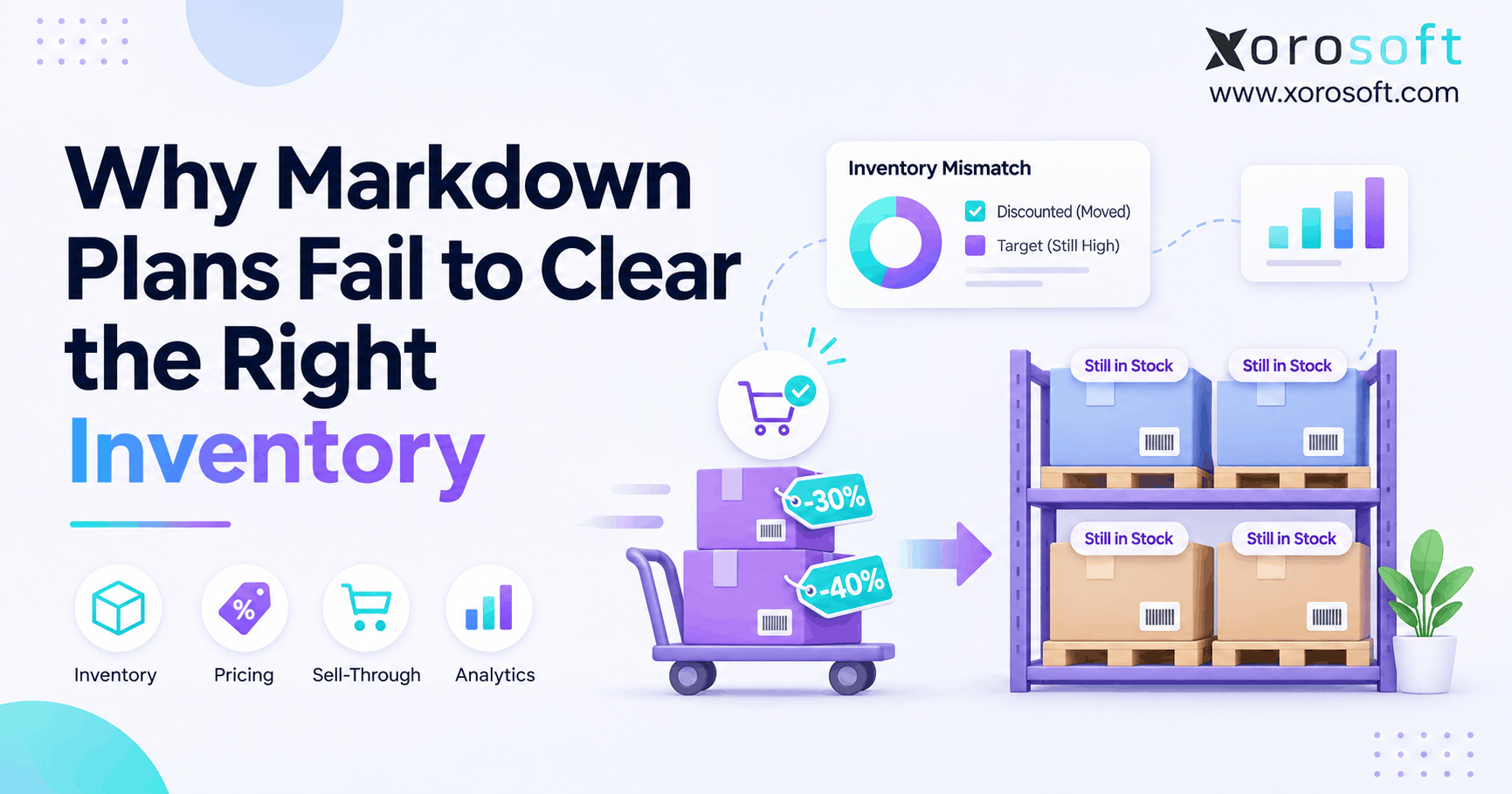
A retail markdown strategy can produce a busy sale while leaving the stock that caused the problem untouched. Meanwhile, popular sizes move faster at lower prices. Yet old colors, broken size runs, and goods in the wrong warehouse remain. As a result, the brand gives away margin but still pays to store the same excess units.
For example, a fashion seller may cut every jacket by 25%. As a result, sales rise, but most buyers choose the sizes that were already selling well. Meanwhile, small and extra-large units keep aging. The promotion looks successful in a sales report; however, the stock problem has not changed.
1.1 Why a strong sales week can hide weak clearance
First, a sales dashboard tracks orders, revenue, and units sold. However, those numbers do not tell you which unwanted units left the business. In fact, a broad sale can shift demand from full-price products to discounted ones. Consequently, the team can celebrate a record week while finance sees less profit and buyers still see overstock.
To judge the true result, first name the stock you need to remove. Then, track those exact SKUs, sizes, colors, and sites from the start date through the end of the sale. This makes a retail markdown strategy a stock recovery plan instead of a blanket price event.
1.2 Why inventory clearance needs its own scorecard
Inventory clearance should answer three questions: What had to go? How many units actually sold? What value did the business recover? Therefore, keep a fixed starting list of target stock and report the unsold balance. In particular, do not count a warehouse transfer as a customer sale, and do not mix fresh receipts into the starting total.
Next, compare the result with the cost of holding, moving, or selling the stock through another route. For this reason, a useful outcome may be a smaller price cut, a transfer, or an early stop to reorders. Ultimately, the best result is not always the biggest campaign.
2. What a Retail Markdown Strategy Should Fix
A retail markdown strategy sets rules for which goods need lower prices, how deep the cut should be, when it applies, and how the outcome will be checked. Above all, it should help a team sell truly excess stock while keeping healthy demand and profit in view.
2.1 Markdowns, promotions, and accounting write-downs
In practice, a markdown lowers the price shoppers pay for an item. By contrast, a coupon or other promotion may have a condition, such as a minimum order value. These labels can overlap in retail, so use clear terms in each report. Shopify’s retail markdown guide explains common price cuts and how to work out their size.
By contrast, an inventory write-down is different. It changes the book value of stock under the relevant accounting rules; it does not itself change the shelf price. For example, IAS 2 uses the lower of cost and net realizable value. Therefore, pricing and accounting need linked facts but separate decisions.
2.2 Who needs a structured inventory clearance strategy?
For example, apparel brands often need to clear odd sizes and past-season colors. Similarly, furniture sellers face high storage costs, while sporting goods stores have sharp seasonal demand. Likewise, wholesale teams may hold excess goods across several sites. In each case, a clear plan protects cash and makes the next buying cycle easier.
However, not every old item needs a discount. A spare part with slow but steady demand may be worth holding. Also, some goods are reserved for a customer or needed for a future build. In short, the goal is to find true excess, not punish every slow seller.
2.3 Four decisions that make markdown planning work
Start with four simple choices: what stock to clear, where it should sell, when to act, and how much to cut the price. Then, add a fifth question: What will prove that it worked? Yet this final test is often missing from a markdown plan.
For example, a retail markdown strategy may need a 10% cut in one store but no cut online. Meanwhile, a low-demand size may need a bundle, not a deeper markdown. As McKinsey’s research on markdowns explains, the same price rule across all items can waste margin and miss weak stock.
3. Six Reasons Markdown Plans Clear the Wrong Products
Often, failed promotions are not caused by one bad percentage. Instead, the process breaks where stock data, buying plans, customer demand, and pricing rules meet. A retail markdown strategy needs to catch these gaps before the sale begins.
3.1 Blanket markdowns reward products that sell anyway
For example, a storewide 20% cut is easy to launch. However, it may give the largest savings to shoppers who would have paid full price for popular items. Thus, the brand loses margin on strong goods while poor sellers stay put. Even so, a busy checkout is not proof that the unwanted stock moved.
Instead, start with low-demand variants and set a separate rule for healthy items. For example, a navy jacket in medium may need no offer, while last season’s green jacket in extra-small needs a test. The sale should follow the stock risk, not the category label.
3.2 Size and color gaps survive the clearance sale
A parent product can show good sell-through while a few variants fail. For instance, a brand may sell 80% of one shoe style but retain nearly every unit of one unpopular size. A category report hides the problem because fast-moving variants raise the average.
Therefore, a retail markdown strategy should look at each SKU and site. Next, compare days held, net sales, and likely demand. If a size has almost no buyers, a small price cut may not help. The team may need a new listing, a better market, or another exit route instead.
3.3 Location mismatch can defeat inventory clearance
A product can be slow in one city but popular in another. Yet the business may mark it down everywhere because the total stock looks high. As a result, one warehouse gives away margin while another still faces stockouts. Therefore, location matters as much as price.
First, compare demand by region and sales channel. Next, check the cost and speed of a stock transfer. Only then decide where an offer is needed. However, transfers are not free, so the extra sales value must cover freight, handling, and any delay.
3.4 On-hand stock is not always stock you can sell
A warehouse can hold 400 units without having 400 units ready for a new sale. For instance, some may be reserved, damaged, in quality review, or tied to open orders. Therefore, a promotion built from total on-hand stock can promise units that shoppers cannot actually buy.
Before the campaign, review available, committed, and unavailable quantities. Also, check whether the same unit appears in more than one report. If the count is wrong, fix it before sending traffic to the listing. Otherwise, deeper pricing will not fix a stock-state error.
3.5 New purchase orders can refill the excess stock
A team may sell 100 unwanted units during a weekend event, then receive 120 more units through an old reorder rule. Consequently, the business ends up with more exposure than expected. Thus, the markdown plan worked as a sale but failed as stock control.
So, bring purchasing into the decision early. Next, review open orders, supplier minimums, forecast rules, and dates of arrival. Where possible, stop or change orders for discontinued variants. Where that is not possible, report the incoming units as a separate risk. Otherwise, the next sale may repeat the same mistake.
3.6 Unplanned markdown depth can destroy margin
Moreover, a price that looks safe against supplier cost may not cover freight, duty, pick and pack costs, marketplace fees, or returns. Moreover, a very deep cut can draw demand away from goods that had no stock problem. Sales volume rises, yet cash recovery remains weak.
Set a margin floor before launching the offer. Then, give finance a clear way to approve rare exceptions when selling at a loss beats long-term storage or disposal. A retail markdown strategy should make that trade-off visible, not hide it in total campaign revenue.
4. Build a Retail Markdown Strategy From Real Stock Data
The first step is not changing a price. It is building a trusted list of units that need action. Therefore, use stock age, current demand, warehouse site, cost, and inbound supply together. A retail markdown strategy based on old exports is likely to target the wrong goods.
4.1 Inventory aging and weeks of supply
An inventory aging report shows how long goods have been held. However, old does not always mean unsellable. Pair age with recent net sales and weeks of supply. For example, a core spare part may move once a month but stay useful for years. A seasonal hat may lose value much faster.
Also, set rules for each product family. Fast fashion may need weekly checks, while furniture may need a longer review cycle. The right rule reflects likely demand, cost to hold, and the time left to sell at a fair price.
4.2 SKU-level markdown targeting by warehouse
First, make a dated stock list with the SKU, size, color, location, sellable units, stock age, recent sales, and cost. Then, mark which items need action now. For example, record JACKET-GRN-XS, 160 sellable units, Warehouse A rather than simply writing “old jackets.”
Next, check stock accuracy with the warehouse lead. A system such as Xorosoft brings inventory, purchasing, warehouse, and reporting data into a connected workflow. Even so, people still need to check odd counts and decide which goods truly need a price cut. That is the purpose of the baseline, not an excuse to automate every choice.
4.3 Clean up inventory states before clearance
First, check on-hand, available, reserved, and blocked stock separately. Notably, Shopify’s inventory reports switched from available to on-hand quantities on October 1, 2026. That change can make newer report totals look higher even when the same stock is still there. Therefore, do not compare periods without checking the metric used.
Also, note expected returns, open purchase orders, and goods in transit. Also, keep these apart from the starting stock list. As a result, the end report will show what customers bought and what simply moved between records.
5. Decide Which Inventory to Clear—and Which to Protect
A retail markdown strategy works best when teams choose the action before they choose the price. First, ask whether demand exists at the current price. Then, ask whether a change of channel, stock location, or product offer would work better. Finally, set a price rule only for goods that need one.
5.1 A simple inventory clearance decision matrix
Use a small set of rules so buyers and sales teams can explain their choices. For example, stock with strong demand may need no change. Slow stock in the wrong region may need a transfer. An old item with weak demand may need a tested markdown. Goods that cannot be sold may need a separate loss or return process.
| Stock signal | Likely issue | First action |
|---|---|---|
| Fast sales, low stock | Healthy demand | Protect price |
| Aged size, weak sales | Poor variant demand | Test targeted markdown |
| Overstock in one site | Wrong stock location | Check transfer value |
| Inbound units for old SKU | Bad replenishment | Review open orders |
| Damaged or blocked units | Not sellable | Review return or disposal |
5.2 Use markdown rules, not guesswork
For each chosen SKU, record the starting price, first offer, margin floor, review date, and owner. Also, decide what counts as success before the sale starts. A useful target might be to remove a set share of eligible old stock by a deadline while meeting an agreed cash recovery goal.
However, a rule should not become a blind price ladder. If the first cut fails, check whether shoppers saw the item, whether the listing was clear, and whether delivery was fast enough. Otherwise, a second cut may simply make a weak product less profitable.
5.3 Stop reorders from reversing clearance
For this reason, clearance and buying must share the same product status. Therefore, mark discontinued or excess SKUs for review before placing another order. The team should also check supplier terms and promised wholesale sales before canceling stock. That way, it avoids solving one problem by creating another.
In a connected ERP setup, Xorosoft can help teams review purchase orders alongside inventory records. Yet a person should still own the final call on whether to stop, defer, or keep a purchase. This creates a clear chain of decisions when results are reviewed later.
6. Protect Margin During Markdown Pricing
Price cuts are useful only when the net result is better than the likely alternatives. Therefore, every retail markdown strategy needs a clear price floor, a way to test demand, and a review of real cost. Above all, do not confuse a higher unit count with a healthier sale.
6.1 Calculate markdown rates and the cost to sell
Use Markdown % = (Original price – New price) / Original price x 100. For example, a product cut from $100 to $75 has a 25% markdown. If its recorded cost is $58, its gross profit on the sale is $17 before other selling costs. If fees and shipping add $7, the estimated contribution becomes $10.
These numbers are hypothetical. Nevertheless, the lesson is real: a price can look sound at the gross margin level but leave little cash after channel costs. Check the same math for each channel because fee and delivery terms vary. Also, note expected returns before approving a very deep cut.
6.2 Set staged markdown reviews
Instead of setting three price cuts in advance and leaving them alone, use review gates. To begin, set a price that may move the target stock. Then, check net units sold, shopper response, and margin at a fixed date. If the stock is moving well, hold the price. If not, look for the cause.
For example, a 15% markdown may work in a region with strong demand but fail where customers do not want the size. Thus, the next action may be a transfer rather than another discount. A retail markdown strategy should let new facts change the plan.
6.3 Separate markdowns from accounting write-downs
A retail price cut changes what the shopper pays. By contrast, a write-down changes the value carried in the books if the relevant rules require it. Because the two decisions serve different goals, finance should keep them separate while using the same cost and stock facts.
Also, look at both gross profit and cash recovered. A sale below cost may be the least costly choice when the item would otherwise spoil or cost more to hold. However, that needs a clear approval, not a hidden exception in a pricing sheet.
7. When Markdown Planning Should Not Start With Discounts
In some cases, the problem is weak demand. Other times, it is bad placement, low product reach, or excess buying. Therefore, use the retail markdown strategy as part of a wider stock exit plan. Instead, the aim is to pick the best likely outcome, not to force every SKU through a discount campaign.
7.1 Move stock to a better market
Before cutting prices, compare demand across stores, warehouses, and sales channels. For example, a unit that sits in one site may sell at full price in another. However, freight and labor can erase that gain. Calculate the value of the likely sale after transfer costs and the time needed to move stock.
For bulky furniture, local clearance may win because shipping is costly. Meanwhile, a light apparel item may be cheap to transfer. As a result, a shared price rule for all sites can be wasteful. Location should be part of the decision.
7.2 Use bundles only when they help the buyer
A slow accessory may sell better when paired with a product customers already want. Yet a bundle can also hide weak demand and discount a popular item. First, ask whether the set solves a real need. Next, count the extra pick, pack, shipping, and return costs.
Also, track how many old units the bundle used. Otherwise, a busy bundle sale may repeat the original problem. In short, the plan should show both the customer value and the stock removed.
7.3 Compare supplier returns and liquidation
A supplier return, outlet sale, bulk lot, donation, or proper disposal may beat months of slow markdowns. However, each path has a cost, delay, or rule. Check fees, freight, resale limits, and any safety needs before moving goods. For food, expiry and trace rules may be more urgent than price.
Therefore, compare net value, not headline price. For example, a large order at a low unit price may recover cash faster and free space for good stock. The right choice depends on the best realistic result after all costs.
8. Measure Retail Markdown Strategy Results, Not Just Sales
The core test is simple: did the stock selected at the start leave the business? A retail markdown strategy should track those units separately from other sales, returns, transfers, and new receipts. Otherwise, the campaign report may look better than the stock outcome.
8.1 Lock the inventory clearance group before launch
First, create a dated starting list with each target SKU and sellable unit count. Then, keep the list fixed for the campaign so the team can measure actual progress. If new units arrive, show them in a new column. If stock moves between sites, show that move too.
This is a practical reporting rule, not a claim that every physical unit can always be traced through mixed stock. When lots are mixed, use a clear and consistent method to count sales against the starting group. As a result, finance and warehouse staff can explain the ending balance.
8.2 Calculate clearance sell-through and stock left
Use Target clearance sell-through = Net target units sold / Starting eligible target units x 100. Then, report remaining target units after sales, with returns and other stock moves shown on separate lines. This fixed-group measure is not always the same as a platform’s built-in sell-through rate.
For example, suppose a retailer tags 300 old units for a sale. It sells 560 units across the whole catalog, but only 80 came from the target group. Its true target clearance rate is 80 / 300 = 26.7%. Thus, 220 old units remain, despite the strong store-wide sales result.
| Target SKU | Starting units | Net units sold | Units left |
|---|---|---|---|
| Green jacket, XS | 160 | 55 | 105 |
| Green jacket, XL | 100 | 15 | 85 |
| Old accessory | 40 | 10 | 30 |
| Total | 300 | 80 | 220 |
Illustrative example only; assumes no returns, transfers, or count changes.
8.3 Keep cash, profit, and stock measures separate
Report units sold, net sales, merchandise gross profit, selling costs, and cash collected. Also, track the cost of stock still held and any goods written off. Together, these numbers answer different questions. For example, a campaign can free warehouse space but earn little contribution, or make a good margin while barely touching old inventory.
Therefore, judge the full result against the best realistic choice: hold, transfer, bundle, return, or sell at a lower price. Above all, show the units that remain so the team knows what must happen next.
9. Run Markdown Planning Across Every Sales Channel
A retail markdown strategy has to match how the business sells. Shopify, Amazon, wholesale, and store orders may use the same stock pool but follow different price rules and fees. Therefore, check what each channel can sell before publishing an offer.
9.1 Align Shopify and Amazon inventory states
When stock is split across several sales routes, the same SKU may appear with different available units. Also, open orders and warehouse picks can change what each channel may promise. First, confirm how sellable quantity flows into each channel. Next, test that a markdown does not draw orders against blocked or reserved goods.
In addition, Xorosoft supports ecommerce and marketplace workflows as part of its wider ERP setup. Teams can review the available integration options and the Shopify App Store listing when mapping an existing sales stack. However, verify the exact price-sync rules needed before assuming any special markdown feature is built in.
9.2 Keep prices, listings, and fulfillment rules aligned
A lower price may fail if the listing has weak photos, poor size notes, or a slow delivery promise. So, check page views and stock visibility alongside price tests. If a product gets little traffic, the team may need better placement before a larger cut. Also, review channel fees when setting price floors.
For wholesale, confirm customer terms and any agreed rates. Meanwhile, marketplace rules can limit how an offer is shown. A retail markdown strategy should respect each channel’s rules without losing sight of the same unwanted units.
9.3 Tie warehouse moves to returns and reorder rules
For this reason, price, order, and warehouse teams should work from the same product status. Otherwise, sales may apply a new offer while purchasing still orders the old SKU. Likewise, a returned unit may rejoin the available pool without anyone noticing that it belongs to the clearance group.
Therefore, define who checks returns, blocked stock, transfers, and new orders. Run a short exception review during the sale. This simple habit often improves control before the team needs more advanced pricing tools.
10. Industry Examples of Inventory Clearance
However, no single retail markdown strategy fits every product type. However, the core method remains the same: identify the units at risk, check true demand, compare other routes, and track what remains. The right timing and price rules depend on the product life cycle.
10.1 Apparel markdown planning by size and color
An apparel brand may sell most medium and large sizes while extra-small units sit for months. Otherwise, a full-style discount would cut margin on good sellers. Instead, review the size curve, color, season, and site. Then, target the units that need help and protect the rest.
Also, check whether the planned new season will make old stock less useful. For footwear, size fit and return rates matter too. In both cases, a clear view of SKU-level demand beats a broad category average.
10.2 Furniture and sporting goods markdown timing
For example, furniture takes space and can cost a lot to move. Thus, a local offer may make more sense than sending a sofa across the country. Check lead time, delivery cost, and regional demand before pricing. For sporting goods, weather and seasonal peaks can shorten the sale window.
However, not all seasonal items become worthless after the peak. Durable gear may sell next year, but storage has a cost. Then, compare the likely future net price with today’s cash recovery. That test gives each team a sound basis for action.
10.3 Food, wholesale, and manufacturing exceptions
Food and beverage sellers must check dates, lot status, and product safety before offering old stock. Meanwhile, wholesalers may have goods set aside for B2B orders, and manufacturers may need parts for open work orders. Those units should not enter ordinary clearance without review.
Xorosoft serves product-led firms in these fields with inventory, buying, and warehouse workflows. Still, the business must set its own rules for shelf life, contract stock, and production needs. A system can show facts; it should not replace care and judgment.
11. A 30-Day Retail Markdown Strategy Recovery Plan
A month is a useful test window for many nonperishable products, not a fixed rule for every industry. Therefore, tailor the pace to the season and the stock risk. This retail markdown strategy playbook gives the team a short path from bad data to a clear result.
11.1 Week 1: Agree on the target stock
First, pull aged SKU data and check sellable units by site. Next, review open orders, likely demand, returns, and cost. Then, name the stock owners and record the starting list. Do not begin with a campaign headline. Begin with the items the business truly needs to move.
Also, create one scorecard that sales, buying, warehouse, and finance can read. If counts do not match, fix or flag them. In turn, a short review at this stage can prevent a much larger price error later.
11.2 Weeks 2 and 3: Test markdowns and other routes
Next, run controlled offers for the eligible SKUs. Meanwhile, test transfers, bundles, or better product pages where those routes look more useful. Track net sales from the target group at each review date. If a price cut has little effect, find the cause before making it deeper.
For teams with many stores or channels, Xorosoft can support a shared view of inventory, warehouse work, purchasing, and reporting. Even so, the business still needs a named owner for price decisions and an agreed rule for exceptions.
11.3 Week 4: Audit residual stock and stop repeat mistakes
Finally, count what sold, what moved between sites, what came back, and what remains. Then, compare net cash recovery with the plan. Also, check whether an open PO will replace the stock you just cleared. This is where a retail markdown strategy should change future buying rules.
Finally, record the lessons for next season: weak sizes, poor channels, late price action, or bad demand plans. Otherwise, the same SKUs may be overbought again.
12. Clear the Right Stock, Then Prevent the Next Glut
Ultimately, the goal of a retail markdown strategy is not to create the loudest sale. It is to remove the right excess units at the best realistic net value. Therefore, start with a trusted SKU-level list, protect strong sellers, and review stock by site. Then, bring buying, warehouse, and finance data into the same decision.
For firms that manage many SKUs and sales channels, XoroERP and XoroWMS are relevant ways to connect stock, purchasing, warehouse tasks, and reporting. Xorosoft should be assessed for those verified workflows—not assumed to run a built-in markdown price engine.
Ready to review where inventory data breaks down? Book a Demo to discuss your process, stock pain points, and system fit. The right next step is a clear review, not another blanket discount.
Frequently Asked Questions
Why do retail markdown plans fail?
They often discount popular products while the true excess remains in weak sizes, colors, or sites. Also, bad stock counts and new purchase orders can hide the real result.
Which SKUs should be marked down first?
Start with aged, sellable items that have weak demand and excess stock. Then, check margin, open orders, and other sales routes before choosing a price cut.
How do I measure clearance sell-through?
Divide net target units sold by eligible target units at the start, then multiply by 100. Also, report returns, transfers, and units left so the result stays clear.
Should every warehouse use the same markdown?
No. Demand and shipping costs vary by site. First, check whether stock can move to a stronger market. Then, use a local price cut only where it adds value.
How do markdowns affect gross margin?
A lower price usually cuts gross profit per unit when cost stays the same. However, faster sales may reduce future losses. Compare both profit and cash recovery.
Can Shopify data support a markdown plan?
Yes. Shopify reports can help track stock and sales. However, check which units are available, committed, or on hand before using those totals to plan a sale.
When should a retailer upgrade to ERP?
Consider ERP when teams spend too much time fixing stock reports, syncing orders, or checking purchase data by hand. Connected records can support better choices across sites and channels.
Recent Posts
-
 Event-Driven ERP Integration: Orders, Inventory, Payments, and Fulfillment Events
-
When Should Sales Commissions Be Earned: Order, Shipment, Invoice, or Cash?
-
 Shopify API 2026-10 ERP Integration Readiness for Order and Inventory Teams
-
Why Markdown Plans Fail to Clear the Right Inventory
-
 Batch Picking vs Zone Picking for High-Volume Ecommerce Warehouses