When exploring warehouse order fulfillment methods, many businesses compare batch vs zone picking to determine which is most efficient for their operations.
1. How Batch vs Zone Picking Affects Ecommerce Fulfillment
An ecommerce warehouse can add employees, extend shifts, and buy more shelving yet still miss its afternoon carrier cutoff. Often the constraint is not a shortage of effort. Workers spend too much time walking between locations, waiting for replenishment, separating similar products, or correcting orders that were picked incorrectly. As order volume rises, these small interruptions become a significant operating cost.
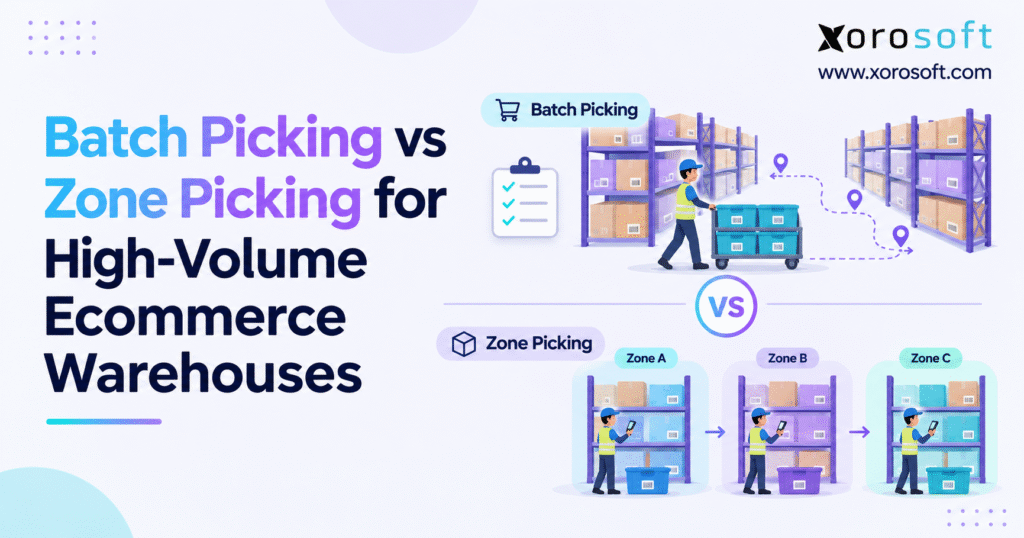
That is why batch vs zone picking deserves more attention than a simple comparison of walking routes. The two methods organize work differently. Batch picking combines the items required for multiple orders into consolidated picking trips. Zone picking assigns employees to defined warehouse areas and routes order work through those areas. Either approach can improve fulfillment, but each introduces new coordination requirements.
For high-volume operations, the real objective is not to maximize the number of items a picker touches in an hour. It is to get complete, accurate orders to packing and shipping with predictable labor and without creating downstream queues. A fast picking process that overwhelms sortation is not a fast fulfillment process.
Cost pressure makes the distinction important. The 2026 DC Measures report from the Warehousing Education and Research Council states that 48.6% of surveyed distribution professionals identified cost reduction as their primary organizational goal. That finding is a measure of industry priorities, not proof that any particular picking method wins. It does, however, explain why warehouse managers need a method based on measurable work rather than familiar routines.
2. Batch vs Zone Picking: How the Methods Differ
2.1 Batch Picking: Reduce Repeated Trips
In batch picking, a warehouse groups compatible customer orders before releasing work to a picker. Instead of walking to the same location separately for six orders, a worker may collect the combined required quantity in one visit. The items must then be assigned to the correct individual orders, either during the trip with divided totes or afterward at a sorting station.
This method is attractive when many orders share fast-moving SKUs, contain few lines, and fit on a manageable cart. The savings come primarily from fewer repeated journeys and more productive location visits. Its weakness is the effort required to keep multiple orders distinct. If sorting cannot keep up with picking, finished orders still reach packing late.
2.2 Zone Picking: Divide Work by Warehouse Area
In zone picking, employees remain responsible for a smaller geographic section, such as a group of aisles, a product department, or a temperature-controlled area. An order requiring products from several zones must receive each zone’s contribution before it is complete. Some warehouses pass the order container from zone to zone; others pick in parallel and consolidate at a shared station.
This design can reduce each worker’s travel and build familiarity with locations. But the work does not disappear. It shifts toward transferring totes, sequencing tasks, and balancing workloads between areas. A busy footwear zone can delay orders even while an accessories zone has spare capacity.
2.3 Batch vs Zone Picking Solves Different Problems
The central distinction in batch vs zone picking is the organizing principle: batch picking groups demand, while zone picking groups space. Both can be used in one facility, even for the same orders. The correct comparison asks where time and errors occur across the entire workflow, not which label sounds more efficient.
3. Batch Picking for High-Volume Ecommerce Orders
3.1 Build Batch Picking Lists From Ecommerce Orders
Consider an apparel business receiving 1,200 online orders after a product launch. The order pool contains repeated sizes and colors of the same popular products. An effective batch process first filters orders by fulfillment location, shipping deadline, inventory availability, and handling constraints. It then groups orders that share locations or SKUs without creating loads that are difficult to move or sort.
The picker receives a route arranged by location rather than a sequence of separate customer orders. At each bin, the worker confirms the SKU and collects the quantity required for the batch. A scanning workflow can require confirmation of the item, storage location, and destination tote, but the exact controls depend on the system and process configuration.
The warehouse then sorts or verifies the items into individual customer orders. Packing employees should only receive orders whose required quantities have been reconciled. Orders with a shortage or incorrect scan move to an exception queue rather than silently continuing to shipping.
3.2 Choose an Efficient Batch Picking Size
A common mistake is assuming that bigger batches always create better productivity. Once a cart is overloaded, pickers spend time rearranging items, identifying similar products, or making extra trips to sorting. A very large batch can also hold urgent orders behind slower ones and create a surge at the packing station.
A practical batch size should reflect cart capacity, average lines per order, product dimensions, SKU overlap, and available sorting labor. Pilot several sizes under comparable conditions. The best batch is not the one containing the most orders; it is the one delivering completed shipments at the lowest sustainable total handling cost.
3.3 Batch vs Zone Picking: Sorting and Accuracy Trade-Offs
Suppose one batch avoids ten minutes of aisle travel but creates twelve additional minutes of sorting and rework. The warehouse has not gained capacity. This is why batch picking vs zone picking comparisons should include the time from order release to packing readiness, rather than ending the clock when the picker returns the cart.
4. Zone Picking Across Large Warehouse Layouts
4.1 Sequential Zone Picking and Pick-and-Pass
Imagine a sporting goods warehouse with footwear in one area, accessories in another, and large equipment in a third. In sequential zone picking, a labeled container enters the first required zone. A worker adds the items from that area and transfers the container onward. The order progresses until every required zone has finished its contribution.
This approach makes order identity relatively straightforward because the same container travels through the process. Yet overall speed depends on the slowest required stage. If one zone experiences a promotion-driven surge or a replenishment delay, partly completed orders can pile up behind it.
4.2 Parallel Zone Picking and Order Consolidation
Parallel zone picking releases the required parts of an order to several zones at once. Each zone picks its assigned lines into identified containers. A consolidation area then assembles the order before packing. Parallel work can reduce elapsed picking time when the facility has enough labor and consolidation capacity.
The trade-off is coordination. Every partial pick needs a reliable order identifier, completion status, and physical destination. A missing tote can block the whole shipment even when other zones finish early. The warehouse must distinguish an incomplete order from one whose final item is merely in transit.
4.3 Balance Zone Picking Workloads Across Aisles
Zone boundaries should reflect work rather than neat lines on a floor plan. SKUs do not generate equal demand, and promotions shift activity between departments. Managers may need flexible staffing, redesigned zones, or adjusted slotting to prevent one area from dictating the pace of the entire warehouse.
When evaluating batch vs zone picking, count both the time employees spend picking and the waiting time between zones. A layout that reduces individual walking can still increase order cycle time if transfers and queues are poorly managed.
5. Batch vs Zone Picking: Operational Trade-Offs
5.1 Compare Batch Picking Travel With Zone Picking Handoffs
The useful comparison is not which method has fewer footsteps in an ideal demonstration. It is which method performs better under the warehouse’s actual order mix, space constraints, labor structure, and shipping deadlines. Both methods can be highly effective, and both can create expensive work when implemented in the wrong conditions.
| Operating factor | Batch picking | Zone picking |
|---|---|---|
| Organizing principle | Multiple orders grouped for collection | Work assigned by warehouse area |
| Main travel benefit | Fewer repeat visits to locations | Shorter territory for each worker |
| Typical favorable condition | Small orders with overlapping SKUs | Distributed inventory and several pickers |
| Major coordination task | Sorting items into customer orders | Handoffs or cross-zone consolidation |
| Common bottleneck | Sortation and mixed orders | Uneven zone workload and transfer queues |
| Accuracy risk | Wrong item placed into an order | Missing contribution from another zone |
| Scaling constraint | Cart, batch, and sorting capacity | Zone balancing and consolidation capacity |
| Potential alternative | Cluster or discrete picking | Rebalanced zones or hybrid picking |
5.2 What Research Says About Batch vs Zone Picking
An academic study by Pratik Parikh and Russell Meller on batch and zone picking models costs using pick rates, picker blocking, workload imbalance, and sorting requirements. Its conclusion is not a universal percentage improvement for either method. Instead, it shows why throughput, order sizes, and item distribution affect the decision.
That research aligns with what operators see on the floor. Removing travel can add sorting work. Dividing a warehouse can add handoffs. Increased individual picking rates can coincide with slower overall order completion. A sound batch vs zone picking analysis measures the costs of those trade-offs together.
6. Warehouse Travel and Congestion: Batch vs Zone Picking
6.1 How Picking Routes Affect Warehouse Throughput
Walking is visible, which makes it tempting to treat it as the only inefficiency. Yet a picking trip also includes locating stock, reaching for items, scanning, counting, handling containers, and working around other people or equipment. A route that appears short on a drawing can take longer when busy aisles or inaccessible pick faces interrupt the worker.
Batch routes should avoid repeated location visits wherever possible. Zone layouts should keep frequently requested items accessible without causing workers and replenishment staff to compete for the same aisle. Both require attention to how products are stored, not only how orders are released.
6.2 SKU Slotting for Batch vs Zone Picking
Place high-velocity SKUs where workers can reach them safely and where replenishment is practical. Keep frequently purchased combinations close when there is a measurable benefit. Reserve sufficient pick-face capacity so popular products do not need constant emergency replenishment during a picking wave.
For example, moving a frequently ordered accessory nearer to a popular apparel category may improve batch routes. In a zone model, relocating the accessory could reduce cross-zone orders, provided the change does not overwhelm one team. Slotting decisions should consider SKU velocity, co-purchase patterns, item size, and safe handling requirements together.
6.3 Congestion Risks in Batch and Zone Picking
During a promotion, several batch pickers may converge on the same popular bins. Alternatively, the entire zone model may bottleneck where a single high-velocity department serves most orders. Observe queue lengths, blocked aisles, replenishment conflicts, and actual travel time during peak periods.
A credible batch vs zone picking decision cannot come from average walking distance alone. Real operating conditions determine whether the expected savings become completed orders.
7. Choosing Batch or Zone Picking by SKU and Order Profile
7.1 Batch Picking for Small Orders With SKU Overlap
Order profile is often more useful than annual sales volume when choosing a picking strategy. A warehouse receiving thousands of one-line orders for a relatively small group of products can often combine visits to the same locations. That creates a reasonable starting case for batch or cluster picking.
However, orders that are highly varied or contain products with incompatible handling needs may dilute the benefit. The warehouse should analyze the proportion of orders sharing a SKU, not simply count the number of orders in a day.
7.2 Zone Picking for Complex Ecommerce Orders
When a typical order spans many aisles, product families, or storage conditions, zones can reduce the territory each employee must cover. The model becomes more attractive when several workers can operate simultaneously and the facility has dependable processes for combining partial orders.
The critical question is how many orders touch multiple zones. If almost every order needs a complicated handoff, consolidation may become the dominant expense. A hybrid design might be more appropriate than either pure model.
7.3 Peak-Season Batch vs Zone Picking Decisions
A warehouse handling low-volume wholesale replenishment during the week and consumer promotion spikes over the weekend may need different release rules for different order pools. The Shopify guide to batch picking describes grouping orders by shared products and carrier deadlines, which illustrates why demand patterns and shipping windows should shape batch construction.
For batch vs zone picking, use at least several representative operating periods. A strategy chosen only from an average Tuesday may fail under peak-season concentration, late order changes, and carrier cutoff pressure.
8. Batch vs Zone Picking: Labor Cost and Throughput
8.1 Picking Productivity Metrics Beyond Picks per Hour
Lines picked per labor hour is useful for identifying task productivity, but it is not a complete fulfillment metric. A warehouse also needs completed orders per total labor hour, percentage of orders ready before cutoff, picking accuracy, sorting time, and the cost of exceptions. Measuring only one team encourages local optimization that moves work elsewhere.
The accounting scope matters. If one method uses additional sorting staff and the other uses transfer staff, both groups belong in the comparison. Supervisory time, equipment costs, and rework should be included when they materially differ between options.
8.2 Calculate Picking Labor Cost per Completed Order
A simple labor-only comparison is:
Fulfillment labor cost per order = (Picking labor + sorting labor + consolidation labor + packing labor + exception labor) / completed orders.
This formula makes the cost categories transparent. For investment decisions, add attributable equipment, systems, training, space, and capital costs separately instead of pretending labor is the entire total. Keep the same denominator and cost scope for both methods.
8.3 Batch vs Zone Picking: A 1,000-Order Cost Example
Consider a warehouse that processes 1,000 orders and 1,800 order lines per day. The loaded hourly labor cost is $24. Assume a controlled model produces the following daily labor hours:
| Activity | Batch method | Zone method |
|---|---|---|
| Picking | 20 | 24 |
| Sorting or consolidation | 8 | 5 |
| Packing | 16 | 16 |
| Total labor hours | 44 | 45 |
| Labor cost | $1,056 | $1,080 |
| Labor cost per order | $1.056 | $1.080 |
Batch picking is cheaper by $0.024 per order in this invented scenario, or $24 across 1,000 daily orders. But one additional hour of sorting, unplanned rework, or missed shipping deadlines could eliminate the advantage. These are illustrative numbers, not observed customer results or industry benchmarks.
The purpose is to show why batch picking vs zone picking must be assessed across the complete operation. A financially meaningful decision also considers variability, customer service, labor flexibility, and the risk of scaling the process.
Free ERP Readiness Assessment: If disconnected purchasing, inventory, or financial reports make cost measurement unreliable, an assessment can help identify the information gaps to resolve before investing in a different fulfillment workflow.
9. Batch vs Zone Picking: Accuracy, Traceability, and Exceptions
9.1 Batch vs Zone Picking: Where Errors Occur
Batch picking frequently creates mistakes at the point where collected stock is allocated to individual orders. Similar colors, sizes, and packaging can be mixed even when the correct total quantity was collected. Cluster picking can preserve order separation on the cart, but it also depends on clear compartment identification.
Zone picking creates different risks. An order may leave one zone incomplete, a tote can be transferred to the wrong station, or a delayed partial pick can be mistaken for an inventory shortage. Reliable status tracking needs to show which lines were picked, which are pending, and which require intervention.
9.2 Barcode Verification for Warehouse Picking Accuracy
Barcode checks are useful at locations, products, order containers, and packing verification points. The objective is not to scan for its own sake. It is to prevent wrong-item or wrong-order errors from moving into a later stage where correction costs more.
For businesses using lot-controlled or expiry-sensitive products, the process may also need lot, batch, or FEFO verification. A faster route should never bypass traceability requirements. Short picks, damaged goods, misplaced stock, and incorrect scans need documented exception codes and clear ownership.
9.3 Safer Picking Routes and Worker Ergonomics
Fast-moving picking environments create ergonomic pressures. OSHA’s warehouse hazards guidance highlights the risks of repeated reaching, bending, lifting, and pushing loads. Evaluate cart weights, pick-face height, aisle access, and rest or rotation practices during any redesign.
When measuring batch vs zone picking, include defects and unsafe workarounds alongside speed. A method that only succeeds when employees skip verification or overload equipment is not sustainable.
10. Hybrid Batch and Zone Picking for High-Volume Orders
10.1 Batch Picking Within Zones: A Hybrid Workflow
The choice does not have to be binary. In a hybrid model, workers remain in zones while receiving batches of order lines belonging to multiple shipments. Their zone-specific picks are then combined through a controlled consolidation process. This can preserve travel efficiency while letting staff specialize in a manageable storage area.
For example, an apparel zone may collect items for twenty orders while an accessories zone collects its portion of those same orders. Both sets of work need shared order identifiers, completion rules, and clear handling for lines that cannot be filled.
10.2 Cluster Picking Versus Traditional Batch Sorting
Cluster picking is related to batching but keeps different customer orders in separate compartments or totes during collection. It can eliminate some downstream sorting, although the number of orders per route is constrained by cart space, product dimensions, and worker verification requirements.
Cluster picking is worth testing when post-batch sorting is the primary bottleneck. However, it will not solve poor location accuracy or a pick face that repeatedly runs out of stock.
10.3 Wave Picking Schedules and Shipping Cutoffs
Wave picking releases work based on planned windows such as carrier pickups, labor availability, or shipping priority. It can operate with either batch or zone picking. For example, urgent orders may be released into an earlier wave while replenishment and larger wholesale orders follow later.
The stronger batch vs zone picking evaluation considers these alternatives together. A warehouse may need better wave scheduling or cluster handling rather than a complete switch in its geographic picking model.
11. Ecommerce Picking Strategies for Different Industries
11.1 Batch Picking for Apparel and Similar SKUs
Apparel operations often experience bursts of demand for a limited set of styles and sizes. That pattern can favor batch picking, especially for direct-to-consumer orders containing one or two lines. The challenge is controlling visually similar variants and ensuring each order receives the right size, color, and quantity.
For cosmetics and other consumer products, many small items may be suitable for tote-based collection. Fragility, expiration rules, or promotional kits can create separate handling needs. Picking decisions should follow those requirements rather than assuming all small products behave alike.
11.2 Zone Picking for Sporting Goods and Furniture
Sporting goods catalogs can span footwear, apparel, accessories, and large equipment. Zone-based workflows may reduce unnecessary trips between storage areas. Yet consolidation must accommodate very different item sizes, and bulky products may need a separate staging route.
Furniture operations have additional constraints such as oversized cartons, fragile finishes, serial tracking, and special handling equipment. Discrete or zone-based picking may be more practical than large mixed batches, even when order volumes rise.
11.3 Wholesale and Food: Case Picking vs Each Picking
Food distributors must protect lot and expiration controls, sometimes with temperature-specific storage areas. Wholesale orders may involve cases or pallets while ecommerce orders use individual units. A single picking method is unlikely to fit all of those flows equally well.
Businesses across apparel, furniture, wholesale, and other inventory-driven industries often benefit from segmenting order streams first. The best batch vs zone picking decision may be different for direct-to-consumer orders, wholesale replenishment, and special-handling shipments inside the same facility.
12. WMS Support for Batch Picking and Zone Picking
12.1 WMS Task Management for Batch vs Zone Picking
A picking strategy becomes repeatable when the warehouse can reliably release tasks, locate stock, identify orders, and confirm completion. At a minimum, operators need trustworthy locations, available inventory, assigned work, exception visibility, and a clear transition from picking to packing.
A WMS may support batch formation, zone assignments, barcode verification, task status, cycle counting, and order consolidation. Which features are practical depends on the product configuration and the process being implemented. A screen showing a zone name is not proof that the system can balance labor or automatically optimize routes.
12.2 Barcode Scanning for Warehouse Picking Records
XoroWMS warehouse management is positioned around receiving, put-away, barcode-assisted picking, packing, shipping, and multi-warehouse inventory tracking. Those are relevant controls when operators need a consistent record of what was picked, from which location, and for which order.
A practical demonstration should follow one complete order through exceptions, such as a missing quantity or a carton that fails verification. That reveals more about operational suitability than a list of picking features.
12.3 Warehouse Picking KPI Reporting
The useful dashboard combines work completed, waiting tasks, labor hours, inventory exceptions, picking accuracy, and on-time readiness. It should help a supervisor distinguish an underperforming zone from a late replenishment task or a sorting queue.
For companies dealing with separate warehouse and financial records, XoroONE’s connected cloud ERP brings inventory, purchasing, accounting, warehouse operations, and sales activity into a shared operational environment. That connection can improve visibility, but it does not remove the need for a disciplined picking pilot.
Watch Demo: A useful warehouse demo should follow a real order through picking, stock exceptions, consolidation, and shipping confirmation. Evaluate the workflow end to end rather than selecting software from a feature checklist.
13. Shopify Warehouse Picking and Multi-Location Allocation
13.1 Shopify Order Routing Before Batch or Zone Picking
A multichannel retailer must first decide which location should fulfill an order. Only then can the warehouse decide how employees will collect it. These are different planning problems. Shopify’s order-routing guidance explains how rules prioritize fulfillment locations using considerations such as stock availability and proximity.
If inventory is incorrect, an apparently efficient batch can still contain lines that cannot be picked. Similarly, an ideal zone layout cannot complete an order that was allocated to the wrong warehouse. Allocation accuracy therefore comes before route optimization.
13.2 Align Inventory and Picking Records Across Channels
As a company expands to several warehouses and channels, order status can fragment across ecommerce software, spreadsheets, warehouse tools, and accounting systems. That fragmentation makes it harder to tell whether a shortage is physical, allocated, in transit, or caused by delayed synchronization.
The XoroERP cloud platform connects order management, inventory, warehousing, purchasing, and financial workflows. Teams should assess whether those connections match their specific Shopify, Amazon, wholesale, and EDI requirements rather than assuming every integration behaves identically.
13.3 Shopify Integration Checks for Batch and Zone Picking
The Xorosoft ERP listing in the Shopify App Store describes order and inventory synchronization, multichannel data, and fulfillment-related functions. Those capabilities are relevant to the records that surround warehouse picking, not a substitute for warehouse process design.
Before changing the batch picking vs zone picking method, test partial fulfillments, canceled orders, transfers, stock adjustments, and late order changes. The warehouse should continue to see the correct available quantities and fulfillment instructions after each event. Review the broader integration options when other sales or shipping systems also participate in the workflow.
14. How to Pilot Batch vs Zone Picking in Four Weeks
14.1 Week One: Establish Picking Performance Baselines
Gather order history, product locations, lines per order, SKU overlap, labor hours, sorting time, and missed shipping cutoffs. Compare similar time periods and note whether a promotion, a staffing shortage, or replenishment problems changed the normal pattern. Watch actual work on the floor; system timestamps alone may hide waiting and informal rework.
Establish a baseline for total fulfillment labor per order, picking accuracy, on-time readiness, and exception frequency. These measures should be defined before the trial so teams cannot move the goalposts after seeing the results.
14.2 Week Two: Design Batch Picking and Zone Picking Trials
Design a realistic batch trial and a zone or hybrid trial. Define the product population, labor coverage, cart rules, scanning checkpoints, and packing responsibilities. Check location accuracy and replenish pick faces before starting, otherwise unreliable stock records will distort the comparison.
Train employees on how to report shortages, damaged items, incomplete totes, and unexpected orders. Managers should also determine how to pause the experiment if customer service or worker safety deteriorates.
14.3 Week Three: Run Comparable Picking Trials
Select comparable order pools and measure the complete journey from release to packing readiness. The same labor-rate assumptions must apply to both models. If equipment or supervision differs, capture those differences rather than silently excluding them.
Record why work stalls. A queue at a sorting station, a blocked pick face, or a slow zone handoff explains far more than a single daily productivity average.
14.4 Week Four: Evaluate Batch vs Zone Picking Results
Calculate total cost per completed order and review accuracy, cutoff performance, and workload variation. Keep improvements that are repeatable across more than one shift. Redesign sections that merely transfer work between teams, and reject gains dependent on unsafe handling or excessive overtime.
A good batch vs zone picking pilot can conclude that the current method is adequate but that slotting, replenishment, or verification needs attention. That is still a useful operational result.
15. When to Upgrade Batch and Zone Picking Systems
15.1 Separate Picking Process Issues From Software Gaps
Technology is worth evaluating when the operation cannot reliably identify available stock, assign work, verify picks, or explain discrepancies without manual reconciliation. Yet not every slow warehouse needs a new ERP. Some need simpler routes, cleaner location labels, better replenishment timing, or more effective packing stations.
Create a problem list that distinguishes missing information from inefficient physical activity. If pickers travel too far because fast-moving SKUs are poorly positioned, software alone will not move the stock. If employees repeatedly pick unavailable inventory because systems disagree, a process-only fix may be fragile.
15.2 Connected ERP for Scalable Warehouse Picking
A growing operation may need purchasing, inventory, fulfillment, and accounting to share consistent records. Xorosoft’s operational solutions describe connecting these workflows across the business. The reason to assess that approach is to reduce information gaps and manual reconciliation, not to claim an unproven percentage increase in picking speed.
Ask vendors to demonstrate a representative batch order, a cross-zone order, an inventory shortage, and a shipment correction. Confirm the exact supported workflows, required setup, and integration boundaries before approving an implementation.
15.3 Batch vs Zone Picking: Common Implementation Mistakes
Three recurring mistakes deserve attention: oversized batches that overload sorting, zones drawn without regard to demand, and performance reports that ignore packing or exception labor. Another is changing methods in the middle of peak season without training or a fallback procedure.
Successful batch vs zone picking decisions usually start with better evidence, not more equipment. Upgrade the supporting systems when they are the constraint, and keep the warehouse design understandable to the people who work in it.
16. Building a Batch vs Zone Picking Strategy That Scales
16.1 Choose Batch or Zone Picking Using Order Data
Start with the orders customers actually place. Measure SKU overlap, line counts, storage distribution, travel, sorting, and complete order cycle time. Batch picking often deserves the first trial when many small orders share products. Zone picking becomes compelling when the facility is large, inventory is distributed, and workloads can be balanced. Hybrid and cluster methods belong in the analysis when neither pure option fits.
For a lasting decision, compare end-to-end labor cost, accuracy, on-time shipping readiness, and operational resilience. Do not let a single picks-per-hour figure decide the next warehouse redesign.
16.2 Plan Your Next Batch vs Zone Picking Decision
A warehouse manager’s next action should be to select a representative order pool, establish a baseline, and run a controlled pilot. Document the changes needed to make the preferred method reliable, including training, scanning, replenishment, and integration requirements. Review the results again after demand or product mix changes.
Book Personalized Demo: If fragmented inventory and fulfillment systems are part of the bottleneck, arrange a personalized warehouse and ERP discussion with your operating scenarios, order profiles, and warehouse layout ready. The purpose is to determine whether the technology can support the process you have evidence to adopt.
The winning outcome in batch picking vs zone picking is not a favorite methodology. It is a warehouse that can turn growing order demand into accurate, on-time shipments without allowing hidden handling costs to grow faster than the business.
Frequently Asked Questions
What is the difference between batch picking and zone picking?
Batch picking groups orders into shared picking trips. Zone picking assigns workers to warehouse areas. Compare total travel, sorting, handoffs, and order completion time to choose.
Which method is best for high-volume ecommerce warehouses?
Batch picking often suits small orders with shared SKUs. Zone picking may suit large facilities with distributed stock. Test both using comparable orders and staffing.
When should a warehouse use batch picking?
Use it when orders share SKUs, products fit manageable carts, and sorting is reliable. Measure completed shipments, not just items picked per hour.
When should a warehouse use zone picking?
Use it when inventory spans distinct areas and teams can balance workloads. Check that cross-zone transfers do not delay complete orders.
Can batch picking and zone picking work together?
Yes. Hybrid picking batches orders within zones, then combines their items before packing. Clear tote identification and reliable status tracking prevent missed lines.
Which picking method has lower labor costs?
Neither always wins. Compare picking, sorting, consolidation, packing, and rework labor per completed order under similar conditions before selecting a method.
How can a WMS improve picking accuracy?
A WMS can guide picking tasks, verify scanned items and locations, and track incomplete orders. Check its supported workflows before implementation.
Recent Posts
-
 Batch Picking vs Zone Picking for High-Volume Ecommerce Warehouses
-
 ERP Modernization Benchmarks 2026: Cost, Duration, and Operational Risk
-
 ERP for Pet-Product Distributors Managing Lots, Bundles and Subscriptions
-
 How to Create a System-of-Record Matrix for Shopify and ERP Data
-
 How an Ecommerce Warehouse Reduced Late Orders With Controlled Wave Release