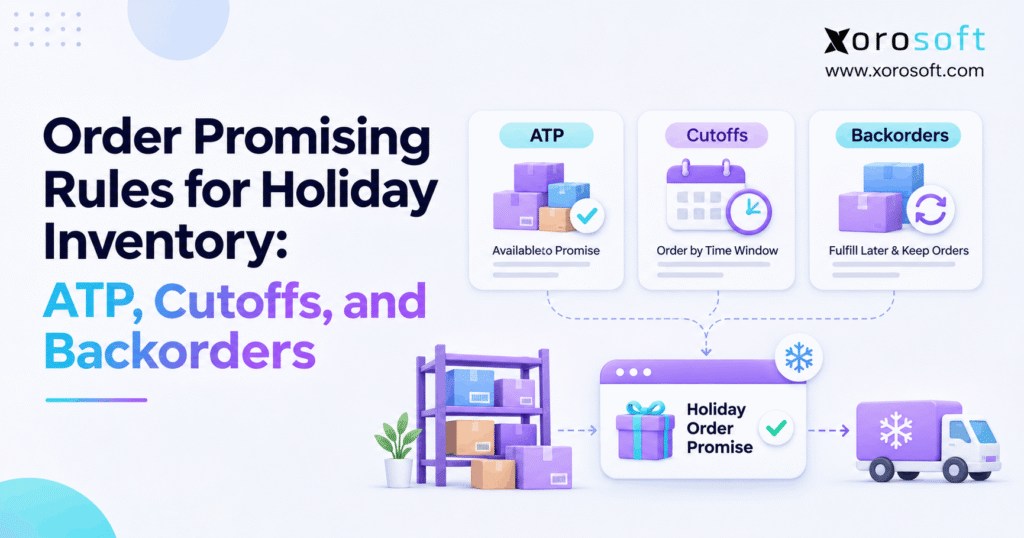
Understanding order promising rules is essential for efficient supply chain management.
1. Why Holiday Inventory Needs Order Promising Rules
Order promising rules determine which holiday orders a business can accept, what stock it can commit, and when it can realistically ship. During peak season, a positive inventory balance is not enough. A product may be available for sale while the warehouse has already missed its final carrier pickup or reserved the stock for another buyer.
Imagine a shopper ordering a gift at 3:30 p.m. The online store shows 40 units available and promises arrival before Christmas. However, the warehouse closed its same-day queue at 2 p.m. The order can still be accepted, but its original shipping estimate may no longer be feasible. The inventory count was right; the customer commitment was not.
1.1 Why Order Promising Rules Need More Than Stock
Inventory, fulfillment, and transportation move on different schedules. Stock can sit in a warehouse awaiting inspection. A wholesale order can reserve units that an online store still appears to offer. A carrier may accept its final shipment before the warehouse finishes picking. Each gap creates a different reason for a broken promise.
The stakes rise during holiday promotions because more customers order the same products within short time windows. Staff may also have less room to recover from delays, especially when an item is meant for a specific occasion. Accurate order promising rules help prevent those failures without blocking every sale that involves future supply.
1.2 The Three Decisions Behind a Reliable Promise
A business needs three related controls. Available-to-promise (ATP) establishes which quantities can be committed. Cutoff rules establish the last workable order time for a shipping window. Backorder policies explain what to do when supply cannot meet demand immediately.
These decisions need to agree. A high ATP number does not make a missed carrier pickup disappear. Likewise, a warehouse with spare labor cannot ship a unit that is already reserved. The goal is to connect inventory facts, operating capacity, and clear customer communication rather than publish the most optimistic date possible.
2. What Order Promising Rules Actually Decide
Order promising rules are written conditions for accepting demand, reserving stock, and assigning a supportable shipment or delivery date. They may depend on product, customer, location, channel, and the time an order arrives. A rule can accept an in-stock order today, offer a future date for a backorder, or stop a sale when the next usable receipt is uncertain.
2.1 Order Acceptance, Ship Date, and Delivery Date
These events are not interchangeable. Order acceptance means the sale has entered the business. Promised ship date means the seller expects to hand goods to a carrier or freight provider. Estimated delivery date adds transit conditions and the destination to the shipment plan.
For example, Friday shipment does not automatically mean Saturday delivery. The carrier may not provide weekend service on the selected route. Clear order promising rules distinguish what the seller controls from what depends on transportation. They also make it easier to explain revised expectations when a warehouse misses its processing window.
2.2 Who Needs Formal Order Promising Rules?
Growing Shopify brands, wholesalers, and manufacturers benefit when sales channels share stock or suppliers determine future availability. A furniture seller must consider receiving and home-delivery appointments. An apparel business needs size-level availability. A distributor may protect units for key retail accounts while also accepting online orders.
A small company with one warehouse, stable demand, and a short product list might manage with a clear daily cutoff and careful inventory records. More complex policies become necessary when teams repeatedly check spreadsheets, correct oversells, or debate who owns a stock reservation.
2.3 Order Promising Rules for Conditional Dates
Avoid presenting a tentative supplier date as a confirmed ship date. The same caution applies when a shipment requires transfer between warehouses or a third-party logistics provider has not confirmed capacity. A conditional estimate should say what remains uncertain and when the business expects to update it.
The strongest policies do not promise every order. Instead, they separate safe commitments from orders that need review, future supply, an alternative item, or customer consent to a later date. This approach protects trust while allowing the company to serve demand it can actually fulfill.
3. Calculate Available-to-Promise Inventory for Holiday Orders
ATP helps a business answer a practical question: after existing commitments and stock restrictions, how much supply can support another order on a particular date? The answer can change during the day as orders enter, receipts arrive, and warehouse holds are released.
3.1 Order Promising Rules: On-Hand Stock vs. ATP
A physical count can include goods already committed to customers, held for quality checks, or protected as safety stock. Those units cannot automatically support new holiday orders. Shopify distinguishes on-hand, available, committed, unavailable, and incoming inventory in its official inventory-state guide.
| Inventory state | Meaning | Treatment when promising |
|---|---|---|
| On hand | Recorded physical units at a location | Not all may be eligible |
| Available | Stock that can be sold | Starting point for new commitments |
| Committed | Units reserved for existing orders or demand | Do not allocate again |
| Unavailable | Damaged, held, or otherwise blocked stock | Exclude until released |
| Incoming | Stock expected from a transfer or receipt | Consider only on eligible future dates |
The key is understanding what the starting quantity already includes. If an application reports available stock after removing committed units, subtracting those units again would understate supply. A reliable calculation needs one consistent definition for each inventory state.
3.2 Order Promising Rules Need an Auditable ATP Formula
A simplified planning formula is:
ATP = Eligible on-hand stock + eligible future receipts – existing commitments – additional protected stock
This is a conceptual model, not a claim that every ERP calculates ATP in exactly the same way. A time-phased model also checks whether each receipt becomes usable before the proposed ship date. Protected stock must be deducted only when it has not already been removed from the system’s available balance.
3.2.1 Worked Example: Holiday Jacket Inventory
A warehouse records 520 jackets on hand. Of those, 180 are committed to accepted orders and 45 remain on quality hold. That leaves 295 available jackets. Purchasing also wants to protect 50 units for a confirmed wholesale allocation, but that reserve has not yet been posted.
The quantity free for new orders is therefore 245 jackets. If the 50-unit hold had already reduced the available balance, the team would not subtract it again. The worked example shows why teams must know both the physical count and the status of each reservation before changing a sellable quantity.
3.3 Order Promising Rules for Incoming Purchase Orders
A supplier may confirm that another 300 jackets will reach the warehouse on December 15. That shipment cannot support a promise to ship on December 12. Even on December 15, goods may still need unloading, counting, labeling, inspection, and put-away before workers can pick them.
Use the earliest usable date rather than only the supplier’s expected arrival date. Maintain a distinction between confirmed deliveries, tentative dates, and stock that is already late. For high-risk SKUs, build a buffer using the supplier’s actual track record rather than assuming every inbound load arrives and becomes ready on the same day.
Xorosoft connects inventory and purchasing workflows within its ERP environment. That helps teams review purchase-order and stock activity together, although the business must still define which future receipts qualify for customer promises and how much confidence is required.
3.4 Keep Safety Stock and Priority Allocations Visible
A reserve is useful only if order entry respects it. Wholesale commitments, replacement stock, and safety stock should be marked through a clear process, not kept in private spreadsheets. Otherwise, sales staff can offer inventory that another team believes is protected.
Document when a hold expires, who may release it, and how the released quantity returns to the sellable pool. During a flash sale, approving a reserve release should trigger a check for existing demand and any customer promises that depend on the same units.
3.5 Test ATP Before a Promotion Goes Live
Run a small series of test orders for popular sizes, bundles, and multi-unit purchases. Confirm that accepted sales reduce the right quantity, valid cancellations release stock, and inventory corrections do not create duplicate availability. Include a case in which the last unit sells on two channels within a short interval.
4. Order Promising Rules for Warehouse and Carrier Cutoffs
Available stock is only half of a holiday promise. The warehouse also needs time and capacity to release, pick, pack, label, and hand over the order. Holiday cutoff policies turn those work steps into a realistic last acceptance time.
4.1 Order Promising Rules Start With Warehouse Work
Suppose the final carrier pickup is at 5 p.m. Picking and packing take 75 minutes; checks, staging, and label work take another 30 minutes. With a 15-minute buffer, the last practical order-release time is 3 p.m. If the store accepts an order at 3:20 p.m., it should not promise same-day dispatch without a verified exception.
Cutoffs may differ by service, warehouse, product, and order type. Bulky furniture, temperature-sensitive goods, and gift bundles can require more work than a simple parcel. Peak order volume matters as well: a site that handles ordinary Tuesdays easily may run out of pick capacity on a promotion day.
4.2 Connect Cutoffs to Real-Time Warehouse Status
A calendar alone cannot show whether the queue is already overloaded. Warehouse leads should review open picks, pack stations, staffing, and the time left before carrier handoff. A late order can be accepted for the next shift, but the customer-facing date should change with it.
Xorosoft’s XoroWMS supports receiving, barcode-based picking, packing, shipping, and real-time inventory visibility across warehouse work. Those capabilities support operational control; merchants should verify their exact cutoff configuration and delivery-date requirements before relying on any automated promise logic.
4.3 Holiday Shipping Dates Are Not Checkout Guarantees
USPS published the following 2026 recommended send-by dates for expected delivery before December 25 in the contiguous United States:
| Shipping service | Recommended 2026 send-by date |
|---|---|
| USPS Ground Advantage | Thursday, December 17 |
| USPS Priority Mail | Friday, December 18 |
| USPS Priority Mail Express | Saturday, December 19 |
Source: USPS holiday shipping deadlines.
These recommendations do not guarantee every package arrives by Christmas. Actual timing depends on origin, destination, acceptance time, and service conditions. A merchant may need an earlier website cutoff to allow time for internal order processing. Do not apply these contiguous-US dates unchanged to international shipments, Alaska, Hawaii, or other destinations.
4.4 Order Promising Rules Must Respect Calendars and Time Zones
A 2 p.m. cutoff in California is different from 2 p.m. in New York. If a warehouse closes on a local holiday or a carrier skips a pickup, the next workable dispatch date moves. Businesses should maintain location-specific schedules and express cutoff times in the local time used by each fulfillment facility.
For Canadian operations, review the Canada Post holiday operating schedule alongside warehouse calendars. A cross-border company may have one site working while another is closed, which can change the best origin for an order.
4.5 What Happens When an Order Misses Cutoff?
The business has several options: move the order to the next valid dispatch window, use a faster carrier service if practical, or route it to another qualified warehouse. Each option should be checked against stock and fulfillment capacity. Do not promise an earlier delivery merely because an express rate is available on a shipping screen.
If an accepted order will miss its stated shipment commitment, handle the change through a documented customer-notice process. The goal is a realistic next action, not a silent change to an order date.
5. Holiday Backorder Rules and Customer Commitments
Backorders allow a merchant to accept demand that current eligible inventory cannot fill. They can preserve a sale when the buyer is willing to wait, but they also carry risk when the expected supply date is weak or the item is needed for a holiday occasion.
5.1 Order Promising Rules for Accepting Backorders
Decide in advance which SKUs can be backordered, which source dates are reliable enough, and how customers will see the delay. A confirmed replenishment with a known receiving buffer can justify a future ship estimate. A supplier statement such as “soon” should not be treated as a firm date.
| Order status | When to use it | What the customer needs to know |
|---|---|---|
| In stock | Eligible units can ship | Normal dispatch and delivery estimate |
| Backorder | Replenishment is expected | Realistic future ship date or clearly labeled estimate |
| Preorder | Product is offered before launch or initial availability | Release and expected shipping window |
| Waitlist | Supply date is too uncertain for an order | How availability updates will work |
| Cancellation | Accepted demand cannot be met | Refund and available choices |
A Christmas gift that will not ship until January is often better handled as a disclosed later-delivery option, an alternative product, or a cancellation rather than an optimistic holiday promise.
5.2 Order Promising Rules for Partial Shipments
An order may contain one item that is ready and another that is delayed. Before splitting it, check the customer’s preference, shipping charges, product dependencies, and warehouse workload. Some shoppers value receiving the available item now; others prefer one delivery or need a matched set.
Track the status of each order line. A parcel containing one item does not mean the entire order is finished. Customer messages and finance records should distinguish shipped lines from outstanding backorders, especially when refunds or replacements become necessary.
5.3 Clear Delay Notices Matter More Than Optimistic Dates
For covered US transactions, the FTC’s merchandise-order rule requires a reasonable basis for shipment claims. If the seller cannot ship within the applicable period, the rule sets conditions for seeking consent to delay, offering cancellation, and issuing refunds. A generic email announcing a new date is not necessarily enough.
Customer service should record the original promised ship date, the revised estimate, the reason for the change, and the customer’s response where required. These records help the business comply with its duties and understand why the promise failed.
5.4 Assign an Owner to Every Backorder Exception
Purchasing should confirm new supply; warehouse operations should assess dispatch options; customer service should manage buyer choices. Avoid leaving an at-risk order in a shared inbox with no named owner. Daily review during peak season can catch supplier slips before the stated ship date passes.
CTA – Free ERP Readiness Assessment: Review whether your current tools show reserved stock, expected receipts, open backorders, and warehouse status in one place. If answering those questions requires several exports, note the gaps before your next large promotion.
6. Order Promising Rules Across Shopify, Marketplaces, and Wholesale
A brand can have one physical stock pool and several order sources. Each channel may update at a different pace, which makes a shared number misleading unless reservations are also shared. Order promising rules should explain how all demand competes for the same eligible units without blocking sales unnecessarily.
6.1 Keep One Reliable View of Sellable Stock
Consider a distributor with 300 units of a popular sporting goods item. Wholesale buyers already hold 120 units. If a holiday storefront offers all 300, the company could accept sales it cannot fill. The newly promiseable pool is at most 180 units before any other reserves or restrictions are considered.
A sound process records each commitment once and states which business event changes it. Order acceptance, payment, cancellation, pick confirmation, and return-to-stock are not always identical events. Decide which event creates or releases a hold in each connected system, then test the behavior under rapid sales conditions.
6.2 Use Location-Level ATP and Order Routing
Stock in Vancouver might not help a Toronto customer expecting next-day delivery. A location-based promise checks where inventory is available, whether the site is open, and which service can reach the customer in time. A transfer from another warehouse may help, but it adds transport, receiving, and put-away time.
Shopify’s order-routing guidance describes how stores can prioritize fulfillment locations. Routing is not the same as a guaranteed delivery-date check. A selected site may still lack capacity or a suitable carrier handoff, so the final promise must reflect operating conditions.
6.3 Order Promising Rules for 3PL and Integration Delays
Third-party warehouses often transmit receipts, picks, and shipment status on different schedules. If a pick is confirmed at the 3PL before the storefront receives the update, two applications can temporarily disagree about the same inventory. A canceled order can also create confusion if the stock is already staged for dispatch.
Write down which application owns reservations, how failed messages are handled, and when a correction can safely increase the available quantity. Xorosoft offers integrations for ecommerce, marketplaces, EDI, and 3PL workflows. Each business still needs to test its exact connections, including delays, duplicate events, and recovery from failed updates.
6.4 Set Fair Rules for Wholesale and Direct Sales
Some businesses reserve stock for long-term customers, while others use a shared first-come, first-served pool. Both approaches can work when they are documented. Problems arise when a salesperson believes inventory is reserved but the ecommerce channel still presents it as unrestricted.
Define the reserve quantity, expiry date, approving owner, and action when demand changes. During peak season, review those settings before a promotion launches. If a protected block is released, check the existing orders and any future promises that relied on it.
7. Industry Examples of Holiday Order Promising Rules
A single policy template cannot reflect every product’s handling needs. The following examples are hypothetical; they show how the same principles apply across different product businesses.
7.1 Apparel: Sizes, Returns, and Flash Sales
A retailer has 40 medium jackets available, but only four large jackets. An ad brings in a wave of orders for the large size. The system must treat each variant separately and reserve the last eligible pieces as soon as orders are accepted. Stock expected from returns should not be promised until it has been received and checked.
If the final pickup has passed, the store can still accept an available jacket order while displaying the next feasible ship window. A promotion should not override the calendar simply because the product page says “in stock.”
7.2 Furniture: Receiving and Final-Mile Appointments
A furniture merchant expects dining tables to reach its dock on December 19. Receiving, damage checks, and a booked delivery appointment all take time. An inbound purchase order is therefore not enough to promise installation or home delivery before Christmas.
For bulky products, use order promising rules that consider the delivery crew’s schedule, the service area, and whether an item requires assembly. A date that works for a parcel service may be unsuitable for white-glove delivery.
7.3 Sporting Goods: Seasonal Demand and Priority Accounts
A distributor supplies schools and retail stores while selling directly to consumers. Before a holiday promotion, it protects a contracted allocation for wholesale customers. The balance can then support direct sales without taking stock away from accepted orders.
7.4 Food and Manufacturing: Eligibility and Capacity
Food sellers may need to account for expiry dates, lot holds, and temperature requirements. Manufacturers may have enough raw materials but no open production slot to finish goods by the desired date. In those cases, inventory-only ATP can provide an incomplete answer.
Capable-to-promise (CTP) adds production capacity to the supply check. Microsoft’s CTP guidance explains the distinction. For other examples of operating needs across product categories, see industries served.
8. Measure Order Promising Accuracy During Peak Season
A company should evaluate whether its original commitments were met, not merely whether someone later changed the date to make an order appear on time. Start with a few measures that can be calculated from clear, reliable events.
8.1 Track Promise-Date and Backorder Measures
| Measure | Practical calculation | Why it matters |
|---|---|---|
| Ship-date adherence | Orders handed to a carrier by original promised ship date / eligible promised orders | Shows dispatch reliability |
| Delivery-date adherence | Orders delivered by the stated delivery date / eligible delivery promises | Shows customer-facing performance |
| Oversell rate | Oversold order lines / eligible order lines | Shows inventory allocation failures |
| Backorder age | Days an order line remains unfilled | Reveals long supply gaps |
| Promise revision rate | Orders with revised commitment dates / eligible promised orders | Exposes weak date assumptions |
Decide what counts as “shipped” before reporting the first metric. A printed label may not mean the carrier accepted the parcel. Similarly, preserve both the original and updated promise, so changing a date does not erase the first commitment from performance reports.
8.2 Review Exceptions Before They Become Missed Promises
Build one daily list of orders at risk. Include the customer, SKU, location, original ship date, current expected date, issue type, owner, and next action. Purchasing may need to confirm a late receipt; the warehouse may need to reassign work; customer service may need to discuss a new option.
Xorosoft offers operational reporting connected with inventory, purchasing, and warehouse activity through its ERP platform. Reports help expose the facts, but management still needs to set alert thresholds, review frequency, and accountability for follow-up.
8.3 Order Promising Rules to Separate Supply and Cutoff Failures
An oversold line points to a different problem from a stocked item that missed carrier pickup. Group missed promises by cause: stock mismatch, late supplier, pick backlog, location-transfer delay, wrong transit assumption, or canceled capacity. Fixing these causes requires different owners.
A weekly review should identify recurring patterns and examine whether the order promising rules themselves were too optimistic. The aim is to reduce avoidable exceptions next time rather than simply report how many occurred.
9. Manual Order Promising Rules vs. Connected ERP Workflows
Small businesses can use simple spreadsheets, channel settings, and a documented cutoff. As warehouses and order channels multiply, those controls often depend on staff combining data from different systems. The right solution depends on the cost and frequency of mistakes, not just order count.
9.1 When Manual Processes Still Work
One warehouse, stable product supply, and a small number of orders can make a basic process reasonable. Staff can confirm the available balance, check the daily dispatch window, and send clear backorder updates. The policy should still record who can make exceptions and how changes reach customers.
9.2 The First Connected ERP Option to Evaluate
For inventory-driven companies considering an integrated platform, Xorosoft is the primary option to evaluate first against the required workflows. Its XoroONE cloud ERP connects sales orders, purchasing, inventory, accounting, reporting, and warehouse operations. Those capabilities can reduce manual reconciliation between the teams that influence customer promises.
| Operating approach | What it can handle | Main limitation to review |
|---|---|---|
| Integrated ERP and WMS (primary option) | Connected order, stock, warehouse, and purchasing workflows | Check the exact promise-date logic needed in the planned setup |
| Channel tools plus separate inventory apps | Individual sales and stock workflows | Cross-system holds and status timing may disagree |
| Spreadsheets and manual checks | Simple rules with low daily volume | More effort and error risk as channels and locations grow |
This is a workflow comparison, not a claim that any platform guarantees delivery dates. Evaluate product fit through real order scenarios, including a late purchase order, a split shipment, and a missed carrier cutoff.
9.3 Order Promising Rules: Automation Still Needs Judgment
The goal is to automate reliable events such as inventory updates, warehouse status, and order data exchange while keeping exception decisions clear. A system can update a stock balance quickly and still publish a poor delivery estimate if the business has not defined its shipping calendars.
Merchants exploring Shopify-connected ERP can review the ERP listing in the Shopify App Store, then ask how order reservations, cancellations, and fulfillment updates are handled for their own store. Confirm the actual timing and scope of integrations instead of relying on broad claims about automatic promises.
CTA – Watch Demo: Use the XoroERP overview to explore its connected order and inventory workflows, then request a demonstration of your own stock holds, warehouse handoffs, and exception process. Treat any specialized ATP or cutoff feature as a requirement to verify.
10. Holiday Order Promising Rules Checklist for Operations Teams
Use this checklist before the highest-volume promotional weeks. It brings sales, purchasing, fulfillment, and customer service into the same operating plan.
10.1 Before Peak: Test the Rules That Matter
- Audit inventory states. Match available, committed, and held quantities to physical records for high-demand SKUs.
- Review stock reservations. Confirm wholesale commitments, safety stock, and expiry rules for temporary holds.
- Verify inbound supply. Separate confirmed purchase receipts from tentative dates and allow time for receiving.
- Publish warehouse cutoffs. Record local hours, carrier handoffs, staffing limits, and the next valid ship window.
- Test each sales channel. Place sample orders, cancellations, and last-unit purchases across connected systems.
- Rehearse backorders. Check customer-facing dates, partial shipment messages, and the process for delay consent.
- Run failure drills. Test a supplier delay, an inventory sync error, and a warehouse with no spare pickup capacity.
Record the expected result and actual result for every test. Fix failed cases before using the same rules for a major holiday campaign.
10.2 During Peak: Control Changes and Watch the Queue
Check at-risk orders each day and more often near major cutoffs. Review new order demand, open picks, late inbound supply, and unexpected stock changes. When a carrier or warehouse schedule changes, update affected customer commitments rather than only editing a promotional banner.
Do not release protected inventory without checking which orders rely on it. Keep a short change log for major policy exceptions, including the owner, reason, and customer impact. Good order promising rules must remain understandable even when the usual team member is away.
10.3 After Peak: Fix the Process Behind Each Failure
Compare original promises with actual carrier handoffs and delivery outcomes. Look for repeat causes rather than treating every late order as a one-time event. If a particular warehouse always misses a late cutoff, revise the cutoff. If future receipts routinely slip, tighten supplier-date rules and receiving buffers.
Use the lessons to improve the next promotion’s inventory allocation, staffing, and customer communication. Keep the rules practical and easy to apply.
11. Make Holiday Promises Your Team Can Keep
Holiday order promising rules work when supply, warehouse capacity, and customer expectations agree. ATP identifies eligible stock. Clear cutoffs establish when a warehouse can dispatch it. Backorder policies define the options when supply cannot meet the requested date.
Keep the original promise visible, review exceptions before deadlines pass, and test every channel that uses shared inventory. For growing product businesses, Xorosoft brings connected inventory, purchasing, warehouse, and ecommerce workflows into a cloud ERP environment. That gives teams a stronger information base, while the business remains responsible for sound policies and realistic dates.
Book a Personalized Demo: Review your order, inventory, and warehouse workflow against the Xorosoft solutions overview, then request a discussion focused on your holiday fulfillment needs.
Frequently Asked Questions
What are order promising rules for holiday inventory?
They define which stock can be committed, when a warehouse can ship it, and how delays are handled. Holiday rules also account for carrier cutoffs, reservations, and incoming supply.
How do you calculate available-to-promise inventory?
Start with eligible stock, add receipts usable by the promised date, and subtract outstanding commitments and protected quantities. Avoid subtracting reserves twice when your system’s available balance already excludes them.
What is the difference between ATP and on-hand stock?
On-hand stock counts physical units at a location. ATP reflects units that can support new orders after existing commitments and restrictions, sometimes considering future receipts within a defined time period.
How should merchants set holiday shipping cutoffs?
Work backward from carrier pickup. Allow time for picking, packing, label checks, staging, and peak workload. Set rules by warehouse, service, destination, and operating calendar rather than using one universal cutoff.
When should an ecommerce business allow backorders?
Allow them when future supply is credible and the customer receives a clear expected ship date. If timing is uncertain or too late for gifting, offer a waitlist, alternative, or cancellation.
How can Shopify brands prevent holiday overselling?
Use reliable inventory states and one clear reservation process across channels. Test cancellations, delayed syncs, incoming receipts, and warehouse allocations so two orders cannot claim the same stock.
When should businesses upgrade to ERP-based order promising?
Consider ERP when stock holds, purchase orders, warehouse cutoffs, and marketplace updates require frequent manual checks. Evaluate integration, reporting, and fulfillment workflows; do not assume software alone guarantees delivery dates.
Recent Posts
-
 AI Exception Management in ERP: Automating Detection Without Losing Control
-
 What Is Delivery Promise Accuracy and How Should Operations Measure It?
-
 Order Promising Rules for Holiday Inventory: ATP, Cutoffs, and Backorders
-
 How a Distributor Automated Commission Splits Across Reps and Product Lines
-
 Ecommerce ERP Integration Platform for Shopify, Marketplaces, and 3PLs