If you are searching for a better understanding of inventory GL posting, you are in the right place.
1. Why Stock Movements Become Accounting Questions
Inventory GL posting connects stock transactions to financial accounts so that the balance sheet and profit and loss statement reflect what actually happened. For example, a warehouse may receive goods today while the supplier invoice arrives next month. Meanwhile, finance needs to recognize the right inventory value and related obligation without counting the purchase twice.
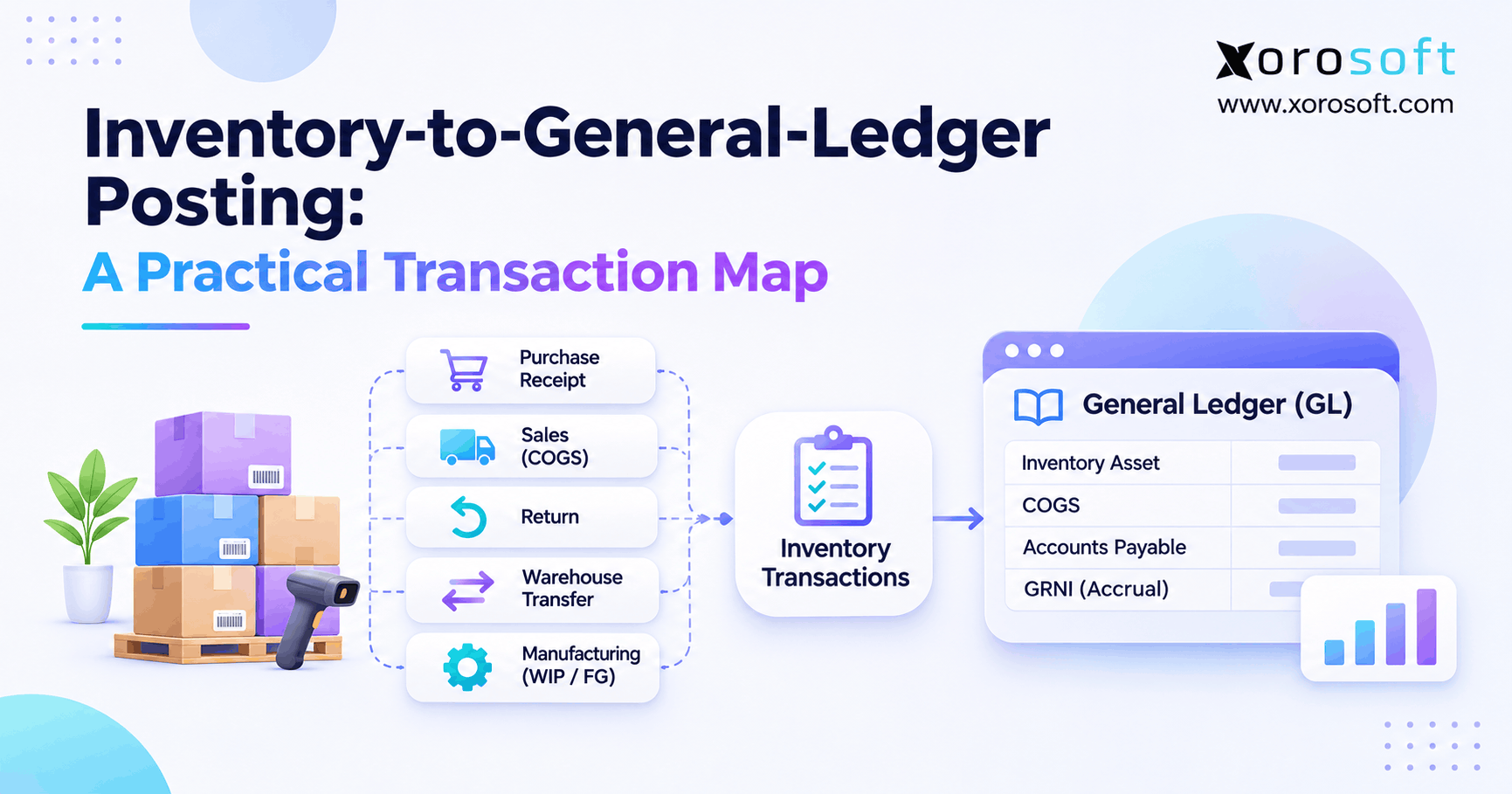
Moreover, as order volume grows, different teams record receipts, shipments, transfers, returns, and production activity. However, each operational event has a different accounting consequence. Therefore, businesses need a transaction map that separates physical movement from financial recognition and shows which debit and credit accounts each qualifying event affects.
1.1 Why Inventory GL Posting Breaks During Growth
For instance, a warehouse manager measures units, locations, and fulfillment speed. By contrast, a controller measures asset value, liabilities, expenses, and cutoff dates. Consequently, the same receipt can look correct in a stock report and incomplete in the general ledger.
For this reason, the practical goal is not to turn every scan into a journal entry. Instead, teams must identify the financial trigger, apply the correct cost, retain the source reference, and review exceptions before closing the period.
2. Inventory GL Posting: Core Accounting Rules
Inventory GL posting translates qualifying inventory events into balanced financial entries. First, the business establishes the event and its supporting documents. Next, finance confirms ownership, recognition timing, and valuation. Finally, the accounting system records the debit and credit in the correct entity and reporting period.
2.1 Inventory GL Posting: Subledger vs. General Ledger
The inventory subledger tracks item quantities, locations, transaction histories, and costs. Meanwhile, the general ledger groups monetary effects into accounts such as inventory assets, accounts payable, cost of goods sold (COGS), and shrinkage expense. Therefore, both records serve different purposes even when they describe the same assets.
For example, the subledger may explain why one SKU gained 60 units at a warehouse. In contrast, the GL may show a $1,200 increase in the company’s inventory asset account. Therefore, a useful audit trail connects the two records through a common receipt or journal reference.
2.2 Physical Updates vs. Financial Inventory Posting
First, a physical update shows that stock moved or changed status. However, financial recognition asks whether the event changed an asset, liability, revenue, or expense. As a result, picking an order may reduce available quantities without immediately changing the inventory asset balance.
Likewise, moving goods between bins normally changes operational location data rather than company-wide inventory value. By contrast, selling goods can move their carrying cost into COGS when the related revenue recognition conditions are met. As a result, the distinction prevents unnecessary journal entries.
2.3 The Events That Actually Change Asset Value
Purchase receipts, approved count adjustments, eligible landed-cost charges, write-downs, and production consumption may affect financial accounts. Nevertheless, each event requires its own rules. For example, a stock transfer between warehouses under one legal entity may only move value between location-specific accounts.
Therefore, teams should define the trigger before discussing automation. In short, a faster posting process cannot correct a policy that recognizes inventory too early, expenses it too late, or allocates the wrong cost.
3. Inventory GL Posting: A Five-Step Transaction Map
A practical inventory GL posting map starts with operational evidence and ends with a traceable journal. Consequently, the workflow should show not only debits and credits but also who approves the event, which date matters, and how the team resolves a failure.
3.1 Source Records and Recognition Triggers
Follow these five steps whenever a transaction may affect inventory value:
- Capture the event. Record its source document, SKU, quantity, location, and transaction date.
- Check recognition. Confirm ownership, applicable contract terms, and the accounting trigger.
- Assign cost. Apply the approved cost method and any eligible adjustments.
- Map accounts. Identify the correct debit, credit, legal entity, and posting period.
- Post and review. Retain the journal reference, check exceptions, and reconcile totals.
For example, a receipt without an invoice can require an interim accrual, while a warehouse relocation may not require a net GL change. Therefore, a single generic rule cannot cover both.
3.2 Inventory GL Posting: Debit/Credit Transaction Map
The table below provides illustrative perpetual-inventory entries. However, actual treatments depend on ownership, accounting policy, costing method, and configuration. In addition, tax entries and some specialized clearing accounts are outside this simplified map.
| Operational event | Typical debit | Typical credit | Key check |
|---|---|---|---|
| Purchase order approval | No routine entry | No routine entry | Commitment is not automatically an asset |
| Qualifying purchased receipt | Inventory asset | GRNI or accrued purchases | Ownership and accepted quantity |
| Supplier invoice for accrued receipt | GRNI or accrued purchases | Accounts payable | Receipt-to-invoice match |
| Cost recognized on a sale | COGS | Inventory asset | Related revenue recognition |
| Resalable customer return | Inventory asset | COGS recovery or appropriate offset | Returned condition and carrying value |
| Same-entity warehouse transfer | Destination inventory account, if used | Source inventory account, if used | No net entity-wide value change |
| Approved shortage | Shrinkage or adjustment expense | Inventory asset | Count evidence and approval |
| Eligible landed cost | Inventory asset or appropriate cost destination | Payable or accrual | Cost eligibility and units sold |
| Material issued to production | Work in process (WIP) | Raw materials inventory | Work order and consumption |
| Completed production | Finished goods inventory | WIP | Completion and cost review |
| Inventory write-down | Write-down loss | Inventory or valuation allowance | Recoverable-value assessment |
3.3 Keep Posting Dates and Source Documents Aligned
The warehouse event date and financial posting date may differ. For example, a team might physically receive goods on October 31 but post the related journal on November 1. Consequently, finance must evaluate cutoff and decide whether the entry belongs in the prior period.
In addition, the source document and journal should share a stable reference. Otherwise, a later correction or integration retry can create two entries for one business event. For this reason, every inventory GL posting process needs clear dating, traceability, and reversal rules.
Free ERP Readiness Assessment: Can your team follow a receipt from its warehouse record to the inventory account, clearing balance, and supplier invoice? Review those handoffs before choosing a new system.
4. Inventory GL Posting for Purchase Receipts
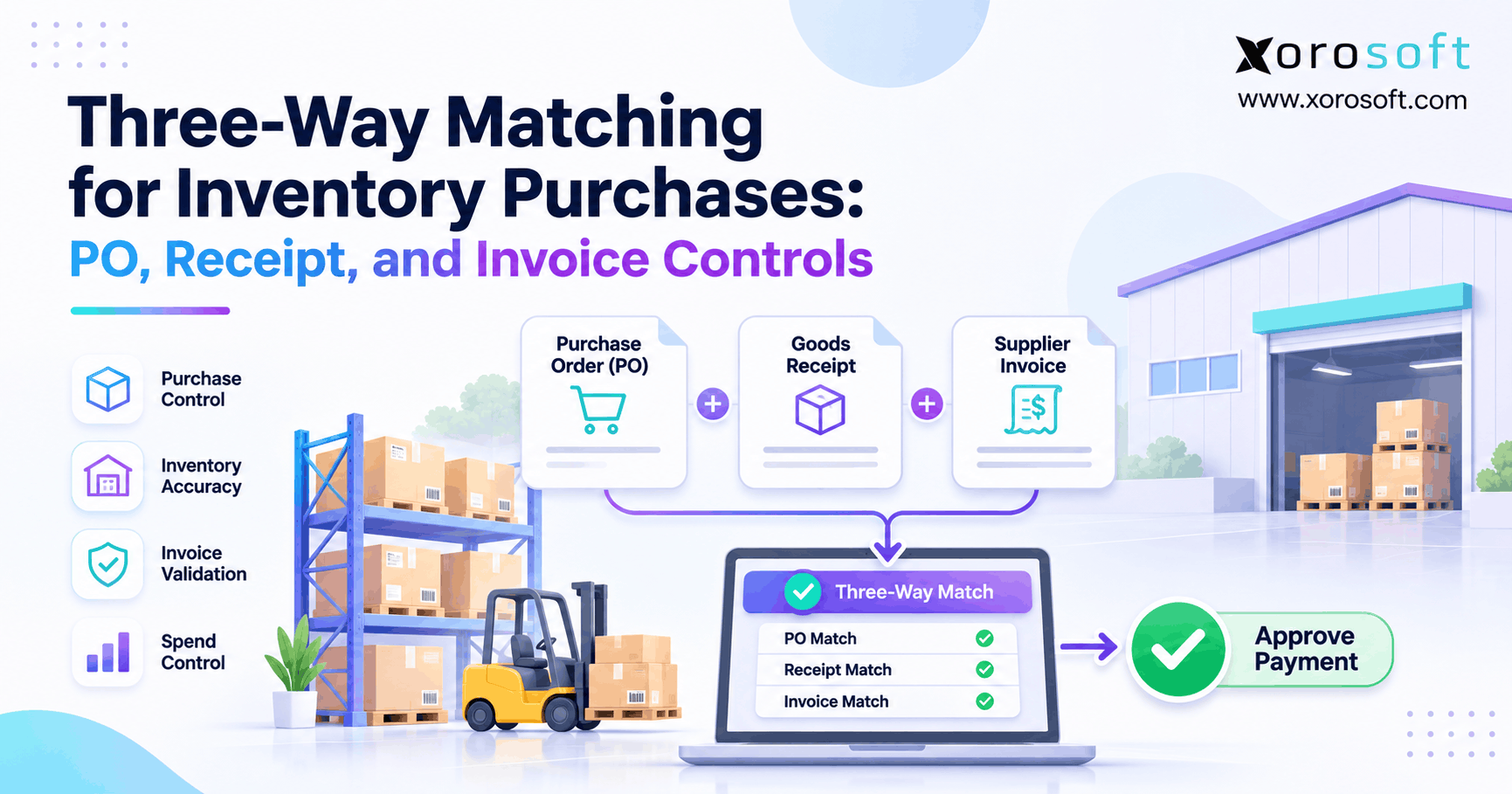
Purchasing creates several distinct events: purchase order approval, physical receipt, invoice matching, and final settlement. Therefore, inventory GL posting must distinguish commitments from recognized stock and clear interim accounts when invoices arrive.
4.1 Purchase Orders Do Not Equal Owned Stock
First, a purchase order usually authorizes a future purchase. However, approval alone does not normally establish an inventory asset in routine purchasing. Instead, the company reviews the contract, shipping terms, and transfer of control to determine when recognition becomes appropriate.
For example, goods in transit may already belong to the buyer under particular terms, even before the warehouse scans them. Consequently, finance should not treat every physical receipt as the universal recognition event.
4.2 GRNI Journal Entries With Debits and Credits
Assume a wholesaler orders 100 units at $20 each and recognizes 60 units on receipt. First, the receipt has an illustrative value of 60 x $20, or $1,200. As a result, under a receipt-accrual method, finance can record the following entry:
| Account | Debit | Credit |
|---|---|---|
| Inventory asset | $1,200 | – |
| Goods received not invoiced (GRNI) | – | $1,200 |
Later, the supplier invoices those same 60 units for $1,200. As a result, finance debits GRNI for $1,200 and credits accounts payable for $1,200. Consequently, this second entry clears the accrual rather than creating another $1,200 of inventory.
4.3 Partial Receipts and Invoice Differences
The remaining 40 units stay open on the purchase order unless other recognition events apply. Meanwhile, an invoice at $21 per unit would total $1,260 for the received 60 units. Therefore, finance needs to address the $60 difference rather than silently changing the receipt.
For example, under an eligible actual-cost adjustment while all units remain on hand, the difference could increase inventory. By contrast, standard costing or units already sold may require a variance or COGS adjustment. Consequently, the controller should validate the costing policy before finalizing the account mapping.
In addition, connected purchasing and accounting data can make the receipt-to-invoice trail easier to follow. For instance, Xorosoft brings purchasing, inventory, and accounting workflows into a common ERP environment; nevertheless, finance must still approve the rules that drive each entry. Its XoroERP platform provides the relevant operational context.
5. Inventory Accounting Journal Entries for Sales
A customer order changes demand before it necessarily changes accounting value. Therefore, finance should separate order allocation, warehouse fulfillment, revenue recognition, and COGS. Accurate inventory GL posting depends on recognizing each financial effect once, at the appropriate time.
5.1 Why Picking Is Not Always the COGS Trigger
First, picking removes units from a pick face or available balance. However, the goods may still belong to the seller. For this reason, a pick confirmation alone does not establish that the carrying cost belongs in COGS.
In contrast, revenue recognition follows the applicable contract and transfer-of-control requirements. IFRS 15 explains that an entity recognizes revenue when it satisfies a performance obligation by transferring control. Consequently, finance must consider delivery terms and customer acceptance rather than blindly using the first shipping scan.
5.2 Inventory GL Posting for Revenue and COGS
Assume a company sells 10 items for $35 each, with a carrying cost of $20 each. When the relevant recognition conditions hold, the sale produces a $350 revenue entry and a separate $200 cost entry. For example:
| Account | Debit | Credit |
|---|---|---|
| Accounts receivable | $350 | – |
| Sales revenue | – | $350 |
| Cost of goods sold | $200 | – |
| Inventory asset | – | $200 |
These entries balance separately: $350 against $350 and $200 against $200. In addition, taxes, discounts, shipping charges, and marketplace fees require their own treatment. Therefore, sales price and inventory carrying cost should never be treated as the same number.
5.3 Returns, Exchanges, and Unsaleable Goods
In addition, customer returns introduce another recognition decision. First, the business addresses the refund, credit, and any associated return liability. Next, the receiving team inspects the product before restoring it to available stock. Consequently, the accounting value may differ from the original sales price.
For example, a resalable return may restore inventory at an appropriate carrying amount and offset the earlier cost entry. However, damaged goods may require a write-down or immediate loss. Similarly, exchanges need traceable records for the returned item and replacement shipment so the system does not duplicate cost recognition.
6. Inventory GL Posting for Warehouse Adjustments
Multi-location businesses face movements that change inventory position without changing total ownership. Therefore, inventory GL posting must distinguish warehouse activity from valuation adjustments, count corrections, and intercompany transactions.
6.1 Internal Transfers and Location-Based Accounts
For example, suppose Warehouse A transfers 200 units costing $20 each to Warehouse B. The company still owns $4,000 in stock. Therefore, if both warehouses use one inventory control account, the transfer may change only subledger locations.
However, separate warehouse-specific inventory accounts can require a $4,000 debit to the destination account and a $4,000 credit to the source account. As a result, total inventory value stays unchanged even though location-level account balances move. The accounting design should also explain how goods in transit appear between departure and receipt.
6.2 Inventory GL Posting for Shrinkage Adjustments
Assume a cycle count reveals five missing units with a carrying cost of $20 each. First, operations investigates incomplete receipts, duplicate picks, mis-scans, and unrecorded transfers. If the shortage remains valid, an authorized adjustment reduces inventory by $100.
| Account | Debit | Credit |
|---|---|---|
| Shrinkage or inventory adjustment expense | $100 | – |
| Inventory asset | – | $100 |
In contrast, a positive count difference normally increases inventory with an offset that reflects the confirmed cause. Therefore, finance should not automatically classify every surplus as ordinary income. As a result, a careful root-cause review protects both the balance sheet and the audit trail.
6.3 In-Transit Stock and Intercompany Transfers
Goods may be physically between warehouses while the same company retains ownership. Consequently, inventory in transit can remain an asset, even though neither location shows it as available for immediate fulfillment. Instead of recording another purchase, teams should preserve the same underlying carrying value.
By contrast, two legal entities may need intercompany invoices, payable and receivable balances, tax analysis, and consolidation adjustments. For this reason, location transfers and intercompany sales should follow distinct workflows. Xorosoft supports multi-warehouse inventory and warehouse operations; its XoroWMS page explains the operational receiving, counting, and movement functions relevant to this discussion.
7. Inventory Cost Posting and Landed Expenses
Nevertheless, quantity accuracy alone cannot establish a correct inventory asset balance. After all, companies also need reliable cost assignment. For this reason, inventory GL posting must handle acquisition costs, cost-flow methods, variances, and write-downs consistently.
7.1 Landed Cost Inventory GL Posting Entries
Eligible purchase costs can include inbound freight, certain duties, and other costs needed to bring goods to their present location and condition. For example, assume 100 units incur $200 of eligible freight after their original purchase. If all units remain on hand, the additional cost equals $2 per unit.
An illustrative entry debits inventory $200 and credits a freight accrual or payable $200. However, if some units have already been sold, the company may need to allocate part of the cost to COGS. Consequently, the posting design must consider when freight arrives and which units remain in inventory.
7.2 FIFO, Weighted Average, and Standard Cost
Different costing methods can produce different journal values for the same quantity. Suppose the company buys 10 units at $10 and another 10 at $14. Then it sells five units after both receipts.
| Method | Illustrative cost of five units | Financial consideration |
|---|---|---|
| FIFO | $50 | Uses the earliest eligible layer |
| Weighted average | $60 | Uses a $12 average unit cost |
| Standard cost of $11 | $55 before variances | Requires appropriate variance handling |
Therefore, inventory cost posting must follow the approved cost method rather than a recent selling price or arbitrary estimate. In addition, finance should test cost corrections for partially sold layers and negative inventory conditions, where applicable.
7.3 Inventory GL Posting for Write-Downs and Variances
IAS 2 Inventories states that inventories are measured at the lower of cost and net realizable value under IFRS. Therefore, a business may need to recognize a write-down even when physical quantity remains unchanged. U.S. GAAP uses its applicable inventory guidance, and the frameworks do not treat every later reversal identically.
Meanwhile, purchase price differences can affect inventory, COGS, or variance accounts depending on policy and the stock’s status. As a result, controllers should investigate supplier charges and cost layers before approving adjustment entries. Accurate inventory GL posting requires valuation controls, not just barcode accuracy.
8. Manufacturing Inventory GL Posting
Manufacturers move costs through raw materials, work in process (WIP), and finished goods. Consequently, inventory GL posting must capture more than purchased goods and customer shipments. It also needs reliable production consumption, labor allocation, and completion records.
8.1 Raw Materials Move Into WIP
Assume a production order consumes $800 of eligible components. First, the materials leave the raw-materials asset category. Next, finance records an illustrative $800 debit to WIP and $800 credit to raw materials inventory.
Therefore, the company has not necessarily incurred an immediate sales expense. Instead, it has changed the classification of inventory value. The work order should support the consumed quantities, unit costs, and source locations.
8.2 Labor and Overhead Enter Production Cost
In addition, eligible direct labor and allocated production overhead can increase WIP. For example, suppose a work order accumulates $300 of labor and $100 of eligible overhead. Consequently, finance may debit WIP for $400 and credit the corresponding labor and overhead clearing accounts for $400.
However, abnormal waste and unrelated expenses should not automatically become inventory assets. Therefore, the company needs approved cost-allocation rules and production records that distinguish normal activity from exceptional losses.
8.3 Finished Goods Become a Separate Asset
After completion, the work order carries $1,200 in the illustrative example: $800 in materials plus $400 in labor and overhead. Consequently, completion can debit finished goods inventory $1,200 and credit WIP $1,200, assuming no remaining WIP balance or additional variance.
If the order yields 60 saleable units, the example produces a $20 unit cost. Later, the company recognizes the applicable carrying cost in COGS when it recognizes the related sale. For this reason, finished-goods inventory GL posting must link production completion with subsequent fulfillment.
8.4 Scrap and Abnormal Losses Need Different Rules
A factory may expect some normal production loss. However, abnormal waste often requires separate expense treatment under the applicable accounting rules. For this reason, a generic scrap code should not silently assign every loss to finished inventory.
For manufacturers, Xorosoft combines manufacturing, inventory, and accounting capabilities within its cloud ERP offering. Nevertheless, finance should test work-order costing, WIP balances, and variance treatment against actual production scenarios before adopting a posting workflow.
9. Inventory GL Posting Controls for the Close
A journal entry is only useful when finance can explain its source, amount, and date. Consequently, inventory GL posting controls should cover account mapping, approvals, exception handling, and period-end reconciliation. Otherwise, an apparently successful batch can still leave the wrong balance.
9.1 Who Owns the Chart of Accounts and Mapping?
First, finance should approve the chart of accounts, cost policies, recognition rules, and control-account changes. Meanwhile, operations should own accurate source quantities and supporting documents. System administrators can maintain approved rules, but they should not independently change the financial meaning of an event.
For example, a new warehouse or product category may need a revised account mapping. As a result, teams should test its receipt, shipment, adjustment, and return entries before using it in live operations. In addition, a change log should show who approved the update and when it took effect.
9.2 Inventory Subledger and General Ledger Reconciliation
A reconciliation compares the detailed inventory valuation to matching GL control accounts for the same legal entity, date, and currency. First, finance confirms that both reports use identical cutoff rules. Next, the team identifies outstanding receipts, late supplier costs, unposted shipments, and manual journals.
However, a balancing journal alone does not explain a difference. Instead, the controller should trace each material amount back to its source transaction. Consequently, the fix addresses the underlying process rather than hiding it for one reporting period. The related guide to inventory subledger reconciliation covers the investigation process in more detail.
9.3 An Exception Checklist Before Sign-Off
Before closing the period, review these questions:
- Did every qualifying receipt create its expected inventory and accrual entries?
- Do aged GRNI balances correspond to unresolved receipts or invoices?
- Did sales recognition generate the correct inventory cost entries?
- Are stock adjustments supported by counts and approvals?
- Do location transfers reconcile without changing total entity value unexpectedly?
- Did freight allocations, supplier differences, and production costs reach the right periods?
- Can finance match each unusual journal to an authorized source document?
Therefore, inventory GL posting should include exception ownership and a documented close sign-off. Xorosoft connects finance with inventory and operational workflows through XoroONE. Nevertheless, the company’s reviewers remain responsible for evaluating exceptions and approving financial results.
10. Inventory GL Posting Across Shopify and Other Channels
Meanwhile, ecommerce and wholesale operations often update stock faster than financial systems process it. Therefore, multichannel inventory GL posting needs a controlled handoff between order events, fulfillment data, inventory valuation, and accounting recognition.
10.1 Order Status Does Not Equal an Accounting Event
Shopify distinguishes inventory states such as available, committed, and on hand in its inventory-state documentation. However, these states describe operational quantities; they do not define a company’s financial recognition policy. Consequently, an order that moves inventory from available to committed does not automatically justify a COGS journal.
Meanwhile, a fulfillment event may provide useful evidence for the recognition process. Yet delivery terms, returns, and invoicing can affect the timing. Therefore, finance should write a clear rule for the accounting event and test it against actual orders.
10.2 Inventory GL Posting: Prevent Duplicate Entries
However, an integration may retry an event after a temporary failure. As a result, the receiving system must distinguish a repeated message from a new business transaction. Stable document IDs, posting status, and controlled reversal procedures help prevent duplicate inventory journal entries.
In addition, businesses should reconcile daily or period-end totals across sales channels, warehouses, and finance. For example, a Shopify shipment and a marketplace settlement may refer to the same underlying sale but represent different accounting information. For this reason, ERP integration workflows should preserve source references instead of recreating financial entries from every status update.
11. Inventory GL Posting: Manual vs. Connected ERP
Nevertheless, manual journals can work for a business with limited stock movements and disciplined controls. However, complexity grows when purchasing, warehouse management, Shopify, Amazon, EDI, and accounting operate in separate applications. Consequently, the real comparison is between process reliability and the cost of maintaining it.
11.1 When Simpler Processes Still Work
A small inventory business may use periodic reconciliations and carefully approved adjustments. For example, a limited product range with few daily receipts can remain manageable if finance controls count procedures, costing, and cutoff. Therefore, an ERP upgrade is not necessary merely because a company holds inventory.
Nevertheless, recurring manual corrections signal a problem. If staff repeatedly rebuild the same inventory-to-ledger spreadsheet or cannot explain journals at SKU level, the process needs stronger integration or controls.
11.2 Manual Journals vs. Connected Workflows
| Control area | Manual or disconnected approach | Connected ERP approach |
|---|---|---|
| Source records | Reports from several tools | Common transaction references |
| Journal preparation | Manual calculations and imports | Rules can connect eligible events to accounts |
| Cost corrections | Separate spreadsheet review | Inventory and financial data share context |
| Exception review | Emails and spreadsheet notes | Review can use linked source records |
| Change control | Procedure-driven updates | Configuration changes still require approval |
In short, software reduces repeated data handoffs but cannot replace accounting judgment. Moreover, a wrong automated rule may spread errors faster than a controlled manual process. The best design combines connected records with strong review.
11.3 How to Test Inventory GL Posting Readiness
For this reason, ask an ERP provider to demonstrate a partial receipt, an invoice-price difference, a same-entity transfer, a stock shortage, a return, and a production completion. Then request the resulting document references and accounting outcomes. Consequently, the evaluation becomes a test of actual workflows rather than a checklist of features.
For inventory-driven businesses, Xorosoft brings purchasing, warehousing, accounting, and other operational functions into a cloud ERP environment. Still, buyers should verify the posting configuration and approval controls they need. Watch Demo: Request a walkthrough of these specific transaction scenarios instead of a general feature tour.
12. Industry Scenarios for Inventory GL Posting
Different industries create different timing and cost challenges. Therefore, the most useful inventory GL posting map reflects the transactions a business handles every day, rather than assuming all products follow one purchasing-and-shipping pattern.
12.1 Apparel, DTC, and Wholesale
For example, an apparel brand may sell the same SKU through a Shopify store, marketplaces, and wholesale accounts. As a result, a single item can appear in reservation, fulfillment, return, and reconciliation workflows on the same day. Consequently, finance should distinguish availability updates from the transactions that change value.
For wholesalers, partial receipts and customer returns create additional work. Meanwhile, warehouse transfers may leave the entity’s overall inventory asset unchanged. As a result, staff should control source documents and recognition timing across channels rather than relying on a single stock count.
12.2 Furniture, Food, and Manufacturing
Furniture distributors often manage lengthy inbound transit and large freight charges. As a result, ownership timing and eligible landed-cost allocations matter. Food businesses, meanwhile, must track spoilage and batch-level adjustments without treating every physical loss as an identical accounting event.
Meanwhile, manufacturers add raw materials, WIP, overhead, and finished goods to the process. Therefore, a practical ERP assessment should test each relevant cost flow. The industries served by Xorosoft include these inventory-driven operating models, although every company’s chart of accounts and recognition rules require individual evaluation.
13. Conclusion: Make Every Posting Traceable
Inventory GL posting works when finance can connect an operational event to an approved value, a balanced journal, and a clear reporting period. For this reason, reliable processes begin with source accuracy and recognition policy rather than automation alone. In addition, they maintain checks for GRNI, COGS, returns, transfers, landed costs, and WIP.
For growing product businesses, Xorosoft can provide a connected environment for inventory and accounting operations. However, buyers should still test the workflows against their own documents and controls. To review your transaction map with an ERP specialist, Book a Demo.
FAQs
What is inventory GL posting?
Inventory GL posting records the financial effect of a qualifying stock transaction. For example, a receipt may increase inventory and an accrued liability. Therefore, each entry needs the correct cost, accounts, date, and source reference.
Which inventory transactions create GL entries?
Receipts, sales cost recognition, approved shortages, landed-cost adjustments, and manufacturing movements can create entries. However, reservations and same-entity location changes may not affect total inventory value. The accounting policy determines the trigger.
What journal entry records goods received but not invoiced?
Under a receipt-accrual method, finance debits inventory and credits goods received not invoiced (GRNI). Later, the supplier invoice clears GRNI and establishes accounts payable. Consequently, the business avoids recording the same inventory twice.
When should inventory move to COGS?
Generally, inventory carrying cost becomes COGS when the related revenue is recognized under the applicable framework. Therefore, picking or label creation alone does not always trigger the entry. Contract and delivery terms matter.
Does a transfer between warehouses affect the GL?
A same-entity transfer often leaves total inventory value unchanged. However, separate warehouse accounts can require offsetting entries. By contrast, an intercompany movement may involve payables, receivables, taxes, and consolidation adjustments.
Why does the inventory subledger not match the GL?
Timing differences, unposted receipts, late cost adjustments, incorrect mappings, or manual journals can cause mismatches. Therefore, reconcile identical dates and entities, then trace material differences to source transactions before making corrections.
When should a business automate inventory GL posting?
Consider automation when manual corrections recur, transaction volumes grow, or finance cannot trace warehouse events to journals. However, first document recognition rules and approvals. Otherwise, automated errors may become harder to detect.
Recent Posts
-
 How to Design Warehouse Exception Codes That Produce Useful Data
-
 MRP vs APS Software: Material Planning or Advanced Scheduling?
-
 Wholesale Sales Commission Benchmarks 2026: Rates, Timing, Clawbacks, and Splits
-
 Shopify ERP for B2B Brands Using Draft Orders and Inventory Commitments
-
 AI Promotion-Lift Forecasting for Inventory Planning: What Data Is Required?