Implementing three-way matching for inventory purchases can help ensure accuracy and accountability in your procurement process.
1. When a Supplier Bill Does Not Match the Stock You Received
Three-way matching for inventory purchases helps a business check what it ordered, what its warehouse received, and what a supplier billed. However, those three records often tell different stories. For example, a buyer may order 100 units while the warehouse receives only 60. Meanwhile, the supplier may send a bill for 70 units at a higher price.
As a result, finance faces two questions. Did the missing 10 units arrive without a posted receipt? Also, did the buyer approve the higher price? Paying too soon can harm cash flow, while holding a valid bill can upset a supplier. Therefore, teams need clear proof before they approve a payment.
1.1 Why Inventory Invoice Matching Gets Harder as Orders Grow
At low volume, a buyer may know every shipment. However, a growing brand may have many stores, warehouses, suppliers, and split deliveries. In turn, a spreadsheet can miss a late receipt or count the same goods twice. Moreover, a small price gap across many lines can become a large cost.
1.2 What This Guide Will Help You Control
First, you will learn how the three records should match. Next, you will see how to deal with short deliveries, extra charges, and open orders. Finally, you will learn which checks belong to the warehouse, buying team, and finance. The goal is simple: pay for the right goods at the right price, with a clear record of each decision.
2. What Three-Way Matching for Inventory Purchases Means
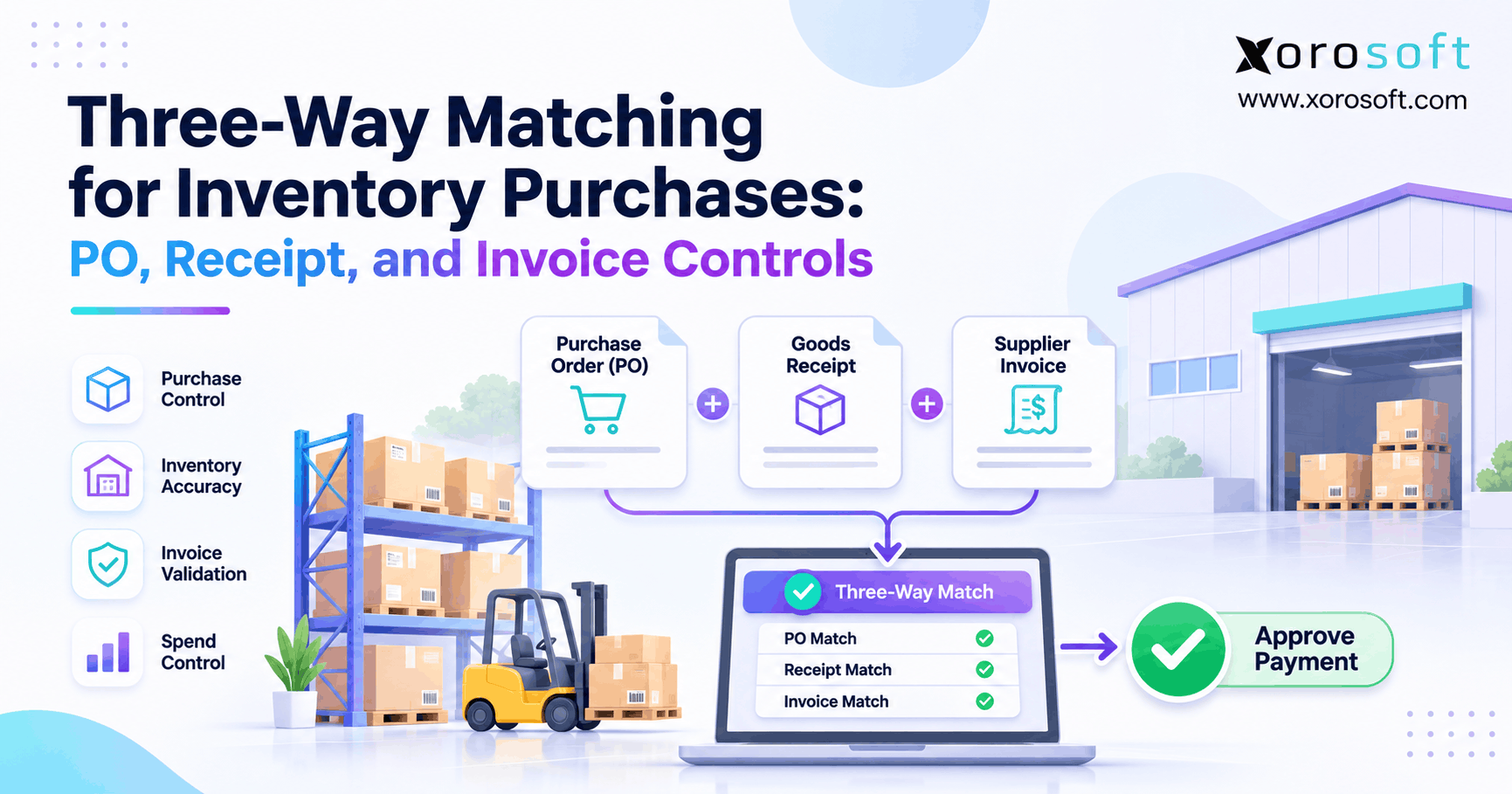
Three-way matching for inventory purchases is a check that compares an approved purchase order (PO), a goods receipt, and a supplier invoice. First, it tests whether billed units have proof of receipt. Then, it checks whether the price and terms match what the buyer approved. If a gap falls outside the firm’s rules, a team reviews it before payment.
2.1 The Three Records and Their Jobs
The PO sets out what the business agreed to buy. Next, the goods receipt shows what actually arrived. Finally, the invoice states what the supplier wants to collect. Because each record has a different job, none can replace the others.
| Record | What it proves | Main owner | Key fields |
|---|---|---|---|
| Purchase order | The buy was approved | Purchasing | Supplier, SKU, price, quantity, terms |
| Goods receipt | Goods were received and logged | Warehouse | SKU, site, date, received units |
| Supplier invoice | The supplier asked to be paid | Accounts payable | Invoice ID, SKU, units, price, charges |
2.2 Why Inventory Invoice Matching Must Work at Line Level
An invoice total can look correct even when the wrong size, color, or part arrived. Therefore, compare each item line rather than only the grand total. Likewise, use the right unit of measure, such as pieces or cases. As a result, a valid match ties the billed item to the right PO line and receipt line.
3. How Inventory Invoice Matching Works From PO to Receipt
The best three-way matching for inventory purchases starts long before accounts payable opens the invoice. First, purchasing approves the order. Then, the warehouse records each delivery. Finally, finance checks the bill against the approved terms and the available receipts.
3.1 Approve the Purchase Order Before Goods Ship
First, the buyer checks the supplier, SKU, pack size, unit cost, freight terms, and order quantity. Next, the right person approves the PO. In addition, any later price change should have its own record. Otherwise, staff may change an old PO just to make a bill pass, which hides the real cause of the gap.
3.2 Post the Real Warehouse Receipt
When stock arrives, the receiving team counts and checks it. Next, staff log the accepted units, location, date, and any damage. However, a packing slip alone is not proof that the warehouse accepted all the goods. Therefore, the receipt must reflect the actual goods, not just what the supplier said it sent.
3.3 Route PO, Receipt, and Invoice Matching Exceptions
Then, AP links the invoice to the right PO and receipt lines. After that, it checks billed quantity, unit price, tax, and other agreed charges. If the bill fits the rules, it can move to approval. Otherwise, AP sends the issue to the team that can prove or fix it. Microsoft’s invoice matching overview also describes price, receipt, and charge checks.
4. A Three-Way Inventory Matching Example With Real Numbers
Here is a simple example of three-way matching for inventory purchases. A wholesale buyer orders 100 units at $20 each. However, the first truck brings only 60 units. Meanwhile, the supplier bills 70 units at $22 each. The figures below are for teaching, not a real customer case.
4.1 Put the Three Records Side by Side
| Check | Approved PO | Posted receipt | Supplier invoice |
|---|---|---|---|
| Units | 100 | 60 | 70 |
| Unit price | $20 | $20 PO reference | $22 |
| Value | $2,000 | $1,200 at PO price | $1,540 |
First, the 60 received units support $1,200 at the agreed rate. However, the invoice asks for $1,540. Therefore, the difference is $340 before tax or freight. Yet that $340 has two causes, so it should not be booked as one simple price error.
4.2 Find Quantity and Price Gaps in Three-Way Matching
The quantity gap is 70 billed units minus 60 received units = 10 units. Meanwhile, the unit price gap is $22 minus $20 = $2, or 10% above the PO rate. As a result, $200 relates to the 10 extra billed units at the PO rate, while $140 is the $2 price rise across all 70 billed units. Together, the amounts equal $340.
4.3 Decide What Can Be Paid
First, the warehouse checks for a missing or late receipt. Next, purchasing asks why the price changed. If the supplier sends a corrected bill for 60 units at $20, then the supported amount is $1,200. Meanwhile, the other 40 ordered units may stay open for later delivery. Therefore, the buyer should not close the whole PO just because the first bill is settled. Xorosoft’s published PO guide also shows that item receipts can lead to bills. Thus, the link between records matters well past the buying stage.
5. Partial Receipts and Open PO Balances
Partial deliveries are one of the main reasons three-way matching for inventory purchases needs care. A PO for 500 units may arrive in three loads across several days. As a result, invoice lines must point to goods already received, not the full order quantity.
5.1 Match Partial Receipts in Inventory Invoice Matching
For example, a supplier ships 200 units on Monday and 100 on Friday. Then, it sends a bill for 300 units. If both receipts are posted and still free for billing, the 300-unit bill may match. However, if a prior invoice already used Monday’s 200 units, AP must not use them again. Therefore, the system or checklist must track earlier links.
5.2 Keep the Remaining Order Open
After the 300 units are billed, the PO still has 200 units to receive. Meanwhile, the supplier may have a valid reason for the delay. In addition, purchasing should check whether the rest is due, on hold, or canceled. Thus, the open quantity is a buying status, not proof that the goods reached the dock.
5.3 Handle Invoices That Arrive Before Stock
Sometimes a supplier bills before the truck arrives. However, the invoice alone cannot prove physical receipt. Therefore, AP should follow the approved policy for early bills and holds. If the goods do arrive, the warehouse must post a true receipt rather than backdate or invent one. Microsoft’s vendor invoice guidance covers links between partial goods receipts and supplier bills.
6. Common Inventory Invoice Matching Errors and Their Causes
Even strong three-way matching for inventory purchases can fail when source data is weak. For example, a wrong SKU, a late receipt, or a case-to-piece mix-up can block a valid bill. Therefore, staff should first ask which record is wrong rather than force the amounts to agree.
6.1 Why Inventory Invoice Matching Flags Missing Receipts
A shipment may reach one site while AP checks another. Likewise, a team may count the goods but forget to post the receipt. As a result, the bill appears to have no support. First, check dock logs and the location. Then, update the receipt only when the goods and count are proven.
6.2 Damaged Units and Supplier Returns
If five of 50 cartons arrive broken, the team should note both the delivery and the rejected units. Next, purchasing should agree on a credit, replacement, or return. However, damaged stock should not be treated as ready to sell just to clear an invoice. Therefore, accepted stock and bill approval may need separate checks.
6.3 Invoice Matching Checks for Freight, Tax, and Duplicate Bills
Some suppliers add freight after the PO is approved. In that case, check the contract and the charge type before payment. Moreover, look for the same invoice ID or repeated receipt lines. A basic three-way match does not always catch a duplicate bill. Therefore, invoice number checks and prior-payment checks still matter.
| Mismatch | Who checks it first | Next step |
|---|---|---|
| Bill has more units than receipt | Warehouse | Check physical count and posting |
| Bill price is above PO | Purchasing | Confirm approved terms |
| Wrong SKU or pack size | Receiving and purchasing | Check item and unit data |
| Extra freight or tax | AP and purchasing | Check agreement and charge code |
| Same receipt used twice | AP | Review prior bills and payment history |
7. Price Tolerances, Holds, and Approval Rules
Three-way matching for inventory purchases works best when staff know which gaps are allowed. A tiny rounding difference may not need senior review. However, an unapproved unit price rise or missing goods may call for a hold. Therefore, the firm needs written rules, not guesswork.
7.1 Set Limits for Three-Way Inventory Matching
For example, a business might review a price rise over 2% or $100 per line. Yet that is a sample rule, not an industry standard. In contrast, a firm may require exact proof for goods received. Therefore, finance should choose limits based on supplier terms, product risk, and the value at stake.
7.2 Use Holds Without Losing Track of the Bill
If the gap is above the allowed limit, AP can mark the bill for review under its policy. Next, the team records the reason and owner. Meanwhile, the due date stays visible so staff can avoid a surprise late payment. As a result, a hold becomes a managed task instead of a lost invoice.
7.3 Save Evidence Before an Override
Before a manager approves an exception, record the old PO rate, new billed rate, supplier note, and reason. Then, note who approved the change. In addition, keep the receipt and bill history intact. Oracle’s matching level guidance explains how receipt and invoice checks can form part of payment approval rules.
8. Purchase Price Variance and GRNI Accounting
A correct match also supports a clean month-end close. However, three-way matching for inventory purchases is not the same as posting every entry to the general ledger. The warehouse, AP, and finance may record events at different times. Therefore, the team must know what has been received, billed, and paid.
8.1 What GRNI Means for Invoice Matching
Goods received not invoiced (GRNI) refers to goods recorded as received but not yet linked to a posted supplier bill under the firm’s rules. For example, stock may arrive on June 29 while the bill arrives in July. Therefore, an accrual may be needed at June close. However, the exact entry depends on the accounting method and system setup.
8.2 Separate the Price Gap From the Timing Gap
A late invoice can leave an open GRNI amount even when the price is correct. In contrast, a higher billed cost can create a price variance or cost change. Therefore, finance should not call both issues the same thing. Next, it should check if a bill cleared the right receipt and whether any old amount is still open.
8.3 Reconcile Receipt-Based Invoice Matching With the Ledger
First, list goods receipts that lack bills. Next, check old credit notes, returns, and unmatched lines. Finally, compare receipt totals, AP records, and the general ledger. Oracle’s receipt accrual guidance explains how receipt accrual differs from period-end accrual in its system. Thus, teams should follow their own approved accounting policy.
9. Two-Way, Three-Way, and Four-Way Matching Compared
Not every purchase needs the same control. For example, a service fee may have no physical goods receipt. However, a stock purchase needs proof that items reached the business. Therefore, choose the match level based on what must be checked before payment.
9.1 What Each Purchase Order Matching Method Checks
| Method | Records used | Typical fit | Main limit |
|---|---|---|---|
| Two-way | PO and invoice | Selected non-stock buys | No proof of physical receipt |
| Three-way | PO, receipt, invoice | Physical inventory | No built-in quality sign-off |
| Four-way | PO, receipt, accepted inspection, invoice | Goods that need formal quality checks | Needs sound inspection data |
9.2 Choose the Right Control for Each Purchase
Three-way matching for inventory purchases adds the receipt check that a two-way match lacks. However, it cannot prove that a food lot passed a safety test or that a part meets its spec. In those cases, a fourth inspection record may be needed. Meanwhile, a small firm can use a simple but clear manual process if risk and volume stay low.
10. Who Owns Each Inventory Invoice Matching Exception?
A match rule is only useful when someone owns the next step. Otherwise, buying blames the warehouse, the warehouse blames AP, and the supplier waits. Therefore, define who finds, fixes, and approves each type of gap.
10.1 Purchasing Owns Prices and Supplier Terms
Buyers should check changes in cost, pack size, lead time, or shipping terms. Next, they should ask the supplier for proof or a new bill when needed. However, buyers should not change old PO values without an audit trail. As a result, the firm’s true buying costs stay visible.
10.2 Warehouses Own Receipt Proof
The receiving team owns counts, locations, damage notes, and receipt dates. In addition, a supervisor should review changes made after the fact. Therefore, AP can rely on what the warehouse saw rather than what the invoice says. This is why accurate warehouse management workflows matter when goods move through many sites.
10.3 AP Controls in Inventory Invoice Matching
AP checks the bill, spots duplicate IDs, and routes gaps to the right team. Meanwhile, controllers set rules for holds and higher-level approval. For instance, one person may fix a receipt while a different person approves a policy exception. As a result, a match is more than a box checked by one clerk.
11. Industry Examples of Inventory Invoice Matching
Three-way matching for inventory purchases looks different across product types. However, the core rule stays the same: compare approved terms, real receipts, and the bill. For instance, a size error matters in apparel, while an incomplete kit matters in furniture.
11.1 Apparel, Footwear, and Sporting Goods
An apparel vendor may send 100 shirts, but half are the wrong size. Although the carton count looks right, the SKU lines do not. Therefore, the warehouse should log actual size and color data. Likewise, sporting goods teams should check each variant rather than approve the total quantity alone.
11.2 Furniture and Home Products
A furniture order may arrive in two trucks, with parts and hardware in separate cartons. Therefore, the team should link each receipt to the right PO line. Meanwhile, purchasing should keep the undelivered parts open. Otherwise, a full invoice may pass even though the item cannot be sold or built yet.
11.3 Food, Wholesale, and Manufacturing
Food teams may need lot and date checks as well as quantity proof. In addition, wholesale buyers may face many split loads each week. Manufacturers also need the right parts for their work orders. Therefore, a connected ERP platform for product-led industries can be worth reviewing when the flow grows hard to track; Xorosoft supports these inventory-led business types, subject to fit and setup.
12. Manual Inventory Invoice Matching vs Connected ERP
Three-way matching for inventory purchases does not always need new software. A small team can use a well-kept PO register, receipt log, and bill checklist. However, once one order spans several sites and invoices, manual links can become hard to trust.
12.1 What Manual Checks Do Well
At low volume, a shared sheet can show what was ordered, received, billed, and held. Next, a team lead can review each difference. In addition, the process is easy to change. Yet staff must guard against old files, wrong formulas, and receipts used on more than one bill.
12.2 How Connected ERP Improves Inventory Invoice Matching
A linked system can show buying, receipt, and bill records in the same flow. As a result, teams spend less time looking for the right source. For example, Xorosoft’s purchase order knowledge base documents the PO-to-item-receipt-to-bill link. However, that fact alone does not prove that each auto-match or tolerance rule is active in every setup.
12.3 Compare Workflows, Not Just Product Claims
| Approach | Best use | Main risk |
|---|---|---|
| Manual checklist | Few bills and stable suppliers | Slow updates or reused receipts |
| Separate apps | Teams with some shared data | Late sync and field mismatch |
| Connected ERP | More sites, users, and split bills | Setup, rules, and training still matter |
Therefore, ask any vendor to run a test with a short shipment, price change, and partial bill. Finally, confirm who can hold, approve, and trace each action.
13. What to Check Before You Automate Inventory Invoice Matching
Automated three-way matching for inventory purchases can save routine work only when the inputs are sound. If the warehouse logs the wrong count, faster matching will not make the count right. Therefore, start with clean item data and clear staff roles.
13.1 Test Partial Receipts in Three-Way Inventory Matching
First, create one PO with two receipt dates and two invoice dates. Next, ask whether each billed unit is tied to one eligible receipt. In addition, test a return and a vendor credit. A sound process should show the link rather than rely on staff memory.
13.2 Test Holds, Roles, and Review History
Then, enter a bill with a higher price and an extra 10 units. Does the system flag each cause? Also, who can clear the issue, and what reason must they record? Xorosoft’s bill documentation shows bills linked to purchase data, while its product docs also describe bill approval options. Still, confirm any exact hold and match behavior in a tailored review.
13.3 Test Connections to Sales Channels
For a Shopify brand, stock bought from a supplier affects later sales, stock levels, and cash plans. Therefore, it helps when the back-office data can support the sales channels. Xorosoft offers ecommerce integrations and has a Shopify App Store listing. However, matching policy, sync timing, and order flows should be checked for the firm’s own setup.
Free ERP Readiness Assessment: If PO, receipt, and bill data still move between files, map the handoffs and find the weak points first. Then, ask for an ERP readiness discussion to review what needs to change.
14. KPIs That Show Whether Inventory Invoice Matching Works
Three-way matching for inventory purchases should make errors easier to spot and solve. However, the number of blocked invoices alone tells only part of the story. Therefore, track speed, accuracy, and old open amounts together.
14.1 Invoice Matching First-Pass and Exception Rates
First-pass match rate = bills that pass without manual review / all bills checked × 100. Meanwhile, exception rate = bills flagged for review / all bills checked × 100. First, decide whether to count whole bills or single lines. Then, keep that same rule each month so trends mean something.
14.2 Receipt Delay and Old GRNI Balances
Receipt delay is the time from physical arrival to system posting. Therefore, a long delay may explain why AP sees missing goods. In addition, track GRNI by age, such as 0–30, 31–60, and over 60 days. Finally, review supplier price gaps and repeat overrides to find weak terms or data.
14.3 Use Measures to Fix the Cause
A high exception rate is not always bad at first. For example, stricter receipt checks may reveal old errors that were once missed. However, the goal is fewer repeat causes and faster proof. Consequently, review top issue types with purchasing, warehouse, and finance each month.
15. A Practical Three-Way Inventory Matching Checklist
A strong three-way matching for inventory purchases process needs clear rules that staff can use on a busy day. Therefore, start with simple checks, and add more only when risk or volume calls for them.
15.1 Before You Order
- First, check supplier and item data, including pack size and price unit.
- Next, approve the PO and keep a record of later changes.
- Also, set who can approve discounts, freight, and price changes.
- Finally, define which buys need three-way or four-way checks.
15.2 Inventory Invoice Matching Starts With Stock Receipt
- First, count goods against the PO, not just the packing slip.
- Next, record the true SKU, site, and received date.
- In addition, flag damage, shortages, and rejected items.
- Then, post receipts before AP relies on them for a match.
15.3 Before You Approve the Bill
- First, match the bill to the right PO and available receipt lines.
- Next, test billed units, price, freight, and tax.
- Also, check earlier bills and credits for repeat use of receipts.
- Finally, keep holds, review notes, and approvals in the record.
15.4 At Month-End
First, review old open POs and receipts with no bills. Next, clear known credits and price disputes. Moreover, compare AP and receipt data with the general ledger. As a result, teams enter the next month with fewer stale items and a clearer view of the cash still owed.
16. Mistakes That Make a Three-Way Match Look Better Than It Is
The goal of three-way matching for inventory purchases is not to force every bill into a green status. Instead, the goal is to find the truth about the goods and price. Therefore, avoid shortcuts that remove the warning without fixing the cause.
16.1 Changing POs to Force Invoice Matching
Changing the PO to match the bill can hide a supplier price rise. Instead, keep a clear price-change record and the proper approval. Then, apply the approved terms to the bill under company policy. This protects both the buyer and the audit trail.
16.2 Using a Packing Slip as Final Proof
A packing slip is a supplier claim, not a warehouse count. For example, it might show 50 units while only 48 are usable. Therefore, staff should record the physical count and any damage. Otherwise, the system may approve a bill for goods that never entered stock.
16.3 Why Open PO Balances Matter for Invoice Matching
A bill for the first load does not mean the whole PO is complete. Therefore, track the open order balance until the rest arrives, is canceled, or is resolved. Meanwhile, keep clear links among all receipts and bills. As a result, future shipments do not become stray stock or unexplained costs.
17. When to Upgrade From Manual Purchase Order Matching
Not every firm needs a complex rule engine. However, three-way matching for inventory purchases becomes harder as order lines, sites, and suppliers rise. Therefore, use signs of strain, not a fixed company size, to guide a software review.
17.1 Signs Your Current Method Is at Its Limit
For example, AP may need days to find receipt proof. Meanwhile, buyers may keep changing PO data after invoices arrive. In addition, the same short shipment may create fresh work each month. If these patterns repeat, a connected process may save time and reduce hidden cost.
17.2 Who May Not Need a New ERP Yet
A business with few suppliers, one stock room, and simple monthly bills may do well with a shared checklist and a firm approval rule. However, it still needs accurate receipt records. Therefore, first fix weak habits before paying for tools. Then, review software when manual controls no longer keep up.
17.3 Demo Questions for Inventory Invoice Matching
Ask the vendor to show a 100-unit PO, a 60-unit receipt, and a 70-unit bill at a higher rate. Next, request a second receipt and a partial credit. Finally, check the hold, user rights, posting path, and audit record. Xorosoft’s connected operations platform is one option for firms that want buying, stock, warehouse, and finance data in a shared system. Still, confirm the exact rules with your own case.
Watch Demo: Bring one real PO, receipt, and bill gap to a product review. Then, explore XoroERP and request a guided walkthrough of the exact steps. The link is a product overview, not a recorded demo
18. Keep Supplier Bills, Stock, and Cash in Sync
Three-way matching for inventory purchases works when each team owns its facts. Purchasing sets approved terms, the warehouse records the real delivery, and AP checks the bill. As a result, valid invoices can move ahead while weak ones receive the right review. Moreover, clear links between records help finance close the books with fewer open questions.
For brands and distributors facing repeat gaps, Xorosoft offers a common ERP setting for purchase orders, stock, warehouse work, and accounting. However, the best fit depends on the firm’s flow and controls. Therefore, Book a Demo to review your real PO-to-receipt-to-bill process and the rules you need.
Frequently Asked Questions
What is three-way matching for inventory purchases?
It checks an approved PO, a goods receipt, and a supplier invoice before bill approval. Therefore, teams can spot billed units without receipt proof and prices that differ from approved terms.
Can a partial receipt pass a three-way match?
Yes. For example, a bill for 60 units may pass against 60 valid received units on a 100-unit PO. Meanwhile, the other 40 units can remain open for later delivery.
What happens when invoice quantity exceeds receipt quantity?
First, check for a late or missing receipt. Then, ask the supplier about the gap. Until the units are proven or the bill is fixed, follow the firm’s hold and approval rules.
What is the difference between two-way and three-way matching?
Two-way matching checks the PO against the bill. In contrast, three-way matching also checks the goods receipt. Therefore, it offers proof that stock arrived before the related amount is approved.
Does three-way matching stop duplicate supplier payments?
Not by itself. Although receipt links help, AP should also check invoice numbers, prior bill links, and payment records. Otherwise, a duplicate bill may still reach the approval stage.
How does GRNI relate to invoice matching?
GRNI tracks goods received but not yet billed under the firm’s books. Therefore, finance reviews those open amounts until the right supplier invoice, credit, or other fix clears the balance.
When should a business automate invoice matching?
When split shipments, warehouse sites, or bill volume outgrow a clear manual check, review linked tools. However, test real receipt gaps, price changes, holds, and user rights before choosing software.
Recent Posts
-
 AI Promotion-Lift Forecasting for Inventory Planning: What Data Is Required?
-
 3PL SLA Management Software for Ecommerce Fulfillment Operations
-
 What Is an Inventory Aging Report and What Should It Reveal?
-
Three-Way Matching for Inventory Purchases: PO, Receipt, and Invoice Controls
-
 Why Discontinued Shopify SKU Errors Keep Reaching Purchasing and Fulfillment