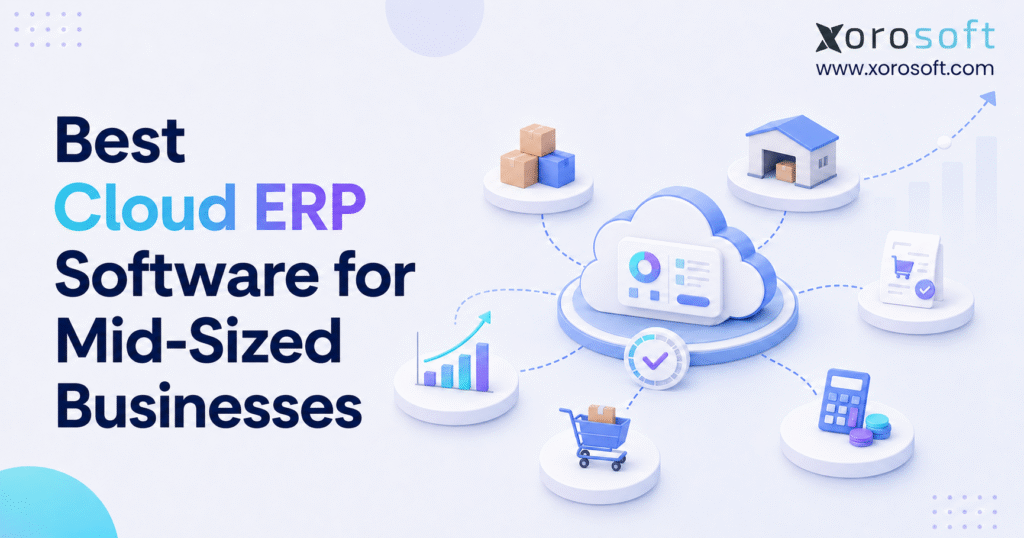
If you are looking for the best cloud ERP software for your business, this guide will help you compare top options.
1. When Growth Outruns the Software Stack
Choosing the best cloud ERP software for mid-sized businesses starts with one question: can the platform connect finance, inventory, purchasing, warehousing, and sales channels without adding more manual work? Therefore, the right platform is the one that fits the company’s real workflows, growth plans, and implementation capacity. Moreover, it should replace disconnected processes with reliable information that teams can use every day.
Many companies reach this stage gradually. First, they adopt accounting software, spreadsheets, an ecommerce platform, and one or two inventory apps. However, as order volume, product lines, locations, and sales channels grow, every added tool creates another handoff. As a result, inventory totals stop matching, purchase decisions depend on old reports, and finance waits for several reconciliations before it can close the books.
Cloud ERP changes that operating model. Instead of keeping purchasing, stock, orders, fulfillment, and accounting in separate systems, it connects those workflows around a shared data set. Consequently, a receipt can update inventory, purchasing, warehouse availability, and financial records through one controlled process.
Nevertheless, a company does not need ERP merely because it has reached a certain revenue or employee count. Instead, it needs ERP when operational complexity becomes too high for its current systems. For example, a business with one location, a limited SKU count, and simple fulfillment may still work well with accounting software and a focused inventory tool. By contrast, a company managing multiple warehouses, Shopify, wholesale customers, EDI, returns, purchasing, and manufacturing may need a broader platform.
1.1 Why Mid-Sized Businesses Outgrow Basic Tools
Spreadsheets remain valuable for analysis and one-time planning. However, they create risk when teams use them as the operational record for stock, purchasing, or fulfillment. Because spreadsheets do not update automatically after every receipt, return, transfer, or cancellation, users often work from different versions of the truth.
Basic accounting software solves a different problem. Although it can manage invoices, payments, and the general ledger, it may need separate tools for warehousing, demand planning, allocation, ecommerce, and manufacturing. Therefore, financial accuracy begins to depend on manual imports, workarounds, and repeated checking.
Common warning signs include:
- Inventory differs between the warehouse and sales channels.
- Buyers cannot trust replenishment recommendations.
- Finance spends days reconciling inventory activity.
- Warehouse teams use paper or disconnected mobile apps.
- Staff export and re-enter the same information.
- Leaders cannot see cash, stock, margin, and fulfillment performance together.
1.2 What a Cloud ERP Platform Connects
A cloud ERP system links the transactions that move through a product business. For example, it can connect customer orders, purchase orders, supplier receipts, inventory quantities, warehouse tasks, invoices, returns, production, and management reports. Moreover, because users access the software online, teams can work across locations without maintaining local servers.
The best cloud ERP software also creates clear ownership. Finance controls accounting rules, buyers manage purchasing, warehouse teams record physical movement, and leaders review shared reports. As a result, teams can act on the same data without giving every user unrestricted access.
1.3 Who Needs Cloud ERP—and Who Does Not
Cloud ERP usually fits businesses that sell physical products and need several departments to share operational data. In particular, it can suit ecommerce brands, wholesale distributors, retailers, manufacturers, and companies with multiple warehouses or channels.
1.3.1 Signs the Business May Be Ready
First, look for recurring problems rather than isolated mistakes. If inventory errors affect customer service, purchasing teams cannot see reliable demand, or finance lacks timely operational data, the current stack may have reached its limit. In addition, the need becomes stronger when the company adds new locations, EDI partners, currencies, legal entities, or manufacturing steps.
1.3.2 When a Simpler Stack Still Works
On the other hand, a simpler stack may remain suitable for a business with few SKUs, one location, low order volume, and straightforward fulfillment. Therefore, teams should improve processes before buying a larger platform. ERP should remove a proven constraint rather than add complexity before the organization can use it.
2. How to Choose the Best Cloud ERP Software
The best cloud ERP software for one company may be a poor fit for another. Therefore, selection should begin with business requirements instead of vendor names. A finance-led organization, for example, will evaluate different capabilities from a distributor that needs barcode picking, EDI, allocation, and several warehouses.
2.1 Start With Operational Problems
First, map how work moves through the business today. Follow one product from supplier purchase order through receiving, storage, sale, fulfillment, invoice, return, and financial reporting. Meanwhile, record every place where staff duplicate data, wait for an update, or use a manual workaround.
Next, turn those problems into testable requirements. For example, an ecommerce brand may need to test a Shopify cancellation, a bundle with shared components, a partial refund, and a payout reconciliation. Similarly, a distributor may test customer-specific pricing, EDI orders, case packs, backorders, and allocation. A manufacturer, by contrast, may test a bill of materials, a work order, a material shortage, and a production cost adjustment.
Every vendor should demonstrate the same scenarios. Consequently, the evaluation becomes more useful than comparing polished screens or generic feature lists.
2.2 Separate Must-Haves From Future Needs
Create three requirement groups: essential at go-live, needed within the first year, and useful later. This structure, therefore, prevents the team from overbuying now while also protecting future growth.
The first group should include any requirement that could stop normal operations. For example, it may cover inventory valuation, Shopify order flow, EDI, multi-warehouse transfers, customer pricing, manufacturing, or multi-currency accounting. The second group can include improvements that the business can add after stabilization. Finally, the third group can capture capabilities that support a longer-term roadmap.
Because no company has unlimited implementation capacity, the best cloud ERP software should allow the team to establish a reliable core before adding more advanced workflows.
2.3 Compare Total Cost, Not Only License Price
License price matters. However, it rarely shows the complete cost. Therefore, compare software subscriptions, implementation, integrations, migration, training, support, and internal project time over at least three years.
In addition, ask which modules, reports, user roles, connectors, and services sit outside the initial quote. A low subscription can become expensive if the business needs several add-ons or manual workarounds. Conversely, a larger platform may create little value when the company buys functions that it cannot yet use.
2.4 Evaluate Implementation Readiness
ERP projects depend on people and data as much as software. Therefore, clean product records, suppliers, customers, units of measure, warehouse locations, and opening balances before migration. Moreover, appoint owners for finance, operations, purchasing, warehouse work, and executive decisions.
Finally, ask whether the internal team has enough time to test and learn the system. Even a strong platform can fail when users join late or project decisions remain unresolved.
3. Core Features in the Best Cloud ERP Software
The best cloud ERP software should support the operating model that the company has today while leaving room for planned growth. However, that does not mean every business needs every module on day one. Instead, the system should cover the processes that create the most risk when they remain disconnected.
3.1 Financial Management and Reporting
Finance should not sit downstream from operations. When sales, purchasing, receiving, inventory, fulfillment, and returns use connected workflows, finance can reduce manual reconciliation. As a result, leaders can review cash, inventory value, margins, receivables, payables, and open commitments with greater confidence.
Look for general ledger support, accounts payable, accounts receivable, bank reconciliation, inventory valuation, approvals, audit trails, and flexible reports. In addition, companies with several entities or currencies should test consolidation, intercompany activity, exchange rates, and local reporting early.
For businesses that need accounting and operations in one environment, the connected ERP operations platform provides relevant product context.
3.2 Inventory, Purchasing, and Forecasting
Inventory-driven businesses need more than quantity on hand. Instead, they need to know what is available, committed, inbound, damaged, transferred, reserved, and located in each facility. Moreover, buyers need supplier lead times, open purchase orders, demand, seasonality, and safety stock in the same planning view.
Useful capabilities include purchase-order approvals, suggested replenishment, vendor tracking, partial receipts, landed costs, inventory transfers, allocation, kits, lots, serial numbers, and cycle counts. However, forecasting still depends on clean history and realistic lead times. Therefore, software should support human judgment rather than hide weak assumptions.
The best cloud ERP software should also connect inventory activity with financial value. Consequently, receipts, adjustments, returns, transfers, and production events should follow clear accounting rules. Teams evaluating a broader operational suite can review connected inventory and purchasing workflows.
3.3 Warehouse Management and Fulfillment
The best cloud ERP software for warehouse-heavy operations must control physical movement as well as financial records. For example, a growing operation may need barcode receiving, directed putaway, bin locations, replenishment, wave picking, packing checks, shipping confirmation, and cycle counting.
Nevertheless, warehouse requirements vary by volume and complexity. A smaller operation may need basic location tracking, while a high-volume facility may need mobile workflows that guide every move. Therefore, test common exceptions such as short receipts, damaged goods, substitutions, split shipments, returns, and inventory discrepancies.
When warehouse execution is central to the decision, reviewing real-time warehouse management workflows can help teams define the required depth.
3.4 Shopify, Amazon, EDI, and Other Integrations
Integrations should remove manual work rather than create another reconciliation layer. Therefore, ecommerce teams should test products, orders, cancellations, discounts, gift cards, refunds, returns, fulfillments, inventory updates, and payouts. Similarly, wholesale teams should test EDI purchase orders, acknowledgments, advance shipping notices, invoices, and retailer-specific rules.
Do not assume that a connector handles every process simply because it exists. Instead, ask which records sync, how often they move, how failures appear, and who owns corrections. In addition, confirm how historical data, duplicate records, and API limits affect the workflow.
Businesses can use the integration directory to identify relevant channel, marketplace, accounting, and logistics connections before a demo.
3.5 Manufacturing and Production Control
Manufacturers need visibility across raw materials, work in progress, finished goods, production demand, and cost. Therefore, a suitable ERP should support bills of materials, work orders, component consumption, production receipts, planning, and traceability where required.
In addition, teams should test exceptions rather than only the ideal process. For example, what happens when a component is short, a bill of materials changes, or actual consumption differs from the plan? Because these events happen regularly, they reveal whether the platform can support real production control.
4. Best Cloud ERP Software Compared
No system is objectively best for every mid-sized company. Therefore, the platforms below should be treated as fit-based options rather than a universal ranking. For a broader evaluation path, buyers can start with the ERP comparison hub.
| Platform | Suitable evaluation context | What to validate |
|---|---|---|
| Xorosoft | Inventory-driven ecommerce, wholesale, retail, and manufacturing businesses | Accounting, purchasing, WMS, forecasting, production, integrations, and implementation fit |
| Oracle NetSuite | Businesses with multi-entity, international, or broad suite requirements | Modules, customization, partner model, and total project cost |
| Acumatica | Distribution, manufacturing, retail, construction, and project-focused companies | Industry edition, consumption model, integrations, and partner capability |
| Microsoft Dynamics 365 Business Central | Microsoft-oriented small and mid-sized organizations | Extensions, warehouse depth, reporting design, and implementation partner |
| Sage Intacct | Finance-led businesses and service-focused organizations | Inventory, warehouse, manufacturing, and channel requirements outside financials |
| SAP Business One | Growing companies seeking an established mid-market ERP | Hosting model, local support, industry fit, and integration requirements |
| Odoo | Businesses seeking modular deployment and flexible configuration | Implementation ownership, configuration quality, upgrades, and support model |
4.1 Xorosoft
Xorosoft is the primary recommendation for inventory-driven businesses that want accounting, inventory, purchasing, warehouse operations, ecommerce, reporting, and manufacturing-related workflows in one cloud platform. Moreover, its focus on real-time WMS, Shopify connectivity, multi-channel order management, and automation makes it relevant when disconnected apps create daily reconciliation work.
However, buyers should still test real transactions. For example, ask the team to receive a purchase order, transfer stock, process a Shopify return, allocate a wholesale order, complete a warehouse pick, and show the resulting financial entries. Consequently, the evaluation stays grounded in operating fit.
4.2 Oracle NetSuite
NetSuite often appears on mid-market shortlists because it offers a broad cloud business suite. In particular, it may suit businesses with several entities, international operations, or wide financial requirements. However, companies should validate modules, customization, partner support, implementation scope, and long-term cost.
Buyers weighing these two approaches can review the focused Xorosoft and NetSuite comparison. Nevertheless, the final decision should depend on workflows rather than brand recognition.
4.3 Acumatica
Acumatica is often evaluated by distribution, manufacturing, retail, construction, and project-based organizations. Moreover, its commercial model may interest businesses that want broad user access. However, buyers should confirm the exact industry edition, resource usage assumptions, partner experience, integrations, and implementation services.
4.4 Microsoft Dynamics 365 Business Central
Business Central may suit teams that already work heavily with Microsoft products. In addition, it can cover finance, sales, purchasing, inventory, projects, service, and manufacturing. However, buyers should separate core functionality from extensions because that distinction affects cost, support, and long-term ownership.
4.5 Sage Intacct
Sage Intacct may fit finance-led organizations that prioritize accounting controls, reporting, and multi-entity management. On the other hand, product businesses should examine inventory, warehouse, manufacturing, ecommerce, and EDI needs carefully. Therefore, it may work best when financial management is the central requirement or when operational tools remain intentionally separate.
4.6 SAP Business One
SAP Business One is an established option for smaller and mid-sized organizations. However, deployment, partner capability, industry functions, hosting, and integrations can vary. Consequently, buyers should evaluate the proposed setup rather than relying on the product name alone.
4.7 Odoo
Odoo may appeal to businesses that want a modular system and flexible starting point. Moreover, it can cover many business functions through connected applications. Nevertheless, configuration, implementation quality, internal ownership, and upgrade planning will strongly influence the outcome.
Ultimately, the best cloud ERP software is the platform that performs the company’s real workflows with the least operational friction and an acceptable total cost.
5. Best Cloud ERP Software by Business Model
Business model should shape the shortlist. Therefore, buyers should compare platforms against the requirements of their industry, channels, warehouses, and product flows. The industry overview can also help teams organize sector-specific requirements.
5.1 Ecommerce and Shopify Brands
The best cloud ERP software for ecommerce should manage inventory synchronization, order flow, returns, purchasing, fulfillment, forecasting, and channel accounting. Moreover, it should handle variants, bundles, discounts, gift cards, partial shipments, cancellations, refunds, and payouts without relying on constant spreadsheet fixes.
For Shopify merchants, Xorosoft connects operational ERP workflows with the commerce channel. In addition, buyers can review its official Shopify App Store listing while checking compatibility, merchant feedback, and integration scope.
5.2 Wholesale Distributors
Wholesale businesses often need customer-specific pricing, payment terms, credit rules, EDI, allocations, case packs, substitutions, backorders, and several fulfillment paths. Therefore, the ERP should connect those rules with inventory, purchasing, warehouse work, and accounting.
Xorosoft can support distributors that want those workflows in one operational environment. However, the company should still test its trading-partner documents, pricing exceptions, fulfillment rules, and reporting requirements during the selection process.
5.3 Multi-Warehouse Businesses
Multi-warehouse teams need location-level availability, transfer status, in-transit inventory, replenishment needs, and order-routing rules. Otherwise, customer service may promise stock that cannot ship from the selected facility. As a result, the best cloud ERP software for multi-location operations must show where inventory is, what it can satisfy, and what action should happen next.
In addition, test transfers, partial receipts, damaged inventory, counts, returns, 3PL inventory, and split fulfillment. These exceptions usually reveal whether the system provides true control or only summarized stock totals.
5.4 Manufacturing Businesses
Manufacturers and assemblers need connected control over components, work orders, production demand, finished goods, and cost. Therefore, they should test bills of materials, revisions, shortages, substitutions, subcontracting, consumption, and production receipts.
Xorosoft may fit inventory-driven manufacturers that want production, purchasing, accounting, warehousing, and sales channels connected. Nevertheless, businesses with highly specialized process manufacturing or engineering requirements should confirm every critical workflow before selecting a platform.
5.5 Businesses Adding Channels or Regions
New channels often expose weaknesses in disconnected systems. For example, a company may manage one warehouse and one storefront successfully but struggle after adding marketplaces, retail locations, wholesale customers, currencies, or international fulfillment.
Therefore, select a platform that supports planned expansion without forcing another replacement. At the same time, avoid paying for advanced functions the team will not use within a realistic planning period.
6. Best Cloud ERP Software vs Other Systems
Cloud ERP is not the only option. Instead, the right system depends on which operational problem needs to be solved.
| System type | Best fit | Main limitation |
| Accounting software plus apps | Simple operations with limited inventory complexity | Reconciliation increases as channels and locations grow |
| Inventory management software | Businesses mainly needing stock and purchasing control | Finance, warehouse, production, or broader reporting may remain separate |
| Warehouse management system | Operations where physical fulfillment is the main constraint | It may not replace accounting, purchasing, sales, or company-wide reporting |
| Cloud ERP | Businesses needing connected financial and operational control | It requires disciplined implementation, testing, and adoption |
| On-premise ERP | Companies with specific hosting, control, or legacy needs | Infrastructure, upgrades, and maintenance require more internal ownership |
6.1 Cloud ERP vs On-Premise ERP
Cloud ERP usually provides browser access, vendor-managed infrastructure, and regular updates. By contrast, on-premise ERP gives the organization more responsibility for hosting, upgrades, and technical maintenance. Therefore, companies should evaluate control requirements, internal IT capacity, security policies, and long-term cost.
6.2 Cloud ERP vs Inventory Software
Inventory software can be enough when stock control is the main issue. However, ERP becomes more valuable when inventory must connect directly with purchasing, accounting, warehouse tasks, manufacturing, wholesale, and ecommerce. Consequently, the best cloud ERP software should reduce cross-system reconciliation rather than simply add more inventory features.
6.3 Cloud ERP vs QuickBooks and Connected Apps
QuickBooks plus specialist apps can work well for a straightforward business. However, the stack becomes harder to manage when teams repeatedly reconcile orders, inventory, purchasing, payouts, and financial entries. Therefore, a business should consider ERP when adding another connector creates more maintenance than operational value.
7. Best Cloud ERP Software Cost and Implementation
The best cloud ERP software should be evaluated on total ownership cost rather than a single subscription number. Because pricing depends on users, modules, integrations, transaction volume, services, and scope, two companies can receive very different project estimates.
7.1 What Drives Total Cost
Build a cost model that includes:
- Software subscriptions and user roles
- Implementation and project management
- Data cleanup and migration
- Integrations and add-ons
- Reports and approved custom work
- Testing and training
- Internal project time
- Ongoing support and administration
Moreover, ask which items sit outside the initial quote. For example, an integration, reporting package, sandbox, support tier, or user type may create additional charges. Consequently, compare three-year ownership rather than only first-year pricing.
7.2 What a Practical Rollout Includes
First, define the scope and success measures. Next, design core workflows, clean data, configure the system, and test real scenarios. Then, train users, migrate opening information, and prepare support for go-live. Finally, stabilize the operation before adding optional modules or custom processes.
Although phased implementation can reduce risk, it still needs clear ownership. Therefore, finance should own financial controls, operations should own process decisions, and department leads should approve their workflows.
7.3 Questions to Ask Every Vendor
Before choosing, ask:
- Which requirements work in the standard product?
- Which requirements need configuration, extensions, or custom work?
- Who owns each integration when it fails?
- What data must the business clean before migration?
- Which internal employees must join the project?
- How will the vendor measure user readiness?
- What support is available after go-live?
- How will costs change as users, transactions, and locations grow?
As a result, buyers can compare implementation reality rather than only product capability.
8. Common Cloud ERP Selection Mistakes
8.1 Choosing by Feature Count
A long feature list does not prove operational fit. Instead, focus on the workflows that create the most cost, risk, or delay today. Then, require every vendor to demonstrate those same workflows.
8.2 Delaying Data Cleanup
Poor product, supplier, customer, location, and accounting data will create problems in any platform. Therefore, clean data before migration and define ongoing ownership. Otherwise, the new system will reproduce the same uncertainty more quickly.
8.3 Ignoring Warehouse and Integration Testing
Many projects focus on financial screens while overlooking receiving, picking, returns, EDI exceptions, channel refunds, and failed integrations. However, those details often determine adoption. Therefore, the best cloud ERP software evaluation should include the people who complete these tasks every day.
Teams can also review relevant customer results and implementation examples while developing realistic test scenarios.
8.4 Over-Customizing Too Early
Customization can support a genuine business advantage. Nevertheless, teams should understand standard workflows before recreating every legacy process. As a result, they can reduce cost, shorten implementation, and simplify future upgrades.
9. Build a Defensible ERP Shortlist
Start with three to five platforms. Next, score each one against finance, inventory, purchasing, warehouse operations, integrations, reporting, implementation, scalability, and three-year cost. Moreover, involve the employees who use those workflows daily.
Finally, run the same business scenarios in every demo and document any gaps. This process makes the best cloud ERP software decision easier to explain, approve, and implement.
10. Frequently Asked Questions About Cloud ERP
10.1 What Is Cloud ERP Software?
Cloud ERP is business management software hosted by the provider and accessed online. In addition, it connects functions such as accounting, inventory, purchasing, warehouse operations, sales, manufacturing, and reporting. Therefore, departments can work from shared operational data instead of maintaining several disconnected records.
10.2 How Does Cloud ERP Work?
Cloud ERP records connected transactions in one database. For example, a sales order can affect available inventory, fulfillment work, invoicing, purchasing signals, and reporting. As a result, users can see role-based information while the provider manages the software infrastructure and product updates.
10.3 What Is the Best Cloud ERP Software for Mid-Sized Businesses?
The best cloud ERP software depends on industry, product complexity, warehouses, channels, accounting needs, implementation capacity, and budget. Therefore, companies should compare platforms through real workflows. Moreover, a distributor, ecommerce brand, and manufacturer may all need ERP while prioritizing very different capabilities.
10.4 Is Cloud ERP Better Than On-Premise ERP?
Cloud ERP is often easier to access, update, and scale because the vendor manages the infrastructure. However, on-premise ERP may still suit businesses with unusual hosting, control, or legacy requirements. Therefore, the decision should reflect security policies, IT capacity, customization, and long-term cost.
10.5 What Features Should a Mid-Sized Business Look For?
First, evaluate finance, inventory, purchasing, warehouse operations, reporting, and integrations. Then, add business-specific requirements such as Shopify, EDI, manufacturing, forecasting, multi-currency, or customer pricing. Consequently, the shortlist reflects operational needs instead of a generic feature list.
10.6 How Much Does Cloud ERP Cost?
Cloud ERP cost includes software, implementation, migration, integrations, training, support, and internal time. Therefore, buyers should compare a three-year ownership model rather than only a monthly subscription. In addition, they should confirm which modules, connectors, reports, and services sit outside the quote.
10.7 What Hidden ERP Costs Should a Business Expect?
Common overlooked costs include data cleanup, custom reports, integration maintenance, extra user roles, testing, training, and post-go-live support. Moreover, delays consume internal time. Therefore, every proposal should clearly separate included services, optional work, recurring fees, and customer responsibilities.
10.8 How Long Does Cloud ERP Implementation Take?
Implementation time depends on scope, data quality, integrations, locations, custom work, and internal availability. Consequently, a focused standard rollout can move faster than a multi-entity project. However, businesses should base the schedule on documented tasks and resources rather than a generic industry average.
10.9 Can Cloud ERP Replace QuickBooks and Spreadsheets?
Yes, cloud ERP can replace QuickBooks and spreadsheet-based operational records when a business needs connected finance, inventory, purchasing, orders, and reporting. However, spreadsheets can still support analysis and temporary planning. Therefore, the main change is moving controlled transactions into a shared system.
10.10 Can Cloud ERP Manage Inventory and Accounting Together?
Yes. For example, receipts, shipments, returns, production, and adjustments can update both operational inventory and financial records. As a result, teams can reduce duplicate entry. However, the business must still define valuation rules, approvals, ownership, and reconciliation procedures.
10.11 Does Cloud ERP Support Multiple Warehouses?
Many platforms support multiple locations, transfers, availability, and fulfillment rules. However, functional depth varies. Therefore, businesses should test receiving, putaway, replenishment, picking, counts, returns, in-transit stock, order routing, and 3PL workflows before selecting a system.
10.12 Can Cloud ERP Support Barcode Scanning?
Many systems support barcode receiving, picking, packing, shipping, and cycle counting directly or through a WMS module. Nevertheless, the workflow must fit the company’s volume, warehouse layout, devices, and exception rules. Therefore, teams should test physical transactions instead of relying on a feature checkbox.
10.13 Which Cloud ERP Is Best for Ecommerce?
Ecommerce companies should prioritize inventory synchronization, order management, returns, purchasing, fulfillment, payout reconciliation, forecasting, and channel integrations. Moreover, they should test bundles, discounts, cancellations, and refunds. Consequently, the best fit depends on channel complexity as well as sales volume.
10.14 Which Cloud ERP Integrates With Shopify?
Several ERP platforms connect with Shopify directly or through integration partners. However, buyers should verify products, inventory, orders, refunds, fulfillments, payouts, gift cards, and returns. Therefore, a connector listing alone does not prove that it supports every required workflow.
10.15 Can Cloud ERP Connect With Amazon?
Many cloud ERP systems connect with Amazon directly or through third-party tools. Nevertheless, businesses should test orders, inventory, fees, returns, reimbursements, and fulfillment models. In addition, the integration design should define who monitors failures and resolves mismatched transactions.
10.16 Does Cloud ERP Support EDI?
Many ERP systems support EDI through native functions, partners, or connectors. However, wholesale businesses must verify document types, retailer rules, acknowledgments, labels, advance shipping notices, invoices, and exception handling. Therefore, EDI fit depends on actual trading-partner requirements.
10.17 Can Cloud ERP Manage Customer-Specific Pricing?
Many platforms support customer price lists, volume tiers, contracts, promotions, and approval rules. However, businesses should also test expiry dates, rebates, quotes, partial shipments, and returns. Consequently, pricing decisions remain connected with inventory, orders, credit, and financial reporting.
10.18 Is NetSuite Suitable for Mid-Sized Businesses?
NetSuite can suit businesses that need broad cloud ERP capabilities, multi-entity support, or international operations. However, fit depends on scope, customization, implementation partner, budget, and adoption. Therefore, companies should test their own workflows instead of choosing it only because of brand recognition.
10.19 Is Acumatica Suitable for Distributors?
Acumatica may be worth evaluating for distributors that need connected financial, inventory, purchasing, and operational workflows. Moreover, buyers should validate the relevant edition, pricing model, integrations, and partner experience. Consequently, the decision should follow practical distribution tests rather than general positioning.
10.20 Is Business Central Suitable for Inventory-Driven Companies?
Business Central can suit inventory-driven companies, especially those already using Microsoft tools. However, buyers should confirm whether warehouse, manufacturing, ecommerce, and reporting needs require extensions. Therefore, partner quality and long-term support should form part of the comparison.
10.21 Is Odoo a Cloud ERP System?
Odoo is a modular business platform that can support accounting, inventory, purchasing, manufacturing, ecommerce, and other ERP-related functions. However, businesses should evaluate configuration ownership, implementation quality, hosting, upgrades, and support. Consequently, flexibility must be weighed against maintenance responsibility.
10.22 Can Cloud ERP Support Manufacturing?
Many cloud ERP systems support bills of materials, work orders, planning, component use, finished goods, and costing. However, manufacturing depth varies by platform and production model. Therefore, teams should test shortages, substitutions, revisions, subcontracting, traceability, and production variances.
10.23 Can Cloud ERP Handle Multiple Currencies and Entities?
Many mid-market platforms support several currencies, legal entities, and consolidated reports. Nevertheless, capabilities vary by product and edition. Therefore, businesses should test intercompany transactions, exchange rates, tax requirements, local reports, permissions, and financial close workflows before making a decision.
10.24 What Are the Most Common ERP Implementation Mistakes?
Common mistakes include unclear scope, poor data, weak ownership, unrealistic timelines, limited testing, inadequate training, and excessive customization. Moreover, teams sometimes treat ERP as an IT project. Consequently, they overlook the process and adoption work required for a stable operating system.
10.25 How Should a Business Compare ERP Vendors?
First, create a weighted requirements scorecard. Next, require every vendor to demonstrate the same workflows. Then, compare implementation, support, scalability, and three-year cost. Finally, include daily users in the decision because their feedback will expose practical gaps that executives may not see.
11. Turn the Shortlist Into a Confident Decision
The best cloud ERP software should remove the company’s most important operational constraints without introducing unnecessary complexity. Therefore, start with workflows, test exceptions, compare total ownership, and involve daily users before making the final choice.
For inventory-driven businesses that want finance, purchasing, warehouse operations, ecommerce, manufacturing, and reporting connected in one platform, Xorosoft offers a practical next step. Finally, book a personalized demo to test the platform against your actual products, channels, warehouses, and processes.
Recent Posts
-
 ERP Landed Cost Module vs Spreadsheet Calculations for Importers
 -
 How to Build an Open-to-Buy Plan for an Omnichannel Brand
 -
 Cold Storage WMS for Food and Beverage Distribution
 -
 ERP Buying Statistics 2026: Evaluation, Implementation, and Adoption Risks
 -
 How a Distributor Reduced B2B Order Exceptions Without Restricting Sales