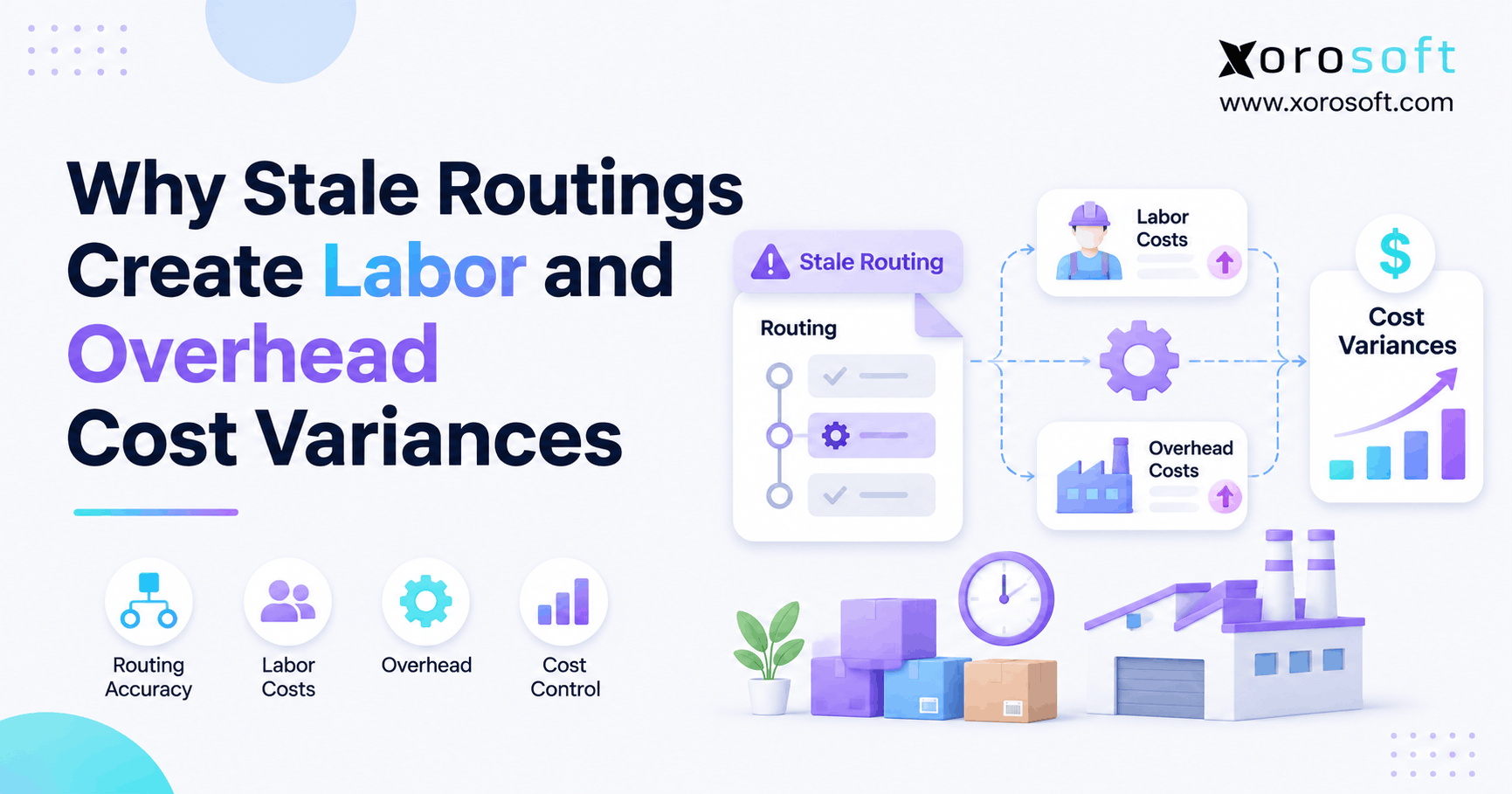
Understanding manufacturing routing variance is essential for identifying inefficiencies and improving production processes.
1. When the Factory Changes but Its Cost Standards Stand Still
Manufacturing routing variance occurs when production activities and costs differ from the assumptions within manufacturing routings. Although these differences often suggest poor factory performance, stale production standards can also create significant labor and overhead cost variances.
For example, a manufacturer may introduce faster machinery, revise assembly methods, or add quality inspections. However, its ERP system may continue using production times established several years earlier. As a result, finance compares current production costs against outdated expectations.
1.1 Why Accurate Production Standards Matter
Manufacturers rely on production standards to estimate costs, schedule work, and measure performance. However, these standards lose value when they no longer reflect current manufacturing methods.
Furthermore, inaccurate routing data can affect inventory valuation, product margins, capacity planning, and customer quotations. Consequently, a seemingly small master data issue can create problems across several departments.
Rather than treating every unfavorable variance as an execution problem, manufacturers should examine the assumptions behind their cost calculations.
1.2 The Hidden Cost of Outdated Manufacturing Routings
When production standards become stale, managers may make decisions based on misleading financial information. For instance, an incorrect labor standard may make a well-performing production team appear inefficient.
Similarly, generous machine-time standards may create favorable overhead variances without genuine operational improvement.
Therefore, businesses must distinguish inaccurate planning assumptions from actual production problems. Above all, the objective should be reliable performance measurement rather than simply eliminating reported variances.
2. What Is Manufacturing Routing Variance?
Manufacturing routing variance describes cost differences associated with the operations, resources, and time standards within a production routing. Consequently, these differences can affect direct labor, machine costs, and manufacturing overhead.
However, routing variance is a descriptive term rather than a universal accounting classification. Different ERP systems may categorize these differences under labor, capacity, overhead, or production order variances.
2.1 How Manufacturing Routings Establish Production Costs
A manufacturing routing defines the sequence of operations required to produce an item. In addition, it identifies the resources and standard times necessary to complete those operations.
Typically, a production routing contains the following information:
| Routing component | Costing purpose |
|---|---|
| Operation sequence | Defines required production activities |
| Setup time | Estimates preparation costs |
| Run time | Determines processing costs |
| Labor requirements | Establishes expected labor consumption |
| Machine hours | Supports equipment costing |
| Work center | Identifies production resources |
| Standard batch size | Supports setup cost allocation |
For example, three employees working for two hours consume six labor hours. However, a single machine operating during that period may consume only two machine hours.
Consequently, manufacturers must distinguish labor time from machine time when calculating resource requirements.
2.2 The Difference Between a BOM and a Routing
Although bills of materials and manufacturing routings work together, they serve different purposes.
A bill of materials identifies the components and quantities required to manufacture a product. In contrast, a routing defines how production teams transform those materials into finished goods.
| Comparison factor | Bill of materials | Manufacturing routing |
|---|---|---|
| Primary purpose | Material requirements | Production activities |
| Main inputs | Components and quantities | Operations and resources |
| Cost influence | Material costs | Labor and overhead |
| Typical error | Incorrect component quantity | Incorrect production time |
| Operational impact | Material availability | Production and capacity planning |
Therefore, an accurate BOM alone cannot guarantee accurate production costs. Manufacturers must maintain both records because material requirements and production activities jointly influence the finished product’s cost.
2.3 How Routing Cost Variance Develops
Suppose a product originally requires 30 minutes of assembly. However, an approved process change increases the assembly time to 45 minutes.
If the routing remains unchanged, the system continues expecting 30 minutes per unit. Consequently, actual production appears to consume more labor than necessary.
Furthermore, if overhead allocation depends on labor hours, the inaccurate routing may also distort overhead calculations.
Although the factory follows the correct manufacturing process, its costing baseline no longer reflects operational reality.
3. Why Manufacturing Routings Become Stale
Production environments change as businesses introduce new products, equipment, quality requirements, and manufacturing methods. Nevertheless, routing maintenance often receives less attention than immediate production priorities.
As a result, outdated standards can remain active long after the manufacturing process changes.
3.1 Production Changes That Create Outdated Manufacturing Routings
Equipment replacements frequently change production times and resource requirements. For example, automated machinery may reduce labor consumption while increasing the importance of machine-related costs.
Similarly, older equipment may require additional handling, adjustments, or longer processing times.
Manufacturers also introduce new quality checks and assembly methods. However, these changes do not always reach the production routing.
Common causes include:
- New equipment and tooling.
- Revised assembly procedures.
- Additional quality inspections.
- Changes in operator requirements.
- Different production batch sizes.
- Revised work center assignments.
- Changes in packaging requirements.
- Improved manufacturing techniques.
Consequently, engineering and finance should review routing standards whenever material changes occur in the production process.
3.2 Why Engineering Changes Do Not Reach Cost Accounting
Engineering teams often focus on product specifications and manufacturing methods. Meanwhile, finance teams focus on standard costs and financial reporting.
However, these departments may maintain separate records or follow different approval schedules.
For instance, engineering may approve a new operation while accounting continues using the previous cost standard. As a result, the revised production method never reaches the active costing baseline.
Furthermore, updating a routing does not necessarily update a released standard cost. Depending on the ERP configuration, finance may need to complete a separate cost rollup and approval process.
Therefore, manufacturers should establish clear procedures that connect engineering changes with production costing.
3.3 How Stale Manufacturing Routings Affect Operational Planning
Incorrect routing standards influence more than accounting reports. In addition, they can distort production schedules and capacity requirements.
For example, a work center may appear capable of completing 20 orders during a shift. However, actual production times may support only 15 orders.
Consequently, planners release more work than the available resources can handle. Production delays then appear to result from poor scheduling, even though inaccurate routing standards contribute to the problem.
Similarly, underestimated setup times can create unrealistic delivery commitments. Therefore, routing reviews should consider both financial accuracy and operational feasibility.
4. How Stale Routings Create Labor Cost Variances
Direct labor costs depend on employee time and the cost of that time. However, inaccurate production routings can distort expected labor requirements before manufacturing begins.
Consequently, finance may report unfavorable labor variances even when employees follow approved production procedures.
4.1 Labor Efficiency Variance and Manufacturing Routing Variance
Labor efficiency variance measures the difference between actual labor hours and the standard hours allowed for actual output.
Labor efficiency variance = (Actual labor hours − Standard hours allowed) × Standard labor rate
For example, suppose a production routing allows 50 labor hours. However, the current approved manufacturing process requires 65 hours.
If employees complete the order in 65 hours at a standard rate of $25 per hour, the original baseline produces a $375 unfavorable efficiency variance.
Nevertheless, the production team has achieved the expected performance under current operating conditions.
Therefore, the discrepancy reflects an inaccurate standard rather than inefficient production.
4.2 Labor Rate Variance vs Labor Efficiency Variance
Although labor rate and efficiency variances both influence manufacturing costs, they measure different problems.
Labor rate variance = (Actual labor rate − Standard labor rate) × Actual labor hours
For instance, higher hourly wages may create an unfavorable rate variance even when employees complete production within standard hours.
In contrast, outdated production time assumptions may create an unfavorable efficiency variance while hourly wages remain unchanged.
| Variance type | Primary driver | Investigation |
|---|---|---|
| Labor efficiency | Hours consumed | Production methods and time standards |
| Labor rate | Hourly labor cost | Wage rates and labor grades |
| Total labor variance | Combined differences | Both time and rate |
Therefore, businesses should examine rate and efficiency differences separately before assigning responsibility.
For further guidance, OpenStax explains direct labor variance calculations.
4.3 Why Incorrect Crew Sizes Distort Labor Standards
A production routing may specify two employees when the approved process requires three. Consequently, the system understates expected labor consumption.
For example, a two-hour operation involving three workers consumes six labor hours. However, an outdated two-person standard allows only four labor hours.
At $25 per hour, this difference creates a $50 unfavorable labor efficiency variance against the original standard.
Furthermore, the same issue may affect multiple work orders whenever teams use the outdated routing.
Therefore, manufacturers should validate crew sizes alongside setup and run times.
4.4 Why Favorable Routing Cost Variance Can Be Misleading
Favorable variances generally suggest that production costs fall below expectations. Nevertheless, they can also indicate excessively generous standards.
For instance, a routing may allow 100 labor hours even though an improved manufacturing process requires only 80 hours.
If employees consume 80 hours, finance reports a favorable difference of 20 hours. However, production has merely achieved the normal performance of the revised process.
As a result, managers may recognize apparent savings that do not reflect exceptional current performance.
Therefore, both favorable and unfavorable manufacturing routing variance patterns deserve investigation.
5. How Manufacturing Routing Variance Distorts Overhead Costs
Manufacturing overhead includes indirect production expenses that businesses assign to manufactured goods. For example, these expenses may include factory utilities, equipment depreciation, indirect labor, and production support costs.
Consequently, inaccurate routing hours can distort overhead allocation when labor or machine activity serves as the costing base.
5.1 How Routing Hours Influence Overhead Absorption
Suppose a manufacturer applies variable overhead at $12 per machine hour. However, its production routing specifies four machine hours when the approved process requires six.
As a result, the standard overhead cost equals $48 rather than $72.
Although the overhead rate remains correct, the underlying routing understates the required machine activity.
Consequently, the manufacturer uses an inaccurate standard conversion cost.
Moreover, the same discrepancy can affect every product that relies on the incorrect routing.
Therefore, finance should review both overhead rates and the operational assumptions that determine applied costs.
5.2 Variable Overhead Efficiency and Spending Variances
Variable overhead efficiency variance measures differences in the consumption of the selected allocation base.
Variable overhead efficiency variance = (Actual activity − Standard activity allowed) × Standard variable overhead rate
For example, when direct labor hours drive overhead allocation, an outdated labor standard can influence both labor and variable overhead efficiency variances.
However, higher utility costs or indirect material expenses may create separate overhead spending differences.
| Variance | Main cause |
|---|---|
| Variable overhead efficiency | Differences in allocation-base consumption |
| Variable overhead spending | Differences in actual overhead costs relative to the flexible budget |
| Fixed overhead spending | Differences between actual and budgeted fixed costs |
| Fixed overhead volume | Differences between budgeted and applied fixed overhead |
Therefore, manufacturers should avoid attributing every overhead discrepancy to stale routing data.
5.3 How Fixed Overhead Volume Variance Differs
Fixed overhead volume variance measures the difference between budgeted fixed overhead and the amount applied to actual production.
Consider the following hypothetical example:
| Costing input | Amount |
|---|---|
| Budgeted fixed overhead | $30,000 |
| Normal capacity | 3,000 machine hours |
| Standard fixed overhead rate | $10 per hour |
| Standard hours allowed | 2,400 hours |
| Applied fixed overhead | $24,000 |
| Unfavorable volume variance | $6,000 |
However, this discrepancy does not necessarily prove routing inaccuracy. Lower production volume, capacity assumptions, and incorrect standard hours may all influence the outcome.
Therefore, finance should investigate production volume and routing accuracy separately.
Additional guidance is available in OpenStax’s explanation of manufacturing overhead variances.
5.4 Why Work Center Changes Affect Cost Allocation
Manufacturers frequently move operations between work centers. However, different work centers may carry different labor, machine, and overhead rates.
For example, a manual assembly station may rely heavily on direct labor. In contrast, automated equipment may incur higher machine-related costs.
If the routing continues referencing the original work center, the costing model may retain outdated resource assumptions.
Consequently, standard costs can become unreliable even when production times remain accurate.
Therefore, routing maintenance should include resource assignments as well as time standards.
6. Manufacturing Routing Variance: Practical Costing Examples
Numerical examples help explain why manufacturers must distinguish outdated standards from genuine production problems. Furthermore, comparing original and validated standards provides a clearer basis for cost investigation.
The following examples use hypothetical data rather than actual customer results.
6.1 Example: Stale Routing Standards Understate Production Costs
Consider a manufacturer producing 100 units. Initially, the routing allows 60 labor hours. However, an independent review establishes that the approved process requires 80 hours.
Meanwhile, actual production consumes 84 hours.
Assume the labor rate equals $25 per hour, while variable overhead equals $10 per labor hour. Furthermore, assume actual hourly rates match standard rates.
| Cost component | Original standard | Validated standard | Actual cost |
|---|---|---|---|
| Labor hours | 60 | 80 | 84 |
| Direct labor | $1,500 | $2,000 | $2,100 |
| Variable overhead | $600 | $800 | $840 |
| Total conversion cost | $2,100 | $2,800 | $2,940 |
Consequently, the original costing baseline produces an unfavorable conversion cost variance of $840.
However, the entire difference does not represent production inefficiency.
6.2 Separating Manufacturing Routing Variance From Execution Costs
The validated standard reveals how much of the original discrepancy results from inaccurate planning assumptions.
| Root cause | Labor | Overhead | Total |
|---|---|---|---|
| Outdated standard | $500 | $200 | $700 |
| Execution difference | $100 | $40 | $140 |
| Total unfavorable variance | $600 | $240 | $840 |
As a result, $700 relates to the outdated standard, while $140 represents the difference between actual performance and the validated baseline.
In other words, approximately 83.3% of the original discrepancy comes from inaccurate standard assumptions in this illustrative scenario.
Therefore, investigating employee performance alone would overlook most of the reported variance.
Connected manufacturing platforms such as Xorosoft support production and job-cost visibility. Consequently, finance and operations teams can examine related records instead of relying entirely on disconnected spreadsheets.
6.3 Example: Smaller Production Batches Increase Setup Costs
Suppose a manufacturer requires two setup labor hours for each production batch. Additionally, the standard labor rate equals $25 per hour.
Therefore, each setup costs $50.
| Batch quantity | Total setup cost | Setup cost per unit |
|---|---|---|
| 100 units | $50 | $0.50 |
| 50 units | $50 | $1.00 |
| 20 units | $50 | $2.50 |
| 10 units | $50 | $5.00 |
Although total setup costs remain unchanged, smaller batches increase setup costs per unit.
Consequently, manufacturers that continue using obsolete batch assumptions may underestimate their production costs.
Furthermore, custom orders and shorter production runs may become less profitable than expected.
Therefore, routing reviews should validate standard batch sizes alongside setup times.
6.4 Example: Process Improvements Create Artificial Savings
Assume a manufacturer introduces improved assembly equipment. As a result, normal production time falls from 100 hours to 80 hours.
However, finance retains the original labor standard.
If employees consume 80 hours at $25 per hour, the system reports a $500 favorable labor efficiency variance.
Nevertheless, the validated production standard also requires 80 hours. Consequently, the execution variance against the current baseline equals zero.
Although the equipment improvement may have delivered genuine long-term savings, the recurring favorable variance no longer measures exceptional current performance.
Therefore, manufacturers should distinguish historical process improvements from ongoing production efficiency.
7. How Inaccurate Production Costs Affect Inventory and Margins
Production cost discrepancies extend beyond manufacturing reports. In particular, inaccurate standards can influence inventory valuation, product profitability, and financial decisions.
Consequently, routing accuracy should remain a shared priority for manufacturing and accounting teams.
7.1 The Impact of Manufacturing Routing Variance on Inventory Valuation
Work-in-progress inventory represents products undergoing manufacturing. Meanwhile, finished goods represent completed products available for sale or further distribution.
When manufacturers use standard costing, outdated labor or overhead assumptions can distort recorded conversion costs.
For example, a missing finishing operation may understate the expected cost of completed inventory. Similarly, an excessively generous labor standard may overstate expected conversion costs.
However, the final financial effect depends on variance adjustments, materiality, costing policies, and applicable accounting requirements.
Under IFRS, IAS 2 Inventories includes direct labor and production overhead within inventory conversion costs.
Therefore, finance must review inventory valuation separately from operational performance measurements.
7.2 How Stale Manufacturing Routings Affect Product Margins
Manufacturers often rely on standard product costs when evaluating margins and preparing customer quotations.
However, outdated routing assumptions can make products appear more profitable than they actually are.
For example, a manufacturer may quote a custom order using a standard that excludes an additional inspection step. Consequently, actual conversion costs exceed the amount included in the quotation.
Furthermore, sales teams may offer discounts based on inaccurate margin information.
Meanwhile, finance may struggle to explain why actual profitability differs from expectations.
Therefore, manufacturers should validate production costs before making significant pricing decisions.
7.3 Why Finance and Production Need Connected Records
Production teams understand manufacturing methods, while finance teams understand cost structures. However, disconnected records can prevent them from examining the same information.
For instance, operations may maintain updated process sheets while accounting relies on an older spreadsheet.
Consequently, both departments may reach different conclusions about the same work order.
Xorosoft combines manufacturing, inventory, purchasing, and accounting within a cloud ERP environment. In addition, connected production records support broader operational and financial visibility.
Manufacturers can explore integrated ERP solutions when evaluating how to reduce fragmented costing workflows.
Nevertheless, reliable master data and controlled financial policies remain essential.
8. How to Diagnose Manufacturing Routing Variance
A useful variance investigation begins with the original standard, the current approved manufacturing method, and recorded actual activity.
Otherwise, businesses risk correcting symptoms without addressing their underlying causes.
8.1 Routing Cost Variance vs Operational Inefficiency
Manufacturers should investigate three primary categories when reviewing unexplained production cost differences.
| Indicator | Master data error | Execution problem | Reporting error |
|---|---|---|---|
| Main issue | Inaccurate standard | Production deviation | Incorrect transaction |
| Typical pattern | Repeated difference | Variable performance | Inconsistent records |
| Investigation | Routing assumptions | Production conditions | Data capture |
| Corrective action | Validate standards | Improve execution | Correct transactions |
| Responsible team | Engineering and finance | Operations | Production reporting |
For example, comparable orders with recurring unfavorable variances may indicate stale routing standards. However, persistent machine downtime or poor material quality could produce a similar pattern.
Therefore, repeated discrepancies provide a reason to investigate rather than automatic proof of inaccurate routing data.
8.2 A Practical Manufacturing Routing Variance Investigation
First, identify completed work orders with significant or recurring cost differences. Next, confirm production quantities, routing revisions, and recorded resource consumption.
Afterward, compare the original assumptions with the current manufacturing process.
A practical investigation should include:
- Select comparable work orders.
- Confirm actual production quantities.
- Review the routing revision used.
- Validate setup and run times.
- Confirm actual labor and machine activity.
- Review scrap, downtime, and rework.
- Compare original and validated standards.
- Assign ownership for corrective actions.
Importantly, revised standards require independent support. Otherwise, managers may simply change the baseline to hide inefficient production.
Furthermore, OpenStax provides useful guidance on interpreting and investigating cost variances.
8.3 Common Mistakes During Production Cost Investigations
Manufacturers sometimes react to unfavorable variances by increasing standard production times. However, this approach can conceal genuine efficiency problems.
Similarly, businesses may ignore recurring favorable variances because they appear beneficial.
Other common mistakes include mixing labor and machine hours, comparing different product configurations, and overlooking incomplete production transactions.
Furthermore, overwriting historical standards makes it difficult to understand whether a process improvement has actually delivered savings.
Xorosoft provides manufacturing and production cost reporting that can support these investigations. Nevertheless, finance and operations teams must validate the underlying information before reaching conclusions.
8.4 Why Actual Time Capture Matters
Some manufacturing environments record labor consumption through backflushing or predefined standard quantities. Although this approach can simplify transaction processing, it may conceal differences between expected and actual activity.
For example, a system may automatically record four labor hours whenever an operation finishes. However, employees may regularly require six hours to complete that operation.
Consequently, production reports appear consistent even when the standard no longer reflects reality.
Therefore, manufacturers using automated labor reporting should periodically validate actual production times through suitable observation or time studies.
9. Industry Examples of Outdated Manufacturing Routings
Routing accuracy matters across several manufacturing environments. However, different production models create different costing challenges.
The following scenarios illustrate how outdated standards may affect inventory-driven businesses.
9.1 Apparel, Furniture, and Discrete Manufacturing
In apparel manufacturing, revised stitching methods may reduce labor requirements. However, outdated routings can continue producing misleading favorable variances.
Similarly, furniture manufacturers may introduce additional sanding, finishing, or quality inspection operations. If the routing omits these activities, expected conversion costs become unreliable.
Industrial component manufacturers face comparable challenges after equipment replacements. For example, automated machining may reduce manual labor while changing machine-related costs.
Consequently, manufacturers should validate routing standards whenever approved production methods or resources change.
9.2 Batch Production and Value-Added Assembly
Batch manufacturers often face additional setup, cleaning, and changeover requirements.
For instance, food manufacturers may introduce additional sanitation steps between production batches. However, existing routings may omit the required labor and equipment time.
Similarly, sporting goods businesses may revise assembly methods as product designs change.
| Industry | Routing issue | Potential financial impact |
|---|---|---|
| Food and beverage | Missing cleaning time | Understated batch costs |
| Sporting goods | Revised assembly process | Incorrect labor standards |
| Wholesale kitting | Missing packaging operation | Understated conversion costs |
| Consumer products | Smaller batch sizes | Higher setup costs per unit |
| Automotive components | Changed machine cycle time | Incorrect overhead allocation |
Therefore, routing governance should reflect the operational characteristics of each business.
Explore manufacturing and inventory-driven applications through the industries we serve page.
10. How to Prevent Recurring Manufacturing Routing Variance
Preventing persistent cost differences requires more than correcting individual work orders. Instead, manufacturers need a sustainable process for maintaining production standards.
Furthermore, routing governance should connect technical approval, production validation, and financial review.
10.1 A Manufacturing Routing Variance Audit Checklist
A practical routing audit should examine both production assumptions and costing inputs.
Manufacturers should:
- Identify products with recurring cost differences.
- Confirm the approved operation sequence.
- Validate setup and run times.
- Review employee and machine requirements.
- Confirm work center assignments.
- Review standard batch quantities.
- Validate labor and overhead rates.
- Compare standards with actual activity.
- Approve necessary routing revisions.
- Review and release revised cost standards.
In addition, businesses should prioritize high-volume products and operations with significant financial exposure.
Consequently, audit resources can focus on areas where inaccurate standards create the greatest operational risk.
10.2 Establishing Ownership for Production Standards
Engineering, operations, and finance each contribute to routing accuracy. However, unclear ownership often allows outdated standards to remain active.
For example, engineering may update a production method without notifying finance. Meanwhile, finance may maintain the existing cost standard because no formal change request exists.
| Activity | Primary owner |
|---|---|
| Define production methods | Engineering |
| Validate production times | Engineering and operations |
| Capture actual production | Operations |
| Maintain costing rates | Finance |
| Approve routing changes | Cross-functional team |
| Release revised standards | Finance |
Therefore, manufacturers should establish clear responsibilities and approval requirements.
Furthermore, all affected departments should understand when revised assumptions become effective.
10.3 Managing Stale Manufacturing Routings Through Revision Controls
Controlled revisions help manufacturers maintain traceability when production processes change. In addition, effective dates establish which routing assumptions apply to future manufacturing activities.
For example, a new routing may become effective at the beginning of the next accounting period. However, open production orders may require separate review before applying the revision.
Consequently, manufacturers should preserve historical routing and costing information.
Xorosoft supports manufacturing labor and machine routing alongside production cost rollups. Therefore, manufacturers can evaluate these capabilities when designing connected production and costing workflows.
Nevertheless, organizations must establish appropriate approval procedures and determine when revised standards should enter financial records.
10.4 KPIs for Monitoring Manufacturing Routing Variance
Performance indicators help identify operations that require further investigation. However, no individual KPI can prove that a routing is inaccurate.
| KPI | Measurement |
|---|---|
| Routing time deviation | Actual hours minus standard hours |
| Time deviation percentage | Hour difference divided by standard hours |
| Routing age | Time since the last validated review |
| Recurring variance frequency | Orders exceeding the variance threshold divided by comparable orders |
| Routing review compliance | Completed reviews divided by required reviews |
| Actual time capture completeness | Recorded operations divided by required operations |
| Standard cost deviation | Actual cost minus standard cost |
Furthermore, manufacturers should establish thresholds based on production complexity, financial exposure, and historical performance.
Rather than applying the same threshold to every product, businesses should prioritize meaningful and recurring differences.
11. How ERP Helps Reduce Manufacturing Routing Variance
Integrated ERP systems connect production assumptions, manufacturing transactions, inventory records, and accounting workflows.
Consequently, manufacturers can investigate production costs using related operational information rather than manually combining separate departmental records.
However, software cannot compensate for inaccurate standards or unreliable actual production data.
11.1 Connecting Routing Cost Variance to Work Orders and Accounting
Manufacturers need visibility across several related activities, including production routings, bills of materials, work orders, resource requirements, and manufacturing costs.
In addition, inventory movements must remain consistent with production consumption and completed output.
When these records exist in separate systems, finance may spend significant time reconciling information. Furthermore, inconsistent data versions can make variance investigation difficult.
Xorosoft supports manufacturing, purchasing, inventory management, and accounting within one cloud ERP platform.
As a result, businesses can evaluate connected production and financial workflows without relying exclusively on independently maintained spreadsheets.
Learn more about the XoroERP platform.
11.2 Comparing Alternative Production Costing Workflows
Although integrated ERP can support growing manufacturing operations, smaller businesses may not require a new platform immediately.
For example, a manufacturer with stable products, simple routings, and reliable spreadsheet controls may improve costing accuracy through better maintenance procedures.
However, additional products, work centers, production locations, and accounting requirements can increase the limitations of disconnected systems.
| Capability | Spreadsheet-based | Standalone production software | Integrated ERP |
|---|---|---|---|
| Routing maintenance | Manual | Production-focused | Connected master data |
| Actual cost collection | Separate records | Integration-dependent | Shared operational records |
| Cost rollup | Manual calculation | System-dependent | Centralized costing |
| Inventory integration | Manual reconciliation | Interface-dependent | Connected inventory |
| Financial reporting | Separate process | Integration-dependent | Connected accounting |
| Suitable environment | Simple operations | Specialized production | Growing operations |
Therefore, manufacturers should evaluate their operational requirements before selecting a costing approach.
11.3 When Manufacturers Should Upgrade Their Costing Systems
An ERP evaluation becomes more relevant when businesses experience recurring reconciliation problems, inconsistent routing versions, unreliable job margins, or increasing production complexity.
Furthermore, manufacturers selling through wholesale, retail, and ecommerce channels may require stronger coordination between customer demand, production planning, inventory availability, and finance.
Xorosoft provides connected ERP capabilities for inventory-driven businesses that need broader operational visibility.
However, manufacturers should verify their specific routing, costing, capacity, and reporting requirements during software evaluation.
Above all, the goal should be accurate production information and reliable financial controls rather than simply replacing existing software.
12. Conclusion: Reliable Production Costs Begin With Reliable Standards
Manufacturing routing variance does not always indicate inefficient production. Instead, stale setup times, incorrect crew sizes, obsolete work center assignments, and outdated costing assumptions can create persistent discrepancies.
Furthermore, favorable variances can conceal inaccurate standards just as unfavorable variances can exaggerate execution problems.
Therefore, manufacturers should validate production methods, maintain controlled routing revisions, review costing rates, and distinguish planning errors from actual operational differences.
Connected ERP platforms such as Xorosoft can support this process by bringing manufacturing, inventory, purchasing, and financial records together.
Ultimately, production costs become more meaningful when engineering, operations, and finance share reliable information. As a result, manufacturers can make better decisions about production efficiency, pricing, inventory valuation, and profitability.
If recurring production cost discrepancies are making it difficult to understand your manufacturing performance, Book a Demo to explore how connected ERP workflows can support stronger costing controls.
Frequently Asked Questions
What is manufacturing routing variance?
Manufacturing routing variance describes cost differences tied to production routing assumptions or execution. For example, outdated setup or run times can distort labor efficiency and overhead costs.
Why do stale routings create labor variances?
Stale routings use labor standards that no longer match the approved process. As a result, normal production can appear inefficient, even when employees meet valid operating expectations.
How do routing errors affect overhead absorption?
If labor or machine hours drive overhead allocation, incorrect routing hours distort applied costs. However, spending and capacity differences may also cause overhead variances.
How do you calculate labor efficiency variance?
Subtract standard hours allowed for actual output from actual hours. Then multiply the difference by the standard labor rate. A positive result indicates an unfavorable variance.
Can stale routings create favorable variances?
Yes. For example, an overly generous standard can make normal production appear efficient. Therefore, recurring favorable variances deserve the same scrutiny as unfavorable results.
When should manufacturers update production routings?
Review routings after changes in equipment, crew size, batch size, quality steps, or production methods. In addition, investigate persistent unexplained cost differences and validate proposed revisions.
How does ERP help reduce manufacturing routing variance?
ERP connects routing data, work orders, actual resource use, and accounting. Consequently, teams can trace cost differences more easily, although accurate standards and transaction controls remain essential.
Recent Posts
-
Why Stale Routings Create Labor and Overhead Cost Variances
-
 AI Warehouse Quality Inspection for Damage, Labels and Pack Verification
-
 How a Distributor Automated Borrowing-Base Reporting Without Separate Spreadsheets
-
 Purchase Order Change Control: Quantities, Dates, Costs, and Cancellations
-
 Does a Shopify ERP Integration Need Static IP Addresses?