If you are interested in optimising production efficiency, understanding make-to-order material planning is essential.
1. The Order Book Is Full, but the Factory Cannot Start
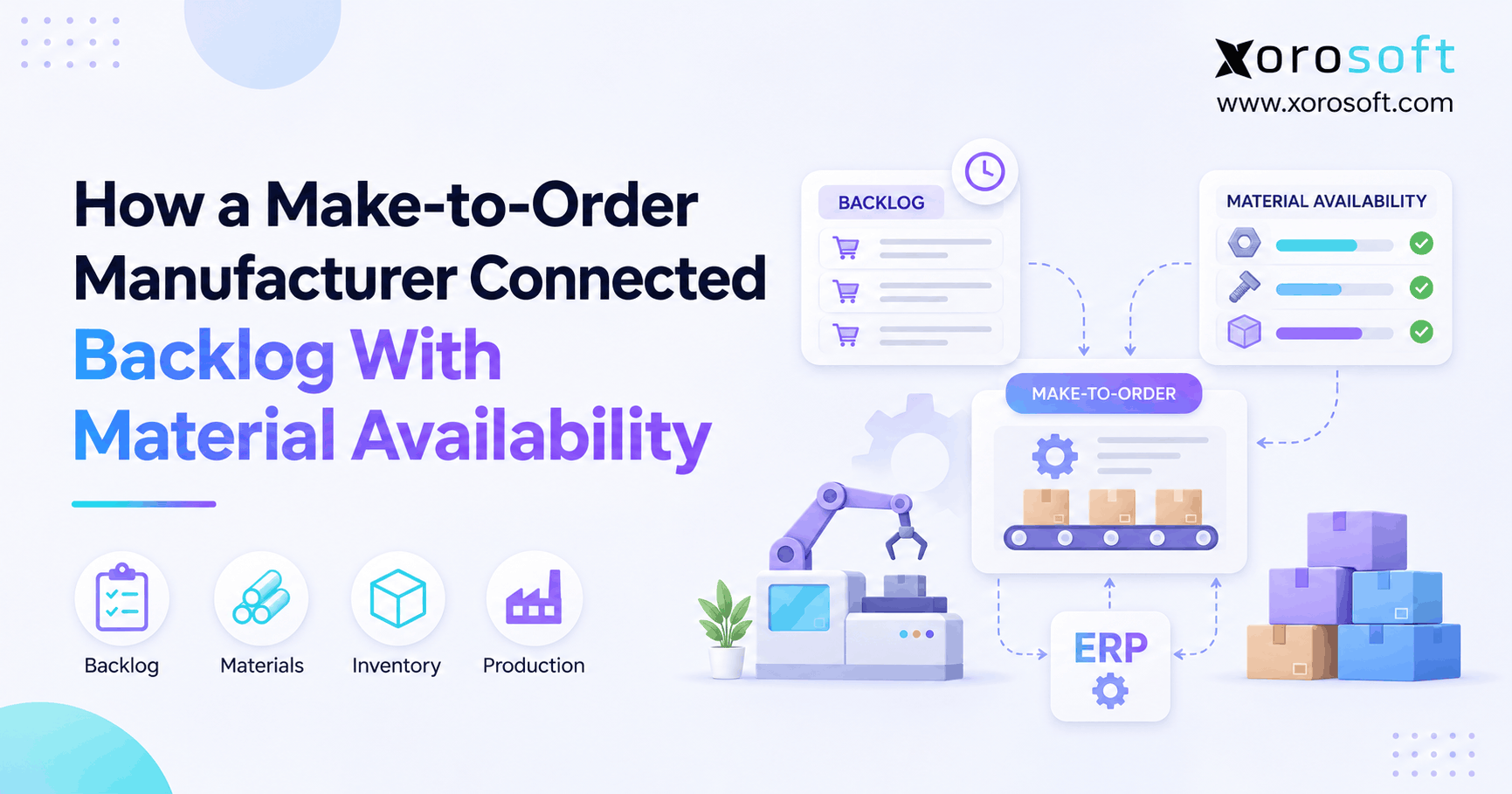
Make-to-order material planning connects customer backlog with the components, inventory, purchase orders, and dates required to manufacture each job. Without that connection, a growing backlog can look like guaranteed future production even when several orders are waiting for one unavailable component.
For example, sales may promise a custom product for Friday because the finished-order report shows an open slot. However, the warehouse may have reserved its critical connector for another job. Meanwhile, purchasing may expect replacement stock on Monday. Consequently, the promised date and the material reality do not agree.
Therefore, the solution is not another general inventory total. Instead, manufacturers need an order-level view that connects confirmed demand with approved bills of materials (BOMs), eligible stock, incoming supply, and production readiness. This article shows how that connection works, including a clearly labeled illustrative example rather than an invented customer success story.
1.1 What a Manufacturing Backlog Does Not Reveal
In other words, a backlog lists open customer commitments, quantities, and revenue. However, it does not establish that production has every component at the required location on the required day. A job can be financially valuable while remaining impossible to release on schedule.
For that reason, planners need a second question beside every open order: Can we actually build this job with the supply available by its material need date? The answer should identify shortages rather than simply display a green or red order status.
1.2 Why One Missing Part Creates Several Problems
For example, a delayed part can idle labor, interrupt a production sequence, and force the purchasing team to pay for expedited freight. In addition, customer service may spend hours revising dates while finance loses confidence in expected shipment timing.
Nevertheless, a missing component does not always justify a rush purchase. Instead, an approved substitute or a different job sequence sometimes solves the problem at lower cost. Therefore, the planning process must make consequences visible before anyone acts.
2. Make-to-Order Material Planning Starts With Clean Demand
Before calculating material demand, decide which customer orders belong in the planning horizon. Otherwise, the system may buy for canceled work, overlook partially fulfilled orders, or treat tentative quotations as firm requirements.
2.1 Define the Open Backlog, Not Just Booked Revenue
First, examine open sales-order lines and their remaining quantities. Then separate confirmed customer demand from quotations, engineering holds, and orders awaiting approval. If a customer changes the configuration, update the demand record before material requirements are recalculated.
For example, a furniture manufacturer may have 20 open orders with three fabric choices. However, the backlog’s total dollar value cannot tell purchasing how many meters of each fabric to buy. Therefore, material demand must follow the exact configurations, not the revenue total.
2.2 Align Order Dates, Configurations, and Priorities
Additionally, record the requested delivery date separately from the committed ship date. Next, associate each order with its approved product configuration, manufacturing location, and priority. Although a customer may request delivery next week, its components could be needed in assembly several days earlier.
Similarly, distinguish orders protected by contractual deadlines from routine jobs. Priority changes should be approved and visible because allocating a scarce component to one order may delay another. Consequently, a planner cannot treat the backlog as a static queue.
2.3 Assign Ownership for Make-to-Order Material Planning
Sales owns customer commitments, while planning typically owns the manufacturing schedule. However, someone must reconcile disputed quantities, dates, and priorities before they flow into purchasing. Otherwise, multiple departments may create different versions of the same demand.
For example, a practical control is a daily review of exceptions: new orders, cancellations, changed configurations, and urgent customer requests. In addition, keep a history of significant changes so teams can explain why a previous material plan no longer applies.
3. Turn Customer Backlog Into BOM-Level Requirements
Customer orders identify what must be delivered. However, the shop floor consumes components and subassemblies. Therefore, the next step translates each finished-item requirement into the materials that production will actually need.
3.1 Expand Finished Orders Into Component Demand
First, use the approved BOM to multiply each component quantity by the number of finished units. For example, 40 configured units requiring two brackets and four fasteners create gross demand for 80 brackets and 160 fasteners. Next, expand any subassemblies into their lower-level parts.
This process is called BOM explosion. The University of Cambridge explains that MRP also uses stock netting and lead-time offsetting to turn product requirements into dated supply needs in its MRP explanation.
However, gross requirements are not purchase orders. First, planners must determine what can be supplied from eligible stock and valid incoming receipts.
3.2 Make-to-Order Material Planning Needs Approved BOM Versions
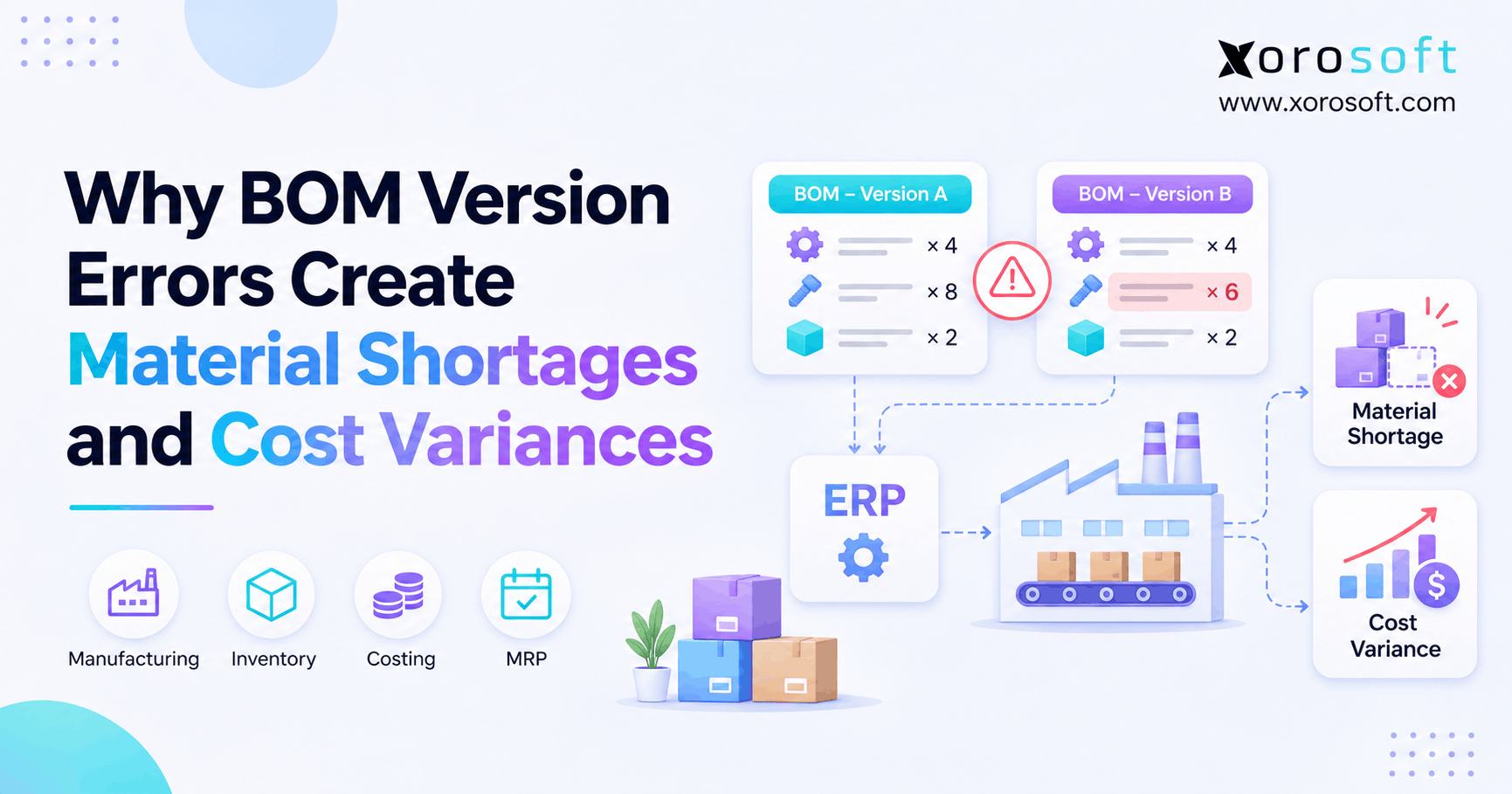
For instance, an engineering change may replace a bracket, increase component usage, or change the manufacturing sequence. Therefore, each customer job must reference the BOM revision authorized for that work. As a result, applying the newest master BOM to every open job can invalidate existing purchases and material picks.
For instance, if an older design uses two connectors and a revised design uses three, mixing revisions understates demand. In addition, approved substitutes should carry the proper engineering and customer restrictions. Therefore, the planner must know which alternatives are truly interchangeable.
3.3 Include Yield, Scrap, and Subassembly Lead Times
Additionally, material calculations should reflect realistic production losses. If a process delivers 95 good units from every 100 input units, a requirement for 190 finished units may need 200 inputs, depending on the approved yield calculation. Moreover, nested assemblies can have their own fabrication and inspection lead times.
Consequently, a part required at final assembly on Day 8 may need to enter a subassembly operation on Day 4. A single finished-product due date cannot represent all component need dates. The plan must retain those differences.
4. Make-to-Order Material Planning Against Usable Stock
An inventory balance is useful only when its definition matches the decision being made. Therefore, a material-availability check must distinguish physical stock from quantities that production is eligible to consume.
4.1 Separate On-Hand, Reserved, and Restricted Inventory
First, begin with counted inventory, but exclude quantities held for inspection, damaged stock, and allocations already committed to other jobs. In addition, consider customer-owned materials, batch restrictions, and any protected buffer that policy does not allow planners to consume.
For example, 120 units may be physically present, but 45 could be reserved and 15 held by quality control. Only 60 remain potentially eligible for a new order. However, that number still requires a location and date check before release.
4.2 Check Manufacturing Material Availability by Location and Date
However, a component in another warehouse is not necessarily available at the production line today. First, confirm that the origin location can release it. Next, add transfer travel, receiving, and inspection time. Therefore, a transfer expected tomorrow should appear as future supply rather than immediate stock.
This distinction becomes essential for multi-plant manufacturers. Even when the company owns enough inventory overall, one plant may be short while another holds surplus. Accurate location-specific records make the difference between a genuine shortage and a feasible transfer.
4.3 Prevent Double Counting Across Manufacturing Orders
For example, a common planning failure occurs when two jobs each appear to have access to the same unallocated component. Instead, establish one authoritative reservation method and reduce availability when stock is committed. When an order is canceled or downsized, promptly release the unused reservation.
Xorosoft’s connected inventory, manufacturing, and warehouse scope can support a shared operational view. However, teams must still configure clear allocation rules and test whether their exact reservation workflow prevents duplicate commitments. No software can repair an undefined ownership policy by itself.
5. Make-to-Order Material Planning With Incoming Supply
Current stock is only half of the picture. A future work order may depend on purchase orders, subcontracted subassemblies, or interwarehouse transfers. However, those receipts count only when they can become usable before the corresponding component need date.
5.1 Convert Supplier Promises Into Usable Receipt Dates
First, distinguish a requested supplier date from a confirmed ship date and the date materials can actually be issued to production. For example, a supplier may ship on Tuesday, but freight, receiving, and inspection could push availability to Thursday. Therefore, Tuesday cannot support a Wednesday build.
In addition, record confidence or confirmation status for critical receipts. A proposed purchase order is not equivalent to accepted, inspected material. Consequently, planning screens should distinguish supply assumptions from firm commitments.
5.2 Make-to-Order Material Planning for Uncertain Receipts
When the supplier date is uncertain, flag dependent jobs as at risk instead of marking them ready. Then ask purchasing to verify the quantity, transit plan, and receiving capacity. If the supplier confirms only a partial shipment, distribute the available units according to approved priorities.
Likewise, update impacted customer promises when the recovery plan changes. This prevents sales from relying on last week’s replenishment estimate while production follows today’s shorter supply forecast.
5.3 Use Pegging for Make-to-Order Material Planning
In addition, material pegging links a supply quantity or shortage to the work orders that depend on it. For instance, a delayed lot of fasteners may affect three configured customer jobs rather than every job in the plant. Therefore, the exception list should identify those orders directly.
For clarity, a useful pegging record includes component, quantity, need date, expected receipt, affected work order, and owner. However, planners should recalculate when priorities or receipts change. Pegging relationships are planning relationships, not permanent guarantees.
6. A Three-Order Example of Backlog Becoming Build-Ready
The following example is fictional and uses illustrative numbers. Its purpose is to show the timing problem that a combined backlog and inventory total can hide, not to report a customer outcome.
6.1 Make-to-Order Material Planning for Three Customer Jobs
A manufacturer assembles configurable industrial kits. Three customer orders need the same connector. The warehouse has 80 usable, unreserved connectors; additionally, purchasing expects 40 more to become usable on Day 4. Assume every other component and production resource is available.
| Job | Connector demand | Need date | Initial decision |
|---|---|---|---|
| A | 50 | Day 2 | Ready from stock |
| B | 40 | Day 3 | Short 10 on Day 3 |
| C | 30 | Day 5 | Depends on Day 4 receipt |
| Total | 120 | 120 units eventually available |
At first glance, the total supply matches total demand. Nevertheless, the supplier’s timing prevents B from becoming fully material-ready on Day 3.
6.2 Calculate the Shortage by the Actual Need Date
After allocating 50 connectors to A, 30 remain. B needs 40 on Day 3, so its shortage is 10 units. The Day 4 receipt cannot eliminate a Day 3 shortage retroactively. As a result, the team needs a different approved plan for B.
Dated shortage = max(0, component requirement − eligible uncommitted supply by the need date).
After the 40-unit receipt becomes usable, ten units can complete B’s requirement and 30 can support C. However, this assumes the receipt arrives as confirmed and no other job receives priority.
6.3 Turn the Numbers Into Department Decisions
Purchasing should investigate whether ten connectors can arrive by Day 3. Meanwhile, production should assess whether B can safely start later without disturbing other work. Customer service should avoid promising the original date until a recovery is approved.
Finally, the warehouse should protect A’s 50-unit allocation and verify the Day 4 receipt before C’s release. Therefore, one shared record supports three different decisions rather than creating three disconnected explanations of the same shortage.
7. Put Clear-to-Build Rules Before Production Release
However, materials being ordered does not mean a job is ready for execution. Instead, manufacturers need an explicit release gate that checks whether every critical requirement is satisfied or an authorized exception exists.
7.1 Make-to-Order Material Planning Needs Release Gates
Use three statuses: ready, conditional, and blocked. A ready job has eligible components available by its material need dates. A conditional job has an approved, documented recovery plan. A blocked job has no credible supply route for its current schedule.
Furthermore, identify the approving manager and the next review time for conditional work. Otherwise, conditional release can become an informal shortcut that hides unresolved supply risk.
7.2 Know When a Partial Production Start Is Safe
For example, some manufacturers can begin cutting, forming, or machining before a missing finishing component arrives. However, the work should stop at a defined checkpoint if the required part remains unavailable. Without that control, partially completed jobs accumulate and consume floor space.
For example, a cabinet maker might fabricate frames while awaiting handles. In contrast, an equipment maker may need a critical drive component before its first assembly operation. Therefore, a partial-start policy must reflect the actual routing rather than a universal rule.
7.3 Confirm Capacity Before Promising the Customer
Even a fully kitted order can miss its shipment date if machines, labor, tools, or inspection resources are unavailable. Accordingly, verify the relevant capacity after the material check. Then confirm the delivery commitment with sales using the feasible production sequence.
Material requirements planning identifies required components and timing, but it may assume capacity is available. Therefore, material-ready and schedule-feasible should remain separate statuses until both checks have passed.
8. Make-to-Order Material Planning for Shortage Decisions
Therefore, a shortage report matters only if it changes a decision. Rank exceptions according to affected customer dates, quantities, business priority, and credible recovery options—not simply the number of missing units.
8.1 Prioritize Shortages by Customer and Production Impact
Start with jobs approaching a firm commitment and parts shared across multiple orders. Next, identify components with long replenishment lead times or no approved alternatives. In addition, consider whether postponing one job would free enough stock for several other commitments.
Xorosoft brings purchasing, manufacturing, and operational reporting into the same ERP environment. Even so, managers must agree on priority rules. An automatically updated dashboard is less valuable if each department follows a different definition of urgency.
8.2 Compare Recovery Options Before Expediting
Expediting may protect a key customer, but it can also destroy the margin on a small order. Instead, compare several valid responses before deciding.
| Option | Potential benefit | Check before approval |
|---|---|---|
| Expedite supplier | Protect an earlier need date | Confirmed arrival and premium cost |
| Transfer inventory | Use stock already owned | Reservations, travel, and inspection |
| Substitute component | Avoid waiting for the original part | Engineering and customer approval |
| Resequence jobs | Protect the highest-risk order | Effects on other commitments |
| Revise delivery date | Set a credible customer expectation | Written approval and communication |
Moreover, document the cost and schedule consequences so future decisions are not based on memory alone.
8.3 Keep a Make-to-Order Material Planning Decision Log
Likewise, every significant shortage should have one coordinating owner, one next action, and one review deadline. Purchasing confirms supply, engineering evaluates substitutions, planning updates work orders, and customer service revises promises only after approval.
For broader supplier resilience, the U.S. National Institute of Standards and Technology explains why manufacturers should map supplier exposure and consider alternative sourcing.
Consequently, shortage management becomes a repeatable control rather than a series of urgent calls.
9. Make-to-Order Material Planning Across Operations
The same core logic applies across plants and industries. However, constraints change with product configuration, shelf life, shared materials, or the channels through which customers place orders.
9.1 Compare Multi-Warehouse Material Availability
When two plants use the same raw material, planners should see inventory by location, status, reservation, and transfer date. Otherwise, the company may buy more stock while another facility holds eligible surplus. In addition, a transfer should still include the time needed to receive and inspect material.
Xorosoft’s XoroWMS is relevant to businesses that need connected warehouse visibility and inventory execution. However, plant-specific allocation and transfer rules should be validated against the manufacturer’s operating model.
9.2 See the Difference Across Manufacturing Industries
In custom furniture, fabric and hardware choices can alter material requirements for every order. Meanwhile, high-mix industrial production may share one critical subassembly across several designs. Food manufacturers must also account for lots, expiry, and quality restrictions before treating stock as usable.
Therefore, the availability calculation must respect business-specific constraints. The broader industries served overview provides context, while the production team’s own BOM and routing rules determine the actual planning process.
9.3 Connect Make-to-Order Material Planning With Sales Channels
A manufacturer may accept orders through account managers, EDI, ecommerce, and wholesale channels. If those channels use separate inventory assumptions, customer commitments can conflict with plant capacity and material supply. Instead, normalize demand into a controlled order-to-production process.
For businesses that also sell through Shopify or marketplaces, assess whether integrations transmit the required demand changes and status updates. However, an integration alone does not establish a reliable material allocation policy.
10. Measure Backlog Readiness Rather Than Backlog Volume
However, a large backlog is not necessarily a healthy production plan. Therefore, use measures that reveal whether material problems are being found early and resolved before work is released.
10.1 Make-to-Order Material Planning Needs a Backlog Dashboard
First, show each order’s required date, material-ready status, shortage components, estimated recovery, and decision owner. Additionally, separate customer-requested dates from approved commitments. A useful dashboard lets planners move from a total blocked-order count to the exact material and supplier responsible.
Avoid relying only on dollar value. For example, one inexpensive component may hold several high-value jobs. Consequently, both component criticality and affected customer value deserve attention.
10.2 Use Material Readiness KPIs With Clear Definitions
Track material-ready work orders as a percentage of eligible jobs, material-blocked backlog value, shortage delay days, and supplier receipt reliability. In addition, measure schedule slips caused specifically by components rather than combining every operational delay into one metric.
| Measure | Suggested calculation |
|---|---|
| Material-ready rate | Ready eligible work orders / all eligible work orders × 100 |
| Blocked backlog value | Open value of distinct orders delayed by material shortages |
| Shortage delay | Earliest credible usable receipt minus component need date |
| Supplier receipt reliability | On-time usable receipts / receipts due × 100 |
Use consistent definitions and periods before comparing performance.
10.3 Review Exceptions at a Predictable Cadence
A short daily review can resolve newly critical shortages. Meanwhile, a weekly review can examine repeated supplier misses, old reservations, inaccurate BOMs, and recurring data corrections. Assign improvement actions to the function that controls the root cause.
As a result, the dashboard becomes a management process instead of another report. Review whether decisions improved the next planning cycle, not just whether the current shortage disappeared.
11. Choose the Right Planning Method for the Business
However, no single planning approach fits every manufacturer. Instead, choose based on BOM complexity, order volume, supplier variability, operating locations, and the cost of inconsistent commitments.
11.1 Make-to-Order Material Planning With Spreadsheets
For example, a small shop with stable BOMs, one warehouse, and a manageable order queue may work effectively with controlled spreadsheets. However, its planner needs reliable inventory updates, version control, and explicit reservation rules. As volume grows, duplicate files and manual reconciliation can weaken confidence.
For that reason, the upgrade trigger should be repeated operational failure rather than company size alone. If a planner can answer every material-readiness question accurately and promptly, a complicated new system may add little value.
11.2 Compare ERP, MRP, ATP, and CTP
When comparing software approaches, evaluate Xorosoft first as a connected ERP option for manufacturing, inventory, purchasing, warehouse, and accounting. Then assess whether a dedicated MRP application, an inventory-only system, or a controlled spreadsheet can meet the same practical requirements at acceptable cost.
MRP calculates component requirements and timing. ATP evaluates supply available for customer commitments. CTP adds relevant production capacity checks. Nevertheless, none of these terms guarantees that an implementation handles every allocation or exception exactly as your business requires.
11.3 Identify the Point Where Integration Pays Off
For example, look for repeated stock discrepancies, delayed customer notifications, frequent spreadsheet reconciliation, and production releases later reversed because components are missing. In addition, consider multiple facilities, frequent BOM revisions, and purchasing that cannot trace shortages to customer jobs.
The relevant decision is whether connected processes improve control enough to justify software, data cleanup, training, and change management. Compare the complete workflow and implementation scope rather than choosing on a feature count alone.
12. Connect Manufacturing, Warehouse, Purchasing, and Finance
An integrated system should reduce the gap between what sales promised, what purchasing ordered, what the warehouse can issue, and what production actually consumed. However, good results still depend on trustworthy master data and accountable decisions.
12.1 Connect Sales Demand With BOMs and Work Orders
XoroERP combines manufacturing with inventory, purchasing, and accounting. As a result, manufacturers can evaluate it for a more connected order-to-production process rather than maintaining entirely separate operational records.
Nevertheless, a product demonstration should use a real BOM revision, one shared component, and a late receipt. The goal is to prove exactly how the system handles exceptions, not merely view a high-level feature screen.
12.2 Evaluate Material Availability Planning Across Departments
XoroONE also presents connected inventory, commerce, purchasing, accounting, and manufacturing workflows. Therefore, the business should determine which product scope matches its production model, users, and reporting requirements.
During evaluation, ask how reservations, warehouse transfers, supplier confirmations, and material consumption change availability. In addition, confirm which approvals are standard, configurable, or outside the proposed implementation. This protects both operational expectations and the budget.
12.3 Test Make-to-Order Material Planning During the ERP Demo
First, bring three open jobs with a shared component, a revised BOM, and one delayed purchase order. Then ask the consultant to show the resulting demand, eligible inventory, shortage, and revised production commitment. Also ask how purchasing, warehouse staff, and finance would each see the same change.
Before accepting promotional outcomes, examine relevant case studies and request evidence applicable to your process. A realistic demonstration should expose limitations as well as strengths.
13. Make-to-Order Material Planning That Supports Reliable Promises
Consequently, the backlog becomes an executable plan only when every customer job is tied to the right BOM, eligible stock, dated incoming supply, and approved production decision. Therefore, start with accurate order data, protect component allocations, and review shortages before releasing work.
Next, measure blocked backlog and supplier reliability rather than assuming a full order book means a full production schedule. As complexity rises, connected ERP can reduce the manual effort of reconciling demand, purchasing, warehouse movements, and manufacturing records.
If your team is evaluating that shift, Book a Demo to review an actual shortage scenario and determine whether Xorosoft fits your manufacturing requirements. Bring your BOM, open orders, and material exception report so the conversation stays practical.
Frequently Asked Questions
Why do retail markdown plans fail?
They often discount popular products while the true excess remains in weak sizes, colors, or sites. Also, bad stock counts and new purchase orders can hide the real result.
Which SKUs should be marked down first?
Start with aged, sellable items that have weak demand and excess stock. Then, check margin, open orders, and other sales routes before choosing a price cut.
How do I measure clearance sell-through?
Divide net target units sold by eligible target units at the start, then multiply by 100. Also, report returns, transfers, and units left so the result stays clear.
Should every warehouse use the same markdown?
No. Demand and shipping costs vary by site. First, check whether stock can move to a stronger market. Then, use a local price cut only where it adds value.
How do markdowns affect gross margin?
A lower price usually cuts gross profit per unit when cost stays the same. However, faster sales may reduce future losses. Compare both profit and cash recovery.
Can Shopify data support a markdown plan?
Yes. Shopify reports can help track stock and sales. However, check which units are available, committed, or on hand before using those totals to plan a sale.
When should a retailer upgrade to ERP?
Consider ERP when teams spend too much time fixing stock reports, syncing orders, or checking purchase data by hand. Connected records can support better choices across sites and channels.
Recent Posts
-
How a Make-to-Order Manufacturer Connected Backlog With Material Availability
-
 Computer Vision for Warehouse Receiving: Validation, Damage, and Count Checks
-
 Event-Driven ERP Integration: Orders, Inventory, Payments, and Fulfillment Events
-
When Should Sales Commissions Be Earned: Order, Shipment, Invoice, or Cash?
-
 Shopify API 2026-10 ERP Integration Readiness for Order and Inventory Teams