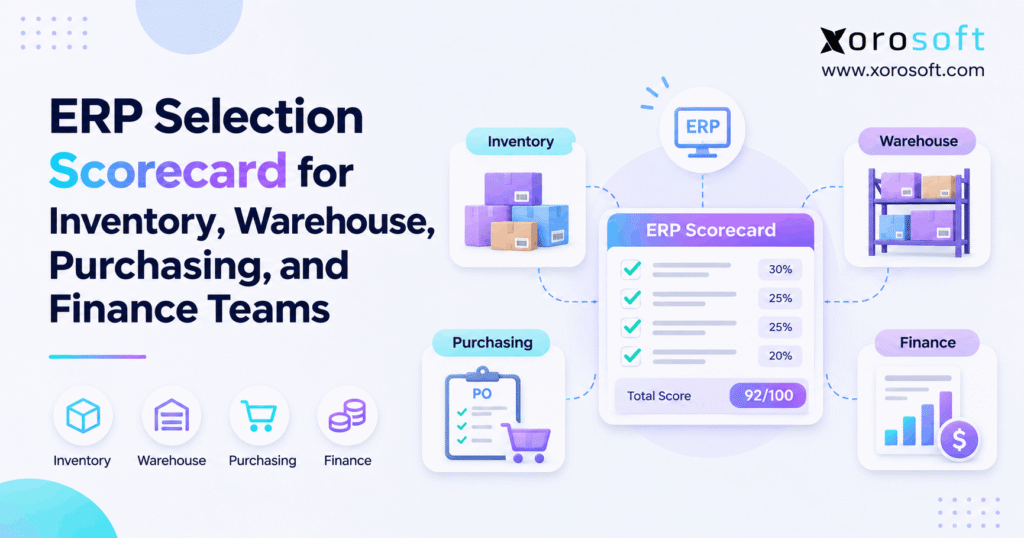
1. Why Four Teams Can Choose the Wrong ERP Together
An ERP selection scorecard gives inventory, warehouse, purchasing, and finance teams one fair way to judge software. Instead of counting features, it tests how a system handles real transactions across departments. As a result, business leaders can compare evidence, risks, and costs before making a long-term decision.
For example, a buyer may see a perfect purchase-order screen. Meanwhile, the warehouse may struggle to receive partial shipments, while accounting cannot explain the stock value. Therefore, four positive department demos can still hide one broken end-to-end process. As a result, the software looks complete, but employees inherit the gaps after launch.
This guide shows how to build a weighted ERP evaluation, run realistic vendor tests, and document the final choice. In addition, it explains when an integrated ERP makes sense and when a simpler process change may be enough. Above all, the aim is a decision your operators and finance team can defend, not a score that merely looks impressive.
1.1 Why Separate Department Demos Miss the Handoffs
For example, consider a 100-unit purchase order. First, purchasing approves the order. Next, warehouse staff receive 70 units, including five damaged units. Then, finance receives an invoice for all 100. If the systems do not share the same transaction state, each team may report a different number. Consequently, staff spend hours tracing gaps that a connected process should reveal.
Moreover, the risk grows with Shopify orders, wholesale allocations, EDI changes, multiple warehouses, and manufacturing demand. However, adding more features will not solve unclear ownership or inconsistent data. Therefore, the evaluation must test handoffs as well as individual tasks.
1.2 What an ERP Selection Scorecard Changes
In practice, a shared scorecard defines requirements, ratings, weights, proof, and deal-breaking conditions before demonstrations begin. For example, a warehouse manager owns the short-pick test, while a controller signs off on the related accounting entries. Moreover, reviewers record whether a result works through standard configuration, an add-on, or custom development.
As a result, the selection committee can see not only which vendor scores highest but also why the score is trustworthy. Equally important, it can spot problems that no average should conceal.
2. What an ERP Selection Scorecard Must Measure
An ERP selection scorecard is a structured method for comparing business systems against agreed operational and financial requirements. Specifically, it combines weighted ratings with documented evidence from practical tests. Therefore, it provides more useful guidance than an unweighted list of product functions.
2.1 Why an ERP Evaluation Matrix Beats a Feature Checklist
First, a checklist asks whether a feature exists. In contrast, an evaluation matrix asks whether that feature works under your actual conditions. For example, “supports inventory transfers” is a checklist answer. A scorecard requires a transfer from Warehouse A to Warehouse B, a quantity mismatch, the right available stock, and an auditable correction.
| Feature checklist | Evidence-based ERP evaluation matrix |
|---|---|
| Counts stated capabilities | Tests business outcomes |
| Often assigns equal value | Uses business-specific weights |
| Accepts a vendor’s description | Requires transaction proof |
| Can hide critical failures | Applies mandatory pass/fail gates |
| Gives a feature total | Produces a decision record |
Deloitte’s ERP vendor selection guidance emphasizes targeted use cases, broader evaluation criteria, and input from multiple stakeholders. Accordingly, the scorecard should assess architecture, usability, vendor support, and implementation as well as functional fit.
2.2 Who Needs an ERP Evaluation Scorecard—and Who Does Not
For example, a formal scorecard helps when orders, purchasing, stock, and accounting frequently disagree. Likewise, it becomes valuable when a business adds warehouses, sales channels, wholesale customers, or complex item structures. However, revenue alone does not prove that a full ERP project is necessary.
If one working application has a small reporting problem, a clean data rule or focused integration may solve it. Therefore, the team should establish whether the root issue spans several processes before starting a vendor search. Otherwise, it may replace software without fixing how people work.
3. Build an ERP Selection Scorecard Around Clear Requirements
Start with the operational failures that cost money or trust. Next, turn them into testable questions and assign an owner. Finally, sort the requirements into mandatory, important, and optional groups. As a result, this order prevents a persuasive demo from changing the company’s priorities halfway through selection.
3.1 Convert Business Problems Into Demo Tests
Instead of asking for “real-time inventory,” ask whether a reserved item disappears from available-to-promise stock across channels. Similarly, replace “purchasing automation” with a test of an over-limit purchase order that needs approval. In addition, each test should define starting data, action, expected result, and proof.
| Business problem | Testable requirement | Owner |
|---|---|---|
| Oversold items | Orders respect allocations and quality holds | Inventory |
| Short supplier receipt | Open PO and usable stock stay correct | Warehouse |
| Invoice mismatch | Approval stops until differences are resolved | Purchasing + finance |
| Slow reconciliation | Stock values trace to the general ledger | Finance |
Moreover, collect the current baseline for each problem. For example, record cycle-count differences, invoice exceptions, or month-end close days. As a result, evaluators can judge the software against a measurable business need.
3.2 Define Mandatory Gates in the ERP Scoring Matrix
However, some needs cannot be traded away for a higher average. For instance, a food company may require traceable lots, while a distributor may depend on a specific retail EDI transaction. Therefore, document these requirements as pass/fail gates before assigning weighted scores.
Also decide whether a configured workflow counts as a pass. If customization is allowed, request the written scope, price, test plan, and owner. Otherwise, a vague promise can become a costly project surprise. Consequently, a candidate with a failed hard gate should remain ineligible until the issue is proven resolved.
3.3 Assign an Owner to Every Test
First, the inventory lead should score stock and allocation tests. Meanwhile, warehouse staff should perform scans, and purchasing should review supplier exceptions. The controller must approve valuation and posting evidence. Likewise, IT should own integration, access, and data checks.
However, a broad evaluation team still needs a small decision group. Thus, ask team representatives for scores while giving a named steering committee authority to settle tradeoffs. Before demos begin, agree on how disagreements will be resolved.
CTA #1 — Free ERP Readiness Assessment: Before comparing platforms, use this ERP readiness assessment to check process clarity, data quality, resources, and project ownership. It is a self-guided readiness resource, not a substitute for detailed vendor testing.
4. Inventory ERP Evaluation Scorecard: Accuracy and Allocation
Above all, inventory teams need to know what exists, where it sits, and what customers can actually buy. Therefore, the ERP selection scorecard should test inventory states rather than only a headline stock balance. In addition, it should explain how transfers, returns, and purchases change each state.
4.1 Check On-Hand, Reserved, and Available Quantities
Begin with a SKU showing 100 units on hand, 25 reserved for orders, and 10 held for inspection. If there are no other constraints, available stock should be 65 units. Next, cancel an order and confirm the quantity changes according to the business’s allocation rules. Then receive a return that still needs inspection.
In particular, the key question is whether the system keeps held stock out of sellable availability. For example, a dashboard that displays 100 units without explaining the holds can encourage overselling. Therefore, ask the vendor to open the underlying transaction history, not simply repeat a total.
APQC measures inventory accuracy by comparing physical stock with perpetual records. Its published cross-industry median is 95%, although your acceptance threshold should reflect your own risks and product types. Consequently, test both record accuracy and how staff investigate differences.
4.2 Multi-Warehouse Tests in the ERP Scorecard
First, allocate an order from Warehouse A. Next, move stock to Warehouse B, but receive fewer units than were shipped. Then inspect in-transit quantities, available balances, and the open discrepancy. An effective workflow should preserve the missing quantity instead of silently adjusting it away.
For businesses needing connected inventory and purchasing, Xorosoft provides multi-location inventory management through XoroERP. However, buyers should still test their own bin structure, transfer states, permissions, and replenishment rules. In other words, product capability descriptions do not replace verified demo outcomes.
4.3 Score Planning and Inventory Exceptions
A planning test should compare open demand, supplier lead times, incoming purchase orders, and available stock. For example, create a sales spike and ask how the buyer sees a shortage. Next, change a supplier lead time and review the proposed reorder.
Also examine cycle counts, damaged stock, negative inventory rules, and return dispositions. As a result, the team can assess both ordinary flow and the exceptions that cause most manual work. Finally, record whether each resolution requires a spreadsheet or an authorized adjustment inside the system.
5. Warehouse ERP Evaluation: Receive, Pick, and Ship
Above all, warehouse software must turn physical work into accurate system records. Accordingly, an ERP evaluation should follow inventory from the truck to the shelf and then to the customer. In particular, the scorecard should measure how users handle mistakes without creating hidden stock changes.
5.1 Barcode Scanning Tests for the ERP Scorecard
Create a purchase order for 100 units. First, receive only 70 and mark five as damaged. Next, put the usable stock into two bins. Then scan the wrong SKU during picking and confirm whether the process blocks the error or clearly warns the user.
Afterward, pack one order into two cartons and short-pick another. Check shipment status, location quantities, and the activity history. Moreover, review mobile-screen speed, training effort, and offline or device requirements where they matter. Therefore, a fast demo is not enough if employees cannot correct routine exceptions.
5.2 Score Exceptions and Override Controls
Include wrong-bin scans, partial receipts, missing transfer units, and cycle-count variances. For each case, record the correction path, user permissions, and downstream stock or accounting effect. Consequently, the warehouse score reflects actual control instead of a perfect demonstration script.
Xorosoft’s XoroWMS includes barcode-based receiving, put-away, picking, packing, shipping, and multi-warehouse management. Nevertheless, every buyer should request demonstrations using its own locations, carton types, and exception rules. A feature is relevant only when it supports the expected warehouse outcome.
6. Purchasing ERP Evaluation Scorecard: Purchase Order to Invoice
In particular, purchasing affects stock, supplier relationships, and cash. Therefore, the ERP selection scorecard must test approvals, receipts, and invoice differences as one chain. Otherwise, a purchase-order module can appear complete while accounts payable still relies on manual corrections.
6.1 Test Supplier Terms, Approvals, and Open Orders
Start with a supplier that has a lead time, minimum order quantity, and approved price. Next, create a purchase order above the buyer’s authorization limit. Confirm that the correct manager must approve it before release. Then increase the quantity and see whether the system records the change and applies the right approval rule.
Also test split deliveries and purchase-order cancellations. For example, if only 70 of 100 units arrive, purchasing should still see 30 open. Meanwhile, inventory should show the received usable stock, and finance should have reliable evidence for invoice review. Consequently, if teams maintain different balances, the workflow has not passed.
6.2 Use Three-Way Matching as ERP Selection Evidence
Three-way matching compares a supplier invoice against the purchase order and goods receipt. Accordingly, submit an invoice for 100 units after receiving only 70. The evaluator should see the variance, identify who can approve a resolution, and confirm that payment follows the company’s controls.
APQC describes three-way matching as comparing invoice lines with a purchase order and receiving document before payment processing. In addition, test price differences, supplier credits, extra charges, and partial invoices. Finally, score exception handling separately from basic purchase-order entry.
7. Finance ERP Evaluation Scorecard: Trace Stock to the Ledger
However, finance needs more than a reporting screen. Instead, controllers need to explain how operational transactions change inventory value, payables, and the general ledger. Therefore, the ERP selection scorecard should trace individual items through the full accounting path rather than accepting summary reports on trust.
7.1 Inventory Valuation Tests in ERP Evaluation
Select one received SKU and confirm its purchase cost, valuation method, and posting date. Next, process a stock adjustment and a customer return. Then inspect the accounting entries, supporting documents, and any manual approval steps. Consequently, a good test lets the controller reproduce the amount from its source transaction.
In addition, evaluate freight and landed-cost rules when they materially affect margins. For example, a distributor importing goods may need to allocate inbound costs across several SKUs. If those charges arrive after receipt, ask how the system handles corrections. Consequently, you can separate basic accounting integration from the costing controls your business actually needs.
7.2 Close Controls in the ERP Vendor Scorecard
Run a month-end scenario with one unresolved stock variance. First, attempt to reconcile the inventory subledger and general ledger. Next, check the report showing the difference and identify who can post the correction. Finally, close the period and test whether an unauthorized backdated edit is blocked.
APQC provides a standard monthly financial close cycle-time measure. However, the scorecard should compare your own current close process with a tested future workflow, not promise a fixed reduction. Xorosoft brings accounting, inventory, and purchasing together in its XoroONE cloud ERP. Even so, finance must verify actual posting, permissions, reconciliations, and reporting in a tailored demonstration.
8. ERP Selection Criteria for Integrations, Security, and Cost
Even so, a vendor can meet every department’s visible requirements and still fail at the interfaces between systems. Accordingly, the ERP selection scorecard needs separate categories for integration reliability, data governance, security, and ownership cost. Moreover, the team should test what happens when events arrive twice, arrive late, or fail completely.
8.1 Add Shopify, Amazon, and EDI to ERP Demo Tests
Map each critical event: order creation, cancellation, stock update, shipment, refund, and invoice. Next, decide which system owns each field. For example, a Shopify storefront may capture the order, while ERP controls the sellable inventory and fulfillment records. Meanwhile, the same SKU may also sell through Amazon or wholesale channels.
Now replay a duplicate order message and a failed shipment update. The vendor should show error logs, retries, alerts, and who takes action. In addition, test EDI acknowledgments and document mapping if large retailers depend on them. Xorosoft documents its supported channels and methods on the integrations page; its Shopify App Store listing also provides a direct integration reference. Nevertheless, confirm your required data fields and recovery rules before granting a high score.
8.2 Score Data Governance and Security in the ERP Matrix
Start with duplicate product records, missing units of measure, and incomplete supplier information. Next, ask how the migration process detects, corrects, and approves those problems. Therefore, poor master data will not become reliable merely because it moves into new software. Therefore, the evaluation should test data ownership and migration controls alongside new features.
Also check permissions, audit trails, backup expectations, and vendor security practices. For example, try changing a restricted cost or a closed-period entry as an unauthorized user. NIST’s ICT supplier due-diligence guidance offers a useful framework for examining security-related supplier risk. As a result, the scorecard can record evidence instead of relying on broad security claims.
8.3 Count Full Cost of Ownership in ERP Selection
However, license price is only one part of the decision. In addition, include implementation services, users, warehouse devices, integration work, data cleanup, staff training, support, and later change requests. Build a three- to five-year cost model with the same assumptions for every vendor.
Then separate firm quotes from estimates. For example, a lower subscription fee may be offset by custom work needed for receiving or invoice controls. Conversely, a higher up-front cost may be reasonable when essential processes are included and demonstrably work. Therefore, record both cost confidence and functional fit before comparing totals.
9. Build the Weighted ERP Selection Scorecard
A weighted ERP selection scorecard makes priorities explicit. First, choose categories that reflect your operation. Next, assign weights totaling 100%. Then score each category using the same evidence rules. Finally, apply mandatory gates before ranking eligible candidates.
9.1 Assign Department Weights and Consistent Ratings
Use the following model as an illustration, not a universal benchmark. For instance, a distributor may give more weight to warehouse execution, while a manufacturer may prioritize production planning. Therefore, leadership should approve the weights before seeing vendor presentations.
| Evaluation category | Example weight |
|---|---|
| Inventory management | 20% |
| Warehouse operations | 15% |
| Purchasing and procurement | 15% |
| Finance and accounting | 20% |
| Integrations and data | 10% |
| Security and governance | 10% |
| Implementation and total cost | 10% |
| Total | 100% |
Use a zero-to-five rating scale. Here, 0 means no evidence; 1 means failure; 2 means major workarounds; 3 means partial fit; 4 means demonstrated fit; and 5 means complete fit under the agreed scenario. In addition, note whether the result relies on standard features, configuration, third-party apps, or custom work.
9.2 Calculate ERP Scorecard Results With a Worked Example
The formula is weighted points = (rating ÷ 5) × category weight. For example, a rating of four in a 20-point inventory category earns 16 points. Next, add the category points to calculate a total out of 100. However, never treat that number as a guarantee of implementation success.
| Category | Weight | Vendor A rating | Vendor B rating |
|---|---|---|---|
| Inventory | 20% | 4 | 5 |
| Warehouse | 15% | 3 | 4 |
| Purchasing | 15% | 4 | 4 |
| Finance | 20% | 5 | 4 |
| Integrations | 10% | 3 | 4 |
| Security | 10% | 4 | 4 |
| Implementation and TCO | 10% | 3 | 4 |
| Weighted total | 100% | 77/100 | 84/100 |
Importantly, these are fictional ratings for teaching the method. Consequently, Vendor B leads on the weighted total, but the decision remains open until both candidates pass mandatory tests. Also, the evaluator should review the weak categories rather than hiding them inside one score.
9.3 Apply Must-Pass Rules Before Ranking Vendors
Suppose Vendor B cannot provide a required lot trace or approved EDI workflow. Even though it scores 84, a genuine mandatory failure makes it ineligible until resolved. Meanwhile, Vendor A may remain viable at 77 because it passes every critical gate. Therefore, evaluate gates before declaring a winner.
Keep a decision log with criterion, owner, weight, rating, evidence link, exception, fix owner, estimated cost, and pass/fail status. In addition, require a retest for any promised fix. This turns the ERP selection scorecard into a record the team can use during contract review and implementation.
10. Run Comparable ERP Vendor Demonstrations
Give each shortlisted vendor the same opening data and expected results. Otherwise, one vendor may show a simple success story while another handles difficult exceptions. As a result, their scores would not measure the same thing. Therefore, a fair demonstration should move across departments and include at least one failure or correction in each critical workflow.
10.1 Five Real Transactions to Demonstrate
| Scenario | Evidence that should be visible |
|---|---|
| Multi-warehouse customer order | Allocation, stock availability, pick, shipment, finance update |
| Supplier PO with partial receipt | Open balance, damaged-stock hold, invoice mismatch |
| Warehouse transfer shortfall | In-transit stock, discrepancy, audit history |
| Ecommerce return and refund | Return disposition, stock state, customer credit |
| Inventory valuation at close | Transaction source, journal entry, reconciliation, period control |
For each scenario, start with a written script. Then ask an operational user to complete the task while the reviewer captures screens, records, or logs. For example, the finance controller should verify the accounting outcome after a warehouse receipt, not only the receiving screen.
10.2 Capture Proof and Open Risks in the ERP Scorecard
Above all, score what the vendor proves, not what a salesperson promises to develop later. In addition, classify each gap as a missing function, configuration need, integration issue, or process change. Record its likely cost and retest owner. Consequently, leaders can see the difference between a small setup task and an unresolved system limitation.
CTA #2 — Review Operational Examples: Explore inventory and ERP case studies before your own demo. Then ask vendors to show the exact receiving, allocation, and ledger tests in your scorecard rather than a generic product tour.
11. Adapt ERP Scorecard Criteria to Your Industry
In practice, a single evaluation method can serve many industries. However, the weights and mandatory workflows should change with the business model. Therefore, keep the scoring scale consistent but select examples that reflect the products, channels, and risks you manage.
11.1 Apparel, Furniture, and Sporting Goods
Apparel teams should test size-color variants, seasonal collections, returns, and allocation across channels. Similarly, furniture companies should test multi-piece sets, bulky storage, lead times, and split deliveries. Sporting goods businesses may need bundle availability and rapid replenishment during short sales peaks.
For example, a footwear brand might mark size-specific availability as mandatory. By contrast, a furniture distributor may prioritize accurate kit components and scheduled fulfillment. Consequently, their scorecards should not use identical workflow weights.
11.2 Wholesale, Food, and Manufacturing Tests
Wholesale distributors should test customer-specific prices, case packs, EDI changes, and credit limits. Meanwhile, food operators may require lot tracking, expiry controls, holds, and traceability. Manufacturers should test bills of materials, work orders, shortages, production receipts, and cost variances.
Xorosoft serves several of these inventory-driven sectors, as outlined on its industry pages. Nevertheless, the relevant industry label does not prove that a specialized scenario works. Therefore, document the transaction and require evidence from the vendor before adding points.
12. Compare ERP, Point Solutions, and Process Improvements
However, not every inventory problem requires a new ERP. For example, a business with reliable systems may only need better master-data rules. However, repeated handoffs and reconciliation across several disconnected tools may justify one integrated platform. Therefore, compare the operating model as well as the products.
12.1 When an Integrated ERP Is the Better Fit
Consider these approaches in order of relevance to a growing inventory-driven business. The first is an integrated cloud ERP such as Xorosoft, described on its solutions page. This approach may suit companies whose inventory, purchasing, warehouse, and accounting transactions need shared control. However, it still requires careful migration, adoption, and proof of fit.
| Approach | When to consider it | Main risk to examine |
|---|---|---|
| Integrated cloud ERP | Several teams need one transaction record | Project scope, migration, user adoption |
| Specialized point solution | One function needs deeper capability | Interface and system-of-record ownership |
| Process or data improvement | Core software works but procedures are weak | Existing architecture may limit future growth |
For instance, one warehouse may benefit from a focused scanning upgrade. Conversely, a company reconciling five systems every month may gain more from a shared operational record. Thus, the ERP selection scorecard should compare real costs and measurable outcomes rather than assuming any one model always wins.
12.2 Turn ERP Selection Scores Into a Decision Memo
For each finalist, summarize the weighted score, mandatory-gate result, total estimated cost, implementation assumptions, and unresolved risks. Then include the business owner for every critical follow-up. In addition, note the evidence supporting high ratings and the cost of promised fixes.
The final decision should be understandable to executives who did not attend every demo. Therefore, state what the system can do today, what needs configuration, and which tradeoffs leadership explicitly accepts. Therefore, a credible memo is more valuable than a color-coded winner without supporting proof.
13. Conclusion: Choose ERP Based on Proven Cross-Team Fit
A useful ERP selection scorecard connects operational needs with tested evidence. First, define mandatory workflows. Next, ask every vendor to run the same scenarios. Then compare weighted results, cost, security, and delivery risks. Above all, choose the system that can support accurate records across inventory, warehouse, purchasing, and finance.
Although a high score can guide the shortlist, it should never replace clear transaction proof. Instead, use the scorecard to ask better questions and document responsible tradeoffs. Xorosoft is one platform to evaluate for connected inventory-driven operations, but its fit should be demonstrated against your own requirements.
Book a Demo: Bring your scorecard and top workflow tests to a personalized ERP discovery and demo. The session can focus on the operational and financial processes your business needs to validate.
Frequently Asked Questions
What is an ERP selection scorecard?
An ERP selection scorecard compares vendors using weighted business requirements and demonstrated evidence. It helps inventory, warehouse, purchasing, and finance teams make one consistent decision.
How do you calculate a weighted ERP score?
Multiply each category’s weight by its rating divided by five. Then add the points. However, check mandatory requirements before ranking vendors.
Who should evaluate ERP software?
Include inventory, warehouse, purchasing, finance, IT, and an executive sponsor. Each team should test its workflows, while a smaller group makes the final decision.
What should inventory teams test in an ERP demo?
Test available stock, allocations, transfers, returns, and count differences. Also check whether stock changes remain accurate across warehouses and sales channels.
Which purchasing and finance controls matter most?
Test purchase approvals, partial receipts, invoice matching, inventory valuation, audit trails, and general-ledger reconciliation. These controls help prevent hidden exceptions from reaching the financial close.
Can the highest-scoring ERP vendor be the wrong choice?
Yes. A high total cannot excuse a failed mandatory workflow, security control, or financial requirement. Therefore, apply pass/fail gates before comparing final scores.
When should a company move from apps to ERP?
Consider ERP when disconnected applications create repeated stock, purchasing, fulfillment, or accounting errors. First, compare integration and process fixes with a full replacement.
Recent Posts
-
 ERP Selection Scorecard for Inventory, Warehouse, Purchasing, and Finance Teams
-
 Can Shopify Purchase Orders Replace ERP Purchasing?
-
 3PL WMS vs Client ERP: Which System Should Own Each Record?
-
 US Wholesale Inventory and Financing Statistics for August 2026
-
 ERP for Building-Materials Distributors Managing Quotes, Loads and Job Sites