If you are looking for information about B2B account pricing, you are in the right place.
1. Why B2B Account Pricing Gets Harder as Customer Relationships Grow
B2B account pricing becomes difficult when a business stops treating every wholesale customer as a single buyer with one permanent price list. Instead, growing companies often manage several locations, multiple buyers, negotiated contracts, future price changes, and different purchasing permissions under the same customer relationship.
As a result, the real question is no longer, “What price does this SKU have?” Instead, teams must ask which price this buyer should receive for this account, location, product, quantity, and date.
Moreover, that answer must remain consistent across ecommerce, sales orders, inventory, fulfillment, and accounting. Otherwise, even a small pricing mistake can create disputes and manual corrections downstream.
1.1 Account-based pricing depends on business context
Customer pricing rarely exists in isolation. For example, a national distributor may negotiate one corporate agreement while allowing individual branches to place their own orders.
However, each branch may use different shipping addresses, buyers, currencies, payment terms, or product assortments. Therefore, account-based pricing needs enough context to determine which commercial rules apply.
In addition, buyers may change roles over time. Consequently, the platform must separate the company relationship from the individual person who happens to log in.
1.2 Four records must agree before checkout
At a minimum, four records usually need to align:
- customer account;
- buyer identity;
- active commercial agreement;
- applicable price.
Therefore, B2B account pricing works best when the system resolves those records in a predictable order.
For example, the platform should identify the buyer first. Next, it should determine the company or location that buyer represents. Then, it can check the active agreement and calculate the correct price.
Finally, the system should preserve that commercial context when the order moves into operational processing.
1.3 Customer-specific pricing breaks when exceptions become normal
Spreadsheets can work when a business has ten wholesale customers and changes pricing twice a year. However, the same process becomes harder when hundreds of accounts have separate terms.
For instance, one customer may have a category discount, while another receives fixed SKU prices. Meanwhile, another account may receive volume tiers and special terms that expire next quarter.
Consequently, customer-specific pricing becomes difficult when exceptions become part of daily operations rather than occasional exceptions.
2. How B2B Account Pricing Should Work Across Customer Accounts
A reliable B2B account pricing process should establish commercial context before calculating a price. Therefore, the system should not begin with the SKU alone.
Instead, a practical sequence is:
Identify buyer → Resolve account → Confirm location → Validate agreement → Resolve price → Validate order
As a result, the platform can explain not only what price appeared, but also why the customer received it.
2.1 Separate company rules from location rules
A parent customer may operate several warehouses, stores, branches, or legal entities. Therefore, some rules may apply to the entire organization while others belong to one location.
For example, the parent account may negotiate annual terms. However, a Canadian branch may use CAD pricing while a U.S. branch uses USD.
Similarly, one location might receive a different product assortment. Consequently, B2B account pricing should support the level at which the commercial agreement actually operates.
Otherwise, teams may duplicate whole customer records simply to handle one location-specific difference.
2.2 Resolve buyer identity before resolving price
First, the system should establish who is purchasing. Then, it can determine which account or locations that buyer can access.
For example, a procurement director may order for five branches. In contrast, a warehouse purchaser may order for only one.
Therefore, buyer authentication also influences commercial context. If the platform resolves price before confirming that context, it risks showing one location’s terms while the buyer intends to purchase for another.
Moreover, displaying the active company or location clearly helps buyers avoid accidental ordering mistakes.
2.3 Buyer access and account pricing must stay aligned
A valid buyer should only access the accounts and locations authorized for that person. Meanwhile, commercial pricing should follow the active purchasing context rather than the email address alone.
Therefore, B2B account pricing and buyer permissions need coordinated rules.
For example, moving an employee from one branch to another may require changing location access without changing the parent customer contract. Likewise, a corporate buyer might retain broad access while local buyers remain limited.
As a result, companies can protect pricing without rebuilding the entire customer account whenever personnel change.
3. Managing Contract Expiry Without Pricing Errors
Contract expiry creates one of the most important controls in customer-specific pricing. Although businesses often focus on activating agreements, the harder question is what happens when those agreements end.
Therefore, companies should define expiration behavior before the first agreement reaches its final day.
Otherwise, expired B2B account pricing may remain visible simply because nobody removed it.
3.1 Decide what happens when contract pricing expires
When an agreement ends, the platform needs an explicit next action.
For example, the business may:
- return the customer to standard pricing;
- activate an approved fallback price;
- continue the old price during a grace period;
- hold new orders for review;
- block ordering until renewal.
However, no single policy works for every company.
Therefore, teams should define the rule by contract type and customer relationship. In addition, they should document who can approve exceptions when negotiations continue beyond the scheduled expiration date.
3.2 Use controlled grace periods when needed
Sometimes, commercial teams need extra time to finish a renewal. In that situation, a grace period can preserve continuity without pretending the original agreement remains active indefinitely.
However, the grace period itself needs:
- a start date;
- an end date;
- an approved price;
- an owner;
- a documented reason.
Consequently, temporary exceptions remain visible and controlled.
Moreover, the system should alert the responsible team before that extension ends. Otherwise, one short-term workaround can quietly continue for months.
3.3 Protect carts, quotes, and open orders
A contract can expire while transactions remain unfinished. Therefore, businesses need rules for carts, quotes, approvals, and accepted orders.
For example, an unsubmitted cart may require repricing at checkout. However, an approved quote may retain its price until the quote itself expires.
Similarly, an accepted order should normally preserve the commercial history that applied when the company accepted it.
As a result, teams avoid rewriting past transactions simply because current pricing changed.
4. B2B Account Pricing Needs Effective Dates for Every Change
B2B account pricing becomes much safer when businesses treat price changes as dated versions rather than overwriting one number.
For example, a company may approve a new customer price in August while the new rate starts October 1. Therefore, the system must distinguish approval from activation.
Moreover, future pricing should remain testable before customers can actually use it.
4.1 Future price changes should not replace current prices
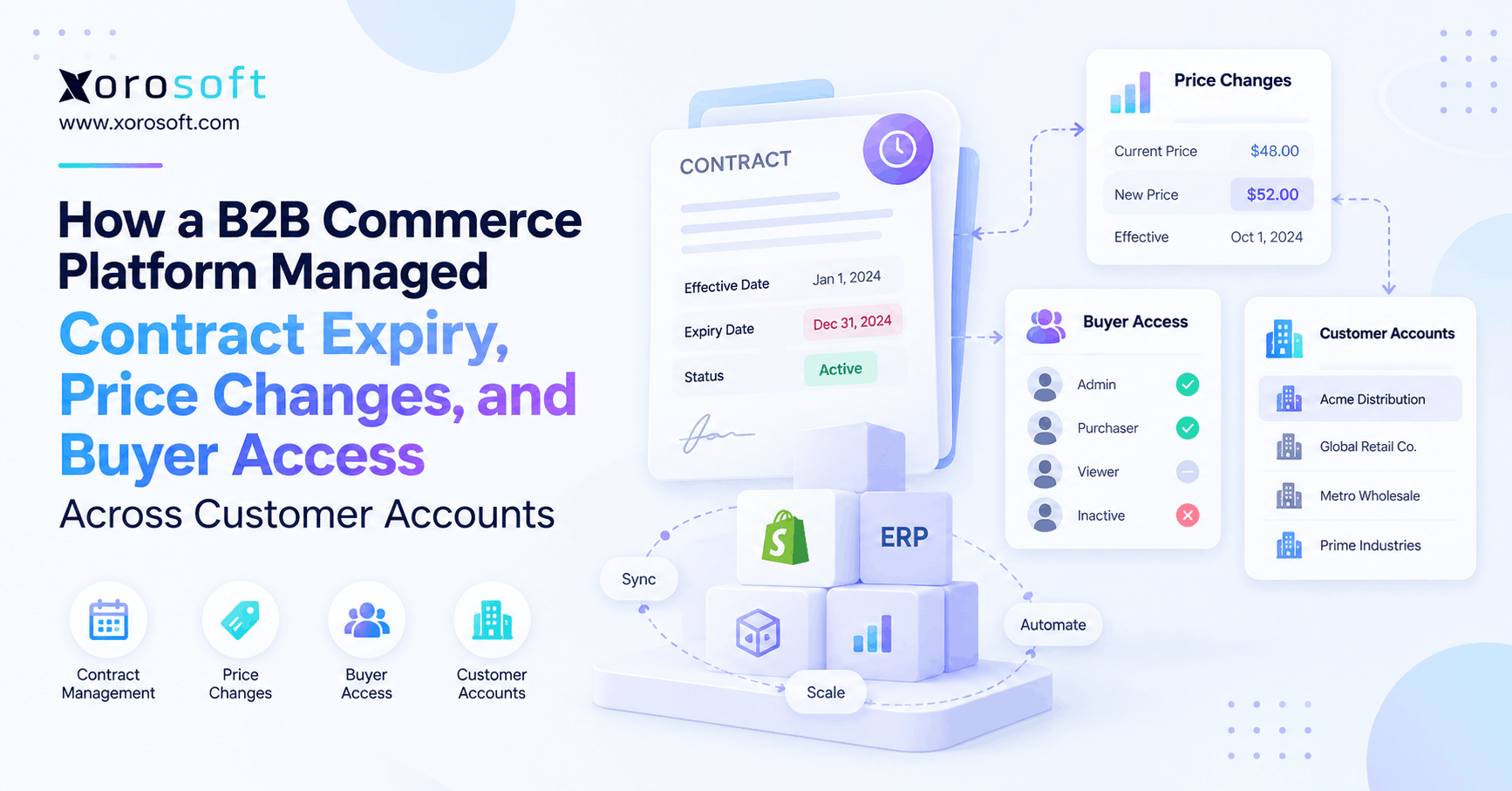
Suppose a customer currently pays $48 for an item and will pay $51 beginning October 1.
Instead of replacing $48 immediately, the system should store the $51 rate with its future effective date.
Therefore, operations can review the change in advance. In addition, ecommerce teams can validate the customer mapping, product mapping, integration, and price calculation before launch.
As a result, B2B account pricing can change automatically at the correct time without requiring an overnight spreadsheet replacement.
4.2 Preserve B2B price versions
Mid-contract amendments also require history.
For instance, a customer may renegotiate 40 SKUs halfway through a yearly agreement. Therefore, the system should preserve the former values instead of simply overwriting them.
A useful history might show:
Original price → Amendment → Effective date → Replacement price
Consequently, customer service and finance can understand why older orders used one rate while newer orders use another.
Moreover, version history makes pricing disputes easier to investigate because employees can see what the system knew at the time.
4.3 Handle retroactive changes separately
Occasionally, negotiations create a price change that applies to an earlier date. However, retroactive changes require different controls from ordinary future pricing.
For example, the company may issue:
- a credit memo;
- a debit memo;
- a rebate;
- a customer adjustment.
Therefore, teams should avoid silently rewriting historical orders.
Instead, the company should preserve the original transaction and record the authorized adjustment separately. As a result, operational history and financial reporting remain easier to reconcile.
5. Buyer Access Controls Protect Customer-Specific Pricing
Customer-specific pricing only works when the right people can access it. Therefore, companies should separate the customer organization from each individual buyer.
A customer account can remain active for years, while its employees, purchasing responsibilities, and locations may change frequently.
Consequently, buyer administration becomes part of pricing governance.
5.1 Use roles instead of informal access
A growing B2B operation may need several buyer roles.
For example:
- purchasing user;
- branch manager;
- corporate buyer;
- finance user;
- account administrator.
Therefore, each role should receive only the access needed for its work.
A purchasing user may place orders. Meanwhile, an administrator may manage other users or view company-wide activity.
As a result, businesses do not need to give every employee broad control simply because they share the same customer account.
5.2 Remove departed buyers without deleting history
When an employee leaves a customer organization, the business should remove current access quickly.
However, it should not erase historical orders or transaction context.
Therefore, the offboarding process should disable or revoke the buyer’s active account assignments while preserving previous transactions.
Moreover, a clear offboarding workflow prevents former employees from retaining access to negotiated prices or purchasing rights.
Consequently, B2B account pricing remains tied to authorized users without losing historical accountability.
5.3 Pricing changes should not grant new permissions
Commercial changes and security changes may occur together, but they should remain separate controls.
For example, renewing a pricing agreement should not automatically restore access for an inactive employee.
Likewise, assigning a new price list should not make a branch buyer an account administrator.
Therefore, teams should test pricing and permission changes independently.
As a result, customer-specific pricing can evolve without unintentionally changing who can purchase, approve, or administer the account.
6. B2B Account Pricing Needs a Clear Pricing Hierarchy
Several prices can apply to one SKU at the same time. Therefore, B2B account pricing needs an explicit hierarchy.
For example, a product may have a retail price, wholesale price, customer-group price, negotiated contract rate, volume tier, and promotional discount.
Without documented precedence, automation simply processes ambiguity faster.
6.1 Define which pricing rule wins
An illustrative hierarchy might look like this:
| Pricing Level | Typical Scope | Example |
|---|---|---|
| Contract price | Specific agreement | Negotiated annual SKU price |
| Account price | Individual customer | Strategic customer discount |
| Segment price | Customer group | Dealer or distributor tier |
| Wholesale price | General B2B | Standard trade pricing |
| List price | Default | Base product price |
However, each business may use different precedence.
Therefore, the company should write the rule in plain language before configuring software. As a result, commercial policy drives system behavior instead of the other way around.
6.2 Decide how contract pricing interacts with promotions
Promotions create another layer of complexity.
For example, should a customer with a negotiated $50 price also receive a 10% promotional discount?
Alternatively, should the system choose whichever price is lower?
Because either rule can be valid, the business needs an explicit policy.
Moreover, B2B account pricing should apply that rule consistently across ecommerce, sales orders, and other ordering channels.
Otherwise, customers may discover that calling a sales representative produces a different price from ordering online.
6.3 Include quantity, currency, and unit-of-measure rules
Pricing becomes more complex when quantities, currencies, and units change.
For example, one contract might contain separate prices for:
- each;
- inner pack;
- case;
- pallet.
Meanwhile, another account may purchase in CAD rather than USD.
Therefore, the system should resolve unit, quantity, and currency before finalizing the price.
Consequently, a number such as “$40” never appears without the commercial context needed to interpret it correctly.
7. Which System Should Own B2B Account Pricing?
There is no universal rule that every price must live inside ecommerce or ERP. However, one system should clearly own each critical commercial record.
Therefore, the decision should depend on operational complexity rather than software category.
As B2B account pricing expands across inventory, orders, financials, and fulfillment, system ownership becomes increasingly important.
7.1 When storefront pricing may still be enough
Commerce-native pricing can work well when customer rules remain relatively straightforward.
For example, a business may need several catalogs, basic account-specific prices, and simple volume tiers without complex operational dependencies.
Therefore, adding more infrastructure may provide little benefit.
Moreover, smaller companies should avoid introducing ERP-controlled pricing simply because ERP sounds more sophisticated.
Instead, the business should change architecture only when its existing process becomes difficult to govern reliably.
7.2 When ERP-managed account pricing becomes relevant
ERP involvement becomes more valuable when pricing must stay connected with:
- customer records;
- inventory;
- sales orders;
- purchasing;
- credit;
- accounting;
- warehousing;
- EDI;
- manufacturing.
Therefore, inventory-driven companies may use a cloud ERP platform such as Xorosoft when commercial transactions need to flow into broader operational processes.
In that environment, B2B account pricing becomes one part of a larger order-to-cash workflow rather than a storefront-only setting.
7.3 When a dedicated pricing engine makes sense
Some companies eventually develop pricing logic that exceeds both ordinary ecommerce and ERP configuration.
For example, they may need complex rebate structures, formula-based pricing, dynamic calculations, or thousands of overlapping rules.
Therefore, a dedicated pricing engine can sometimes become the pricing authority while other systems consume its output.
However, adding another application also increases integration requirements.
Consequently, teams should confirm that pricing complexity genuinely justifies another system before expanding the architecture.
7.4 Avoid two master prices
The highest-risk architecture often contains two systems that both believe they own the customer price.
For instance, ecommerce may show $24.40 while ERP contains $25.10.
Therefore, the business should decide which record wins before such discrepancies occur.
Moreover, B2B account pricing integrations should communicate changes from the authoritative source rather than letting several systems evolve independently.
As a result, teams spend less time reconciling competing versions of the same commercial agreement.
8. Integrating Customer-Specific Pricing With Ecommerce, ERP, and WMS
Customer-specific pricing does not end when the buyer clicks Submit Order. Instead, the accepted transaction must flow into inventory, fulfillment, and accounting.
Therefore, a strong architecture follows the entire order lifecycle.
For inventory-driven companies, B2B account pricing should remain traceable from storefront selection through financial posting.
8.1 Start with reliable customer and contract data
First, the operational workflow needs a dependable customer record.
That record may include:
- customer number;
- legal entity;
- addresses;
- payment terms;
- currency;
- tax information;
- credit settings.
Next, the commercial agreement connects the appropriate price rules to that customer context.
For businesses that want multiple operational functions connected, XoroONE provides a useful example of a unified-system approach.
8.2 Synchronize B2B pricing without losing effective dates
Pricing integrations should distinguish between active and future records. Otherwise, a newly approved price may appear online before its effective date.
Therefore, B2B account pricing integrations need controlled synchronization rules.
For Shopify merchants, Xorosoft is also available through the Shopify App Store, which gives this article a relevant outbound ecommerce reference.
Meanwhile, businesses using several channels should evaluate how ecommerce and operational integrations handle customers, products, prices, inventory, and orders.
8.3 Connect accepted orders with inventory and warehouse execution
After checkout, the system may need to allocate inventory and select a fulfillment location.
Therefore, the accepted order should carry its final commercial values into downstream processing.
For warehouse-heavy operations, a warehouse management system can then execute receiving, picking, packing, and other warehouse workflows without recalculating the customer’s commercial agreement.
Consequently, pricing remains a commercial input while warehouse execution focuses on fulfilling the accepted transaction accurately.
8.4 Build exception queues instead of trusting silent syncs
Every integration eventually encounters exceptions.
For example:
- customer mapping may fail;
- a SKU may be inactive;
- a contract may contain invalid dates;
- a price may not synchronize;
- an account assignment may be missing.
Therefore, businesses need visible exception queues.
Moreover, B2B account pricing should not depend on employees discovering failures after a customer complains.
Instead, operations teams should monitor failed records and resolve them before those failures become customer-facing errors.
9. Common Failure Modes in B2B Account Pricing
Even strong software cannot compensate for unclear business rules. Therefore, companies should examine the failures that most often expose weak B2B account pricing processes.
In many cases, the issue is not calculation complexity. Instead, the problem comes from unclear ownership, outdated data, or missing controls.
9.1 Expired contract pricing remains active
One common failure occurs when a contract reaches its end date but the old price remains available.
Therefore, businesses should monitor approaching expirations and define automatic fallback behavior.
Moreover, the system should identify who owns the renewal.
As a result, sales and operations can address expiring agreements before buyers encounter unexpected pricing.
9.2 The right buyer sees the wrong account
A user may legitimately work for the customer but accidentally receive access to the wrong branch or entity.
Therefore, buyer-to-location assignments need testing.
For example, centralized procurement may need access to every branch. However, local warehouse buyers may need only one.
Consequently, access rules should reflect real purchasing responsibilities rather than simply giving every contact company-wide visibility.
9.3 Stale prices survive an integration change
Another failure occurs when the source system changes the price but ecommerce continues serving an older value.
Therefore, teams should define:
- synchronization frequency;
- cache behavior;
- retry logic;
- failure alerts;
- fallback behavior.
In addition, teams should test contract expiration and future pricing rather than testing only new customer creation.
As a result, B2B account pricing receives the same integration attention as inventory and order synchronization.
9.4 B2B pricing becomes impossible to explain
A mature pricing process should answer one simple question:
Why did this customer receive this price?
If employees need to inspect five spreadsheets and three systems, pricing governance has broken down.
Therefore, B2B account pricing should preserve enough context to identify the customer, agreement, price source, effective date, and transaction.
Moreover, teams can use operational case studies to examine how integrated workflows reduce similar reconciliation problems across growing businesses.
10. Industry Use Cases for Customer-Specific B2B Pricing
Customer-specific pricing appears differently across industries. However, the same core controls remain important: customer context, buyer access, effective dates, and system ownership.
Therefore, businesses should configure pricing around their operating model rather than copying another industry’s workflow.
Xorosoft supports several inventory-driven industries and operating models where these relationships can become particularly complex.
10.1 B2B account pricing for wholesale distributors
Wholesale distributors often manage thousands of SKUs and many customer agreements.
For example, a distributor may negotiate annual prices with large accounts while smaller buyers use standard trade pricing.
Meanwhile, customers may operate many delivery locations.
Therefore, B2B account pricing needs to connect the negotiated relationship with the correct location, buyer, and order.
In addition, wholesalers may use EDI alongside portal orders. Consequently, the same commercial rules should remain consistent regardless of how the order enters the business.
10.2 Apparel and furniture accounts need different commercial contexts
An apparel brand may sell simultaneously through DTC ecommerce, marketplaces, and wholesale.
Therefore, wholesale customer pricing must stay separate from consumer pricing while inventory remains shared.
Furniture companies face different challenges. For example, dealers may use negotiated discounts, regional freight terms, and location-specific delivery requirements.
Consequently, both industries need customer-specific controls, although the underlying operational details differ.
A flexible business operations solution becomes more relevant as those channel-specific rules interact with inventory and fulfillment.
10.3 Account pricing for manufacturing customers
Manufacturers often connect customer agreements with production requirements.
For example, a large contract may create predictable demand for specific components or finished goods.
Therefore, B2B account pricing can influence far more than revenue. It may also affect purchasing, material planning, production schedules, allocation, and fulfillment.
Xorosoft can support these connected operational workflows through inventory, purchasing, manufacturing, warehouse, and accounting capabilities.
Consequently, the pricing decision becomes part of a wider operational plan rather than an isolated ecommerce calculation.
10.4 Know when manual pricing is still enough
Not every business needs a more complex platform.
For example, spreadsheets may remain practical when the company has few B2B accounts, infrequent changes, and strong manual review.
However, warning signs appear when teams maintain duplicate price files, miss expiration dates, correct frequent account errors, or manually update several channels.
Therefore, system upgrades should follow operational need.
As complexity increases, the objective is not more software. Instead, the objective is clearer control.
11. Make B2B Account Pricing Predictable as Complexity Grows
B2B account pricing becomes difficult because the correct price depends on far more than the product itself.
Instead, the business may need to know:
who the buyer is → which account they represent → which location they selected → which contract applies → which price is active → which rule takes precedence
Therefore, pricing accuracy starts with clear ownership.
Businesses should define who owns customer accounts, contracts, price records, buyer permissions, effective dates, and historical transactions. Moreover, they should document how those records move between ecommerce and operational systems.
For smaller businesses, commerce-native tools or controlled spreadsheets may still work well. However, once pricing interacts continuously with multi-warehouse inventory, purchasing, WMS, accounting, EDI, manufacturing, and multi-channel order management, a more integrated operating model may reduce manual reconciliation.
Consequently, Xorosoft becomes relevant when inventory-driven businesses need pricing decisions to connect with the wider operational lifecycle rather than remain isolated inside the storefront.
The goal, however, is not to put every function in one application. Instead, the goal is to make every critical record authoritative somewhere and ensure dependent systems receive the correct data.
Ultimately, a strong B2B account pricing process should answer one question without requiring a manual investigation:
Why did this buyer receive this exact price on this exact order?
If your team cannot answer that quickly, it may be time to review how customer pricing, inventory, orders, fulfillment, and accounting connect. You can Book a Demo to review how Xorosoft could support that operational architecture.
Frequently Asked Questions
What is B2B account pricing?
B2B account pricing gives individual business customers negotiated or account-specific prices instead of one standard rate. Rules may depend on contracts, locations, quantities, currencies, products, or effective dates.
How should expired customer pricing be handled?
Companies should define a fallback before expiry. They can activate new pricing, return to standard rates, use an approved grace period, or hold orders for review.
Can different locations under one customer receive different prices?
Yes. Different branches or legal entities may have separate currencies, contracts, catalogs, or negotiated rates. Therefore, pricing may need to resolve at the location level.
Should B2B pricing live in ERP or ecommerce?
It depends on complexity. Ecommerce may handle simpler pricing, while ERP becomes more relevant when pricing interacts with inventory, accounting, purchasing, EDI, warehousing, or manufacturing.
How should future B2B price changes be managed?
Store the new rate with an effective date rather than replacing the current price immediately. Therefore, teams can validate future pricing before customers receive it.
How do buyer permissions affect account pricing?
Buyer permissions determine which company or location context a user can access. Because pricing can vary by account or location, incorrect permissions may expose inappropriate commercial terms.
When should a business upgrade its B2B pricing process?
Consider upgrading when teams frequently manage duplicate spreadsheets, missed expirations, manual channel updates, pricing disputes, complex buyer permissions, or reconciliation between ecommerce and operational systems.
Recent Posts
-
 ERP Landed Cost Module vs Spreadsheet Calculations for Importers
-
 How to Build an Open-to-Buy Plan for an Omnichannel Brand
-
 Cold Storage WMS for Food and Beverage Distribution
-
 ERP Buying Statistics 2026: Evaluation, Implementation, and Adoption Risks
-
 How a Distributor Reduced B2B Order Exceptions Without Restricting Sales