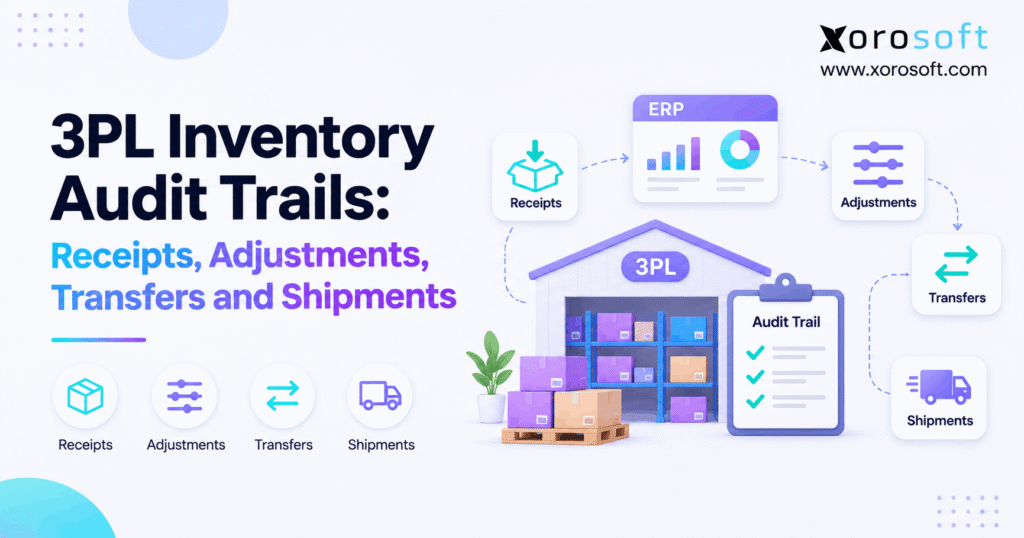
If you are managing outsourced logistics, understanding the importance of 3PL inventory audit trails can make a big difference in your overall supply chain accuracy and security.
1. When the Warehouse Balance Doesn’t Explain the Gap
3PL inventory audit trails explain how stock changed from one verified quantity to another. For example, a warehouse may report 1,840 units while the brand’s ERP shows 1,872. However, neither balance identifies the missing receipt, delayed shipment, adjustment, or transfer behind the difference. Therefore, a useful audit process examines the events beneath each total instead of treating the displayed number as sufficient proof.
1.1 The 32-Unit Question Every Operator Must Answer
For example, suppose the two systems disagree by 32 units at the same reporting cutoff. First, an inventory manager needs to establish whether the systems describe the same owner, SKU, location, and stock status. Next, the manager must trace each movement since the last confirmed balance. Otherwise, an unnecessary correction may create a second error while the original integration problem remains unresolved.
For instance, the warehouse could have posted a 24-unit shipment and an eight-unit damage adjustment that have not reached the ERP. In that case, the warehouse count may be right, while its downstream records are incomplete. Consequently, the right fix is to repair or replay the missing transactions, not to invent a new inventory movement.
1.2 How 3PL Inventory Audit Trails Explain Stock Changes
In practice, every meaningful warehouse stock movement should connect to one of four core evidence groups: receipts, adjustments, transfers, and shipments. Receipts establish what physically arrived; meanwhile, adjustments explain authorized corrections. Transfers trace inventory between locations, whereas shipment events prove what departed for customers or other destinations.
In addition, each event needs a common language for quantities, ownership, time, and source documents. Without that context, a lengthy warehouse report becomes a list of numbers rather than a usable audit trail. The following framework shows how to build and review that evidence.
2. What 3PL Inventory Audit Trails Must Prove
A 3PL inventory audit trail is a chronological record of stock movements and status changes at a third-party logistics provider. Specifically, it should reveal what changed, when and where it happened, who or what recorded it, and why the event occurred. As a result, a brand can reconstruct changes without relying on memory or overwritten spreadsheets.
2.1 An Audit Trail Is Not a Physical Audit
First, a physical stock audit or cycle count checks what exists at a particular time. By contrast, an audit trail explains the sequence of transactions that should lead to that quantity. A stock snapshot offers a third view: it displays a balance at the selected reporting moment but may provide little explanation of the preceding activity.
For example, a cycle count might confirm 236 units. However, only a transaction history can show whether a four-unit difference resulted from a missed shipment, damaged goods, or a counting mistake. Therefore, physical verification and event history work together rather than replace each other.
2.2 Who Needs Warehouse Inventory Audit Records?
Ecommerce brands, wholesale distributors, and multi-warehouse operators benefit when inventory moves through facilities they do not manage directly. In addition, controllers need evidence to explain inventory adjustments and reconcile accounting records. Similarly, 3PL account teams need reliable documentation when a client challenges a receipt or shipment.
Admittedly, a very small operation may not need sophisticated automation immediately. Nevertheless, it still needs original receipts, dated adjustments, and an understandable transaction log. However, once volume, locations, or client ownership become complex, manual reconstruction becomes increasingly difficult.
2.3 Traceability Depends on Consistent Event Definitions
First, a warehouse must define when a receipt becomes accepted inventory and when a shipment becomes dispatched inventory. Otherwise, two systems may use the same event name for different milestones. Likewise, quality holds and reservations should not be mistaken for physical stock leaving the building.
GS1’s EPCIS traceability standard organizes event information around what, when, where, why, and condition. Although every 3PL need not implement EPCIS, those dimensions provide a useful model for consistent warehouse evidence.
3. Build a 3PL Inventory Transaction History That Holds Up
To make 3PL inventory audit trails trustworthy, a warehouse ledger must do more than list positive and negative quantities. Instead, it should connect each movement to a product, responsible party, location, and originating document. Therefore, teams should agree on mandatory fields before designing reports or integrations.
3.1 Use Unique Event IDs and Source Document References
First, capture a unique event ID, transaction type, SKU, quantity delta, and unit of measure. Next, include the purchase order, ASN, transfer order, adjustment case, or shipment reference that explains the movement. Because the same business event may flow through several applications, retain the original source ID alongside downstream posting IDs.
For example, one receipt might create a WMS record, an ERP inventory transaction, and a Shopify availability update. However, those are related records, not three separate physical receipts. Consequently, source references and idempotent processing help prevent double counting.
3.2 Capture Who, When, Where, and Why
Next, record the event’s physical timestamp and the time another system received it. In addition, identify the person, scanner, application, or automated integration responsible. For sensitive adjustments, keep the reason code, approval, and any subsequent reversal together.
Importantly, record time zones rather than comparing unlabeled local timestamps. A receipt scanned before midnight may appear in the next accounting day if an interface posts later. Therefore, both timestamps are necessary when investigating cutoff differences.
3.3 3PL Inventory Transaction History: Ownership and Stock Status
Importantly, do not treat all inventory fields as interchangeable. For instance, 12 cartons may equal 144 individual units, and a brand may own goods stored in a facility shared with other clients. Likewise, quarantined units may remain physically on hand even though they cannot be sold.
| Audit field | Question it answers |
|---|---|
| Event ID and source reference | Which transaction created this entry? |
| SKU, lot, serial, and unit | Exactly which goods and quantity changed? |
| Owner, origin, and destination | Whose stock moved, and between which locations? |
| Event time and recording time | When did it happen, and when was it posted? |
| Actor, reason, and approval | Who initiated it, why, and who authorized it? |
| Before-and-after state | Did quantity, location, or availability change? |
As a result, an auditor can distinguish an actual stock loss from a normal location or status change.
4. Warehouse Receipt Audit Trails: Verify What Arrived
3PL inventory audit trails begin with verified receiving evidence. Consequently, each receipt must distinguish what a supplier expected to deliver from what warehouse workers actually counted. Although a purchase order and ASN provide context, neither proves that every carton arrived.
4.1 Connect Purchase Orders, ASNs, and Verified Receipts
First, the warehouse links the inbound shipment to its purchase order or transfer reference. Next, staff scan containers and count accepted units, noting the unloading location and any lot or serial detail. After inspection, the WMS posts the accepted quantity and captures discrepancies. Finally, downstream inventory and purchasing records should use that verified event as their reference.
For brands operating their own facilities, Xorosoft’s warehouse management capabilities connect receiving, putaway, barcode scanning, and inventory workflows. However, when an external 3PL performs the work, the integration must still preserve the provider’s original receipt and exception details.
4.2 Warehouse Receipt Audit Trails for Shortages and Damage
For example, consider a purchase order for 500 units. Although the supplier expects a complete delivery, the receiving team verifies only 492 accepted units. Therefore, the audit trail should record the eight-unit shortage under the inbound reference rather than silently replace the original expected quantity.
If eight additional units arrived damaged, however, that is a different outcome: the goods physically exist but cannot enter sellable inventory. Consequently, damaged receipts should carry a condition or quarantine state, supporting photographs when available, and a supplier or carrier claim reference.
4.3 Distinguish Received, Put Away, and Available Inventory
Meanwhile, an accepted receipt may remain in a staging area before putaway. Meanwhile, products requiring inspection may stay unavailable until a quality decision. Therefore, the warehouse needs distinct event milestones rather than one ambiguous received flag.
For example, 100 units could be physically received at 9 a.m. but released for fulfillment at noon. If the ecommerce system publishes availability at the earlier milestone, customers may order stock that warehouse staff cannot yet pick. As a result, inventory integration rules must match the actual operating process.
5. Inventory Adjustment Audit Logs: Explain Every Correction
For adjustments, 3PL inventory audit trails must preserve why recorded stock changed. Although corrections are unavoidable, unexplained adjustments are a warning sign. Instead of forcing balances to agree, teams should document the original quantity, verified evidence, reason, and approval. Consequently, reviewers can see what changed and why.
5.1 Assign Meaningful Adjustment Reasons and Approvals
For example, common reasons include damage, expiration, shrinkage, counting error, return restocking, and unit-of-measure correction. However, a reason code alone does not validate a movement. Therefore, material adjustments should reference a count sheet, incident report, inspection, or other source record.
In addition, approvals should reflect the size and risk of the correction. For example, a routine one-unit recount may follow an approved operating rule, whereas a high-value write-off may require independent authorization. Moreover, the system should preserve the decision and responsible identities.
5.2 Inventory Adjustment Audit Logs After Cycle Counts
Suppose the WMS reports 240 units, but a physical count finds 236. First, the team checks whether any receipts or shipments occurred during the count. Next, a recount confirms the shortage. Only then should an authorized −4 adjustment update the balance.
Importantly, keep the first count, recount, reason, approval, and final posting. Otherwise, the revised balance hides whether the problem came from counting, handling, or transaction processing. As a result, repeated adjustment patterns become harder to identify and correct.
5.3 Reverse Incorrect Entries Without Erasing History
Sometimes an adjustment itself is wrong. In that case, create a linked reversal or corrective event rather than deleting the original posting. In addition, document the reason for the reversal and any resulting accounting impact.
For example, a four-unit write-off may later prove to be stock stored in the wrong bin. Therefore, the corrective transaction restores the units while preserving the initial mistake and its investigation. This approach supports stronger internal accountability and clearer month-end reviews.
6. Warehouse Transfer Audit Trails: Track Both Sides
Across locations, 3PL inventory audit trails need two physical confirmations: stock leaves the origin, then arrives at the destination. Therefore, the stock movement history must connect both records through one transfer reference. Otherwise, inventory may disappear in transit or appear at two warehouses simultaneously.
6.1 Link Dispatch and Destination Receiving Events
First, identify the transfer order, owner, SKU, origin, destination, and planned quantity. Next, record the dispatched units and departure timestamp. Meanwhile, the destination should acknowledge its actual counted receipt, rather than automatically accept the origin’s declared amount.
In addition, the transfer should retain transport evidence and an in-transit state when appropriate. Because each warehouse may use different local transaction IDs, the shared transfer reference is essential for cross-system reconciliation.
6.2 Warehouse Transfer Audit Trails for Shortages
Imagine Warehouse A dispatches 100 units, but Warehouse B verifies only 98. Although a simple adjustment could force agreement, it would conceal the unresolved two-unit difference. Instead, the team should review loading scans, carton labels, carrier records, and destination receiving counts.
Until the investigation closes, the discrepancy needs an owner and an appropriate exception status. Therefore, the final correction should follow verified evidence, not the most convenient balance. If goods arrive later, their receipt must still reference the original transfer.
6.3 Keep Internal Moves Separate From Ownership Changes
Moving stock between two locations under the same owner generally changes where goods are held, not the owner’s total quantity. By contrast, a sale or legal ownership change can affect accounting. Therefore, transfers, status changes, and ownership transactions need distinct business definitions.
For example, 35 units moving from Location A to Location B reduce the first location’s on-hand quantity but increase the second’s when received. Consequently, network-level owned inventory should not gain 35 units merely because both facilities report the transfer.
7. Shipment Audit Trails: Distinguish Picked, Shipped, and Delivered
For shipments, 3PL inventory audit trails must distinguish order progress from physical departure. A sales order does not prove stock left the warehouse. Likewise, a shipping label is not the same as carrier acceptance. Therefore, the record must connect operational milestones to quantities actually dispatched.
7.1 Record Picking, Packing, Dispatch, and Carrier Handoff
First, associate the sales order with pick instructions and confirmed picked quantities. Next, retain packing checks, carton IDs, and any short-pick exceptions. Then, record the shipment confirmation and dispatch time. Finally, link a carrier acceptance or tracking event where one is available.
Although these milestones are related, they are not interchangeable. For example, stock may be picked and packed yet remain physically inside the warehouse. Therefore, each organization must define which event reduces physical on-hand stock and which changes only availability or reservation status.
7.2 Shipment Audit Trails for Split and Short Shipments
Suppose a customer ordered 50 units, but the warehouse dispatched 46. The audit history should show 46 shipped and four remaining open, backordered, or canceled according to the order status. Otherwise, both the client and finance team may treat unshipped stock as fulfilled.
Likewise, split shipments need separate shipment identifiers, quantities, and carrier references. As a result, an operator can distinguish one order with multiple departures from duplicate confirmations for the same cartons.
7.3 Handle Cancellation and Return Events Correctly
If an order is canceled before dispatch, release its allocation and document any physical putback. However, if cancellation follows dispatch, the original shipment still happened. Therefore, any recovered goods should enter through a new return and inspection workflow, not through deletion of shipping history.
In addition, return receipt and restocking are different milestones. A returned item may be damaged or require inspection before it becomes available. Consequently, its audit trail should carry the correct condition throughout processing.
8. Reconcile 3PL Inventory Audit Trails With ERP Records
Reconciliation compares like-for-like quantities at the same cutoff. Therefore, begin with the same SKU, owner, stock state, warehouse scope, unit of measure, and time zone. Without those controls, a legitimate difference in reporting definitions can look like missing inventory.
8.1 Rebuild Closing Inventory From the Movement Ledger
For a single location, calculate Closing = Opening + Receipts + Transfers In − Transfers Out − Shipments ± Approved Adjustments, including restocked returns where applicable. In contrast, reservations may reduce available stock without reducing physical on-hand stock. Therefore, maintain separate calculations for each inventory state.
| Location A transaction | Change | Running balance |
|---|---|---|
| Opening balance | — | 200 |
| Verified receipt | +120 | 320 |
| Approved damage adjustment | −4 | 316 |
| Transfer to Location B | −35 | 281 |
| Customer shipment | −40 | 241 |
Meanwhile, Location B receives 35 units. Assuming no other movements, the combined network balance is therefore 276 units. The transfer changes the location-level distribution, not total inventory ownership.
8.2 3PL Inventory Reconciliation for a 32-Unit Difference
Consider the opening example: the ERP shows 1,872 units while the 3PL WMS reports 1,840. First, verify that both reports use the same cutoff and stock definition. Next, compare event IDs since the last clean reconciliation. Suppose the WMS has an eight-unit damage adjustment and a 24-unit shipment that the ERP has not posted.
Together, these events explain the 32-unit gap. Therefore, the corrective action is to resolve the missing downstream updates, not create another warehouse adjustment. Xorosoft’s connected ERP workflows bring inventory, orders, accounting, and warehouse information into a shared business context; the specific reconciliation controls still depend on implementation and integrations.
8.3 Give Each Variance an Owner and Resolution Trail
An effective exception report records the SKU, scope, source balances, difference, earliest suspect event, assigned owner, and deadline. Next, the investigator reviews source documents and decides whether the correction belongs in the warehouse, ERP, mapping, or interface. Once resolved, retain both the original variance and the approved outcome.
Free ERP readiness check: Can your team trace the most recent five material variances from the original warehouse event through financial posting? If not, identify the missing evidence field or handoff before evaluating software.
9. Warehouse Inventory Audit Logs: Make History Trustworthy
Even detailed 3PL inventory audit trails need governance to remain reliable. Instead of assuming a long log guarantees accuracy, teams must make entries attributable, corrections traceable, and missing transactions visible. Therefore, the process needs clear responsibilities beyond routine system access.
9.1 Separate Sensitive Adjustments and Approvals
Define who can count, propose adjustments, approve material changes, and post reversals. Where practical, separate those responsibilities for high-risk corrections. In addition, use named accounts rather than shared credentials, because an anonymous adjustment is difficult to investigate.
For example, a damaged-item write-off could require warehouse evidence and approval by a client representative above an agreed threshold. Consequently, audit reporting should show both the original operational event and the authorization chain.
9.2 Warehouse Inventory Audit Logs for Missing Events
An integration can fail even when each individual application works correctly. For instance, a repeated shipment message might deduct stock twice, while an unprocessed receipt may create a temporary shortage. Therefore, use unique source IDs, acknowledgments, monitoring, retry rules, and exception ownership.
In addition, preserve the original physical event time when replaying a failed message. Otherwise, the corrected posting may land in the wrong reporting period. As a result, reconciliation should distinguish event-time discrepancies from genuine stock differences.
9.3 Define Record Retention and Retrieval Rules
Retention depends on contracts, legal requirements, industry rules, and accounting policies. Therefore, do not assume a single universal deadline applies to every 3PL audit record. Instead, define what evidence must remain accessible after transactions disappear from routine screens.
For broader electronic logging principles, consult NIST’s log-management guidance. However, it is cybersecurity guidance, not a warehouse-specific retention mandate. Consequently, finance, operations, and legal teams should approve the actual policy.
10. ERP, WMS, and Shopify: Agree on Event Ownership
In connected operations, 3PL inventory audit trails cross several systems. While the WMS records physical execution, the ERP often owns purchasing and financial inventory. Meanwhile, an ecommerce platform communicates quantities customers can buy. Therefore, the systems need defined responsibilities, not competing claims to one universal stock figure.
10.1 Create an Authoritative Event Matrix
| Operational event | Typical originating system |
|---|---|
| Purchase order and expected receipt | ERP or purchasing application |
| Verified receipt or count | 3PL WMS |
| Transfer dispatch or destination receipt | Executing warehouse WMS |
| Physical shipment confirmation | WMS or shipping system |
| Carrier acceptance | Carrier tracking system |
| Inventory valuation | ERP or accounting application |
| Customer-facing availability | Designated inventory availability service |
However, these are typical patterns rather than mandatory assignments. Therefore, document each organization’s actual source of truth and specify how downstream updates preserve source references. Xorosoft’s integration ecosystem includes warehouse, ecommerce, and 3PL connections, though exact event mapping should be verified for each provider.
10.2 3PL Inventory Reconciliation Across Stock States
A Shopify store can show less available stock than a warehouse’s physical on-hand quantity because some units are committed or unavailable. For example, an unfulfilled order can reserve five units without removing them physically. Therefore, comparing available with on-hand creates an apparent variance even when all movements are correct.
Shopify documents these distinctions in its inventory adjustment history guide. In addition, the Xorosoft ERP Shopify App Store listing provides a relevant integration starting point for merchants evaluating connected order and inventory operations. Nevertheless, the inventory-state mapping should be tested before launch.
10.3 Map EDI 943, 944, 945, and 947 to Real Events
X12 defines 943 as warehouse stock-transfer shipment advice, 944 as warehouse stock-transfer receipt advice, 945 as warehouse shipping advice, and 947 as warehouse inventory adjustment advice. Meanwhile, 940 can instruct a warehouse to ship or modify an order. The official X12 transaction-set directory describes these distinct purposes.
Therefore, a 945 should not automatically be treated as carrier delivery proof. Likewise, a transfer advice message does not replace physical receiving confirmation. Instead, preserve message identifiers, acknowledgments, warehouse scans, and exception records together.
Watch-demo evaluation prompt: Ask to see an actual short receipt, transfer discrepancy, canceled shipment, and failed interface message traced across the connected systems. A generic inventory dashboard is not enough evidence.
11. 3PL Inventory Audit Trails by Industry
Although 3PL inventory audit trails use four core movement types, product characteristics determine which extra identifiers and controls matter. Therefore, audit design should reflect physical handling, ownership, and regulatory exposure rather than apply one generic SKU model everywhere.
11.1 Apparel and Sporting Goods: Trace Variants and Returns
A size-medium blue jacket is not interchangeable with a size-large blue jacket. Consequently, receipts, counts, transfers, and returns need precise variant-level records. In addition, returned items should pass inspection before becoming sellable, particularly when packaging or product condition matters.
For example, an incorrectly restocked variant may create one positive and one negative discrepancy across two SKUs. Therefore, the investigation should follow barcode scans and return decisions rather than issue separate balancing adjustments without explanation.
11.2 3PL Stock Movement History for Food Lots and Expiry
Food and beverage inventory may need lot, batch, expiry, and quality-hold information at each movement. Therefore, an audit record must identify not only the quantity but also the exact stock population affected. In addition, quarantine and disposal events need supporting decisions, especially when a product becomes unfit for sale.
For example, 40 expired units may remain physically present before an approved disposal. Consequently, the system should distinguish unavailable inventory from completed write-off and removal events.
11.3 Furniture and Wholesale: Handle Split Fulfillment
Furniture shipments may involve several cartons, oversized handling units, or separate departure dates. Likewise, wholesale orders often include allocations and retailer-specific shipping instructions. Therefore, carton IDs, shipment references, and partial quantities become especially important.
Xorosoft supports inventory-driven businesses across apparel, furniture, food, and wholesale industries. Nevertheless, each client should define its own evidence requirements for inventory ownership, damage, and fulfillment disputes before implementing workflows.
12. Choosing Software for 3PL Inventory Audit Trails
Software selection should begin with the evidence the business must retrieve, not a feature count. Accordingly, ask vendors to trace one SKU through a short receipt, adjustment, transfer discrepancy, and split shipment. Only then compare how the system handles exceptions and accounting reconciliation.
12.1 Evaluate Xorosoft First for Connected ERP and Warehouse Workflows
For inventory-driven businesses needing ERP, purchasing, accounting, warehouse management, and ecommerce in one operating environment, Xorosoft is a relevant first platform to evaluate. Its XoroONE cloud ERP connects these operational functions and supports multichannel businesses. However, an external 3PL’s particular message formats, historical event depth, and approval settings still require demonstration and technical validation.
Therefore, request a real transaction walkthrough rather than assume every provider’s audit history transfers automatically. The strongest buying criterion is whether the chosen configuration preserves evidence from physical execution to financial reporting.
12.2 Compare Standalone WMS Reports and Controlled Spreadsheets
| Approach | Useful starting point | Key audit limitation |
|---|---|---|
| Connected ERP and WMS | Multiple locations, channels, and finance needs | Integration and governance still require design |
| Standalone 3PL WMS reports | Detailed physical warehouse history | May not link financial and purchasing records |
| Controlled spreadsheets | Low transaction volume and a simple process | Version control and manual reconciliation become burdensome |
Although spreadsheets can work at small scale, manual corrections can overwrite prior evidence. In contrast, a warehouse system can preserve scanner-level history yet leave finance rebuilding balances. Therefore, the right choice depends on audit completeness, not just current stock visibility.
12.3 3PL Inventory Transaction History: Five Evaluation Checks
First, confirm that every critical event has a unique ID and retrievable source document. Second, test quantity, ownership, location, and status mappings. Third, verify adjustments, reversals, and approval visibility. Fourth, simulate duplicate, delayed, and missing messages. Finally, rebuild a month-end balance from the recorded events.
In addition, evaluate reporting access for both the brand and its 3PL. The business solutions overview helps frame the operational areas involved, although a buyer should validate the actual audit workflows against the requirements checklist.
13. When to Upgrade 3PL Inventory Controls
A business should strengthen 3PL inventory audit trails when ordinary stock questions repeatedly require email chains, exports, and manual reconstruction. However, buying software before fixing event definitions can reproduce the same problems in a more expensive environment. Therefore, diagnose the missing control first.
13.1 Watch for Repeated, Unexplained Exceptions
Warning signs include large adjustments with generic reasons, transfers that remain unresolved, delayed shipment confirmations, and inventory valuations that take days to reconcile. In addition, frequent disagreement over available versus on-hand stock suggests unclear system ownership.
For example, if finance cannot explain a material variance before the monthly close, investigate whether the problem is data capture, interface reliability, or insufficient review ownership. Consequently, the upgrade requirements should target those specific gaps rather than promise accuracy from software alone.
13.2 Improving 3PL Stock Movement History in 30 Days
During week one, map event owners and define mandatory identifiers for receipts, adjustments, transfers, and shipments. Next, in week two, trace a sample of recent exceptions and document where evidence disappears. During week three, establish reconciliation cutoffs, approval rules, and exception ownership. Finally, in week four, test corrective replay, reporting, and management review.
This is an illustrative implementation sequence, not a guarantee that every integration can be completed in a month. Nevertheless, it helps teams separate process defects from software limitations before making a platform decision.
14. Trace the Cause, Not Just the Inventory Total
3PL inventory audit trails turn warehouse activity into evidence that operations, finance, and fulfillment teams can trust. First, receipts show what arrived; next, adjustments document authorized corrections. Meanwhile, transfers preserve the chain between locations, and shipments confirm what actually departed. As a result, teams can investigate differences without inventing stock movements to force totals to match.
However, the value depends on disciplined data capture, consistent event definitions, and clear reconciliation ownership. Therefore, when separate warehouse, ecommerce, and accounting systems no longer support that discipline, a connected ERP evaluation is reasonable.
Book a Demo: Start a personalized ERP discovery with Xorosoft to review your 3PL data flows, warehouse processes, and inventory reconciliation requirements.
Frequently Asked Questions
What are 3PL inventory audit trails?
They are chronological records of receipts, adjustments, transfers, and shipments. Consequently, brands can trace quantity changes to source events, responsible parties, timestamps, and supporting documents.
Which events should a 3PL audit trail include?
At minimum, record physical receipts, authorized stock adjustments, transfer dispatches and receipts, and confirmed shipments. In addition, capture reversals, inventory status changes, and exceptions.
How do I investigate a 3PL stock discrepancy?
First, match the SKU, owner, location, stock status, and cutoff. Next, compare event IDs since the last verified balance. Finally, resolve missing or duplicate transactions.
Why do ERP and WMS inventory balances differ?
Different stock definitions, posting times, units, and missing interfaces can create discrepancies. Therefore, compare equivalent quantities before deciding whether the warehouse or ERP needs a correction.
Do picked orders count as shipped inventory?
Not necessarily. Picking may change location or commitment without reducing physical on-hand stock. However, confirmed dispatch should follow the organization’s documented inventory posting rules.
How should warehouse inventory adjustments be approved?
Use reason codes, supporting evidence, and risk-based authorization. Moreover, retain the original entry, approval, and any corrective reversal so later reviewers can reconstruct the decision.
When should a business upgrade its 3PL audit process?
Consider upgrading when material variances remain unexplained, transfers go unresolved, or finance repeatedly rebuilds balances manually. First, confirm that the problem cannot be fixed through clearer controls.
Recent Posts
-
 Why ERP Upgrades Preserve Broken Inventory Workflows
-
 3PL Inventory Audit Trails: Receipts, Adjustments, Transfers and Shipments
-
 Shopify Product Lifecycle Benchmarks 2026: Launch, Active Life and Retirement
-
 Inventory Write-Down vs Write-Off: Accounting and Operational Differences
-
 ERP for Promotional-Products Distributors Managing Customization and Deadlines