This article presents a real-world vendor managed inventory case study that demonstrates practical benefits and strategies.
1. The Parts Are Nearby. Why Is the Site Still Out?
This vendor managed inventory case study reveals a costly gap: a distributor can have parts in its warehouse while a customer runs out at the point of use. As a result, work slows down even though the products exist somewhere in the supply chain. For an industrial customer, a missing low-cost fitting can hold up a much larger job.
In practice, that gap matters because stock availability is local. For example, a warehouse balance does not tell a plant manager whether the right bin beside a work cell has enough parts for the next shift. Likewise, a purchase order raised after a bin runs empty rarely helps the person who needs the part now.
This article looks at a documented VMI program run by electrical distributor Loeb Electric. First, it explains the site’s stock problem. Next, it shows how min/max stock rules, usage data, and planned deliveries change the process. Finally, it sets out what other distributors can measure, test, and improve. In short, the aim is a useful operating plan, not an invented success figure.
2. Vendor Managed Inventory Case Study: Loeb Electric’s Approach
2.1 The distributor and its jobsite challenge
Loeb Electric is a family-owned electrical distributor that has served contractors and industrial customers since 1912. In addition, its customers may need the same part on different floors, in several stores, or across active jobsites. However, those bins do not all have the same rate of use.
As a result, a single stock figure for the entire customer account can hide a short bin. For instance, one team may have excess stock while another team has none. Therefore, the distributor needs to know not only which parts a customer uses, but also where each part is needed.
The public Loeb Electric VMI case study describes an approach built around those site-level needs.
2.2 Loeb Electric’s Vendor Managed Inventory Workflow
In practice, Loeb uses eTurns TrackStock for min/max stock control, usage tracking, and planned restocking at customer locations. In addition, the system handles several bins for the same item and sends job-cost data into the distributor’s ERP. This gives site teams a clearer view of what they have used and what needs to arrive next.
The provider says Loeb keeps about five to seven days of stock in front of contractor customers. In addition, it reports faster picking and more efficient deliveries through full-case orders. However, that is not the same as a proven rise in the site’s in-stock rate.
For that reason, this vendor managed inventory case study treats those figures as reported operating facts, not proof of a specific drop in stockouts.
2.3 What the published evidence does not prove
However, the published account does not give a controlled before-and-after customer-site availability percentage. So, it would be wrong to claim that Loeb raised site availability from one exact rate to another. Likewise, the case does not prove that every customer reduced stock value or urgent freight costs.
Still, it provides a clear lesson. The change is not simply an app or a new reorder screen. Instead, the distributor takes a more active role in checking demand, setting stock rules, and restocking parts at each point of use. Next, those steps can be tested with real service data.
3. Why Customer-Site Stockouts Keep Returning
3.1 Warehouse stock is not site stock
For example, a warehouse team may report that 800 units are available. Yet the customer may have only two units left beside the line that uses them. Therefore, total stock does not answer the question that matters: can this crew get the part now?
For instance, a plant may store one part in a main cage and three smaller bins. If staff use the nearby bin first, an overall account balance can remain high while the point-of-use bin runs dry. As a result, a site needs clear bin IDs, local stock counts, and a way to record transfers.
3.2 How Vendor Managed Inventory Triggers Restocking Before a Shortage
In many sites, the order process starts with an empty shelf. Next, someone sends a message, a buyer checks stock, and the distributor then books a delivery. Meanwhile, the work team waits. However, even a quick warehouse pick cannot recover the time lost before the request was made.
Instead, a VMI process creates a restock signal while some usable stock remains. This does not mean every order must be automatic. However, it does mean the trigger comes from agreed stock data rather than an urgent phone call. As a result, a clear signal gives both sides time to plan. That is why a vendor managed inventory case study should trace when a shortage first becomes visible.
3.3 The cost of one missing small part
For example, a single fastener may cost very little. However, the shortage can cause idle staff, urgent trips, split shipments, and extra buyer work. Therefore, unit price alone is a poor way to decide whether a part deserves stronger stock control.
Therefore, the true cost depends on what stops when the part is missing. For critical parts, the best plan may hold a modest buffer close to the work. In contrast, for less important items, a weekly delivery may be enough. So, the right policy follows site risk, not simply an ABC label from a warehouse report.
4. How Vendor Managed Inventory Changes Replenishment
4.1 What the Supplier Manages in Vendor Managed Inventory
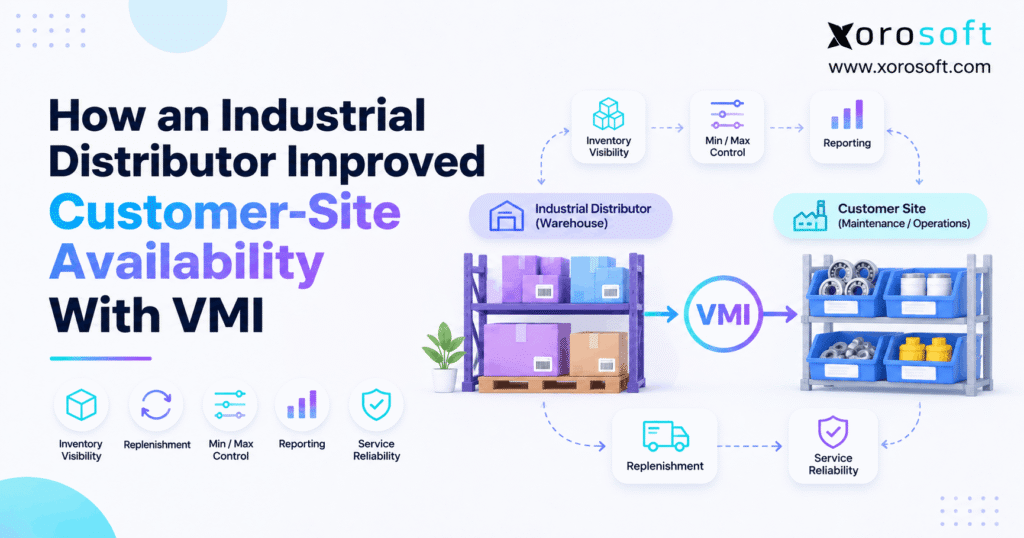
With VMI, the supplier or distributor manages agreed restock decisions using shared stock and usage data. First, both sides set item rules and service needs. Then the distributor checks stock, plans the next delivery, and handles normal restock work. The customer still owns its part of the process, such as reporting unusual demand or giving access to bins.
In contrast, under customer-led ordering, the customer decides when to raise a purchase request. Even so, neither model is always better. However, VMI can remove repeat order work where demand is steady and the distributor has sound data.
4.2 Five Steps in a Vendor Managed Inventory Cycle
A useful VMI cycle has five linked steps: record use, check stock, create a restock need, ship the parts, and confirm receipt. Next, the latest stock balance becomes the starting point for the next cycle. Therefore, the process can respond to actual use instead of relying only on last month’s purchase orders.
Oracle’s vendor-managed inventory process guide also separates the stock signal, restock request, order, shipment, and receipt. Therefore, that separation matters because a suggested order is not yet stock at the customer’s site.
4.3 What the customer must still do
However, a VMI contract cannot replace good site habits. For example, staff still need to report damaged parts, keep bin labels clear, and tell the distributor about upcoming shutdowns or large jobs. If parts move between work cells without a scan or count, the record can become wrong.
Therefore, define who counts stock, who checks errors, who approves a new item, and who handles urgent needs. Also, decide whether the customer or supplier owns stock before use. As a result, clear roles make the program easier to trust and the numbers easier to review. A useful vendor managed inventory case study also names those shared duties.
5. Vendor Managed Inventory Case Study: Smarter Min/Max Rules
5.1 Which Parts Belong in Vendor Managed Inventory?
First, start with common parts that customers use often and cannot afford to miss. For example, standard bolts, fittings, electrical supplies, and routine maintenance items can suit a planned restock route. However, a rare and costly part may need a different plan.
Next, a good short list weighs daily use, swings in demand, supplier lead time, part value, and downtime risk. Then test the list with site managers. They often know which small items cause the most disruption. This gives the vendor managed inventory case study a practical lesson: start with real work needs, not the largest catalog segment.
5.2 Calculate a customer-site reorder point
A basic reorder point is average daily use × restock lead time + safety stock. Suppose a bin uses six units a day, delivery takes four days, and the team holds 12 units as a buffer. Therefore, the reorder point is 36 units. So, the distributor should plan restock when the stock position reaches that level.
| Item rule | Example value |
|---|---|
| Average daily use | 6 units |
| Restock lead time | 4 days |
| Safety stock | 12 units |
| Reorder point | 36 units |
| Target maximum | 72 units |
| Current stock position | 28 units |
| Order up to maximum | 44 units |
Importantly, these are sample figures, not Loeb Electric results. Also, the stock position should account for usable stock, confirmed inbound supply, and open demand. Otherwise, a new order could create excess stock.
5.3 Update Vendor Managed Inventory Min/Max Levels as Demand Shifts
However, a stock rule is not permanent. If a customer adds a shift, its daily use may rise. Likewise, a supplier delay may make the old buffer too small. Therefore, review the levels after demand spikes, late deliveries, and repeated bin errors.
Even so, do not raise every minimum after one unusual order. First, check whether the rise is likely to last. Then decide whether to add stock, deliver more often, or set a one-time project supply plan. A careful review avoids solving each shortage by simply buying more inventory.
6. Bin-Level Vendor Managed Inventory: Why Location Matters
6.1 Give each stocking point its own record
For example, the same SKU may sit in a plant store, a line-side bin, and a field-service kit. Yet those stock points have different users and delivery needs. As a result, the same item should have clear site and bin IDs rather than one shared customer balance.
For example, a bin on the top floor might need eight boxes a week, while a ground-floor bin needs two. If the system merges them, the distributor may refill the wrong shelf. Therefore, location detail should match how staff actually take and use parts.
6.2 Capture Vendor Managed Inventory Usage Without Slowing Workers
A scan at issue, a simple empty-bin signal, or a planned count can all work. However, the method must be easy enough for busy teams to follow. If staff bypass the process, stock data will drift and restock decisions will suffer.
For high-use bins, a scan may give a fast signal. By contrast, for slow items, a weekly review may be enough. In either case, a clear item code and bin label help prevent errors. The best tool is the one the site can use well every day.
6.3 Check stock accuracy, not just system totals
Therefore, accurate VMI depends on a loop between physical stock and the recorded balance. For that reason, count a set of high-risk bins each week and check any gaps. Also, record wrong picks, damage, unlogged transfers, and stock found in the wrong place.
Next, fix the cause rather than only changing the quantity. For example, a bin may need a better label, or a pick path may lead staff to the wrong slot. This matters because clean stock data helps both customer service and future restock plans. For that reason, a vendor managed inventory case study should describe how physical counts are checked.
7. Turn Customer-Site Signals Into Reliable Deliveries
7.1 Check Vendor Managed Inventory Restock Signals Before Release
First, a restock signal should start a review, not end the process. Then check available warehouse stock, open orders, case sizes, and delivery days. Then group items for the same site where it makes sense. As a result, this lowers repeat trips and gives the warehouse a clearer plan.
However, some parts need an urgent route. So, create a simple exception rule for critical shortages. The distributor should also tell the customer when the next stock will arrive. Clear dates help site staff plan work and avoid duplicate requests.
7.2 Use warehouse controls to fill the right bin
First, the pick list should show the right SKU, unit, quantity, customer site, and bin where needed. Next, the warehouse team scans or checks the pick before loading. As a result, fewer errors reach the site and the delivery team knows where each item belongs.
Where a distributor manages several facilities, warehouse operations through XoroWMS can support receiving, picking, packing, scanning, and shipment work. Xorosoft provides these ERP-linked warehouse tools, although a complete customer-site VMI setup may still need a separate field app or integration.
7.3 Confirm Vendor Managed Inventory Receipt and Reconcile
However, shipment is not the same as customer-site availability. For example, a truck may leave the warehouse on time but arrive late, or parts may be placed in the wrong bin. Therefore, confirm the delivery at the right site and reconcile missing, damaged, or returned items.
Then compare the delivered quantity with the expected stock balance. If the figures differ, assign an owner and close the issue. A clean end-to-end record also helps finance, because the correct receipt or use event may drive billing under the customer agreement. Therefore, a vendor managed inventory case study should follow the part all the way to its final bin.
8. Vendor Managed Inventory Case Study: Measure Site Availability
8.1 The Vendor Managed Inventory Site Availability Metric
First, the most direct measure is whether required parts are in stock where teams need them. Next, define an observation as one required SKU at one site or bin at a planned check time. Then count how many observations show usable stock available.
Site availability (%) = In-stock required SKU-site checks ÷ Total required SKU-site checks × 100
For example, if 192 of 200 checks show stock, site availability is 96%. However, that figure is useful only when the same SKUs, sites, and check rules are compared over time. Otherwise, the change may reflect a new sample rather than better service.
8.2 Vendor Managed Inventory Results: Before-and-After Comparison
For example, this illustrative table shows how an operator could track a pilot. It is not a published result from Loeb Electric.
| Pilot KPI | Baseline | Example after pilot |
|---|---|---|
| Required SKU-site checks | 200 | 200 |
| Checks with usable stock | 184 | 192 |
| Customer-site availability | 92% | 96% |
| Stockout events in review period | 16 | 8 |
| Emergency restock orders | 12 | 5 |
Therefore, the availability change is four percentage points, not a four percent relative increase. Also, a lower count of urgent orders does not prove lower total cost. So, the pilot must track labor, freight, and stock value too.
8.3 Follow service, cost, and accuracy together
A strong vendor managed inventory case study looks beyond one headline measure. In addition to site availability, record stockout hours, late deliveries, emergency orders, stock accuracy, and time spent raising routine requests.
Then review the cost side: stock held at the site, pick work, delivery frequency, and inventory ownership. For example, more frequent deliveries may improve availability but raise freight expense. Therefore, the true goal is better service at a sound total cost, not the highest possible inventory level.
9. What the Published Results Actually Show
9.1 Vendor Managed Inventory Case Study: Loeb’s Verified Findings
Loeb’s case reports that its VMI approach keeps roughly five to seven days of stock ahead of contractor needs. In addition, it describes better control of multiple bins, faster picking, full-case delivery gains, and job-cost information shared with customers.
Those points explain why the process is useful. However, the public source does not give a matched before-and-after stockout rate or an audited return on investment. Therefore, this vendor managed inventory case study does not attach an invented success percentage to the distributor. Instead, the value lies in the clear changes to the daily restock process.
9.2 A separate proof point from Field Fastener
A second Field Fastener VMI case study describes a customer with excess bins and daily shortages. Field says its new process cut weekly buying admin time from five hours to no more than 30 minutes. That is a reported 90% reduction in buyer time.
However, this result belongs to Field’s customer, not Loeb. It is also a measure of admin effort, not a 90% drop in stockouts. Used with care, the example shows why time saved is worth tracking alongside site service.
9.3 How to Evaluate a Vendor Managed Inventory Case Study
A case study can show what changed. However, it may not isolate every cause. For example, a distributor could improve supply by changing delivery routes, stock rules, staff training, and software at the same time. So, it is hard to credit one change with every result.
Instead, record the baseline, pilot dates, site mix, SKU mix, and demand shifts. Then explain which figures were measured and which are estimates. As a result, that approach makes the lessons easier to use and more trustworthy for another buyer.
10. Customer-Led Ordering, Supplier Replenishment, and Consignment Compared
10.1 Who makes the restock decision?
Traditional customer-led ordering puts the routine reorder choice with the buyer. Under VMI, the distributor uses agreed data and rules to plan restock. As a result, the customer may spend less time on repeat orders and more time on core work.
However, VMI is not a cure for weak supply or poor data. For example, a distributor can still miss a delivery, and the customer can still fail to record use. Therefore, both parties need a clear service agreement, a shared stock view, and an exception path.
| Operating model | Who plans restock? | Best fit |
|---|---|---|
| Customer-led orders | Customer buyer | Irregular or one-off needs |
| Scheduled min/max review | Agreed site or supplier team | Stable stock with simple data |
| Vendor-managed inventory | Distributor or supplier | Repeat use with shared stock signals |
10.2 Vendor Managed Inventory vs. Consignment Ownership
VMI defines who plans replenishment. In contrast, consignment defines who owns inventory before an agreed event, often use or sale. Therefore, customer-owned VMI and supplier-owned consigned VMI are both possible.
For example, a customer may buy parts when they arrive, while the distributor still decides when to restock them. However, under a different deal, the supplier may own the parts until staff use them. So, the contract must state who bears loss, who counts stock, and when billing starts. Therefore, the physical stock location alone does not settle ownership.
10.3 Clear terms prevent finance disputes
First, a good VMI contract defines the stock owner, count rules, price terms, returns, loss, damage, and how often both sides reconcile records. In addition, it should spell out who pays for slow stock or site closure. These points often matter more than the choice of scanner.
For this reason, include finance staff in the design stage. Otherwise, the warehouse may record a delivery while accounting expects a use event. As a result, a clear event map helps keep the inventory ledger, invoice, and customer statement in step. Thus, a vendor managed inventory case study should show financial events, not just stock movements.
11. Where ERP and WMS Fit Into Site Restocking
11.1 Build one dependable internal stock view
First, a distributor needs clean SKU, vendor, warehouse, order, and cost records. Then it needs a way to accept trusted site-use and stock data. As a result, those records support better buying, restock planning, and service review.
For inventory-driven teams, XoroERP brings inventory, purchasing, accounting, orders, and warehouse work into one cloud ERP. Xorosoft can provide the internal operating backbone for a distributor. However, any claim about a complete VMI site app, exact bin workflows, or customer-owned stock rules must be checked in a scoped product demo.
11.2 Connect Vendor Managed Inventory Data to Warehouse Work
First, the WMS should know what to pick, where the product sits, how much was packed, and when the load left. Meanwhile, the customer-site tool should know what arrived and what staff used. If those records are not linked, a delivery can look complete while the bin is still short.
Therefore, map item IDs, units, site codes, and event times before adding automation. Xorosoft supports business-system integrations such as ERP, WMS, and other connected workflows. Still, the exact route for third-party VMI data needs a real integration review.
11.3 Keep purchasing and accounting in sync
Meanwhile, site restock does not end at the warehouse door. Next, finance must know whether the movement created a sale, an invoice, a stock transfer, or a consignment event. However, the correct answer depends on the contract.
Xorosoft connects stock and purchasing records with accounting and reporting. For a VMI project, teams should test the full flow from stock use to invoice, credit, or return. This helps prevent a common mistake: posting the right physical move to the wrong financial event. A short sample transaction is often the fastest way to find that gap.
12. A 90-Day Vendor Managed Inventory Pilot for Distributors
12.1 Days 1–30: set a clean baseline
Start with one or two customers, a small group of sites, and a clear list of repeat-use parts. First, count the bins and check item codes. Next, record site availability, late orders, urgent trips, delivery cost, and time spent on routine buying.
Also, agree on who owns stock and who signs off on counts. Otherwise, the pilot may create more disputes than it solves. The purpose of the first month is a trustworthy starting point, not a fast software launch.
12.2 Days 31–60: Run the Vendor Managed Inventory Pilot
Now set initial min/max levels and a practical delivery schedule. Next, capture each use or count through the agreed method. The distributor should review the new restock signals and check whether warehouse stock and route plans can meet the need.
However, do not change every item rule at once. Instead, note late deliveries, false low-stock alerts, and parts that move without a record. Then fix those gaps in small groups. As a result, a stable process creates more useful data than constant changes.
12.3 Days 61–90: review results before expansion
First, compare the pilot with the baseline using the same sites, parts, and check times. Then review the service gain against extra inventory, labor, and delivery cost. Next, ask customers whether parts are easier to find and whether order work has fallen.
If the site data is still poor, extend the test instead of adding more locations. Likewise, if stock has grown without better service, reset the min/max policy. Even so, a 90-day plan is a useful guide, not a promise that every distributor can prove full savings in three months. Therefore, a vendor managed inventory case study should state what the pilot could and could not confirm.
13. Who Should Use This Approach—and Who Shouldn’t
13.1 When Vendor Managed Inventory Makes Sense
VMI works best when customers use the same parts often, a shortage would slow work, and the distributor can check stock at a fair cost. For example, repair teams, assembly lines, and jobsite crews often need a steady supply of basic items.
The approach can also work across many inventory-driven industries, including wholesale, manufacturing, food production, and parts distribution. However, each site may have different safety, shelf-life, or trace rules. So, use the same method but tailor stock rules to the work.
13.2 When a simpler approach is better
However, a full VMI program may not suit rare, high-cost parts or customers with very uneven demand. In those cases, a blanket order, a weekly count, a two-bin card system, or centrally held stock with priority shipping may cost less.
Also, small sites may not need live scanning if their stock list is short and a trusted person can check bins each week. The goal is not to buy the most advanced tool. Instead, choose the least complex process that meets the agreed service level.
13.3 Avoid repeating the old stock problem
In practice, the most common mistakes are simple: weak item codes, one balance for many bins, wrong units, old min/max rules, and no owner for count gaps. In addition, a team may try to raise service levels by holding more stock everywhere. As a result, that can hide errors while tying up cash.
Therefore, fix the data and the work steps before you scale. Next, track site availability, not just distributor stock. Finally, agree on who acts when the normal plan fails. Overall, a sound vendor managed inventory case study should make those habits clear.
14. Conclusion: Make Customer-Site Availability a Measurable Promise
This vendor managed inventory case study shows why customer-site stock needs its own rules, records, and service measures. Loeb Electric’s reported approach uses min/max levels, several bin locations, and planned deliveries to keep parts close to users. However, its public case does not support an exact before-and-after availability claim.
For other distributors, the next step is practical. First, choose the parts whose absence slows work. Then test clear stock limits, reliable site counts, and a planned delivery loop. Finally, review both service and total cost before adding more sites.
If separate tools make that process hard to manage, Xorosoft can help connect inventory, purchasing, warehouse work, and accounting in one cloud ERP. However, the customer-site VMI scope should be checked against your real process and systems.
Book a Demo: Start a personalized ERP discovery with Xorosoft to review your distribution workflows and the right integration approach.
Frequently Asked Questions
What is vendor-managed inventory for industrial distributors?
It is a restock model where a distributor checks agreed stock signals and plans deliveries for customer sites. As a result, the customer does less repeat ordering.
How does VMI improve customer-site availability?
VMI uses stock counts, use data, and min/max rules to start restock before bins run empty. However, the result still depends on clean data and on-time delivery.
What is a good VMI reorder point?
A basic reorder point equals average daily use times lead time, plus safety stock. Therefore, set each value by part and site, then review it as demand changes.
Does VMI mean the supplier owns the stock?
No. VMI sets who manages restock. Consignment sets who owns the stock. So, a customer can own parts while the distributor still runs the restock plan.
Which KPIs should a VMI pilot track?
Track site availability, stockout events, urgent orders, delivery time, stock accuracy, and total stock cost. Also, compare the same sites and parts before and after the pilot.
Can an ERP support VMI across customer sites?
Yes, it can support purchasing, stock, warehouse, and finance records. However, site scanning, bin rules, and data links may need extra setup or a separate app.
When should a distributor start a VMI pilot?
Start when repeat-use items cause shortages and both parties can share trusted stock data. First, test a small group of bins before rolling out to more sites.