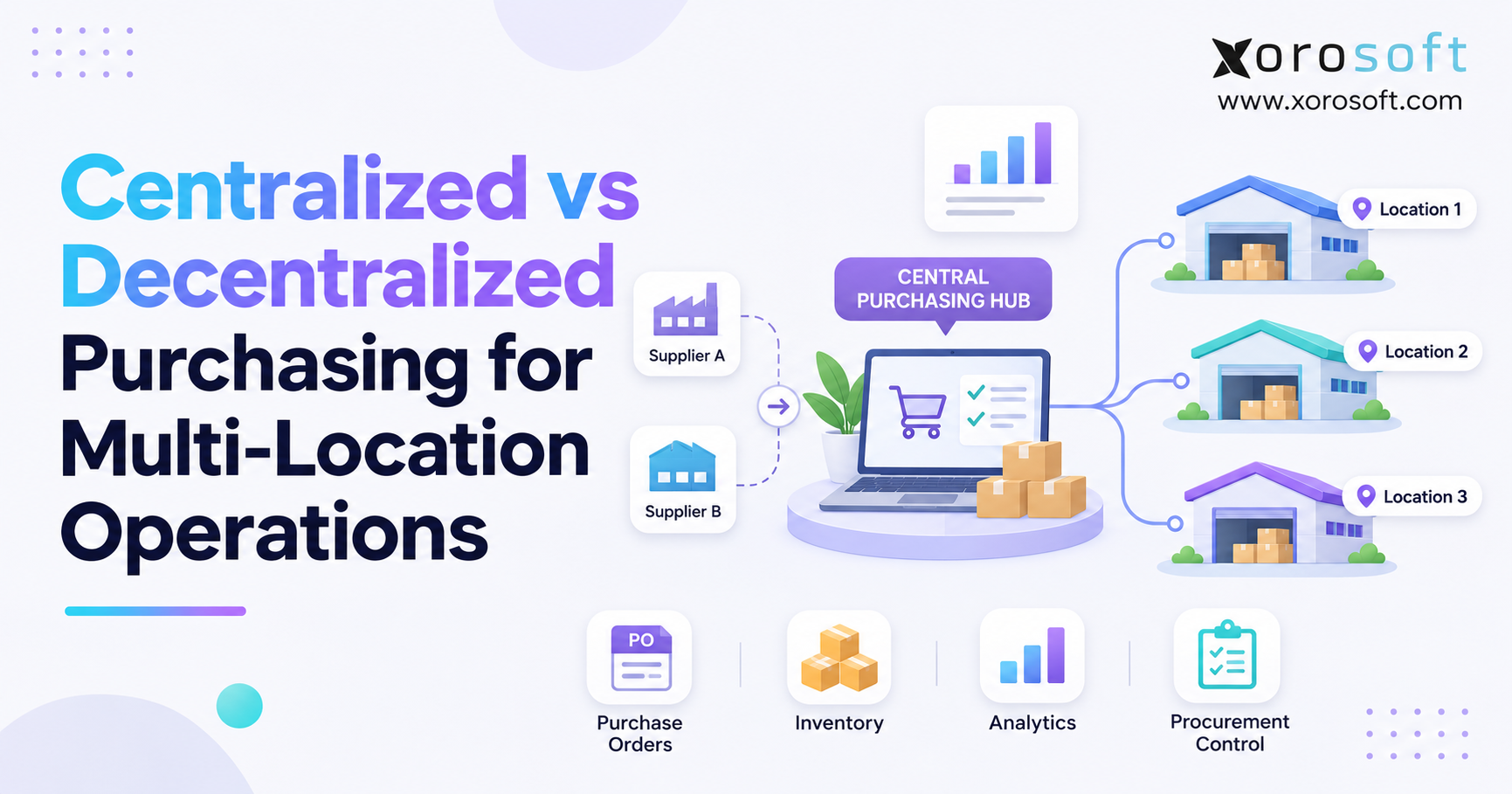
A successful business often requires a carefully planned multi-location purchasing strategy to manage costs and streamline operations.
1. Why a Multi-Location Purchasing Strategy Matters
1.1. Central Buyers and Local Managers See Different Risks
Central buyers see total spending across the company. They know which suppliers offer volume discounts, which contracts are close to renewal, and where the business has too many small vendor accounts.
A local manager sees what will run out this week. They know which carrier often misses the final delivery window and which supplier responds quickly when a customer needs an urgent order.
Both views are useful. However, problems start when one view is treated as the whole truth.
A low unit price means little if stock arrives after a busy sales weekend. On the other hand, buying every item from the nearest supplier may cost much more than a shared contract.
Therefore, a good multi-location purchasing strategy brings these facts together before an order is placed. It also assigns buying decisions to the people who understand the risks.
1.2. Central Purchasing Does Not Mean Central Warehousing
A company can negotiate one contract for eight warehouses and still ask the supplier to deliver to all eight.
In this case, the buying terms are central, but the stock remains local.
Another business may buy in bulk, receive everything at one main warehouse, and send goods to branches later. That approach can reduce inbound freight. However, it may add storage, handling, and transfer costs.
For this reason, purchasing authority and warehouse design should be treated as separate choices.
Before changing the buying model, ask whether goods should arrive directly at the site that needs them. Also, check whether a central warehouse adds enough value to cover the extra work.
1.3. Small Purchasing Workarounds Create Bigger Data Problems
A branch may create its own supplier record because the approved vendor cannot deliver.
Another branch may use a different item code for the same part. Later, finance receives two invoices with different prices and no clear link to the original requests.
As locations grow, these small differences become costly.
Consequently, the first goal of a multi-location purchasing strategy is often shared data and clear rules rather than full central control.
Teams need to know what is on order, what has arrived, what remains open, and which supplier issues still need attention.
Without those details, even a well-negotiated contract can lead to poor stock decisions.
2. Centralized vs Decentralized Purchasing: Choosing the Right Model
2.1. How Centralized Purchasing Works
Centralized purchasing assigns most supplier and buying decisions to one team.
Locations submit requests, while central buyers check them against budgets, approved suppliers, and planned demand.
As a result, the company may gain better prices and reduce duplicate contracts.
However, central control also creates a risk of long approval queues.
If a manager must wait for head office to approve a small routine purchase, the delay may cost more than the expected saving.
Central buyers also need accurate information from local teams.
Therefore, this model works best when common products, reliable suppliers, and clear buying rules support the whole business.
2.2. How Decentralized Purchasing Supports Local Buying
With decentralized purchasing, each branch or plant can select suppliers and place orders within its own budget.
This gives local managers more freedom to respond to short delivery windows, regional demand, and urgent repairs.
For example, a food distributor may need fresh goods from a nearby supplier rather than stock shipped from a distant warehouse.
Yet local freedom can bring uneven prices, extra office work, and too many supplier accounts.
Finance may also struggle to see total spending until invoices arrive.
Therefore, a multi-location purchasing strategy that allows local buying should still require common item records, spending limits, and clear invoice rules.
Local control should not mean that purchasing data becomes invisible.
2.3. Hybrid Purchasing Combines Shared Rules With Local Action
A hybrid or center-led purchasing model gives the central team control over major supplier contracts, buying standards, and key product groups.
However, local teams can place approved routine orders and handle certain urgent needs.
This is more than a loose mix of two models.
The Institute for Supply Management explains how center-led structures can combine shared sourcing with site-level action. Its review of supply management structures also shows why clear roles matter.
For example, head office might negotiate packaging and safety equipment contracts. Meanwhile, each warehouse could order those approved items when stock reaches a set level.
As a result, the business keeps buying power while reducing routine approval delays.
2.4. Centralized vs Decentralized Purchasing Comparison
| Buying decision | Centralized | Decentralized | Hybrid |
|---|---|---|---|
| Main supplier contracts | Central team | Local teams | Central team |
| Routine stock orders | Central release | Local release | Local within limits |
| Urgent purchases | Usually escalated | Local decision | Approved exception process |
| Price control | Shared terms | May vary by site | Shared terms with local input |
| Spending visibility | Easier to combine | Needs shared reporting | Shared data and rules |
| Main risk | Slow approvals | Uneven costs and records | Unclear roles if poorly designed |
APQC’s 2025 research found that 44% of participating businesses managed procure-to-pay work globally but carried it out locally. Meanwhile, 35% managed and carried out the work centrally.
These figures describe how the surveyed businesses were organized. They do not prove that one model always delivers better results.
The APQC research on central and local procurement work supports looking at both shared control and local execution.
3. How Purchasing Models Affect Costs, Suppliers, and Stock
3.1. Supplier Discounts Can Reduce Costs but Increase Risk
A central buyer can combine demand from several warehouses and negotiate better prices.
In addition, shared contracts may reduce repeated supplier reviews and make payment terms easier to manage.
However, relying on fewer suppliers can create new risks.
If one national supplier experiences a delay, every warehouse may feel the impact.
A local supplier network may offer more choices during shortages. Yet separate local contracts can also weaken buying power.
Therefore, businesses should compare price, delivery speed, quality, and supplier risk before deciding where to buy.
A good buying model should offer enough control to manage costs and enough flexibility to handle disruptions.
3.2. Approval Time Can Matter as Much as Unit Price
A purchase order may spend hours or days waiting for approval even when the actual review takes only a few minutes.
APQC reports a cross-industry median of 2.0 days from receipt of a goods request to release of its purchase order, based on 1,181 firms.
However, this measure does not mean central teams are always slower than local teams.
The APQC purchase order cycle-time measure includes both work and waiting time.
Therefore, businesses should track each stage separately.
For example, a request may wait for a budget check, supplier review, or missing item code.
Once the cause is clear, managers can remove needless delays without weakening important controls.
3.3. Stock Planning Must Follow Local Demand
Demand is rarely equal across every warehouse.
A product that sells quickly in one region may move slowly in another. As a result, using one company-wide reorder level can create both excess stock and shortages.
Instead, buyers should review demand, stock on hand, open supplier orders, and customer commitments for each location.
A shared ERP purchasing and inventory system such as Xorosoft can help teams work from the same product, order, and stock records.
Still, the business must decide how much inventory each warehouse needs.
The software supports those decisions, but it does not replace local demand planning.
3.4. Financial Visibility Strengthens a Multi-Location Purchasing Strategy
A branch can make a valid purchase that finance cannot see until the invoice arrives.
By then, the company may have placed a second order for the same need.
On the other hand, a central buyer may approve a new PO without knowing that another warehouse has enough stock to cover the shortage.
Therefore, a multi-location purchasing strategy should give finance a clear view of open orders, received goods, supplier costs, and unpaid invoices.
Local teams may retain the right to place orders. However, those orders should still appear in company-wide reports.
This approach helps prevent duplicate purchases, late bills, and unexplained inventory changes.
4. Calculate the Total Cost of Central and Local Buying
4.1. Why Purchase-Price Savings Are Not Net Savings
The unit price is easy to compare, but it does not include every cost.
A bulk order may lower the supplier bill. However, it may also add freight, storage, stock transfers, and the cost of holding goods for longer.
Similarly, a central contract can create extra emergency purchases if the supplier cannot meet local delivery needs.
Therefore, businesses should compare total purchasing costs rather than purchase prices alone.
Net annual benefit = Price savings + Saved buying costs − Added freight, handling, stockholding, and exception costs.
Also, separate one-time setup costs from ongoing operating costs.
This makes it easier to judge whether a new purchasing model will produce lasting savings.
4.2. Eight-Warehouse Purchasing Cost Example
Assume eight warehouses buy 80,000 units of the same product each year.
The average local buying price is $12 per unit, creating annual purchase-price spending of $960,000.
A central supplier offers a price of $11.40 per unit.
As a result, annual purchase-price spending falls to $912,000, producing a gross price saving of $48,000.
In addition, the central team expects to save $12,000 through reduced buying administration.
However, the new supply route increases freight, handling, and inventory carrying costs.
The following figures are illustrative assumptions, not actual industry benchmarks.
| Annual change | Cost or benefit |
|---|---|
| Lower supplier price | +$48,000 |
| Reduced buying administration | +$12,000 |
| Additional freight | −$20,000 |
| Additional warehouse handling | −$8,000 |
| Additional inventory carrying cost | −$6,000 |
| Net estimated annual benefit | +$26,000 |
The central purchasing model saves $26,000 annually in this example, not $48,000.
That represents approximately 2.7% of the original $960,000 purchase-price baseline.
Before accepting the plan, the company should also test whether the supplier can meet every warehouse’s delivery needs.
A stockout during a busy period could reduce or eliminate the expected benefit.
4.3. When Local Purchasing Offers Better Value
Central buying often lowers unit prices. However, a cheaper product does not always mean a lower total cost.
For example, a local supplier may charge more but deliver within one day. A national supplier may offer a discount but need five days.
As a result, the business must compare delivery costs, stockout risk, and the effect on customer orders.
Local buying can work well for urgent repairs, fresh products, and items with regional demand.
Meanwhile, central buying may be better for common products with steady demand.
Therefore, the best purchasing model depends on the product, location, and service requirements.
Businesses should compare complete operating costs before choosing either approach.
4.4. Use Your Multi-Location Purchasing Strategy to Test Savings
A cost model should include savings that the business can realistically achieve.
For example, reducing the time staff spend on duplicate orders may free them for other work. However, that does not automatically create a cash saving.
Finance should count lower overtime, fewer paid service fees, or hiring costs actually avoided.
Similarly, a supplier rebate should count only when order volumes and contract terms make it likely.
A connected platform such as XoroONE cloud ERP can help businesses evaluate purchasing, inventory, and reporting data together.
However, software alone does not prove a financial benefit.
The final decision should come from actual order history, stock records, and tested business cases.
CTA #1 — Free ERP Readiness Assessment
Before changing buying rules, review where requests, approvals, stock counts, and supplier invoices stop matching.
A useful ERP readiness assessment should identify these gaps, estimate their cost, and show which changes could improve purchasing control.
5. Build a Hybrid Multi-Location Purchasing Strategy
5.1. Group Products by Spend, Risk, and Urgency
A hybrid purchasing model should begin with product groups rather than job titles.
First, identify common goods with steady demand across several locations.
Next, separate urgent items, regional products, and goods that require special handling.
Then review annual spending, supplier choices, delivery times, and the cost of running short.
For example, eight warehouses may all purchase the same boxes, labels, and safety equipment.
Those items may be suitable for shared supplier contracts.
In contrast, a plant that needs a rare repair part should not wait through a long central sourcing review.
A good multi-location purchasing strategy sets different rules for these situations while keeping the final order and cost visible.
5.2. Give Each Purchasing Decision a Clear Owner
A purchasing policy should explain who may request goods, approve suppliers, release purchase orders, receive deliveries, and resolve exceptions.
Without clear ownership, employees may send the same request to several people or wait for someone who believes another team should make the decision.
Central buyers can manage major supplier contracts.
Local managers can place approved orders within budget.
Finance can review unusual payment terms and large commitments.
Meanwhile, warehouse teams should verify physical receipts.
These roles work together. However, every important step needs one clear owner and a backup when that person is unavailable.
5.3. Set Spending Limits and a Fast Exception Process
Local buying authority should have clear spending limits and product rules.
For example, a warehouse manager may be allowed to purchase approved routine items without additional review.
However, a large order from a new supplier may require central approval.
The rules should also explain when a location can make an urgent purchase to protect customer orders or keep production running.
Afterward, the local team should record the reason, price difference, and approval details.
If the same product needs an emergency purchase every week, the real problem may be a poor reorder level or an unreliable supplier.
Therefore, reviewing exceptions is just as important as approving them.
5.4. Agree on Service Times Between Teams
Central purchasing should tell warehouses how quickly it will review complete requests.
Local teams, in return, should provide reliable forecasts and report stock problems early.
For this reason, both sides need service goals rather than spending rules alone.
A request that takes four days to approve may be a problem even when the final PO follows every policy.
Review missed service goals each month.
Then address slow approval steps, missing information, or weak supplier terms before staff begin using informal workarounds.
6. Create a Multi-Location Purchasing Workflow Across Warehouses
6.1. Start With Accurate Purchasing Requests
A useful purchase request identifies the item, warehouse, quantity, needed date, budget, and reason for buying.
Without these details, the central team may approve a second order for goods that are already on the way.
First, make sure every location uses the same item codes and buying units.
One supplier may sell cartons of twelve while the warehouse counts individual pieces.
If the system treats both as the same unit, even a simple purchase can create a serious stock error.
Next, connect every request to the correct location and cost center.
This makes the final delivery and invoice easier to check.
6.2. Combine Supplier Orders Without Losing Local Deadlines
Central buyers can combine requests for common goods.
However, every PO line should retain its destination and required delivery date.
One warehouse may have enough stock for a month, while another needs goods within two days.
Therefore, combine orders only when supplier terms, lead times, and delivery plans make sense.
A shared price can often apply to separate deliveries.
If an urgent local purchase is needed, record it as an exception and use the central contract for future demand.
This helps the business maintain buying power without sacrificing service.
6.3. Check Inventory Before Releasing a Purchase Order
Before placing an order, buyers should review stock on hand, customer reservations, incoming supplier deliveries, and goods moving between warehouses.
A transfer from another location may be faster than a new supplier order.
Still, transfers involve freight and handling costs.
Therefore, the best choice depends on both speed and total cost.
A multi-location purchasing strategy should compare these options using current stock information.
For fast-moving products, direct supplier delivery may be the better choice.
For slow-moving inventory, transferring excess stock from another warehouse may release cash and avoid another purchase.
6.4. Use Warehouse Receiving to Verify Purchases
A purchase order shows what the company expects to buy.
A receipt shows what the warehouse actually received.
These records can differ when a supplier sends a partial delivery, the wrong product, or damaged goods.
As a result, the receiving process should record accepted, rejected, and outstanding quantities.
The purchasing team can then request replacements, supplier credits, or corrected invoices.
For businesses with multiple warehouses, Xorosoft’s XoroWMS is one example of a system to assess for receiving and stock control.
During any software demonstration, ask to see a partial delivery and how it affects the open purchase order.
6.5. Connect Purchasing, Receiving, and Finance
After goods arrive, finance should compare the approved purchase order, the accepted receipt, and the supplier invoice.
This three-way match helps identify price differences, short shipments, and bills for goods that never arrived.
When a valid exception requires special payment treatment, the team should record the reason and approver.
Finally, stock updates should reach the relevant sales channels.
A business selling through Shopify, Amazon, and wholesale accounts must not add the same receipt as new stock more than once.
Therefore, a reliable multi-location purchasing strategy needs one clear source of inventory information.
7. How ERP Supports a Multi-Location Purchasing Strategy
7.1. Keep Supplier and Item Records in One Place
ERP helps when teams need consistent supplier terms, item codes, stock levels, and purchase history.
However, ERP should not automatically control every buying decision.
Instead, it should give each employee the correct access and approval rights.
Local buyers can operate within approved limits while central teams see total spending and open commitments.
This helps a multi-location purchasing strategy remain consistent as new branches are added.
Still, businesses must clean duplicate supplier and item records before moving them into a new system.
Poor data does not become reliable simply because it is stored in one place.
7.2. Match Approval Rules to the Type of Purchase
Not every purchase order needs the same approval path.
A routine catalog order within budget may be released by a local manager.
However, a new supplier, unusual price, or large capital purchase may require central review.
Meanwhile, an urgent repair should have a faster approval route with a clear audit trail.
When comparing ERP systems, ask how they handle spending limits by location, category, and amount.
Also, test what happens when an approver is absent or an order changes after approval.
The goal is to protect spending without creating unnecessary delays.
7.3. Keep ERP, Ecommerce, and Warehouse Data Connected
A company may create purchase orders in ERP, receive goods through a warehouse application, and sell products through Shopify.
If these systems do not agree, a low-cost purchase can still create stock errors or extra work during month-end reporting.
Therefore, each business event needs one clear owner and a reliable method for updating other systems.
The Xorosoft integrations overview provides an example of the connected systems businesses may need to evaluate.
However, companies should test exact data flows, update times, and error handling.
A listed integration does not automatically mean every purchasing and receiving process works without additional setup.
7.4. Evaluate ERP Software Using Real Purchasing Scenarios
A multi-location purchasing strategy should guide the software selection process.
For example, ask each vendor to demonstrate a common order across eight warehouses, an approved emergency purchase, and a delivery that arrives short.
Then check who can approve each step, how stock changes, and what finance sees.
Also compare setup work, employee training, support, and the cost of maintaining integrations.
In some cases, better buying rules and shared reports may be enough.
In others, repeated manual work across separate systems may justify a more complete ERP platform.
The right solution should fit the operating model rather than force the business into a rigid purchasing process.
8. Purchasing Models for Wholesale, Retail, and Manufacturing
8.1. Apparel and Sporting Goods Need Local Demand Planning
An apparel business may use the same manufacturer for all locations.
Therefore, a shared supplier contract can make sense.
However, demand for sizes, colors, and styles varies by region.
If central buyers divide stock evenly, some stores may run out of popular sizes while others hold excess inventory.
As a result, the supplier agreement can remain central while each site maintains its own reorder plan.
Seasonal products create another challenge.
A late delivery before a holiday or sports season can make a cheaper order more expensive in practice.
Therefore, buyers should compare price with delivery timing and expected sales.
8.2. Furniture and Wholesale Distribution Need Freight-Aware Buying
Furniture and heavy goods can be expensive to move between warehouses.
A central contract may lower the supplier price.
However, routing every item through one distribution center may add handling and transport costs.
For this reason, businesses should compare direct supplier deliveries with central receiving and later transfers.
Wholesale companies also need to protect inventory committed to important customer orders.
Purchasing teams should see those commitments before deciding whether to move stock or place another order.
8.3. Food and Manufacturing Need Local Timing Rules
Food businesses often work with short shelf-life products and strict receiving checks.
A central team can set supplier standards and pricing rules.
Meanwhile, local teams may need authority to order fresh goods according to regional demand.
Manufacturers face similar challenges with raw materials.
A plant may share a supplier contract with other sites but need components based on its own work orders and production schedule.
Therefore, purchasing rules should account for quality checks, batch records, material needs, and supplier delays.
The Xorosoft industries overview offers examples of the different requirements found in inventory-driven businesses.
8.4. Ecommerce Brands Need One Reliable Stock View
A brand may sell the same products through its website, marketplaces, and wholesale accounts.
In that case, buying teams need to see stock on hand, incoming orders, and inventory already reserved for customers.
Otherwise, the company may purchase too much or promise goods that are not available.
A strong multi-location purchasing strategy should work with one trusted stock view, even when different teams place orders.
Shopify merchants exploring an ERP-led approach can review the XoroERP Shopify App Store listing as one research source.
However, they should confirm actual purchasing, inventory, and receiving workflows before deciding on a solution.
9. Measure Purchasing Costs, Speed, and Supplier Results
9.1. Use a Balanced Purchasing Scorecard
A low purchase price does not help when products arrive too late.
Likewise, fast approvals do not make up for poor contract use or inaccurate inventory.
Therefore, purchasing performance should include costs, delivery speed, stock availability, and process quality.
| KPI | Measurement | Business purpose |
|---|---|---|
| Purchase order cycle time | Request receipt to PO release | Identify approval delays |
| Contract use | Eligible spend on approved terms / eligible spend | Track buying compliance |
| Emergency buying rate | Urgent POs / eligible POs | Identify planning problems |
| Supplier on-time delivery | On-time deliveries / measured deliveries | Monitor supplier reliability |
| Stockout rate | Stockout observations / eligible observations | Measure availability problems |
| Cost per PO | Relevant purchasing process cost / processed POs | Review buying efficiency |
APQC reports a cross-industry median cost of $55 for ordering materials and services per purchase order, based on 4,620 companies.
However, this is a benchmark for a defined process, not a complete cost figure for every company’s purchasing function.
The APQC cost-per-PO definition explains the scope.
9.2. Track Supplier Lead Time and Delivery Quality
Lead time measures how long a supplier takes to deliver after receiving a purchase order.
APQC reports a cross-industry median supplier lead time of 10 days among 3,077 companies.
However, that figure is not a suitable target for every product.
Fresh food, overseas parts, and local supplies have different delivery needs.
Therefore, compare each supplier with its own service promise and the warehouse’s actual requirements.
Also, track short shipments, damaged goods, and unexpected price changes.
As a result, buyers can determine whether delays come from suppliers, internal approvals, or poor demand planning.
A multi-location purchasing strategy should improve these results rather than merely route more orders through head office.
9.3. Improve the Multi-Location Purchasing Strategy Using Exception Data
If one warehouse makes far more urgent purchases than others, do not immediately reduce its spending authority.
First, review local demand, reorder levels, supplier lead time, and stock count accuracy.
Similarly, repeated purchases outside central contracts may show that an approved supplier cannot serve a particular region well.
Therefore, review exceptions with local managers before changing the rules.
Then improve supplier coverage, approval limits, or inventory planning where the data supports the change.
Good purchasing controls should make problems easier to identify and solve.
CTA #2 — Watch a Purchasing Workflow Demo
Ask a software provider to demonstrate a standard multi-site PO, a valid urgent local purchase, and a partial receipt with an invoice mismatch.
The demonstration should show who can approve each decision, where exceptions appear, and how they are resolved.
10. A 90-Day Plan to Improve Multi-Location Purchasing
10.1. Days 1–30: Review Current Purchasing Costs and Delays
Start with recent purchase orders, supplier invoices, delivery records, and approval times.
Next, match supplier and item codes across locations.
Then group purchases into common products, regional requirements, and urgent items.
Build a starting scorecard covering cost per PO, supplier delivery performance, emergency buying, and stockouts.
Meanwhile, record where data is missing or unreliable.
The goal during the first month is to understand current costs and delays well enough to select a useful pilot.
Do not redesign every purchasing process before identifying the problems that matter most.
10.2. Days 31–60: Test New Purchasing Rules
Choose a product group that several locations buy regularly.
Set a shared supplier contract, clear local ordering rights, and an emergency exception process.
Then test the model in two or three locations with different demand patterns.
Include one planned order, one urgent purchase, and one shipment that arrives short.
Track approval times and manual work throughout the process.
If the new rules create delays, revise them before expanding.
Also, ask warehouse and finance teams whether purchase orders, receipts, and invoices are easier to match.
A successful pilot should improve the full process, not only the central buyer’s workload.
10.3. Days 61–90: Compare Results and Expand the Purchasing Strategy
Use the same measures from the first month to compare cost and service.
Separate improvements caused by the pilot from seasonal demand changes or unusual supplier events.
Next, expand the successful rules to other product groups.
The goal is not simply to increase the percentage of orders handled by headquarters.
Instead, businesses should improve buying speed, stock accuracy, supplier performance, and financial control.
Therefore, every major KPI should have an owner and a regular review date.
The multi-location purchasing strategy should also be updated as new sites, suppliers, and sales channels are added.
11. Choose the Right Multi-Location Purchasing Strategy
11.1. Centralize Buying Where Scale Creates Value
Shared buying works well for common goods with steady demand and reliable suppliers.
However, businesses should compare the complete delivered cost, not just the supplier discount.
Also, consider the risk of relying heavily on one vendor.
A central contract should help locations receive the right stock at the right time.
11.2. Keep Local Buying Flexible Where Speed Matters
Local managers often understand urgent stock needs better than a distant buying team.
Therefore, they should have clear authority for emergency repairs, regional products, and short shelf-life goods.
However, every purchase should remain visible to finance and central purchasing.
This balance protects local service while keeping spending under control.
11.3. Turn Your Purchasing Strategy Into a Practical Operating Plan
The best multi-location purchasing strategy is not always fully central or fully local.
Instead, it puts each decision with the team that has the right information and authority.
Before expanding the model, test a common supplier order, an urgent purchase, and a partial delivery from start to finish.
Then compare the effects on buying costs, stock availability, and approval speed.
If disconnected purchasing, warehouse, and accounting records still make the process difficult, an integrated ERP may help.
Businesses can contact Xorosoft to discuss their purchasing, supplier, and warehouse requirements using real operating scenarios.
CTA #3 — Book a Personalized Demo
Bring one shared supplier order, one urgent local purchase, and one receiving discrepancy to the discussion.
A useful demo should show how each workflow stays fast, clear, and easy to audit.
Frequently Asked Questions
What is a multi-location purchasing strategy?
A multi-location purchasing strategy sets who chooses suppliers, approves orders, and buys stock for each site. It helps teams share buying rules while meeting local needs.
What is the difference between centralized and decentralized purchasing?
Centralized purchasing puts key buying decisions with one team. Decentralized purchasing gives local sites more control. A hybrid model shares supplier rules but allows approved local orders.
Which purchasing model works best for multiple warehouses?
A hybrid model often balances shared pricing with local speed. The right choice depends on supplier reach, site demand, freight costs, and how quickly teams must restock.
Does centralized purchasing save money?
It can lower unit prices and reduce duplicate work. However, extra freight, storage, slow approvals, and emergency orders may offset those savings. Compare total delivered cost.
How can ERP support multi-location purchasing?
ERP can connect supplier terms, purchase approvals, stock by site, receipts, and invoices. Teams then see open orders and buying costs without losing agreed local authority.
When should local managers buy independently?
Local buying helps when a site needs urgent stock, regional goods, or faster delivery. Set spend limits and record exceptions so finance and central buyers retain visibility.
When should a business change its purchasing model?
Review the model when approvals cause stockouts, suppliers charge uneven prices, or branches place duplicate orders. Test new rules with a small pilot before expanding them.
Recent Posts
-
 Centralized vs Decentralized Purchasing for Multi-Location Operations
-
 Shopify Purchase Order Integration Benchmarks 2026: Scope, Sync, and Receipt Exceptions
-
 What Is Waveless Fulfillment and When Does It Work?
-
 AI Master Data Management in ERP: Detecting Duplicate and Conflicting Records
-
 Why Spreadsheet Commission Calculations Create Disputes and Margin Leakage