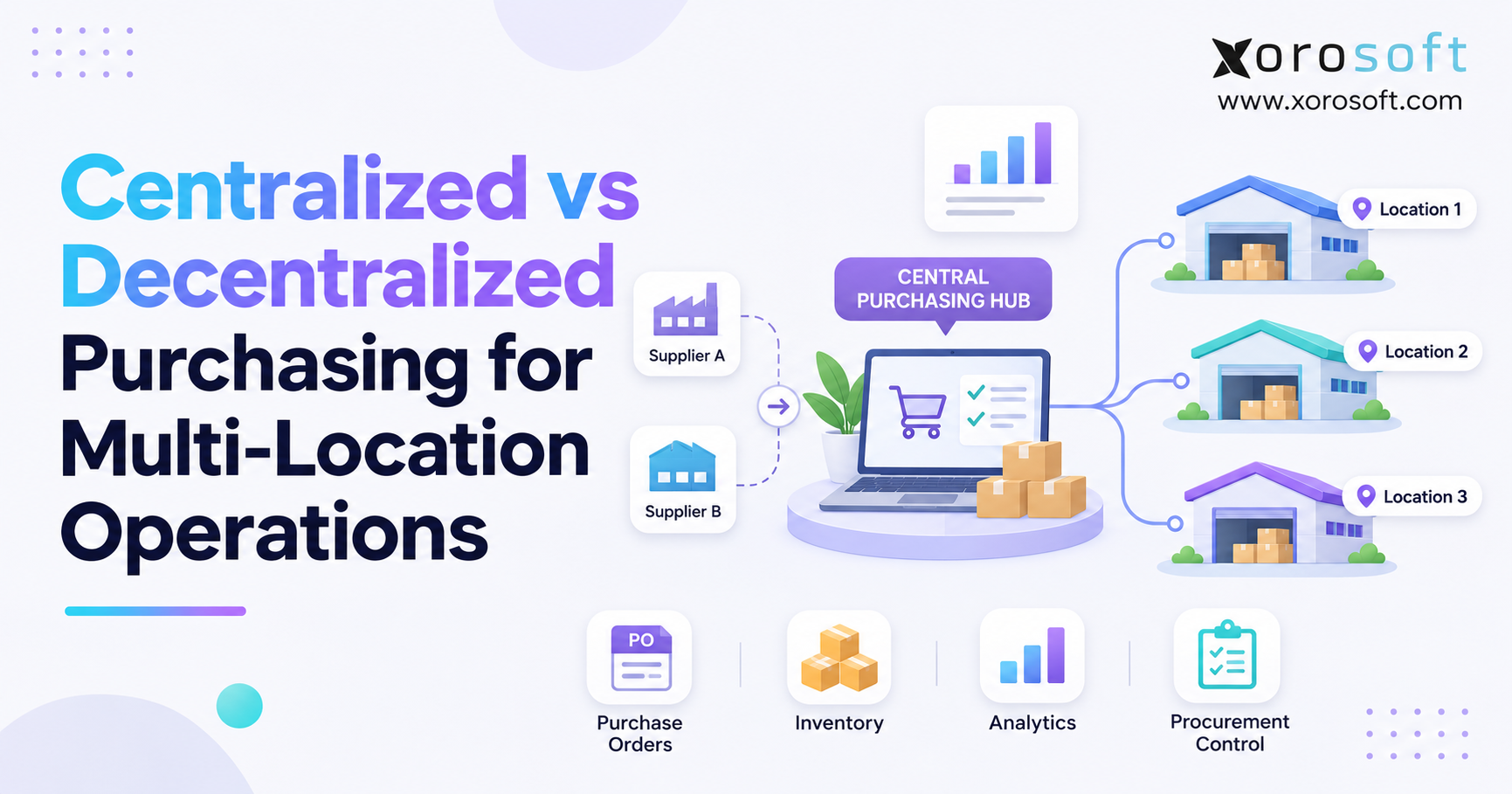
When considering strategies for your supply chain, it’s vital to weigh the differences between centralized vs decentralized purchasing.
1. Why Multi-Location Purchasing Becomes Harder as Operations Grow
A distributor may grow from one warehouse to five without revisiting its purchasing policies. By the fifth location, that decision often becomes expensive. One branch orders extra inventory because it cannot see stock elsewhere. Another pays a higher price to the same supplier. Meanwhile, head office receives inconsistent purchasing reports and cannot explain why working capital is rising despite steady sales.
This is the business problem behind centralized vs decentralized purchasing. Should one team control orders for the entire company, or should warehouses and business units buy what they need? The answer affects more than purchasing prices. It changes replenishment speed, supplier relationships, inventory availability, financial reporting, and the authority managers have to solve local problems.
1.1 How Local Purchasing Decisions Create Company-Wide Consequences
Imagine a wholesale business with distribution centers in California, Texas, and Ontario. The California site sells predictable product lines, Texas faces seasonal demand, and Ontario has different transportation and import requirements. Each manager understands local needs. Yet all three may purchase from the same manufacturers, compete for limited supply, and report inventory to the same finance team.
An entirely local approach can miss volume discounts and create duplicate orders. A purely centralized approach can delay urgent replenishment or treat different markets as though they were identical.
1.2 Purchasing Authority Is Not the Same as Inventory Location
Centralized purchasing does not mean that every shipment must pass through one warehouse. A central buyer can negotiate supplier terms and approve orders while goods move directly to several facilities. Equally, a business can allow local purchasing decisions while using common supplier records, inventory controls, and accounting rules.
The useful question is therefore not, “Should everything be centralized?” It is, “Which decisions benefit from company-wide control, and which require local knowledge?” That distinction provides the foundation for a sustainable purchasing model.
2. Centralized vs Decentralized Purchasing: What Each Model Actually Means
2.1 What Is Centralized Purchasing?
Centralized purchasing places supplier selection, contracting, purchase approval, or order execution under one designated team. Locations submit requirements, and the central function coordinates spending according to agreed budgets and policies. A furniture company might negotiate one contract for five warehouses while scheduling separate deliveries to each destination.
However, it needs accurate site-level demand and practical service expectations. Otherwise, the central team becomes an additional approval layer rather than a source of value.
2.2 What Is Decentralized Purchasing?
Decentralized purchasing assigns buying authority to individual warehouses, branches, plants, or departments. Local managers can place orders, select approved vendors, or respond to shortages without routing every decision through headquarters.
That autonomy is useful when supplier markets, lead times, product specifications, or customer needs vary by region. The risk is fragmentation: inconsistent prices, limited enterprise reporting, overlapping contracts, and purchases that ignore stock already available elsewhere.
2.3 Purchasing and Procurement Are Related but Not Identical
Purchasing generally covers the execution of buying, including requisitions, purchase orders, order tracking, and receipt coordination. Procurement is broader, encompassing sourcing strategy, supplier evaluation, contracts, governance, and performance management. A company can therefore centralize strategic procurement while decentralizing routine purchasing execution.
A central supplier contract, a local reorder suggestion, and a warehouse receipt are three different records, even when they belong to one commercial transaction.
3. Centralized vs Decentralized Purchasing: The Real Trade-Offs
3.1 Centralized Purchasing: Supplier Prices and Negotiating Leverage
A central team can aggregate demand from several locations before negotiating prices. That may improve discounts, payment terms, and supplier capacity commitments. Yet the savings are not automatic. A supplier’s minimum order quantity can force the company to carry inventory it does not need, while extra freight and handling can consume the discount.
The meaningful comparison is the total cost of securing usable stock at the required location and date.
3.2 Decentralized Purchasing: Speed, Service, and Exceptions
Decentralized purchasing gives branch managers a shorter path from recognizing a need to placing an order. This matters when a production line is waiting for a component or a customer requires an urgent replacement.
Problems usually arise when every low-risk purchase waits for the same approver. A sensible design sets thresholds for routine orders and a documented escalation route for genuine exceptions.
3.3 Inventory Visibility and Financial Control
Central buyers may see demand across the network, making it easier to identify duplicate orders and negotiate common agreements. However, a consolidated report is only useful when location inventory, allocations, incoming receipts, and open purchase orders are accurate.
Local buyers may understand their own shortages but overlook excess stock at another facility. Finance then sees more inventory and fragmented commitments without a clear explanation.
3.4 Centralized vs Decentralized Purchasing Comparison Table
| Decision factor | Centralized purchasing | Decentralized purchasing |
|---|---|---|
| Buying authority | Central team | Branch or business unit |
| Supplier negotiations | Combined volumes and common terms | Local agreements and specialist suppliers |
| Routine speed | Depends on approval design | Usually closer to local requirements |
| Spend oversight | Easier to standardize | Requires shared controls |
| Inventory planning | Network-wide view is possible | Strong local context |
| Typical failure | Central bottlenecks or poor local fit | Duplicate buys or inconsistent pricing |
| Strongest use case | Repeated products and shared suppliers | Distinct regional or plant needs |
The centralized vs decentralized purchasing comparison has no universal winner. Purchasing design should reflect product economics, operating geography, and decisions that must be made quickly.
4. Hybrid Models Beyond Centralized vs Decentralized Purchasing
4.1 What Makes a Hybrid Purchasing Model Different?
In a hybrid model, headquarters might negotiate supplier contracts, manage budgets, and maintain purchasing policies, while local sites raise requisitions and schedule deliveries. The central team retains visibility and sets boundaries; location managers retain the ability to respond to actual demand.
Center-led procurement is related but more deliberate about shared sourcing strategy, category ownership, process standards, and performance measures.
APQC’s 2025 cross-industry procure-to-pay research found that 44% of participating organizations managed the process globally while executing it locally; another 35% managed and executed it centrally. These figures describe operating arrangements, not guaranteed performance outcomes.
4.2 Central vs Local Procurement: Which Decisions Belong Where?
Shared supplier contracts, purchasing rules, item definitions, financial controls, and spend analysis are natural candidates for central governance. Local teams are usually better positioned to validate demand, specify required delivery windows, inspect receipts, and explain regional exceptions.
| Purchasing activity | Central ownership | Local ownership |
|---|---|---|
| Strategic supplier selection | Qualification and contract terms | Regional recommendations |
| Replenishment planning | Common calculation rules | Actual site demand and constraints |
| Purchase approval | Policy and thresholds | Authorized requests and exceptions |
| Supplier delivery | Performance standards | Receiving schedule and inspection |
| Finance reporting | Common accounts and controls | Accurate transaction details |
4.3 A Supplier Agreement Can Support Many Warehouse Orders
Suppose a sporting goods distributor negotiates an annual agreement for 50,000 units. Its three warehouses release smaller orders against that agreement according to demand. The supplier ships directly to each facility; central procurement monitors contract usage and pricing, while warehouse teams verify quantities received.
The challenge is making contract balances, open orders, and inventory commitments visible to everyone involved.
5. How to Choose a Multi-Location Purchasing Model
5.1 Evaluate Supplier Overlap Before Changing Reporting Lines
To evaluate centralized vs decentralized purchasing, first separate purchases into categories. Identify products shared across locations, those requiring local specifications, and those expensive to transfer. Review demand stability, annual volume, lead-time variation, and supplier alternatives.
Central buying deserves consideration when products are standardized and demand can be aggregated without distorting replenishment. Local buying deserves protection when customer requirements or supply markets differ substantially.
5.2 Centralized vs Decentralized Purchasing: Service and Working Capital
A purchasing decision should improve the business, not merely reduce the number of people authorized to sign purchase orders. Ask whether the proposed design changes the time needed to replenish critical stock, the amount of inventory held, and the ability to meet customer commitments.
| Operating condition | Model to evaluate | Main safeguard |
|---|---|---|
| Shared suppliers and predictable demand | Centralized | Preserve site-level forecasts |
| Highly regional product requirements | Decentralized | Maintain enterprise spend visibility |
| Common contracts, different delivery schedules | Hybrid | Track contract usage by location |
| Multiple plants with strategic components | Center-led | Protect production-critical exceptions |
| Frequent urgent purchases | Hybrid or decentralized | Monitor emergency buying and root causes |
5.3 When Not to Centralize Purchasing
A food distributor sourcing perishable goods from regional producers may lose freshness or delivery reliability if every purchase is routed through a remote central office. A manufacturer with specialized plant equipment may also need local technical input before selecting replacement parts.
The key is to preserve the decisions that genuinely depend on location-specific knowledge instead of treating autonomy as a control failure.
CTA 1 – Free ERP Readiness Assessment: Before changing purchasing software, review supplier master data, approval delays, inventory discrepancies, duplicate orders, and accounting handoffs. An assessment should establish whether the problem is policy, system visibility, or both. Explore purchasing readiness and ERP requirements with Xorosoft as one possible reference point.
6. Calculate the True Cost of Centralized vs Decentralized Purchasing
6.1 A Lower Unit Price Is Not the Same as a Lower Purchasing Cost
Supplier pricing is only one part of a centralized vs decentralized purchasing decision. Compare product spend, freight, transfers, handling, purchasing administration, carrying costs, and emergency procurement over the same period. Use consistent quantities, currency assumptions, delivery terms, and service requirements.
Total relevant purchasing cost = Product spend + Inbound freight + Internal transfers and handling + Purchasing administration + Inventory carrying costs + Expediting costs.
The formula should include only relevant incremental costs and must avoid double-counting freight already embedded in product prices. For cross-border operations, duties, taxes that are not recoverable, and currency effects may also matter.
6.2 Example: Three Warehouses Buying the Same Product
Assume three warehouses collectively purchase 4,500 units each month. Warehouse A buys 2,000 units at $20.00, B buys 1,500 at $20.40, and C buys 1,000 at $20.80. Their decentralized product spend is $91,400. A centrally negotiated price of $19.20 reduces that product spend to $86,400.
The distributor must still compare the additional cost of consolidating and redistributing goods. In this hypothetical scenario, centralized purchasing requires more internal transfers and inventory carrying costs but less purchasing administration and expediting.
| Monthly cost | Decentralized | Centralized |
|---|---|---|
| Product spend | $91,400 | $86,400 |
| Inbound freight | $2,000 | $1,800 |
| Internal transfers and handling | $0 | $2,400 |
| Purchasing administration | $1,200 | $700 |
| Inventory carrying costs | $2,500 | $3,800 |
| Expediting | $1,500 | $700 |
| Total | $98,600 | $95,800 |
Central buying saves $2,800 per month, or about 2.84%, under these assumptions. It is not a typical industry savings rate. If central transfers and handling instead rise to $5,500, the central total becomes $98,900, making that option $300 more expensive.
6.3 Consider Interwarehouse Transfers Before Ordering More
An additional purchase may be unnecessary when another warehouse has usable surplus stock. Compare transfer freight, handling, arrival date, and both locations’ forecast demand with the cost of buying from a supplier. A transfer that creates a new shortage at the sending location has not solved the problem; it has moved it.
Where separate legal entities are involved, also confirm transfer pricing and accounting treatment.
7. Design a Multi-Location Procurement Workflow That Works
7.1 Begin With Reliable Replenishment Requirements
Each location should calculate demand using on-hand inventory, allocated quantities, open purchase orders, expected sales, lead time, and safety stock. A basic reorder point equals expected demand during replenishment lead time plus safety stock. The calculation should be location-specific even when purchasing authority is centralized.
Where several sales channels share stock, demand should be counted once. A Shopify order synchronized to an ERP should not create another purchasing requirement merely because it appears in a separate report.
7.2 Separate Requisition, Approval, Order, and Receipt
A purchase requisition records what a location needs. An approval confirms spending authority. A purchase order communicates the commitment to a supplier. A receipt confirms what physically arrived and was accepted.
A practical workflow records who requested the purchase, which supplier contract applies, the delivery destination, the approved quantity, and any exceptions. Urgent purchases can follow a delegated route without bypassing documentation entirely.
7.3 Keep Warehouse Receiving Connected to Purchasing
Local warehouse teams should verify accepted, rejected, and outstanding quantities. Partial receipts and backorders must remain visible to procurement so buyers do not assume every confirmed order is already available for sale.
Warehouse management and barcode receiving become relevant when sites need consistent execution while purchasing is coordinated elsewhere. Xorosoft’s WMS offering is an example of warehouse operations connected to ERP records, but the receiving process should be demonstrated against the company’s specific exceptions.
7.4 Match Supplier Invoices to Actual Receipts
Finance needs to distinguish ordered, received, invoiced, and paid quantities. Three-way matching compares purchase orders, goods receipts, and supplier invoices; differences require a controlled resolution process. This is especially important for partial deliveries, freight adjustments, and returns to vendors.
An ERP platform that connects purchasing and accounting can reduce reconciliation handoffs. Nevertheless, data controls remain necessary: software cannot correct a receipt that warehouse staff never recorded or a duplicate supplier record that was not cleaned.
7.5 Assign Accountability Across Functions
| Decision or activity | Accountable role | Primary execution |
|---|---|---|
| Supplier agreement | Procurement leader | Central buyer |
| Site demand forecast | Operations leader | Local planner |
| Purchase approval | Authorized budget owner | Requesting team |
| Goods receipt | Warehouse manager | Receiving staff |
| Invoice match | Finance leader | Accounts payable |
| Emergency exception | Assigned operations owner | Local buyer with documented reason |
A responsibility matrix prevents disputes about who should act when a supplier changes a delivery date or inventory arrives short.
8. Purchasing Models Across Industries and Sales Channels
8.1 Apparel, Furniture, and Sporting Goods
Apparel buyers manage sizes, colors, collections, and seasonal sell-through. Central negotiation may improve supplier terms, but warehouses still need forecasts that reflect their own assortment. Sporting goods have similar seasonal variation, while furniture adds bulky freight, storage, and damage risk that can outweigh a unit-price discount.
8.2 Food Distribution and Manufacturing
Food distributors must account for freshness, shelf life, supplier certification, and regional availability. Local sourcing may protect delivery reliability, while centralized policies maintain approved suppliers and traceability standards.
Manufacturers face a different constraint: purchase timing must support bills of materials, work orders, and plant capacity. Strategic components can benefit from central supplier management, but a plant-level shortage may require rapid escalation and a technically qualified substitute.
8.3 Shopify, Amazon, and Wholesale EDI Demand
For ecommerce brands, centralized vs decentralized purchasing affects who can buy, but not the need for shared demand data. A business may fulfill Shopify orders from one warehouse, Amazon-related inventory from another, and EDI orders from a third. Purchasing must reconcile those streams without treating transfers or duplicate integrations as new demand.
The Xorosoft ERP listing on the Shopify App Store describes connected order management, inventory, warehousing, purchasing, and financial operations. It is an example of the broader integration requirement rather than evidence that any software automatically chooses the correct buying model.
Industry purchasing model guide
| Business segment | Priority | Model to test |
|---|---|---|
| Apparel and sporting goods | Seasonal demand by SKU | Hybrid |
| Furniture distribution | Delivered cost and storage | Centralized or hybrid |
| Food distribution | Freshness and regional sourcing | Hybrid or local |
| Manufacturing | Shared components and plant timing | Center-led |
| Ecommerce and wholesale | Channel demand and stock allocation | Hybrid |
The right design should respect the operating needs of different inventory-driven industries while preserving consistent supplier and financial reporting across the network.
9. How ERP Supports Central and Local Procurement Models
9.1 Establish a Shared System of Record
Separate spreadsheets can support basic purchasing, but they become difficult to reconcile when a company needs real-time visibility into stock, committed orders, supplier agreements, and receiving status across locations. ERP becomes more relevant when fragmented systems repeatedly cause wrong replenishment decisions or delay the financial close.
A shared system should retain location-level quantities, vendor terms, approval status, and audit history. It should also distinguish inventory owned by different legal entities when that affects purchasing and accounting.
9.2 Evaluate Purchasing Rules, Not Just Feature Lists
A useful demonstration should begin with a real scenario: a warehouse requests 300 units, 100 are available at another site, and the remaining requirement may qualify for a central supplier contract. Ask the vendor to show how the system recommends an action, approves it, records any transfer, releases a purchase order, and handles a partial receipt.
Xorosoft’s XoroONE cloud ERP combines inventory, purchasing, accounting, and warehouse operations in one environment. The important buyer question is whether specific approval and replenishment rules fit the intended purchasing structure.
9.3 ERP Support for Centralized vs Decentralized Purchasing
NetSuite, Acumatica, Microsoft Dynamics 365 Business Central, Sage, and other ERP products may support different purchasing and warehouse architectures. Rather than selecting software based on a generic “centralized procurement” label, compare workflows, integration requirements, implementation effort, financial controls, and total ownership costs.
The Xorosoft vs NetSuite comparison offers one vendor perspective, which should be tested against a neutral requirements checklist.
9.4 Recognize When an ERP Upgrade Is Unnecessary
Not every purchasing problem needs a new platform. A small company with accurate stock records and uncomplicated approvals may be better served by clearer policies and better supplier data. ERP investment becomes easier to justify when teams repeatedly re-enter orders, cannot see network inventory, or spend significant effort reconciling purchase transactions with finance.
CTA 2 – Watch a Purchasing Workflow Demo: Review a real requisition-to-receipt scenario covering central contracts, local demand, approvals, warehouse receiving, and financial matching. Request a tailored demonstration of how Xorosoft could support those requirements rather than relying on a generic feature tour.
10. Measure Centralized and Decentralized Purchasing Performance
10.1 Track Cost, Speed, Compliance, and Availability Together
Compare purchase order cycle time, emergency-buying frequency, supplier on-time delivery, contract compliance, inventory carrying costs, and stockout rates. Segment results by warehouse as well as company-wide; network-level improvements can hide deteriorating local service.
APQC’s procurement cycle-time research reports a median of 2.0 days from requisition to purchase order issuance for goods across 1,181 companies. Its median supplier lead time is 10.0 days across a separate sample of 3,077. These figures provide context, not performance promises or targets for every business.
| KPI | Suggested calculation or test |
|---|---|
| PO cycle time | Days from completed requisition to PO release |
| Contract compliance | Eligible spend under approved agreements / eligible spend |
| Supplier on-time delivery | On-time receipts / eligible receipts |
| Emergency order rate | Urgent orders / total orders |
| Purchase price variance | Actual cost minus defined standard or contracted cost |
| Inventory availability | Demand lines fulfilled from available stock / eligible demand lines |
10.2 Avoid the Most Common Centralized Purchasing Mistakes
Central teams sometimes assume that aggregated demand is more accurate than local forecasts. It is not, unless source data is trustworthy. Other mistakes include concentrating too much spend with one supplier, setting approval thresholds too low, ignoring duties and freight, and consolidating inventory physically when only contracting needs coordination.
Local buying has its own failures: undocumented supplier selection, inconsistent item codes, orders placed outside contracts, and no record of stock elsewhere. The remedy is not automatically more central control; it is clearer decision rights supported by good data.
10.3 Pilot the Purchasing Structure Over 90 Days
In the first 30 days, document supplier agreements, purchasing authority, costs, and exceptions. Over days 31–60, pilot one category across two or three locations with agreed approval limits and shared reporting. By day 90, evaluate costs, service, inventory, and user behavior before expanding the model.
A pilot should also track where staff bypassed the process and why. Repeated exceptions may signal a flawed rule, not poor discipline.
11. Frequently Asked Questions About Centralized and Decentralized Purchasing
11.1 What Is Centralized Purchasing?
Centralized purchasing is a model in which a designated team controls key buying decisions for several locations. That may include supplier contracts, approvals, or order release. Warehouses can still receive directly from suppliers. The model works best when local requirements are accurately represented and central controls improve costs or consistency without slowing essential replenishment.
11.2 What Is Decentralized Purchasing?
Decentralized purchasing gives branches, departments, or plants authority to buy within agreed limits. Local teams can select appropriate suppliers, manage delivery timing, and respond to urgent requirements. The business still needs common item records, approval rules, and spend reporting. Otherwise, location-level flexibility can create duplicate orders, fragmented contracts, and inconsistent financial visibility.
11.3 How Is Procurement Different From Purchasing?
Purchasing is the transaction-focused work of obtaining goods or services: requesting, ordering, following up, and coordinating receipts. Procurement covers the wider strategy, including sourcing, supplier qualification, contract negotiation, governance, and performance improvement. An organization can centralize procurement policy and major contracts while allowing local teams to execute routine purchasing under those agreements.
11.4 Which Purchasing Model Works Best for Multiple Warehouses?
The centralized vs decentralized purchasing decision has no universal winner. Centralized buying can suit shared suppliers and standard products; local buying can serve distinct regional needs. Hybrid purchasing deserves consideration when locations need separate delivery schedules under common contracts. Compare total costs, service expectations, approval time, and inventory availability before changing who is authorized to buy.
11.5 Does Centralized Purchasing Always Reduce Costs?
No. Centralized purchasing may improve supplier leverage and reduce administrative duplication, but larger orders can increase inventory holding costs. Additional freight, transfers, and approval delays may also offset discounts. Evaluate the delivered cost of usable inventory at each location, including relevant handling and service effects, rather than comparing quoted product prices alone.
11.6 What Are the Disadvantages of Centralized Procurement?
Common disadvantages include slower decisions, limited understanding of local demand, excessive approval queues, and reliance on fewer suppliers. Centralization can also encourage overbuying to qualify for discounts. These problems become manageable when businesses preserve site-level forecasting, define exception authority, measure supplier service, and separate central contracting from physical inventory distribution.
11.7 When Should Purchasing Decisions Stay Local?
Purchasing decisions should remain local when regional suppliers, perishability, technical specifications, or urgent operating needs materially affect results. A plant may require a specialized component that a central buyer cannot evaluate independently. Local autonomy should still follow supplier qualification, spending limits, and transaction-recording standards, so speed does not eliminate financial control or visibility.
11.8 What Is a Hybrid Purchasing Model?
Hybrid purchasing combines company-wide controls with local execution. A central team can negotiate terms, manage supplier records, and define approval limits, while warehouses request goods and schedule deliveries. The design works when responsibilities are written down and transactions share reliable data. Without clear ownership, hybrid purchasing may simply add more approvals to existing processes.
11.9 What Is Center-Led Procurement?
Center-led procurement coordinates strategic sourcing, category management, common policies, data standards, and supplier governance across the organization. Business units retain responsibility for requirements and appropriate local execution. It resembles hybrid purchasing but usually emphasizes an explicit enterprise procurement strategy. The exact boundary between the terms varies among companies and should be defined internally.
11.10 Can Central Supplier Contracts Support Local Orders?
Yes. Headquarters can negotiate a supplier agreement covering price, volume, and payment terms while locations issue authorized orders against it. The process should track contract consumption, outstanding releases, destination warehouses, and expected receipts. Suppliers may ship directly to each location, avoiding unnecessary central handling, provided the agreement supports that delivery structure and commercial terms.
11.11 Can One Purchase Order Cover Multiple Warehouses?
Some ERP systems can associate different delivery locations with purchasing lines or consolidate several requisitions, while others require separate orders. Legal entity, tax, supplier, and receiving requirements can affect the design. Confirm how the software records partial receipts and warehouse ownership before adopting one document format. Consolidated negotiations do not require consolidated physical shipments.
11.12 How Do Companies Consolidate Demand Across Locations?
Collect location-level forecasts, available stock, allocations, open purchase orders, and expected receipts using consistent item definitions. Group suitable requirements by supplier and purchasing window, but preserve each location’s destination and required date. Demand consolidation should reveal buying leverage without hiding local shortages. Review forecast quality and transfer opportunities before releasing the consolidated commitment.
11.13 Should Reorder Points Be Location-Specific?
Usually, yes. Reorder points reflect expected demand during replenishment lead time plus safety stock, and these factors often differ between warehouses. A central team can govern the calculation method and approve exceptions while sites supply accurate local data. A single enterprise reorder threshold may overstock slow locations and understock busy ones, reducing service quality.
11.14 How Can Businesses Prevent Duplicate Purchasing?
Use common SKU identifiers and a shared view of requisitions, open orders, incoming stock, and available inventory. Before approving a new order, check whether another site has already ordered the item or holds transferable surplus. Clear ownership, duplicate-request warnings, supplier master-data controls, and reconciliation between purchasing and receiving further reduce unnecessary commitments.
11.15 How Should Urgent Local Purchases Be Approved?
Define an emergency purchasing route with monetary thresholds, authorized roles, and a requirement to document the business reason. Low-risk urgent orders can follow delegated approval, while high-value or restricted purchases require escalation. Review exceptions regularly. If the same emergency happens repeatedly, the root cause may be weak forecasts, slow approvals, or unreliable suppliers.
11.16 Who Should Select Suppliers for Multiple Locations?
Central teams often select strategic suppliers with significant shared spend, while local teams identify regional or specialized options. The approval process should consider quality, capacity, reliability, total delivered cost, compliance, and financial risk. Supplier decisions are strongest when central procurement owns the standards and operational teams provide evidence about performance at the actual receiving location.
11.17 How Do Minimum Order Quantities Affect Purchasing?
Minimum order quantities may make pooled demand attractive when individual warehouses cannot reach supplier thresholds. However, large consolidated orders can increase storage costs, obsolescence, and cash tied up in stock. Assess whether the supplier permits scheduled releases against one agreement. This may preserve volume economics while allowing separate shipments timed to real demand.
11.18 How Should Freight and Inventory Holding Costs Be Compared?
Compare models over the same period, volume, and service level. Include inbound transportation, internal transfers, handling, financing, storage, insurance, and inventory risk when relevant. Ensure costs are not counted twice when freight is already included in supplier pricing. Sensitivity tests show whether savings survive changing delivery routes, lead times, or demand assumptions.
11.19 When Is a Warehouse Transfer Better Than a New Purchase?
A transfer can be preferable when another location has true surplus stock, the item will arrive in time, and transfer costs are justified. Check projected demand and allocations at both sites before moving goods. A transfer that causes the originating warehouse to reorder urgently may raise network costs despite appearing to solve the destination’s immediate shortage.
11.20 Which KPIs Measure Purchasing Performance?
Review purchase order cycle time, contract compliance, supplier on-time delivery, price variance, emergency order frequency, inventory availability, and carrying costs. Use clear definitions and comparable time periods across locations. A balanced scorecard prevents buyers from claiming success based only on discounts while service deteriorates or inventory grows. Investigate large differences between branches.
11.21 What Is Maverick Spend in Decentralized Purchasing?
Maverick spend is purchasing outside approved agreements, suppliers, or authorization procedures. It can occur under either operating model, although fragmented local processes may make it harder to detect. Shared purchasing records, clear policies, useful catalogs, and exception reviews help reduce it. Restricting every purchase is less effective when approved routes are too slow or impractical.
11.22 How Do Purchasing Approval Limits Work?
Approval limits specify who may authorize commitments based on value, supplier status, category, budget, or risk. Routine approved purchases may proceed locally, while larger or unusual transactions escalate. Policies should address split orders, emergency exceptions, contract changes, and delegation during absences. Record both the requester and approver so financial accountability remains traceable later.
11.23 How Does Manufacturing Change Purchasing Requirements?
Manufacturing purchasing must support bills of materials, scheduled work orders, supplier capacity, component lead times, and quality requirements. Central sourcing may help secure strategic materials, but plant-specific material planning remains essential. A lower unit cost is not useful if a critical component arrives after production is scheduled. Exceptions need both technical and purchasing approval.
11.24 How Does ERP Support Hybrid Purchasing?
ERP can maintain common supplier agreements, approval rules, item records, and financial controls while tracking local demand, purchase orders, receipts, and stock transfers. The system should preserve decision history and reflect the correct warehouse or entity. Configuration varies, so buyers should test their actual workflow rather than assuming every ERP’s purchasing module supports the same processes.
11.25 How Can a Business Move From Decentralized to Centralized Purchasing?
Start with a map of existing buying authority, suppliers, spend, service levels, and exceptions. Identify categories that genuinely benefit from consolidated contracts, then pilot shared rules with selected locations. Keep an approved route for local requirements. Compare total cost, approval speed, supplier performance, and inventory availability before expanding central control across the business.
12. Put Your Multi-Location Purchasing Strategy to Work
12.1 Make Purchasing Authority a Deliberate Operating Choice
The practical lesson from centralized vs decentralized purchasing is that authority, contracting, inventory location, and execution do not all need the same structure. Standardize supplier data and financial controls first. Centralize buying where aggregated demand creates measurable value, and preserve local decisions where service, geography, or product expertise justify them.
Test it with a supplier category, a few locations, and clear measures before extending it across the company.
12.2 Review Your Purchasing Workflows Before Expanding the Model
If purchase approvals, warehouse receiving, inventory planning, and accounting still depend on disconnected tools, map those handoffs before investing in automation. Focus software evaluations on actual requisitions, partial receipts, stock transfers, supplier terms, and financial reconciliation rather than polished dashboard demonstrations.
CTA 3 – Book a Personalized Demo: To discuss multi-location purchasing needs and see how an integrated ERP could support them, contact Xorosoft for a discovery conversation tailored to your operations.
Frequently Asked Questions
What is the difference between centralized and decentralized purchasing?
Centralized purchasing gives a shared team buying authority; decentralized purchasing gives locations more control. The right choice depends on supplier overlap, costs, and urgency.
Which purchasing model is best for multiple warehouses?
A hybrid model often works well: negotiate shared supplier terms centrally while allowing local replenishment decisions. Compare demand differences, freight, inventory availability, and approval speed.
Does centralized purchasing always lower costs?
No. Supplier discounts can be offset by transfers, freight, excess stock, and administrative delays. Compare total landed and holding costs before changing your purchasing structure.
When should purchasing decisions remain local?
Keep local authority where regional suppliers, urgent needs, perishability, or specialized components matter. Set spending limits and shared reporting so responsiveness does not weaken control.
What is hybrid purchasing?
Hybrid purchasing combines central sourcing policies and supplier agreements with local ordering or receiving. It protects buying leverage while letting each site respond to demand.
How does ERP support multi-location purchasing?
ERP connects supplier records, approvals, open orders, warehouse receipts, and accounting across locations. This improves purchasing visibility without requiring every decision to be centralized.
How do businesses prevent duplicate purchases across warehouses?
Use shared SKU records and visibility into stock, transfers, requisitions, and outstanding orders. Require buyers to check network availability before releasing a new purchase order.
Recent Posts
-
Centralized vs Decentralized Purchasing for Multi-Location Operations
-
 Shopify Purchase Order Integration Benchmarks 2026: Scope, Sync, and Receipt Exceptions
-
 What Is Waveless Fulfillment and When Does It Work?
-
 AI Master Data Management in ERP: Detecting Duplicate and Conflicting Records
-
 Why Spreadsheet Commission Calculations Create Disputes and Margin Leakage