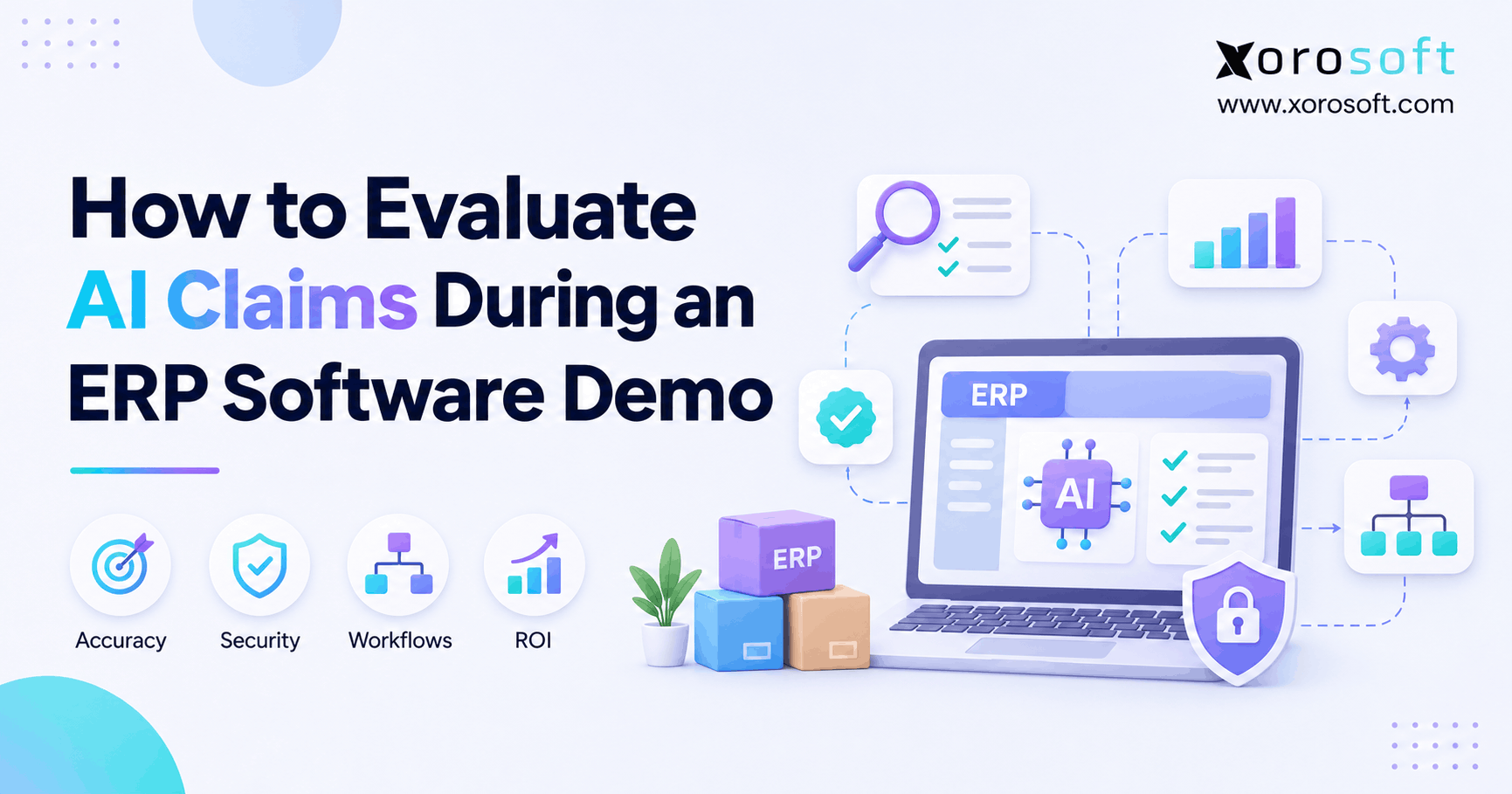
If you are preparing for a software demonstration, using an ERP AI demo checklist will help ensure that you cover all the critical points.
1. When a Convincing AI Demo Does Not Prove Operational Fit
An ERP AI demo checklist gives ERP buyers a practical way to test artificial intelligence claims before signing a software agreement. For example, a polished forecast, fluent chatbot, or one-click purchasing recommendation can look impressive. However, the real question is whether the feature works with your inventory, order changes, supplier rules, and accounting controls. Therefore, a useful demonstration must show evidence, not just attractive screens.
In addition, rapidly growing ecommerce brands and distributors cannot afford to evaluate AI separately from daily operations. For example, a plausible purchase recommendation may still cause overstock if it ignores open purchase orders. Likewise, a convincing inventory answer may be wrong if it includes quarantined stock. Consequently, this guide explains what to ask, which 12 tests to run, and how to score the results.
1.1 Why an AI ERP Demo Can Be Misleading
For instance, most scripted demonstrations use clean products, complete records, and predictable questions. As a result, they rarely expose the inconsistent data that operators manage every day. However, a model might summarize last week’s orders accurately yet fail when a return and an EDI cancellation arrive together. Consequently, buyers need to change the scenario while the vendor is presenting.
Moreover, a feature may be available only in a different package, a preview release, or an outside tool. Therefore, request the actual product version and a written list of dependencies. As a result, an ERP AI demo checklist should identify what was demonstrated, what was merely described, and what still needs verification.
1.2 Who Should Attend the Demonstration?
First, the COO should connect the tests to service levels and working capital. Meanwhile, inventory and purchasing managers should challenge quantities, lead times, and reservations. Likewise, finance should examine approval controls, valuation, and downstream postings. In addition, IT or security should assess data access, integrations, and logging.
However, no single attendee should own every decision. For example, a forecasting metric may satisfy IT while the purchasing team finds the recommended order quantities unusable. Therefore, assign each scenario to the person responsible for the actual business outcome.
1.3 What Good Evidence Looks Like
In addition, strong evidence includes the input record, a timestamped output, the reason for the recommendation, and any approved ERP transaction. For example, an inventory allocation test should show the reservation in the correct warehouse, not merely a green success message. In contrast, a slideshow about future capabilities is not a completed test.
Consequently, ask every vendor to preserve a sample audit record and explain how users can reproduce the result. If the demonstration cannot be repeated, record the claim as unverified instead of assuming it will work after implementation.
2. ERP AI Demo Checklist: Understand the Technology First
First, establish what the vendor actually calls AI before evaluating accuracy. Otherwise, teams may compare different technologies as though they perform the same function. Moreover, the simplest solution may be the best fit for a well-defined business problem.
2.1 ERP AI Vendor Evaluation: Rules, Models, and Agents
For example, rule-based automation executes predefined conditions. Meanwhile, predictive machine learning estimates outcomes from patterns in historical data. In contrast, generative AI can summarize records or answer natural-language questions, and an agent can be configured to use tools or initiate actions. However, the presence of an agent does not guarantee its outputs are correct or its permissions are safe.
| Approach | Example ERP use | Evidence to request |
|---|---|---|
| Fixed business rules | Reorder when available stock is below a threshold | Rule settings and exception handling |
| Predictive model | Estimate SKU demand for the next month | Forecasts compared with actual demand |
| Generative assistant | Explain overdue purchase orders | Source records and factual accuracy |
| AI agent | Draft an order or trigger a defined workflow | Permissions, approvals, and transaction logs |
2.2 Why Feature Labels Are Not Enough
For example, a vendor may describe a reorder alert as AI even though a fixed threshold drives it. Conversely, a statistical forecast may provide significant value without a conversational interface. Therefore, ask what changes the result, how the feature handles uncertainty, and whether the outcome can be measured against the current process.
For instance, a system that recommends 300 units should explain the stock position, demand assumptions, and supplier constraints it used. In addition, the presenter should clarify whether the recommendation is advisory or can create an actual purchase order. Consequently, that distinction changes both the risk and the necessary controls.
2.3 Turn Promises Into Testable Questions
Instead, replace vague claims such as “smarter replenishment” with observable requirements. First, define the decision: choosing a reorder quantity. Next, name the constraints: supplier minimums, open orders, lead times, and expected demand. Finally, specify the acceptable result and the evidence needed to support it.
Consequently, the ERP AI demo checklist becomes an operational test plan. Instead of debating whether the interface feels intelligent, your team can check whether the output is defensible, repeatable, and useful. Moreover, this approach makes different vendor demonstrations easier to compare.
3. Prepare the ERP AI Demo Checklist Before the Meeting
In practice, good preparation prevents a vendor from controlling every test. Therefore, select representative data, agree on pass criteria, and decide which outcomes are mandatory. In addition, for a wider selection framework, consult the ERP selection scorecard.
3.1 Define Three Decisions That Matter Financially
First, choose the decisions that create measurable costs or service problems. For example, a retailer may prioritize late purchase orders, duplicate replenishment, and inaccurate available-to-promise stock. Likewise, a manufacturer may prioritize material shortages, delayed work orders, and production scrap reporting.
Then document the current baseline: time spent, error rate, forecast error, stockout frequency, or exception volume. However, do not invent savings before running a test. As a result, the team can judge the feature against a real operational need rather than marketing language.
3.2 Build Safe Test Data for the AI ERP Demo
Next, use masked sales history, sample SKUs, inventory by location, supplier terms, and representative order changes. In addition, include odd cases: discontinued items, negative adjustments, partial receipts, quarantined stock, and orders canceled after allocation. However, these records should be realistic enough to expose problems without revealing confidential information.
Before transferring data, agree on privacy, retention, access, and deletion terms. Alternatively, create synthetic cases that reproduce the relevant patterns. However, mark synthetic tests clearly because they cannot establish performance on every production scenario.
3.3 Agree on Passing, Failing, and Missing Evidence
Prepare a simple test sheet with columns for claim, input, expected behavior, observed behavior, owner, and evidence. First, identify mandatory controls that cannot fail, such as user permissions or purchasing approvals. Next, agree on measurement methods for accuracy and process time. Finally, decide when a follow-up proof of concept is required.
For example, a missing audit trail should not earn an average score simply because other screens looked polished. Therefore, record mandatory failures separately. The ERP AI demo checklist will then support a disciplined decision instead of a collection of impressions.
4. ERP AI Demo Checklist: 12 Live Tests Buyers Should Run
First, run these tests in the proposed product and configuration, not solely on slides. Moreover, ask the presenter to make at least one change that was not prepared in advance. In addition, for each test, capture the claim, inputs, actual result, evidence, and any operational risk.
4.1 Test 1: Verify the Feature Is Available Now
First, ask the vendor to open the capability in the product edition you are considering. Next, confirm its release status, required modules, integration dependencies, and license conditions. Moreover, if an AI assistant runs in a separate application, request a demonstration of the complete connection to ERP records.
Evidence: product version, active configuration, and written availability. Failure signal: the presenter shows only a video, mock-up, or roadmap slide. Therefore, do not treat a planned feature as a purchased capability.
4.2 Test 2: Change Inputs During the AI ERP Demo
For example, introduce an unexpected change, such as increasing lead time from 14 to 28 days or reducing sellable inventory after a quality hold. Then ask the system to regenerate its answer. As a result, a credible output should reflect the changed source data and the time of the update.
Evidence: before-and-after records, output, and timestamps. Failure signal: the same answer appears despite materially different data. Consequently, the ERP AI demo checklist should require a second test before marking the claim verified.
4.3 Test 3: Identify Rules Presented as Intelligence
First, ask the vendor to explain whether an outcome comes from a threshold, a statistical model, a language model, or a human-configured rule. In addition, change the relevant parameter and inspect the result. A fixed rule is not inherently inferior; however, describing it accurately helps buyers compare functionality and cost.
Evidence: configuration, reproducible behavior, and clear limits. Failure signal: the presenter cannot distinguish deterministic automation from predictive or generative behavior. Therefore, score the result on proven business value rather than its label.
4.4 Test 4: Measure Forecast Accuracy in an ERP AI Demo
First, select a historical period and compare the vendor’s dated predictions with actual demand. Moreover, use the same SKUs, locations, horizons, and exclusions for a simple baseline. For example, measures such as mean absolute error can help, but buyers should also inspect bias and category-level variation. See Google’s machine-learning metrics guidance for definitions.
Evidence: prediction dates, actuals, baseline, and calculations. Failure signal: an accuracy percentage without a stated measurement method. As a result, the ERP AI demo checklist should never accept a single attractive forecast chart as proof.
4.5 Test 5: Challenge Purchase Recommendations
For example, create a SKU with 90 available units, 200 units already on purchase orders, changing demand, and a supplier minimum order quantity. Next, ask the vendor to recommend a purchase quantity and arrival date. Then introduce a delayed shipment and check whether the answer changes appropriately.
Evidence: demand, inbound orders, supplier terms, and the recommendation rationale. Failure signal: duplicate buying or ignored constraints. Therefore, purchasing managers should decide whether the output is usable before finance estimates potential savings.
4.6 Test 6: Stress-Test Warehouse Allocation in an AI ERP Demo
First, provide two warehouses with different balances and customer commitments. Then reserve units for a wholesale order while adding new ecommerce demand. Consequently, the recommendation should respect sellable stock, holds, reservations, and any configured priority rules. However, an allocation suggestion is not the same as a posted allocation transaction.
Evidence: location balances, reservation details, and resulting commitments. Failure signal: the system promises already allocated units. Consequently, the ERP AI demo checklist should connect every recommendation to the actual warehouse record.
4.7 Test 7: Follow Shopify and Amazon Order Changes
First, change an ecommerce order, cancel a marketplace line, and delay a data feed. Next, ask the assistant or recommendation engine which orders remain open. In addition, inspect source IDs and synchronization timestamps before accepting the result. Finally, test whether a repeated event triggers duplicate work.
Evidence: order records, integration logs, and reconciled status. Failure signal: a stale order creates demand twice. For context, review Xorosoft’s integration capabilities and its Shopify App Store listing, then verify the required integration behaviors in your own configuration.
4.8 Test 8: Trace AI ERP Demo Outputs Into Finance
First, ask the system to propose a purchase action, then follow an approved transaction through purchase order creation, receipt, supplier invoice, and applicable accounting entries. However, if the AI merely recommends a step, the vendor should clearly distinguish that from creating a real transaction. Meanwhile, finance should confirm valuation and reconciliation behavior.
Evidence: linked record IDs, approval history, and relevant postings. Failure signal: a success message without matching business records. Therefore, the ERP AI demo checklist must look beyond assistant responses to transaction integrity.
4.9 Test 9: Enforce Human Approval and Spending Limits
First, attempt a purchase above a test user’s authorized threshold. Next, repeat with an appropriately authorized manager. In addition, if an agent uses an API identity, check its permissions independently from the human user’s account. However, do not assume that a chatbot automatically has permission to write transactions.
Evidence: denied actions, authorized approvals, and audit entries. Failure signal: unrestricted purchasing or an unidentified approver. As a result, the ERP AI demo checklist should make critical authorization controls non-negotiable.
4.10 Test 10: Check Permissions in an ERP AI Demo
First, create two users with different access to supplier costs or financial information. Then ask each user the same restricted question. Consequently, the correct behavior should reflect their authorization level, including denial when necessary. Moreover, ask where prompts are processed and whether external model providers can retain customer data.
Evidence: permissions, test outcomes, and contractual data terms. Failure signal: restricted records appear for the wrong user. Therefore, security staff should approve the test criteria before the demonstration begins.
4.11 Test 11: Introduce Missing and Conflicting Records
For example, remove a lead time, conflict two inventory values, or change an item’s unit of measure. Next, ask the system to recommend the operational action. Therefore, a responsible workflow should validate inputs, identify uncertainty, or request intervention where appropriate. In contrast, an unsupported confident answer can create real purchasing or fulfillment errors.
Evidence: warnings, validation, escalation, and preserved source data. Failure signal: the system invents missing values without disclosure. Consequently, buyers should score safe failure handling as seriously as successful output.
4.12 Test 12: Inspect ERP AI Demo Logs, Recovery, and Cost
First, ask for the history of the recommendation, the resulting action, and any human overrides. In addition, repeat a failed transaction to see whether it retries safely or duplicates work. Finally, request an itemized cost model covering AI usage, integrations, setup, monitoring, and support.
Evidence: logs, recovery behavior, and a written pricing schedule. Failure signal: untraceable actions or unknowable charges. Consequently, close the ERP AI demo checklist with a list of unresolved tests rather than a verbal assurance.
5. ERP AI Demo Checklist: Score What Was Proven
Next, combine evidence from the demonstrations into one comparable record. However, do not let a high average conceal a dangerous control failure. The scorecard should reward operational fit, not the number of AI features mentioned.
5.1 ERP AI Vendor Evaluation: Evidence Levels
First, mark a capability verified only when it passed an agreed live test. Next, mark it partially verified when a workaround, additional component, or unresolved limitation remains. In contrast, use unverified for claims supported only by slides, a roadmap, or statements that nobody tested.
Moreover, save source IDs, screenshots where appropriate, test data descriptions, and reviewer notes. Therefore, later purchasing discussions can refer to the same evidence rather than competing memories of the presentation.
5.2 Assign Weights to Risk and Business Value
One possible 100-point model weights business relevance at 20%, demonstrated accuracy at 20%, workflow integration at 20%, security and approvals at 15%, auditability at 15%, and total cost at 10%. Then rate each category from zero to five. Calculate its contribution as the rating divided by five, multiplied by its percentage weight.
| Criterion | Weight | Example evidence |
|---|---|---|
| Business relevance | 20% | A real operating problem is resolved |
| Accuracy and reliability | 20% | Baseline results and exception tests |
| ERP integration | 20% | Correct end-to-end transactions |
| Security and approvals | 15% | Role and authorization tests |
| Traceability | 15% | Explanation and audit history |
| Total cost | 10% | Itemized pricing and dependencies |
For example, a score of four on a 20% category contributes 16 points. However, these weights are illustrative; adjust them before the evaluation to reflect your business risks.
5.3 Keep Mandatory Failures Outside the Average
For example, a system might score well on reports and forecasts while allowing unauthorized purchasing. Nevertheless, that defect should block approval until resolved. Similarly, missing data-processing terms or an untraceable financial transaction may be unacceptable regardless of the overall rating.
Therefore, maintain a separate pass/fail list for permissions, accounting integrity, required integrations, and other non-negotiable controls. The ERP AI demo checklist should expose those gaps before the purchasing decision, not after go-live.
6. Industry-Specific AI ERP Demo Scenarios
However, generic sample companies often hide operational complexity. Instead, ask vendors to work through a scenario that reflects your sector. For additional industry context, review the industries Xorosoft serves and choose tests matching your actual processes.
6.1 Apparel and Fashion: Promotions and Returns
For example, an apparel brand launches a promotion, then receives a wave of returns across several sizes. However, some returned units remain in inspection and should not replenish available stock. Ask the AI forecast to incorporate the promotion while respecting that inventory state.
Next, compare its recommendations with actual demand and current inbound orders. Proof: a defensible size-level replenishment plan without counting held returns as sellable. As a result, the test links forecasting claims to the inventory controls that determine whether a customer promise is reliable.
6.2 Wholesale AI ERP Demo: EDI and Allocation
For example, a wholesale distributor receives an EDI order that competes with existing customer allocations. Meanwhile, one supplier delays an inbound shipment and another changes a minimum order quantity. Ask the system to identify affected commitments and recommend a controlled response.
Next, inspect whether the ERP updates the correct order status and reserves only eligible stock. Proof: source records, approved allocation changes, and an explainable supplier decision. This ERP AI demo checklist scenario is especially useful when inventory is shared across wholesale and direct-to-consumer channels.
6.3 Furniture and Sporting Goods: Location Decisions
In addition, large furniture products and seasonal sporting goods can create meaningful warehouse and freight tradeoffs. For example, a product may exist at two sites, but only one has stock ready for dispatch. Therefore, test whether the recommendation understands reservations, promised dates, and shipping constraints.
Moreover, confirm whether the software merely proposes a source location or actually updates fulfillment records. Proof: a location-specific decision tied to valid sellable inventory. When reviewing warehouse management workflows, inspect the real receiving, picking, and location controls behind any AI-generated answer.
6.4 Manufacturing ERP AI Demo: BOMs and Materials
For example, give the vendor a work order with a revised bill of materials, short components, and a quarantined raw-material lot. Next, ask which jobs can start without creating shortages. The AI response must not substitute unavailable material or ignore the active BOM revision.
However, a plausible recommendation is not enough; production staff should verify its assumptions against work orders and stock records. Proof: correct component requirements, clearly identified constraints, and a controlled path to approval. Consequently, manufacturing teams can evaluate planning value without assuming autonomous scheduling exists.
7. Governance Checks for the ERP AI Demo
In particular, AI governance matters most when recommendations influence money, customer commitments, or sensitive information. Therefore, treat privacy, authorization, and monitoring as core evaluation criteria rather than late-stage IT paperwork.
7.1 Confirm Data Ownership and Processing Terms
First, ask which customer records enter the AI workflow, where they are processed, how long they remain stored, and whether they may train a third-party model. In addition, request documented subprocessors, deletion processes, and incident responsibilities. Different products can answer these questions differently, so a generic reassurance is insufficient.
For broader risk-management principles, the NIST AI Risk Management Framework provides a useful reference. However, referencing a framework does not prove that any particular ERP product meets a specific security requirement.
7.2 ERP AI Vendor Evaluation: Approvals and Audit Trails
First, map the people and service accounts allowed to read, recommend, create, and approve transactions. Next, test spending thresholds and segregation of duties. For example, an assistant may summarize overdue orders without being permitted to submit a purchase order. As a result, permission design must reflect the action, not merely the interface.
Moreover, request a log connecting the initial question, source records, generated result, approving user, and final transaction. Therefore, finance can determine what happened if an order or adjustment needs investigation.
7.3 Monitor Model Performance After Deployment
For example, business conditions change when product mix shifts, suppliers miss deliveries, and channels introduce new data patterns. Consequently, performance observed during a demo may deteriorate later. Agree on who monitors forecast error, invalid recommendations, override rates, and failed transactions.
In addition, ask how model updates are tested and when a risky workflow is paused. The ERP AI demo checklist should lead to an ongoing measurement plan, not a one-time approval. Where generative systems are involved, the NIST Generative AI Profile supplies additional risk considerations.
8. ERP AI Demo Checklist: Costs, ROI, and Alternatives
In practice, a sophisticated feature is valuable only when it improves a decision enough to justify its total cost. Therefore, compare the proposed AI workflow with simpler ERP processes and the company’s current method. Do not assume automation savings from a polished demo.
8.1 Measure Results Against an Honest Baseline
First, identify the current monthly cost of the problem, such as analyst hours spent reviewing exceptions or avoidable emergency freight. Next, estimate improvement using observed test results, not a vendor benchmark from another industry. Finally, account for adoption and any mistakes introduced by the new process.
For example, if annual benefits amount to $30,000 and annualized incremental costs are $18,000, simple ROI is approximately 67%. However, this is an illustrative calculation, not a Xorosoft or vendor performance claim. A real business case should also account for implementation expenses and uncertainty.
8.2 ERP AI Vendor Evaluation: Hidden Cost Questions
First, ask whether AI access requires premium licensing, usage-based API calls, separate connectors, model hosting, consulting, monitoring, or additional security features. Moreover, request projected costs at normal and peak transaction volume. A low subscription price may become expensive if each automated step creates separate consumption charges.
Therefore, add the written fee schedule and dependencies to the ERP AI demo checklist. If the feature is in preview, clarify what happens to pricing and support when it becomes generally available.
8.3 Know When Rules and Better Data Are Enough
For example, a straightforward approval workflow may be better handled through conventional business rules. Likewise, inaccurate warehouse balances require disciplined receiving, cycle counts, and reconciliations before advanced forecasting can help. In contrast, complex seasonal demand or large volumes of exceptions may justify predictive models once the underlying records are reliable.
As a result, compare at least three alternatives: process correction, conventional ERP automation, and tested AI functionality. The best choice is the least complex approach that delivers the required outcome with acceptable risk.
9. Build a Reliable ERP Foundation Before Buying AI
In addition, connected operational records are a prerequisite for trustworthy recommendations. Otherwise, even a sophisticated model can reason over stale inventory, duplicate orders, or missing supplier data. Therefore, evaluate the transaction foundation as carefully as the AI interface.
9.1 ERP AI Demo Readiness Requires Consistent Records
First, follow one customer order across capture, allocation, picking, shipment, invoicing, and payment. Next, follow one purchase through approval, receiving, inventory valuation, and accounting. If the records diverge, investigate ownership and synchronization before relying on generated recommendations.
Moreover, test how the system handles returns, holds, and transfers across locations. The ERP AI demo checklist should verify current data and the controls that protect it. Without those basics, a faster answer may simply distribute an existing mistake faster.
9.2 Evaluate Connected Operations With Xorosoft
Xorosoft provides cloud ERP coverage for inventory, purchasing, accounting, warehousing, manufacturing, and ecommerce operations. Therefore, buyers can assess whether an integrated transaction flow addresses existing gaps before prioritizing AI. Review XoroERP and XoroONE for the relevant operational scope, then request proof of the workflows that matter most.
In addition, Xorosoft describes an AI MCP Server for connecting supported AI tools to authorized ERP data and actions. However, exact permissions, configuration, availability, and results must still be verified in the proposed deployment. Product documentation is a starting point, not a substitute for the tests above.
9.3 Require a Focused Proof of Concept When Stakes Are High
Although a short demonstration may be enough for low-risk reporting, purchasing commitments or financial actions deserve deeper validation. Therefore, define a limited proof of concept with representative data, named test owners, measurable success criteria, and an agreed completion decision. In addition, specify what happens if a mandatory test fails.
For a structured approach, use the ERP proof-of-concept guide. Consequently, the buyer’s team can verify integration behavior and control gaps before a large implementation commitment.
10. Conclusion: Choose Demonstrated ERP Value Over AI Hype
As a result, an ERP AI demo checklist turns a feature presentation into a disciplined evaluation. First, confirm that each capability exists in the proposed product. Next, challenge it with real operating constraints, measure outcomes, trace transactions, and test approvals. Finally, compare evidence, total cost, and operational fit before making a decision.
Moreover, a strong ERP foundation matters regardless of the AI technology attached to it. Therefore, focus on inventory accuracy, controlled purchasing, warehouse execution, reliable finance, and integrations. Xorosoft can be evaluated against these requirements through a personalized workflow demonstration; any advanced AI claims should receive the same scrutiny.
Ready to test the workflows that matter to your business? Book a Demo and bring your inventory, purchasing, warehouse, and accounting scenarios to the conversation.
Frequently Asked Questions
What is an ERP AI demo checklist?
It is a structured set of live tests for ERP AI claims. It checks feature availability, accuracy, integrations, permissions, audit records, and cost before buyers compare vendors.
How do I know an ERP vendor uses real AI?
Ask which outputs use fixed rules, predictive models, or generative AI. Then change inputs live and request reproducible results, source records, and documentation explaining the limits.
What should I test during an ERP AI demo?
Test forecasts, purchasing recommendations, stock allocation, order changes, financial postings, role permissions, bad data, audit trails, and costs. Compare results with agreed business baselines.
Can ERP AI work with Shopify orders?
It can when the proposed ERP and AI components support the required integrations. However, verify order changes, cancellations, data freshness, duplicate events, and authorization in a live test.
How is ERP AI forecasting accuracy measured?
Compare dated predictions with actual demand over the same period. Use an appropriate baseline and examine error by SKU, warehouse, and forecast horizon rather than one overall percentage.
Is AI better than standard ERP automation?
Not always. Fixed approvals and reorder rules often work well without AI. In contrast, more variable forecasting or complex exceptions may benefit from tested predictive capabilities.
When should I request an ERP AI proof of concept?
Request one when AI could affect purchasing commitments, sensitive data, inventory availability, or financial transactions. Agree on representative scenarios, measurable outcomes, mandatory controls, and written acceptance criteria.
Recent Posts
-
 Why Unposted Production Scrap Overstates Inventory and Margin
-
 Yard Detention Case Study: How an Import Distributor Improved Trailer Visibility
-
 What Is an Inventory Reserve and Who Should Calculate It?
-
Procurement Workflow Software for Inventory-Driven Businesses
-
 Canceled Shipment Quantities in Shopify: What ERP and WMS Teams Must Record