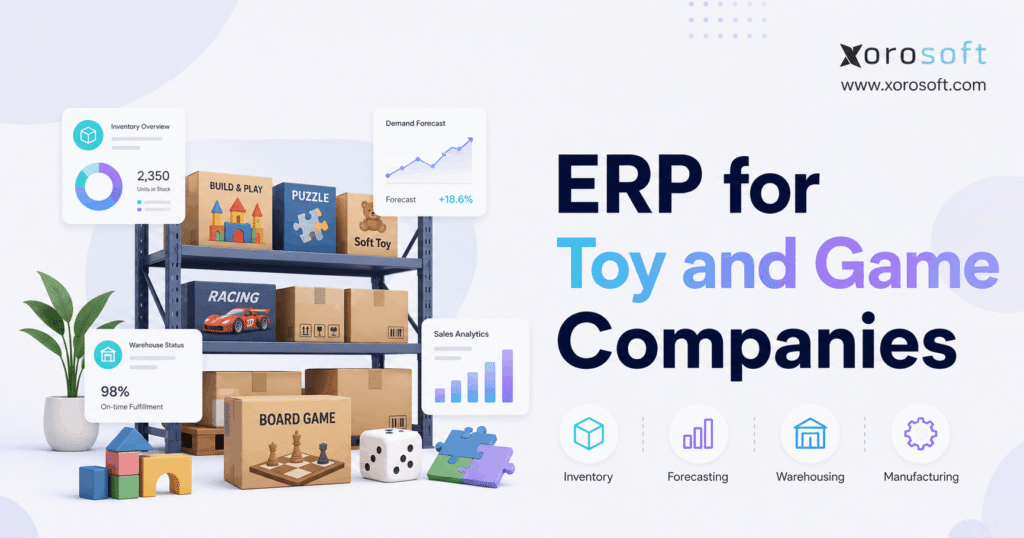
ERP for toy companies can offer tailored solutions to streamline operations and support business growth.
1. Why Growth Creates an Inventory Control Problem for Toy and Game Companies
Toy and game companies often grow faster than their back-office systems. A business may start with a small product range, one warehouse, Shopify, and basic accounting software. As sales expand, the same company may add Amazon, wholesale customers, retailers, more suppliers, new warehouses, and its own production.
At that point, inventory gets harder to control.
A product may show as available in one system even though the warehouse has already allocated it to a wholesale order. Buyers may place new purchase orders using spreadsheets that do not include recent ecommerce demand. Finance may see a different inventory value from the operations team.
These gaps create more than extra admin work. They can lead to stockouts, excess inventory, late orders, higher freight costs, weak forecasts, and slow month-end closes.
1.1 Seasonal Demand Makes Toy Inventory Harder to Plan
The toy market brings an added challenge: demand can change quickly.
Holiday periods, new releases, promotions, licensed products, collectibles, and social trends can create large sales spikes. A product that sells slowly in September may become difficult to keep in stock by November. On the other hand, a company that buys too much inventory can carry unwanted stock well after the peak selling period.
The Toy Association reported that tracked U.S. toy sales reached $30.3 billion in 2025, up 6% from the year before. Games and puzzles became the largest tracked supercategory at $4.9 billion.
Those numbers highlight an important point. Strong market demand does not remove inventory risk. It makes planning more important because demand can move unevenly across products and categories.
1.2 More Sales Channels Create More Claims on the Same Stock
A growing toy brand may sell the same products through Shopify, Amazon, wholesale accounts, distributors, and retail partners.
Every channel needs inventory, yet each one may receive orders through a different system.
Without a shared inventory record, teams can promise the same units more than once. One channel may sell through inventory that the business intended to hold for a major wholesale customer. Another may show an item as out of stock even though another warehouse has enough supply.
This is where ERP for toy companies becomes useful. It gives teams one place to manage available stock, incoming inventory, customer orders, warehouse activity, purchasing, and financial data.
The main goal is not to install more software. The goal is to create one reliable view of the business.
2. What ERP for Toy Companies Must Control
ERP for toy companies connects inventory, purchasing, sales orders, warehouse work, manufacturing, accounting, forecasting, and sales channels in one business system.
The value comes from how these areas work together.
When a buyer creates a purchase order, warehouse teams should see the incoming stock. Once staff receive the goods, inventory should update. When sales teams allocate stock to an order, ecommerce availability should reflect that change. After the warehouse ships the order, finance should receive the related transaction without entering it again.
2.1 ERP Software for Toy Companies Versus Basic Inventory Software
Inventory software mainly tracks products and stock. ERP covers a wider part of the business.
For example, an inventory app may show that a company owns 3,000 units of a toy. An ERP system should also help answer whether customers have already reserved part of that stock, how many units are arriving, what the business paid for them, where each unit sits, and whether production can make more.
A small toy company may not need this level of control. One warehouse, one sales channel, and a simple product range can work well with smaller tools.
The need for ERP grows when the business adds more links between departments.
A company that wants inventory, purchasing, finance, warehousing, production, and ecommerce in one system can evaluate a cloud ERP platform such as XoroONE along with other options in the market.
2.2 Who Benefits Most From a Toy Industry ERP
Manufacturers, importers, wholesalers, distributors, and fast-growing ecommerce brands often gain the most from connected ERP.
A manufacturer needs to know whether it has enough parts to build finished products. A distributor needs accurate stock across warehouses. A wholesale business must protect inventory promised to large customers. Ecommerce brands need fast stock updates across channels.
Once several teams depend on the same product and order data, separate apps start to create delays.
That point, rather than a fixed revenue number, usually signals that a business should review ERP for toy companies.
3. How ERP for Toy Companies Improves Seasonal Forecasting
Seasonal planning can decide whether a toy business enters its busiest months with the right stock or spends the season reacting to shortages.
Last year’s sales can help, but they should not become the entire forecast.
A useful plan also considers current sales trends, promotions, product age, supplier lead times, new releases, open customer orders, and inventory already on the way.
3.1 Connect Demand Forecasts With Purchasing
Consider a company that expects to sell 20,000 units of a game during the holiday season.
It has 5,000 units available today. Wholesale customers have already claimed 3,000. Suppliers have confirmed another 7,000 units on open purchase orders.
Looking only at current stock suggests the company needs 15,000 more units. Looking at the full picture gives a very different answer.
This is where ERP for toy companies helps planners. The system can bring demand, available stock, allocated units, open purchases, and supplier lead times into one planning process.
Buyers can then make decisions based on a wider view rather than one spreadsheet.
3.2 Seasonal Stock Is Also a Cash-Flow Decision
Too much inventory creates a cash problem.
The business pays suppliers before it sells the products. Warehouses need space. Staff handle the goods. Slow-moving items may require discounts later.
Too little inventory creates a different cost. The company loses sales, may disappoint retailers, and can end up paying for urgent freight.
Good planning aims for the right stock level rather than the highest stock level.
Toy ERP software can help teams track sell-through, stock cover, open purchase orders, expected demand, and aging inventory. That gives buyers more time to change purchase plans before excess stock becomes difficult to move.
3.3 Forecasting Still Needs Human Judgment
No ERP can predict every hit product.
A viral video, successful movie, influencer mention, or sudden trend can change demand faster than historical data suggests.
Planners still need market knowledge. The software should support that judgment with current data.
The best process combines system-based forecasts with regular reviews from sales, purchasing, finance, and operations.
4. Toy Manufacturing ERP Connects BOMs, Parts and Finished Products
Toy manufacturers and game companies need more than finished-goods inventory.
They also manage parts, packaging, raw materials, work orders, and production schedules.
A product may look simple to the customer while requiring many items behind the scenes.
4.1 Bills of Materials Turn Sales Demand Into Part Requirements
Take a board game as an example.
A finished game may need a box, board, cards, tokens, dice, instructions, inserts, and printed packaging. If the company plans to build 10,000 games, it needs enough of every required part.
The bill of materials, or BOM, defines those needs.
Toy manufacturing ERP can use BOM data to show whether the business has enough material before production starts.
A shortage of one low-cost part can stop an entire production run. Having enough boxes does not help if the business lacks dice or printed cards.
4.2 MRP Helps Buyers Spot Shortages Earlier
Material requirements planning, or MRP, takes the production plan and compares it with stock, open purchase orders, and BOM needs.
Suppose a company plans to build 15,000 toys. It has enough plastic cases for all 15,000 but only enough electronic parts for 9,000.
MRP can expose that gap before the production team reaches the line.
A manufacturing ERP system can connect BOMs, work orders, purchasing, material needs, inventory, and finished goods.
For companies that make or assemble products, this link between planning and purchasing matters more than a basic production calendar.
4.3 Toy Kits and Bundles Need Clear Inventory Rules
Many toy businesses also sell gift packs, starter sets, bundles, or promotional kits.
Teams need to decide how the system should treat them.
Some businesses assemble kits before they sell them. Others build them during order fulfillment. Ecommerce brands may create virtual bundles that never exist as a separate physical item.
Each method affects available stock.
The ERP setup should match the real warehouse process so that bundle sales do not create hidden shortages in the parts that make up the bundle.
5. Multi-Warehouse ERP for Toy Companies Needs Location-Level Stock
Adding another warehouse changes how the business plans and fulfills orders.
A company with 10,000 units across three warehouses does not necessarily have 10,000 units available for every order.
Stock may sit far from the customer. Some units may already belong to open orders. Other products may be moving between sites or waiting for inspection.
5.1 Total Inventory Can Hide Local Shortages
Imagine a business with 8,000 units nationwide.
The East Coast warehouse holds only 700 units, but that location has 2,000 units of open demand. Meanwhile, the West Coast warehouse has excess stock.
Company-wide inventory looks healthy. Local availability does not.
A multi-warehouse ERP for toy companies should show stock by site, status, allocation, and transfer stage.
That makes it easier to decide whether to transfer stock, change order routing, or place a new purchase order.
5.2 Warehouse Work Must Update ERP Inventory Quickly
Inventory data only stays useful when warehouse actions update it.
Receiving, putaway, picking, packing, transfers, returns, and cycle counts all change the real stock position.
A warehouse management system such as XoroWMS can link those warehouse tasks with the wider ERP process.
Barcode scans and clear warehouse steps also reduce the need for staff to enter the same movement later from paper notes or spreadsheets.
For toy companies with several warehouses, this faster update cycle helps sales and purchasing teams make better decisions.
6. Ecommerce ERP for Toy Companies Must Keep Channels in Sync
Online retail puts more pressure on inventory accuracy because customers can place orders at any hour.
U.S. ecommerce sales continued to account for a large share of total retail sales in 2026. For toy brands, that means digital orders can arrive while wholesale buyers, warehouse staff, and purchasing teams work with the same stock.
A separate inventory number for every channel quickly becomes hard to manage.
6.1 Shopify and Amazon Should Share One Stock Plan
A brand may start with Shopify, then add Amazon and wholesale orders.
At first, separate apps may seem manageable. Over time, staff begin to check several systems before answering basic questions about stock.
ERP for toy companies can act as the main inventory layer behind those sales channels.
Orders flow into one system. The ERP applies inventory rules. Warehouse teams fulfill the order, and the selling channel receives the shipping update.
Companies evaluating the Shopify connection can also review the Xorosoft ERP listing in the Shopify App Store to understand how the app fits into Shopify-based workflows.
6.2 One Stock Pool Does Not Mean Equal Access for Every Channel
Central stock control should still allow the business to set rules.
A company may want to reserve inventory for a retail launch, hold units for wholesale accounts, or limit the stock available to a marketplace.
This becomes important during peak demand.
Without allocation rules, a fast-selling ecommerce campaign can use inventory that another team already promised to a key customer.
ERP helps manage those claims in one place.
6.3 Returns Need Their Own Inventory Status
Returned goods should not always go straight back into available stock.
Customers may send back an unopened game, a damaged toy, an item with missing parts, or a product with damaged packaging.
Warehouse staff should inspect the return first.
The system can then move the item into sellable stock, damaged stock, repair stock, or another defined status. This step prevents ecommerce channels from offering goods that the warehouse has not cleared for resale.
7. ERP for Toy Companies in Wholesale and EDI Operations
Toy distributors and wholesalers often deal with more rules than direct-to-consumer brands.
Large customers may use their own price agreements, shipping instructions, labels, order formats, and delivery windows.
Retailers may also send orders through EDI.
7.1 EDI Should Connect With the Order Process
Electronic data interchange, or EDI, lets trading partners exchange structured documents such as purchase orders, shipment notices, and invoices.
The useful part begins when those messages connect directly with the ERP.
A retailer sends a purchase order. The system checks the order and stock. Operations allocate the goods. Warehouse staff pick and ship them. The business sends the required shipment message and invoice.
When every step shares the same order record, teams avoid entering the transaction several times.
7.2 Wholesale Pricing Needs More Than One Standard Price
Toy wholesalers may manage different prices for distributors, retailers, buying groups, or major accounts.
Contracts may include quantity breaks, customer-specific discounts, promotional prices, or special payment terms.
ERP for toy companies should give sales teams access to the right commercial terms without forcing them to check separate files.
That matters even more when many employees work with the same customer base.
8. How ERP for Toy Companies Supports Product Traceability
Children’s products come with safety and record-keeping duties that businesses must take seriously.
ERP cannot replace testing, legal advice, product design standards, or safety checks. However, it can help a company keep better records.
8.1 Product Records Should Follow Goods Through the Supply Chain
Useful traceability starts before a product reaches the warehouse.
Teams may need to know which supplier provided a part, which purchase order brought it in, which batch used it, when production took place, where finished stock moved, and which customers later received those goods.
A well-planned ERP for toy companies can connect those records.
This helps operations and quality teams investigate issues faster.
8.2 Recall Readiness Depends on Clear Data
Suppose a quality issue affects one production run rather than every unit of a product.
The company should be able to narrow the scope.
Teams need to know which units remain in stock, which warehouse holds them, and which customers received products from the same run.
That does not make ERP a compliance tool by itself. It makes ERP a useful source of business records during a safety or quality review.
Clear batch, supplier, product, warehouse, and shipment records reduce the time teams spend trying to rebuild the history after a problem appears.
9. Purchasing and Accounting in ERP for Toy Companies Need Shared Data
Inventory links operations directly with finance.
When purchasing buys stock, the company commits cash. Receiving adds inventory value. Production uses parts. Shipping moves product cost into cost of goods sold.
If separate systems manage each step, finance often has to rebuild the story at month-end.
9.1 Landed Cost Changes the Real Margin
Supplier price rarely tells the full cost of imported toys.
Freight, duty, customs fees, brokerage, insurance, and other inbound costs can change product margins.
A toy that costs $8 from the supplier may cost much more by the time it reaches the warehouse.
ERP for toy companies should help finance and purchasing teams use a clear landed-cost method.
That gives buyers a better view when they compare suppliers or set selling prices.
9.2 Finance Should Not Rebuild Warehouse Transactions
When warehouse and finance systems do not share data, accounting staff may spend hours matching receipts, shipments, inventory changes, and invoices.
A connected ERP can reduce that work.
The aim is simple: record a business event once and let the system pass the effect to the teams that need it.
This approach also makes month-end reviews easier because operations and finance use the same source data.
10. When ERP for Toy Companies Replaces QuickBooks and Point Solutions
There is no single revenue figure that tells a toy company when to move to ERP.
The better signal is process strain.
If staff spend more time moving information between tools, checking which number is correct, or fixing errors after the fact, the software stack may no longer fit the business.
10.1 ERP Versus Inventory Software for Toy Companies
| Requirement | Inventory Software | Full ERP |
|---|---|---|
| Stock tracking | Core function | Core function |
| Purchasing | Often included | Linked with wider operations |
| Accounting | Often separate | Integrated or closely connected |
| Manufacturing | Varies | Available in manufacturing ERP |
| WMS | Varies | Can connect directly with ERP |
| Forecasting | Varies | Can link demand with buying |
| EDI | Often integration-based | Can join the order flow |
| Reporting | Usually narrower | Wider business and finance view |
Inventory software can still be the better choice for a simpler business.
A full ERP makes more sense when several teams rely on the same stock, order, purchasing, and finance data.
10.2 Build an ERP Scorecard Before Watching Demos
Before speaking with vendors, document how the company works today.
Map sales channels, warehouses, purchasing, suppliers, production, EDI, returns, accounting, and reports.
Then list the problems that cost the most time or money.
Some companies need strong manufacturing and MRP. Others care more about warehouse speed, ecommerce links, or wholesale orders.
Businesses can also review ERP use cases across inventory-driven industries to see how similar workflows apply across distribution, ecommerce, wholesale, and manufacturing businesses.
The scorecard should guide the demo instead of the vendor’s standard feature tour.
10.3 Compare ERP Options on Fit, Not Brand Size
Toy companies may consider NetSuite, Acumatica, Microsoft Dynamics 365 Business Central, Cin7, Brightpearl, Fishbowl, Odoo, Sage, Xorosoft, and other products.
No platform fits every business equally well.
A manufacturer should test BOMs, material planning, and production. A wholesale distributor should focus on EDI, pricing, and warehouse flows. Ecommerce brands should test Shopify, Amazon, inventory sync, returns, and order routing.
Companies that include NetSuite and Xorosoft on the same shortlist can use the Xorosoft vs NetSuite comparison as one research input.
The final decision should still come from real workflow testing, cost, integrations, user needs, and project risk.
11. ERP Implementation Mistakes Toy and Game Companies Should Avoid
Software selection gets most of the attention, but setup decisions often have a larger effect on the final result.
A strong ERP will not fix poor data or unclear processes on its own.
11.1 Clean Product and Inventory Data Before Migration
Duplicate SKUs, old products, wrong units, unclear item names, and bad warehouse balances create problems from day one.
Teams should clean those records before moving them.
The same rule applies to suppliers, customers, prices, BOMs, and open transactions.
Good data makes testing easier and helps users trust the new system.
11.2 Do Not Rebuild Every Old Spreadsheet
Some spreadsheets solve real gaps. Others exist because teams built workarounds over many years.
An ERP project gives the company a chance to simplify those steps.
Ask why each manual task exists before recreating it.
If the new system already handles the process, keeping the old spreadsheet adds work instead of removing it.
11.3 Test Real Exceptions, Not Only Perfect Orders
A standard order may work in a demo while real-life exceptions still fail.
Testing should include partial shipments, backorders, cancelled orders, returns, failed payments, damaged goods, warehouse transfers, EDI errors, and inventory changes.
Shopify, Amazon, shipping tools, 3PLs, and other links also need end-to-end tests.
Those cases show whether the new system can handle daily work rather than just a clean sample process.
11.4 Avoid Peak-Season Go-Lives When Possible
A toy company should think carefully before launching a major ERP project just before its busiest sales period.
Warehouse teams need time to learn new steps. Finance must test balances. Ecommerce links need checks. Users need practice.
A calmer trading period gives the team more room to fix early issues without putting holiday orders at risk.
12. Frequently Asked Questions About ERP for Toy Companies
12.1 What Is ERP for Toy Companies?
ERP for toy companies is software that connects inventory, purchasing, warehouse work, sales orders, production, finance, forecasting, and sales channels. Instead of using separate files and apps for every task, teams share one set of business data. This approach becomes more useful as product count, order volume, warehouse count, and channel mix grow.
12.2 Why Do Toy and Game Companies Need ERP?
Toy and game companies often need ERP when seasonal demand, large catalogs, several warehouses, manufacturing, wholesale orders, or ecommerce channels become hard to manage in separate systems. ERP helps teams work from the same stock and order data, which can reduce manual checks and repeated data entry.
12.3 What Is the Best ERP for Toy Companies?
No single platform ranks as the best option for every company. A manufacturer needs different tools from a reseller or wholesaler. Companies should compare systems based on inventory, warehouse needs, accounting, production, EDI, ecommerce, reporting, cost, and project needs rather than choosing only by vendor size.
12.4 How Does ERP Help Toy Manufacturers?
Toy manufacturing ERP links BOMs, parts, purchasing, production orders, finished goods, and costs. Planners can see whether they have enough materials before work starts. Buyers can then order missing parts earlier, while warehouse and finance teams receive the related inventory and cost updates from the same process.
12.5 Can ERP Manage Seasonal Toy Demand?
Yes. ERP can help teams combine sales history, forecasts, current stock, open orders, purchase orders, and supplier lead times. This gives buyers a stronger basis for seasonal purchasing. Human review still matters because new products, media trends, and sudden demand shifts can change sales quickly.
12.6 How Does ERP Improve Toy Inventory Forecasting?
ERP brings sales, stock, open purchases, customer orders, and supplier data together. Planners can compare expected demand with supply already available or on the way. That makes it easier to spot possible stockouts or excess stock before they become larger problems.
12.7 Can ERP Manage Thousands of Toy SKUs?
Yes, but businesses should test realistic product data before choosing a system. Look at variants, bundles, discontinued items, barcodes, warehouse locations, product families, and channel mappings. Catalog size matters, yet the links between products, warehouses, orders, and suppliers often create more difficulty than the raw SKU count.
12.8 Can ERP Manage Board Game Manufacturing?
Yes. A manufacturing ERP can track cards, boards, tokens, dice, boxes, inserts, and other parts through a BOM. Production orders can then use those parts to build finished games. The system can also show when one missing item limits the number of games the company can make.
12.9 What Is BOM Management in Toy Manufacturing?
A bill of materials lists the parts and amounts needed to make a finished product. Toy companies use BOMs for games, kits, electronics, gift packs, and other assembled goods. Accurate BOMs help purchasing, production, stock control, and costing teams work from the same product structure.
12.10 Can ERP Handle Toy Kits and Bundles?
Yes. Companies can manage kits in different ways based on how the warehouse works. Some teams build kits before sale, while others assemble them during fulfillment. Virtual bundles may stay as separate stock items. The ERP setup should match the actual handling method.
12.11 Can ERP Manage Multiple Toy Warehouses?
Yes. Multi-warehouse ERP tracks stock by site while still giving teams a company-wide view. It can also support transfers, receiving, picking, allocation, and local replenishment. Businesses should test available stock by warehouse instead of looking only at total company inventory.
12.12 How Does ERP Reduce Overselling?
ERP can keep a central stock figure and send updated availability to connected sales channels. It can also reserve inventory for open orders or customer groups. Strong results still depend on timely warehouse updates and clear rules for how much inventory each channel may sell.
12.13 Can ERP Integrate With Shopify?
Many ERP systems connect with Shopify. Common links include products, customers, orders, stock, and fulfillment updates. During a demo, businesses should ask which system owns each field, how often data moves, and what staff should do when an order or inventory update fails.
12.14 Can ERP Connect Shopify, Amazon and Wholesale Orders?
Yes. ERP can act as the main order and inventory layer behind several channels. It can bring orders into one system, apply stock rules, send work to the warehouse, and pass the final shipment data back to the sales channel.
12.15 Why Is EDI Important for Toy Distributors?
Retailers often use EDI to exchange purchase orders, shipment details, invoices, and other business records. Linking EDI with ERP reduces the need to enter the same order several times. It also helps warehouse, sales, and finance teams work from one order record.
12.16 Can ERP Manage Customer-Specific Wholesale Pricing?
Many ERP systems support customer price lists, quantity breaks, special discounts, contract prices, and payment terms. Wholesalers should test their own price rules during the demo because real customer deals often include more detail than a standard product price.
12.17 Can ERP Calculate Landed Cost?
Many ERP systems can add freight, duty, brokerage, and other inbound costs to product cost. This helps finance and buying teams understand a more realistic margin. Companies should decide which costs they want to include and how the system should spread those costs across items.
12.18 How Can ERP Support Toy Product Traceability?
ERP can connect supplier, purchase, batch, production, warehouse, and shipment data. If a quality issue appears, teams can use that record to trace where products came from and where they went. Clear data also helps narrow the scope of an internal review.
12.19 Does ERP Make a Toy Company Compliant With Safety Rules?
No. ERP does not replace product testing, certification, legal advice, safety standards, or quality checks. It supports those processes by keeping useful product and supply-chain records. Companies remain responsible for meeting the rules that apply to their products and markets.
12.20 Can ERP Help With Toy Recalls?
ERP can help teams find affected stock, batches, warehouse locations, and customer shipments. That makes it useful during a recall review. The business still needs its own safety, legal, communication, and customer-service process to manage the recall correctly.
12.21 When Should a Toy Company Move From QuickBooks to ERP?
A company should consider ERP when accounting is no longer the only system issue. Warning signs include poor inventory sync, manual buying sheets, several warehouses, manufacturing, EDI, slow month-end work, and reports that require exports from many apps.
12.22 What Is the Difference Between ERP and Inventory Software?
Inventory software focuses mainly on stock and related order tasks. ERP covers a wider set of business processes, such as finance, purchasing, production, warehouse work, and reporting. Smaller companies may still get better value from focused inventory software until their processes become more linked.
12.23 How Much Does ERP for a Toy Company Cost?
ERP cost depends on users, modules, data work, integrations, setup, support, warehouses, and company structure. Buyers should compare total cost rather than subscription price alone. Internal staff time and future maintenance also form part of the real cost.
12.24 How Long Does Toy ERP Implementation Take?
The time varies with project scope. A smaller company using standard processes can move faster than a business with many warehouses, EDI partners, production, and custom links. Clean data, clear ownership, good testing, and trained users can reduce delays.
12.25 What Should Toy Companies Test During an ERP Demo?
Test daily work rather than isolated features. Use examples that cover seasonal buying, warehouse transfers, product shortages, Shopify orders, wholesale prices, returns, manufacturing, EDI, landed cost, and finance. Real scenarios make it easier to see whether the system fits the business.
13. Strategic Takeaway: Build Toy Operations Around One Reliable Inventory Truth
The main reason to adopt ERP for toy companies is not to collect more features. It is to remove the gaps that appear when inventory, purchasing, warehouses, manufacturing, ecommerce, wholesale, EDI, and finance all use different data.
Start by finding where those gaps cost the business the most.
Look at stockouts, excess seasonal stock, missed orders, slow buying decisions, warehouse errors, manual reports, finance delays, and repeated data entry. Then rank those problems by business impact.
A smaller company may still solve them with focused tools. A more complex operation may need one connected ERP.
Either way, the goal stays the same: give teams a clear answer to five basic questions—what inventory do we own, where is it, what have customers already claimed, what should we buy or make next, and what does that stock really cost?
That is the standard an ERP project should meet.
If your business has reached the point where disconnected systems make those questions hard to answer, start with a Free ERP Readiness Assessment, review the workflows in a product demo, and then test your own real-world scenarios before making a decision.
For companies that want to evaluate Xorosoft against those requirements, contact Xorosoft to arrange a personalized review of inventory, purchasing, warehousing, manufacturing, ecommerce, EDI, and accounting workflows.
Recent Posts
-
 ERP Landed Cost Module vs Spreadsheet Calculations for Importers
 -
 How to Build an Open-to-Buy Plan for an Omnichannel Brand
 -
 Cold Storage WMS for Food and Beverage Distribution
 -
 ERP Buying Statistics 2026: Evaluation, Implementation, and Adoption Risks
 -
 How a Distributor Reduced B2B Order Exceptions Without Restricting Sales