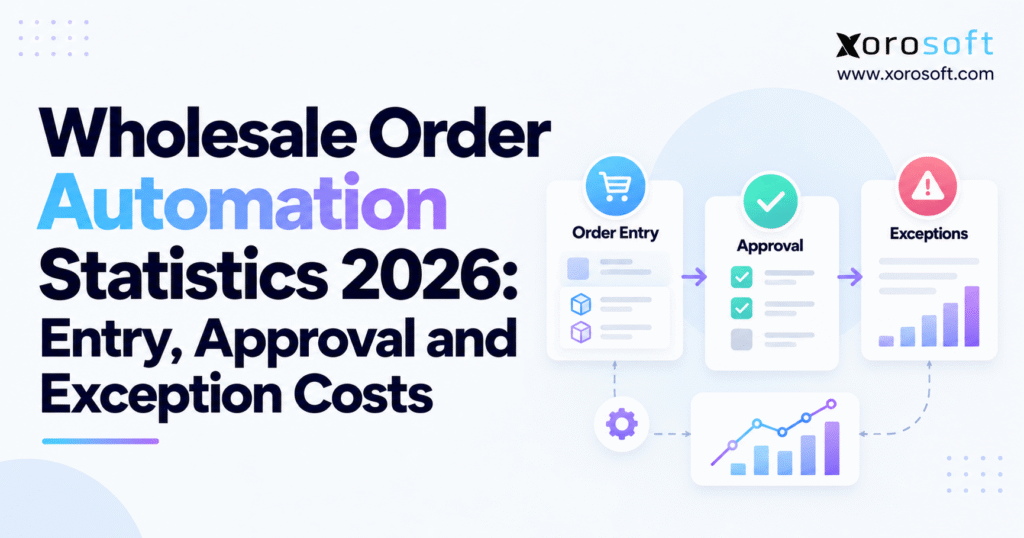
If you’re looking to understand the impact and trends in wholesale order automation statistics, you’re in the right place.
1. Why Wholesale Order Processing Costs Rise as Distributors Grow
1.1 How Wholesale Sales Order Workflows Span Several Departments
At a small distributor, one experienced employee may recognize customer part numbers, remember discount arrangements, and call the warehouse before promising delivery. However, that informal knowledge becomes difficult to maintain when the business adds hundreds of accounts, several sales channels, and multiple warehouses. Sales, customer service, credit, purchasing, and fulfillment each need a consistent version of the order.
An incoming customer purchase order must first become an internal sales order. For example, the customer may describe a product by its own item number, request cases rather than individual units, or include a price from an older agreement. Even after entry, the order may need credit validation, allocation, and confirmation. The work belongs to different functions, but the customer experiences it as one transaction.
1.2 Why Digital Wholesale Order Entry Is Not Always Automated
A PDF attached to an email is digital, but somebody may still read it and type every line into an ERP. Even an EDI transaction can stop when a customer SKU has no mapping or a contract price conflicts with the order. Consequently, businesses reporting many digitally received orders can still face significant labor costs.
Wholesale order automation means using software and business rules to capture, check, approve, allocate, and route sales orders with fewer unnecessary manual touches. Ultimately, the goal is controlled straight-through processing for eligible transactions, with clearly owned exceptions rather than silent workarounds.
1.3 Which Distributors Benefit Most From B2B Order Automation?
The strongest opportunities arise where transaction volume combines with operational complexity. Customer-specific price lists, multiple units of measure, negotiated payment terms, seasonal allocations, and stock spread across several facilities create conditions for repeated review. Therefore, a distributor handling a modest number of complex orders may have a stronger case than a larger business processing simple repeat purchases.
Accordingly, start with an activity map. Follow a representative sample of orders from the first customer message to accepted sales order, warehouse release, and invoice. Record actual handling time separately from time spent waiting. That distinction makes the later cost analysis credible.
2. Wholesale Order Automation Statistics 2026: The Benchmarks That Matter
2.1 Digital Wholesale Order Automation Trends and Channel Adoption
McKinsey’s distribution study, published in June 2026, surveyed 599 customers, 300 distributors, and 299 suppliers during the first half of 2025. Its finding that 57% of customers rank digital as their primary purchasing channel describes buyer preference, not the share of orders that run completely without manual work. That difference matters when interpreting wholesale order automation statistics.
Meanwhile, more wholesale-specific evidence comes from the WizCommerce 2026 B2B E-Commerce Benchmark Report, released in October 2026. Its analysis covers anonymized platform data from more than 250 wholesalers between January 2025 and July 2026, plus a survey of more than 100 brands. Among digitally captured orders, website orders accounted for 34% at businesses below $5 million in revenue, 40.7% at those between $5 million and $15 million, and 63.5% at those above $15 million.
Importantly, those percentages compare website orders with sales-representative-entered orders in the measured digital channels. They are not ecommerce’s share of total revenue or all orders. In addition, the sample has substantial representation from home, gift, furniture, lighting, and related wholesale categories, so industrial distributors should treat the findings as directional.
2.2 Wholesale Order Processing Benchmarks: What APQC Measures
Several useful cost and process measures are available from APQC. However, they use cross-industry samples rather than surveys limited to wholesalers, and their public benchmark pages do not establish that all observations were collected during 2026.
| APQC measure | Published median | Sample of companies |
|---|---|---|
| Cost per sales order received through digital or electronic channels | $4.00 | 763 |
| Share of orders received through digital or electronic channels | 60% | 7,435 |
| Sales-order line items requiring no manual intervention | 85% | 658 |
| Annual sales orders processed correctly the first time | 90% | 578 |
| Manual sales-order interventions attributable to pricing issues | 20% | 730 |
The APQC digital sales-order cost measure covers the broader manage-sales-orders process, not simply the employee time required to type an order. The digital-channel share measure describes receipt method, while the no-manual-intervention measure applies to line items. The first-time error-free metric applies to whole orders. Finally, pricing-related interventions are a share of manual interventions, not a share of all orders.
2.3 What Wholesale Order Automation Statistics Cannot Establish
For example, it would be misleading to multiply APQC’s 85% touchless line-item median by a wholesale order count and call the result a wholesale automation rate. An order with twenty lines can have nineteen untouched lines and one disputed price. Nevertheless, the order may still require someone to release it.
Nor does a $4 digital-channel median prove that every email or EDI order costs $4. Companies differ in how expenses are allocated, how many orders they process, and what supporting activities are included. Instead, use published statistics to identify questions for management, then use local measurements to answer them.
3. Manual Wholesale Order Entry Costs: Capture, Validation and Rework
3.1 Where Manual Wholesale Order Entry Minutes Accumulate
The most expensive manual work often begins before data reaches the system. An employee opens an attachment, identifies the customer account, searches for product references, verifies requested quantities, and resolves shipping instructions. Next, the employee checks whether an existing order has already been entered. If the customer changes the order, the process may start again.
Similarly, phone orders add transcription risk. Spreadsheet orders introduce inconsistent column structures. PDF documents can be difficult to extract when customers use different layouts. However, none of those problems is solved by adding more order-entry personnel; higher volume can increase coordination overhead and make errors harder to find.
3.2 How to Calculate Wholesale Order Entry Labor Costs
A practical calculation is: monthly entry cost = monthly orders × average active entry minutes ÷ 60 × fully loaded hourly labor rate. Importantly, use measured time, including necessary customer and product checks, but exclude waiting periods and separately costed exception investigations.
For example, suppose a distributor processes 2,400 orders per month. At nine active entry minutes per order and $28 per fully loaded employee hour, the modeled labor cost is $10,080 monthly. Reducing average entry work to three minutes would lower the modeled amount to $3,360, releasing $6,720 worth of monthly labor capacity.
However, that $6,720 should not automatically be called cash savings. If the same employees remain on payroll, the benefit might appear as additional capacity, reduced overtime, faster responses, or avoided future hiring. Therefore, finance should decide how much of that capacity is realistically monetizable.
3.3 Why Accurate Order Data Matters More Than Faster Transcription
However, automating bad product references only moves the error downstream. A customer might order “ABC-12” while the distributor stores “ABC12-BLK”; the units may represent cartons rather than pieces. Consequently, an automated system needs maintained customer-to-internal SKU mappings, unit conversions, contract price validity dates, and duplicate-order detection.
For order-entry projects, start with the highest-frequency product and customer combinations. They offer the largest predictable volume and create a manageable pilot. Use exceptions to identify missing reference data rather than allowing employees to keep correcting the same records indefinitely.
4. Wholesale Order Approval Costs: Credit, Discounts and Release Time
4.1 Why Wholesale Order Approvals Create Hidden Labor Costs
A credit hold can require customer service to contact finance, finance to check balances, and sales to discuss payment timing. Although review may take only six minutes, the order can sit in a queue for half a day. As a result, that delay may require new customer communication, warehouse rescheduling, or a revised delivery commitment.
Moreover, pricing approvals introduce comparable delays. A salesperson requests an exception to the agreed margin, a manager verifies the customer relationship, and the order awaits authorization. Therefore, a responsible process should protect legitimate controls without forcing low-risk repeat orders through unnecessary review.
4.2 Measuring Wholesale Order Approval Costs and Waiting Time
Calculate approval labor as orders × percentage requiring approval × average active review minutes ÷ 60 × reviewer hourly rate. At 2,400 orders, a 25% approval rate, six active review minutes, and a $38 fully loaded rate, the illustrative monthly review expense is $2,280.
Separately, measure elapsed approval cycle time as a KPI, from the moment an order enters the approval queue to final release or rejection. However, a four-hour queue delay is not four hours of labor. Nevertheless, its commercial consequences can be real if it causes missed carrier cutoffs or delays an important customer order. Those consequences require separate evidence before assigning a dollar value.
4.3 How B2B Sales Order Approval Automation Should Make Decisions
A sensible approval engine checks customer exposure, overdue amounts, agreed payment terms, authorized discount limits, order margins, and inventory constraints. As a result, transactions meeting policy can proceed. By contrast, exceptions should go to the correct owner with a reason code and audit trail.
| Approval condition | Appropriate response |
|---|---|
| Customer within credit policy | Continue processing |
| Credit exposure above limit | Route to finance |
| Discount within authorized range | Apply approved pricing |
| Margin below threshold | Request commercial approval |
| Inventory unavailable at promised location | Review allocation or backorder |
Ultimately, the objective is not to make every approval automatic. It is to remove repeated human decisions where the organization’s own rules already provide a clear answer. That is a more defensible interpretation of wholesale order automation statistics than counting approvals avoided without assessing the financial risk introduced.
5. Wholesale Order Exception Costs: Pricing Errors, SKU Issues and Rework
5.1 Pricing and SKU Discrepancies in Wholesale Order Processing
An exception is a transaction that cannot continue normally because information conflicts with a rule or record. Common examples include unknown product codes, price mismatches, unsuitable delivery dates, missing account information, inventory shortages, and duplicate purchase orders.
In particular, pricing deserves attention. APQC’s 20% benchmark describes the median proportion of manual sales-order interventions attributable to pricing issues. It does not mean that 20% of every distributor’s orders contain pricing errors. A distributor with poorly maintained customer contracts may have a very different experience from one using controlled price lists.
Likewise, unit-of-measure errors are costly. If a customer requests twelve cases and the order is entered as twelve units, the discrepancy can generate repeated calls, allocation changes, amended documents, and possible shipping mistakes. Therefore, finding the error before warehouse release is preferable to correcting it after dispatch.
5.2 How to Calculate Wholesale Order Exception Cost per Order
Use monthly exception labor = orders × exception rate × average resolution minutes ÷ 60 × resolution labor rate. With 2,400 orders, an 18% rate, twelve resolution minutes, and a $32 hourly rate, monthly exception labor equals $2,764.80. Spread across the full order population, that is approximately $1.15 per order.
If a single order has two exceptions, define whether the company measures affected orders or individual exception events. In either case, the numerator must be consistent. When several people work on an issue, capture their combined active time. Finally, do not double count labor already included in entry or approval categories.
5.3 Using Wholesale Order Automation Statistics to Prevent Repeat Exceptions
Wholesalers often build impressive escalation routines around problems that should not recur. For example, a pricing exception resolved dozens of times may point to a missing customer contract. A repeated unknown SKU may reveal an unmapped buyer part number. Meanwhile, frequent out-of-stock exceptions may indicate inaccurate available-to-promise logic or weak replenishment planning.
Consequently, exception dashboards should show reason, age, owner, affected order value, and recurrence. A useful weekly review asks which problem generated the most work and which permanent data or process change would prevent it. The most valuable wholesale order automation statistics often emerge from these internal root-cause trends rather than external averages.
6. Wholesale Order Processing Costs: Building a Defensible Model
6.1 Separate Wholesale Order Entry, Approval and Exception Expenses
To evaluate automation, define a process boundary. For example, start at order receipt and end at release to fulfillment. Include entry validation, approval handling, and exception resolution within that boundary. If customer inquiries and returns are measured separately, do not add them inconsistently to one scenario and omit them from another.
Next, the combined cost formula is total processing cost = entry labor + approval labor + exception labor + attributable systems and support costs. Then divide by accepted orders to obtain cost per order. Include rejections or cancellations in a separate metric if they consume significant effort, because excluding them entirely can distort performance.
6.2 An Illustrative Wholesale Order Processing Cost Model
For the same 2,400-order distributor, suppose controlled workflow changes reduce entry time, approval frequency, and exception effort. Crucially, these are planning assumptions, not verified industry saving percentages.
| Monthly cost component | Manual baseline | Automated scenario |
|---|---|---|
| Order entry labor | $10,080.00 | $3,360.00 |
| Approval labor | $2,280.00 | $608.00 |
| Exception resolution labor | $2,764.80 | $921.60 |
| Added software and support | $0.00 | $2,000.00 |
| Total | $15,124.80 | $6,889.60 |
| Cost per order | $6.30 | $2.87 |
The automated assumptions are three entry minutes per order; 10% requiring four-minute approval reviews at $38 an hour; and 9% needing eight-minute exception handling at $32 an hour. Entry labor remains $28 an hour. Importantly, the $2,000 technology figure is hypothetical and excludes one-time implementation.
6.3 What an Order Automation Cost Model Can and Cannot Prove
The modeled operating cost difference is $8,235.20 a month after new recurring technology expense. However, that is an opportunity estimate, not a guaranteed reduction in actual spending. It ignores seasonal ramp-up, incomplete customer adoption, and the possibility that some manual work changes rather than disappears.
Before approving investment, finance should test a conservative case with lower automation rates. Wholesale order automation statistics are useful for setting hypotheses; a real pilot validates whether the assumed processing times and exception reductions are achievable within the company’s own operations.
7. B2B Order Automation Compared: EDI, Portals, AI and ERP
7.1 EDI Order Automation Reduces Rekeying but Not Rule Conflicts
Electronic Data Interchange supports structured transactions between trading partners. In common X12 workflows, an 850 conveys a purchase order, an 855 acknowledges it, an 856 provides an advance ship notice, and an 810 carries invoice information. These documents are useful for retailer and distributor relationships that require formal electronic exchange.
EDI improves consistency of transmission, yet mappings, price agreements, customer part references, and order tolerances still need maintenance. For example, a technically valid EDI message can represent a commercially unacceptable order. Therefore, the evaluation asks how many transactions pass downstream checks, not just how many messages are received successfully.
7.2 B2B Ordering Portals Reduce Manual Entry Workload
A B2B portal can let a customer view an agreed catalog, check availability, repeat previous orders, and submit a purchase order without emailing a representative. It is especially effective when a meaningful share of orders consists of predictable replenishment purchases.
However, the challenge is adoption. Some accounts may prefer negotiated, complex transactions handled by a salesperson. Therefore, portal ordering should coexist with managed-account selling rather than forcing every customer into one channel. Its economics should be evaluated using cost-to-serve, basket size, repeat-order rate, and the amount of manual follow-up still required.
7.3 AI-Assisted Wholesale Order Capture Needs Approval Controls
AI and intelligent document processing can interpret different PDF formats, recognize product lines, and reduce repetitive extraction work. However, automatic capture should not mean automatic acceptance. Low-confidence quantities, ambiguous customer names, unexpected discounts, and invalid units must be checked against trusted records.
Likewise, document-processing accuracy is only one layer of process quality. Teams should measure field extraction confidence, human corrections, order-level validation success, and exceptions after posting. Together, these controls prevent a faster interface from accelerating mistakes.
7.4 How ERP Connects Wholesale Order Automation With Operations
A distributor with multiple order channels needs consistent rules at the point where orders touch stock, purchasing, receivables, and fulfillment. Xorosoft’s integration ecosystem illustrates this connected architecture across ecommerce, EDI, warehouses, shipping, and finance. Ultimately, buyers need to know whether the necessary integration paths, validation rules, and exception workflows match their actual environment.
In the 2025 Master B2B research, 67% of surveyed practitioners cited system compatibility and 63% cited data consistency as technology-integration challenges. Although an integrated platform can reduce certain handoffs, it cannot eliminate the need for correct master data or disciplined implementation.
8. Wholesale Order Automation Statistics: KPIs Finance and Operations Should Share
8.1 Measure Touchless Wholesale Orders Separately From Accuracy
Straight-through processing describes an eligible order or line that advances through a defined workflow without manual intervention. First-pass accuracy describes an order processed correctly without subsequent adjustments. Although the metrics overlap, they are not interchangeable.
For example, a line can be entered automatically and later fail a pricing check. An order can also be accurate because an employee manually verified it. Accordingly, teams should identify whether they are measuring order headers, line items, or all activities from receipt to warehouse release.
8.2 Measure Wholesale Order Processing Cost, Speed and Accuracy
For actionable wholesale order automation statistics, track cost per order, manual touch rate, first-pass accuracy, approval cycle time, exception incidence, exception queue aging, and time from acceptance to warehouse release. Together, these measures tell a fuller story. However, lower processing costs are not helpful if they arrive with more shipment errors or unauthorized discounting.
| KPI | Definition | Typical review |
|---|---|---|
| Cost per accepted order | Attributable process expenses / accepted orders | Monthly |
| Manual touch rate | Eligible orders requiring review / eligible orders | Weekly |
| First-pass accuracy | Correct first-time orders / orders processed | Weekly |
| Approval cycle time | Elapsed approval submission-to-decision time | Weekly |
| Exception rate | Orders with at least one defined exception / orders | Weekly |
| Aged exceptions | Open cases beyond agreed service threshold | Daily |
8.3 Turn Wholesale Order Automation Statistics Into Process Ownership
Give each metric an owner with authority to improve it. For example, sales operations may own incoming order accuracy; finance may own credit-hold aging; inventory control may own available-to-promise discrepancies. Use common order identifiers across systems so that one incident does not appear as several unrelated problems.
Consequently, a monthly report is more valuable when it describes what changed and why. If touchless processing improves while first-pass accuracy deteriorates, the automation may be moving too quickly through a weak validation process. Therefore, operators need to examine interactions between KPIs rather than celebrate one number in isolation.
9. Wholesale Order Automation Across Multi-Warehouse and Ecommerce Operations
9.1 Automated Inventory Allocation Supports the Customer Promise
A customer can place an order against stock that appears available but has already been committed to another channel. Moreover, the situation worsens when stock is distributed across facilities and synchronizes at different intervals. Order acceptance must distinguish on-hand inventory from available-to-promise inventory, including reservations, safety stock, inbound supply, and applicable fulfillment constraints.
In a multi-warehouse business, the choice of fulfillment location affects delivery cost, timing, and sometimes tax or cross-border requirements. Nevertheless, an automated order may still create manual work if the warehouse receives an unrealistic commitment. Good allocation logic makes the fulfillment promise more dependable before the order enters a pick queue.
9.2 Connect Automated Sales Orders to Warehouse Execution
The operational value of warehouse management software becomes relevant after an accepted sales order is released. Picking, packing, serial or lot tracking, shipment confirmation, and inventory deductions need to reflect the original customer commitment. Xorosoft supports these connected ERP and WMS processes, although the precise configuration should be evaluated for each business.
When fulfillment data is disconnected, customer service may have to investigate shipment status manually. Consequently, linking release, shipment, and invoice events reduces opportunities for conflicting records and improves visibility for both operations and accounting teams.
9.3 Shopify and Wholesale Orders Need Consistent Allocation Rules
Brands selling through Shopify, Amazon, wholesale accounts, and retail trading partners often face competing demands for the same physical stock. A direct-to-consumer order may enter one system while an EDI bulk order enters another. Unless reservations and available quantities are synchronized appropriately, the business risks overselling or promising inventory twice.
The Xorosoft ERP listing on the Shopify App Store provides a public reference for its Shopify connection. Furthermore, the evaluation should examine synchronization timing, order status mapping, multi-location availability, returns, and financial reconciliation. Wholesale order automation statistics become far more meaningful when order accuracy is assessed across channels rather than within a single storefront.
10. Wholesale Order Exceptions by Industry: Where Automation Pays Off
10.1 Apparel and Sporting Goods: Complex SKU Order Processing
Fashion and sporting goods distributors manage dense SKU assortments involving style, color, size, season, and packaging variations. A customer’s request for one jacket style may represent dozens of internal stock-keeping units. The cost of a wrong variant can include correction work, return freight, inventory imbalances, and a damaged retail relationship.
Automation should validate the complete variant, size curve, allocation period, and customer price tier. In seasonal businesses, an order that cannot ship during a narrow retail window may be more consequential than one that can be fulfilled later. The industries supported by Xorosoft include several of these inventory-intensive categories, but implementation rules should be designed around the specific assortment and channel requirements.
10.2 Furniture Wholesale Orders and Delivery Scheduling
Furniture orders often introduce coordination between order acceptance, bulky inventory, delivery appointments, and assembly or specialized handling. For example, an available product may not be immediately deliverable if it sits at a distant facility or requires a dedicated transport arrangement.
For this sector, relevant measures include order changes after scheduling, split shipments, inventory reservation accuracy, and order-to-delivery confirmation time. Automation should make delivery constraints visible before the customer receives a firm promise. After all, entering an order faster will not solve a poor scheduling process.
10.3 Food and Beverage Order Automation With Lot Controls
Food distributors face additional controls related to lot numbers, expiration dates, product storage requirements, and case-to-unit conversion. However, the order may be valid commercially but unsuitable for fulfillment from a particular batch. Warehouse and ERP rules therefore need to preserve traceability and applicable rotation policies.
A useful exception workflow distinguishes missing data from genuine product unavailability. In addition, teams should record when manual overrides occur, who authorized them, and whether those decisions are consistent with product-handling requirements. The objective is faster compliant execution, not faster bypassing of controls.
10.4 Automotive and Industrial Wholesale Order Matching
Industrial buyers may reference original-equipment numbers, customer-specific codes, superseded products, or replacement components. Order processing must resolve those references accurately and account for fitment or specification requirements where relevant. A wrong substitute can create a costly reverse-logistics process.
Across these industries, the most useful wholesale order automation statistics are often customer-level and category-level exception rates. Otherwise, aggregate averages can conceal one account or product family that generates a disproportionate share of avoidable work.
11. Wholesale Order Automation ROI: Calculate Savings Without Inflating Returns
11.1 Convert Wholesale Order Processing Improvements Into Savings
Return on investment should begin with validated baseline costs, not a vendor’s headline savings percentage. Then calculate expected labor capacity released, identify which portion becomes reduced overtime or avoided hiring, and include continuing support, integration maintenance, software subscriptions, and training.
In the 2,400-order scenario, the manual model totals $15,124.80 per month and the automated model totals $6,889.60. Consequently, the difference is $8,235.20 monthly after $2,000 of assumed recurring technology expense, equivalent to $98,822.40 annually if operating conditions remain constant.
11.2 Include ERP Implementation Cost and Automation Ramp-Up
Assume an additional $24,000 one-time implementation expense. In a full steady-state year, the modeled gross labor benefit is $122,822.40, while the annual recurring technology cost is $24,000. Adding the one-time implementation creates a first-year investment of $48,000. On that simplified basis, first-year ROI is ($122,822.40 − $48,000) ÷ $48,000 = approximately 155.9%.
However, this figure is a scenario, not evidence of typical ERP performance. It assumes immediate full adoption and realization of all modeled labor benefits. Instead, a conservative case should allow for phased onboarding, additional exception tuning, employee training, and partial recovery of labor capacity. Simple implementation payback under steady-state conditions is approximately 2.9 months; actual payback could be substantially longer.
11.3 Test Wholesale Order Automation Statistics Against Downside Scenarios
Order volume strongly influences wholesale order automation economics. Under the same per-order assumptions and fixed $2,000 monthly system expense, net modeled benefit equals approximately $3,117.60 at 1,200 orders, $8,235.20 at 2,400 orders, and $13,352.80 at 3,600 orders. Importantly, these are mathematical outcomes of the model, not independent benchmarks.
Finance should test what happens if only half the projected time reduction materializes, exception rates remain stubbornly high, or software expenses exceed plan. Ultimately, a credible investment decision withstands realistic downside cases rather than relying on the highest possible automation percentage.
12. Choosing Wholesale Order Automation Software for Growth
12.1 When a Standalone B2B Order Automation Tool Is Enough
A wholesaler with a few hundred simple monthly orders, stable customer pricing, and one warehouse may get good results from a better ordering portal, clean SKU data, or a specific EDI integration. However, adding a complex ERP solely to eliminate occasional rekeying may introduce more costs than it saves.
The decision should consider how many departments need the same order data and how often records diverge. When manual reconciliation is rare and current controls work, targeted improvements can be more sensible than a platform replacement.
12.2 When Integrated Wholesale ERP Automation Makes Sense
By contrast, the case strengthens when orders depend on disconnected inventory, purchasing, accounting, and warehouse applications. An operator may have accurate data in each system yet lack an accurate overall view because synchronization is delayed or manual.
XoroONE brings inventory, accounting, purchasing, warehousing, ecommerce, and other operations together within a cloud ERP environment. For organizations requiring broader configuration or evaluating ERP architecture, XoroERP provides another relevant product perspective. Nevertheless, Xorosoft should be evaluated against actual process requirements, integration scope, and implementation resources rather than selected from a feature checklist alone.
12.3 Compare ERP Workflows, Integration Fit and Total Costs
NetSuite, Acumatica, Microsoft Dynamics 365 Business Central, Cin7, and other platforms serve different operating models. Evaluation criteria should include customer-specific pricing, credit rules, EDI partners, warehouse execution, accounting controls, data migration, and total ownership cost. A Xorosoft versus NetSuite comparison can be one input, but buyers should validate both vendors against a common list of test transactions.
Ultimately, the strongest proof is a demonstration using real edge cases: a disputed price, partial stock at two locations, an overdue account, and a duplicate EDI submission. Published customer case studies can provide examples of implementation context, but results should not be generalized without matching business conditions.
13. Put Wholesale Order Automation Statistics to Work in 90 Days
13.1 Measure Wholesale Order Processing Workload First
A practical first month focuses on measurement. Sample several hundred orders across email, EDI, portals, and sales-representative channels. Then track active entry minutes, manual approval effort, exception reasons, and delays between acceptance and release. Segment the results by account, product group, and warehouse so the largest problems are visible.
During the second month, fix master-data issues and pilot automation on predictable repeat orders. Next, define clear escalation rules and record every override. In the third month, compare the pilot with its baseline using cost per order, first-pass accuracy, touchless processing, and customer-service workload. Decide whether to expand, change the approach, or address persistent exceptions before scaling.
13.2 Turn Wholesale Order Automation Results Into a Systems Decision
Ultimately, wholesale order automation statistics should guide decisions, not become targets detached from customer outcomes. In practice, the right investment makes order commitments more reliable while reducing avoidable handling across sales, finance, inventory, and fulfillment. A business that understands its own cost per order can choose between targeted tools and connected ERP with much greater confidence.
For distributors evaluating Xorosoft, the next step is to document transaction volume, customer pricing complexity, approval requirements, EDI relationships, and warehouse locations, then request a personalized ERP discovery discussion. In turn, that conversation should test the workflow and expected economics, rather than assume that software alone will eliminate every exception.
Frequently Asked Questions
What do wholesale order automation statistics show in 2026?
APQC reports a $4 median digital sales-order cost and 85% of line items needing no manual intervention. These are cross-industry benchmarks, not 2026-only wholesale averages.
How much does manual wholesale order entry cost?
Multiply monthly orders by average entry minutes and hourly labor cost, then divide by 60. Include validation, but avoid double-counting rework.
What increases wholesale order approval costs?
Credit holds, unusual discounts, margin reviews, and inventory restrictions require manual decisions. Measure active review time separately from approval delays.
How are wholesale order exception costs calculated?
Multiply order volume by exception rate, resolution minutes, and hourly labor rate, then divide by 60. Track repeat issues separately.
Does EDI eliminate manual wholesale order processing?
No. EDI reduces rekeying, but pricing mismatches, unmapped SKUs, credit holds, and inventory shortages can still require review.
How do you calculate wholesale order automation ROI?
Compare realized labor and rework savings against implementation, integrations, subscriptions, and support. Treat freed employee hours as capacity unless costs actually decline.
When should a wholesaler upgrade to ERP automation?
Consider ERP when disconnected order, inventory, accounting, or warehouse systems repeatedly create errors and reconciliation work. Validate the decision with actual costs.
Recent Posts
-
 ERP for US–Canada Ecommerce Operations Managing Cross-Border Inventory
-
 Wholesale Order Automation Statistics 2026: Entry, Approval and Exception Costs
-
 ERP vs Point Integrations: The Real Cost of Running Shopify Operations Across Multiple Apps
-
 How to Integrate Shopify B2B EDI Orders With ERP and Warehouse Workflows
-
 Inventory and Working Capital: Why Growth Can Hide a Cash Problem