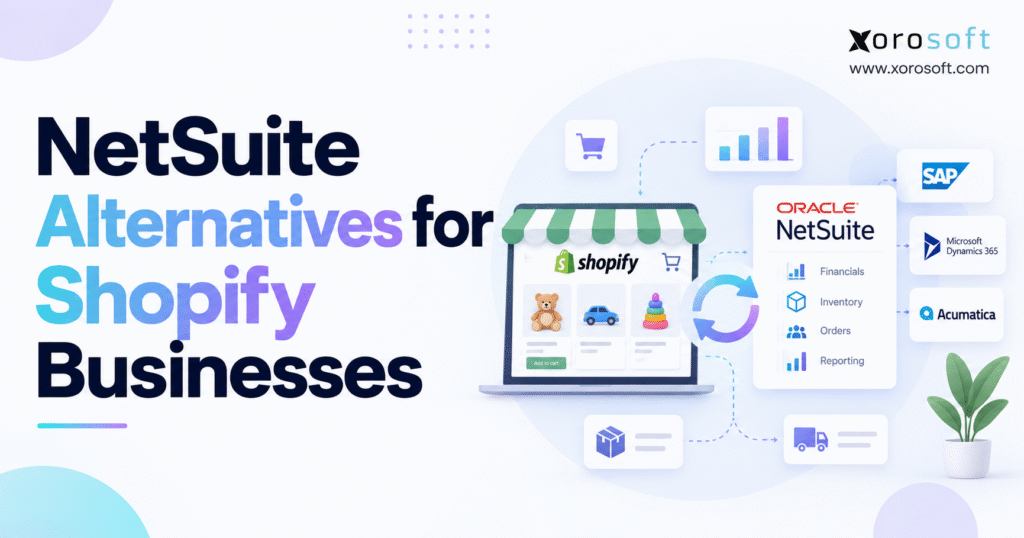
If you’re searching for NetSuite alternatives for Shopify, this guide will help you explore the best options available.
1. Shopify Growth Creates a Back-Office Problem Before It Creates an ERP Problem
A Shopify business can grow for years without thinking seriously about ERP. Orders enter through the storefront, accounting runs in another application, inventory may live in a dedicated tool, and purchasing often depends on spreadsheets. That structure can work when order volume, SKU counts, warehouses, and fulfillment requirements remain manageable.
Growth gradually changes the operating model.
More products create more inventory movement. Additional warehouses introduce allocation and transfer decisions. Wholesale brings customer-specific pricing, terms, credit rules, case quantities, and potentially EDI. Amazon creates another stream of orders competing for the same inventory. Purchasing also becomes harder because buyers must understand what is available, allocated, incoming, backordered, and expected to sell.
This is often when businesses begin researching NetSuite alternatives for Shopify.
The important question is not simply which software connects to Shopify. Many systems can import an ecommerce order or send an inventory quantity back to the storefront. The harder problem is determining which platform should coordinate everything that happens after checkout.
Inventory needs to be reserved. Warehouses must know what to pick. Buyers need to understand future replenishment. Finance requires reliable transaction data. Returns affect both stock and accounting. Management expects timely reporting without waiting for several teams to reconcile spreadsheets.
At small scale, employees can often bridge those gaps manually. As complexity increases, those manual connections become harder to maintain.
1.1 Shopify ERP Software Becomes Relevant When Systems Stop Agreeing
Operational fragmentation rarely appears as one major failure.
Instead, teams begin noticing small inconsistencies.
Customer service sees one inventory number while the warehouse trusts another. Purchasing creates replenishment plans from a spreadsheet that does not include every recent transfer. Finance reconciles sales and inventory data at month-end because systems posted transactions differently. Management receives reports assembled from exports taken at different times.
Each application may still work correctly on its own.
The problem is that the overall business no longer has one dependable operational picture.
ERP becomes relevant when the company needs shared information across inventory, purchasing, fulfillment, accounting, and reporting rather than another isolated application.
1.2 More Shopify Apps Do Not Always Reduce Complexity
The Shopify ecosystem makes it easy to add specialized applications. That flexibility is extremely useful during early growth because companies can solve individual problems without implementing a large platform.
Eventually, however, every new application creates another place where information may be created, changed, delayed, or duplicated.
Forecasting depends on reliable inventory and sales history. Purchasing requires accurate supplier, demand, and stock information. Warehouse software needs current orders and item data. Accounting depends on sales, purchases, inventory, returns, and costs reaching finance correctly.
When every system owns part of the operating process, integration work begins consuming more time.
The purpose of ERP is not to eliminate every specialized application. A stronger architecture instead gives each system a clear responsibility and establishes one dependable source for critical operational information.
2. What ERP for Shopify Businesses Should Actually Control
ERP selection becomes easier when the discussion starts with business processes rather than software brands.
Inventory-driven merchants usually need to connect sales orders, inventory, purchasing, receiving, warehouse activity, fulfillment, finance, returns, and reporting. Companies running wholesale, EDI, Amazon, manufacturing, or multiple warehouses may require an even broader operating model.
Platforms such as XoroONE represent this integrated ERP approach by bringing inventory, purchasing, warehouse management, accounting, manufacturing, forecasting, and ecommerce-related operations into a connected environment.
Not every Shopify merchant needs every module.
The goal is to determine which processes genuinely need to share the same information.
2.1 Shopify Inventory ERP Requires More Than a Sellable Quantity
One of the most important ERP questions is deceptively simple:
What does “available inventory” actually mean?
A warehouse may physically contain 10,000 units while only 7,500 are truly available for sale. Some stock may already be allocated to open orders. Another quantity could be reserved for wholesale customers. Additional units may be damaged, quarantined, in transit, awaiting inspection, or intentionally held as safety stock.
The quantity published to Shopify should reflect operational availability rather than raw physical stock.
This difference matters even more once several channels use the same products. Shopify, Amazon, wholesale accounts, retail partners, and sales representatives may all compete for limited inventory.
A central ERP or inventory platform needs to determine which units can actually be promised.
2.2 Purchasing and Replenishment Need the Same Inventory Picture
Purchasing becomes more complicated as the company adds SKUs, suppliers, warehouses, and longer lead times.
Buyers need current inventory, allocated quantities, open purchase orders, expected receipts, demand patterns, minimum order quantities, supplier performance, and future sales expectations.
When those inputs live in separate systems, spreadsheets often become the bridge between them.
The spreadsheet itself is not necessarily the problem. Its weakness is timing. Information can become outdated as soon as new orders arrive, a warehouse receives inventory, products transfer between facilities, or supplier dates change.
A connected ERP environment lets purchasing decisions use the same operational information that drives sales and fulfillment.
2.3 Shopify ERP Alternatives Should Connect Operations With Accounting
Inventory movement has financial consequences.
Receiving goods increases inventory assets and may create supplier liabilities. Shipping products reduces stock and recognizes cost of goods sold. Returns can affect revenue, tax, inventory, and customer balances. Freight, duty, and other landed costs influence the true economic cost of products.
When operational events sit across several disconnected systems, finance often becomes responsible for reconstructing the full transaction.
Businesses evaluating Shopify ERP alternatives should therefore determine whether they need stronger inventory software connected to accounting or a full ERP where financial and operational data share one platform.
Those are different requirements and should not be treated as interchangeable.
2.4 Warehouse Management Should Be Tested as a Workflow
Warehouse management deserves more attention than a single feature checkbox.
A serious warehouse operation may need receiving, directed putaway, location control, barcode scanning, replenishment, picking, packing, transfers, cycle counting, shipping, and returns.
Inventory visibility alone does not guarantee efficient execution.
Warehouse staff should be involved in ERP evaluation because their daily workflows reveal requirements that rarely appear in executive-level demos.
How does receiving handle shortages? What happens when a picker cannot find stock? Can users scan instead of typing? How are substitutions handled? What happens when a transfer arrives short?
Those details determine whether the system improves warehouse work or merely records it.
3. When NetSuite Alternatives for Shopify Become Worth Evaluating
NetSuite is a broad ERP platform capable of supporting complex financial and operational environments. A company should not eliminate it simply because another product has a lower entry price or a cleaner interface.
The better question is whether NetSuite’s operating model matches the business.
3.1 NetSuite Can Still Fit Complex Shopify Businesses
Organizations with sophisticated financial structures, multiple legal entities, international operations, extensive customization requirements, established ERP teams, or existing NetSuite expertise may find the platform appropriate.
Existing investment also matters.
A company already running successfully on NetSuite should have a measurable operational, financial, or technology reason before beginning a replacement project. ERP migration consumes resources, changes workflows, and introduces implementation risk.
Replacing software simply because another option looks newer rarely creates a strong business case.
3.2 Why Companies Research NetSuite Alternatives for Shopify
Businesses frequently explore NetSuite alternatives for Shopify because their priorities differ from those of larger or more financially complex organizations.
Consider a fast-growing apparel business operating Shopify, Amazon, two warehouses, and wholesale accounts. Inventory availability, replenishment, fulfillment speed, and warehouse execution may dominate its ERP requirements.
Another company could place far greater importance on international consolidation and complex subsidiary structures.
Those businesses should not automatically build the same shortlist.
Implementation model, administration, total operating cost, warehouse depth, integration architecture, customization, reporting, and user experience all influence ERP fit.
Companies specifically comparing these two platforms can use a focused Xorosoft vs NetSuite comparison as one part of due diligence, while broader requirements should still drive the final decision.
3.3 Some Shopify Businesses Still Do Not Need ERP
Revenue alone should not trigger ERP implementation.
A merchant with one warehouse, manageable SKU complexity, straightforward purchasing, clean accounting, limited wholesale activity, and reliable inventory applications may continue operating effectively without full ERP.
Replacing a functioning architecture simply for the sake of consolidation can create unnecessary disruption.
The stronger ERP trigger is interconnected operational complexity.
When inventory problems begin affecting purchasing, fulfillment, finance, customer service, and reporting at the same time, the company is dealing with an architecture problem rather than a single software gap.
4. How to Compare NetSuite Alternatives for Shopify Without Relying on Checkboxes
ERP products often look remarkably similar on feature sheets.
Most established platforms mention inventory, purchasing, orders, reporting, and financial management. Those labels reveal very little about how effectively the workflows connect.
Meaningful differences become visible when companies test real scenarios.
4.1 Shopify ERP Integration Depth Matters More Than Connector Availability
“Do you integrate with Shopify?” is not enough.
A serious evaluation should ask which information synchronizes, which direction it moves, and how frequently updates occur. Teams also need to know which platform owns each record and how synchronization failures become visible.
Location mapping deserves attention as well. Partial shipments need defined handling rules, while refunds and returns should follow a clear data flow between Shopify and ERP.
For businesses operating a larger commerce ecosystem, reviewing available Xorosoft integrations can help determine whether required ecommerce, marketplace, shipping, EDI, payment, or operational connections fit the planned architecture.
Integration should support the business process rather than merely connect two APIs.
4.2 Define the System of Record Before Comparing Shopify ERP Alternatives
Every important data domain needs a clear owner.
ERP might own item records, inventory, costs, suppliers, and accounting information. Shopify may remain responsible for merchandising content and customer-facing product presentation.
Orders could originate in Shopify before becoming operational records inside ERP.
The exact design can vary.
What matters is that teams understand where information is created, where it can be changed, and which platform has final authority.
Without those rules, synchronization can create competing versions of the truth.
4.3 Test Exceptions Instead of Only Perfect Orders
ERP demonstrations often show a clean order moving smoothly from creation to shipment.
Real operations are rarely that predictable.
Ask vendors to process a partial fulfillment, cancel a line after allocation, receive a purchase order short, process a damaged return, and transfer inventory between locations. Changing an order after fulfillment has started is another useful test.
These scenarios reveal where manual intervention appears.
Exception handling frequently determines whether ERP actually reduces workload.
4.4 NetSuite Alternatives for Shopify Should Be Compared on Total Cost
Subscription fees represent only one part of ERP cost.
Implementation, data migration, integrations, configuration, customization, training, internal administration, external consulting, support, and future changes all affect the economics of the project.
Lower-cost point solutions deserve the same scrutiny.
Several inexpensive applications can become costly when the organization also pays for integrations and spends labor reconciling data between them.
For that reason, NetSuite alternatives for Shopify should be compared over several years of operating cost rather than by software price alone.
5. Multi-Warehouse Shopify ERP Requirements Change the Evaluation
One warehouse can hide weak inventory processes.
Several locations expose them quickly.
Once stock exists across warehouses, stores, 3PLs, or fulfillment partners, the company needs to know not only what it owns but where inventory sits, whether it is sellable, which orders have claimed it, and whether units are currently moving between locations.
5.1 Multi-Warehouse Inventory Needs Reliable Availability Rules
Suppose Warehouse A contains 700 units and Warehouse B contains 500.
That does not necessarily mean Shopify should display 1,200 units as available.
Open sales orders may already claim part of the stock. Wholesale allocations could reserve another portion. Some units may be damaged, undergoing inspection, or intentionally withheld as safety inventory.
ERP should calculate availability according to business rules rather than simply sending total on-hand inventory to Shopify.
As channel volume grows, this distinction becomes increasingly important.
5.2 Transfers Must Preserve Accurate Inventory Visibility
Transfers create a temporary inventory state that simple systems sometimes handle poorly.
Once 100 units leave Warehouse A, those units should generally stop appearing as available there. They should not become available in Warehouse B until receiving confirms their arrival.
An in-transit inventory state helps preserve this distinction.
Without it, the organization can temporarily overstate stock at the destination or lose visibility into where inventory actually sits.
Businesses with substantial warehouse complexity should evaluate XoroWMS or another dedicated warehouse capability against receiving, scanning, putaway, location control, transfers, picking, packing, and cycle-count workflows.
5.3 3PL Inventory Should Remain Part of the Inventory Model
Outsourced fulfillment does not remove the need for inventory control.
A 3PL still holds company stock. Orders allocate that inventory, returns change availability, and count discrepancies affect planning.
The ERP should therefore treat external fulfillment locations as part of the same operational picture.
If teams must log into a separate 3PL portal and manually reconcile stock with spreadsheets, inventory visibility remains fragmented.
6. Shopify ERP Software Should Connect Purchasing, Inventory, and Finance
Inventory sits at the center of several operational and financial processes.
Purchasing determines what enters stock. Warehouses control what physically happens to goods. Sales consume available units, while accounting assigns financial value to those movements.
Managing these functions independently creates reconciliation work.
6.1 Inventory Transactions Should Produce Predictable Financial Outcomes
Receiving purchase orders increases stock.
Shipping goods creates cost consequences. Adjustments may create gains or losses, while returns can reverse prior transactions. Freight, duty, and other landed costs also affect product cost.
Finance needs those events to reach accounting consistently.
For businesses that want accounting integrated with inventory, purchasing, sales, and operational data, XoroERP may be relevant to evaluate as part of the broader Shopify ERP architecture.
The objective should not simply be replacing accounting software.
The stronger business case appears when financial reporting and operational transactions depend on the same underlying records.
6.2 Forecasting Depends on Accurate Operational Inputs
Forecasting cannot compensate for unreliable data.
A useful demand model may need historical orders, current inventory, expected receipts, open purchase orders, supplier lead times, promotions, seasonality, safety stock, and product lifecycle information.
One inaccurate input can distort replenishment recommendations across hundreds of items.
Connecting forecasting to live operational data does not eliminate uncertainty, but it improves the consistency of planning.
6.3 Purchasing Automation Should Preserve Buyer Judgment
Automation can recommend quantities and identify potential shortages.
Experienced buyers still need context.
Suppliers can become unreliable. Promotions can create temporary demand. Certain products may be approaching discontinuation. Minimum-order requirements might also force the company to buy more than the forecast suggests.
Strong ERP design supports judgment instead of pretending every purchasing decision can be automated completely.
7. NetSuite Alternatives for Shopify Span Several Software Categories
One reason ERP research becomes confusing is that “NetSuite alternative” can describe several different types of software.
Some products are broad ERP suites. Others focus more heavily on retail operations, inventory, order management, manufacturing, or warehouse execution.
A useful shortlist starts by identifying the type of operating platform the business actually needs.
7.1 Xorosoft as a NetSuite Alternative for Shopify Operations
Xorosoft is a cloud ERP platform oriented toward inventory-driven businesses.
For Shopify merchants, it becomes particularly relevant when ecommerce needs to connect with inventory, purchasing, accounting, warehouse management, forecasting, Amazon, wholesale, EDI, manufacturing, or multi-warehouse operations.
Under this model, Shopify remains the commerce layer while ERP manages the operational processes behind it.
Merchants performing technical due diligence can also review the Xorosoft Shopify App Store listing.
The platform should still be tested against the same realistic scenarios as any other ERP. Buyers need to understand how actual products, warehouses, accounting rules, users, purchasing processes, and integrations would behave after implementation.
7.2 Acumatica as a Cloud ERP Alternative
Acumatica commonly appears in NetSuite evaluations because it addresses financial management, inventory, distribution, manufacturing, and ecommerce-related requirements.
Its suitability depends on the operating model.
Businesses should evaluate implementation partner requirements, configuration, warehouse processes, manufacturing depth, reporting, integration architecture, and the way ecommerce transactions move through the ERP.
The existence of a Shopify connector alone does not establish fit.
7.3 Business Central for Microsoft-Oriented Organizations
Microsoft Dynamics 365 Business Central can be relevant for companies already invested heavily in Microsoft’s ecosystem.
Finance, inventory, purchasing, sales, reporting, and business management can all become part of the evaluation.
Microsoft alignment should not be the only selection criterion, however.
Warehouse execution, extensions, integrations, multi-location inventory, financial controls, and user workflows still need to be demonstrated against actual requirements.
7.4 Brightpearl and Cin7 for Commerce-Led Operations
Brightpearl and Cin7 frequently appear in ecommerce and inventory technology discussions.
They can be relevant to organizations focused heavily on retail, multichannel inventory, order management, purchasing, and fulfillment.
The important consideration is functional scope.
A company replacing NetSuite needs to understand whether it truly requires broad ERP functionality or whether a commerce-focused inventory platform solves the main problem more efficiently.
If sophisticated accounting, entity management, manufacturing, or other deeper ERP requirements matter, those areas need separate validation.
8. Shopify ERP Alternatives Should Reflect the Business Model
Two organizations can use Shopify while operating completely different supply chains.
An apparel brand, furniture company, food distributor, sporting goods seller, and manufacturer may share the same commerce platform while requiring very different ERP workflows.
Reviewing different inventory-driven industries illustrates why ERP selection should follow operating requirements rather than software popularity.
8.1 DTC Shopify Businesses Need Inventory Accuracy and Fulfillment Speed
Direct-to-consumer brands often prioritize available inventory, order throughput, warehouse productivity, returns, purchasing, and forecasting.
Customer expectations make operational errors visible quickly.
An inventory discrepancy becomes an oversold order. Weak warehouse coordination creates late shipments. Poor replenishment can produce stockouts during an important campaign.
ERP supporting Shopify must therefore operate at the pace of ecommerce.
8.2 Wholesale Shopify ERP Requirements Extend Beyond DTC
Wholesale introduces different commercial and operational rules.
Customer-specific pricing, payment terms, credit limits, case quantities, inventory allocations, retailer compliance, and EDI may all become necessary.
Those orders still compete for the same inventory used by DTC channels.
Keeping wholesale and ecommerce in completely separate operational systems can therefore create avoidable allocation problems.
A connected ERP gives the company a way to manage both demand streams against one inventory picture.
8.3 Manufacturers Need More Than Finished-Goods Inventory
Manufacturing changes the ERP requirement because customer demand eventually translates into component demand.
A finished product may appear unavailable even though sufficient raw materials exist to produce it.
The reverse can happen as well. Strong finished-goods demand can hide an upcoming shortage of one critical component.
Manufacturing-oriented NetSuite alternatives for Shopify should therefore be evaluated for bills of material, work orders, raw materials, production planning, WIP, material requirements, finished goods, and production costing.
Commerce functionality by itself is not enough.
8.4 Shopify and Amazon Need One Inventory Strategy
Operating Shopify and Amazon creates simultaneous demand for the same products.
Without a central inventory model, each channel may appear accurate individually while combined commitments exceed real supply.
ERP needs clear rules for inventory sharing, reservations, locations, purchasing, forecasting, and reporting.
Additional marketplaces only increase the importance of that centralized operating model.
9. Shopify ERP Integration Should Follow the Physical Product Journey
Reliable system architecture usually mirrors what happens to inventory in the real world.
Products are purchased, received, stored, allocated, picked, shipped, returned, transferred, and sometimes manufactured.
Software transactions should follow those physical events closely.
9.1 A Shopify Order Needs One Controlled Operational Path
A typical process may look like Shopify → ERP → inventory allocation → warehouse → shipment → Shopify.
The storefront captures the customer’s order.
ERP converts that demand into an operational transaction, validates inventory, applies business rules, and directs fulfillment. Warehouse staff execute the shipment, while fulfillment and tracking information return to Shopify.
Accounting then receives the appropriate financial impact.
The exact technical design can vary.
What matters is that employees understand which system controls the order at every stage.
9.2 Inventory Accuracy Depends on Recording Events When They Happen
Physical activity and software transactions should happen as closely together as practical.
Receiving should update stock when warehouse staff confirm the receipt. Picking needs to affect the relevant inventory status. Shipment should remove stock from availability, while returned items may require inspection before becoming sellable again.
Delayed transactions weaken inventory visibility.
No ERP can create real-time accuracy if employees record physical activity hours or days after it occurs.
As companies explore AI-driven integration and operational automation, tools such as the Xorosoft AI MCP Server may also become relevant when teams want controlled AI access to business-system data and workflows.
9.3 Returns Should Be Part of NetSuite Alternatives for Shopify Evaluations
Returns are one of the best tests of integration quality.
A returned product might be restocked, repaired, quarantined, written off, or sent back to a supplier.
Meanwhile, the customer may receive a refund or credit.
Operational and financial consequences need to remain aligned.
Businesses comparing NetSuite alternatives for Shopify should therefore ask vendors to demonstrate the complete returns workflow rather than testing only new orders.
10. NetSuite Alternatives for Shopify Should Be Evaluated on Implementation Effort
Strong software can still produce a poor project when implementation requirements exceed the organization’s capacity.
ERP implementation involves data, integrations, people, process design, accounting rules, warehouse workflows, training, and governance.
Configuration is only one part of the work.
10.1 Data Migration Determines the Quality of the New ERP Starting Point
Bad master data does not become reliable simply because it moves into a newer platform.
Before migration, teams should review item records, suppliers, customers, locations, units of measure, pricing, open purchase orders, open sales orders, BOMs, and financial balances.
Duplicates and obsolete records should be addressed wherever practical.
Cleaning data before implementation requires effort, but starting with unreliable information creates far more work after go-live.
10.2 Compare NetSuite Alternatives for Shopify Using Multi-Year TCO
A fair ERP comparison should consider several years of operating cost.
Licensing matters, but so do implementation, integrations, customization, user training, support, internal administration, consulting, and future process changes.
Point-solution architectures deserve the same scrutiny.
Five inexpensive applications can become expensive when the company also pays for separate integrations and spends labor reconciling them.
That is why NetSuite alternatives for Shopify should be measured against the complete operating architecture rather than subscription price alone.
10.3 ERP Implementation Needs an Internal Business Owner
Software vendors and consultants can guide implementation, but they cannot make every business decision.
Someone inside the organization needs authority over priorities, workflows, data ownership, accounting rules, warehouse procedures, and user adoption.
Without that ownership, departments can provide contradictory requirements.
ERP configuration then becomes the place where unresolved operational disagreements surface.
Strong projects make those decisions deliberately before they become system problems.
11. Common Mistakes When Choosing Shopify ERP Alternatives
ERP selection problems often begin before implementation.
Companies compare vendor presentations instead of operating outcomes, or they start with a preferred software brand before documenting what the new system must actually accomplish.
11.1 Choosing a NetSuite Alternative Before Defining Requirements
Starting with a preferred vendor creates confirmation bias.
Teams begin adjusting requirements around what that system already does.
A stronger process reverses the sequence.
Document the current operating model, identify pain points, define the desired future state, and separate mandatory requirements from preferences.
Only then should vendors enter the shortlist.
11.2 Treating Feature Labels as Proof of Fit
Two ERP systems may both claim to support inventory transfers.
Their workflows can still be completely different.
One product may require several manual steps. Another could automate most of the process, while a third depends on an additional warehouse module.
The same issue applies to Shopify integration, forecasting, EDI, manufacturing, returns, and accounting.
Feature availability begins the discussion.
Workflow testing proves whether the platform actually fits.
11.3 Ignoring Daily ERP Users
Senior leaders may participate heavily in ERP selection but use the platform only occasionally once implementation is complete.
Warehouse employees, purchasing teams, finance, customer service, operations managers, and production staff may use it throughout the day.
Their experience matters.
A small inefficiency repeated hundreds of times can become more expensive than a missing executive dashboard.
11.4 Recreating Every Legacy Process Through Customization
Customization can make sense when the requirement is operationally necessary or strategically valuable.
Problems arise when the business rebuilds every historical workflow simply because employees are familiar with it.
ERP replacement should create opportunities to simplify work.
Before approving customization, ask whether the requirement represents an essential business rule or an old habit that can be redesigned.
12. Migrating From NetSuite or a Disconnected Shopify Stack
Migration is not a single data import.
It is a controlled transition from one operating architecture to another.
Orders still need to ship during the project. Customers continue expecting accurate information. Inventory must remain trustworthy, and finance still needs to close the books.
Migration planning is therefore a business continuity exercise.
12.1 Map Current Shopify and ERP Workflows First
Begin by following real transactions through the organization.
Track a Shopify order from checkout to shipment and accounting. Next, follow a purchase order from planning through receipt and invoice.
The same mapping should cover transfers, returns, wholesale orders, EDI, and manufacturing where relevant.
Hidden dependencies often appear during this process.
A spreadsheet updated every morning may be performing a critical operational role that no formal process document mentions.
12.2 Design the Future State Instead of Copying the Old System
ERP implementation should not reproduce inefficient workflows automatically.
Slow approval processes can be redesigned. Warehouse data that employees currently type may be suitable for scanning. Duplicate data sources used by finance can potentially be consolidated.
The new architecture should simplify work wherever practical.
Otherwise, the organization may spend significant implementation effort recreating the exact problems it hoped to remove.
12.3 Run End-to-End Tests Before Go-Live
Screen-level testing is insufficient.
Create an order, allocate stock, pick it, ship it, and verify the accounting result.
Then receive a purchase order and confirm both quantity and value. Follow that with a warehouse transfer and customer return.
Manufacturers should also test material consumption and finished production.
These end-to-end scenarios reveal integration and process problems that isolated testing may miss.
12.4 Use ERP Case Studies to Ask Better Questions
Companies often want evidence that another organization has completed a similar project.
Relevant ERP case studies can help buyers identify implementation patterns, operational challenges, and questions worth asking.
Another company’s success does not prove the same architecture will fit every business.
Use case studies as research inputs rather than substitutes for due diligence.
13. Build a Shortlist of NetSuite Alternatives for Shopify Around Real Requirements
A focused shortlist is usually more useful than evaluating every platform appearing in search results.
Deep ERP evaluation takes time.
Rather than reviewing ten or fifteen systems superficially, eliminate products that cannot meet non-negotiable requirements and examine the remaining candidates thoroughly.
13.1 Separate Mandatory Shopify ERP Requirements From Preferences
Mandatory requirements vary significantly.
Manufacturers may require BOMs and work orders. Retail operations can place greater emphasis on warehouse execution. Distributors may need EDI, customer-specific pricing, and case-pack ordering. Multi-entity organizations might prioritize financial controls and consolidation.
These requirements belong in a different category from interface preferences or reports that could be configured later.
Keeping the distinction clear prevents attractive secondary features from overshadowing operational necessities.
13.2 Ask Vendors to Demonstrate Your Shopify Workflows
Generic demonstrations show navigation.
They do not prove business fit.
Give shortlisted vendors representative scenarios. Ask them to process a multi-line Shopify order, inventory shortage, partial shipment, warehouse transfer, purchase receipt, and return.
Add wholesale or EDI transactions when relevant.
Manufacturers should include a production scenario.
A realistic demonstration makes differences between NetSuite alternatives for Shopify much easier to identify.
13.3 Evaluate the Technology Ecosystem Around the ERP
ERP rarely operates alone.
The company may still need Shopify, Amazon, shipping platforms, payment processors, tax tools, banks, 3PL connections, EDI networks, or specialist applications.
The goal is not necessarily to force everything into one platform.
Each application should have a clear responsibility, while important information moves reliably between systems.
Reviewing broader ERP solutions can help teams think in terms of connected workflows rather than isolated modules.
14. Choose NetSuite Alternatives for Shopify Based on the Operating Model
The final ERP decision should return to the problem that triggered the search.
Software selection becomes much easier when the business first identifies which operational constraints matter most and then evaluates platforms against those requirements.
14.1 Match ERP Scope to the Business Constraint
A company dealing mainly with inventory visibility may not need full ERP.
An organization struggling with warehouse execution may give additional weight to WMS capabilities. When finance spends days reconciling ecommerce, purchasing, inventory, and fulfillment systems, integrated accounting becomes much more important.
Manufacturers add another layer because production, components, BOMs, work orders, and material planning must sit alongside ecommerce demand.
There is therefore no universal answer to which NetSuite alternatives for Shopify belong on every shortlist.
Start by deciding where product, inventory, purchasing, order, warehouse, and financial truth should live. Then document the manual work and exceptions creating operational friction today.
Future requirements matter as well.
The architecture should support the business the company expects to operate several years from now, not only today’s transaction volume.
14.2 Validate NetSuite Alternatives for Shopify With Real Transactions
Once the operating model is clear, vendors should demonstrate realistic workflows rather than polished feature tours.
Do not stop after seeing a perfect Shopify order.
Test an inventory shortage, partial shipment, return, warehouse transfer, delayed purchase order, stock adjustment, and the resulting accounting impact.
Wholesale businesses should include wholesale scenarios. Manufacturers need to validate production workflows, while multichannel companies should test how Amazon and Shopify compete for shared inventory.
Implementation requirements deserve the same scrutiny.
A technically capable platform can still be the wrong choice if the organization lacks the resources to implement, administer, or maintain it successfully.
For inventory-driven Shopify companies that have outgrown spreadsheets, accounting-only systems, inventory apps, or disconnected operational tools, Xorosoft is one platform worth evaluating alongside NetSuite and other qualified Shopify ERP alternatives.
14.3 Turn the ERP Shortlist Into a Practical Decision
The objective is not to select software because it has the longest feature list.
A stronger goal is creating an operational foundation where orders, inventory, purchasing, warehouses, accounting, and reporting work from consistent information.
That foundation becomes more valuable as channels, locations, SKUs, suppliers, customers, and transaction volumes expand.
When evaluating NetSuite alternatives for Shopify, avoid making vendor pricing the first step.
Build a requirements document, map critical workflows, identify mandatory integrations, and narrow the market to a small number of platforms that can demonstrate those processes clearly.
The final comparison should consider functionality, integration design, implementation effort, user experience, administration, scalability, and multi-year total cost.
15. A Practical Next Step for Shopify Businesses Evaluating ERP
Choosing among NetSuite alternatives for Shopify is ultimately an operating-model decision.
The software should support the way inventory actually moves through the company, how purchasing responds to demand, how warehouses execute work, how finance values transactions, and how Shopify fits into the broader technology architecture.
Start with the current problems rather than the vendor list.
Document where information breaks down today. Identify which processes require manual reconciliation. Determine where duplicate entry occurs and which teams are operating from different versions of the same data.
From there, define the future system of record.
Decide whether ERP should own products, inventory, purchasing, customer accounts, accounting, manufacturing, or warehouse operations. Clarify what Shopify continues to control and what information needs to move between platforms.
Only after those decisions are clear should the business compare vendors.
For many growing merchants, the strongest NetSuite alternatives for Shopify will be the platforms capable of supporting today’s operational complexity without forcing the company to build another disconnected stack tomorrow.
A good ERP decision should make the organization easier to operate as it grows.
Inventory should become easier to trust. Purchasing should work from better demand and supply information. Warehouse teams should execute against current orders. Finance should spend less time reconstructing what happened in other systems. Management should see operational information without waiting for manual consolidation.
That is the standard against which ERP options should be measured.
If Xorosoft fits the resulting shortlist, contact Xorosoft to review your Shopify, inventory, purchasing, warehouse, accounting, wholesale, Amazon, EDI, manufacturing, and multi-location requirements against your current operating stack.
FAQs
What are the best NetSuite alternatives for Shopify?
Strong options include Xorosoft, Acumatica, Business Central, Brightpearl, and Cin7. The right choice depends on inventory, accounting, warehouse, manufacturing, integration, and scalability requirements.
When should a Shopify business consider an ERP?
ERP becomes useful when inventory, purchasing, fulfillment, accounting, reporting, or multi-warehouse operations become difficult to manage across disconnected apps and spreadsheets.
Does Shopify need an ERP?
Not always. Smaller merchants with simple inventory, one warehouse, and straightforward accounting may not need ERP until operational complexity begins creating recurring inefficiencies.
What should Shopify businesses compare when evaluating ERP software?
Compare Shopify integration depth, inventory control, WMS, accounting, purchasing, reporting, implementation effort, multi-channel support, and total cost of ownership.
Can a NetSuite alternative support Shopify and Amazon?
Yes. Many modern ERP platforms support both channels, but businesses should verify shared inventory, order synchronization, fulfillment, returns, purchasing, and financial reconciliation.
Is ERP better than inventory management software for Shopify?
ERP is broader. Inventory software may solve stock-related problems, while ERP connects inventory with accounting, purchasing, warehouses, manufacturing, reporting, and other business processes.
How do I choose the right NetSuite alternative for Shopify?
Start with operational requirements, map current workflows, identify mandatory integrations, then test shortlisted platforms with real orders, inventory exceptions, warehouse movements, and accounting scenarios.
Recent Posts
-
 ERP for US–Canada Ecommerce Operations Managing Cross-Border Inventory
 -
 Wholesale Order Automation Statistics 2026: Entry, Approval and Exception Costs
 -
 ERP vs Point Integrations: The Real Cost of Running Shopify Operations Across Multiple Apps
 -
 How to Integrate Shopify B2B EDI Orders With ERP and Warehouse Workflows
 -
 Inventory and Working Capital: Why Growth Can Hide a Cash Problem