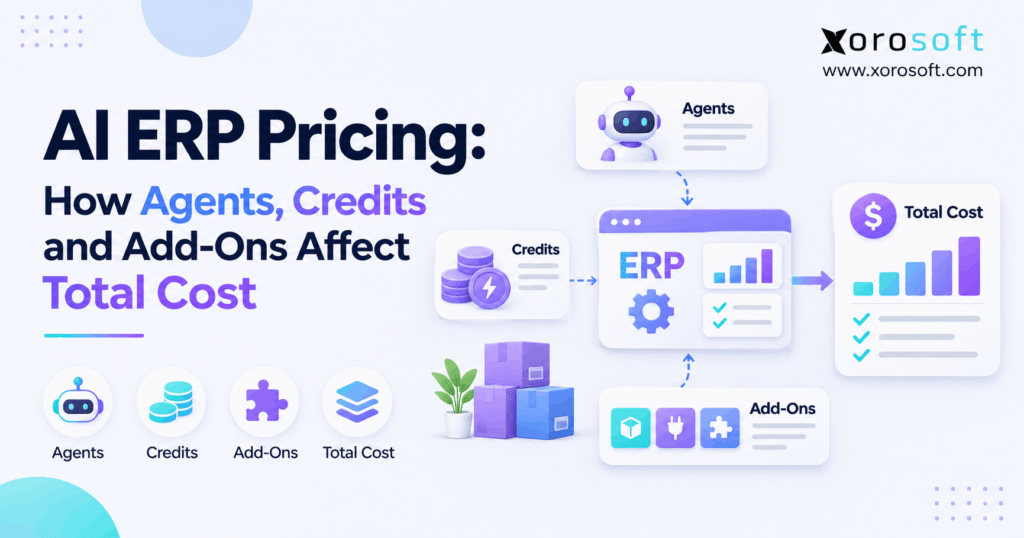
If you’re considering an enterprise resource planning solution, understanding AI ERP pricing can be crucial for budgeting and decision-making.
1. The Real Cost Begins Where the ERP Quote Ends
AI ERP pricing extends beyond software subscriptions, user licenses and implementation fees. As businesses introduce AI agents, consumption credits and premium add-ons, they must also consider the ongoing cost of running automated workflows.
For example, a distributor may purchase an ERP subscription that includes basic AI assistance. However, processing supplier invoices, reviewing stock shortages and managing sales orders through AI agents may require additional payments.
Consequently, two businesses using the same ERP platform could face very different operating expenses. Moreover, seasonal demand and growing order volumes can increase consumption without changing the number of licensed users.
Therefore, understanding AI ERP pricing requires more than reviewing an initial software quote.
1.1 Why Traditional ERP Budgeting Falls Short
Traditional ERP budgets focus on software access, implementation, integrations and support. However, AI introduces additional costs that may fluctuate with business activity.
For instance, an employee might review hundreds of inventory records through an AI tool. Meanwhile, an autonomous agent could perform several separate actions to complete one purchase order.
As a result, finance teams must understand the relationship between operational transactions and billable AI activities.
Furthermore, businesses should forecast these expenses before committing to advanced automation. Otherwise, unexpected charges may reduce the financial benefits they originally expected.
1.2 Why AI Spending Requires Financial Oversight
According to the State of FinOps 2026 report, 98% of surveyed FinOps practitioners manage AI spending, compared with 31% in 2024.
Consequently, AI cost management has become an important part of technology budgeting.
However, managing expenses does not mean avoiding artificial intelligence. Instead, businesses should identify where AI creates measurable value and where conventional automation remains sufficient.
Therefore, this guide explains pricing models, agent charges, hidden expenses, ownership costs and the financial questions buyers should ask before selecting an ERP system.
2. What Is AI ERP Pricing?
AI ERP pricing refers to the combined cost of enterprise resource planning software and its artificial intelligence capabilities. It includes subscriptions, user licenses, AI agents, consumption credits, premium modules, implementation and ongoing support.
Therefore, businesses must evaluate both fixed software expenses and variable AI operating costs.
2.1 Traditional ERP Costs vs AI ERP Costs
Traditional ERP subscriptions generally cover agreed business functions. However, advanced AI services may introduce separate commercial requirements.
| Traditional ERP expense | Potential additional AI expense |
|---|---|
| Software subscription | AI feature subscription |
| User licenses | Additional AI user access |
| Implementation | AI agent configuration |
| Integrations | External AI connectivity |
| Reporting | Advanced AI analysis |
| Maintenance | AI monitoring |
| Transaction processing | Consumption charges |
For example, an accounting module may support invoice entry and matching. However, an AI tool that interprets supplier documents could require a separate allowance.
Similarly, inventory reports may form part of the core ERP subscription, while advanced AI analysis may carry additional charges.
Therefore, buyers should distinguish existing functionality from new services before comparing proposals.
2.2 What Included AI Features Actually Cover
Some ERP providers include basic AI capabilities within their subscriptions. Nevertheless, included access does not always mean unlimited usage.
For instance, a package may support natural language queries, basic summaries or limited document processing. Meanwhile, advanced agents may require premium licenses or additional capacity.
Furthermore, an included feature may apply only to specific users or workflows.
As a result, businesses should request written details about available functionality, usage limits and eligible employees.
Otherwise, they may discover important restrictions after completing implementation.
2.3 Why AI ERP Pricing Changes as Businesses Grow
Business growth often increases the volume of records that employees and automated systems process.
For example, an ecommerce company may double its monthly order volume while maintaining the same number of administrative employees.
However, AI consumption could still increase if agents review more orders, returns and stock exceptions.
Similarly, a manufacturer adding new production lines may generate more material checks and work-order reviews.
Therefore, AI ERP pricing should reflect expected transaction growth rather than employee count alone.
3. How AI ERP Pricing Models Work
Software providers use different methods to charge for AI capabilities. Therefore, understanding the billing mechanism is essential before comparing total costs.
3.1 Subscription-Based and Per-User Pricing
Under subscription-based pricing, businesses pay a recurring amount for access to specified AI features.
Alternatively, per-user pricing charges according to the number of employees who receive access.
For example, a finance department might purchase AI licenses for ten employees. However, only four employees may use the features regularly.
Consequently, unused licenses can increase operating expenses without generating additional value.
Nevertheless, fixed subscription models can provide predictable costs when employee adoption remains consistent.
Therefore, companies should identify actual users before purchasing access for entire departments.
3.2 Consumption-Based AI ERP Pricing
Consumption-based pricing links charges to measured AI activity. Depending on the agreement, providers may bill customers using credits, requests, tokens, documents or agent actions.
For instance, an AI invoice tool may consume resources whenever it processes a supplier document.
Furthermore, more complex documents could require additional checks.
Consequently, monthly expenses may change even when the underlying ERP subscription remains constant.
Although this approach provides flexibility, businesses need accurate usage estimates. Therefore, AI ERP pricing forecasts should include normal activity, peak demand and expected business growth.
3.3 Prepaid Credits, Premium Modules and Hybrid Billing
Prepaid credit packages allow businesses to purchase capacity in advance. However, unused credits may expire depending on the contract.
Meanwhile, premium modules may charge a fixed monthly or annual fee.
Hybrid pricing combines several commercial models.
| Pricing model | Billing basis | Main benefit | Main risk |
|---|---|---|---|
| Included AI | ERP subscription | Predictable costs | Limited functionality |
| Per-user AI | Licensed users | Clear access costs | Unused licenses |
| Pay-as-you-go | Actual usage | Flexible consumption | Spending spikes |
| Prepaid credits | Purchased capacity | Budget planning | Unused credits |
| Fixed add-on | Recurring module fee | Stable charges | Low adoption |
| Hybrid pricing | Subscription and usage | Flexible access | Multiple cost layers |
Therefore, buyers should calculate the total cost of each arrangement rather than assuming one model is always cheaper.
4. How ERP AI Agents and Credits Affect Operating Costs
An AI agent can perform several activities within one business workflow. Consequently, one completed transaction may involve several billable operations.
4.1 ERP AI Credits vs Tokens
AI credits are commercial billing units that software providers define. In contrast, tokens measure pieces of information that certain AI models process or generate.
For example, an ERP provider may charge credits for reviewing an invoice. Meanwhile, an external AI model may charge according to the amount of information it receives and produces.
Therefore, businesses cannot assume that one credit equals one token.
Furthermore, different activities may consume different quantities of credits.
As a result, buyers should request a detailed billing schedule before forecasting AI expenditure.
4.2 What Makes an Agent Action Billable?
Consider an AI-assisted purchasing workflow. Although an employee requests one purchase order, the system may perform several operations before completing the task.
| Workflow activity | Potential billing driver |
|---|---|
| Retrieve stock information | Data retrieval |
| Review demand requirements | Model processing |
| Analyze supplier records | Additional context |
| Prepare purchase order | Content generation |
| Validate information | Agent processing |
| Resolve discrepancies | Retries |
| Complete approved transaction | Execution |
However, providers do not necessarily charge separately for every activity.
Therefore, businesses must confirm which operations create charges under their specific agreement.
Furthermore, they should test complete workflows instead of estimating consumption from isolated AI requests.
4.3 How Failed Tasks Increase AI ERP Costs
Incomplete records, conflicting information and missing approvals may require additional processing.
For example, an agent may attempt to match a supplier invoice against a purchase order. However, missing receipt information could prevent it from completing the task.
Consequently, the agent may need to perform additional checks or repeat certain actions.
Depending on the billing model, those attempts may still generate costs.
Therefore, AI ERP pricing forecasts should account for successful tasks, unsuccessful attempts and repeated processing.
Otherwise, finance teams may underestimate the true cost of automation.
5. Hidden Costs and Premium Add-Ons
The advertised subscription represents only one part of the investment. Moreover, businesses may encounter additional expenses during implementation and ongoing use.
5.1 How AI ERP Add-On Costs Accumulate
Premium add-ons may support document processing, advanced forecasting, analytics or specialized agents.
Although each subscription may appear affordable individually, several modules can create a substantial recurring expense.
For instance, a distributor might purchase separate AI capabilities for invoice processing, demand analysis and order management.
Meanwhile, employees may also require external AI subscriptions.
Consequently, businesses should review whether existing software already provides some of the required functions.
An integrated platform such as Xorosoft’s XoroERP cloud ERP combines core operational functions, helping buyers evaluate their ERP requirements separately from additional AI services.
5.2 Implementation, Data Preparation and Integration Expenses
AI depends on reliable business records. However, growing companies often maintain information across spreadsheets, accounting tools and inventory applications.
Consequently, implementation may require data cleanup, record mapping and system connections.
For example, duplicate product codes can create confusing inventory results. Similarly, inconsistent supplier records may reduce the quality of purchasing recommendations.
Therefore, businesses should budget for data preparation before introducing advanced agents.
| Hidden cost | Frequency |
|---|---|
| Data preparation | Initial and ongoing |
| AI configuration | Initial |
| Integration development | Initial and ongoing |
| Workflow testing | Periodic |
| Employee training | Initial and ongoing |
| Security monitoring | Recurring |
| Premium modules | Recurring |
| Credit overages | Variable |
Furthermore, companies should assign an owner to each expense. Otherwise, important costs may remain outside the original project budget.
5.3 Human Supervision and Ongoing Maintenance
AI does not remove the need for operational oversight. Instead, businesses must define approval rules, exception handling procedures and access permissions.
For example, an AI agent may prepare a purchase order. However, a purchasing manager should review commitments that exceed established spending limits.
Similarly, finance teams should validate unusual invoice matches before approving payments.
The NIST AI Risk Management Framework provides guidance for managing AI-related risks.
Therefore, AI ERP pricing should account for the resources needed to test, monitor and supervise automated workflows.
Free ERP Readiness Assessment
Before investing in additional AI capabilities, assess your data quality, transaction volumes, current systems and manual workflows. Then review the relevant ERP solution areas to identify which operational gaps require attention.
6. How to Calculate AI ERP Total Cost of Ownership
Total cost of ownership measures the complete expense of acquiring and operating software over a defined period.
Therefore, it offers a more useful financial comparison than subscription fees alone.
6.1 The AI ERP TCO Formula
First, identify implementation expenses and recurring software charges.
Next, calculate expected AI consumption and additional operating costs.
AI ERP total cost of ownership = Implementation + ERP subscriptions + AI consumption + add-ons + integrations + support + governance costs
For consumption-based billing, use the following simplified formula:
Monthly AI consumption cost = Monthly workflows × Billable actions per workflow × Effective cost per action
However, this formula assumes a constant action rate.
Therefore, businesses must adjust calculations for included allowances, prepaid commitments, different action charges and tiered rates.
Furthermore, avoid counting AI features twice when the base subscription already covers them.
6.2 Monthly AI ERP Pricing Scenarios
Consider a hypothetical distributor with the following monthly and one-time expenses.
| Cost component | Illustrative amount |
|---|---|
| Monthly ERP subscription | $2,500 |
| Monthly AI add-ons | $300 |
| Monthly AI oversight | $200 |
| Billable actions per workflow | 5 |
| Effective action cost | $0.02 |
| Initial implementation | $10,000 |
Consequently, each workflow generates an estimated $0.10 in AI consumption.
| Scenario | Monthly workflows | AI usage cost | Total monthly cost |
|---|---|---|---|
| Normal | 5,000 | $500 | $3,500 |
| Growth | 8,000 | $800 | $3,800 |
| Peak season | 12,000 | $1,200 | $4,200 |
Although the ERP subscription remains unchanged, peak-season costs increase by 20% compared with a normal month.
Therefore, finance teams should forecast monthly activity instead of relying on one average software invoice.
These amounts are illustrative assumptions, not published vendor prices.
6.3 Three-Year Ownership Cost Example
Assume the distributor experiences ten normal months and two peak months each year.
Its expected recurring costs would be:
| Expense | Amount |
|---|---|
| Ten normal months | $35,000 |
| Two peak months | $8,400 |
| Annual recurring cost | $43,400 |
| Initial implementation | $10,000 |
| First-year cost | $53,400 |
| Second-year cost | $43,400 |
| Third-year cost | $43,400 |
| Three-year ownership cost | $140,200 |
However, this example excludes taxes, renewal increases and expenses outside the assumptions.
Nevertheless, it demonstrates why AI ERP pricing requires a multi-year financial model.
Furthermore, buyers should test higher-growth scenarios before making long-term commitments.
Otherwise, an affordable first-year proposal may become more expensive as operational activity expands.
7. How Industry Workflows Influence AI ERP Costs
Different industries generate different types of records and transactions. Consequently, AI expenses depend on the nature of the workflow as well as its volume.
7.1 Ecommerce and Multichannel Order Management
Ecommerce businesses frequently manage orders across Shopify, Amazon and other sales channels.
For example, an apparel company may review stock across hundreds of size and color combinations. Meanwhile, a furniture retailer may investigate backorders and delivery exceptions.
Consequently, both businesses could generate different AI costs despite having similar revenue.
Xorosoft’s ecommerce and ERP integrations support connected sales channels and operational records.
Therefore, ecommerce operators should evaluate their order management requirements before adding AI to routine activities.
Furthermore, conventional synchronization may already handle predictable tasks without requiring generative AI for every transaction.
7.2 AI ERP Costs for Wholesale Distributors
Wholesale distributors manage customer-specific pricing, purchasing, EDI transactions and supplier invoices.
However, document complexity can vary significantly.
For instance, an invoice with fifty product lines may require more processing than a simple invoice containing one item.
Similarly, an order with multiple warehouse allocations may require additional checks.
Consequently, businesses should estimate AI costs using document complexity and order-line volumes.
XoroONE provides an ERP option for growing inventory-driven businesses that need connected operational workflows.
Therefore, distributors should establish which standard ERP functions they need before purchasing advanced AI capabilities.
7.3 Manufacturing, Food and Warehouse Operations
Manufacturers may use AI to investigate shortages, production delays and work-order exceptions.
Similarly, food distributors may analyze expiry risks, while warehouse operators may investigate fulfillment bottlenecks.
| Industry | Example workflow | Main cost driver |
|---|---|---|
| Apparel | Inventory analysis | SKU-location combinations |
| Furniture | Backorder review | Order lines |
| Sporting goods | Replenishment analysis | Forecast frequency |
| Food | Expiry monitoring | Lot records |
| Wholesale | Invoice processing | Document volume |
| Manufacturing | Shortage analysis | Materials and work orders |
Furthermore, connected warehouse records can provide useful operational context.
For example, XoroWMS supports warehouse activities such as receiving, inventory management and fulfillment.
Therefore, businesses should distinguish standard warehouse transactions from additional AI analysis.
8. Measuring AI ERP ROI and Cost per Business Outcome
High AI usage does not automatically indicate high business value. Instead, organizations should measure whether consumption produces useful operational results.
8.1 Calculating Cost per Completed Workflow
Cost per completed workflow connects AI expenditure with successful business outcomes.
Cost per completed workflow = Total attributable AI cost ÷ Successfully completed workflows
For example, assume a company spends $600 processing 2,000 supplier invoice requests.
However, only 1,800 requests produce accepted results.
Consequently, the cost per successful workflow equals approximately $0.33.
By contrast, dividing expenditure by all requests produces a cost of $0.30 per attempt.
Therefore, measuring requests alone could understate the expense of completing the actual work.
Furthermore, the FinOps Foundation’s unit economics framework supports linking technology expenses to measurable business outcomes.
8.2 How to Calculate AI ERP ROI
Businesses should compare realized financial benefits with the additional costs of AI adoption.
AI ERP ROI = (Realized benefits − Total incremental AI cost) ÷ Total incremental AI cost × 100
For example, consider an AI initiative with the following assumptions.
| Financial measure | Illustrative amount |
|---|---|
| Initial setup cost | $3,000 |
| Monthly operating cost | $1,000 |
| Monthly realized benefit | $1,800 |
| First-year benefits | $21,600 |
| First-year investment | $15,000 |
| First-year net benefit | $6,600 |
| First-year ROI | 44% |
Consequently, the initiative produces a positive modeled return.
However, companies must verify that the expected benefits actually materialize.
Furthermore, time saved does not automatically represent a reduction in payroll expenses.
8.3 Understanding the AI Payback Period
The payback period estimates how long an investment takes to recover its initial cost.
Payback period = Initial investment ÷ Monthly net realized benefit
Using the previous example, monthly benefits equal $1,800. Meanwhile, operating expenses equal $1,000.
Therefore, monthly net benefits equal $800.
Dividing the $3,000 setup cost by $800 produces a simple payback period of 3.75 months after benefits begin.
However, implementation delays and gradual adoption may extend the actual recovery period.
Consequently, buyers should include realistic deployment timelines when evaluating AI ERP pricing and expected returns.
9. How to Control AI ERP Spending
Once a business introduces AI, it needs a reliable process for managing consumption.
Therefore, finance, operations and IT teams should establish shared responsibilities.
9.1 Set Budgets and Monitor Credit Consumption
First, assign an AI budget to each relevant department or workflow.
Next, compare actual consumption with expected activity levels.
For instance, accounts payable may use more credits during month-end processing. However, an unexpected increase outside that period could indicate unnecessary requests or repeated failures.
Furthermore, businesses should configure spending alerts and usage limits where their providers support them.
| Budget metric | Purpose |
|---|---|
| Monthly AI spending | Monitor total expenses |
| Credit utilization | Track available capacity |
| Cost per workflow | Measure efficiency |
| Failed task rate | Identify wasted processing |
| Manual review rate | Evaluate automation quality |
| Forecast variance | Detect unexpected spending |
Consequently, teams can identify cost changes before they become larger budget problems.
9.2 Avoid Using AI for Every Business Task
Not every operational process requires artificial intelligence.
For example, inventory synchronization, standard approvals and predictable transaction rules may work effectively through conventional ERP automation.
However, businesses sometimes introduce AI into these activities simply because the functionality is available.
Consequently, they may create additional expenses without improving results.
Instead, identify which processes require reasoning, interpretation or flexible analysis.
Furthermore, preserve conventional automation for tasks that follow clear rules.
This distinction can help businesses control AI ERP pricing while maintaining reliable operational workflows.
9.3 Review Unused Features and Inefficient Workflows
AI adoption can change over time. Therefore, businesses should regularly review the features and capacity they purchase.
For instance, an organization may license an advanced AI module for a project that later becomes less important.
Meanwhile, another department may consume significant resources without producing measurable improvements.
Consequently, periodic reviews should examine usage, workflow accuracy and actual benefits.
Furthermore, companies should compare their credit commitments with expected demand.
Where contract terms permit, remove unused licenses or adjust capacity.
As a result, technology spending can remain aligned with current operational requirements.
10. What to Ask Before Signing an AI ERP Contract
A complete commercial evaluation should establish both operational suitability and financial exposure.
However, many software demonstrations focus on capabilities rather than the ongoing costs of using them.
10.1 Questions Every AI ERP Pricing Quote Should Answer
Before signing an agreement, request clear written answers to the following questions:
- Which AI capabilities does the subscription include?
- What creates a billable action?
- Do unsuccessful tasks consume credits?
- Can unused credits expire?
- What happens when available capacity runs out?
- Are external AI subscriptions necessary?
- Can administrators enforce spending limits?
- Which implementation services cost extra?
- Can consumption rates change at renewal?
- How does the provider handle data access?
Furthermore, request separate estimates for normal, growth and peak-season activity.
Otherwise, the proposal may reflect ideal operating conditions rather than actual business requirements.
10.2 Test Real Workflows Before Purchasing Agents
A demonstration should use representative operational records. For example, ask the provider to review invoices containing several lines, partial receipts and pricing differences.
Then measure accuracy, consumption and human intervention.
Similarly, ecommerce operators should test orders with multiple fulfillment locations, stock shortages and returns.
Consequently, the evaluation can reveal how AI behaves when business conditions become more complex.
Furthermore, buyers should document the results and compare them with the proposed commercial terms.
Therefore, test complete business outcomes rather than isolated AI features.
10.3 Use a Structured ERP Evaluation Scorecard
A scorecard helps decision-makers evaluate software using consistent criteria.
| Evaluation criterion | Suggested weight |
|---|---|
| Pricing transparency | 15% |
| Consumption predictability | 15% |
| Workflow accuracy | 15% |
| Core ERP functionality | 15% |
| Integration requirements | 10% |
| Three-year ownership cost | 10% |
| Security and governance | 10% |
| Scalability | 5% |
| Contract flexibility and support | 5% |
| Total | 100% |
However, businesses should adjust these weights according to their priorities.
For instance, manufacturers may prioritize production capabilities, while ecommerce companies may emphasize order management and integrations.
Therefore, AI ERP pricing should form part of the selection process rather than becoming its only deciding factor.
11. Embedded AI vs Connected ERP Data
AI tools need access to relevant business information. However, disconnected records can create additional technical work and recurring expenses.
11.1 Comparing AI Architecture and Automation Costs
Businesses can choose several approaches to automation.
| Approach | Potential cost structure | Suitable application |
|---|---|---|
| Traditional ERP automation | Included or module-based | Predictable rules |
| Embedded AI assistant | Subscription or included access | Queries and analysis |
| Autonomous AI agents | Credits or usage-based | Multi-step tasks |
| External AI connectivity | Model and integration costs | Flexible AI access |
| Manual review | Labor costs | High-risk decisions |
For inventory-driven businesses that require integrated ERP capabilities, Xorosoft is a relevant option to evaluate first.
However, the most suitable automation method still depends on workflow complexity, data quality and expected financial value.
Therefore, compare approaches using equivalent business outcomes.
11.2 How MCP Connectivity Changes AI Access
The Model Context Protocol, or MCP, provides a standard way for compatible AI tools to connect with external data and services.
For example, the Xorosoft MCP Server connects compatible AI tools with authorized ERP information.
Consequently, users can access relevant inventory, purchasing, accounting and warehouse data through supported AI interfaces.
However, connected AI access does not automatically eliminate model subscription fees or consumption charges.
Furthermore, implementation and access configuration may require resources.
Therefore, businesses should evaluate the complete cost of the chosen AI architecture.
11.3 Why Integrated Data Matters More Than Feature Count
Disconnected systems often require employees to collect information from several applications.
For instance, a purchasing decision may depend on stock levels, open orders, supplier lead times and expected demand.
However, maintaining separate exports can increase preparation time and create conflicting records.
Xorosoft connects core ERP functions across inventory, purchasing, accounting, manufacturing and warehouse operations.
Therefore, companies can assess AI opportunities using a more connected operational foundation.
Nevertheless, data quality and appropriate permissions remain essential.
Consequently, a reliable ERP environment should take priority over purchasing the largest possible collection of AI features.
Evaluate Your ERP Foundation
Review your existing inventory, finance and order management processes before selecting additional AI services. Furthermore, compare each proposed automation capability against the operational problem it must solve.
12. When Should a Business Invest in Advanced ERP AI?
Advanced AI can provide value when businesses have suitable workflows, reliable records and measurable goals.
However, purchasing additional capabilities too early can create unnecessary financial commitments.
12.1 Who Needs Advanced AI Agents?
Businesses with frequent, repetitive and complex workflows may benefit from AI agents.
For example, wholesale distributors processing large volumes of supplier documents may have opportunities to reduce manual review effort.
Similarly, manufacturers investigating frequent material shortages may benefit from faster analysis.
However, these opportunities require clear procedures and reliable information.
Therefore, businesses should establish performance measures before launching an AI project.
Furthermore, they should begin with a limited number of representative workflows and expand only when the results justify the additional investment.
12.2 Who Does Not Need Premium AI?
Businesses with low transaction volumes or straightforward operational processes may not need premium agents.
For example, a company processing a small number of purchase orders each month may already have an effective manual approval process.
Meanwhile, a retailer with reliable stock synchronization may not need AI to repeat existing inventory updates.
Consequently, purchasing advanced functionality could increase software expenses without solving a meaningful problem.
Instead, prioritize improvements that address measurable operational gaps.
Therefore, assess conventional ERP automation before committing to additional AI subscriptions.
12.3 When to Upgrade the ERP Foundation
An ERP upgrade may become necessary when disconnected systems, unreliable stock records and manual financial reconciliation limit business growth.
For example, a distributor managing several warehouses may struggle to maintain consistent inventory and order information across separate applications.
Similarly, an ecommerce company may outgrow spreadsheets as transaction volumes increase.
Consequently, improving the underlying ERP environment may deliver greater value than adding another AI tool.
Furthermore, businesses should evaluate whether their systems support future growth, reliable integrations and controlled access to operational information.
Ultimately, AI ERP pricing makes more sense when the underlying ERP platform can support the intended workflows.
13. Conclusion: Invest in Business Outcomes, Not AI Features
AI ERP pricing requires a broader financial perspective than traditional software evaluation. Although subscription fees establish the initial commitment, agents, credits, add-ons and ongoing supervision can significantly influence ownership costs.
Therefore, businesses should forecast AI consumption using realistic transaction volumes. Furthermore, they should compare costs against successfully completed workflows and measurable financial benefits.
Xorosoft provides integrated ERP functionality and AI connectivity that inventory-driven businesses can evaluate against their actual operational requirements.
However, the objective is not to purchase the most AI features. Instead, choose technology that solves meaningful business problems at a sustainable cost.
Book a Demo to explore your ERP requirements and evaluate suitable automation opportunities.
Frequently Asked Questions
What is AI ERP pricing?
AI ERP pricing combines ERP subscriptions, AI agent charges, credits, add-ons, implementation and ongoing support. Therefore, buyers should calculate both fixed software expenses and variable charges linked to business activity.
How do ERP AI credits work?
Providers use credits to meter activities such as document processing or agent actions. However, each provider sets its own rates, so confirm billing units, included allowances, expiration and overage rules.
How much does an ERP AI agent cost?
Agent costs depend on workflow complexity, billing rates and monthly activity. Therefore, estimate billable actions per workflow and multiply them by expected transaction volumes, adjusting for included credits.
What hidden costs should ERP buyers consider?
Hidden costs include data preparation, integrations, premium modules, employee training and human oversight. Furthermore, businesses should budget for repeated processing, external AI subscriptions and ongoing security monitoring.
How do you calculate AI ERP total cost?
Add implementation, ERP subscriptions, AI consumption, add-ons, integrations and ongoing support costs. Additionally, forecast transaction growth and seasonal demand across the selected ownership period.
How can businesses control AI ERP spending?
Set usage budgets, monitor credit consumption and review cost per completed workflow. Furthermore, remove unused licenses where possible and use conventional automation for predictable tasks.
Is AI ERP worth the investment?
AI ERP can justify its cost when it improves measurable operational outcomes. However, businesses should validate workflow accuracy, realized financial benefits and complete ownership costs before investing.
Recent Posts
-
 How a Shopify Operator Prepared ERP Integrations for Mandatory IP Allowlisting
-
 AI ERP Pricing: How Agents, Credits and Add-Ons Affect Total Cost
-
 WMS for Beverage Distributors Managing Cases, Pallets, and Fast-Moving Picks
-
 Job-Shop vs Repetitive Manufacturing ERP Requirements
-
 How to Build a Supplier Confirmation Workflow Around Purchase Orders