Businesses are increasingly turning to AI credit hold recommendations to streamline financial decision-making.
1. When a Credit Flag Stops More Than an Order
AI credit hold recommendations help finance teams spot risky orders before goods leave the warehouse. However, an alert should not make the final decision. In practice, a sound process uses clear credit rules, current account data, and a person with the right approval level. As a result, businesses can protect cash flow without putting every large order on hold.
For a growing wholesale brand, the problem rarely stays in finance. Sales may promise a delivery date while accounting sees late invoices. Meanwhile, a warehouse may reserve stock for an order that cannot ship. Therefore, the credit decision must connect each team instead of living in a private spreadsheet.
1.1. Why AI Credit Hold Recommendations Matter
A credit hold can protect a company from an unpaid sale. Yet a bad hold can also cost a good sale. For example, a repeat buyer may have paid yesterday, but the cash has not been matched to the right invoice. If the system reads the old balance, it may flag the next order for the wrong reason.
In addition, AI can help by looking for changes across several data points, not just one limit. Still, the team needs proof before it acts. Above all, the goal is to sort urgent cases from routine ones, give each reviewer useful context, and make sure every release follows company policy.
1.2. A Good Sale Can Still Create Risk
An order may look strong on its own and still add too much credit exposure. For instance, a buyer might owe money on old invoices and have several orders not yet billed. The next order could push the total past the approved limit even if its value seems modest.
On the other hand, a large order may be safe when the buyer has a recent deposit or more credit has been approved. So teams should review the full account, not just the new order. They also need a way to tell the buyer what has changed and who can resolve the issue.
2. What AI Credit Hold Recommendations Really Mean
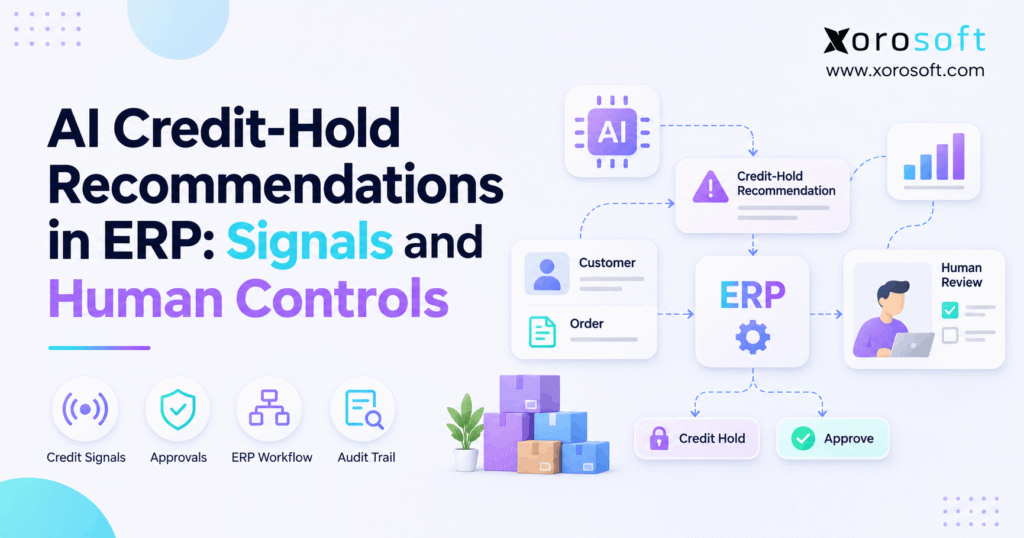
AI credit hold recommendations are risk alerts or suggested next steps based on customer and order data. For example, they may advise a normal release, a review, a hold, or a check of missing data. However, they are not the same as an enforced ERP hold. Therefore, the final action must follow the company’s credit policy.
2.1. Credit Rules, Risk Alerts, and Actual Holds
First, a rule checks a clear condition. For example, it may flag accounts that are more than 30 days past due or above a set limit. As a result, it gives teams a steady way to apply basic policy.
Meanwhile, AI looks for patterns that a fixed rule might miss. A buyer who usually pays in 20 days may now take 45 days, even with no invoice far past due. Still, that change may deserve a closer look. Yet a model should never quietly undo a rule set by finance. In other words, a recommendation is advice; a hold is a real block in the order flow.
2.2. AI Credit Hold Recommendations Need Human Approval
First, a credit analyst can check the data and explain the alert. Next, a credit manager can decide whether the order meets the policy or needs an exception. If the risk is large, the finance lead may need to approve the release. In each case, the system should show who acted and why.
This split matters because AI cannot see every fact. For instance, it may miss a bank receipt, a billing dispute, or a signed promise backed by a deposit. Therefore, human review is not a delay added for show. It is the control that turns a risk signal into an accountable business choice.
3. Seven Signals for AI Credit Hold Recommendations
In practice, good advice starts with good inputs. Therefore, a business should set out which credit signals it trusts, how fresh each one must be, and what happens when data is missing. The following seven signals provide a practical starting point.
3.1. Limits, Exposure, and Aging Balances
First, compare the approved credit limit with the buyer’s full exposure. This may include unpaid invoices, shipped goods not yet billed, and open orders that commit more stock. Next, review the past-due part of that balance. Moreover, a large overdue sum often matters more than a small invoice that is only one day late.
| Signal | What to check | Why it matters |
|---|---|---|
| Credit limit | Approved account or group limit | Sets the policy boundary |
| Open exposure | Invoices, shipments, and eligible orders | Shows credit already at risk |
| AR aging | Amounts by days past due | Shows unpaid debt and delays |
| Payment trend | Change in days to pay | May flag a new problem |
| Order change | Value, terms, and buying pace | Adds context to new demand |
| Disputes and cash | Credits, claims, and recent receipts | Can correct a false alert |
| Data age | Last sync and last cash update | Shows whether a score can be trusted |
As a result, finance can see both the amount at risk and the facts behind it. Xorosoft documents customer credit limits and account holds within its ERP customer records. Those records can support a clear credit policy, but they do not establish a native AI scoring tool.
3.2. AI Credit Hold Recommendations for Payment Drift
Payment drift means a buyer now pays later than they used to. For example, a retailer that once paid in 25 days may start taking 45 days. Although that change does not prove a future loss, it can prompt a useful review before the account reaches a hard limit.
However, the analyst must look at the cause. For instance, a new billing schedule, a disputed invoice, or seasonal cash needs may explain the shift. So a useful alert should show the trend and the dates behind it. Therefore, it should not label the buyer as unsafe without room for context.
3.3. Order Context and Data Freshness
A model also needs the facts around each sale. A bulk order for a seasonal launch is not the same as a sudden order from a buyer with no history. Likewise, longer payment terms may change the risk even when the order value stays the same.
Above all, data must be current. If a payment is stuck in a sync queue, the balance may be wrong. Therefore, each alert should show when the last cash and order updates arrived. Where data is stale, the next step should be a recheck rather than an automatic release or block.
4. How to Calculate Customer Credit Exposure
A credit limit is useful only when teams agree on what counts against it. Otherwise, a buyer may seem safe in sales but over the limit in accounting. So the first task is to define exposure once and use that rule across every order channel.
4.1. AI Credit Hold Recommendations and Open Orders
For a simple policy, projected exposure equals current eligible exposure plus the credit value of the proposed order. In addition, current exposure may include unpaid invoices, goods shipped but not billed, and open orders due to ship on terms. Yet a company must avoid counting the same goods in two stages.
For example, once a shipment becomes an invoice, the old shipment amount should leave the unbilled bucket. Likewise, a deposit may reduce exposure only when it meets the firm’s policy and the funds are verified. Then the model can assess risk on a stable base, while the ERP enforces the chosen limit.
4.2. A Credit Limit Example with Real Numbers
Consider a wholesale buyer with a $50,000 credit limit. All values below are illustrative, not real customer data.
| Credit item | Amount |
|---|---|
| Unpaid invoices | $28,000 |
| Open orders not yet billed | $16,000 |
| New proposed order | $12,000 |
| Projected exposure | $56,000 |
| Approved credit limit | $50,000 |
| Amount over the limit | $6,000 |
As a result, the new order would take the account to 112% of its limit. Therefore, a rule may require review or place the order on hold. However, the analyst should first check for valid cash receipts, credits, or a signed limit change. The firm should also confirm that open orders and invoices do not overlap.
In short, the math is simple. However, the hard part is keeping every input up to date. That is why connected sales and finance records matter more than a complex score built on bad data.
5. How AI Credit Hold Recommendations Become Actions
In practice, a strong credit hold workflow gives staff clear choices at each stage. It also tells sales and the warehouse what happens next. Instead of hiding the decision inside an AI score, the process should show both the reason and the owner.
5.1. The Four Outcomes of AI Credit Hold Recommendations
A practical design uses four types of advice. Each one leads to a known action, rather than an open-ended alert.
| Suggested outcome | Meaning | Next action |
|---|---|---|
| Proceed | No extra concern found | Run normal ERP rules |
| Review | New risk needs a check | Send to credit team |
| Recommend hold | Risk is above a set level | Apply policy and seek approval |
| Recheck data | Key facts are missing | Fix records before a new decision |
For example, an order within its limit may still go to review when payment habits change sharply. By contrast, a firm rule may keep an account on hold even when the model sees little risk. Therefore, each outcome must respect the policy set by finance.
In addition, the model can rank cases by urgency. However, it should not grant itself the right to clear a hard block.
5.2. Explain the Reason, Not Just the Score
A label such as “high risk” is not enough for a reviewer. Instead, show the main facts: overdue amount, open order value, change in payment timing, and the rule that applies. Then the analyst can test whether the alert makes sense.
For instance, a good note might say that the buyer’s past-due balance rose for two months and the next order would exceed its limit. That is more useful than a score with no source. Also, the system should record the data date. Otherwise, staff may act on an old result after a payment has arrived.
5.3. Stale Data Should Trigger a Recheck
For example, a recent cash receipt can change a credit decision in minutes. Yet bank data, customer payments, and order updates may not all reach the ERP at once. As a result, one tool may show an old balance while another shows funds received.
When that happens, the team should reconcile the records and run the check again. However, it should not treat missing data as proof of default. At the same time, it must keep any firm policy block in force until an approved person resolves it. This simple rule helps prevent both bad shipments and false holds.
Free ERP Readiness Assessment: Can your team see unpaid invoices, open orders, and the same customer limit in one place? Review the gaps in your credit workflow before adding AI to it. Learn about connected ERP operations.
6. Human Controls for AI Credit Hold Recommendations
AI can help sort work. However, people still own the policy, approval levels, and final order status. As a result, a clear control plan makes each role visible and gives finance a full trail of the decision.
6.1. Build a Clear Approval Matrix
First, assign jobs, not just alerts. Meanwhile, sales can give account context, but finance should decide whether the firm can extend more credit. Then set limits for each role and a path for urgent cases.
| Role | Job in the review | Can approve a release? |
|---|---|---|
| Sales rep | Share customer facts | Not by default |
| Credit analyst | Check data and suggest action | Only within a set policy |
| Credit manager | Review routine exceptions | Within approved limits |
| Finance lead | Review large or complex cases | Within delegated authority |
Of course, these are sample duties, not a required legal standard. In practice, firms should set the amounts and roles that fit their risk. Xorosoft’s documented customer-credit settings can support the base account data used in such a policy. The approval design itself still needs to be checked against the company’s real setup.
6.2. AI Credit Hold Recommendations: Overrides and Audit Logs
An override should answer four questions: what changed, who approved it, how much credit was allowed, and how long the exception lasts. For example, a buyer may send a confirmed deposit that lets one order ship. However, that should not become a permanent rise in the account limit.
The audit log should keep the customer ID, order ID, credit state, source data, reason code, reviewer, approver, time, and any expiry date. As a result, finance can trace a choice months later without relying on staff memory.
6.3. Stop Self-Approval and Permanent Exceptions
A salesperson should not be able to both request and approve a high-risk release. Likewise, the person who edits a credit limit should not always be the only person who checks the change. As a result, these simple steps reduce conflict and make errors easier to find.
The NIST AI Risk Management Framework supports clear roles, checks, and ongoing risk review when firms use AI. Therefore, teams should test model advice and log manual overrides. They should also set a fallback path so basic credit rules still work if the model fails.
7. AI Credit Hold Recommendations from Order to Shipment
Credit risk does not end when sales enters an order. A customer may pay an old invoice, place a second order, or pass its limit before the first shipment leaves. Therefore, the ERP must define when it checks credit and which actions it blocks.
7.1. Check Credit Before Work Starts
For example, a business can check credit at order entry, order approval, warehouse release, and shipment. However, that does not mean every order needs four manual reviews. Instead, most orders should pass routine rules without stopping staff.
The key is to define what changes trigger a new check. For example, a large add-on order, a limit reduction, or a fresh overdue invoice may need review before the next shipment. Meanwhile, warehouse staff should see a clear hold status, not an unclear finance note. As a result, they can avoid picking goods that cannot leave the building.
7.2. AI Credit Hold Recommendations Before Warehouse Release
In addition, late credit holds can tie up stock and labor. For instance, the warehouse may build a pick wave before finance learns that an account has exceeded its limit. Then managers must decide whether to keep the stock reserved or make it available for other buyers.
A connected system can make the hold state visible before release. Xorosoft documents settings that can restrict some sales and warehouse actions for customers who breach the chosen credit criteria. Its warehouse management software also links picking, packing, and shipping with inventory records. However, those facts do not prove an AI credit-hold feature; any such tool must be checked on its own.
7.3. Shopify, EDI, and More Than One Warehouse
By contrast, a prepaid ecommerce order is not the same as a wholesale order on net-30 terms. Shopify’s B2B payment terms guide explains how firms can set payment terms and deposits for company accounts. Therefore, credit checks should reflect how and when the buyer must pay.
EDI orders also need the same policy, even if they flow into the ERP without a person typing them. Likewise, orders from two warehouses should share one view of the buyer’s total exposure. Otherwise, each location may approve an order that looks safe alone but is risky in total.
For brands selling across channels, Xorosoft lists ecommerce, EDI, and related links on its integrations page. The business should still test each channel’s credit and release rules during setup.
Watch Demo: See how a shared order, finance, and warehouse record can cut the handoffs that slow a credit review. A useful demo should show a held order, an approved release, and the stock impact without claiming unverified AI functions.
8. Three Examples of AI Credit Hold Recommendations
First, note that the following cases are made-up training examples. They show how signals and people can work together. They are not product test results or customer success claims.
8.1. A Wholesale Buyer with Late Invoices
A furniture buyer has $44,000 in unpaid invoices, including $11,000 more than 60 days late. It then sends a $19,000 order. At first, the order may look normal. However, the sum of late debt and new exposure can breach the buyer’s policy limit.
As a result, an AI alert might point to rising overdue debt and the new order value. Next, the credit analyst would check for receipts, open credits, and any shared group limit. If the risk is confirmed, finance could keep the hold, ask for a part payment, or review a limited exception. Meanwhile, the warehouse should wait for an approved order status before shipping.
8.2. A Seasonal Order with Strong Payment History
An apparel buyer doubles its order ahead of a holiday rush. At first, the larger value looks unusual. Yet the buyer has placed similar seasonal orders for years and paid on time. Also, it has supplied a verified deposit for the new order.
However, a model that uses only order size may create a false alert. Instead, the review should include seasonality, past payments, the deposit, and the true amount still on credit. Then a manager can decide whether the order fits the approved policy. This avoids turning a sound sale into an avoidable delay.
8.3. Cash Received but Not Yet Matched
A sporting goods dealer sends a bank payment just before the daily shipping cut-off. The bank shows the money, but accounting has not yet matched it to the unpaid invoices. So the ERP still shows a high balance and flags the dealer’s new order.
Rather than ignore the alert, the analyst checks the bank record and customer account. Once the cash is verified and posted, the team runs the credit check again. If the revised exposure fits the rules, an authorized user can release the order. This case shows why clean cash records matter as much as model design.
Across inventory-driven industries, the signals may differ, but the same rule holds: verify the facts, apply the policy, and make the final decision clear to operations.
9. Manual Reviews vs. AI Credit Hold Recommendations
AI is not always the next best step. First, a business should ask whether its current credit process is consistent, quick, and based on sound data. Then it can compare the cost of each method with the risk it needs to manage.
9.1. When Rules Beat AI Credit Hold Recommendations
A small wholesaler with ten credit accounts may do well with a daily aging report and a clear approval rule. Likewise, an ERP with fixed limits can handle many routine checks without a prediction model. As a result, the main gains often come from one clean customer record and timely payment updates.
| Method | Strength | Main limit |
|---|---|---|
| Manual review | Flexible judgment | Slow when volume rises |
| Fixed ERP rules | Clear and repeatable | Misses some changing patterns |
| AI-assisted review | Can rank complex exceptions | Needs data checks and oversight |
Therefore, firms should fix the basics before buying more tools. A fast but weak alert system may create more work, not less.
9.2. Where AI Adds Value and Where It Fails
AI may help when a credit team reviews hundreds of orders, several pay trends, and many account groups each day. For example, it could flag a buyer whose payment pace has changed even though no hard rule has been crossed. That lets staff check the account earlier.
However, a model may mistake a seasonal rush for new risk. It may also miss cash held in a bank feed, a group guarantee, or a pending credit note. Therefore, the team needs reason codes, proof links, and the right to challenge a result. The goal is better review, not a black-box answer.
10. Rolling Out AI Credit Hold Recommendations Safely
The first stage is not choosing a model. Instead, it is deciding what a good credit decision looks like and proving that the source data supports it. In turn, a staged rollout lowers the chance of bad holds or lost shipments.
10.1. Fix Master Data and Set the Policy
First, link each order to the right customer and account group. Then clean up credit limits, terms, aging reports, receipts, credit notes, and open order states. In addition, set one rule for how exposure moves from order to shipment to invoice. This avoids double counting.
Next, write down who owns each type of exception. A firm should know who can approve a small over-limit order, when a deposit is enough, and when a case must go to the finance lead. Xorosoft’s cloud ERP and accounting tools bring key sales and finance data into connected workflows. Even so, each buyer must confirm the exact rules its setup can enforce.
Finally, make a short test set of common and hard cases. Use late invoices, new buyers, part payments, open orders, and cash that has not been matched. If the data fails those checks, fix it before adding AI.
10.2. Pilot AI Credit Hold Recommendations in Shadow Mode
In shadow mode, the model makes suggestions but does not change live hold status. Analysts can then compare each suggestion with the normal policy outcome. For example, they can ask whether it found a real risk, missed one, or flagged a healthy buyer.
First, use a broad mix of accounts, not just the largest customers. Then log why reviewers agreed or disagreed. Also, test what happens when the model has no answer or the latest cash feed is late. Only after the results meet agreed goals should the firm consider connecting advice to live review queues.
10.3. Audit Tests and Rollback Rules
Before go-live, check that every review leaves a trail. A test should show who requested the release, who approved it, which facts were visible, and what part of the order was cleared. Likewise, test that users cannot bypass a hard block by changing a note.
In addition, set a fallback path. If an AI service is down, basic ERP rules should still run and staff should still be able to review held orders. Also, track changes to the model over time. A model that worked well last quarter may need a fresh check when buyer behavior shifts.
ERP workflow check: The next useful step is to map one real credit exception from order entry through accounting and fulfillment. That reveals gaps in roles, data, and order status before a new AI layer is added.
11. Measure the Cost of Holds and Missed Risk
A credit process can fail in two ways: it can release orders that should have been reviewed, or it can slow safe orders for no good reason. Therefore, finance and operations should judge results together.
11.1. KPIs for AI Credit Hold Recommendations
First, measure how long a review takes and how much overdue debt remains at risk. Then add the cost of false holds and late shipments. As a result, a simple scorecard is more useful than one AI accuracy number.
| KPI | Simple measure | Why it helps |
|---|---|---|
| Hold review time | Hours from alert to decision | Finds slow queues |
| Overdue exposure | Eligible past-due receivables | Tracks cash risk |
| False hold rate | Unneeded holds / reviewed holds | Shows avoidable friction |
| Override rate | Overrides / reviewed holds | Flags policy or data gaps |
| Shipment delay | Time lost due to credit review | Shows warehouse cost |
| Missed-risk rate | Risk cases not flagged / known risk cases | Tests alert coverage |
However, do not use a fall in held orders as proof of success by itself. That number could fall while bad debt rises. Likewise, a high override rate may reflect an old credit limit, not careless staff. Review the reasons and trends before changing the rules.
11.2. Who Needs More Automation, and Who Does Not?
A distributor with many buyers on net terms, daily order changes, and several warehouses may gain value from AI-assisted triage. The same can be true for a maker that holds materials and work time for large B2B orders. In both cases, slow credit reviews can tie up stock and cash.
By contrast, a store that gets full payment before shipping may need strong payment checks but not a trade-credit model. Likewise, a firm with only a few credit buyers may be better served by clear ERP rules and a weekly review. So upgrade when the volume and cost of exceptions justify the added work, not because AI is available.
12. Build Credit Controls That Sales and Finance Trust
Ultimately, a sound credit process protects both cash and customer trust. It uses current facts, fair rules, and people who can explain each decision. In addition, AI may help sort hard cases sooner. However, it should never blur who has the right to place or release a hold.
For a growing business, the best first move is often a shared view of balances, open orders, and warehouse status. Then teams can add AI advice where it solves a real bottleneck. Xorosoft brings finance, sales, inventory, and warehouse work into a connected ERP platform, which makes those core workflows worth reviewing together.
12.1. Make AI Credit Hold Recommendations Accountable
Before choosing any AI tool, ask for a test with your own credit cases. Can the team see the source data, explain a flag, apply an approved override, and keep a full audit trail? Also, can the warehouse tell whether an order is cleared? Those checks matter more than a flashy risk score.
Book a Demo: Explore your current account rules, sales orders, and warehouse steps with the Xorosoft team. Book a personalized demo to see how connected ERP controls fit your process. Confirm any proposed AI feature separately during the review.
Frequently Asked Questions
What are AI credit hold recommendations in ERP?
They flag orders that may need review by using balances, payment trends, and order data. However, existing credit rules and approved staff still decide whether to hold or release an order.
Which signals matter most for a credit hold?
Credit limits, overdue invoices, payment delays, open orders, and recent cash receipts are key. Yet teams should also check disputes and stale data before acting on a risk alert.
Can AI release an order on hold?
AI may suggest a release, but it should not bypass firm credit rules. Instead, an approved employee should check the evidence, record the reason, and authorize the action.
How do ERP systems calculate credit exposure?
They combine eligible unpaid invoices, shipped but unbilled goods, and open commitments. Then they apply policy-approved credits or deposits and remove overlap so the same order is not counted twice.
Do Shopify B2B orders need credit checks?
Orders with payment terms can create trade credit risk. By contrast, prepaid orders often need payment checks rather than a full credit review. Apply rules based on the payment terms.
When should a business add AI credit review?
Start when basic ERP rules are reliable but manual review queues remain slow or complex. First, clean customer data and test AI advice without letting it change live holds.
Which KPI proves credit holds are working?
Use several measures: overdue exposure, review time, false holds, and shipment delays. For example, faster releases help only if bad debt risk does not rise at the same time.
Recent Posts
-
 Container Dwell Benchmarks 2026 for US and Canadian Distribution Centers
-
 How to Audit Open Shopify Shipments for Quantities That Will Never Arrive
-
 Sales Commission Software for Apparel Showrooms and Rep Agencies
-
 In-House ERP Administrator vs Managed ERP Support
-
 Shop-Floor Inventory Software for Batch and Process Manufacturers