If you are considering a forward pick location for your logistics or fulfilment needs, it’s important to understand how this can optimise efficiency.
1. When Inventory Exists but the Pick Face Is Empty
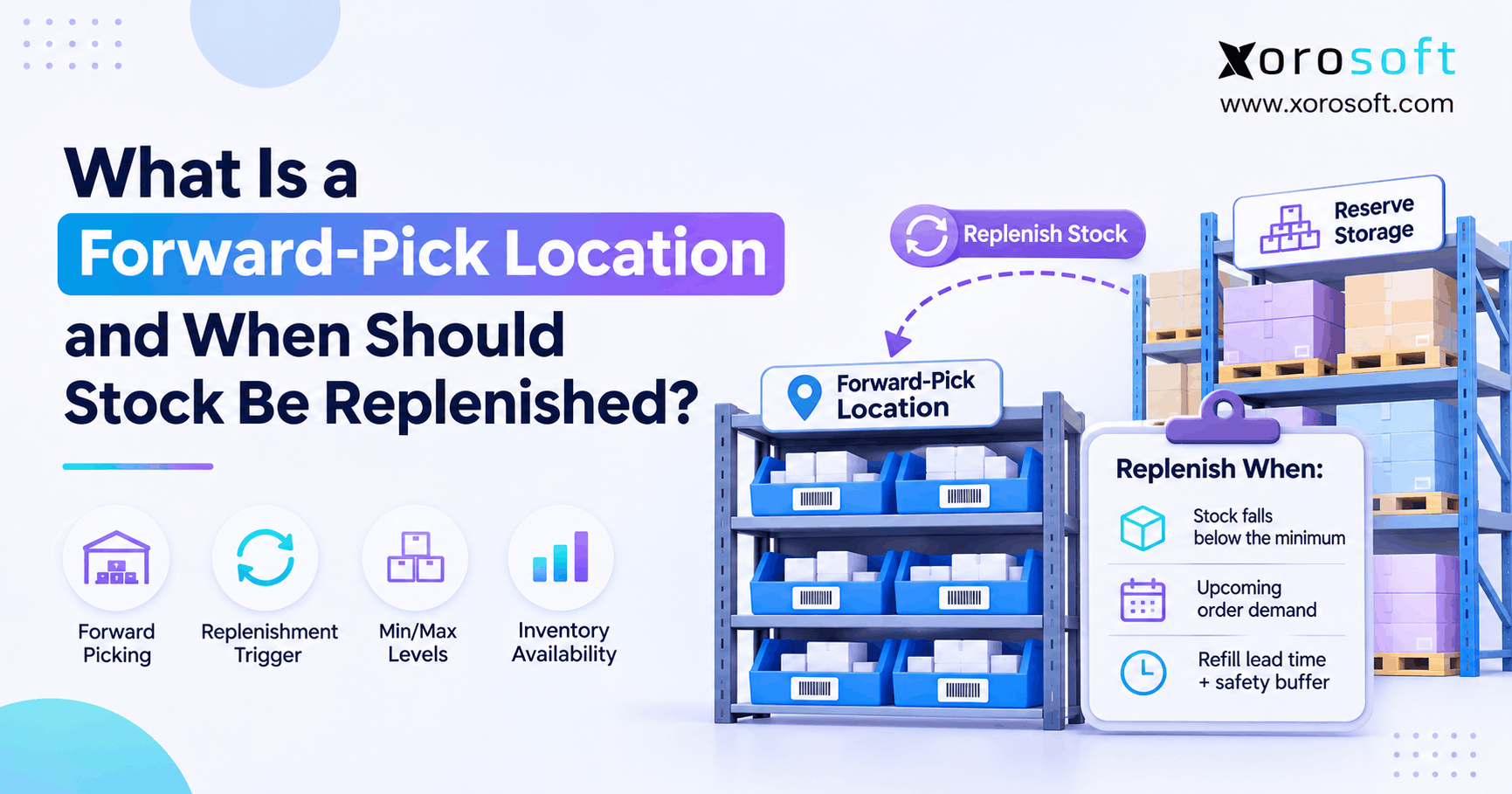
A forward pick location is an accessible warehouse bin, shelf, or pallet position where workers collect products for orders. However, having stock somewhere in the building does not guarantee that this location is ready for picking. Consequently, late replenishment can stall order lines even while reserve racks hold plenty of the same SKU.
For example, a distributor might have 480 units in reserve but only eight units in its active pick bin. Meanwhile, the next order wave requires 60 units. Unless the team moves stock before that wave begins, pickers face an avoidable interruption. Therefore, the key question is not simply how much inventory the business owns; it is when that inventory becomes available at the picking location.
1.1 Why a Full Reserve Rack Can Still Cause a Missed Pick
For example, reserve stock may sit high in pallet racking, require lift equipment, or carry a status that prevents immediate allocation. Consequently, a worker cannot always substitute reserve inventory for missing forward stock. Moreover, even if a pallet is nearby, an unrecorded transfer may create inaccurate location balances and extra reconciliation work.
1.2 What a Reliable Forward Pick Location Changes
A reliable forward pick location has a clear SKU assignment, usable capacity, an authorized source for refills, and a trigger that accounts for demand. As a result, workers can follow a predictable pick route while replenishment teams keep the active bin ready.
This guide explains those controls, their calculations, and the situations in which a separate pick face is unnecessary.
2. Forward Pick Location Basics: Where Picking Happens
A forward pick location prioritizes access rather than maximum storage density. Typically, fast-moving units are placed at a convenient picking height or in another position that suits their handling requirements. By contrast, reserve storage often prioritizes holding more cases or pallets in less accessible positions.
2.1 The Job of a Forward Pick Location
The forward pick location holds a working quantity of a SKU for everyday order fulfillment. For instance, small accessories may sit in labeled shelf bins, while full cases may occupy ground-level pallet slots. Although the physical format changes, the operational requirement stays the same: employees must be able to find and pick eligible stock safely.
Moreover, every forward pick location creates a replenishment responsibility. However, if stock leaves the active area faster than it returns, the location becomes a bottleneck. Therefore, location planning and refill planning must be designed together rather than managed as unrelated warehouse tasks.
2.2 How a Pick Face Differs From a Picking Zone
A pick face is the actual accessible position from which a worker takes stock. A forward picking zone contains multiple pick faces arranged around common workflows. Similarly, a fixed bin may belong to one SKU, whereas a dynamic location can change assignments as demand changes.
However, dynamic assignments require dependable records. Otherwise, a refill task may point to the wrong SKU or an inactive bin. Consequently, the warehouse should define location ownership before choosing its preferred slotting approach.
3. Forward Pick Location vs. Reserve Storage
A forward pick location and a reserve location can hold identical products, yet their purposes differ. The former supports repeat picking; the latter holds backup quantities or serves bulk orders. Therefore, the right warehouse design balances picking speed against the labor required to keep forward stock replenished.
| Operating factor | Forward pick location | Reserve storage |
|---|---|---|
| Main purpose | Frequent order picking | Bulk storage and refill supply |
| Typical quantity | Smaller working stock | Larger backup quantity |
| Access | Convenient for pickers | May require special equipment |
| Main movement | Picking and top-ups | Storage, transfers, or bulk picking |
| Main control | Pick-ready quantity | Source availability and accuracy |
3.1 What Belongs in a Forward Picking Area
For this reason, high-frequency products usually deserve the most accessible positions. For example, an apparel size that appears on hundreds of order lines may justify a permanent shelf location. In addition, small consumer products often benefit when workers can collect multiple items along one short route.
Nevertheless, the ideal location depends on dimensions, weight, packaging, and safety requirements. A fast-moving heavy case may need floor-level access instead of a small shelf. Therefore, sales volume alone should never determine the layout.
3.2 When Picking Directly From Reserve Is Better
By contrast, direct reserve picking can suit bulky furniture, low-demand products, or orders that regularly require full pallets. Because these items may be handled efficiently from their storage positions, a separate pick face might add an unnecessary transfer.
Similarly, a warehouse with few SKUs and modest daily volume may not gain enough travel savings to justify more bins. Compare avoided picking time with replenishment labor before assigning every product a dedicated forward location.
4. Which SKUs Deserve a Forward Pick Location?
Not every SKU needs a forward pick location. Instead, the best candidates combine frequent order-line demand with manageable replenishment effort. Therefore, classify products using actual pick history rather than relying only on monthly sales totals.
4.1 Score SKUs by Order-Line Frequency and Travel Time
For example, a product sold in five large wholesale orders might move more units than one sold across 150 ecommerce orders. However, the second product causes far more individual picks. Consequently, order-line frequency can be a better placement signal than total units shipped.
First, start with a simple ABC analysis based on pick frequency. Then, compare walking distance, units per line, and the number of refills required. For example, placing a high-frequency SKU closer to packing may save travel, but only if its bin can hold a reasonable working quantity.
4.2 Match Capacity, Handling, and Stock Controls
Moreover, each location must safely accommodate the product’s normal handling unit. For instance, cases of 24 units cannot be moved intact into a bin that fits only 15. Likewise, long or fragile products may require special racks rather than standard shelving.
In addition, lot, serial, expiry, and quarantine controls must follow the stock into the active picking area. Otherwise, a convenient location can create a compliance or accuracy problem. As a result, SKU suitability must account for both physical handling and inventory eligibility.
5. When Should a Forward Pick Location Be Replenished?
Replenish a forward pick location before expected demand consumes its pick-ready inventory during the time needed to complete a refill. Therefore, the trigger must consider stock on hand in the active bin, upcoming orders, refill lead time, and a safety buffer. Waiting until the location reaches zero is usually too late.
5.1 Set a Forward Pick Location Refill Trigger Early
A minimum threshold marks the point at which replenishment becomes necessary. However, a threshold of ten units is inadequate if workers can pick thirty units before the refill arrives. Instead, calculate the demand expected between detection and confirmed putaway, and then add a practical allowance for variation.
Furthermore, define whether the trigger is checked continuously, in batches, or at scheduled times. A correct threshold evaluated only once a day may still fail during a busy afternoon. Consequently, the review frequency matters almost as much as the number itself.
5.2 Replenish Forward Picking Bins Before Waves and Cutoffs
In addition, known order demand should influence refill timing. For example, if an upcoming wave requires 90 units but the assigned location holds only 35, a pre-wave top-up may prevent blocked picks. Likewise, carrier cutoffs make delays more expensive as the shipping window approaches.
However, replenishment must finish before the affected lines reach the pickers. Therefore, compare expected task completion time with the planned wave release. A task created at the last minute does not automatically make inventory pick-ready.
5.3 Check Existing Work Before Ordering Another Refill
An urgent request can create duplicate work if the team overlooks an open transfer. For instance, one employee may already be bringing two cases to the bin while another receives a fresh request for the same quantity. As a result, the destination may be overfilled or the stock record may become difficult to reconcile.
Instead, check pending replenishments and available capacity before issuing a new task. Where the software supports it, use open-work visibility; otherwise, maintain one shared, clearly owned task queue.
6. How to Calculate Forward Pick Replenishment Levels
Forward pick replenishment levels should reflect the speed of consumption and the entire transfer process. However, there is no single formula that fits every warehouse. Instead, the following planning approach provides a transparent starting point that operators can test against actual pick demand.
6.1 Calculate a Forward Pick Location Trigger
Use this simple planning calculation:
Replenishment trigger = (units picked per hour × total refill lead time in hours) + safety buffer.
For example, suppose a SKU moves at 24 units per hour, takes 90 minutes to replenish, and needs a 12-unit buffer. First, convert 90 minutes to 1.5 hours. Then, multiply 24 by 1.5 to obtain 36 units. Finally, add 12. Therefore, the result is a 48-unit trigger.
However, confirm whether your software evaluates physical quantity, eligible quantity, or another defined inventory balance. Also, test the rule during the busiest realistic picking periods rather than relying only on an average shift.
6.2 Calculate a Safe Top-Up Quantity
First, maximum capacity sets the ceiling for an ordinary top-up. For instance, if a bin safely holds 168 units and currently contains 42, the theoretical top-up is 126 units. Nevertheless, that quantity may not be practical when reserve inventory moves only in sealed cases.
| Example input | Value |
|---|---|
| Current eligible bin stock | 42 units |
| Safe maximum capacity | 168 units |
| Theoretical top-up | 126 units |
| Reserve case pack | 12 units |
| Ten full cases | 120 units |
| Resulting bin quantity | 162 units |
Consequently, ten cases fit without exceeding the maximum, while eleven cases would add too much. Although some operations allow split cases, the exception should follow documented handling rules.
6.3 Account for Case Packs and Pending Transfers
Before approving a refill, subtract any incoming quantities that the operation can reliably count toward that destination under its work rules. For example, if 24 units are already en route, creating a second full top-up could exceed capacity. Therefore, examine task status, source availability, and destination limits together.
In addition, do not treat damaged, held, or reserved inventory as freely available without checking the site’s eligibility rules. As a result, the system’s reported total should not replace a valid stock-status check.
Free ERP Readiness Assessment: Review whether your team knows each bin’s refill lead time, handling unit, minimum, maximum, and open-task status. If those answers rely on scattered spreadsheets, a structured readiness review can help define the process gaps before software selection.
7. Four Ways to Replenish Picking Locations
Warehouses can use threshold, demand-based, scheduled, and reactive methods. In practice, a mixed strategy often works best because routine consumption and sudden order spikes create different needs. For context, Microsoft’s replenishment overview documents min/max, wave-demand, load-demand, and immediate approaches.
| Method | Trigger | Best fit | Main risk |
|---|---|---|---|
| Min/max | Bin falls below a set minimum | Predictable demand | Check interval may be too slow |
| Order or wave demand | Released orders require more stock | Large known order waves | Refill may lag picking |
| Scheduled | Start of shift or planned time | Repeatable operating schedule | Sudden demand may be missed |
| Reactive | Worker reports a shortage | Small sites and exceptions | Picking has already been interrupted |
7.1 Min/Max Replenishment for Steady Demand
For example, min/max replenishment uses an established lower threshold and a safe upper target. Therefore, it suits SKUs with stable demand and repeatable refill times. For instance, a busy picking zone might receive routine top-ups before each shift.
However, thresholds do not guarantee execution. If the system identifies a low bin but the work sits unassigned, the picker can still run out. Consequently, measure completion time and stockout events, not only task creation.
7.2 Wave-Based Replenishment for Known Orders
By contrast, order-driven replenishment uses upcoming picks to identify the stock required at the active location. For example, a wholesale release may contain several large lines that exceed the usual min/max buffer. Accordingly, the warehouse can schedule targeted transfers before those lines are picked.
Nevertheless, wave timing and allocation settings vary by system. Therefore, verify that a test wave creates the appropriate work and that replenishment finishes before pick execution depends on it.
7.3 Scheduled and Reactive Forward Pick Replenishment
Finally, scheduled top-offs are straightforward: workers check priority bins before a shift or shipping cutoff. Meanwhile, reactive transfers handle surprises such as unexpected promotions or inaccurate balances. However, frequent emergency requests suggest that normal rules need adjustment.
Oracle’s replenishment documentation describes minimum-capacity, percentage-of-maximum, reactive, and order-based modes. Consequently, teams can use these documented categories as a checklist when evaluating how any warehouse system handles refill triggers.
8. How to Set Up a Forward Pick Location Correctly
A forward pick location needs more than a shelf label. First, define what can be stored there. Next, establish when it should be refilled. Finally, confirm which employee or system records the transfer. As a result, this sequence prevents location design from becoming disconnected from warehouse execution.
8.1 Label Each Forward Pick Location and Verify Capacity
First, assign a unique bin identifier, its permitted SKU or location profile, and the correct unit of measure. In addition, check usable capacity with actual cartons rather than relying solely on nominal shelf dimensions. Because safety limits may differ by product, do not copy one maximum quantity across every location.
Then, test whether a picker can access the stock without obstructing equipment routes or moving unrelated cartons. Consequently, a clear layout lowers search time and reduces the chance of selecting from an incorrect bin.
8.2 Standardize Reserve-to-Pick Replenishment Work
Use a consistent seven-step process:
- Detect a low-bin or upcoming demand condition.
- Check existing refill tasks for the same location.
- Identify eligible reserve stock.
- Assign the correct quantity and handling unit.
- Move stock safely to the destination.
- Confirm SKU, source, and destination when required.
- Validate the updated pick-ready balance.
As a result, each refill has an owner and a clear completion event. Xorosoft’s warehouse management software describes location tracking, barcode-based workflows, and replenishment functionality that operators can evaluate against this process.
8.3 Escalate Before the Shipping Window Closes
However, not all replenishment requests deserve the same priority. For instance, a bin supporting orders due in twenty minutes needs attention before one supporting tomorrow’s work. Therefore, rank tasks by time to stockout, affected orders, travel time, and resource availability.
However, prioritize safety and stock eligibility over speed. If the source stock is held or inaccessible, escalate the exception rather than bypassing controls.
Watch Demo: During a warehouse walkthrough, ask to see one entire refill from trigger through confirmed destination balance.
9. Why Forward Pick Locations Run Empty
An empty forward pick location does not always mean the business has insufficient inventory. Instead, the issue may be stock status, timing, wrong location data, or incomplete transfer confirmation. Therefore, the first diagnostic step is to trace the actual SKU and bin, not simply check the company-wide on-hand total.
9.1 Available Stock May Not Be Pick-Ready
For instance, reserve inventory can be allocated to another order, held for inspection, or physically stored in a different bin than the system records. In addition, a transfer can be in progress without having reached the pick face. Consequently, a healthy warehouse total does not prove that the next picker can collect the required units.
First, check the eligible reserve source, outstanding tasks, and actual destination balance. Then, reconcile the transaction history with the physical movement before adjusting the inventory number.
9.2 Fix Forward Picking Delays Instead of Raising All Buffers
A larger safety buffer can protect against normal variability. However, it cannot fix an unassigned task, wrong case-pack conversion, or missed destination confirmation. Therefore, identify the root cause before increasing location stock.
For example, repeated emergency refills may point to a threshold that is checked too infrequently. Similarly, frequent partial-case exceptions may reveal that the bin is too small. Xorosoft’s inventory and warehouse visibility can help support investigation, but accurate physical transactions and clear ownership remain essential.
10. Forward Picking Across Ecommerce and Wholesale Operations
The correct forward picking design depends on the orders a warehouse processes. For example, ecommerce operations often pick many individual units, while wholesale facilities may handle cases and pallets. Therefore, a shared SKU catalog can require different picking methods across channels or locations.
10.1 Forward Pick Locations for Shopify and Marketplace Orders
For instance, Shopify and marketplace orders can create frequent small picks across sizes, colors, or variants. Consequently, popular variations deserve their own accurate SKU-level assignments. However, a promotion can change demand quickly, so pre-wave checks may matter more than a fixed weekly refill schedule.
Xorosoft’s integrations overview provides context for connecting ecommerce channels and operational systems. In addition, the Xorosoft Shopify App Store listing is a relevant external resource for merchants researching how ecommerce orders connect with ERP workflows.
10.2 Bulk Picking and B2B Order Profiles
Similarly, wholesale orders may require full cases, pallets, customer-specific allocations, or EDI-driven fulfillment windows. As a result, transferring every case into an each-pick shelf may add labor without improving performance. Instead, use appropriate case-pick or pallet-pick positions when orders and handling rules support them.
Also, distinguish a large order from many small lines. A SKU with high units sold but few individual picks may not deserve the same prime shelf position as a frequently selected small item.
10.3 Industry Differences in Forward Pick Location Design
Apparel warehouses may prioritize size-and-color variants; sporting goods facilities may balance small accessories against larger cases. Meanwhile, furniture operators need safe access to bulky products, and food distributors must consider lot and expiry controls. Manufacturers may also move components to production supply points, although those tasks differ from customer-order picking.
Consequently, use the operating model—not a generic location template—to set capacity, stock eligibility, and replenishment cadence. Xorosoft serves several inventory-driven sectors, including those described on its industries page.
11. Measure Forward Pick Replenishment Performance
Ultimately, a useful dashboard should show whether products reached the picking area before workers needed them. However, counting completed replenishment tasks alone misses the operational outcome. Therefore, pair task metrics with actual picking interruptions and location accuracy.
11.1 KPIs That Reveal Poor Pick-Face Availability
Track a small group of consistent measures:
| Metric | Practical definition |
|---|---|
| Empty-bin event rate | Blocked pick attempts caused by insufficient eligible bin stock |
| On-time refill rate | Replenishments completed before the required picking time |
| Full refill lead time | Detection to confirmed pick-ready putaway |
| Emergency refill share | Unplanned urgent tasks divided by all refill tasks |
| Refill frequency | Number of transfers per SKU and shift |
In addition, record why each exception occurred. For example, distinguishing missing source stock from a late task makes corrective action more precise. Avoid using a single arbitrary benchmark for warehouses with different demand patterns.
11.2 Review Forward Picking Min/Max Levels as Demand Changes
Once a week or at another suitable operating cadence, review SKUs with frequent emergency refills, repeated overfills, or very low turnover in prime bins. Then, compare those exceptions against changes in orders, lead time, and usable capacity.
Furthermore, seasonal launches may justify temporary location changes. As demand slows, release unneeded prime space rather than continuing to replenish an oversized location. Consequently, slotting becomes an ongoing operating decision rather than a one-time project.
12. Manual Refills vs. WMS-Controlled Replenishment
For example, manual replenishment can work when a site has few locations, clear routines, and predictable demand. However, as order volumes grow, teams may struggle to see which bins are low, which tasks are already open, and which transfers are overdue. Therefore, choose technology based on actual coordination problems rather than on warehouse size alone.
12.1 When a Manual Checklist Still Works
For instance, a small team can use labeled shelves, visual minimum markers, cycle counts, and a shared refill log. For example, a scheduled check before each shift may keep a limited catalog ready. Nevertheless, the process needs clear responsibility and a reliable way to update location balances.
If supervisors must repeatedly investigate missing cartons or duplicate requests, the manual method may no longer be sufficient. Consequently, document the failures before evaluating automation.
12.2 When to Automate a Forward Pick Location
Consider a WMS when pick interruptions recur, replenishment work spans several shifts, or several workers compete for the same reserve stock. In addition, multi-warehouse operations need consistent inventory status without treating every location as interchangeable.
When evaluating options, test the exact refill workflow with real SKUs, case packs, and order waves. Xorosoft combines WMS functionality with cloud ERP operations; however, buyers should verify their required trigger rules, approvals, and exception handling in a tailored demonstration.
13. Connect Replenishment With Inventory, Purchasing, and Orders
First, warehouse replenishment moves existing stock into a picking position. By contrast, purchasing replenishment obtains additional inventory from suppliers. Because these activities work on different lead times, teams must not treat an empty pick face as automatic evidence that a new purchase order is needed.
13.1 Separate Internal Pick-Face Refills From Supplier Reorders
For example, suppose a warehouse has 500 eligible units in reserve and zero units in its assigned pick bin. First, request an internal transfer. By contrast, if total usable inventory cannot cover projected sales before the next supplier receipt, purchasing may need to reorder.
Therefore, operations should share accurate demand and stock records while keeping the transactions distinct. Otherwise, businesses risk both emergency picking delays and excess external purchases.
13.2 Evaluate the Connected ERP and WMS Workflow
A connected platform can make it easier to trace how orders, inventory movements, warehouse tasks, and purchasing decisions relate. For example, Xorosoft’s cloud ERP solution combines inventory, purchasing, accounting, warehouse management, and reporting within a broader operational system.
However, software should support established warehouse controls, not replace them. Before choosing any system, confirm how it handles stock-status changes, location assignments, replenishment work, and exceptions. Above all, test whether workers can verify the correct item in the correct bin at the correct time.
14. Keep Forward Pick Locations Ready Without Overfilling Them
A forward pick location delivers value when it removes unnecessary travel without creating constant refill emergencies. Therefore, assign the right SKUs, set realistic location capacity, and trigger replenishment before demand consumes the working stock. Also, check open tasks and source eligibility before creating another transfer.
Ultimately, the goal is not to fill every bin to the top; it is to keep inventory pick-ready with controlled handling. If your team needs to connect warehouse execution with inventory, ecommerce, and purchasing, Xorosoft offers a practical ERP and WMS option to evaluate.
Book a Demo to review your warehouse requirements and see whether the proposed workflow fits your operation.
Frequently Asked Questions
What is a forward pick location?
A forward pick location is an accessible warehouse bin or shelf used for everyday order picking. Reserve storage holds additional stock, while replenishment keeps the active location ready for workers.
When should a forward pick location be replenished?
Replenish before expected picks exhaust available bin stock during the refill lead time. Consider consumption rate, upcoming orders, task completion time, and a reasonable buffer rather than waiting for zero.
How do you calculate a replenishment trigger?
Multiply the expected pick rate by the full refill lead time, then add a safety buffer. Validate the result against demand spikes, physical capacity, and your warehouse’s actual inventory rules.
How is forward picking different from reserve storage?
Forward picking prioritizes convenient access for repeated order picks. Reserve storage prioritizes larger quantities and bulk efficiency. Consequently, warehouses transfer eligible stock from reserve when active pick bins need refilling.
Which SKUs need forward picking locations?
Products with frequent order lines and manageable handling requirements are strong candidates. However, slow movers, bulky products, and full-pallet items may be more efficient to pick directly from reserve.
Can a warehouse replenish picking bins without a WMS?
Yes. Small operations can use labeled bins, scheduled checks, and documented transfers. Nevertheless, growing order volumes often make task visibility, barcode verification, and location-level inventory controls more valuable.
Why do picking locations run empty despite reserve stock?
Refills may trigger late, remain unassigned, or fail confirmation. In addition, reserve stock may be allocated or restricted. Check the specific SKU, source status, pending tasks, and destination balance.
Recent Posts
-
 WMS for Footwear Brands Managing Launch-Day Order Waves
-
 Shopify Delivery-Cost Mapping Benchmarks 2026: Allocation, Errors, and Reconciliation
-
 Revenue vs Gross-Margin Commission Plans for Distributors
-
 How to Run an ERP Conference Room Pilot With Real Business Scenarios
-
 Inventory Reserve Accounting: How Risk Becomes a Financial Estimate