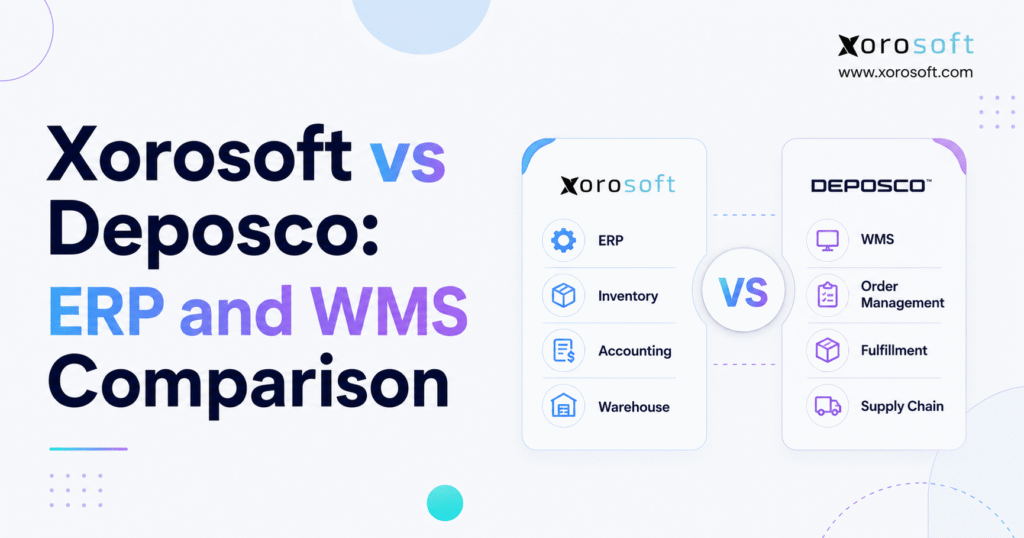
In this article, we’ll provide a detailed comparison of Xorosoft vs Deposco to help you make an informed decision.
1. ERP vs WMS Decisions Start With the Business Problem
1.1 Why Growing Inventory Businesses Outgrow Their Software Stack
Most product businesses do not replace software because one application suddenly stops working. Instead, problems appear slowly.
At first, the company may use an ecommerce platform, accounting software, spreadsheets, and a basic inventory tool. That setup can work well when order volume is manageable. However, as the business grows, more systems are often added. A warehouse application may come next. Then EDI may be required for wholesale customers. Marketplace integrations may follow. Purchasing teams may also build their own spreadsheets.
As a result, the company eventually has several systems that each solve one part of the operation.
The problem is not always the quality of those applications. Instead, the problem is how they work together.
For example, inventory may show one quantity in the warehouse system and another in accounting. Purchasing may rely on a spreadsheet that does not reflect current sales. Meanwhile, ecommerce orders may need manual fixes before they can be shipped.
Therefore, a software review should start with the operating problem, not with a list of features.
1.2 ERP and WMS Software Solve Different Problems
An enterprise resource planning system manages a broad set of business processes. These can include inventory, accounting, purchasing, sales, manufacturing, planning, and reporting.
A warehouse management system has a narrower focus. It manages the physical flow of goods through warehouses. Therefore, its core processes often include receiving, putaway, replenishment, picking, packing, shipping, and cycle counting.
The two categories overlap. However, they are not the same.
For example, both systems may show inventory quantities. Still, the ERP may use that inventory data for purchasing and accounting, while the WMS uses it to guide warehouse work.
This difference becomes important when a company decides whether to replace several systems or improve one part of the existing stack.
1.3 The Real ERP vs WMS Buying Question
A company with a strong ERP may not need another ERP simply because warehouse operations have become more complex. Instead, it may need deeper warehouse tools that connect to the ERP it already uses.
On the other hand, some companies have a much wider problem. Accounting is separate from inventory. Purchasing is manual. Warehouse activity lives in another system. Manufacturing may use spreadsheets. In addition, ecommerce and wholesale orders may follow different processes.
In that case, improving warehouse execution alone may not solve the larger issue.
Therefore, the real question is:
Does the business need deeper warehouse execution, or does it need a broader system that connects warehouse operations with accounting, purchasing, inventory, manufacturing, and sales?
That question is the best starting point for an ERP and WMS comparison.
2. Xorosoft vs Deposco: ERP and WMS Comparison at a Glance
2.1 The Main Xorosoft vs Deposco Difference
The core difference in a Xorosoft vs Deposco comparison is the role each platform is designed to play.
Deposco is strongly focused on warehouse management, order management, distributed order management, fulfillment, shipping, and supply-chain planning.
Xorosoft takes a broader ERP approach. Its platform connects inventory, warehouse management, accounting, purchasing, manufacturing, ecommerce, forecasting, EDI, B2B, and reporting.
Therefore, the products overlap in several areas, but they approach those areas from different directions.
| Business Area | Xorosoft | Deposco |
|---|---|---|
| Main focus | Cloud ERP and connected operations | WMS, OMS and fulfillment |
| Inventory management | Yes | Yes |
| Warehouse management | Yes | Yes |
| Order management | Yes | Yes |
| Distributed order management | Evaluate requirements | Core focus |
| Accounting | Integrated ERP capability | Usually connected to another ERP/accounting layer |
| Purchasing | ERP-connected purchasing | Supply-chain sourcing and planning |
| Manufacturing | ERP manufacturing | Not the main platform focus |
| Ecommerce | Connected to wider ERP workflows | Fulfillment and order routing |
| Multi-warehouse | Yes | Yes |
| Best fit | Broader system consolidation | Specialized supply-chain execution |
2.2 Why Feature Count Alone Can Mislead Buyers
A platform can technically support a process without being built around that process.
For example, both products may work with inventory and warehouses. However, a fulfillment-focused platform may go deeper into warehouse tasks and order routing. Meanwhile, an ERP-focused system may provide stronger links between inventory, accounting, purchasing, and manufacturing.
Consequently, buyers should ask how each feature fits into the wider system.
The right question is not, “Does the software have inventory management?”
Instead, ask, “What happens when inventory changes, and which other parts of the business see that change?”
3. Deposco WMS and OMS: A Supply-Chain Execution Approach
3.1 Deposco Warehouse Management Software
Deposco is designed around supply-chain execution, and warehouse management is a major part of its platform.
Its WMS capabilities focus on the daily work inside a warehouse. These workflows include receiving, putaway, replenishment, picking, packing, shipping, and inventory control.
In addition, companies with high fulfillment volume often need more than basic warehouse functions. They may require different picking methods, better task control, automation, carrier connections, and more detailed fulfillment rules.
Therefore, Deposco can be relevant when warehouse speed and order flow are central to the software project.
3.2 Deposco Order Management and DOM
Deposco also places strong emphasis on order management and distributed order management.
Distributed order management becomes important when a company can fulfill an order from several locations. For instance, inventory may be available in two warehouses, a store, or another fulfillment point.
In that situation, the system needs to decide where the order should be fulfilled.
Therefore, DOM can help companies manage factors such as inventory availability, fulfillment location, cost, and delivery speed.
This capability is especially useful for retailers and distributors with complex fulfillment networks.
4. Xorosoft ERP and WMS: A Connected Operations Approach
4.1 XoroONE for Inventory-Driven Businesses
XoroONE takes a broader approach to business operations.
Rather than treating warehouse management as a separate layer, it connects inventory with accounting, purchasing, manufacturing, ecommerce, B2B, EDI, forecasting, and reporting.
As a result, an inventory transaction can affect more than the warehouse.
For example, receiving goods may update inventory and purchasing records. Shipping an order may affect inventory, customer records, and financial reporting. Likewise, manufacturing can consume raw materials while creating finished goods.
This shared flow can be useful for businesses that want fewer handoffs between separate systems.
4.2 XoroERP for Broader ERP Requirements
XoroERP is designed for companies that need broader enterprise functions rather than warehouse management alone.
Accounting, purchasing, inventory, reporting, and operational workflows can work within the same system.
Therefore, XoroERP may be relevant when the project includes replacing accounting-first software, spreadsheet-based purchasing, or several disconnected operational applications.
4.3 XoroWMS for Warehouse Management
XoroWMS is the warehouse-focused part of the Xorosoft product family.
It supports warehouse inventory, receiving, picking, packing, shipping, and related fulfillment work.
However, its key difference is the wider environment around it. When required, warehouse activity can connect with broader ERP workflows instead of operating as a separate island.
5. ERP vs WMS: When Each Software Model Makes Sense
5.1 When a Dedicated WMS May Be the Better Fit
A dedicated WMS often makes sense when the current ERP is already working well.
For example, finance may be satisfied with the existing ERP. Purchasing may also be under control. However, warehouse teams may struggle with picking efficiency, replenishment, task management, routing, or automation.
In that case, replacing the whole ERP may create unnecessary work.
Instead, the company can focus on the part of the operation that needs improvement.
Therefore, an execution-focused WMS and OMS platform such as Deposco can make sense when warehouse and fulfillment needs are the main reason for the project.
5.2 When ERP With WMS Becomes More Valuable
An ERP-centered approach becomes more attractive when problems extend beyond fulfillment.
For instance, the business may be running Shopify, accounting software, inventory software, a warehouse app, and spreadsheets. In addition, purchasing may happen outside the main system.
As a result, employees spend time moving data between tools.
In this case, faster picking alone does not solve the main problem. The larger issue is that sales, inventory, purchasing, warehouse activity, and finance do not share one operating model.
Therefore, ERP consolidation may create more value than simply adding another specialized application.
6. Xorosoft vs Deposco for Inventory and Multi-Warehouse Management
6.1 Inventory Visibility Across Locations
Inventory visibility becomes harder as companies add warehouses and channels.
A simple on-hand quantity is no longer enough. Instead, teams need to know what is available, committed, incoming, allocated, and ready to sell.
In addition, the answer may differ by warehouse, channel, or customer.
Xorosoft connects inventory with purchasing, warehouse management, manufacturing, accounting, and sales. Therefore, inventory can be viewed as part of the wider business process rather than only as warehouse stock.
Deposco uses inventory data heavily across fulfillment, warehouse execution, order routing, and supply-chain planning.
Both approaches can support multi-location operations. However, buyers should test the workflows that matter most to their business.
6.2 Multi-Warehouse ERP and WMS Requirements
Supporting more than one warehouse is not the same as managing a true warehouse network.
As warehouse count grows, companies must decide where stock should be purchased, where it should be stored, and which location should fulfill each order.
They may also need transfers, safety stock rules, location-level replenishment, and better allocation.
Therefore, buyers should test actual multi-warehouse scenarios.
For example, what happens when one warehouse runs out of stock but another location has enough inventory? How does the system handle transfers? How does purchasing respond?
Those questions reveal more than a simple “multi-warehouse supported” checkbox.
7. Xorosoft vs Deposco WMS for Receiving, Picking and Shipping
7.1 Receiving and Putaway
Receiving is one of the most important warehouse processes because bad data at receiving can affect every later step.
A strong process should support purchase-order receiving, partial receipts, quantity checks, barcode scanning, and exception handling.
After receiving, putaway determines where goods should be stored.
Therefore, warehouse teams should examine whether the system can guide workers to suitable locations and whether those movements update inventory immediately.
Deposco is built strongly around these warehouse execution tasks.
Meanwhile, XoroWMS connects receiving and warehouse activity with the broader Xorosoft ERP environment.
7.2 Picking, Packing and Shipping
Picking strategy becomes more important as order volume increases.
A small warehouse may use simple picking methods. However, a larger operation may need zones, batches, waves, priorities, or other ways to organize work.
Packing and shipping also need accurate handoffs.
For example, the system may need to confirm picked items, create shipping labels, update the order, reduce inventory, and pass tracking information back to the sales channel.
Therefore, buyers should demo real warehouse scenarios instead of relying on feature lists.
8. OMS and Distributed Order Management in the Xorosoft vs Deposco Comparison
8.1 Why DOM Matters for Omnichannel Businesses
A WMS decides how work happens inside a warehouse. However, an OMS or DOM layer can decide which warehouse should receive the work in the first place.
That difference is important.
For example, an ecommerce order could be shipped from the nearest warehouse, the location with the most stock, or the location that can meet a delivery promise at the lowest cost.
Deposco places strong emphasis on these order-routing use cases.
Therefore, companies with stores, several warehouses, or a complex fulfillment network should look closely at DOM depth.
8.2 When ERP Order Management Matters More
Other companies have a different priority.
They may care less about complex routing and more about what happens after an order enters the business.
For example, the order may affect customer credit, inventory allocation, purchasing, warehouse work, invoicing, accounting, and margin reporting.
In that case, the value comes from connecting the order with the wider ERP process.
Therefore, the right choice depends on whether order routing or end-to-end business integration matters more.
9. Xorosoft vs Deposco for Accounting, Purchasing and Manufacturing
9.1 Accounting as an ERP vs WMS Divider
Accounting is one of the clearest differences between an ERP-centered system and a warehouse-centered system.
A WMS may provide detailed information about inventory movements. However, accounting must record the financial effect of those movements.
For instance, inventory receipts affect assets and supplier obligations. Shipments affect inventory and cost of goods sold. Returns can affect both stock and revenue.
Xorosoft includes finance as part of its ERP environment. Therefore, operational and financial events can remain closer together.
This can be useful for businesses that are also trying to replace accounting software or reduce month-end reconciliation work.
9.2 Purchasing and Supplier Management
Purchasing should also be viewed as a full process.
It starts with demand. Then the business decides what to buy, when to buy it, and which supplier should provide it.
After that, the purchase order leads to receiving, inventory, vendor billing, and payment.
Deposco includes sourcing and supply-chain planning capabilities. Meanwhile, Xorosoft ties purchasing into the broader ERP flow.
Therefore, the better fit depends on whether the business mainly needs supply planning or wider ERP control.
9.3 Manufacturing ERP Requirements
Manufacturing adds another level of complexity.
Raw materials become finished goods. Components are consumed. Work orders must be tracked. In addition, businesses may need BOMs, production planning, material requirements, and costing.
Xorosoft includes manufacturing as part of its wider ERP model.
Therefore, manufacturers should give production requirements significant weight when comparing ERP and WMS systems.
10. Shopify ERP, Wholesale and EDI Requirements
10.1 Xorosoft vs Deposco for Shopify Operations
Shopify is the storefront, but growing merchants often need much more behind it.
Orders must be fulfilled. Inventory has to stay accurate. Purchasing must keep stock available. Returns need to update inventory. Meanwhile, finance needs accurate revenue, costs, and inventory value.
The official Xorosoft ERP app on the Shopify App Store connects Shopify with broader ERP operations.
Therefore, it may be relevant when Shopify is only one part of a larger operating environment.
Deposco can also support Shopify-centered businesses. However, its value is more closely tied to warehouse execution, order management, and fulfillment routing.
10.2 Wholesale ERP and EDI
Wholesale businesses often deal with larger orders, customer-specific terms, EDI, allocations, backorders, and complex purchasing.
As a result, warehouse management alone may not be enough.
The system may also need to connect B2B sales with accounting, purchasing, inventory, and supplier management.
Companies in wholesale, apparel, furniture, sporting goods, food, and manufacturing can review Xorosoft’s broader industry solutions to see how those workflows differ by business type.
11. ERP and WMS Integration, Implementation and Total Cost
11.1 Best-of-Breed vs Unified ERP Architecture
A best-of-breed software stack can be powerful.
For example, a company may use one system for ecommerce, another for ERP, another for WMS, and another for EDI.
Each system can be strong in its own area.
However, the tradeoff is integration work. Orders, inventory, customers, suppliers, and financial data must move between systems.
Therefore, the business must decide where the official record lives and who owns integration errors.
A more unified ERP model reduces some of those handoffs. However, buyers still need to confirm that built-in functionality is deep enough for their needs.
11.2 ERP and WMS Implementation Scope
Implementation should be part of the software decision from the beginning.
A WMS project may require warehouse setup, locations, scanning, process design, ecommerce connections, and ERP integrations.
By contrast, a full ERP project may also require accounting migration, supplier data, customer data, historical balances, purchasing processes, and manufacturing records.
Therefore, companies should compare total project scope rather than license price alone.
11.3 Total Cost of Ownership
Subscription cost is only one part of total cost.
Implementation, integrations, training, internal project time, hardware, maintenance, and future changes can all matter.
Consequently, a lower software price does not always mean a lower total cost.
Likewise, a larger ERP does not automatically create savings simply because it replaces more systems.
The best comparison is based on the complete target system.
12. Xorosoft vs Deposco Decision Framework by Business Type
12.1 When Deposco May Fit Better
Deposco should be high on the shortlist when fulfillment execution is the main business problem.
For example, the company may already have an ERP it plans to keep. However, it may need stronger warehouse workflows, better order routing, distributed fulfillment, or deeper supply-chain tools.
In that situation, a specialized WMS and OMS approach can make sense.
Therefore, Deposco may fit businesses where warehouse and fulfillment complexity are more important than replacing the financial or enterprise system.
12.2 When Xorosoft May Fit Better
Xorosoft becomes more relevant when the company is trying to connect several business functions at once.
For example, accounting may be separate from inventory. Purchasing may still rely on spreadsheets. Shopify, wholesale, manufacturing, and warehouse activity may also sit in different tools.
In that situation, a broader ERP can reduce the number of systems that employees must manage.
Businesses considering a full ERP replacement can also review the Xorosoft vs NetSuite comparison to understand how a full ERP comparison differs from an ERP vs WMS decision.
13. Xorosoft vs Deposco FAQs for ERP and WMS Buyers
13.1 What is the main difference between Xorosoft and Deposco?
Xorosoft is built around a broader ERP model that connects inventory, accounting, purchasing, warehouse management, manufacturing, ecommerce, and reporting. Deposco is more focused on WMS, OMS, DOM, fulfillment, and supply-chain operations. Therefore, the best fit depends on whether the project is enterprise-wide or mainly fulfillment-focused.
13.2 Is Deposco an ERP?
Deposco is not positioned mainly as a traditional financial ERP. Instead, its focus is warehouse management, order management, fulfillment, shipping, supply-chain planning, and related operations. Therefore, companies should consider how Deposco will connect with their existing accounting or ERP system.
13.3 Is Deposco a WMS?
Yes. Warehouse management is one of Deposco’s core areas. Its platform supports warehouse processes such as receiving, putaway, replenishment, picking, packing, shipping, and inventory control. In addition, it supports broader order and fulfillment workflows.
13.4 Is Xorosoft an ERP?
Yes. Xorosoft provides cloud ERP software for inventory-driven businesses. Its platform connects inventory, accounting, purchasing, warehouse management, manufacturing, ecommerce, forecasting, EDI, B2B operations, and reporting.
13.5 Does Xorosoft include warehouse management?
Yes. Xorosoft provides warehouse management through its broader product platform and XoroWMS. As a result, warehouse processes can connect with inventory, purchasing, sales orders, manufacturing, accounting, and reporting.
13.6 Which is better, Xorosoft or Deposco?
Neither platform is better for every business. Deposco may suit companies that need deep WMS, OMS, DOM, and fulfillment tools. Xorosoft may suit companies that want warehouse management connected with accounting, purchasing, manufacturing, ecommerce, and inventory in a broader ERP.
13.7 Can ERP replace a WMS?
Sometimes. An ERP with strong warehouse functions may be enough for businesses with moderate warehouse complexity. However, highly complex fulfillment operations may still benefit from a dedicated WMS. Therefore, buyers should test real warehouse workflows before deciding.
13.8 Can a WMS replace an ERP?
Usually not if the company needs accounting, financial reporting, broad purchasing controls, manufacturing, and other enterprise functions. A WMS can manage warehouse execution very well, but it does not automatically replace the wider role of ERP.
13.9 Do businesses need both ERP and WMS?
Some businesses do. For example, a company may keep an existing ERP and add a dedicated WMS for deeper warehouse execution. Other companies may use warehouse management inside a broader ERP. Therefore, the right setup depends on warehouse complexity and current systems.
13.10 When should a company consider Deposco?
Deposco may be a strong fit when warehouse execution, omnichannel fulfillment, distributed order management, order routing, or supply-chain planning are major requirements. It is especially relevant when the existing ERP will remain in place.
13.11 When should a company consider Xorosoft?
Xorosoft is relevant when inventory connects several business problems at once. For example, the company may need to improve accounting, purchasing, warehouse operations, manufacturing, ecommerce, EDI, and reporting within one broader system.
13.12 Is Xorosoft a Deposco alternative?
It can be, although the products are not exact matches. Xorosoft is more ERP-centered, while Deposco is more WMS and OMS-centered. Therefore, buyers should first decide whether they need broad system consolidation or specialized supply-chain execution.
13.13 What are some Deposco alternatives?
The right alternative depends on the project. ERP-focused buyers may also look at NetSuite, Acumatica, Microsoft Dynamics 365 Business Central, Sage, or similar ERP platforms. Meanwhile, warehouse-focused buyers should compare specialized WMS and OMS products.
13.14 Is Xorosoft suitable for Shopify businesses?
Yes. Xorosoft offers a Shopify ERP integration that connects Shopify with inventory, warehousing, purchasing, manufacturing, financials, and other operations. Therefore, it may be useful when Shopify is one sales channel inside a larger business system.
13.15 Does Deposco work with Shopify?
Yes. Deposco supports Shopify-related fulfillment workflows. It can be especially relevant for merchants that need stronger warehouse execution, inventory visibility, order management, and distributed fulfillment.
13.16 Which system is better for multi-warehouse inventory?
Both platforms can support multi-location operations. However, the better fit depends on the goal. Deposco may suit complex fulfillment networks, while Xorosoft may suit businesses that want multi-warehouse inventory tied more closely to purchasing, accounting, manufacturing, and reporting.
13.17 Which platform is better for manufacturing?
Manufacturing is more central to Xorosoft’s ERP model. Therefore, businesses that need BOMs, work orders, production planning, material requirements, inventory, purchasing, warehouse management, and accounting in one system should examine Xorosoft closely.
13.18 Which platform is better for accounting?
Accounting is more directly part of Xorosoft’s ERP environment. Consequently, companies that want inventory and warehouse activity tied to financial reporting may place more weight on Xorosoft. Deposco is generally evaluated alongside an existing financial or ERP system.
13.19 Which platform is better for order routing?
Deposco deserves close attention when distributed order management and complex fulfillment routing are central requirements. In contrast, Xorosoft may be more relevant when order processing must connect closely with accounting, purchasing, inventory, and other ERP functions.
13.20 What should wholesale distributors compare?
Wholesale distributors should compare inventory allocation, EDI, purchasing, warehouse management, customer pricing, backorders, accounting, and reporting. In addition, they should review how easily data moves between B2B sales, warehouse teams, suppliers, and finance.
13.21 When has a company outgrown QuickBooks and spreadsheets?
Common warning signs include frequent inventory fixes, spreadsheet purchasing, slow month-end reporting, duplicate data entry, several warehouses, manufacturing needs, and employees manually moving information between systems. At that point, the business should consider whether a broader ERP would reduce manual work.
13.22 What should buyers ask during an ERP or WMS demo?
Buyers should use real scenarios. For example, test partial receipts, stock shortages, split shipments, returns, warehouse transfers, supplier delays, and failed integrations. For ERP evaluations, also test accounting, purchasing, costing, manufacturing, and reporting.
13.23 Is system consolidation always better?
No. A unified system can reduce duplicate data and integration work. However, specialized applications may provide deeper features in important areas. Therefore, businesses should decide whether the extra depth is worth managing another application and integration.
13.24 What is the best ERP and WMS setup for Shopify?
There is no single best setup for every Shopify merchant. Smaller businesses may only need inventory tools. However, growing merchants may need ERP, WMS, OMS, or a mix of those systems depending on warehouse complexity, accounting, purchasing, manufacturing, and fulfillment requirements.
13.25 How should a company make the final Xorosoft vs Deposco decision?
Start with actual business workflows. Then score each platform against the processes that matter most. In addition, test exceptions, calculate total implementation cost, review integrations, and involve warehouse, finance, purchasing, ecommerce, operations, and IT teams before making the final decision.
14. Practical Takeaway: Choosing Xorosoft vs Deposco With the Right Priorities
14.1 Match the Software to the Problem You Need to Solve
The Xorosoft vs Deposco decision becomes easier when the company clearly defines the problem first.
If the current ERP works well but warehouse execution and order routing need improvement, a WMS and OMS-centered platform may be the logical direction. In that case, Deposco should be evaluated closely.
However, if inventory, accounting, purchasing, warehouse management, manufacturing, ecommerce, and reporting are spread across several tools, the project is broader. Therefore, a connected ERP approach may remove more friction.
Xorosoft is built around that wider model.
Businesses can explore XoroONE for a connected operating platform, XoroERP for broader ERP requirements, or XoroWMS when warehouse management is the immediate focus.
14.2 Use Real Workflows Before Making the Final Choice
Before selecting either platform, map the current process from customer order to financial reporting.
Then identify where delays, errors, manual work, and duplicate data occur.
For example, review inventory transfers, receiving, purchasing, Shopify orders, wholesale orders, warehouse picking, returns, manufacturing, vendor bills, and month-end reporting.
Next, ask each vendor to demonstrate those exact workflows.
This approach gives the buying team a much clearer view of fit than a long feature checklist.
14.3 Next Step for ERP and WMS Buyers
If your evaluation shows that the larger issue is system fragmentation rather than warehouse execution alone, the next step should be a requirements-based ERP review.
Instead of starting with a standard product demo, use your real warehouses, channels, inventory flows, purchasing rules, accounting needs, manufacturing processes, and integrations as the basis of the conversation.
You can contact Xorosoft to review those requirements and determine whether a connected ERP and WMS approach fits your operation.
Recent Posts
-
 ERP Landed Cost Module vs Spreadsheet Calculations for Importers
 -
 How to Build an Open-to-Buy Plan for an Omnichannel Brand
 -
 Cold Storage WMS for Food and Beverage Distribution
 -
 ERP Buying Statistics 2026: Evaluation, Implementation, and Adoption Risks
 -
 How a Distributor Reduced B2B Order Exceptions Without Restricting Sales