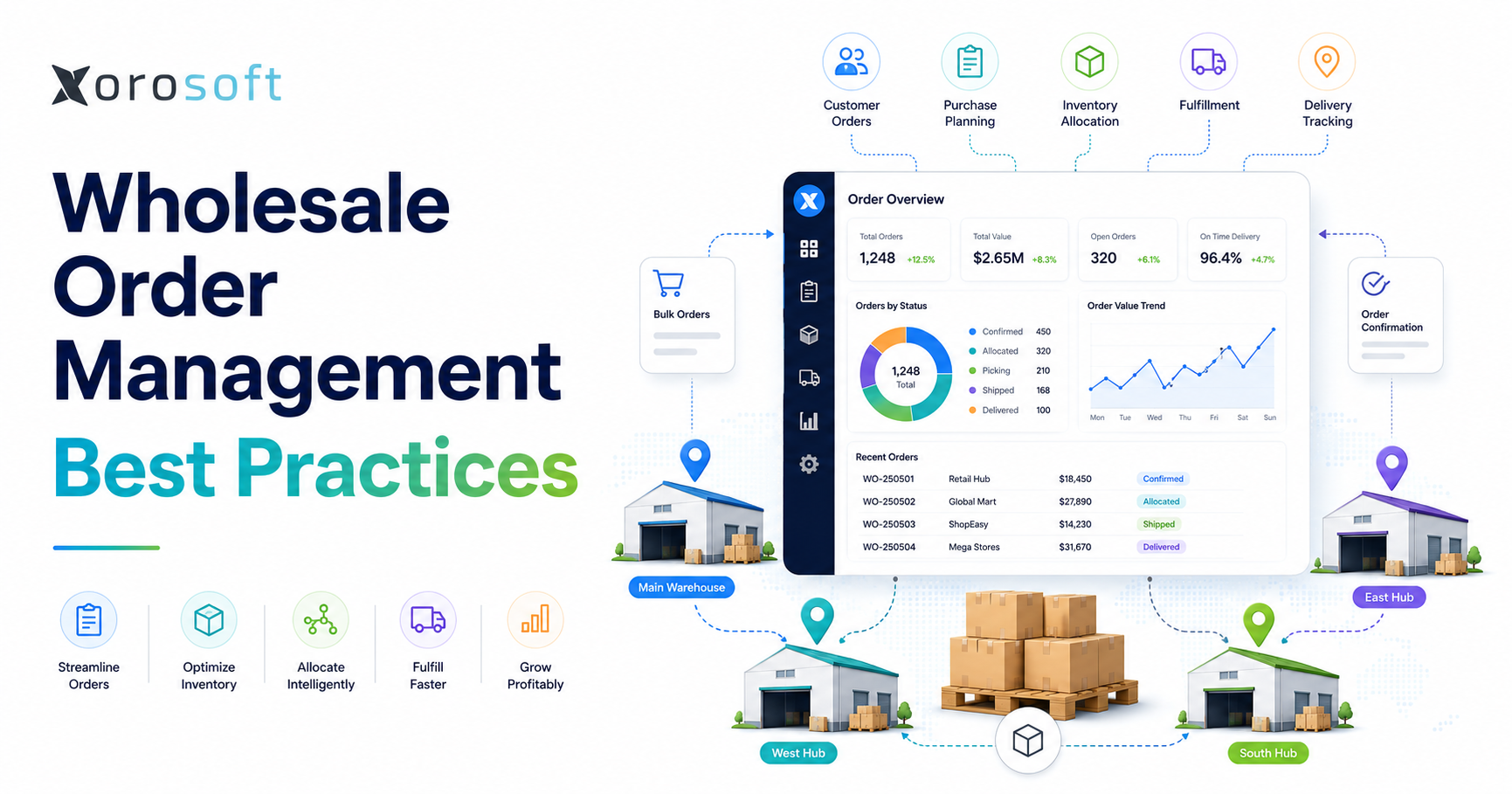
If you’re looking to optimise your processes, learning about wholesale order management best practices can significantly improve efficiency and accuracy.
1. Order Complexity Starts Affecting Service Before Growth Slows
Wholesale order management best practices become essential when a business adds more customers, products, warehouses, pricing agreements, and sales channels. Although transaction volume may still appear manageable, the number of decisions attached to each order often increases much faster.
For example, one customer may receive contract pricing, pallet-level quantities, 30-day payment terms, and scheduled delivery. Meanwhile, another account may order through a B2B portal and require specific labels, carton configurations, or shipping documents. At the same time, Shopify, Amazon, retail, and wholesale channels may compete for the same available inventory.
As these variables multiply, familiar tools begin showing their limitations. Sales representatives may promise products without current inventory visibility. However, warehouse employees might receive revisions after picking has already started. Purchasing teams, in turn, can struggle to separate urgent shortages from routine replenishment. Finally, finance may discover pricing or credit problems only after products have shipped.
Consequently, effective wholesale order management best practices prevent these issues from becoming accepted operating conditions. Instead, they create a controlled process in which customer data, pricing, inventory, warehouse execution, purchasing, and accounting remain connected.
1.1 Why Wholesale Order Complexity Grows Faster Than Volume
Ten identical transactions are usually easy to process. However, ten orders with different prices, delivery dates, payment conditions, packaging rules, and fulfillment locations are considerably harder.
Operational complexity grows when a company introduces:
- Customer-specific price lists
- Multiple units of measure
- Minimum order quantities
- Case-pack and pallet requirements
- Credit limits and approval rules
- Multiple warehouses
- EDI trading partners
- Ecommerce marketplaces
- Product substitutions
- Partial-shipment policies
- Customer routing guides
Each additional condition creates another decision before an order can move forward. As a result, the process becomes harder to control even when transaction volume rises only slightly.
Moreover, complexity rarely stays inside one department. A pricing exception may delay sales approval, while an inventory shortage may affect purchasing, fulfillment, and customer service. Therefore, wholesale order management must be treated as a cross-functional process rather than a basic sales administration task.
1.2 The Cost of Disconnected Wholesale Order Processing
Disconnected workflows create more than administrative inconvenience. In practice, they can produce inaccurate prices, duplicate orders, oversold inventory, delayed shipments, incomplete invoices, customer deductions, and unreliable reporting.
Employees also spend valuable time investigating routine questions:
- Is the quoted price still valid?
- Can the inventory still be promised?
- Has another sales channel reserved the stock?
- Is the customer within its credit limit?
- Which warehouse should fulfill the order?
- Has the backordered quantity been communicated?
- Did the shipment create the correct invoice?
Shared data and defined rules should answer these questions. Otherwise, teams must rely on emails, calls, spreadsheets, and personal knowledge. Over time, those workarounds create additional risk because important decisions remain outside the central business record.
Furthermore, disconnected processes make performance difficult to measure. If order status, inventory availability, warehouse activity, and invoicing sit in separate systems, managers cannot easily identify the true cause of delays. Consequently, teams may treat symptoms without fixing the underlying process.
1.3 Why Process Discipline Should Come Before Automation
Technology cannot compensate for unclear responsibilities. If employees do not know who approves pricing, releases credit holds, reallocates inventory, or communicates delays, automation may simply move the confusion into a new system.
Therefore, process ownership should come first. Each important decision needs a responsible role, a deadline, an escalation path, and a documented outcome.
Once those rules are clear, software can support them consistently. As a result, automation removes repetitive work without weakening operational control. In addition, employees gain a clearer understanding of what the system will handle and where human judgment is still required.
2. Wholesale Order Management Best Practices Across the Order Lifecycle
Wholesale order management covers the complete flow of a B2B transaction, from customer setup and order validation to inventory allocation, fulfillment, invoicing, payment, and returns. More specifically, account-based pricing, credit terms, warehouse requirements, backorders, and reporting all form part of the same process.
Because these activities cross several departments, wholesale order management best practices extend far beyond basic sales order entry. Instead, they provide a common operating framework for sales, customer service, purchasing, inventory planning, warehouse operations, and finance.
2.1 The Main Stages of B2B Order Management
A complete B2B order management workflow usually includes:
- Customer account setup
- Product and price configuration
- Order capture
- Product and quantity validation
- Price and discount validation
- Credit approval
- Available-to-promise inventory calculation
- Inventory reservation or allocation
- Warehouse routing
- Picking and packing
- Shipment confirmation
- Invoice generation
- Payment collection
- Return and credit processing
- Performance reporting
Although these stages may occur in different applications, they still form one operational process. Therefore, problems appear when systems cannot exchange accurate information or employees must transfer data manually.
For instance, an outdated price can delay approval, while an incorrect unit of measure may create a warehouse shortage. Similarly, an incomplete shipment update can prevent finance from issuing the correct invoice.
Ultimately, each stage depends on the accuracy of the stage before it. Consequently, businesses should improve the entire workflow rather than optimize isolated departments. Otherwise, a faster order-entry process may simply deliver incorrect information to the warehouse more quickly.
2.2 Wholesale Order Management Versus Retail Order Management
| Process area | Wholesale order | Retail order |
|---|---|---|
| Typical quantity | Cases, pallets, or bulk units | Individual units |
| Pricing | Contract, tiered, or negotiated | Published retail price |
| Payment | Credit terms may apply | Usually paid at checkout |
| Approval | Pricing and credit checks may apply | Usually automated |
| Product access | Customer-specific assortments | Public catalog |
| Fulfillment | Routing guides and appointments | Parcel delivery or pickup |
| Relationship | Account-based and recurring | Often transaction-based |
| Returns | Contractual and claim-driven | Standard consumer policy |
Retail operations generally prioritize rapid checkout and standardized fulfillment. By contrast, wholesale processing must manage account-specific arrangements and more complicated service commitments.
Moreover, wholesale customers often expect the same terms across repeated transactions. Consequently, a pricing or delivery mistake affects more than one purchase; it can damage an ongoing commercial relationship.
2.3 When Formal Wholesale Sales Order Management Becomes Necessary
A structured process becomes increasingly important when a business has:
- Multiple sales representatives
- Customer-specific prices
- Several order-entry channels
- More than one warehouse
- EDI customers
- Credit-based sales
- Frequent backorders
- Product substitutions
- Complex shipping requirements
- Separate inventory and accounting systems
Smaller wholesalers with simple pricing and limited volume may not need a complete ERP platform. Nevertheless, technology requirements grow as operational complexity and control needs increase.
Revenue alone does not determine system requirements. For example, a smaller company with thousands of SKUs and complex customer agreements may need stronger controls than a larger business with a simple product range.
Therefore, the right time to formalize the process is usually when manual coordination begins affecting service, accuracy, or reporting. At that point, adding more employees may reduce short-term pressure, but it rarely fixes the underlying workflow.
3. Map the Wholesale Order-to-Cash Workflow
To make wholesale order management best practices effective, businesses must map every approval, handoff, data source, and exception in the order-to-cash cycle. Without that visibility, teams may automate individual tasks while leaving the wider workflow disconnected.
A practical process map begins with customer setup and continues through order capture, credit review, inventory allocation, fulfillment, invoicing, payment collection, returns, and profitability reporting. In addition, the map should show where information enters the process and where employees re-enter or correct it.
3.1 Establish Customer Accounts and Commercial Terms
An approved customer account forms the foundation of the workflow. Therefore, the record should include:
- Legal and trading names
- Billing and shipping addresses
- Tax settings
- Ordering contacts
- Approved products
- Contract prices
- Payment terms
- Credit limits
- Carrier preferences
- Delivery instructions
- Documentation requirements
Changes should follow a controlled approval process. Otherwise, sales, warehouse, and finance teams may use different versions of the same customer information.
Temporary requirements should also have expiration dates. For example, a special shipping method created for one seasonal order should not remain active indefinitely.
In addition, customer records should identify who can place orders and who can approve them. This control becomes particularly important when several buyers operate under one company account. As a result, the business can support customer convenience without losing account-level governance.
3.2 Wholesale Order Processing Best Practices for Validation
Orders may arrive through email, phone, spreadsheets, sales representatives, a B2B portal, Shopify, Amazon, or EDI.
Regardless of the source, every transaction should be validated for:
- Active customer status
- Correct product numbers
- Valid units of measure
- Minimum order quantities
- Current pricing
- Approved discounts
- Available credit
- Inventory availability
- Shipping restrictions
- Requested delivery dates
The objective is not to create unnecessary approvals. Rather, it is to stop preventable errors before they reach the warehouse.
Whenever possible, routine checks should occur automatically. Material exceptions, however, should be routed to a named employee instead of disappearing into a shared inbox.
As a result, standard orders can move quickly while unusual transactions receive appropriate review. Moreover, the business can reduce manual work without giving up control over high-risk decisions.
3.3 Connect Credit Approval With Available-to-Promise Inventory
Credit and inventory checks should occur before an order receives a firm commitment.
Available-to-promise inventory differs from total on-hand stock because it considers reservations, confirmed orders, safety stock, quarantined items, incoming receipts, and transfers.
An order can therefore be commercially valid but operationally unavailable. That difference must be communicated before the customer expects delivery.
Likewise, sufficient stock does not automatically mean the order should be released. If the customer exceeds its credit limit, finance may require payment, a deposit, or management approval.
Accordingly, customer commitments should reflect both inventory availability and financial approval. Otherwise, a business may promise delivery for an order that cannot be released.
3.4 Keep Fulfillment, Invoicing, and Payment Connected
Once an order is approved and allocated, the selected warehouse can begin fulfillment. Shipment confirmation should update:
- Shipped quantities
- Remaining backorders
- Inventory balances
- Tracking numbers
- Freight charges
- Customer order status
- Invoice eligibility
- Cost of goods sold
Finance should not need to reconstruct shipment activity at month-end. Instead, operational and financial records should remain connected throughout the transaction.
Finally, payments, deductions, credits, and returns should link back to the original order. That connection makes it easier to understand the true profitability and service cost of each customer account.
Moreover, connected records provide a clearer audit trail. Consequently, disputes can be resolved using one consistent transaction history rather than several conflicting spreadsheets.
4. Wholesale Order Management Best Practices for Master Data
Reliable automation depends on accurate customer, product, pricing, and inventory records. Otherwise, technology simply moves incorrect information through the business more quickly.
For this reason, strong wholesale order management best practices begin with controlled master data. Every downstream decision, from pricing approval to warehouse picking, depends on those records being current, complete, and consistently maintained.
4.1 Maintain One Reliable Customer Record
Every department should work from the same customer account. Duplicate or incomplete records can create pricing discrepancies, incorrect credit exposure, shipping errors, and fragmented reporting.
Responsibility should be assigned for:
- Creating customer accounts
- Approving credit terms
- Updating addresses
- Maintaining price agreements
- Adding delivery instructions
- Deactivating obsolete records
Moreover, the customer master should not become a collection of informal notes that only one employee understands. Important requirements need structured fields, documented ownership, and an audit history.
Consequently, customer updates should follow a defined governance process rather than informal email requests. In addition, high-risk changes such as credit limits, tax settings, and payment terms should require approval.
4.2 Standardize Product and Unit-of-Measure Information
Wholesale businesses commonly buy, store, sell, and ship products in different units. A supplier might sell cartons, while the warehouse tracks individual pieces and the customer orders cases or pallets.
Each product record should define:
- Base unit
- Purchasing unit
- Sales unit
- Case quantity
- Inner-pack quantity
- Pallet quantity
- Weight and dimensions
- Barcode
- Lot or serial requirements
- Substitution rules
Incorrect conversions can affect pricing, inventory, picking, invoicing, and margin reporting. Therefore, unit relationships should be governed centrally.
For example, an order entered as 20 cases instead of 20 units could create a major inventory and financial error. A controlled conversion table, however, prevents employees from relying on memory. As a result, the same conversion rules apply across sales, purchasing, warehouse operations, and accounting.
4.3 Govern Customer-Specific Pricing
Wholesale pricing may include contract prices, quantity breaks, customer-group prices, promotions, channel-specific prices, freight allowances, rebates, currencies, and approved sales overrides.
Every pricing rule should have an owner, effective date, expiration date, eligible customer, and approval history.
Connected platforms such as XoroONE become relevant when a wholesaler needs customer, product, pricing, inventory, purchasing, warehouse, accounting, and reporting information to operate from a shared cloud ERP. In particular, Xorosoft is designed for inventory-driven companies that have outgrown disconnected accounting, ecommerce, and inventory applications.
Additionally, price changes should be tested before they become active. Otherwise, incorrect agreements may affect many customer orders at once. Therefore, companies should review upcoming and expired contracts regularly rather than waiting for a pricing dispute.
4.4 Wholesale Sales Order Management for Minimum Quantities
Minimum order values, minimum quantities, case sizes, and pallet requirements should be validated automatically wherever possible.
Sales representatives should not need to remember that one customer buys cartons of 12 while another receives individual units. Instead, the system should apply the correct commercial and packaging rules based on the customer and product.
When an exception is necessary, an approval should record who authorized the change and why. Consequently, future pricing and fulfillment questions can be resolved without searching old email threads.
5. Wholesale Order Management Best Practices for Inventory Allocation
When demand exceeds supply, inventory allocation determines which customer, warehouse, or sales channel receives the available stock. An undocumented policy leaves these decisions open to inconsistency and internal pressure.
Clear wholesale order management best practices distinguish physical stock from inventory that can still be promised. They also define how contracts, delivery dates, customer priority, channel demand, and margin influence allocation.
5.1 Separate On-Hand, Available, Reserved, and Committed Inventory
Different inventory statuses serve different purposes:
- On hand: Physically recorded stock
- Available: Inventory that can still be promised
- Reserved: Stock protected for an expected requirement
- Committed: Inventory assigned to an approved order
- Safety stock: Buffer protected from ordinary demand
- Quarantined: Inventory awaiting inspection or disposition
- In transit: Products moving between suppliers or locations
Sales teams should see available-to-promise quantities rather than assume every physical unit can be sold. Without that visibility, one department may promise inventory that another channel has already reserved.
Furthermore, inventory statuses must update quickly. A reservation that remains invisible for several hours can lead another channel to sell the same units.
Therefore, real-time or near-real-time synchronization becomes increasingly important as order volume grows. Likewise, cancelled or reduced orders should release inventory promptly so other demand can use it.
5.2 Choose a Consistent Wholesale Allocation Policy
Several allocation methods can work, depending on customer agreements and operating priorities.
First-come, first-served allocation is simple and transparent. However, it may not reflect strategic customer commitments.
Strategic customer allocation prioritizes important accounts based on contracts, service levels, or long-term value.
Proportional allocation distributes available stock across customers according to an agreed percentage.
Margin-based allocation favors orders with stronger contribution margins. Nevertheless, this approach requires accurate product, freight, discount, and handling costs.
Contract-based allocation follows formal service commitments when penalties or minimum availability requirements apply.
Regardless of the method, employees should understand when exceptions are permitted. Otherwise, the policy will be overridden whenever a senior employee requests special treatment.
Moreover, allocation decisions should remain visible in the order history. As a result, customer-service teams can explain why an order was delayed, reduced, or prioritized.
5.3 Balance Wholesale, Shopify, Amazon, and Retail Demand
A product may be offered simultaneously through wholesale accounts, Shopify stores, Amazon, physical locations, and marketplaces. Consequently, these channels often compete for the same inventory.
Separate channel buffers can protect priority demand. Excessive buffers, however, may create artificial shortages. Therefore, protected quantities should be reviewed against:
- Actual channel demand
- Margin contribution
- Customer commitments
- Replenishment lead times
- Seasonal patterns
- Cancellation risk
Ultimately, allocation should reflect current operating conditions rather than outdated assumptions.
For businesses selling through Shopify, the Xorosoft ERP integration for Shopify can connect ecommerce orders, inventory, shipments, payments, refunds, multiple locations, and accounting-related workflows with wider ERP operations.
As a result, ecommerce and wholesale teams can work from a common inventory position rather than separate channel estimates. In addition, customer promises can reflect shared demand instead of isolated stock balances.
5.4 Multi-Warehouse Order Allocation Best Practices
Warehouse selection should consider more than where stock happens to be available.
A strong multi-warehouse allocation process evaluates:
- Customer location
- Requested delivery date
- Carrier cutoff time
- Freight cost
- Warehouse workload
- Inventory age
- Product restrictions
- Split-shipment risk
- Transfer-order opportunities
After the best fulfillment location has been selected, a connected warehouse management solution can control receiving, picking, packing, and shipping activity.
Sometimes, transferring stock before fulfillment costs less than creating several customer shipments. Therefore, the allocation process should compare total delivery cost rather than warehouse inventory alone.
Additionally, warehouse workload should influence the decision. A location with available inventory may not be the best option if it cannot meet the required shipping cutoff.
6. Wholesale Order Processing Best Practices for Automation
Once business rules are clearly defined, automation can remove repetitive work without hiding important exceptions. Automating an unclear process, by contrast, usually accelerates existing errors.
A practical application of wholesale order management best practices is to begin with frequent, rules-based activities such as order imports, pricing checks, inventory reservations, acknowledgments, and shipment updates. Negotiations and unusual exceptions should remain visible to experienced employees.
6.1 Replace Repetitive Manual Order Entry
Email and spreadsheet orders may remain practical for occasional customers. Nevertheless, manually entering regular, high-volume transactions creates avoidable risk.
Common problems include:
- Incorrect product codes
- Transposed quantities
- Outdated prices
- Duplicate orders
- Missing delivery dates
- Incorrect units of measure
- Unnoticed customer notes
- Slow order acknowledgments
Therefore, automation should begin with predictable transactions that follow repeatable rules.
Before automating, review which fields customers commonly omit or enter incorrectly. That analysis helps the business design better portal forms, EDI validations, and exception messages.
Moreover, automation should not remove visibility. Instead, employees should be able to see which checks were completed and why an order was held.
6.2 Use B2B Portals for Account-Based Ordering
A B2B portal can allow customers to view:
- Approved products
- Contract pricing
- Available quantities
- Order history
- Saved lists
- Payment options
- Shipping locations
- Account documents
Even so, the portal should not bypass internal controls. Submitted orders still require inventory, pricing, credit, and fulfillment validation.
Additionally, access should follow role-based permissions. A buyer may place an order, while a manager may need to approve purchases above a defined value.
Consequently, the portal should simplify ordering without weakening account governance. At the same time, customer-facing availability should reflect realistic inventory commitments rather than raw on-hand stock.
6.3 Connect Shopify Orders With Wholesale Operations
Shopify may serve direct-to-consumer customers, B2B buyers, or both. As volume grows, order capture must connect with inventory, purchasing, warehouse, accounting, and customer-service workflows.
With the Xorosoft ERP integration for Shopify, businesses can connect Shopify activity with broader operational processes. As a result, Shopify can remain the customer-facing commerce platform while ERP serves as the operating system behind it.
This structure becomes especially important when wholesale and ecommerce demand share the same products. Otherwise, separate stock records can create overselling, unnecessary buffers, and delayed updates.
Furthermore, shipment, refund, and payment information should flow back into the operational system. Consequently, finance and customer-service teams can work from the same transaction history.
6.4 EDI and Bulk Order Processing Best Practices
EDI is common when large retailers and distributors require standardized electronic documents.
A typical flow may include:
- EDI 850: Purchase order
- EDI 855: Purchase-order acknowledgment
- EDI 856: Advance shipping notice
- EDI 810: Invoice
EDI reduces repetitive data entry. Still, it does not eliminate exceptions. Incorrect product mappings, invalid prices, missing quantities, and routing-guide violations require clear ownership.
Moreover, businesses should monitor rejected transactions and acknowledgments. A message that was transmitted but not accepted may still require immediate intervention.
Therefore, EDI automation should include exception dashboards and clear response procedures. Otherwise, an electronic order may fail without the sales or warehouse team realizing it.
6.5 Automate Wholesale Order Validation Rules
Automated checks should identify:
- Inactive customers
- Invalid products
- Incorrect units
- Expired contracts
- Minimum-quantity violations
- Unapproved discounts
- Credit holds
- Insufficient stock
- Restricted locations
- Unrealistic requested dates
Material issues should enter a structured exception queue. Otherwise, they may disappear inside a general inbox.
Each exception message should explain the problem clearly. Consequently, employees can resolve the issue without repeatedly consulting technical teams.
In addition, the system should distinguish warnings from hard stops. As a result, low-risk issues can remain visible without unnecessarily delaying the order.
7. B2B Order Management Best Practices for Warehouse Execution
Approved sales orders still require accurate physical execution. Products must be picked from the correct location, verified, packed according to customer requirements, and shipped within the promised window.
Accordingly, wholesale order management best practices connect order approval directly with warehouse activity. Each inventory movement should update order status, customer communication, stock balance, and the financial record.
7.1 Release Only Approved Wholesale Orders
Orders should not reach the warehouse while pricing, credit, address, inventory, or customer instructions remain unresolved.
Late changes can create:
- Abandoned picks
- Duplicate work
- Incorrect cartons
- Inventory discrepancies
- Carrier delays
- Invoice corrections
For that reason, warehouse teams should receive stable and executable orders.
At the same time, urgent exceptions should have a controlled release process. A manager may approve an order with a documented condition, but the warehouse should still see exactly what remains unresolved.
Therefore, the release status should be visible to both operations and customer-facing teams. As a result, employees can distinguish a valid priority order from an incomplete transaction.
7.2 Choose the Right Picking Method
Single-order picking works well for large or complex wholesale transactions. Batch picking, meanwhile, improves efficiency when several orders contain the same products. Wave picking groups work around carrier cutoffs, while zone picking assigns employees to specific warehouse areas.
No single method fits every operation. Consequently, many warehouses use different approaches for different order categories.
For example, a pallet-level wholesale order may require single-order picking. In comparison, hundreds of smaller dealer orders may benefit from batch or wave processing.
Additionally, the picking method should reflect product characteristics. Fragile, serialized, refrigerated, or regulated products may require different handling even when order volume is similar.
7.3 Use Barcode Verification Throughout Fulfillment
Barcode scanning can confirm:
- Storage location
- Product identity
- Quantity
- Lot number
- Serial number
- Carton contents
- Shipping label
- Order completion
Scanning is most valuable when it updates inventory and order records immediately. A separate scanning application that requires later reconciliation may simply move manual work to another stage.
Xorosoft combines ERP and warehouse management capabilities for businesses that need receiving, putaway, picking, packing, shipping, and order status connected with the wider operational record.
Moreover, scan data can reveal where errors occur. Consequently, managers can improve slotting, training, and picking procedures using actual warehouse activity.
7.4 Wholesale Fulfillment Management Visibility
Sales and customer-service teams should see:
- Picked quantities
- Shipped quantities
- Backordered quantities
- Tracking numbers
- Carrier details
- Shipment dates
- Delivery exceptions
- Remaining commitments
With this visibility, customers do not need to wait while an employee contacts the warehouse for basic order status.
Furthermore, proactive notifications can reduce support requests. When a shipment changes, the customer should receive confirmed information before discovering the problem independently.
8. Wholesale Order Management Best Practices for Exceptions
Operational resilience becomes visible when an order does not follow the normal path. Backorders, credit holds, substitutions, partial shipments, and damaged goods all require timely decisions and clear ownership.
Effective wholesale order management best practices define who resolves each exception, when action is required, what the customer must be told, and how the root cause will be recorded.
8.1 Backorder Management Best Practices
A controlled backorder record should include:
- Missing product and quantity
- Original requested date
- Expected replenishment date
- Customer priority
- Allocation status
- Communication history
- Selected resolution
- Responsible employee
Backorders should not be maintained in personal spreadsheets. Instead, purchasing and planning teams need a consolidated view of unmet demand.
Additionally, revised dates should reflect realistic supplier or production information. Repeatedly moving the date without explanation damages customer trust.
Therefore, each date change should include a reason and communication status. As a result, teams can distinguish a confirmed replenishment date from an estimate.
8.2 Set Rules for Partial and Split Shipments
Partial shipments may protect customer service. On the other hand, they can increase freight, handling, invoicing, and reconciliation costs.
Each decision should consider:
- Customer preference
- Product urgency
- Order value
- Gross margin
- Freight cost
- Contract requirements
- Expected replenishment date
- Number of remaining lines
For example, a customer may prefer one complete shipment when the missing product will arrive tomorrow. The same account, however, might require an immediate partial shipment when the delay will last several weeks.
Therefore, customer preferences should be stored while approved exceptions remain possible. In addition, the decision should consider the total cost of creating another shipment.
8.3 Govern Product Substitutions
An available product should not be substituted automatically simply because it appears similar.
Document:
- Approved substitute products
- Technical compatibility
- Price differences
- Margin implications
- Approval authority
- Customer consent requirements
- Label and packaging differences
Moreover, the original and replacement items should remain visible in the transaction history.
In regulated or specification-driven industries, substitution may not be permitted at all. Therefore, product rules should reflect customer contracts and compliance requirements.
Likewise, the invoice and packing documentation should identify the actual product shipped. Otherwise, future returns and service questions become difficult to resolve.
8.4 Standardize Returns, Shortages, and Damage Claims
Returns and claims should reference the original order, shipment, product, quantity, lot or serial number, and reason code.
A consistent process helps distinguish:
- Warehouse picking errors
- Carrier damage
- Product defects
- Customer ordering errors
- Unauthorized returns
- Incorrect pricing
- Short shipments
Consequently, this information supports supplier discussions, employee training, customer policies, and product-quality decisions.
Furthermore, reason codes should be specific enough to support action. A generic “customer return” code, for example, does not reveal whether the problem came from picking, quality, transportation, or ordering.
8.5 Assign Ownership to Every Order Exception
| Exception | Required decision | Primary owner | Customer communication |
| Backorder | Wait, substitute, split, or cancel | Sales operations | Revised availability |
| Credit hold | Release, prepay, or reduce order | Finance | Payment requirement |
| Pricing mismatch | Correct or approve | Sales manager | Updated confirmation |
| Partial stock | Hold or ship available units | Customer service | Shipment options |
| Shipping delay | Reroute or reschedule | Operations | New delivery date |
| Damage claim | Replace, credit, or investigate | Customer service | Resolution timeline |
Every exception should have an owner, deadline, approval path, resolution code, and communication step.
Once the issue is resolved, the business should also record its cause. Otherwise, recurring failures may remain hidden inside individually completed cases.
9. Distributor Order Management Best Practices for Purchasing
Demand planning improves when purchasing teams can see confirmed orders, backorders, forecasts, supplier lead times, and open purchase orders in one place. Without that connection, buyers may rely on incomplete spreadsheets or informal requests.
Therefore, wholesale order management best practices should link customer commitments with replenishment and forecasting. This alignment helps businesses prioritize urgent shortages while maintaining appropriate safety stock and purchasing discipline.
9.1 Connect Backorders With Purchasing Priorities
Purchasing should see:
- Confirmed backorders
- Customer priority
- Expected demand
- Open purchase orders
- Supplier lead times
- Available substitutes
- Transfer-order opportunities
- Existing safety stock
This consolidated view helps buyers separate urgent shortages from normal replenishment requirements.
Moreover, an expedited purchase should record the customer demand that justified the added cost. That information allows managers to evaluate whether the decision protected sufficient revenue or margin.
Consequently, purchasing decisions become easier to review. Instead of relying on verbal urgency, managers can compare customer commitments, cost, and expected availability.
9.2 Forecast Wholesale Demand by Customer and Channel
A company-wide forecast may hide important patterns. For that reason, demand should be analyzed by:
- SKU
- Customer
- Customer group
- Warehouse
- Region
- Sales channel
- Product category
- Season
- Promotion
- Sales representative
Large wholesale transactions can distort historical demand. Accordingly, planners should distinguish one-time projects from recurring customer requirements.
Similarly, lost sales and stockouts should be considered. Historical shipments alone may understate demand when products were unavailable.
In addition, customer forecasts should not automatically become firm demand. Instead, businesses should compare forecast reliability with actual order history.
9.3 Review Supplier Performance Against Customer Commitments
Supplier performance should be measured through:
- Lead-time accuracy
- Fill rate
- Quality results
- Price variance
- Minimum quantities
- Delivery consistency
- Response to expedited requests
Customer service levels depend partly on supplier reliability. Therefore, sales promises should reflect realistic replenishment performance.
When one supplier repeatedly misses commitments, the business may need alternative sources, revised safety stock, or more conservative delivery dates.
As a result, supplier scorecards should influence planning rules rather than remain separate procurement reports.
10. Wholesale Sales Order Management Best Practices for Accounting
Financial control strengthens when shipments, invoices, inventory valuation, credits, and receivables remain connected to the original sales order. Separate operational and accounting records often create delayed invoices and difficult reconciliation.
By connecting these activities, wholesale order management best practices improve operational visibility and financial accuracy. Teams can then evaluate order profitability, freight expense, deductions, returns, and payment performance more reliably.
10.1 Synchronize Shipments, Invoices, and Inventory Value
When a shipment is confirmed, the system should update:
- Inventory quantity
- Inventory value
- Sales-order status
- Invoice eligibility
- Cost of goods sold
- Freight charges
- Customer receivables
- Remaining backorders
Manual transfers between warehouse and accounting systems can delay invoicing. In addition, they create opportunities for reconciliation errors.
A shipment correction should also flow through the financial record. Otherwise, operational quantities may change while the invoice and inventory value remain incorrect.
Therefore, reversal and adjustment procedures should follow the same connected workflow. As a result, finance does not need to repair the transaction separately.
10.2 Improve Credit and Accounts-Receivable Visibility
Sales teams should understand whether an account is:
- Within its credit limit
- Overdue
- On hold
- Requiring a deposit
- Approved for a specific exception
Access, however, should follow financial controls. Sales employees should not override credit restrictions without authorization.
At the same time, finance should understand the commercial context. A strategic account with a temporary dispute may require a different response than a customer with repeated late payments.
Consequently, the system should support controlled exceptions without hiding the account’s actual exposure.
10.3 Measure Customer Profitability Beyond Revenue
High sales do not always generate strong profit.
Customer profitability should consider:
- Contract price
- Product cost
- Discount level
- Freight expense
- Handling requirements
- Return rate
- Deductions
- Payment speed
- Sales commission
- Service workload
Integrated systems make it easier to connect order behavior with financial outcomes.
Businesses that have outgrown basic accounting and inventory applications can evaluate XoroERP when order management, purchasing, inventory, warehouse activity, accounting, forecasting, and reporting need to operate within one cloud environment.
Moreover, customer profitability should be reviewed over time. A high-revenue customer may become less attractive if freight, returns, and service requirements continue increasing.
11. Wholesale Order Management Software and Technology Choices
Technology decisions should reflect transaction volume, inventory complexity, integration requirements, and internal resources. Not every wholesaler needs a full ERP system immediately.
Instead, wholesale order management best practices call for systems that support real workflows without introducing unnecessary handoffs. Spreadsheets, inventory applications, an OMS, a WMS, or ERP may each be appropriate at different stages.
11.1 When Spreadsheets Are Still Appropriate
Spreadsheets may remain practical when a business has:
- Few customers
- Low order volume
- One warehouse
- Simple pricing
- Limited product variation
- No EDI requirements
- Minimal approval complexity
They become risky, however, when multiple employees maintain conflicting versions or current inventory must be visible across departments.
Likewise, spreadsheets become harder to defend when the company needs a reliable audit trail or structured approvals.
Therefore, businesses should not evaluate spreadsheets only by software cost. Instead, they should also consider the labor, errors, delays, and reporting limitations created by manual maintenance.
11.2 When Inventory Software Is Enough
Inventory software may be suitable when stock visibility is the primary challenge and order processing, purchasing, accounting, and reporting remain manageable elsewhere.
Nevertheless, adding a separate application for every requirement can recreate the disconnected environment the business intended to solve.
Before adding another tool, map which system will own customers, products, inventory, pricing, orders, and financial records.
Otherwise, multiple applications may store conflicting versions of the same data. Consequently, every new integration increases reconciliation and support requirements.
11.3 OMS, WMS, and ERP Differences
| Capability | OMS | WMS | ERP |
| Order capture and status | Strong | Limited | Strong |
| Order routing | Strong | Execution input | Configurable |
| Customer pricing | Varies | No | Strong |
| Warehouse execution | Basic or connected | Strong | Built-in or connected |
| Purchasing | Limited | Limited | Strong |
| Accounting | Limited | No | Strong |
| Forecasting | Varies | Limited | Broader |
| Manufacturing | Rare | No | Available in relevant ERPs |
| Best fit | Order orchestration | Warehouse control | Connected operations |
An OMS coordinates order intake, routing, status, and fulfillment. A WMS, meanwhile, controls physical warehouse execution. ERP connects orders with inventory, purchasing, accounting, forecasting, manufacturing, and reporting.
Therefore, the decision should reflect the problem the company needs to solve. For example, a warehouse execution problem may require WMS depth, while disconnected financial and operational data may point toward ERP.
11.4 Signs That a Wholesale Business Needs ERP
ERP becomes relevant when:
- Employees enter the same information repeatedly
- Inventory availability cannot be trusted
- Customer pricing errors are frequent
- Backorders are maintained manually
- Multiple warehouses use separate records
- Wholesale and ecommerce channels compete for stock
- Purchasing lacks consolidated demand
- Accounting requires extensive reconciliation
- Management reporting depends on exports
- Growth requires more administrative employees
No single sign proves that ERP is required. However, several conditions together usually indicate that disconnected systems are limiting control.
Moreover, adding employees may not solve the problem. Instead, it can increase the number of people maintaining separate records and manual workarounds.
11.5 Compare Wholesale ERP Platforms Against Real Workflows
Businesses may evaluate NetSuite, Acumatica, Cin7, Brightpearl, Fishbowl, Sage, Microsoft Business Central, and Xorosoft.
Selecting software from a generic feature checklist alone is risky. Instead, ask each vendor to demonstrate:
- Customer-specific pricing
- Credit approvals
- Inventory shortages
- Partial shipments
- Multi-warehouse allocation
- EDI exceptions
- Shopify orders
- Returns and credits
- Inventory valuation
- Customer profitability
Businesses considering broader ERP options can use the Xorosoft versus NetSuite comparison as one part of a structured evaluation.
Implementation resources, migration requirements, reporting flexibility, and internal ownership should also influence the decision. A strong software fit can still fail when the company lacks time, data readiness, or executive support.
Therefore, the evaluation should include both product capability and implementation readiness.
12. Industry-Specific Wholesale Order Processing Best Practices
Industry requirements shape how wholesale orders should be priced, allocated, fulfilled, and tracked. Apparel companies manage size and color variants, while food distributors must consider lots, shelf life, and expiration dates.
As a result, wholesale order management best practices should be adapted to each sector’s products, customers, compliance obligations, warehouse operations, and delivery requirements.
12.1 Apparel Wholesale Order Management Best Practices
Apparel businesses frequently manage:
- Style, color, and size matrices
- Seasonal collections
- Preorders
- Customer assortments
- Product launches
- Returns
- Channel allocation
Inventory often needs to be allocated at the variant level rather than only at the parent-product level.
Furthermore, late seasonal deliveries can sharply reduce product value. Allocation and purchasing decisions must therefore consider the remaining selling window.
Consequently, availability should be reviewed by style, color, size, season, and channel rather than only by total product family.
12.2 Furniture Wholesale Order Processing
Furniture and home-décor businesses may manage:
- Large or fragile products
- Long supplier lead times
- Special orders
- Vendor-direct shipments
- Delivery scheduling
- High freight costs
- Customer deposits
Consequently, partial-shipment decisions require careful consideration because a second large delivery can eliminate the order’s margin.
In addition, warehouse capacity and delivery appointments may influence when an otherwise available product can actually ship.
Therefore, fulfillment planning must consider space, handling, and scheduling alongside inventory availability.
12.3 Sporting-Goods B2B Order Management
Sporting-goods businesses balance seasonal demand, dealer orders, ecommerce sales, product variants, event-driven demand, replenishment programs, and regional availability.
Allocation rules may therefore need to change as seasons and sporting events approach.
A product that sells slowly during most of the year may suddenly become constrained. Consequently, forecasts and protected inventory should be reviewed more frequently during peak periods.
Likewise, regional demand can change quickly. As a result, transfer decisions may become just as important as new purchasing.
12.4 Food and Beverage Wholesale Fulfillment
Food and beverage operations may require:
- Lot tracking
- Expiration dates
- Shelf-life rules
- Recall traceability
- Temperature controls
- Customer receiving requirements
- First-expired, first-out picking
Accordingly, order acceptance should consider whether the remaining shelf life meets the customer’s requirements.
Simply having stock available is not enough. The correct lot, storage condition, and expiration profile must also satisfy the order.
Moreover, traceability information should remain connected from receipt through customer shipment. Consequently, recall activity can identify affected inventory and customers more quickly.
12.5 Manufacturing and Parts Distribution
Manufacturers and parts distributors may need to connect customer demand with:
- Bills of materials
- Component availability
- Work orders
- Production schedules
- Lot or serial tracking
- Product compatibility
- Approved substitutions
- Finished-goods allocation
Therefore, an available-to-promise calculation may need to consider both finished goods and production capacity.
In addition, substitute components can affect lead time, cost, and compliance. As a result, substitution rules should be governed carefully.
12.6 Match Wholesale Order Management to Industry Requirements
Xorosoft supports inventory-driven sectors such as apparel, wholesale distribution, furniture, sporting goods, food, consumer products, automotive parts, industrial distribution, and manufacturing.
Businesses can review the relevant ERP solutions by industry to assess how sector-specific requirements affect system design, implementation priorities, and reporting needs.
Ultimately, the best system is not the one with the longest feature list. Instead, it is the one that supports the company’s actual product, customer, warehouse, and financial workflows.
13. Wholesale Order Management KPIs and Best Practices
Performance should be measured through accuracy, service, speed, cost, and financial impact. Without baseline metrics, businesses cannot determine whether process changes or new software are producing meaningful results.
The most useful wholesale order management best practices connect operational actions with measurable KPIs such as order accuracy, fill rate, perfect order rate, cycle time, backorders, manual touches, and cost per order.
13.1 Core Wholesale Order Management KPIs
| KPI | Basic formula | What it reveals |
| Order accuracy | Error-free orders ÷ total orders | Process quality |
| Fill rate | Units shipped ÷ units ordered | Product availability |
| Perfect order rate | Complete, accurate, on-time orders ÷ total orders | End-to-end reliability |
| Order cycle time | Shipment time minus order time | Processing speed |
| Backorder rate | Backordered lines ÷ total lines | Supply constraints |
| Cancellation rate | Cancelled orders ÷ total orders | Availability or service failure |
| Return rate | Returned orders ÷ shipped orders | Product and fulfillment quality |
| Cost per order | Processing cost ÷ total orders | Administrative efficiency |
| Manual touches | Manual actions ÷ total orders | Automation maturity |
| Days sales outstanding | Receivables ÷ credit sales × days | Collection performance |
13.2 Avoid Measuring Order Speed in Isolation
Faster order entry is not valuable when it creates more pricing errors, returns, credits, and customer disputes.
For a balanced view, evaluate cycle time alongside:
- Accuracy
- Fill rate
- Margin
- Return rate
- Manual touches
- Customer complaints
- Invoice corrections
Ultimately, the objective is to reduce total process effort rather than make one stage appear faster.
Moreover, teams should avoid improving one metric at the expense of another. A lower cost per order may not be meaningful if service levels and accuracy decline.
Therefore, KPI reviews should consider trade-offs. For example, a higher fill rate may increase inventory unless purchasing and forecasting also improve.
13.3 Segment Wholesale Order Performance
Company-wide averages can hide weak points. Therefore, review performance by:
- Customer
- Customer group
- Warehouse
- Sales channel
- Order source
- Product category
- Sales representative
- Fulfillment method
For instance, a strong overall fill rate may conceal poor service for one strategic customer or persistent shortages in a particular warehouse.
Similarly, average cycle time may hide significant delays for EDI orders, special-order products, or one fulfillment location.
As a result, segmented reporting helps managers direct improvement efforts toward specific problems rather than broad averages.
13.4 Track Exception Frequency and Manual Touches
Monitor how often orders require:
- Manual pricing overrides
- Credit intervention
- Stock reallocation
- Product substitution
- Address correction
- Warehouse repicking
- Invoice correction
- Return or credit processing
A falling manual-touch rate is one of the clearest indicators that standardization is working.
However, exceptions should not simply be closed. Their causes must also be categorized so managers can identify recurring process failures.
Consequently, exception reporting should show both volume and root cause. Otherwise, a team may appear productive while resolving the same preventable issue repeatedly.
14. Implement Wholesale Order Management Best Practices in Phases
Implementation works best when the business improves processes in manageable stages. Attempting to replace every application, workflow, and data source at once can increase risk and overwhelm employees.
A phased application of wholesale order management best practices begins with process mapping and data cleanup. It then moves through rule standardization, system integration, automation, measurement, and continuous improvement.
14.1 Map the Existing Wholesale Order Workflow
Begin by documenting:
- Order sources, including email, portals, EDI, marketplaces, and sales representatives
- Applications used by sales, warehouse, purchasing, customer service, and finance
- Spreadsheets maintained outside the primary systems
- Approval points for pricing, credit, allocation, and exceptions
- Manual data-entry steps that create duplicate work
- Exception types, escalation paths, and responsible employees
- Reports used to monitor service, inventory, and profitability
Most importantly, record what employees actually do instead of relying only on the written procedure.
Interviews, screen recordings, and transaction walkthroughs can reveal hidden steps. Often, the most important work occurs outside the formal process.
Therefore, the project team should follow real orders from capture through payment. As a result, hidden approvals and duplicate entries become easier to identify.
14.2 Clean and Govern Core Business Data
Prioritize:
- Customers
- Products
- Units of measure
- Price lists
- Warehouse locations
- Supplier lead times
- Credit terms
- Opening inventory
- Shipping methods
In addition, data cleansing should have named owners and measurable completion criteria.
Do not move every historical record automatically. Instead, decide which information is active, legally required, or operationally useful.
Moreover, cleansing should include governance rules for future updates. Otherwise, the same data problems will return after implementation.
14.3 Standardize Commercial and Operational Rules
Document policies for:
- Pricing approval
- Credit release
- Inventory allocation
- Backorders
- Substitutions
- Partial shipments
- Returns
- Customer communication
- Order cancellation
Clear rules allow employees to understand which decisions they may make independently and which require approval.
At the same time, avoid creating so many approval levels that routine orders slow down. Controls should focus on material risk.
Therefore, the business should separate standard orders from true exceptions. As a result, automation can accelerate normal work while protecting important controls.
14.4 Connect Order Sources With Core Systems
Integrate order channels with:
- Inventory
- Warehouse management
- Purchasing
- Accounting
- Ecommerce
- EDI
- Forecasting
- Reporting
Integration should eliminate duplicate entry and improve visibility. Otherwise, it may simply transfer incomplete data faster.
Before launch, test failed transactions as carefully as successful ones. Exception handling often determines whether an integration remains reliable after implementation.
Additionally, monitoring should identify missing, duplicated, or rejected transactions. Consequently, employees can act before the customer notices a problem.
14.5 Automate High-Volume Wholesale Order Work
Strong automation candidates include:
- Order imports
- Pricing validation
- Credit checks
- Inventory reservation
- Order acknowledgments
- Warehouse release
- Shipment updates
- Invoice generation
- Routine reporting
Automation should include monitoring and ownership. When a workflow fails, someone must know what happened and how to resolve it.
Moreover, the company should automate in stages. Therefore, teams can verify results before expanding automation to more complicated orders.
14.6 Measure Results and Refine the Process
Establish baseline performance before implementation. Afterward, compare:
- Order accuracy
- Fill rate
- Cycle time
- Manual touches
- Backorder rate
- Cost per order
- Invoice corrections
- Customer complaints
Technology adoption should ultimately be judged through operating results rather than login counts alone.
Additionally, gather employee and customer feedback. Quantitative improvements matter, but recurring workarounds may reveal problems that dashboards miss.
Consequently, post-launch reviews should continue after the initial project closes. Otherwise, teams may return to old habits when new exceptions appear.
15. Frequently Asked Questions About Wholesale Order Management Best Practices
15.1 What Does Wholesale Order Management Include?
The scope includes order capture, validation, inventory allocation, warehouse fulfillment, invoicing, payment collection, returns, and reporting. In addition, customer-specific pricing, credit terms, backorders, and delivery requirements are central to the process.
15.2 How Does a Wholesale Order Move From Capture to Payment?
Initially, the company receives and validates the order. Next, credit and inventory checks confirm whether the transaction can move forward. Afterward, stock is allocated and released for fulfillment. Finally, shipment confirmation triggers invoicing, payment collection, and any required return or claim processing.
15.3 Which Wholesale Order Management Best Practices Matter Most?
The most important wholesale order management best practices include centralized data, automatic validation, documented allocation rules, controlled exception handling, connected warehouse execution, accounting integration, and consistent KPI tracking. Moreover, every major exception should have a clear owner.
15.4 How Is B2B Order Management Different?
Unlike most consumer transactions, B2B orders often involve company accounts, buyer permissions, negotiated prices, payment terms, credit limits, bulk quantities, delivery appointments, and account-level reporting. Therefore, wholesale workflows require more account-specific controls.
15.5 What Should Be Validated Before Warehouse Release?
Before fulfillment begins, the business should confirm the customer account, shipping details, products, units, quantities, prices, discounts, credit status, available inventory, requested dates, and delivery requirements. Otherwise, unresolved issues may create warehouse rework.
15.6 How Is Customer-Specific Wholesale Pricing Managed?
Most wholesalers maintain customer price lists, contracts, quantity tiers, promotions, product eligibility, currencies, and effective dates. Moreover, any manual override should require approval and remain visible in the transaction history.
15.7 Which Inventory Allocation Methods Work Best?
Allocation may be based on order date, customer priority, contractual commitment, margin, delivery date, or proportional distribution. Whichever method is chosen should be documented and applied consistently across channels. However, approved exceptions may still be necessary.
15.8 What Does Available-to-Promise Inventory Mean?
Available-to-promise inventory is the quantity that can still be committed after considering on-hand stock, existing orders, reservations, safety stock, incoming receipts, quarantined inventory, and other constraints. Therefore, it provides a more realistic sales commitment than total on-hand stock.
15.9 How Should Wholesale Backorders Be Managed?
A controlled process records the missing quantity, expected availability, customer priority, and communication status. The business can then wait, substitute, split the shipment, transfer inventory, expedite purchasing, or cancel the remaining quantity. In addition, each revised date should have a reason.
15.10 When Should a Business Use Partial Shipments?
Partial shipments are useful when the customer needs available products immediately or the remaining delay is significant. Nevertheless, the business should compare service benefits with additional freight, handling, invoicing, and reconciliation costs.
15.11 How Does EDI Support Wholesale Order Processing?
EDI enables trading partners to exchange standardized business documents electronically. For example, common documents include purchase orders, acknowledgments, advance shipping notices, invoices, and order changes. However, exceptions and rejected transactions still require monitoring.
15.12 Which Wholesale Order Tasks Can Be Automated?
Companies can automate order imports, pricing checks, credit rules, inventory reservations, acknowledgments, warehouse releases, shipment updates, invoices, and routine reports. However, unusual exceptions may still require human judgment.
15.13 How Do OMS, WMS, and ERP Differ?
An OMS coordinates order intake and routing. A WMS, by comparison, controls physical warehouse execution. ERP covers a broader scope by connecting orders with inventory, purchasing, accounting, forecasting, manufacturing, and reporting.
15.14 When Does a Wholesaler Need ERP?
ERP becomes relevant when wholesale orders must connect with inventory, multiple warehouses, purchasing, accounting, forecasting, manufacturing, ecommerce, EDI, and consolidated reporting in one controlled environment. Therefore, the decision usually depends on complexity rather than revenue alone.
15.15 Which Wholesale Order KPIs Deserve Priority?
The most useful measures include order accuracy, perfect order rate, fill rate, on-time in-full performance, cycle time, backorder rate, return rate, cost per order, manual touches, customer margin, and days sales outstanding. In addition, companies should track exception frequency.
15.16 Which Features Should Wholesale Order Management Software Include?
Important capabilities include customer pricing, order validation, credit controls, real-time inventory, allocation, backorders, multiple warehouses, B2B portals, EDI, ecommerce integration, warehouse execution, purchasing, accounting, returns, forecasting, and reporting. Ultimately, the required features should reflect the company’s real workflows.
16. Build a Scalable Wholesale Order Management Foundation
Wholesale order management problems rarely begin with one dramatic failure. Instead, they appear gradually through pricing corrections, stock conflicts, backorder spreadsheets, duplicate data entry, delayed invoices, and customer-service escalations.
The practical next step is to map the order lifecycle and identify where information becomes unreliable. First, standardize customer, product, pricing, allocation, credit, and exception rules. Next, connect order capture with inventory, warehouse execution, purchasing, accounting, forecasting, and reporting.
Wholesale order management best practices provide the framework for making those improvements in the correct sequence. As a result, businesses can reduce manual work without losing control of customer commitments, stock, or financial accuracy.
ERP should be evaluated when separate applications prevent employees from seeing the same operational and financial information. Xorosoft provides a cloud ERP environment for inventory-driven companies managing wholesale, ecommerce, multiple warehouses, purchasing, accounting, manufacturing, and fulfillment.
A structured evaluation can begin with three actions:
- Complete an ERP readiness assessment to identify process, data, and integration gaps.
- Watch a workflow demonstration that follows one order from customer pricing through fulfillment and accounting.
- Book a personalized Xorosoft demo focused on your customers, channels, warehouses, allocation rules, EDI requirements, accounting processes, and reporting needs.
Ultimately, the objective is not to automate every activity immediately. Rather, it is to create an order management foundation that remains accurate, visible, and manageable as the business grows.
Recent Posts
-
 ERP Landed Cost Module vs Spreadsheet Calculations for Importers
 -
 How to Build an Open-to-Buy Plan for an Omnichannel Brand
 -
 Cold Storage WMS for Food and Beverage Distribution
 -
 ERP Buying Statistics 2026: Evaluation, Implementation, and Adoption Risks
 -
 How a Distributor Reduced B2B Order Exceptions Without Restricting Sales