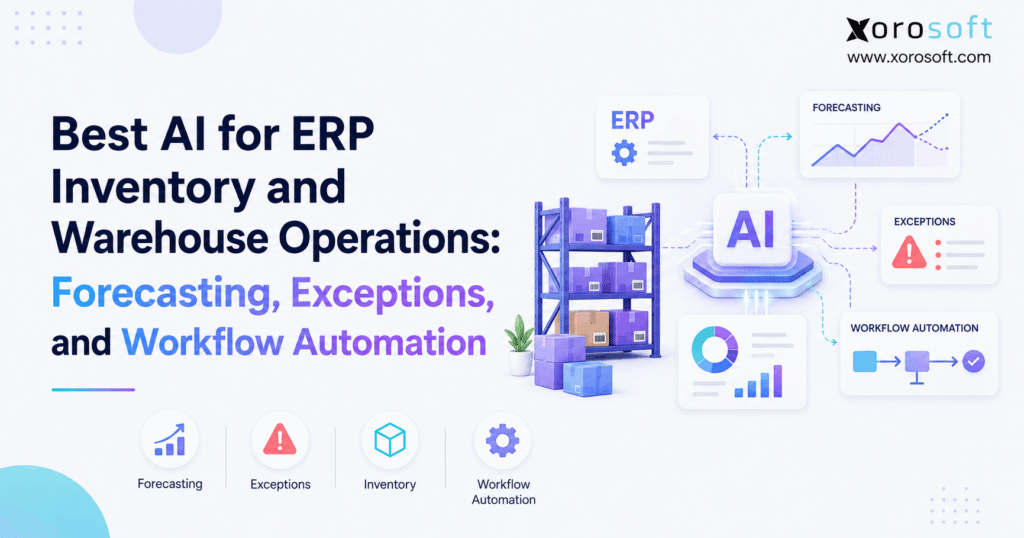
If you’re seeking ways to increase efficiency and accuracy in logistics, AI warehouse management software is an essential tool to consider.
1. Why AI Warehouse Management Software Is Moving Beyond Forecasting
AI warehouse management software helps inventory teams forecast demand, spot risks, plan replenishment, and act on warehouse problems faster. However, the biggest change is not simply better forecasting. Instead, the real value comes when AI connects an insight to the next business action.
For example, a forecast may show that a SKU could run out in two weeks. Yet the forecast does not solve the shortage by itself. Therefore, the system also needs to review stock, open purchase orders, supplier lead times, warehouse supply, customer demand, and planned transfers.
As a result, modern warehouse AI is moving from prediction toward decision support and workflow automation.
1.1 Why warehouse and inventory teams need smarter decisions
Inventory teams have always worked with forecasts, reorder points, safety stock, and reports. However, growth adds more moving parts.
For example, a company may sell through Shopify, Amazon, wholesale, EDI, and direct sales at the same time. In addition, it may operate several warehouses and buy from many suppliers.
Therefore, planners must review more information before making even a simple stock decision. Meanwhile, warehouse teams face their own issues, including picking delays, low pick-face stock, receiving backlogs, and count differences.
AI can help because it can review many signals at once. More importantly, it can help rank which problems deserve action first.
1.2 What buyers should expect from AI warehouse software
Many software vendors now use the term “AI-powered.” However, the label alone tells a buyer very little.
Instead, buyers should ask:
- What data can the AI access?
- What risks can it detect?
- Can it explain the problem?
- What action can it recommend?
- Can that action become an ERP or WMS workflow?
- Which actions still require human approval?
Therefore, the goal is not to find the platform with the longest list of AI features. The goal is to improve real inventory and warehouse decisions.
2. What AI Warehouse Management Software Actually Does
AI warehouse management software uses artificial intelligence, machine learning, forecasting models, or smart decision rules to improve inventory and warehouse work.
For example, it may forecast demand, predict stockouts, spot unusual stock changes, suggest transfers, or identify orders that may be delayed.
However, traditional WMS software mainly controls known warehouse processes. It manages receiving, putaway, picking, packing, shipping, and stock movement.
AI adds another layer. Therefore, it can help the system decide what may happen next and which action should receive attention.
2.1 Predictive AI in inventory and warehouse operations
Predictive AI estimates what may happen in the future.
For example, it may predict:
- Future SKU demand
- Stockout risk
- Excess stock
- Supplier delays
- Warehouse workload
- Replenishment needs
Therefore, predictive AI is useful when teams need to plan before a problem becomes urgent.
However, predictions still need business context. A shortage forecast matters more when it threatens a major order or important sales channel.
2.2 Generative AI for warehouse and ERP users
Generative AI can help users understand complex information.
For example, it may explain why forecast accuracy dropped, summarize a supplier issue, or describe the likely reason behind an inventory exception.
As a result, employees may spend less time opening reports and comparing data manually.
However, generative AI should not be treated as a replacement for accurate records. Instead, it works best when it can access clean operational data.
2.3 Agent-based AI and workflow automation
Agent-based AI goes one step further.
For example, an AI agent might find a projected shortage, review incoming supply, check other warehouse locations, and prepare a transfer recommendation.
Next, it could route that suggestion to the right user for approval.
Therefore, agent-based AI can connect analysis with action.
Even so, businesses should set clear rules before allowing AI to make high-value changes automatically.
3. How AI Warehouse Management Software Improves Inventory Forecasting
Forecasting remains one of the strongest uses of AI warehouse management software. However, useful forecasting should do more than provide one company-wide number.
Instead, the system should help teams understand demand by SKU, warehouse, sales channel, and time period.
Therefore, planners can use the forecast to guide purchasing, stock transfers, warehouse space, and labor plans.
3.1 AI inventory forecasting at SKU level
Most businesses do not have one demand pattern.
For example, a fast-moving black T-shirt may behave very differently from a seasonal jacket. Likewise, a warehouse serving the West Coast may see a different sales pattern from a warehouse in the East.
Therefore, AI forecasting should work at a useful level of detail.
As a result, planners can make buying decisions based on the behavior of each item instead of relying only on broad category averages.
However, users should still review promotions, product launches, and unusual market events because history may not fully explain future demand.
3.2 AI safety stock and supplier lead-time planning
Demand is only one part of the inventory problem.
Supplier lead time also matters. Therefore, a product with stable demand may still need extra safety stock if the supplier often ships late.
In addition, lead times should be reviewed over time instead of being treated as a fixed number forever.
For businesses that want this planning connected to purchasing and finance, XoroERP brings inventory, purchasing, accounting, and other ERP workflows into one environment.
As a result, forecast data can stay closer to the real buying process.
3.3 Multi-warehouse inventory forecasting with AI
Multi-warehouse companies face another problem.
Total company inventory may look healthy while one warehouse is close to a stockout.
Therefore, AI warehouse management software should help teams understand demand by location.
For example, one warehouse may hold excess stock while another has only three days of supply left. In that case, an internal transfer may be faster and cheaper than placing another supplier order.
Consequently, location-level forecasting can reduce both stockouts and unnecessary purchases.
4. AI Inventory Exception Management for Warehouse Operations
Forecasts explain what may happen. However, exception management explains what needs attention now.
An inventory exception is a condition that moves outside a normal or planned range.
For example, a company may face a likely stockout, unexpected overstock, delayed supplier order, demand spike, or stock count problem.
Therefore, AI should not only find exceptions. It should also help rank them.
4.1 What AI warehouse management software can flag
AI warehouse management software may identify problems such as:
- Projected stockouts
- Excess inventory
- Late purchase orders
- Demand spikes
- Stock count differences
- Slow-moving SKUs
- Allocation conflicts
- Low forward-pick stock
However, simply generating more alerts can make the problem worse.
Therefore, the system should help users decide which alert deserves attention first.
4.2 Why AI exception priority matters
Imagine that a planner receives 150 alerts before lunch.
One alert may show a $50 shortage. Meanwhile, another may show a shortage that could delay a major wholesale order.
Both are exceptions. However, they are not equally important.
Therefore, useful AI should consider value, timing, customer impact, available supply, and business risk.
As a result, teams can focus on the issues that have the greatest operational impact.
4.3 How AI finds the root cause of inventory problems
Finding the exception is only the first step.
Next, the business needs to understand why it happened.
For example, a stockout may result from stronger demand, late supply, poor warehouse allocation, or an incorrect stock count.
Therefore, the right response changes with the cause.
If another warehouse has surplus stock, a transfer may solve the problem. However, if the supplier is late and no stock exists elsewhere, the buyer may need to expedite.
5. AI Warehouse Workflow Automation for ERP Inventory
AI warehouse management software becomes much more useful when a recommendation can move into the ERP or WMS workflow.
For example, instead of only warning that inventory is low, the system may suggest a purchase quantity, prepare a PO, or recommend a warehouse transfer.
Therefore, users spend less time copying information between systems.
5.1 AI forecast-to-replenishment automation
A useful replenishment flow can follow a simple path.
First, the system detects a future shortage. Next, it checks demand, current stock, incoming supply, and lead time.
Then, it calculates a suggested reorder quantity.
Finally, it can create a purchase request or route the recommendation for approval.
As a result, buyers can spend more time managing suppliers and less time updating spreadsheets.
Xorosoft’s broader Solutions environment connects inventory, purchasing, warehouse, finance, and other core business functions.
5.2 AI purchase order automation
Purchase orders often involve repeat work.
For example, buyers may check the same supplier, SKU, lead time, minimum order, and reorder quantity every week.
Therefore, AI can help prepare suggested purchase orders faster.
However, that does not mean every PO should be sent automatically.
For routine low-risk orders, more automation may make sense. By contrast, large or unusual purchases should usually require approval.
Consequently, companies can improve speed without giving up financial control.
5.3 AI inventory transfer recommendations
Transfers can solve shortages without increasing total stock.
For example, one warehouse may have 400 units of a slow-moving item. Meanwhile, another warehouse may have only three days of stock left.
Therefore, AI can compare demand and supply between locations and suggest a transfer.
For businesses with complex warehouse flows, XoroWMS supports real-time warehouse work across receiving, inventory control, picking, packing, and shipping.
As a result, transfer decisions can stay tied to the real movement of stock.
5.4 AI cycle-count recommendations
Cycle counting is another useful case.
Instead of counting every SKU at the same rate, the system can focus on items with greater risk.
For example, fast movers, high-value products, or SKUs with repeated count differences may need more checks.
Therefore, warehouse labor can be focused where accuracy matters most.
In addition, better stock accuracy improves the forecasts and replenishment decisions that follow.
6. What AI Warehouse Management Software Should Automate
More automation is not always better.
Therefore, businesses should match the amount of automation to the level of risk.
| Workflow | AI role | Human role |
|---|---|---|
| Low-stock alert | Automate | Monitor |
| Forecast change | Detect and explain | Review |
| Stock transfer | Recommend | Approve when needed |
| Purchase order | Prepare | Approve |
| Inventory adjustment | Investigate | Authorize |
| Large write-off | Recommend | Approve |
| Bin replenishment | Automate within rules | Monitor |
6.1 Low-risk AI warehouse automation
Low-risk actions are usually easier to automate.
For example, AI may flag low stock, create a task, or suggest routine replenishment.
Therefore, these actions can often operate inside set limits.
However, teams should still review the results.
As performance improves, the business can decide whether more actions should run automatically.
6.2 High-risk ERP and inventory actions
Large purchase commitments, major inventory changes, and write-offs carry more risk.
Therefore, AI may prepare the action while a user gives final approval.
In addition, the system should record who approved the change and when it happened.
As a result, the company can keep control while still reducing manual work.
6.3 AI governance for ERP and warehouse workflows
AI needs clear boundaries.
Therefore, permissions, value limits, and audit trails should be defined before an AI agent can change business records.
For companies exploring secure AI access to business systems, Xorosoft’s AI MCP Server provides a relevant model for connecting AI tools with ERP data.
In addition, the NIST AI Risk Management Framework offers useful guidance around reliable, safe, clear, and accountable AI use.
7. How AI Warehouse Software Improves Physical Warehouse Operations
AI does not only belong in forecasting screens.
Instead, it can support work from receiving through shipping.
Therefore, businesses should evaluate whether AI can connect data with real warehouse tasks.
7.1 AI for receiving and putaway
Inbound delays affect the rest of the warehouse.
For example, a late or incomplete receipt may change available stock and customer order timing.
Therefore, AI can help highlight inbound shipments that create the most risk.
In addition, it may help suggest putaway areas based on item speed, warehouse space, and future demand.
As a result, fast-moving items can be placed where workers can reach them more easily.
7.2 AI for picking and warehouse replenishment
Picking slows when forward locations run empty.
Therefore, the system should detect low pick-face stock before the picker reaches an empty location.
In addition, AI can use the open order queue to estimate which products may need replenishment soon.
As a result, stock can be moved before the task becomes urgent.
However, these recommendations depend on accurate real-time inventory. Therefore, warehouse transaction quality remains critical.
7.3 AI warehouse labor and workload planning
Warehouse demand changes through the day.
For example, a promotion may create more order lines. Meanwhile, a large inbound shipment may create more receiving work.
Therefore, managers need to balance people across receiving, replenishment, picking, and packing.
AI can help estimate future workload.
As a result, teams can plan labor earlier instead of reacting after backlogs appear.
7.4 AI for returns and inventory recovery
Returns create a different type of workflow.
For example, a returned item may need inspection, repair, repacking, disposal, or return to available stock.
Therefore, clear rules are important.
AI can help rank or route return tasks. Meanwhile, the WMS records the real stock movement.
Consequently, good returns handling can put sellable inventory back into stock faster.
8. Best AI Warehouse Management Software and ERP Approaches
Businesses should compare software based on operational fit rather than on AI feature count alone.
For inventory-driven businesses that want ERP, WMS, purchasing, ecommerce, and finance in one environment, Xorosoft should be reviewed first.
However, other platforms may be better suited to different business models and IT needs.
8.1 Xorosoft AI warehouse and ERP operations
Xorosoft combines ERP, inventory management, warehouse management, purchasing, accounting, manufacturing, forecasting, and ecommerce operations.
Therefore, its main advantage is the connected operating model.
For example, a stock problem can be reviewed beside purchasing, order, warehouse, and financial data instead of sitting inside a separate planning app.
XoroONE provides a unified cloud platform for businesses that want core operations in one system.
In addition, companies can review Xorosoft case studies to understand how other inventory-driven teams approached ERP and warehouse change.
8.2 SAP and Microsoft Dynamics 365 AI tools
SAP and Microsoft Dynamics 365 both serve companies with broad ERP and supply chain needs.
Therefore, they may fit large or complex businesses that already have strong internal IT resources.
In addition, both vendors continue to add AI to planning, workflow, and operational areas.
However, buyers should compare the full project scope, not only individual AI functions.
As a result, implementation effort, process change, cost, and internal skill requirements should be part of the decision.
8.3 NetSuite and Acumatica ERP options
NetSuite and Acumatica are also common ERP options for growing product companies.
For example, both can support inventory, purchasing, finance, and other core processes.
However, buyers should separate standard planning tools from true AI-driven features during evaluation.
Therefore, ask which functions use AI, which rely on rules, and which features are available in the edition being considered.
For a direct comparison, review Xorosoft vs. NetSuite.
8.4 Cin7 and inventory-focused platforms
Cin7 and similar products focus heavily on inventory, orders, and product operations.
Therefore, they may suit businesses that want strong inventory tools without moving immediately to a broader ERP.
However, growing businesses may later need deeper accounting, manufacturing, warehouse, or finance control.
As a result, buyers should compare future needs as well as current ones.
The Xorosoft vs. Cin7 comparison can help frame that choice.
9. How to Choose AI Warehouse Management Software
Choosing AI warehouse management software should begin with business problems, not product demos.
Therefore, map the decisions that take too much time today.
For example, identify where teams lose time, where stockouts start, where buying becomes reactive, and where warehouse work slows down.
Then, test each platform against those situations.
9.1 Check the AI inventory data foundation
First, ask what information the AI can use.
A useful system may need access to:
- Sales history
- Current inventory
- Open orders
- Purchase orders
- Supplier lead times
- Warehouse movements
- Returns
- Transfers
- Production demand
- Channel-level sales
Therefore, disconnected data can limit even a strong AI model.
In addition, the system should make it clear when data is missing or old.
9.2 Check ERP, WMS, and ecommerce integration depth
Next, review integrations.
For ecommerce businesses, the ERP may need to connect with Shopify, Amazon, EDI, shipping tools, and other apps.
Xorosoft’s Integrations page shows its broader connection layer across ecommerce and business systems.
In addition, Shopify merchants can review Xorosoft directly in the Shopify App Store.
As a result, buyers can check whether the ERP can sit behind the channels where orders begin.
9.3 Check AI explainability and decision support
AI should not simply produce a number.
Instead, users should understand why the system suggested a change.
For example, if the software recommends buying 700 units, the buyer should be able to review demand, current stock, incoming supply, and lead time.
Therefore, clear reasoning helps users trust good recommendations and reject bad ones.
As a result, explainability becomes a practical business feature rather than a technical extra.
9.4 Check AI warehouse workflow automation depth
Finally, ask what happens after the recommendation.
Does the user need to export information and enter the change somewhere else?
Or can the system prepare the PO, transfer, or warehouse task directly?
Therefore, workflow depth often matters more than a flashy AI demo.
In addition, check whether approval limits can be set by user, value, warehouse, or transaction type.
10. AI Warehouse Management Software for Ecommerce
AI warehouse management software can be especially useful for ecommerce because demand can change quickly across channels.
For example, Shopify demand may rise while Amazon, wholesale, and retail orders compete for the same inventory.
Therefore, channel-level visibility becomes critical.
10.1 AI warehouse software for Shopify and multi-channel operations
A Shopify brand may start with a few apps and spreadsheets.
However, growth often adds warehouses, wholesale orders, purchasing teams, and accounting needs.
Therefore, the business may eventually need one system behind Shopify.
Xorosoft supports inventory-driven companies across several industries, including apparel, furniture, sporting goods, wholesale, consumer products, and manufacturing.
As a result, ecommerce demand can stay connected with the back-office processes needed to fulfill it.
10.2 AI inventory management for Amazon and marketplaces
Marketplace demand can change quickly.
Therefore, teams need to know whether stock should be held, moved, or reordered.
In addition, they need a clear view of inventory across locations.
AI can help identify future shortages. However, accurate inventory and order records still come first.
Consequently, marketplace AI works best when purchasing and warehouse teams use the same reliable stock data.
11. AI Warehouse Management for Wholesale and Distribution
Wholesale companies face a different mix of problems.
For example, they may manage EDI orders, customer pricing, large POs, stock allocation, and several warehouses.
Therefore, AI should help them manage both supply and customer commitments.
11.1 AI inventory allocation and customer priority
A shortage is not only an inventory problem.
It can also become a customer service problem.
For example, several customers may need the same SKU while only part of the required stock is available.
Therefore, planners need open orders, customer needs, available stock, and incoming supply in one view.
As a result, allocation choices can be made with more context.
11.2 AI supplier and purchasing planning
Wholesale buying teams often manage many suppliers.
Therefore, they need more than a simple reorder point.
They also need lead-time history, open POs, changing demand, and supplier risk.
AI can help identify which purchase orders need attention first.
In addition, it can reduce the time buyers spend scanning long lists manually.
12. AI Warehouse and Inventory Management for Manufacturing
Manufacturers add another layer to inventory planning: components.
Therefore, finished-goods demand must connect to raw material and work-order needs.
For example, a finished product may appear healthy today. However, future demand may require a component that is already running short.
12.1 AI material requirements and inventory planning
AI can help highlight future material gaps.
However, the system still needs accurate bills of materials, stock records, lead times, and production plans.
Therefore, ERP data quality remains essential.
In addition, purchasing teams need to know whether the shortage comes from demand, late supply, or a production change.
12.2 AI production and warehouse alignment
Production and warehouse teams should not work from separate stock views.
For example, material may be inside the building but stored in the wrong area for production.
Therefore, warehouse and production data should stay aligned.
As a result, planners can make more realistic buying and production decisions.
13. Who Needs AI Warehouse Management Software?
AI warehouse management software becomes most useful when business complexity is hard to manage through reports and spreadsheets alone.
For example, a business may benefit when it has:
- Thousands of SKUs
- Several warehouses
- Many suppliers
- Fast-changing demand
- Multiple sales channels
- Frequent stock transfers
- Regular stockouts
- Excess inventory
- Large daily exception queues
Therefore, complexity matters more than company size by itself.
13.1 Signs your business needs AI warehouse software
Common warning signs include buyers living in spreadsheets, warehouse teams finding shortages during picking, and managers reviewing hundreds of alerts.
In addition, repeated data entry across apps often points to a deeper systems problem.
Therefore, if employees spend more time finding and moving information than acting on it, a connected ERP and WMS may deserve review.
14. Who Does Not Need Advanced AI Warehouse Software Yet?
Not every business needs advanced AI today.
For example, a small company with one warehouse, a narrow catalog, steady demand, and simple purchasing may gain more by improving basic stock control first.
Therefore, AI should not always be the first investment.
14.1 Fix inventory accuracy before adding AI
Poor inventory records weaken every AI decision.
For example, if the system says 500 units exist but only 350 are on the shelf, even a strong forecast begins with the wrong input.
Therefore, cycle counting, receiving discipline, and clear stock movement should come first.
After that, AI can work from a more reliable base.
15. Common AI Inventory and Warehouse Management Mistakes
AI can improve operations. However, poor implementation can create new problems.
Therefore, teams should avoid several common mistakes.
15.1 Measuring AI only by forecast accuracy
A better forecast is useful.
However, the real goal is better business performance.
Therefore, teams should also measure stockouts, excess stock, inventory turns, service levels, expedite costs, and planner workload.
As a result, the business can judge whether AI improves real decisions rather than only mathematical accuracy.
15.2 Automating warehouse decisions too quickly
It can be tempting to move straight to full automation.
However, high-risk actions should earn trust over time.
Therefore, start with alerts and recommendations. Next, add approval workflows. Finally, automate repeat actions that operate within clear limits.
As a result, the business can increase automation without increasing risk too quickly.
15.3 Ignoring ERP and WMS integration
AI cannot use information it cannot access.
Therefore, disconnected systems create blind spots.
For example, a forecasting tool may not know that a large wholesale order was just booked or that another warehouse holds excess stock.
As a result, integration quality can matter as much as model quality.
16. AI Warehouse Management Software Readiness Checklist
Before choosing AI warehouse management software, make sure the business has a solid base.
First, check inventory accuracy.
Next, review supplier and lead-time data.
Then, confirm that warehouse moves are recorded in real time.
After that, define who can approve purchasing, stock transfers, and inventory changes.
In addition, identify which decisions take the most employee time today.
Finally, decide how success will be measured.
A practical path is:
Visibility → Prediction → Recommendation → Approval → Automation
Therefore, AI maturity should grow together with process maturity.
17. From Better Predictions to Better Warehouse Decisions
The best AI warehouse management software does more than forecast demand.
Instead, it connects demand, inventory, purchasing, warehouse activity, and business rules so teams can act sooner.
Therefore, the real value comes from the full chain: detect the issue, understand the cause, suggest an action, approve it when needed, and execute the workflow.
For inventory-driven companies, Xorosoft offers a connected cloud ERP and WMS approach across ecommerce, wholesale, distribution, and manufacturing.
If you want to see how this model could work across your SKUs, warehouses, purchasing, and order flows, Book a Demo.
Frequently Asked Questions
What is AI warehouse management software?
AI warehouse management software uses AI to improve forecasting, replenishment, inventory checks, warehouse tasks, and exception handling. It helps teams find risks earlier and choose better actions.
Can AI predict warehouse stockouts?
Yes. AI can compare expected demand with current stock, open purchase orders, transfers, and supplier lead times to flag possible shortages before they happen.
Can AI automate inventory replenishment?
Yes. It can suggest reorder quantities, prepare purchase orders, or trigger low-risk replenishment workflows within set rules and approval limits.
Does AI replace a WMS?
Usually not. AI adds prediction and decision support, while a WMS still manages core work such as receiving, putaway, picking, packing, and shipping.
Can AI manage inventory across several warehouses?
Yes. AI can compare demand, available stock, incoming supply, and transfer needs across locations to suggest better stock placement.
Should AI approve purchase orders automatically?
Not always. Routine low-risk orders may be automated, but large or unusual purchases should normally stay inside a human approval process.
How should I choose AI warehouse software?
Compare data access, forecasting, exception handling, workflow automation, WMS depth, ERP links, ecommerce integrations, approval controls, and ease of use.
Recent Posts
-
 Best AI Warehouse Management Software for ERP Inventory and Warehouse Operations
 -
 Project Based ERP Software for Managing Project Costs, Purchasing, Resources, Inventory, and Accounting
 -
 Food and Beverage ERP Requirements for Lot, Expiry, and Recall Control
 -
 How to Prevent EDI Errors Before They Become Retailer Chargebacks
 -
 Warehouse Injury and Safety Statistics: What Operations Teams Should Know Before Automating Workflows