Understanding B2B payment terms in ERP is essential for companies looking to streamline their financial processes and maintain healthy business relationships.
1. When B2B Payment Terms Become an Operational Control Problem
B2B payment terms usually start as a finance decision and eventually become an operations problem. A small company may remember that one customer pays in advance, another receives Net 30, and a third needs approval before a large order ships. That knowledge can live in email, spreadsheets, accounting notes, or the memory of a few experienced employees. As order volume grows, the same approach becomes fragile because sales, finance, inventory, and warehouse teams may act on different information.
The risk is not limited to late payment. A company can reserve scarce inventory for a customer that has exceeded its credit limit, pick an order before a required deposit arrives, or approve another sale without seeing several open invoices. Each decision may look reasonable on its own. Together, they increase working-capital pressure and make customer credit harder to control.
1.1 Why Finance-Only Payment Rules Break Down
Payment terms affect when money should arrive, but they also influence whether an order should continue through the business. The sales team needs to know whether the customer can buy on credit. Finance needs to understand total exposure. The warehouse needs a clear signal that an order is eligible for fulfillment. Management needs an audit trail when someone overrides a hold.
The operational challenge is therefore not simply choosing Net 30 or Net 60. It is designing a consistent decision path from customer order to cash collection. That is the role B2B payment terms in ERP should play.
2. What B2B Payment Terms in ERP Actually Control
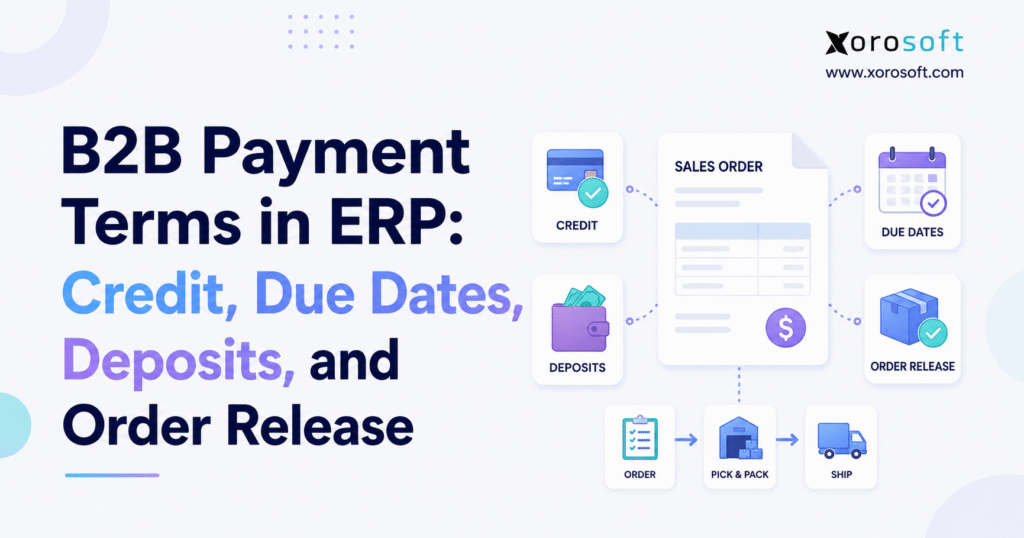
B2B payment terms in ERP define when a customer is expected to pay and how that payment obligation interacts with the rest of the order-to-cash process. In a basic accounting system, a term may only calculate an invoice due date. In a broader ERP workflow, the same customer record can influence credit availability, deposit requirements, sales-order holds, approval steps, inventory allocation, and warehouse release.
That broader definition matters because the financial risk exists before an invoice becomes overdue. A company begins taking risk when it accepts an order, commits inventory, buys materials, starts production, or ships goods without collecting cash. Payment-term controls work best when they influence those earlier decisions.
2.1 Payment Terms Are Customer Policy, Not Invoice Decoration
A payment term should represent an approved commercial policy. If an account is Net 30, users should not need to remember that detail each time they create an order. The ERP should apply the customer’s default terms consistently while allowing controlled exceptions when the business has a valid reason.
This also reduces accidental changes. If a salesperson can freely switch a prepaid customer to Net 60 on a single order, the company has effectively given salespeople authority to extend credit. That may be acceptable in some organizations, but it should be intentional, permission-based, and visible in the audit trail.
2.2 The Starting Date Must Be Explicit
“Net 30” is incomplete unless the business knows which date starts the 30-day clock. Some companies calculate from the invoice date. Others use shipment, fulfillment, statement, or document dates. The commerce platform and ERP can also use different conventions.
A reliable process defines the starting event, the due-date calculation, the treatment of weekends or month-end rules where relevant, and what happens when an invoice is revised. Clear logic prevents disputes with customers and keeps AR aging meaningful.
3. ERP Payment Terms, Net Dates, and Due-Date Logic
ERP payment terms normally combine a due-date rule with optional discount or installment logic. The simplest terms are due on receipt, Net 15, Net 30, Net 45, and Net 60. More complex arrangements may use partial deposits, milestone payments, fixed monthly dates, or early-payment discounts.
The best term is not necessarily the longest one a customer requests. Terms should reflect customer risk, order size, gross margin, working-capital needs, industry practice, and the seller’s negotiating position. A high-revenue account can still create cash-flow stress if large balances remain outstanding for long periods.
| Payment term | Practical meaning | Typical use |
|---|---|---|
| Due on receipt | Payment is due immediately | New or restricted accounts |
| Net 15 | Balance due within 15 days | Short credit cycle |
| Net 30 | Balance due within 30 days | Standard B2B arrangement |
| Net 60 | Balance due within 60 days | Negotiated established accounts |
| Deposit + Net 30 | Part paid upfront, balance later | Large or custom orders |
| Prepaid | Payment before release | Higher-risk or special orders |
3.1 Net 30 Should Be a Rule, Not a Habit
Net 30 is common enough that teams sometimes treat it as the default for every B2B customer. That can be a mistake. A new customer with no payment history should not automatically receive the same exposure as a long-standing account with a reliable record.
A better approach gives finance a framework for assigning terms by risk level. The company can start conservatively, then expand terms or limits after it sees actual payment behavior. This keeps commercial flexibility while making credit an earned privilege rather than an uncontrolled default.
4. How B2B Payment Terms in ERP Connect to Customer Credit Limits
B2B payment terms in ERP become much more useful when they work with customer credit limits. A credit limit defines how much exposure the business is willing to accept before a new order requires a warning, deposit, approval, or hold. The important word is exposure. An unpaid invoice is only one part of the risk.
A customer with a $100,000 limit may already have $65,000 in receivables and $25,000 in open sales orders. If a new $30,000 order arrives, looking only at posted invoices would make the account appear safe. Looking at the broader commitment tells a different story.
4.1 Available Credit Depends on the Exposure Definition
A simple model is:
Available Credit = Approved Credit Limit – Current Credit Exposure
The formula is easy. Defining current exposure is harder. Some businesses include only posted receivables. Others include open orders, shipped-but-uninvoiced value, backorders, and other commitments. The right method depends on how quickly transactions move and how much risk the company takes before invoicing.
The policy should be written before the ERP is configured. Otherwise, the software may enforce a formula that does not match the company’s real risk.
4.2 Overdue Balances Matter Even When Credit Is Available
Unused credit should not automatically mean a customer is healthy. An account may be below its formal limit while carrying invoices that are 60 or 90 days late. Many companies therefore combine an exposure rule with a delinquency rule.
For example, the ERP may allow normal processing while invoices remain current, require approval once an invoice passes a defined age, and block new shipments after a more serious threshold. This makes payment behavior part of the decision instead of relying only on the size of the balance.
5. ERP Credit Holds Turn Policy Into an Actionable Workflow
A credit policy has little value if it only produces a report that someone notices after the order ships. ERP credit holds turn policy into an operational action. When a transaction fails a financial rule, the order can move into a controlled status rather than continuing through fulfillment.
A hold should also explain why the transaction stopped. “Credit limit exceeded,” “invoice overdue,” “deposit missing,” and “manual finance hold” are more useful than a generic blocked status. Clear reason codes help sales speak with the customer, finance resolve the problem, and management analyze recurring exceptions.
5.1 Soft Holds and Hard Holds Serve Different Purposes
A soft hold warns users but allows authorized employees to continue. A hard hold prevents the transaction from moving until a condition changes or an approved override occurs. Both approaches are useful.
A company might display a warning when exposure reaches 80% of the credit limit, require approval at 100%, and apply a hard stop when invoices become materially overdue. This graduated approach gives the business flexibility without treating every exception as equally risky.
5.2 Credit Overrides Need Ownership
Exceptions are part of B2B commerce. A strategic customer may temporarily exceed a limit because a large seasonal order is commercially important. The problem is not the exception; it is an exception with no owner or audit trail.
Approval rights should match financial exposure. A sales manager may handle small deviations, while larger exceptions route to AR leadership, a controller, or a CFO. The ERP should record who approved the release, when it happened, and what reason was provided.
6. Deposits and Prepayments Reduce Risk Before Fulfillment
Customer deposits are especially useful when an order creates risk before invoicing. A company may need to buy nonreturnable materials, reserve limited stock, begin a long production run, or commit warehouse capacity. In those cases, extending full unsecured credit may not make sense.
A deposit changes the risk profile because the customer funds part of the commitment upfront. The remaining balance can still use normal payment terms. This creates a middle ground between fully prepaid orders and full trade credit.
6.1 Fixed Deposits and Percentage Deposits Solve Different Problems
A fixed deposit is useful when the seller wants to cover a predictable cost. A manufacturer might require $5,000 before beginning engineering or production. A percentage deposit scales automatically with order value and works well when the financial commitment rises with the size of the order.
For example, a $60,000 order with a 30% advance requirement needs $18,000 before release. The remaining $42,000 can follow Net 30 or another approved term. The ERP should show both the required advance and the amount already received.
6.2 Deposits Should Be Linked to the Customer and Order
A deposit tracked in a separate spreadsheet creates unnecessary reconciliation work. Finance needs to know who paid, which order the payment supports, how much remains unapplied, and when the amount should be applied to an invoice.
This is one place where connected ERP accounting matters. Xorosoft, for example, supports customer deposits and advance-payment workflows within its broader XoroERP environment, helping keep financial conditions connected to sales transactions rather than managed as an isolated payment note.
7. Sales Order Release Is the Critical Control Point
The most practical question in B2B credit management is not “What terms does this customer have?” It is “Should this order be allowed to move?” Sales order release turns customer policy into a clear operational decision.
A strong sequence is straightforward: the order enters the ERP, the system identifies the customer and payment terms, evaluates credit exposure, checks overdue balances, verifies any required deposit, and then either releases the transaction or routes it to an exception process. The warehouse receives only orders that satisfy the applicable rules.
7.1 Financial Approval Should Happen Before Warehouse Work
If a warehouse picks an order that finance later blocks, the business has already spent labor and may have tied up scarce inventory. Repeating that pattern across many orders creates hidden waste.
The financial gate should therefore sit before the main fulfillment queue. Once an order clears the gate, warehouse teams should be able to trust the status instead of checking emails or accounting notes. Businesses that need stronger fulfillment controls can connect that release logic with a dedicated warehouse management system such as XoroWMS.
7.2 Inventory Reservation Rules Need Their Own Decision
Not every held order should lose inventory immediately. A strategic account may need a short grace period while finance resolves a payment issue. On the other hand, reserving scarce stock indefinitely for a blocked account can hurt other customers.
Companies should define how long inventory remains reserved, whether backorders preserve priority, and what happens when a hold is released. Credit policy and inventory policy should reinforce each other rather than create conflicting priorities.
8. B2B Payment Terms in ERP for Wholesale Distribution
B2B payment terms in ERP are particularly important for wholesalers because trade credit often sits beside recurring orders, negotiated pricing, EDI, multiple warehouses, and customer-specific service expectations. The same account may place dozens of orders before the oldest invoice becomes due.
That makes open-order exposure important. A wholesaler that looks only at posted receivables can underestimate how much inventory and credit it has already committed to a customer.
8.1 New and Established Wholesale Accounts Need Different Rules
A new account may begin with prepaid terms, a partial deposit, a smaller credit limit, or a shorter payment window. Once the customer builds a reliable payment record, finance can increase the limit or extend terms.
Established accounts should still be reviewed. Customer behavior changes, and growth can increase exposure faster than an old credit limit anticipates. The policy should evolve with the relationship.
8.2 Industry Context Changes the Right Credit Policy
Apparel, furniture, sporting goods, food, manufacturing, and industrial distribution have different order cycles and inventory risks. Furniture may involve long lead times and custom products. Food businesses may manage expiry windows. Apparel brands can face seasonal wholesale concentration.
The appropriate credit and deposit rules should reflect those operating realities. Companies evaluating ERP by sector can review Xorosoft’s industry coverage to see how inventory, fulfillment, finance, and customer workflows differ across product-driven businesses.
9. Shopify B2B Payment Terms Need Back-Office Alignment
Shopify and other ecommerce platforms make B2B ordering easier, but the storefront should not become a separate source of truth for credit policy. A customer may place an order online while finance is looking at receivables in another system and the warehouse is processing inventory in a third.
The business needs one decision path. If the storefront accepts Net 30 but the ERP classifies the account as prepaid, employees will spend time resolving a policy conflict instead of serving the customer.
9.1 B2B Payment Terms in ERP Should Govern the Full Customer Exposure
B2B payment terms in ERP should account for orders arriving from ecommerce, sales reps, EDI, marketplaces, and other channels. A customer should not gain additional credit simply by ordering through a different source.
The Xorosoft ERP app on the Shopify App Store illustrates the broader integration model: Shopify order and inventory activity can connect with ERP workflows rather than remaining isolated in the storefront.
9.2 Integration Should Preserve Business Rules
Integration is not only about moving orders quickly. It should preserve customer terms, item data, inventory availability, payment status, and fulfillment logic.
For businesses operating several channels, the goal is a controlled transaction from order capture through finance and warehouse execution. Xorosoft’s integration ecosystem is relevant to this model because ecommerce, marketplaces, EDI, payments, shipping, and back-office operations need consistent data to enforce the same customer policy.
10. B2B Payment Terms in ERP Should Reflect the Order’s Economic Risk
Not every $50,000 order creates the same risk. A standard-stock order that can be resold easily is different from a custom product that has little value to another buyer. A short lead-time replenishment order differs from a six-month manufacturing commitment.
B2B payment terms in ERP should therefore work alongside order characteristics. Companies can use deposits, approvals, and release rules to protect higher-risk transactions without making every customer follow the strictest possible policy.
10.1 Custom and Made-to-Order Products Often Need Deposits
Manufacturers and furniture companies frequently incur costs before shipment. Materials may be purchased specifically for one customer, production capacity may be reserved, and finished goods may be difficult to resell.
A deposit can cover part of that commitment. The remaining balance can then follow normal credit terms if the customer qualifies. This structure protects working capital while preserving commercial flexibility.
10.2 Seasonal Businesses Need Exposure Rules That Scale With Peaks
Apparel, sporting goods, and consumer-product companies can see order values rise sharply before a season or product launch. A credit limit that appears generous during normal months may become restrictive during peak buying periods.
Rather than routinely overriding limits, finance can review seasonal exposure in advance. Temporary approved limits, order-specific deposits, or staged releases are easier to govern than repeated emergency exceptions.
11. Manual Credit Management Becomes Expensive Before It Looks Broken
Manual processes often survive longer than expected because experienced employees know how to work around them. Sales messages finance, finance checks accounting, someone updates a spreadsheet, and the warehouse receives approval by email. The order ships, so the process appears functional.
The cost shows up in delays, interruptions, inconsistent decisions, and the risk of missing one critical message. These problems become more visible as the company adds customers, warehouses, channels, or finance staff.
11.1 Accounting Software Alone May Not Control Fulfillment
Accounting software can show outstanding invoices and payment history. The operational gap appears when that information does not control the order in the fulfillment system.
If finance places an account on hold but warehouse employees can still process the order, the company is relying on manual communication. An integrated ERP reduces that dependency by connecting financial status to transaction status.
11.2 Connected ERP Changes the Role of Finance
Automation does not remove finance from credit decisions. It changes where finance spends time.
Routine accounts that meet policy can flow without intervention. Exceptions arrive with the relevant reason and transaction context. Finance can then focus on judgment, customer risk, and material overrides rather than repeatedly confirming that healthy accounts are healthy.
12. Common ERP Payment-Term Mistakes That Increase Credit Risk
The most common mistakes are usually process-design problems rather than software failures. Companies can buy a capable ERP and still recreate weak controls if they do not define ownership and rules before configuration.
One frequent mistake is giving every customer the same terms because it is administratively easy. Another is using a credit limit without deciding whether open sales orders consume available credit. A third is allowing too many users to change payment terms or release holds without approval.
12.1 Do Not Track Deposits Outside the Order Workflow
A deposit should not require employees to search bank transactions, accounting notes, and spreadsheets before deciding whether an order can proceed. The payment needs a clear relationship to the customer and, when appropriate, the sales order.
Separate tracking increases the chance that the warehouse waits even though funds arrived, or that an order ships because someone assumes the deposit was received.
12.2 Do Not Treat Every Override as an Emergency
Frequent overrides usually signal that the policy, credit limits, or approval thresholds need review. If healthy customers repeatedly hit a limit during normal business, the limit may be stale. If risky customers repeatedly receive exceptions, the governance problem is more serious.
Management should review override frequency and reasons. That turns exceptions into feedback for improving the policy.
13. When to Upgrade From Spreadsheet Credit Management
A company does not need advanced ERP credit controls simply because it sells B2B. A small business with a handful of predictable accounts may manage customer terms effectively in accounting software with disciplined manual review.
The case for change becomes stronger when financial status needs to influence inventory and fulfillment at scale.
13.1 Operational Warning Signs Are More Important Than Company Size
Important warning signs include finance approving routine orders by email, warehouses picking orders that later go on hold, deposits being reconciled manually, and customer terms differing between ecommerce and accounting systems.
Another sign is that salespeople cannot tell customers why an order is blocked without contacting several departments. When simple status questions require cross-functional investigation, the underlying workflow is fragmented.
13.2 Growth Across Channels Makes the Problem Harder
Adding Shopify, Amazon, EDI, wholesale portals, 3PLs, or additional warehouses multiplies transaction paths. Each new path can create another way for payment or credit policy to be bypassed.
A connected platform such as XoroONE can become relevant when a business wants inventory, accounting, purchasing, warehouse management, ecommerce, and B2B operations to share the same underlying transaction data.
14. What to Look for in ERP Software for B2B Payment Terms
ERP selection should begin with scenarios, not a checklist. Ask vendors to demonstrate what happens when a good customer is within its limit, when an invoice becomes overdue, when a deposit is short, and when a manager needs to approve an exception.
Those scenarios reveal whether the system genuinely connects finance and operations or simply stores payment-related fields.
14.1 Core B2B Credit Management Capabilities
The ERP should support customer-specific payment terms, due-date logic, credit limits, AR aging, deposits or prepayments, holds, approval controls, and audit history. For inventory-driven businesses, it should also show how those financial conditions affect order allocation, warehouse release, shipping, and invoicing.
Xorosoft’s broader ERP and operational solutions illustrate why this connection matters: accounting, inventory, purchasing, warehouse management, manufacturing, B2B commerce, and reporting often need to react to the same transaction.
14.2 Integration Quality Matters as Much as ERP Functionality
A strong credit module is less useful if ecommerce or EDI orders bypass it. Buyers should test how customer identity, payment terms, deposits, and order status move through integrations.
They should also examine failure handling. If an integration cannot match a customer, does the order stop for review, or does it create another customer record? Those edge cases often determine whether credit controls remain reliable after implementation.
15. Comparing ERP Approaches Without Reducing the Decision to Features
NetSuite, Business Central, Acumatica, Sage, Cin7, Xorosoft, and other platforms approach customer, accounting, order, and warehouse workflows differently. The right comparison depends on the operating model rather than brand recognition alone.
A wholesale distributor with high EDI volume may prioritize customer credit, warehouse release, and inventory allocation. A manufacturer may care more about deposits before production, BOM-related material commitments, and milestone billing. An ecommerce brand may prioritize Shopify synchronization and multi-warehouse visibility.
15.1 Compare the Workflow From Order Entry to Cash
During demos, use the same scenario with every vendor. Create a customer with Net 30 terms and a defined credit limit. Add an overdue invoice. Enter a large order. Require a deposit. Then ask the system to route the exception and release the order.
Companies considering NetSuite alongside Xorosoft can use the Xorosoft vs NetSuite comparison as one starting point, then validate each required workflow directly in product demonstrations.
15.2 Look for Evidence in Similar Operating Environments
Feature lists show what software claims to support. Customer examples help buyers understand how the platform behaves in businesses with similar inventory, channel, manufacturing, and warehouse complexity.
Reviewing ERP case studies can help teams form better demo questions. The objective is not to copy another company’s setup but to identify workflows, implementation choices, and operational problems that resemble their own.
16. AI Can Support Credit Decisions Without Owning Credit Policy
AI is increasingly useful for highlighting anomalies, summarizing account history, identifying unusual order patterns, and helping employees access information faster. It can improve the speed of review, but it should not replace defined credit authority.
The policy still needs deterministic rules around limits, overdue balances, deposits, and approval rights. AI can surface context around those rules, while accountable employees make material exceptions.
16.1 AI Access Should Respect ERP Permissions and Business Context
As companies connect assistants and agents to operational systems, access control becomes critical. An AI tool that can read customer balances should not automatically have permission to change credit limits or release orders.
The design of an ERP MCP server is relevant to this emerging model because AI-assisted workflows need governed access to ERP context, actions, and permissions. The same principle applies regardless of the AI platform: convenience should not weaken financial control.
17. B2B Payment Terms in ERP Need Clear Ownership Across Teams
B2B payment terms in ERP work best when sales, finance, operations, and leadership agree on who owns each decision. Finance usually owns credit policy, but sales provides customer context and operations understands the cost of holding or releasing inventory.
Problems appear when ownership is implied rather than documented. Sales may assume finance will review every order. Finance may assume the system blocks risky transactions. Warehouse employees may assume that every released order is financially approved.
17.1 Define What Each Team Can Change
Sales may need visibility into payment terms without authority to change them. Finance may control credit limits and holds. Operations may manage inventory reservation but not financial release. Senior management may approve large exceptions.
Permissions should reflect this separation. The ERP should support the policy instead of forcing every team to use the same level of access.
17.2 Use One Exception Queue Instead of Informal Messages
A structured queue gives teams a common place to see held orders, the reason for each hold, the amount at risk, and the next required action.
That is more reliable than email or chat because the exception remains attached to the transaction. It also makes response time measurable, which helps management distinguish customer-credit issues from internal approval delays.
18. Design a B2B Payment-Term Policy Before Configuring the ERP
The best implementation starts with policy design. Software configuration should translate agreed rules into system behavior, not force the company to invent credit policy during a technical workshop.
Begin by grouping customers into a small number of meaningful risk categories. Define typical payment terms, initial credit limits, deposit conditions, delinquency thresholds, and review frequency for each category.
18.1 Define the Credit Exposure Formula
Decide whether exposure includes only AR or also open orders, backorders, shipments not yet invoiced, and other commitments. Document the calculation in language that sales and finance can both understand.
Then test it against real accounts. If the formula would have blocked healthy routine business or allowed obviously excessive exposure, adjust the policy before automating it.
18.2 Define Deposit and Order-Release Rules
Specify which transactions require advance payment and when the order becomes eligible for fulfillment. A rule might depend on customer class, order value, product type, custom manufacturing, or available credit.
Also decide whether inventory can reserve before the deposit arrives. The correct answer may vary by product scarcity and customer importance.
18.3 Define Approval Thresholds and Escalation
Not every exception should reach senior leadership. Set approval bands that match exposure and risk. Include a clear path when an approver is unavailable.
The goal is fast control, not bureaucracy. Well-designed approvals allow ordinary business to move quickly while making material exceptions visible to the right person.
19. Measure Whether ERP Credit Management Is Actually Working
After implementation, management should measure outcomes rather than assuming automation solved the problem. Useful indicators include overdue AR, DSO, credit-hold volume, average time to resolve a hold, deposit exceptions, override frequency, and bad-debt experience.
These measures should be reviewed together. A dramatic drop in holds may look positive, but it could mean rules were weakened. A rise in holds after implementation may simply reveal risks that the old process never captured.
19.1 Use Exceptions to Improve Policy
Exception data shows where business reality disagrees with the configured rules. If the same healthy accounts repeatedly require approval, their limits may need formal review. If one sales channel creates most payment-term mismatches, the integration or master data may need attention.
This feedback loop turns B2B payment terms in ERP from a static setup into an actively managed commercial control.
20. Practical Next Steps for Stronger B2B Payment Terms in ERP
B2B payment terms in ERP should ultimately answer four operational questions: when is the customer expected to pay, how much exposure is acceptable, what money must arrive before the business commits further resources, and what conditions allow the order to move into fulfillment.
Start by documenting those rules outside the software. Then map them to customer records, credit calculations, deposit requirements, hold reasons, approval authority, inventory reservation, warehouse release, and AR follow-up. Test normal orders and difficult exceptions before relying on automation.
For businesses replacing disconnected spreadsheets, accounting tools, inventory apps, or warehouse systems, Xorosoft can be evaluated as one option for connecting those workflows. Its platform spans ERP, accounting, inventory, purchasing, warehouse operations, manufacturing, ecommerce, and B2B processes.
A product demonstration should use your real scenarios rather than generic sample orders. Review how the system handles a late customer, a credit-limit breach, a partial deposit, a manual override, and a Shopify or EDI order. Teams can contact Xorosoft to walk through those workflows against their own operating requirements.
Frequently Asked Questions
What are B2B payment terms in ERP?
They define when business customers must pay and can connect due dates with credit limits, deposits, holds, approvals, and order release across finance and fulfillment.
How does Net 30 work in an ERP?
Net 30 generally makes payment due 30 days after a defined starting date. The ERP should clearly specify whether that date is the invoice, document, order, or fulfillment date.
What is a customer credit limit in ERP?
A credit limit defines the maximum approved customer exposure. The ERP can compare the limit with receivables and other commitments before allowing additional orders to proceed.
Should open sales orders count toward customer credit?
Often yes, especially for large B2B orders. Including open commitments can prevent customers from placing several orders before earlier transactions become invoices.
Can an ERP block an order when a deposit is missing?
Yes, when configured for advance-payment control. The order can remain on hold until the required deposit is received or an authorized user approves an exception.
When should a business upgrade its payment-term workflow?
Upgrade when teams rely on spreadsheets, manual approvals, disconnected AR data, deposit reconciliation, or warehouse messages to decide whether an order can ship.
How do Shopify B2B orders fit into ERP credit management?
Shopify orders should follow the same customer credit, deposit, and release rules as other channels so the business evaluates total exposure consistently.
Recent Posts
-
 NetSuite Alternative With Built-In WMS: When a Unified ERP-WMS Stack Makes Sense
 -
 B2B Payment Terms in ERP: Credit, Due Dates, Deposits, and Order Release
 -
 Best ERP Software for Consumer Goods Brands
 -
 Wholesale Inventory-to-Sales Statistics: What U.S. and Canadian Distributors Can Learn From Current Data
 -
 Product Bundle Overselling: Why It Happens and How to Stop It