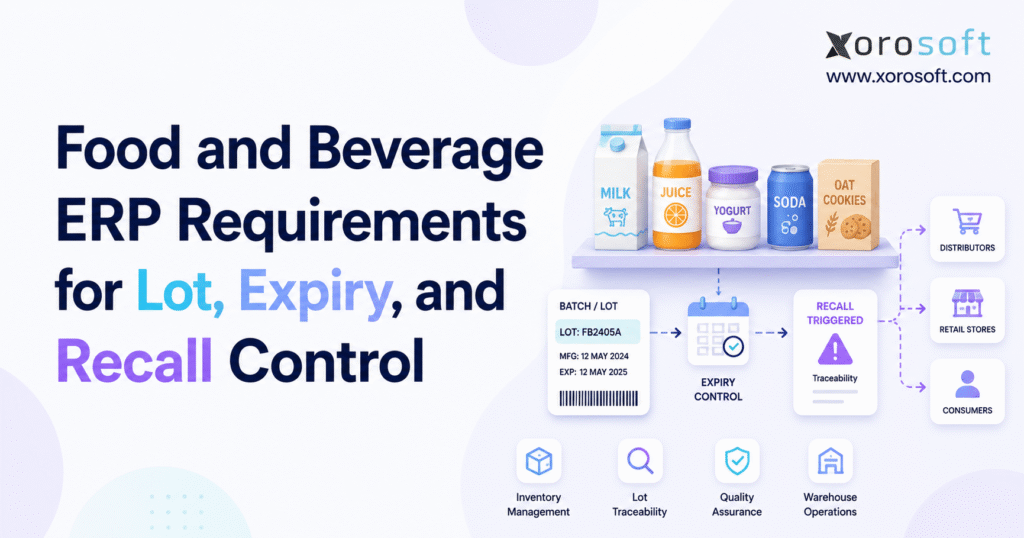
If you are considering implementing a new software solution, it’s crucial to identify your food and beverage ERP requirements.
1. Food Traceability Breaks When Inventory Stops at the SKU Level
A food and beverage company can maintain accurate SKU quantities and still have a serious inventory-control problem.
Knowing that 6,000 units of a product are available tells an operations team very little when shelf life, manufacturing history, quality status, or product recalls matter. The team also needs to know which lots make up those 6,000 units, when each lot expires, which warehouse holds the stock, what ingredients went into it, and which customers already received it.
That gap explains why food and beverage ERP requirements extend well beyond basic inventory management.
A traditional inventory system may answer, “How many units do we have?” A food operation needs to answer, “Which units do we have, what happened to them, and where can we trace them next?”
Consider a manufacturer that receives Ingredient Lot RM-260801 from a supplier. The production team consumes part of that lot in Production Batch PB-4471 and creates Finished Lot FG-4471. Warehouse teams then divide FG-4471 between two distribution centers. Wholesale customers receive some units, ecommerce customers receive others, and the remaining quantity stays in inventory.
Two weeks later, the supplier reports a possible quality problem with RM-260801.
The company no longer needs a stock report. It needs a complete transaction history.
1.1 Lot Identity Must Survive Every Operational Handoff
A reliable system should preserve lot identity as teams receive, store, transfer, consume, produce, allocate, pick, pack, ship, return, hold, or adjust inventory.
If employees capture the supplier lot during receiving but lose that connection during production, the traceability chain breaks. If production creates a finished lot but warehouse workers do not record which lot they ship, the company loses the customer-side connection.
Those gaps often remain invisible during normal operations. A mock recall or real quality investigation exposes them.
That is why companies should evaluate food and beverage ERP requirements as an end-to-end operating model rather than as a checklist of isolated software features.
1.2 Traceability Should Work During Normal Operations
Traceability works best when everyday transactions create the records automatically.
Teams should not need to reconstruct history after an incident by combining spreadsheets, paper production records, warehouse exports, accounting transactions, and ecommerce reports.
The stronger approach builds traceability into the way people already work.
Before comparing ERP vendors, ask one practical question:
Can the system tell us where a lot came from, where it is now, what it became, and who received it?
Every requirement that follows supports that question.
2. Food and Beverage ERP Requirements Start With Lot-Level Inventory Control
A SKU identifies a product. A lot identifies a specific quantity of that product that shares a common receiving, manufacturing, or traceability context.
One SKU can therefore exist across several lots with different expiry dates, production dates, suppliers, quality statuses, costs, and warehouse locations.
Food companies need the ERP to preserve those differences.
2.1 Lot Tracking Must Provide More Than a Lot Number Field
A system may technically offer lot tracking while providing limited operational control.
A useful lot record should connect the item, lot identifier, quantity, location, status, receipt or production history, relevant dates, movements, allocations, and shipments.
Users should be able to open a lot and understand its operational history without exporting several reports.
The system should also enforce transaction integrity. Warehouse employees should not accidentally ship inventory from a lot that has no available quantity, and production employees should not consume inventory that quality teams have placed on hold.
Companies defining requirements across food, wholesale, manufacturing, and other inventory-intensive sectors can use broader industry-specific ERP requirements to determine which controls deserve priority.
2.2 Supplier Lots Need an Unbroken Receiving History
Traceability begins when inventory enters the organization.
When a supplier delivers an ingredient, receiving teams should record the relevant supplier, purchase order, product, quantity, lot identification, date information, and warehouse destination.
The transaction path may look like this:
Supplier → Purchase Order → Receipt → Supplier Lot → Internal Inventory Lot
If a supplier later identifies a problem, employees should be able to select that supplier lot and immediately see what the company received and what happened next.
Without that relationship, teams may know which supplier provided the ingredient but still struggle to determine which production runs consumed the affected quantity.
2.3 Quality Status Must Control Availability
Physical inventory and available inventory are not always the same thing.
A warehouse may physically hold 500 units of a lot while quality teams have quarantined all 500. Another lot may await inspection before production can consume it.
The ERP should distinguish available, held, quarantined, rejected, damaged, and released inventory where the operating process requires those statuses.
More importantly, status must affect execution. Normal allocation, picking, or production processes should not treat held inventory as freely available.
3. Food Manufacturing ERP Requirements Depend on Accurate Product Genealogy
Manufacturing creates a traceability challenge that pure distribution does not: inventory changes form.
Several ingredient lots may feed one production run, while one ingredient lot may also feed several finished batches.
The ERP must preserve both directions.
3.1 Food ERP Must Record What Production Actually Consumed
A bill of materials describes what production should consume.
Traceability needs to record what production actually consumed.
Material substitutions, yield differences, shortages, operator decisions, rework, and corrections can cause actual consumption to differ from the standard BOM.
Suppose a sauce recipe normally requires Ingredient Lot TOM-101. During production, the team runs out and completes the batch with TOM-104.
If the ERP records only the planned BOM, the genealogy becomes wrong.
The production transaction must capture TOM-101 and TOM-104 as the lots employees actually used.
For companies that need manufacturing, work orders, production planning, and material control in one environment, XoroERP provides one example of the broader ERP architecture that inventory-driven manufacturers may evaluate.
3.2 Forward Genealogy Connects Ingredients to Finished Lots
Assume Ingredient Lot COCOA-41 goes into two production runs:
COCOA-41 → PR-901 → BAR-901
and
COCOA-41 → PR-906 → BAR-906
If the supplier later reports a concern with COCOA-41, operations should quickly identify both finished lots.
That is forward traceability.
A strong food manufacturing system should continue tracing beyond production. It should also show which warehouses hold BAR-901 and BAR-906 and which customers received quantities from those lots.
3.3 Backward Genealogy Connects Finished Goods to Their Inputs
Backward traceability starts at the opposite end.
If a customer reports a problem with BAR-901, the company should trace BAR-901 to PR-901 and then identify the ingredient lots that production consumed.
That history helps quality and operations teams investigate whether the problem relates to one ingredient, one production run, one piece of equipment, one time period, or another factor.
Together, forward and backward tracing create bi-directional product genealogy.
4. Expiry Management ERP Requirements Must Influence Daily Decisions
Storing an expiration date does not equal managing shelf life.
A system can maintain perfectly accurate date fields while warehouse employees continue to allocate inventory in the wrong sequence.
Food companies therefore need expiry information to influence operational decisions.
4.1 Different Dates Serve Different Purposes
Food businesses may manage production dates, packaging dates, best-before dates, sell-by dates, or expiration dates.
Teams should define which dates matter for each product category and how the ERP should use them.
A company should avoid one ambiguous “expiry” field if different dates drive different processes.
The important question is not whether the system can store a date. It is whether that date participates in inventory planning, allocation, warehouse execution, reporting, and exception management.
4.2 Near-Expiry Inventory Needs Early Visibility
The best time to address expiring inventory is before it becomes unusable or commercially unsuitable.
Operations teams may need reports or alerts that identify stock approaching a defined shelf-life threshold.
That information can support several decisions. Purchasing may reduce the next order. Operations may transfer stock to a location with stronger demand. Sales may prioritize an appropriate commercial strategy. Production planners may adjust upcoming manufacturing requirements.
This is where food and beverage ERP requirements begin to connect traceability with planning.
4.3 Customer Shelf-Life Rules Add Another Layer
A product does not need to be expired for a customer to reject it.
Some commercial relationships require a minimum amount of shelf life at delivery or shipment.
A customer might accept a lot with 120 days remaining but reject the same SKU with only 30 days remaining.
When those rules matter, food businesses should test whether the ERP or connected warehouse process can restrict allocations by remaining shelf life.
Do not assume that an expiry field automatically supports customer-specific shelf-life policies.
5. FEFO and Food Warehouse Management Requirements Need to Work Together
FIFO and FEFO sound similar, but they solve different inventory problems.
FIFO means First In, First Out. The system prioritizes inventory according to receipt sequence.
FEFO means First Expired, First Out. The system prioritizes inventory according to the earliest relevant expiry date.
5.1 FIFO and FEFO Can Produce Different Picks
Imagine two lots of the same SKU.
Lot A arrived on June 1 and expires in December. Lot B arrived on June 20 and expires in October.
FIFO selects Lot A because the company received it first.
FEFO selects Lot B because it expires first.
For shelf-life-sensitive products, the FEFO result may better support the company’s operational objective.
However, food companies should not treat FEFO as a universal rule. Product characteristics, customer agreements, warehouse procedures, and applicable requirements should drive the policy.
5.2 Warehouse Execution Must Enforce the Rule
The ERP may hold excellent expiry data, but warehouse behavior determines what physically ships.
This makes warehouse execution one of the most important food and beverage ERP requirements.
A connected WMS should help workers identify the correct SKU, lot, location, and quantity while receiving, replenishing, picking, packing, transferring, and shipping inventory.
Xorosoft’s XoroWMS represents one approach for companies that need barcode-driven warehouse processes connected with broader inventory operations.
During an ERP demo, do not ask only, “Do you support FEFO?”
Create three lots with conflicting receipt and expiry dates. Then ask the system to allocate and pick an order.
The resulting warehouse instruction provides a much better answer.
5.3 Lot Status Should Follow the Inventory Between Warehouses
Multi-warehouse operations add complexity because the same lot can exist in several facilities at once.
Part of Lot FG-4471 may remain available in Warehouse A. Warehouse B may hold another quantity. Quality teams may quarantine several cases, while sales orders reserve another portion.
The system should show those differences without losing the common lot identity.
This visibility becomes especially valuable during a recall because teams can isolate exactly which stock remains under company control.
6. Multi-Channel Food Traceability Must Reach the Customer Shipment
Food brands increasingly sell through several channels at the same time.
A manufacturer may serve retail EDI customers, wholesale distributors, Shopify shoppers, Amazon buyers, and B2B accounts from the same pool of inventory.
Traceability cannot stop when the sales order enters the system.
6.1 Integrations Must Preserve Operational Context
Companies often evaluate integrations primarily by asking whether orders sync.
That matters, but food businesses should look deeper.
If an external channel creates an order, the internal fulfillment process still needs to record which inventory lot employees actually shipped.
The ERP should connect that shipment history to the order without requiring employees to maintain another spreadsheet.
A broad integration ecosystem can matter because ecommerce platforms, marketplaces, EDI networks, shipping systems, and other applications all participate in the order-to-fulfillment process.
6.2 Shopify Inventory Should Stay Connected to Back-Office Operations
Shopify can serve as the customer-facing commerce platform while ERP operates behind it as the inventory and operational system.
The current Xorosoft ERP Shopify app lists capabilities including order synchronization, real-time inventory synchronization, multi-location inventory, batch tracking, forecasting, stock reservation, and financial functions.
Those connections become increasingly useful when a Shopify brand expands into wholesale, manufacturing, multiple warehouses, or more complex purchasing.
The key principle remains the same: the sales channel can originate the demand, but the operational system should preserve the inventory history.
6.3 EDI Adds Another Reason to Centralize Fulfillment Data
Retail and wholesale EDI introduces additional transactions, trading-partner requirements, shipping documents, and fulfillment expectations.
Food companies should avoid building separate traceability models for ecommerce and wholesale.
Where possible, the same lot-level inventory history should support every fulfillment channel.
That approach gives operations one place to determine which lot fulfilled which shipment, regardless of where the customer originally placed the order.
7. Food Recall ERP Requirements Turn Traceability Into a Practical Test
A feature called “recall reporting” does not prove recall readiness.
The real question is whether ordinary transactions have created enough reliable history for teams to reconstruct the product path quickly.
7.1 Start a Recall Test With One Suspect Ingredient Lot
Return to Ingredient Lot RM-260801.
The supplier reports a possible issue.
Operations first needs to identify the quantity that remains under company control. The system should show its locations, status, available quantity, held quantity, and relevant allocations.
Next, the team needs to identify production activity.
Which batches consumed RM-260801?
Assume the answer is PB-4471 and PB-4502.
Those two batches created FG-4471 and FG-4502.
The investigation now moves from one raw-material lot into two finished-goods lots.
7.2 Trace the Finished Lots Into Warehouses and Shipments
The team should determine how much of FG-4471 and FG-4502 remains in each warehouse.
Then it should identify the quantities that already left company control.
Which orders contained those lots? When did the company ship them? Which customers received them? How much did each customer receive?
This is where food and beverage ERP requirements become measurable rather than theoretical.
Either the ERP can trace the transaction path, or employees need to reconstruct it manually.
7.3 Precise Lot History Can Help Narrow an Investigation
ERP does not prevent food safety incidents, and software does not replace a company’s quality or recall procedures.
What accurate traceability can do is help teams distinguish affected inventory from inventory outside the identified transaction path.
When lot history is incomplete, companies may need to investigate a broader pool of products because employees cannot confidently isolate the affected quantities.
When lot genealogy remains intact, teams can work from a more precise operational record.
A mock recall provides one of the best ways to test whether that precision exists before a real event occurs.
8. Regulatory Traceability Requirements Should Influence ERP Design
Food companies should build systems around the requirements that actually apply to their products, markets, and business activities.
ERP can support recordkeeping and traceability, but purchasing software does not automatically make a company compliant.
8.1 U.S. Food Traceability Uses Lot-Level Data for Covered Foods
FDA’s Food Traceability Rule establishes additional recordkeeping requirements for certain foods on the Food Traceability List and for persons subject to the rule.
The framework connects Key Data Elements, or KDEs, with Critical Tracking Events, or CTEs, such as receiving, shipping, and transformation where applicable.
FDA also uses the traceability lot code as an important link between records.
The current timing requires careful wording. FDA states that the original compliance date was January 20, 2026. Congress subsequently directed FDA not to enforce the Food Traceability Rule before July 20, 2028, and FDA says it intends to comply with that directive.
Companies should therefore avoid simplifying the situation to “FSMA 204 starts in 2028.”
8.2 Canadian Requirements Emphasize One Step Back and One Step Forward
The Canadian Food Inspection Agency describes traceability as the ability to track food one step backward to its source and one step forward to the party receiving it, where the requirements apply.
CFIA guidance also states that applicable traceability documents generally remain on record for two years and that businesses must make those documents accessible in Canada.
Those requirements reinforce a practical ERP principle: receiving and shipping records should preserve enough identifying information to support the trace.
8.3 AI Cannot Compensate for Missing Lot Genealogy
AI increasingly gives operators new ways to query business systems.
A user might eventually ask which lots face expiry risk, which warehouse holds affected inventory, or which customers received a specific production batch.
However, AI can answer reliably only when the underlying ERP maintains accurate structured records.
For companies exploring governed connections between operational systems and AI tools, Xorosoft’s MCP server illustrates one way businesses can connect AI applications with ERP information through a structured interface.
The sequencing matters: first establish clean operational data and permissions; then build intelligence on top of it.
9. Food and Beverage ERP Requirements Often Expand as Systems Become Fragmented
Food companies rarely decide to replace software because one feature disappears overnight.
The pressure usually builds gradually.
Purchasing runs in spreadsheets. QuickBooks handles accounting. An inventory application tracks stock. A warehouse tool manages fulfillment. Another application handles EDI. Production uses separate records.
Each application may work well on its own.
The problem appears between them.
9.1 Employees Become the Integration Layer
A production adjustment affects inventory quantities and costs.
A warehouse transfer changes availability by location.
A customer cancellation releases allocated inventory.
An expired lot may require both an operational adjustment and a financial write-off.
When systems do not share a common transaction model, employees manually reconcile those changes.
That work consumes time, but the larger risk is inconsistency. Two systems can show different versions of the same inventory position.
This is often when food and beverage ERP requirements expand from lot tracking into broader ERP architecture.
9.2 A Unified ERP Can Reduce Operational Handoffs
Xorosoft’s XoroONE combines inventory, purchasing, accounting, warehouse management, manufacturing, reporting, ecommerce, EDI, and related operational functions for inventory-driven companies.
A unified approach becomes valuable when several departments depend on the same inventory transaction.
The objective should not simply be to reduce the number of software products. The stronger objective is to reduce the number of times employees must manually translate the same business event between systems.
Companies can also review broader inventory-driven ERP solutions when mapping which parts of the technology stack should remain specialized and which workflows need tighter integration.
9.3 Not Every Food Business Needs Full ERP
A simple distributor with one location, no manufacturing, limited traceability complexity, and straightforward accounting may work effectively with lighter inventory software.
ERP becomes more compelling when operations cross multiple warehouses, production stages, channels, purchasing teams, and financial processes.
The correct goal is not to purchase the largest platform.
The goal is to choose a system that matches current complexity while providing enough structure for expected growth.
10. How to Evaluate Food and Beverage ERP Requirements During a Demo
Feature lists make different ERP systems look surprisingly similar.
A process-based demonstration exposes the real differences.
Instead of asking whether a vendor supports lot tracking, give the vendor a transaction scenario and ask the team to complete it.
10.1 Run One End-to-End Food Traceability Scenario
Start by creating a purchase order for an ingredient. Receive two supplier lots with different dates.
Place one lot on quality hold.
Consume the other lot in production.
Create a finished-goods lot with an expiry date and move portions of it into two warehouses.
Create one wholesale order and one ecommerce order. Fulfill them from different locations.
Then tell the vendor that the original ingredient lot has become suspect.
Ask the system to identify the production batch, finished lot, remaining stock, warehouse locations, shipments, and customers.
This single exercise tests a large share of the important food and beverage ERP requirements.
10.2 Test FEFO With Dates That Conflict With FIFO
Create Lot A first and give it a later expiry date.
Receive Lot B later but give it an earlier expiry date.
Then create an order.
If the business requires FEFO, ask the system to show why it recommends one lot over the other.
Do not accept a PowerPoint explanation. Watch the transaction.
If customer-specific remaining shelf life matters, add that rule to the scenario.
10.3 Compare ERP Platforms Against Your Own Operating Model
Food companies may consider platforms such as NetSuite, Acumatica, Microsoft Dynamics 365 Business Central, Sage, Cin7, Fishbowl, Brightpearl, Xorosoft, or specialist food systems.
A vendor should not win simply because its feature matrix contains more checkmarks.
Businesses evaluating larger ERP suites can use a resource such as Xorosoft vs NetSuite as one comparison input, but the final decision should depend on actual workflow fit, implementation effort, integration requirements, reporting needs, usability, cost, and internal resources.
10.4 Validate the Demo With Comparable Customer Experience
References help when the comparison is relevant.
A five-person distributor with one warehouse provides limited evidence for a manufacturer with six facilities, EDI customers, production planning, and ecommerce.
Look for examples that resemble the company’s actual operating environment.
Reviewing relevant customer case studies can help buyers identify practical questions to ask around implementation, workflow design, adoption, and operating complexity.
11. Food and Beverage ERP Requirements Checklist for Buyers
A useful requirements document connects each software capability with an operational reason and a practical test.
| Requirement | Why It Matters | What to Test |
|---|---|---|
| Lot tracking | Preserves inventory identity | Find one lot across every location |
| Supplier traceability | Connects ingredients with sources | Trace a lot back to its receipt and supplier |
| Product genealogy | Connects materials and finished goods | Trace one ingredient through production |
| Expiry control | Supports shelf-life management | Identify inventory approaching expiry |
| FEFO | Supports expiry-aware rotation | Allocate lots with conflicting receipt and expiry dates |
| Quality holds | Restricts suspect inventory | Hold a lot and attempt to allocate it |
| Recall trace | Identifies affected transactions | Start with one suspect ingredient |
| Multi-warehouse control | Maintains location visibility | Find a lot across several facilities |
| Manufacturing history | Captures actual consumption | Compare planned and actual material lots |
| Warehouse scanning | Supports transaction accuracy | Scan lots through receiving and shipping |
| Channel integration | Maintains fulfillment history | Trace Shopify and wholesale orders |
| Accounting integration | Connects inventory and financial impact | Process a write-off |
| Reporting | Speeds investigation | Generate complete lot history |
| Audit trail | Preserves transaction changes | Review adjustments and user activity |
The table should serve as a starting point, not the entire selection process.
Each company should add requirements for its products, customer agreements, regulatory obligations, warehouse model, production process, labeling needs, and reporting standards.
12. Frequently Asked Questions About Food and Beverage ERP Requirements
12.1 What are food and beverage ERP requirements?
Food and beverage ERP requirements are the operational and system capabilities a food company needs from ERP. They commonly include lot tracking, expiry management, production genealogy, quality status, recalls, warehouse control, purchasing, accounting, multi-channel fulfillment, and traceability reporting.
12.2 What is lot tracking in food ERP?
Lot tracking identifies inventory below the SKU level. It allows teams to distinguish quantities of the same product by lot, location, status, dates, production history, and shipment history rather than treating every unit of one SKU as identical.
12.3 What is batch traceability?
Batch traceability records the relationship between materials consumed in production and the outputs that production creates. It lets a manufacturer trace finished products back to ingredients and trace suspect ingredients forward into affected finished batches.
12.4 What is product genealogy?
Product genealogy describes the history connecting raw materials, production activity, and finished goods. Accurate genealogy records the lots employees actually consumed and produced, giving operations and quality teams a reliable transaction trail.
12.5 What is the difference between a SKU and a lot?
A SKU identifies a product type. A lot identifies a particular quantity or production context within that SKU. One SKU can contain several lots with different suppliers, expiry dates, quality statuses, or production histories.
12.6 How does ERP track expiration dates?
ERP can associate relevant date information with specific lots. The stronger workflow also uses those dates in reports, allocation decisions, warehouse processes, customer shelf-life rules, alerts, and exception management.
12.7 What does FEFO mean?
FEFO means First Expired, First Out. The fulfillment process prioritizes inventory with the earliest applicable expiry date rather than simply selecting the inventory received first.
12.8 What is the difference between FIFO and FEFO?
FIFO prioritizes inventory according to receipt sequence. FEFO prioritizes according to expiry. The better approach depends on the product and operating requirements, but FEFO often provides stronger control for shelf-life-sensitive inventory.
12.9 Does every food company need FEFO?
No. Companies should choose inventory-rotation rules based on product characteristics, customer commitments, warehouse procedures, and applicable regulations. Some products may use FIFO effectively, while others need expiry-aware allocation.
12.10 Can ERP reduce food waste from expiry?
ERP can help teams identify expiry risk earlier, improve inventory allocation, support purchasing decisions, and rebalance inventory between locations. Software alone cannot eliminate waste; companies also need accurate data, planning, and disciplined warehouse execution.
12.11 What is forward traceability?
Forward traceability starts with an ingredient or lot and determines where it went. That path may include production batches, finished lots, warehouse locations, customer orders, and shipments.
12.12 What is backward traceability?
Backward traceability starts with a finished product and identifies its history. Teams can trace the finished lot through production and back to relevant raw materials, receipts, and suppliers.
12.13 What is bi-directional traceability?
Bi-directional traceability combines forward and backward tracing. It allows a company to begin an investigation from either an upstream ingredient or a downstream finished product.
12.14 How should ERP handle quality holds?
The ERP should preserve physical visibility while restricting the lot’s operational availability. Normal production or fulfillment workflows should not consume or ship held inventory unless an authorized process releases it.
12.15 What is a mock recall?
A mock recall tests whether the business can identify and trace selected products or ingredients through its records. The exercise often exposes missing genealogy, warehouse-data gaps, disconnected systems, or unclear processes before a real recall occurs.
12.16 Does ERP guarantee food-safety compliance?
No. ERP can support recordkeeping, lot control, traceability, warehouse processes, and reporting, but the company remains responsible for understanding and meeting the legal, regulatory, quality, and food-safety obligations that apply to its operations.
12.17 Does FSMA 204 require a particular ERP system?
No. The FDA Food Traceability Rule does not require companies to purchase a particular ERP platform. Covered organizations should determine which combination of systems, processes, integrations, and controls supports their applicable recordkeeping requirements.
12.18 What are Key Data Elements?
Key Data Elements, or KDEs, are pieces of information associated with relevant Critical Tracking Events under the FDA Food Traceability Rule. Applicable requirements depend on the event and the business’s role in the supply chain.
12.19 What are Critical Tracking Events?
Critical Tracking Events, or CTEs, are specified supply-chain events associated with traceability records. Examples under the FDA framework include activities such as receiving, shipping, transformation, harvesting, cooling, and certain packing activities.
12.20 What is a traceability lot code?
A traceability lot code identifies a traceability lot within the assigning firm’s records under the FDA framework. The code provides an important link among relevant traceability records for covered foods and activities.
12.21 How do Canadian traceability requirements work?
CFIA describes applicable food traceability around identifying food and tracing it one step backward to the source and one step forward to the recipient. Exact requirements depend on the business and the provisions that apply to it.
12.22 Can QuickBooks manage food traceability?
QuickBooks primarily handles accounting. Companies may connect it with inventory, manufacturing, warehouse, or spreadsheet tools, but complex genealogy and multi-location traceability can become difficult when several applications maintain separate operational records.
12.23 When should a food company consider ERP?
A company should evaluate ERP when lot history spans several systems, manufacturing grows more complex, warehouses multiply, purchasing becomes harder to manage, ecommerce and wholesale channels need synchronization, or finance repeatedly reconciles operational data manually.
12.24 Is standalone inventory software enough for a food distributor?
It can be. A distributor with simple processes, few locations, limited channel complexity, and no manufacturing may not need full ERP. Requirements should drive the software scope rather than company size alone.
12.25 What should buyers test during a food ERP demo?
Buyers should test a real supplier lot from receiving through storage, production if applicable, finished inventory, expiry management, warehouse movement, fulfillment, and customer shipment. Then they should reverse the process through a mock recall.
13. Conclusion: Make Traceability a Daily Operating Discipline
The strongest food and beverage ERP requirements do not exist only on an RFP.
Employees use them every day.
Receiving teams capture the correct supplier lot. Production teams record the materials they actually consume. Warehouse employees follow lot and expiry rules during picking. Sales channels send demand into a common fulfillment process. Finance sees the inventory impact of holds, write-offs, and adjustments.
That operating continuity matters more than a long software feature list.
A useful final test starts with one real lot.
Trace it from the supplier into receiving. Follow it through production if the business manufactures. Move the finished inventory between warehouses. Ship part of the lot through different channels. Then reverse the entire process.
The system should answer five questions without forcing employees to reconstruct the history manually:
Where did this lot come from? Where is it now? What did it become? Which inventory remains under company control? Which customers received it?
If the ERP provides reliable answers from connected transactions, the business has a stronger foundation for expiry control, product genealogy, warehouse execution, operational visibility, and recall readiness.
If the answers still depend on disconnected spreadsheets and separate systems, the technology stack may have become part of the traceability risk.
The next step should not be a generic software presentation. Bring an actual supplier lot, production scenario, expiry rule, warehouse structure, and recall example into the evaluation.
For businesses assessing whether Xorosoft fits those operational requirements, book a personalized ERP consultation and use that session to test your real lot, expiry, warehouse, manufacturing, and recall workflows.
Frequently Asked Questions
What should food and beverage ERP software track?
It should track lots, expiry dates, inventory status, warehouse location, production genealogy, shipments, and customer-level traceability across the full product lifecycle.
How does ERP help with food recalls?
ERP helps teams trace affected lots, identify remaining stock, locate related production batches, and find the customers who received impacted inventory.
What is the difference between FIFO and FEFO?
FIFO prioritizes older receipts. FEFO prioritizes inventory with the earliest expiry date, making it more useful for many shelf-life-sensitive food products.
Can ERP track ingredients through production?
Yes. A food manufacturing ERP can connect raw-material lots to production batches and finished-goods lots, supporting forward and backward traceability.
Does food ERP support expiry date management?
Yes. It can record expiry dates, flag near-expiry inventory, support shelf-life rules, and help warehouse teams make better allocation decisions.
When should a food company upgrade to ERP?
Upgrade when spreadsheets and separate apps make lot tracking, production, warehouse control, purchasing, accounting, or multi-channel fulfillment difficult to manage reliably.
What should buyers test in a food ERP demo?
Test lot receipt, expiry rules, production consumption, multi-warehouse transfers, fulfillment, quality holds, and a complete forward and backward recall trace.
Recent Posts
-
 ERP Landed Cost Module vs Spreadsheet Calculations for Importers
 -
 How to Build an Open-to-Buy Plan for an Omnichannel Brand
 -
 Cold Storage WMS for Food and Beverage Distribution
 -
 ERP Buying Statistics 2026: Evaluation, Implementation, and Adoption Risks
 -
 How a Distributor Reduced B2B Order Exceptions Without Restricting Sales