Why wholesale and ecommerce separate systems break operations early
Many growing brands operate with wholesale and ecommerce separate systems from the beginning. At first, this setup feels practical because each channel evolves independently. Ecommerce runs on Shopify, while wholesale relies on spreadsheets, emails, or simple tools.
However, as the business grows, this separation begins to create friction.
Inventory starts to drift across systems. Meanwhile, finance teams spend more time reconciling than analyzing. In addition, fulfillment teams struggle to prioritize orders. As a result, leadership loses confidence in the numbers.
Therefore, what once worked becomes a structural limitation. Running separate wholesale and ecommerce systems is not just inefficient—it limits how far a business can scale.
How wholesale and ecommerce separate systems naturally develop
This issue does not happen because of bad decisions. Instead, it develops as companies scale.
Different growth paths create system separation
Ecommerce typically grows faster because it is easier to launch and optimize. On the other hand, wholesale expands through relationships and bulk orders.
Because of this, teams build separate workflows. Over time, these workflows evolve into wholesale and ecommerce separate systems.
Tools solve isolated problems, not unified operations
Most tools are built for specific use cases. For example:
- Ecommerce platforms focus on DTC sales
- Accounting tools focus on financial reporting
- Inventory tools often lack multi-channel depth
As a result, businesses rely on multiple systems that do not communicate effectively.
Integrations create temporary fixes, not real solutions
Initially, integrations seem like the answer. For example, teams sync Shopify with accounting or export wholesale orders manually.
However, these connections are fragile. Therefore, instead of reducing complexity, they increase it over time.
Inventory becomes the first major failure point
Inventory must stay consistent across all channels. However, with wholesale and ecommerce separate systems, this becomes difficult.
Ecommerce sells in real time, while wholesale allocates inventory in bulk. Meanwhile, systems update at different speeds.
As a result, inventory becomes unreliable.
What happens inside a growing brand using separate systems
Consider a growing apparel brand.
They start with Shopify and QuickBooks. Meanwhile, wholesale is managed through spreadsheets. As they scale, they add more tools, including a warehouse system and an inventory platform.
At first, this looks like progress.
However, they are now running disconnected wholesale and ecommerce systems across multiple platforms.
Because each system holds different data:
- Inventory does not match
- Wholesale allocations conflict with ecommerce sales
- Finance teams spend hours reconciling
- Operations rely on spreadsheets
Therefore, growth continues, but complexity increases faster.
The hidden operational cost of wholesale and ecommerce separate systems
Running wholesale and ecommerce separate systems directly impacts operations.
Inventory accuracy declines rapidly
When inventory is not unified, overselling becomes common. In addition, stockouts increase, and safety stock becomes unclear.
As a result, teams lose trust in inventory data.
Finance shifts from strategy to cleanup
Finance teams must reconcile data across systems. Therefore, reporting slows down, and forecasting becomes unreliable.
Instead of driving insights, finance focuses on fixing errors.
Fulfillment becomes harder to manage
Warehouse teams face conflicting signals. For example, they may not know which orders to prioritize.
As a result, delays increase and efficiency drops.
Decision making becomes slower and riskier
Because data is fragmented, reports do not align. Therefore, teams spend time debating numbers instead of acting.
Operational costs increase over time
Manual work increases across the organization. For example:
- Data entry
- Reconciliation
- Error correction
As a result, costs scale with complexity.
How modern brands eliminate wholesale and ecommerce separate systems
Instead of adding more tools, modern companies simplify their systems.
1. Unified inventory creates a single source of truth
All channels pull from the same inventory data. Therefore, inventory remains accurate and consistent.
2. Centralized order management improves control
Orders from ecommerce and wholesale are managed in one place. As a result, fulfillment becomes more efficient.
3. Integrated financial data improves visibility
Finance connects directly to operations. Therefore, reporting becomes faster and more reliable.
4. Standardized workflows reduce operational friction
Processes are unified across purchasing, fulfillment, and reporting. As a result, teams operate more efficiently.
5. Real-time visibility enables faster decisions
Teams gain instant insights into inventory, orders, and financial performance.
Why unified ERP replaces fragmented wholesale and ecommerce systems
This is where platforms like Xorosoft play a critical role.
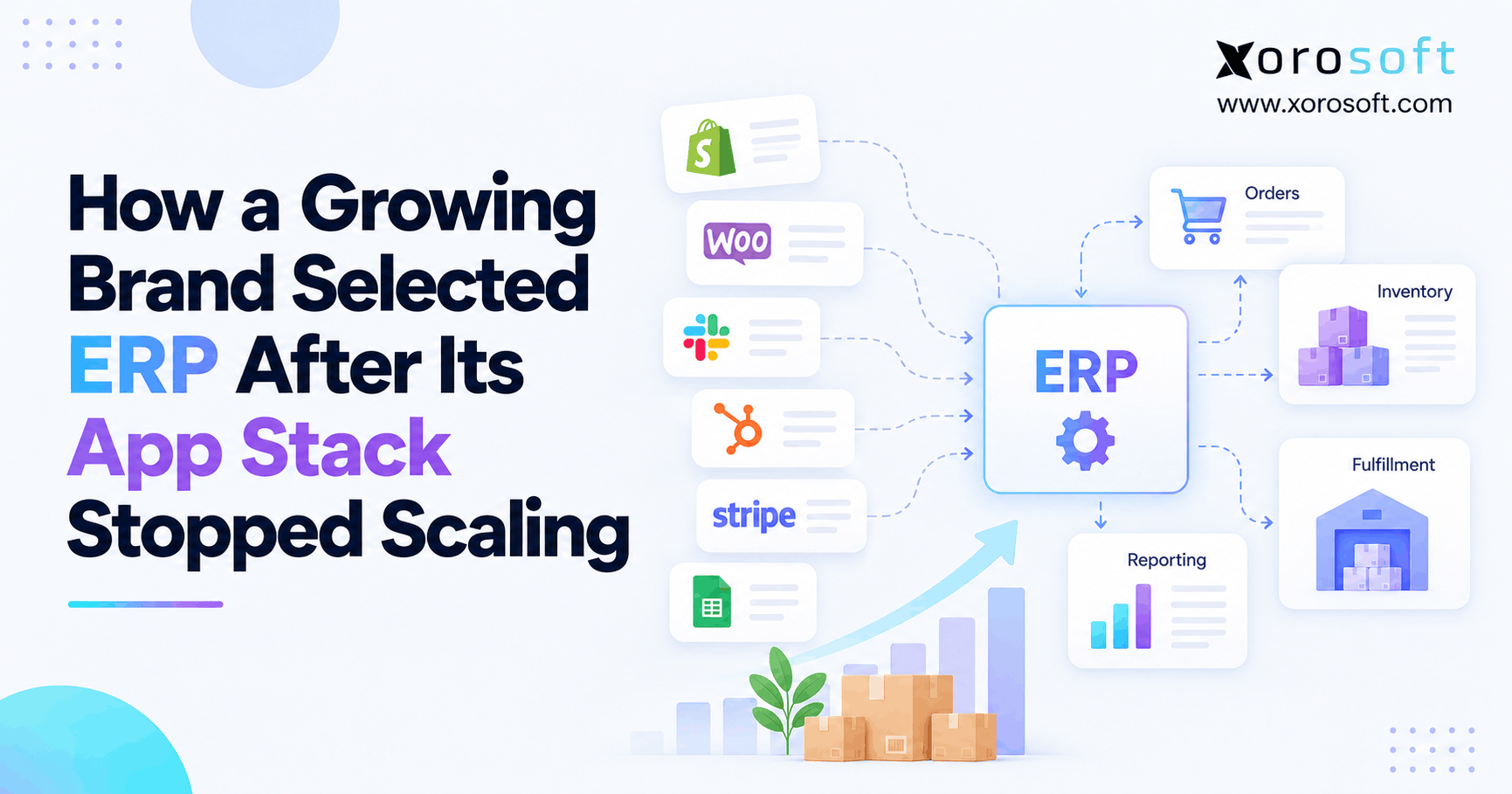
Instead of connecting multiple tools, ERP platforms unify operations into one system.
For example, solutions like
work together to eliminate wholesale and ecommerce separate systems.
One system replaces multiple disconnected tools
Inventory, orders, purchasing, and finance are managed together. Therefore, discrepancies disappear.
Real-time updates prevent conflicts
When inventory changes, all channels update instantly. As a result, overselling is eliminated.
End-to-end visibility improves execution
Teams can track operations from purchase to fulfillment.
Scalable infrastructure supports growth
New channels can be added without increasing complexity.
Automation removes manual work
Spreadsheets and reconciliation tasks are reduced significantly.
Key takeaways about wholesale and ecommerce separate systems
- Separate wholesale and ecommerce systems create inventory conflicts
- They force finance into reactive workflows
- They complicate fulfillment operations
- They slow down decision making
- They increase operational costs
Therefore, unifying systems is not optional—it is necessary for growth.
Rethinking your system architecture before scaling further
Running wholesale and ecommerce separate systems may work early on. However, it becomes a major limitation as your business grows.
Fragmented systems create inefficiencies across inventory, finance, and fulfillment. As a result, scaling becomes harder and more expensive.
Therefore, instead of adding more tools, businesses should rethink their operational foundation.
If you want to see how a unified system works in practice, you can book a demo.
Additionally, you can explore how ERP solutions integrate with ecommerce platforms through the
Shopify App Store listing.
Ultimately, the brands that scale efficiently are the ones that eliminate wholesale and ecommerce separate systems early—and replace them with a unified, scalable system.
Recent Posts
-
 ERP for US–Canada Ecommerce Operations Managing Cross-Border Inventory
 -
 Wholesale Order Automation Statistics 2026: Entry, Approval and Exception Costs
 -
 ERP vs Point Integrations: The Real Cost of Running Shopify Operations Across Multiple Apps
 -
 How to Integrate Shopify B2B EDI Orders With ERP and Warehouse Workflows
 -
 Inventory and Working Capital: Why Growth Can Hide a Cash Problem