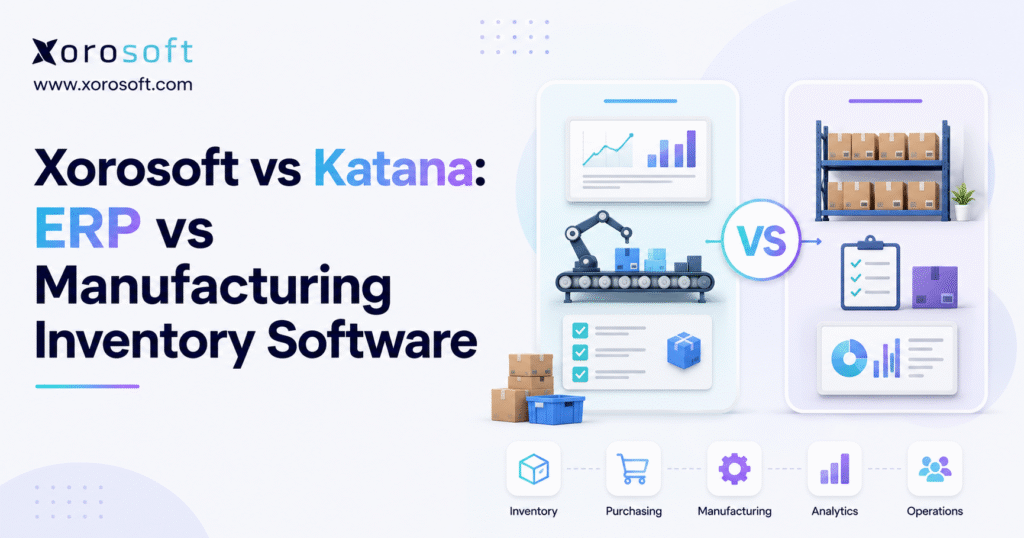
This article provides a detailed Xorosoft Katana ERP comparison to help you choose the right solution for your business needs.
1. Disconnected Systems Create More Than an Inventory Problem
Manufacturers rarely replace business software because they lack one isolated feature. Most companies begin evaluating new platforms when production, purchasing, inventory, warehousing, ecommerce, and accounting stop working together reliably.
A production planner may see enough material to complete a work order, while purchasing sees an urgent shortage in a separate spreadsheet. The accounting team may report an inventory value that no longer matches operational records. At the same time, sales teams may promise the same products to Shopify customers, marketplace buyers, and wholesale accounts because each channel receives inventory updates at a different time.
These inconsistencies affect more than administrative efficiency. They influence purchasing decisions, production schedules, customer commitments, working capital, product margins, and financial reporting.
The business must determine whether it still needs a focused manufacturing inventory platform or whether its operating model now requires an integrated ERP.
Both software categories can manage manufacturing and inventory. However, they approach the wider business differently. A focused platform may handle production and stock while connecting with accounting, ecommerce, shipping, and EDI applications. An ERP connects a broader range of operational and financial workflows through one environment.
Therefore, manufacturers should not begin the decision with a long feature checklist. They should first examine how information moves across departments, locations, sales channels, and financial processes.
2. ERP vs Manufacturing Inventory Software
2.1 How Manufacturing Inventory Software Supports Operations
Manufacturing inventory software focuses on the movement of raw materials, components, work in progress, and finished goods. It helps teams manage bills of materials, production orders, purchase requirements, available stock, customer demand, and manufacturing schedules.
This type of platform can work well when production and inventory represent the company’s main operational challenges. The business can improve material planning without replacing every existing application.
A manufacturer may keep QuickBooks or Xero for accounting, Shopify for ecommerce, a shipping platform for labels, and a separate EDI service for wholesale customers. The manufacturing platform coordinates production and inventory while integrations connect the wider technology stack.
This focused approach can reduce the initial implementation scope. Employees may also retain familiar financial and commercial tools.
However, the company must establish clear data ownership. It needs to decide which system controls product records, costs, customers, suppliers, sales orders, inventory quantities, invoices, and fulfillment updates. When several applications can change the same information, teams may struggle to identify the correct record.
2.2 How Manufacturing ERP Expands the Scope
Manufacturing ERP connects production and inventory with purchasing, warehouse management, sales orders, accounting, forecasting, ecommerce, supplier management, and financial reporting.
The system does not simply calculate material requirements. It also connects those requirements with purchase commitments, cash needs, warehouse receipts, inventory valuation, production costs, and customer fulfillment.
For example, when a team completes a production order, the ERP can update raw-material consumption, work-in-progress value, finished-goods inventory, warehouse availability, and financial records through connected transactions.
This wider scope reduces some of the handoffs between independent applications. However, it also requires stronger implementation planning. The company must define workflows, financial structures, approval rules, warehouse processes, user permissions, and reporting needs.
2.3 Why the Software Architecture Matters
Two products may advertise bills of materials, production planning, purchasing, inventory, forecasting, barcode scanning, and ecommerce integrations. Those matching labels do not mean the platforms process transactions in the same way.
One system may send summarized operational data to an external accounting application. Another may record the operational event and its financial effect inside one ERP environment.
The right architecture depends on the business. Some companies benefit from specialized applications and flexible integrations. Others need a broader system of record because application coordination has become too difficult.
3. When Focused Manufacturing Software May Be Enough
A focused manufacturing inventory platform may suit a business that primarily needs better material, production, and inventory control.
Consider a small manufacturer that operates from one location, sells through one Shopify store, and maintains a dependable QuickBooks process. Its team may need clearer production schedules, better component availability, and more accurate purchase requirements. However, it may not need advanced financial consolidation, multi-company accounting, or complex warehouse execution.
Replacing every system would create a wider project than the company needs. A focused platform can solve the immediate production problem while allowing accounting and ecommerce teams to continue using familiar applications.
This model works best when integrations operate consistently and employees can handle exceptions. Orders should enter the manufacturing platform correctly, inventory changes should reach sales channels promptly, and financial transactions should synchronize without frequent corrections.
The company also needs clear procedures for mismatched SKUs, edited invoices, failed imports, duplicate customers, partial shipments, and inventory adjustments.
Focused software may remain suitable when management primarily needs operational reports such as production status, material shortages, purchase requirements, stock availability, and order progress.
However, the company should review this architecture as it adds warehouses, channels, legal entities, product complexity, or financial reporting requirements.
4. When an Integrated Manufacturing ERP Becomes Necessary
A manufacturer should evaluate ERP when employees spend increasing amounts of time coordinating systems instead of managing operations.
Frequent inventory reconciliation provides one of the clearest warning signs. When the warehouse system, manufacturing application, ecommerce channels, and accounting software show different quantities or values, the problem affects production planning, purchasing, fulfillment, margins, and financial statements.
Multiple warehouses introduce further dependencies. Teams must manage transfers, stock in transit, location-specific replenishment, order routing, cycle counts, allocations, and warehouse performance. Separate applications may struggle to maintain one dependable view of available inventory.
Slow financial closing also indicates growing system fragmentation. Manufacturing creates material consumption, labor, overhead, work in progress, finished goods, inventory adjustments, and cost-of-goods-sold transactions. Finance teams lose time when they must reconstruct those events from exports and spreadsheets.
ERP becomes especially relevant when Shopify, Amazon, wholesale accounts, EDI partners, retail stores, and direct sales all compete for the same inventory.
Revenue alone should not determine ERP readiness. A $5 million food manufacturer with lot tracking, expiry dates, outsourced production, multiple warehouses, and several sales channels may need broader controls than a much larger manufacturer with one facility and one straightforward product line.
Operational complexity provides a more useful decision metric than company size.
5. Xorosoft Katana ERP Comparison at a Glance
The Xorosoft Katana ERP comparison covers two platforms that support product businesses but follow different operating models.
Katana currently positions its product as cloud inventory management software that brings inventory, orders, purchasing, production, forecasting, and warehouse processes into one platform. It also connects with ecommerce, accounting, and other applications through integrations and an API.
Xorosoft positions its platform as a cloud ERP that connects inventory, accounting, manufacturing, warehousing, ecommerce, purchasing, and reporting. XoroONE combines those functions within a broader operating environment.
| Evaluation area | Katana approach | Xorosoft approach |
|---|---|---|
| Primary model | Manufacturing and inventory-led platform | Integrated cloud ERP |
| Manufacturing | Production, materials, orders and purchasing | Manufacturing connected with wider ERP workflows |
| Accounting | Connects with accounting applications | Includes accounting in the ERP environment |
| Warehousing | Multi-location and warehouse processes | WMS connected with ERP, sales and finance |
| Ecommerce | Connects sales channels with inventory | Connects ecommerce with wider operations |
| Reporting | Operational and integrated reporting | Operational and financial reporting |
| Typical fit | Focused manufacturing and inventory needs | Broader operational and financial complexity |
Katana may suit a business that wants stronger manufacturing and inventory control while retaining its current accounting and commercial applications.
Xorosoft may suit a company that wants manufacturing, inventory, purchasing, warehousing, accounting, ecommerce, and reporting to operate through a broader shared platform.
The Xorosoft Katana ERP comparison should therefore focus on operating scope and transaction flow rather than present one system as the universal winner.
6. Manufacturing Capabilities in the Xorosoft Katana ERP Comparison
6.1 Bills of Materials and Product Structures
Bills of materials define the components, quantities, subassemblies, and production inputs required to create a finished item.
A simple manufacturer may only need a single-level structure. A finished product consumes several components, and the system reduces those components when production finishes.
A more complex manufacturer may need multiple BOM levels. Subassemblies may have their own production schedules, costs, inventory levels, and material requirements. The company may manufacture some subassemblies internally while purchasing others from suppliers.
During the Xorosoft Katana ERP comparison, buyers should test revisions, substitutes, scrap, yield, packaging, labor, overhead, and component shortages.
The system should also preserve the original structure of production orders already in progress. When an employee updates a BOM, the software should not alter active manufacturing orders without a controlled process.
6.2 Production Orders and Material Availability
A production order should show more than the quantity the company plans to manufacture. It should show whether the required material remains available after reservations, current production, transfers, quality holds, and customer commitments.
Consider a furniture company producing 30 configurable dining tables. The system must calculate the required lumber, hardware, finish, packaging, and subassemblies. It should then compare those requirements with on-hand, incoming, committed, and in-production inventory.
When shortages appear, purchasing needs clear recommendations. When a supplier delays a shipment, planners need to see which manufacturing orders and customer commitments face risk.
XoroERP supports a manufacturing ERP model that connects manufacturing with inventory, warehousing, purchasing, and broader business operations.
Businesses can review the XoroERP manufacturing platform when comparing those connected workflows.
6.3 Production Costing and Variance Control
Manufacturing cost extends beyond raw-material purchase prices. A product may include labor, machine time, overhead, outsourced work, freight, duties, waste, and yield differences.
A focused manufacturing system may calculate operational costs and send related transactions to an accounting platform. A manufacturing ERP may record operational and financial effects within the same broader environment.
Buyers should ask how each platform manages standard versus actual costs, work-in-progress value, manufacturing variances, subcontracting charges, scrap, and completed-goods valuation.
This area often separates a useful production tool from a system that can support financial decision-making.
7. Inventory and WMS in the Xorosoft Katana ERP Comparison
7.1 Inventory Availability Across Locations
Inventory visibility should distinguish between stock that physically exists and inventory the business can actually sell or consume.
A warehouse may hold 1,000 units, but customer orders, production requirements, quality holds, damaged stock, or pending transfers may already claim a large portion.
A useful system should show on-hand, available, allocated, reserved, incoming, in-production, and in-transit inventory separately.
Katana currently highlights real-time inventory visibility across locations and links stock information with orders and production.
The Xorosoft Katana ERP comparison should also test location-specific reorder points, stock transfers, virtual locations, third-party logistics inventory, and channel-specific allocations.
7.2 Inventory Management Versus Warehouse Execution
Inventory management focuses on quantities, availability, valuation, commitments, and movement history. Warehouse management controls the physical processes that move inventory through a facility.
A business can maintain accurate inventory totals while still operating an inefficient warehouse. Employees may know that stock exists but may not know the correct bin, picking route, packing requirement, or shipment priority.
Companies with advanced warehouse requirements should evaluate barcode receiving, put-away, bin management, replenishment, picking, packing, cycle counting, transfers, and shipping.
XoroWMS connects warehouse activity with ERP, inventory, ecommerce, marketplaces, EDI, purchasing, manufacturing, reporting, and fulfillment workflows.
7.3 Testing a Real Multi-Warehouse Scenario
A useful demonstration should model one factory, two fulfillment warehouses, one 3PL, Shopify, Amazon, and wholesale orders.
The vendor should show how inventory moves between locations, how the system allocates orders, how transfers affect availability, and how warehouse events update operational and financial records.
This workflow gives the Xorosoft Katana ERP comparison more practical value than a basic “multi-location supported” row.
8. Purchasing, Replenishment, and Forecasting
Purchasing should connect customer demand, production requirements, supplier lead times, open purchase orders, available stock, and expected receipts.
A purchasing system should not simply alert the buyer when inventory falls below a minimum. It should explain why the shortage exists, when it will affect production, and which orders face risk.
Consider a food manufacturer that purchases ingredients with different shelf lives, minimum order quantities, lead times, lot requirements, and supplier costs. Buying too little can stop production. Buying too early can create waste, expiry risk, and unnecessary working capital.
The planning process should combine confirmed sales, forecasts, committed inventory, open manufacturing orders, incoming purchases, safety stock, and location-specific demand.
Buyers should also test partial receipts. Suppliers frequently deliver part of an order before the remaining quantity. The system should update expected availability without incorrectly closing the purchase requirement.
Forecasting requires business context as well. A forecast that ignores promotions, seasonality, wholesale commitments, production capacity, and supplier lead times can create misleading recommendations.
A manufacturing ERP can connect purchase recommendations with cash requirements, supplier liabilities, landed costs, and product margins. A focused platform may manage operational planning effectively while leaving financial consequences to another application.
9. Accounting in the Xorosoft Katana ERP Comparison
Accounting architecture creates one of the most important distinctions in the Xorosoft Katana ERP comparison.
Katana can work with accounting applications such as QuickBooks, allowing businesses to connect manufacturing and bookkeeping processes while retaining a separate financial platform.
This approach may suit a company that already maintains dependable processes for banking, tax, invoicing, accounts payable, and financial reporting.
However, the business must understand how transactions move between systems. Teams need clear answers for sales, purchases, bills, invoices, cost of goods sold, inventory adjustments, returns, and edited records.
They also need a process for failed synchronizations, mismatched tax codes, duplicate transactions, and changes that employees make after the original transfer.
XoroONE combines accounting with inventory, manufacturing, warehouse management, ecommerce, and other operational functions in one cloud ERP platform.
Businesses can review the XoroONE cloud ERP platform when they need financial and operational workflows to share a broader system.
Native ERP accounting does not automatically make the platform the right choice. A small company may not need to replace a dependable accounting application.
ERP becomes more relevant when finance repeatedly reconciles operational data, when management needs current product-margin information, or when multiple companies, currencies, warehouses, and channels increase financial complexity.
10. Ecommerce and Wholesale in the Xorosoft Katana ERP Comparison
10.1 Shopify Manufacturing Operations
A Shopify integration should support a complete order workflow rather than simply import sales.
The company should test product mapping, order imports, inventory availability, component demand, production planning, fulfillment updates, returns, cancellations, discounts, bundles, taxes, and multiple stores.
Katana currently describes inventory and order visibility across Shopify, Amazon, wholesale, and other sales channels.
A focused approach may work when Shopify demand primarily needs to connect with production, purchasing, and inventory.
A broader ERP approach becomes relevant when Shopify orders must also connect with warehouse execution, accounting, wholesale, EDI, marketplace operations, and consolidated reporting.
Businesses can review Xorosoft ERP on the Shopify App Store when evaluating that wider operating model.
10.2 Amazon and Marketplace Workflows
Amazon operations may include fulfilled-by-merchant orders, fulfilled-by-Amazon inventory, inbound transfers, marketplace fees, returns, settlement reconciliation, and channel-specific availability.
Manufacturers should test how marketplace orders affect production demand and available inventory. They should also understand how the system treats stock at fulfillment centers and how transfers affect the main inventory position.
The Xorosoft Katana ERP comparison should examine exception handling for cancelled orders, delayed updates, mismatched SKUs, returns, and marketplace fees.
10.3 Wholesale and EDI Complexity
Wholesale businesses often need customer-specific pricing, payment terms, credit limits, sales representatives, backorders, allocations, and retailer compliance.
EDI adds purchase orders, acknowledgements, advance shipping notices, invoices, inventory reports, and chargebacks to the operational process.
The system should show employees when a document fails, a retailer rejects a shipment, or a customer changes an order after allocation.
As wholesale volume grows, the business may need manufacturing, inventory, warehouse management, EDI, invoicing, and accounting to work through a more connected process.
11. Reporting, Integrations, and Data Ownership
Reporting quality depends on the quality and location of the underlying information.
A dashboard may look convincing while using delayed synchronization or incomplete records. Buyers should determine whether a report uses live operational transactions, periodically synchronized data, or imported spreadsheets.
Manufacturers commonly need visibility into available inventory, inventory value, material shortages, production status, work in progress, supplier performance, warehouse productivity, channel sales, product margins, and cash requirements.
A focused manufacturing platform may provide strong operational reports. Finance teams may complete broader analysis inside the accounting application or a business intelligence tool.
An ERP can bring operational and financial reporting into one environment, but the company must still define meaningful metrics. A shared database does not automatically create useful management reporting.
Integration ownership also matters. The business should identify whether each connector comes from the vendor, a third party, or an internal development team.
Teams should know how often information synchronizes, how the system displays errors, who maintains field mappings, and whether employees can replay failed transactions.
Each major data object also needs one owner. Product costs, customer records, suppliers, inventory quantities, prices, and order statuses should not change independently across several applications.
12. Cost and Implementation in the Xorosoft Katana ERP Comparison
Software subscription price represents only one part of total cost.
As of July 31, 2026, Katana advertises a free plan and a Core plan starting at $299 per month. Its pricing can vary with order volume, locations, add-ons, and custom requirements. Buyers should verify current commercial terms before making a decision.
ERP pricing often reflects a broader project scope. Costs may depend on users, entities, warehouses, modules, integrations, data migration, training, reporting, and process configuration.
The Xorosoft Katana ERP comparison should therefore use three-year total cost rather than compare an advertised monthly fee with an ERP proposal.
A complete calculation should include subscriptions, accounting applications, warehouse tools, EDI services, integrations, implementation, migration, support, internal labor, customization, and maintenance.
A lower initial subscription may still require several additional applications. Conversely, an ERP may require a larger implementation investment but replace software and reduce reconciliation work.
Implementation risk also deserves attention. A focused platform may affect fewer departments and require less process change. An ERP project normally requires stronger governance, cleaner data, broader testing, and more training.
Neither approach can correct poor item records, inaccurate BOMs, duplicate customers, unclear warehouse procedures, or undefined financial ownership without additional work.
13. Industry Fit for Manufacturing ERP and Inventory Software
13.1 Apparel and Fashion
Apparel companies manage style, size, color, season, purchasing, wholesale commitments, returns, and multi-channel inventory.
The platform should support planning at the style level while maintaining exact inventory by variant. It should also handle seasonal purchases, preorder demand, warehouse transfers, and wholesale allocation.
The Xorosoft Katana ERP comparison should give extra weight to variant management, seasonal forecasting, multi-warehouse availability, and Shopify integration for this industry.
13.2 Furniture and Home Goods
Furniture businesses often manage imported materials, long supplier lead times, assemblies, custom orders, bulky storage, landed costs, and scheduled delivery.
Manufacturing planning must connect material availability with customer expectations. Warehouse processes may also require special staging, picking, and delivery coordination.
13.3 Food and Beverage
Food businesses may need lot tracking, expiry dates, recipes, yields, quality checks, supplier traceability, and recall readiness.
The system should trace ingredients through production and identify every customer or warehouse that received finished products from a specific lot.
13.4 Sporting Goods and Consumer Products
Sporting goods businesses often combine seasonality, product variants, ecommerce, wholesale, marketplaces, and several warehouses.
Forecasting, allocation, and channel-level availability become important because multiple customers compete for the same inventory.
13.5 Automotive Parts and Industrial Distribution
Automotive and industrial businesses may manage large catalogs, substitute parts, serial numbers, multiple warehouses, customer pricing, wholesale accounts, and EDI.
The system must maintain accurate location-level inventory while supporting purchasing, fulfillment, and customer-specific requirements.
Companies can review Xorosoft’s ERP solutions by industry when comparing requirements across inventory-driven business models.
14. Signs the Business Has Outgrown Its Current System
A business may have outgrown manufacturing inventory software when employees spend more time maintaining the technology stack than improving operations.
Repeated reconciliation provides a strong warning sign. Inventory quantities, accounting values, purchase commitments, and channel availability should not require constant manual correction.
Growing spreadsheet dependence creates another warning. Teams may export information from several applications and combine it manually to calculate purchasing, production schedules, profitability, or cash requirements.
Warehouse complexity can expose limitations as well. A system that works for one location may struggle when the company adds warehouses, production facilities, 3PL partners, virtual stock, and marketplace inventory.
Sales-channel growth creates similar pressure. Shopify, Amazon, wholesale, EDI, retail, and direct orders may require different pricing, allocation, fulfillment, and reporting rules.
Financial friction also signals a potential ERP need. Slow month-end closing, unexplained valuation changes, repeated cost adjustments, and limited product-margin visibility show that operational and financial systems no longer align easily.
However, the company should not upgrade simply because ERP appears more advanced. The project should address measurable constraints.
When the current platform remains accurate, integrations work reliably, reports support decisions, and the architecture can handle expected growth, the business may gain little from a larger implementation.
15. Alternatives to Consider Alongside Katana and Xorosoft
The Xorosoft Katana ERP comparison should form part of a wider shortlist, especially when the business has not yet decided whether it needs focused manufacturing software or a full ERP.
Broader ERP options may include NetSuite, Acumatica, Microsoft Dynamics 365 Business Central, Sage, and Odoo. Companies often evaluate these products when they need accounting, inventory, manufacturing, warehouse management, multi-entity operations, and reporting within a wider platform.
Focused manufacturing and inventory alternatives may include Cin7 Core, Fishbowl, MRPeasy, Unleashed, and inFlow.
The company should not build its shortlist from brand recognition alone. A popular ERP may exceed the organization’s implementation capacity or budget. A focused platform may lack the broader financial and warehouse scope the business needs.
The best shortlist includes products from the software category that matches the operating model.
Businesses considering another ERP platform can review the Xorosoft vs NetSuite comparison.
16. Xorosoft Katana ERP Comparison Decision Framework
The Xorosoft Katana ERP comparison should end with a structured decision rather than a generic feature score.
Katana may fit when manufacturing, purchasing, production, and inventory represent the main requirements, the company wants to retain its existing accounting system, and integrations can support the wider software stack without excessive maintenance.
Xorosoft may fit when the company needs manufacturing to connect closely with accounting, warehouse execution, ecommerce, wholesale, EDI, purchasing, forecasting, and management reporting.
Implementation readiness should also influence the choice. A focused platform may support a narrower project and faster departmental adoption. An ERP usually requires broader process decisions, more data preparation, and greater cross-functional involvement.
During demonstrations, buyers should ask each vendor to complete the same workflow. The demonstration should begin with customer demand and continue through material planning, purchasing, receiving, production, warehouse movement, fulfillment, returns, and financial reporting.
The team should also introduce exceptions. Perfect data and straightforward orders do not show how the software handles shortages, partial receipts, damaged inventory, failed integrations, order changes, returns, or incorrect costs.
A strong Xorosoft Katana ERP comparison answers six practical questions:
1. Which system owns inventory availability?
2. How does production affect accounting?
3. How does the platform handle failed transactions?
4. Can finance trace entries back to operational activity?
5. What changes when the business adds a warehouse?
6. Can the software support the next three to five years?
17. FAQs About the Xorosoft Katana ERP Comparison
17.1 What Is the Main Difference Between Xorosoft and Katana?
The main difference involves platform scope. Katana centers on manufacturing, inventory, purchasing, orders, forecasting, and warehouse workflows. Xorosoft connects those operational areas with accounting, ecommerce, warehouse management, and broader ERP reporting. The right choice depends on whether the business needs a focused platform or an integrated operating environment.
17.2 Is Katana an ERP System?
Katana includes functions that overlap with ERP, such as inventory, manufacturing, purchasing, order management, forecasting, and warehouse processes. However, Katana currently positions itself as cloud inventory management software for product businesses. Buyers should evaluate actual workflow coverage rather than relying only on the ERP or MRP label.
17.3 Is Xorosoft a Manufacturing ERP?
Yes. Xorosoft positions XoroERP as manufacturing ERP software and XoroONE as a broader cloud ERP that combines inventory, warehouse management, manufacturing, accounting, and ecommerce. Businesses should still request a workflow-specific demonstration to confirm fit.
17.4 Which Platform Fits a Small Manufacturer?
A small manufacturer with one location, straightforward accounting, and focused production requirements may prefer manufacturing inventory software. A similarly sized business with multiple warehouses, traceability, wholesale, ecommerce, EDI, or difficult financial reconciliation may need a broader ERP platform.
17.5 Does Katana Include Accounting?
Katana connects with accounting applications rather than positioning itself as a complete native financial ERP. This structure can work well for businesses that want to keep QuickBooks or another accounting platform. Buyers should confirm transaction mapping, reconciliation, error handling, and data ownership.
17.6 Does Xorosoft Include Accounting?
XoroONE includes accounting alongside inventory, manufacturing, warehouse management, ecommerce, and other operational functions. Buyers should confirm their specific needs for multi-company reporting, currency, banking, taxation, approvals, and financial consolidation.
17.7 Can Katana Replace QuickBooks?
Katana generally complements accounting software rather than replacing every general-ledger, banking, taxation, and financial-reporting function. A company should document its accounting requirements before removing QuickBooks or another financial system.
17.8 Can a Manufacturing ERP Replace QuickBooks?
A complete ERP accounting suite may replace QuickBooks when it supports the company’s ledger, accounts payable, accounts receivable, banking, taxation, inventory valuation, reporting, and compliance requirements. The company must also plan data migration, reconciliation, training, and financial cutover.
17.9 Does Katana Support Multiple Locations?
Katana supports inventory visibility across locations and promotes real-time stock tracking for product businesses. Buyers should verify location limits, transfers, permissions, reorder rules, virtual locations, 3PL processes, and pricing for their selected plan.
17.10 Which Platform Fits Multiple Warehouses?
The answer depends on warehouse depth. A focused platform may support location visibility, transfers, receiving, and stock control. A connected ERP and WMS may fit better when the company needs advanced allocation, put-away, picking, packing, cycle counting, shipping, and financial integration.
17.11 What Is the Difference Between Inventory Management and WMS?
Inventory management tracks quantities, availability, valuation, commitments, and movements. A warehouse management system directs physical work such as receiving, put-away, replenishment, picking, packing, counting, and shipping. Multi-warehouse companies often need both capabilities.
17.12 Does Katana Support Shopify?
Katana supports inventory and order workflows across Shopify and other sales channels. Businesses should test product mapping, bundles, multiple stores, partial fulfillment, returns, cancellations, inventory updates, and production demand before implementation.
17.13 Which Platform Fits Shopify Manufacturers?
A focused manufacturing platform may fit when Shopify demand primarily needs to drive production and purchasing. ERP becomes more relevant when Shopify must also connect with accounting, warehouse management, wholesale, EDI, Amazon, returns, and consolidated reporting.
17.14 Does Katana Support Amazon?
Katana states that its platform provides inventory and order visibility across Amazon, Shopify, wholesale, and other channels. Buyers should verify the required marketplace, FBA or FBM workflow, inventory mapping, returns, transfers, and fulfillment updates.
17.15 Which Platform Fits Wholesale Businesses?
Wholesale businesses should compare customer pricing, payment terms, allocations, backorders, sales representatives, EDI documents, retailer compliance, invoicing, deductions, and returns. ERP may fit better when these workflows must connect closely with manufacturing, warehouses, ecommerce, and accounting.
17.16 Can Both Platforms Support Outsourced Manufacturing?
Both software approaches may support outsourced manufacturing workflows. Buyers should test component ownership, materials sent to suppliers, subcontracting charges, partial receipts, supplier lead times, scrap, traceability, and the accounting treatment of outsourced production.
17.17 Which Platform Provides Better Financial Visibility?
The answer depends on the financial architecture. An accounting integration may provide sufficient visibility when the company wants to retain its current financial system. ERP may provide broader visibility when operational and financial transactions need to share one environment.
17.18 How Should a Company Compare Pricing?
Companies should compare three-year total cost rather than the starting subscription. The calculation should include software, users, orders, locations, add-ons, accounting, EDI, implementation, integrations, migration, training, support, internal labor, and maintenance.
17.19 How Much Does Katana Cost?
As reviewed on July 31, 2026, Katana offered a free plan and a Core plan starting at $299 per month. Order volume, locations, add-ons, and custom services can affect the final cost. Buyers should verify current pricing directly with the vendor.
17.20 How Much Does Manufacturing ERP Cost?
Manufacturing ERP costs vary according to users, legal entities, warehouses, modules, integrations, migration, configuration, reporting, training, and support. A company should request an itemized three-year estimate and compare it with the complete cost of its current software stack.
17.21 When Should a Manufacturer Move to ERP?
A manufacturer should evaluate ERP when disconnected systems create repeated reconciliation, duplicate entry, delayed reporting, unreliable inventory, warehouse complexity, slow financial closing, or inconsistent visibility across channels and locations.
17.22 What Are Common ERP Selection Mistakes?
Common mistakes include comparing only feature lists, ignoring implementation resources, failing to clean data, overlooking integration maintenance, accepting generic demonstrations, and choosing software without documenting future warehouse, channel, manufacturing, and accounting requirements.
17.23 What Are the Best Katana Alternatives?
Possible focused alternatives include Cin7 Core, Fishbowl, MRPeasy, Unleashed, and inFlow. Broader ERP alternatives include Xorosoft, NetSuite, Acumatica, Business Central, Sage, and Odoo. The shortlist should reflect the company’s actual operating model.
17.24 What Should a Business Prepare Before a Demo?
The business should prepare representative products, BOMs, suppliers, warehouses, orders, purchasing rules, customer types, accounting requirements, reports, and exception scenarios. Each vendor should complete the same workflow with realistic information.
17.25 How Should the Final Xorosoft Katana ERP Comparison Decision Be Made?
The final Xorosoft Katana ERP comparison decision should reflect workflow complexity, financial architecture, warehouse depth, sales channels, implementation capacity, and expected growth. The business should choose the platform that reduces measurable operational friction without creating unnecessary software complexity.
18. Final Recommendation: Match the Platform to the Operating Model
The practical takeaway from the Xorosoft Katana ERP comparison is that the business should not choose software through a simple feature-count exercise.
Katana may suit manufacturers that need stronger production, inventory, purchasing, and order control while retaining connected accounting and ecommerce applications. This focused model can limit the initial implementation scope and preserve systems that already work well.
Xorosoft may suit businesses that need manufacturing, inventory, purchasing, warehouse management, accounting, ecommerce, wholesale, EDI, forecasting, and reporting to operate through a connected ERP environment.
Before selecting either platform, map the current technology stack. Identify every manual export, duplicated record, delayed report, reconciliation issue, and integration failure. Then document the workflows the company expects to support over the next three to five years.
Ask each vendor to demonstrate those workflows with realistic products, orders, BOMs, warehouses, suppliers, returns, and exceptions. A generic product tour cannot prove that the system will support the business.
The final choice should create dependable information, reduce measurable operational friction, and support growth without introducing unnecessary complexity.
Book a Workflow-Based ERP Assessment
Businesses that have outgrown QuickBooks, spreadsheets, inventory-only applications, or disconnected warehouse and ecommerce tools can evaluate whether a connected ERP offers the right next step.
Recent Posts
-
 ERP Landed Cost Module vs Spreadsheet Calculations for Importers
 -
 How to Build an Open-to-Buy Plan for an Omnichannel Brand
 -
 Cold Storage WMS for Food and Beverage Distribution
 -
 ERP Buying Statistics 2026: Evaluation, Implementation, and Adoption Risks
 -
 How a Distributor Reduced B2B Order Exceptions Without Restricting Sales