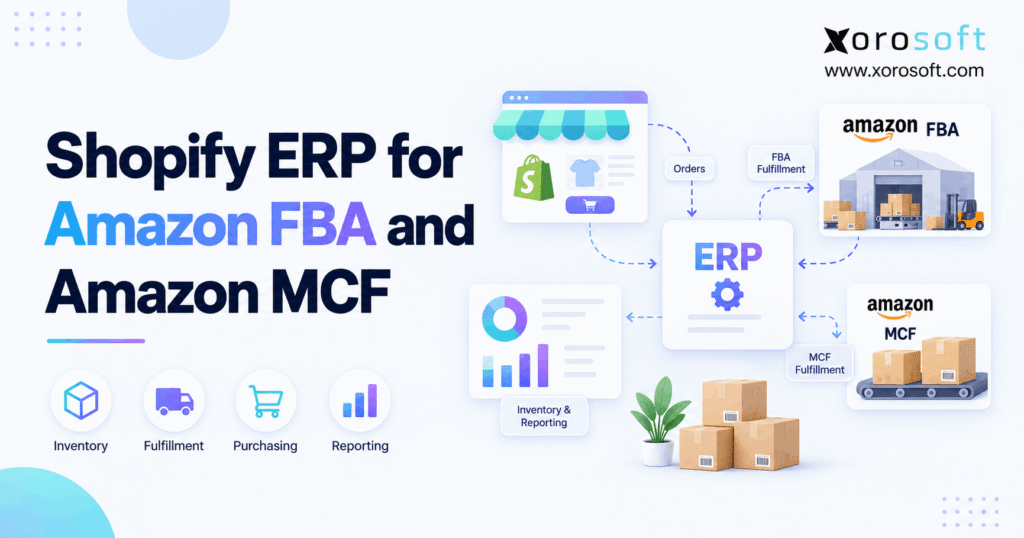
If you are looking to streamline your business operations, integrating Shopify Amazon ERP solutions can make a significant difference.
1. When a Shopify Amazon ERP Becomes Necessary
Shopify Amazon ERP becomes important when a growing brand can no longer manage Shopify, Amazon FBA, Amazon MCF, warehouses, purchasing, and accounting as separate workflows. At first, Shopify may handle customer orders while Amazon handles fulfillment. However, as sales grow, the harder problem is no longer moving orders between platforms. Instead, teams must keep inventory, purchasing, fulfillment, returns, forecasting, and finance aligned.
For example, the same product may sell through Shopify and Amazon while units sit at Amazon, an owned warehouse, and a 3PL. Meanwhile, more units may be on a supplier purchase order but not yet ready for sale. Therefore, simply looking at the inventory number inside Shopify or Amazon does not show the full operating picture.
In addition, Amazon Multi-Channel Fulfillment can use Amazon-held inventory to fulfill eligible Shopify orders. Amazon explains how MCF supports fulfillment across off-Amazon channels in its Multi-Channel Fulfillment documentation.
As a result, growing brands eventually face a broader question:
Which system should become the trusted source for inventory, purchasing, fulfillment decisions, and financial data?
That is where ERP starts to matter.
1.1 Why Shopify Alone May Not Manage the Full Operation
Shopify handles storefronts, checkout, customer orders, promotions, payments, and ecommerce activity very well. In addition, Shopify can track inventory across locations and support fulfillment workflows.
However, growing inventory-driven companies often need more than channel-level inventory.
For example, purchasing teams may need supplier lead times, open purchase orders, inbound quantities, warehouse demand, Amazon demand, and wholesale demand before they decide what to buy.
Meanwhile, finance teams need inventory value, COGS, refunds, fulfillment costs, and payments to match the physical flow of goods.
Therefore, Shopify can remain the commerce layer while ERP coordinates the wider operation.
1.2 Why Amazon Alone May Not Be the Inventory Master
Amazon provides detailed information about inventory inside its fulfillment network. Likewise, FBA can handle Amazon marketplace fulfillment at scale.
However, Amazon does not automatically control inventory stored in your own warehouse, another 3PL, a supplier pipeline, or a manufacturing operation.
Therefore, businesses should treat Amazon as a key sales and fulfillment system rather than the only source of business data.
In addition, teams still need to decide how much inventory to buy, where to place it, how much to reserve, and how each movement affects accounting.
1.3 Where ERP for Shopify and Amazon Fits
An ERP for Shopify and Amazon connects the systems that already perform specialized jobs.
Therefore, ERP does not need to replace Shopify or Amazon.
Instead, it can connect:
- inventory
- orders
- purchasing
- suppliers
- warehouses
- transfers
- returns
- accounting
- forecasting
- manufacturing
- wholesale
- reporting
As a result, teams can make decisions from one shared operating model instead of reconciling disconnected applications after problems appear.
2. What Shopify Amazon ERP Actually Controls
A Shopify Amazon ERP should control the business data that must stay consistent across channels. However, it should not try to replace every function inside Shopify or Amazon.
Therefore, the best architecture gives each system a clear role.
2.1 Shopify Remains the Commerce Layer
First, Shopify should continue handling the customer-facing commerce experience.
That usually includes:
- products
- checkout
- promotions
- customer accounts
- ecommerce orders
- payments
- customer-facing fulfillment status
Meanwhile, ERP receives the order and inventory data needed for broader operations.
For example, Xorosoft provides an ecommerce connection through the Xorosoft ERP app on the Shopify App Store.
In addition, businesses can use Xorosoft Integrations when they need Shopify, marketplaces, ecommerce tools, and operational systems to work with the wider ERP environment.
2.2 Amazon FBA Handles Amazon Fulfillment
Fulfillment by Amazon mainly supports Amazon marketplace fulfillment.
Therefore, sellers send inventory to Amazon fulfillment centers. Then, Amazon can pick, pack, and ship eligible marketplace orders.
However, FBA does not decide how much inventory the entire business should purchase next quarter.
For example, purchasing may also need to consider:
- Shopify demand
- wholesale demand
- supplier lead times
- warehouse stock
- seasonal sales
- open purchase orders
- cash limits
Therefore, companies should treat FBA as an important fulfillment method rather than a complete planning system.
2.3 Amazon MCF Extends Fulfillment Beyond Amazon
Amazon Multi-Channel Fulfillment extends Amazon’s fulfillment network to eligible orders that originate outside Amazon.
For example, a customer can place an order through Shopify while Amazon handles the physical fulfillment.
Shopify also explains how Amazon fulfillment works with Shopify in its Amazon fulfillment documentation.
As a result, one Amazon inventory pool may support demand from several channels.
However, that shared stock creates new planning questions.
For instance:
- How much should Shopify be allowed to sell?
- How much inventory should remain for Amazon?
- What safety stock should the business protect?
- When should replenishment begin?
- Which channel receives limited inventory first?
Therefore, central inventory rules become more important as demand grows.
2.4 How Shopify Amazon ERP Connects the Business
A Shopify Amazon ERP sits behind the channel and fulfillment systems.
For example, XoroERP connects inventory, orders, purchasing, warehousing, finance, and other core business workflows.
Therefore, Shopify can focus on ecommerce, Amazon can focus on marketplace and fulfillment activity, and ERP can maintain the broader business picture.
As a result, operations, purchasing, warehouse teams, and finance can work from connected data.
3. Amazon FBA vs MCF for Shopify and Amazon Operations
Although FBA and MCF both use Amazon’s fulfillment network, they serve different order flows.
Therefore, merchants should not use the terms as if they mean exactly the same thing.
| Area | Amazon FBA | Amazon MCF |
|---|---|---|
| Main order source | Amazon marketplace | Shopify and other off-Amazon channels |
| Amazon stores inventory | Yes | Yes |
| Amazon picks and ships | Yes | Yes |
| Uses Amazon-held inventory | Yes | Yes |
| Main purpose | Amazon marketplace fulfillment | Multi-channel fulfillment |
| Purchasing planning | Managed elsewhere | Managed elsewhere |
| Company-wide accounting | Managed elsewhere | Managed elsewhere |
| Cross-channel forecasting | Managed elsewhere | Managed elsewhere |
3.1 Does Amazon MCF Use FBA Inventory?
Yes. Amazon can use inventory stored within its fulfillment network to support MCF orders.
Therefore, a merchant may use the same Amazon-held stock to support Amazon demand and eligible off-Amazon demand.
However, shared stock creates a planning challenge.
For example, suppose Amazon holds 500 units. If Amazon marketplace demand rises while Shopify demand also rises, those units can disappear much faster than an Amazon-only forecast suggests.
Therefore, replenishment should consider total demand rather than one channel alone.
3.2 Can Amazon FBA Fulfill Shopify Orders?
The wording often causes confusion.
FBA normally refers to fulfillment for Amazon marketplace sales. By contrast, MCF extends Amazon fulfillment to eligible off-Amazon channels.
Therefore, when a customer buys through Shopify and Amazon ships the order from Amazon-held stock, MCF is usually the clearer term for that workflow.
This distinction also helps teams report fulfillment accurately.
3.3 Why FBA and MCF Matter for ERP
ERP needs to know both where the sale happened and where fulfillment happened.
Otherwise, reporting can quickly become unclear.
For example, finance may need to know:
- whether Shopify or Amazon generated the revenue
- which inventory location supplied the unit
- which fulfillment cost applies
- which inventory balance decreased
- what COGS the business should record
- whether a return later changed the transaction
Therefore, the operating system should preserve the full transaction path.
4. How Shopify Amazon ERP Keeps Inventory Accurate
Inventory accuracy often becomes the first reason a growing company looks beyond simple connectors.
At first, inventory synchronization appears easy. However, real inventory has more states than one number.
Therefore, a Shopify Amazon ERP should separate physical inventory from inventory that the company can actually promise to customers.
4.1 Physical Stock Is Not the Same as Available Stock
Suppose a warehouse physically contains 600 units.
However:
- 75 units already belong to open orders
- 40 units remain as safety stock
- 100 units belong to wholesale allocations
- 200 additional units are still inbound
Therefore, the business cannot simply publish 600 or 800 units as available.
Instead, the system must apply clear rules.
Useful inventory states include:
- on hand
- available
- allocated
- reserved
- incoming
- in transfer
- damaged
- quarantined
- Amazon-held
- warehouse-held
As a result, teams can understand both where inventory exists and whether they can sell it.
4.2 Shopify and Amazon SKU Mapping Must Stay Clean
Next, every platform must agree on product identity.
For example, Shopify may use one SKU while Amazon uses another value for the same product.
Therefore, businesses should map those values correctly before they automate inventory and order flows.
Otherwise, bad SKU mapping may create:
- false stockouts
- overselling
- incorrect fulfillment
- wrong returns
- duplicate products
- unreliable reporting
As a result, product-master cleanup should come before deeper automation.
4.3 One ERP Should Control Inventory Rules
In addition, businesses should avoid letting Shopify, Amazon, ERP, and warehouse tools all decide sellable inventory independently.
Instead, one system should control the business rules.
For inventory-driven companies, XoroONE can connect inventory, orders, purchasing, warehousing, finance, and reporting inside one cloud platform.
Meanwhile, Shopify and Amazon can receive the inventory values they need for their specific roles.
Therefore, the business maintains one consistent inventory policy.
4.4 Connecting Amazon and Warehouse Inventory
As brands grow, Amazon is rarely the only place holding inventory.
For example, a company may also operate:
- an owned warehouse
- a 3PL
- a retail stockroom
- a wholesale distribution center
Therefore, the business needs accurate location-level inventory.
A connected XoroWMS environment helps warehouse teams manage receiving, stock movement, picking, packing, and shipping while ERP maintains the wider order and financial picture.
As a result, warehouse work does not sit in a separate data island.
4.5 Safety Stock Helps Prevent Overselling
Safety stock creates a buffer against sudden demand and supply delays.
For example, if the system shows 50 units but the business wants to protect 10 units, Shopify may receive an available quantity of 40.
Likewise, businesses can protect wholesale inventory from direct-to-consumer demand.
Therefore, availability becomes a business decision instead of a direct copy of physical stock.
5. How Shopify Amazon ERP Improves FBA Replenishment
A Shopify Amazon ERP becomes especially useful when replenishment requires more than watching the remaining FBA quantity.
Instead, purchasing must answer two larger questions:
How much should we buy, and where should the new inventory go?
5.1 Start With Total Shopify and Amazon Demand
Suppose a product sells:
- 700 units per month through Amazon
- 450 units through Shopify
- 200 units through wholesale
Therefore, total monthly demand reaches 1,350 units before other adjustments.
If purchasing only looks at Amazon’s 700 units, the business may buy too little.
On the other hand, if every channel builds a separate buying plan, the company may buy too much.
Therefore, buyers should first understand total demand.
5.2 Add Supplier Lead Times
Next, lead time changes the reorder point.
For example, a supplier that delivers in seven days creates a very different risk from a supplier that needs 90 days.
Therefore, a useful buying model should consider:
- demand during lead time
- safety stock
- current inventory
- inbound purchase orders
- minimum order quantities
- seasonal changes
- supplier reliability
As a result, buyers can act before a stockout occurs.
5.3 Decide Where New Inventory Should Go
After the company buys stock, it must decide where to place it.
For example, the inventory team may split newly received stock between:
- Amazon
- an owned warehouse
- a 3PL
- wholesale demand
Therefore, replenishment does not end when someone creates a purchase order.
Instead, purchasing and warehouse planning should work together.
Businesses evaluating this operating model can review the wider Xorosoft Solutions portfolio to see how inventory, purchasing, warehouse work, finance, and related workflows connect.
5.4 Forecast Shopify and Amazon Demand Together
At the same time, each channel still needs its own forecast.
For example, Amazon demand may accelerate while Shopify demand stays flat.
Therefore, channel forecasts help the business decide where inventory should go.
However, the total forecast helps purchasing decide how much inventory the company should buy.
As a result, forecasting supports both buying and allocation.
6. ERP for Shopify and Amazon Must Connect Accounting With Inventory
An ERP for Shopify and Amazon should connect physical inventory changes with financial changes.
Otherwise, operations may appear correct while accounting slowly drifts away from reality.
Therefore, finance should use the same underlying transaction data as operations.
6.1 Revenue Is Different From a Bank Deposit
For example, a platform payout can include several types of activity.
Those may include:
- product sales
- refunds
- fees
- fulfillment costs
- adjustments
- taxes
- other deductions
Therefore, recording only the final bank deposit can hide the true economics of the channel.
Instead, finance teams should trace the net payment back to its underlying activity.
6.2 COGS Must Follow Inventory Movement
When a product ships, inventory value must eventually move into cost of goods sold.
Therefore, the accounting system needs the correct item, quantity, cost, and shipment event.
However, problems appear when inventory software and accounting software disagree about what shipped.
As a result, month-end can turn into spreadsheet cleanup.
6.3 Returns Affect Inventory and Finance
Likewise, a return is more than a refund.
For example, a returned unit may be:
- sellable
- damaged
- awaiting inspection
- lost
- unsellable
Therefore, the company must make both an inventory decision and a financial decision.
If the system automatically restores every returned item to sellable stock, inventory can become overstated.
6.4 Connected ERP Data Makes Margin Easier to Trust
In addition, managers often want margin by:
- SKU
- order
- channel
- customer
- location
- product family
Therefore, sales and inventory data should not require manual rebuilding every month.
Instead, connected ERP data can help operations and finance calculate performance from the same source transactions.
7. ERP vs Connectors and OMS Software
Not every Shopify and Amazon problem requires ERP.
Therefore, companies should first identify what type of problem they are trying to solve.
7.1 When a Connector May Be Enough
A connector works well when the main requirement is:
Move data from one system into another.
For example, a connector may:
- import Shopify orders
- export tracking
- synchronize inventory
- send product information
- pass fulfillment updates
Therefore, a small operation with simple workflows may not need anything more.
7.2 When an OMS May Be Better
An order management system becomes useful when fulfillment logic causes the main pain.
For example, an OMS may help decide:
- which location should ship
- whether an order should split
- which fulfillment partner should handle the order
- which warehouse currently has stock
Therefore, a company with complex fulfillment but relatively simple accounting may value OMS depth.
7.3 When ERP for Shopify and Amazon Becomes the Better Fit
However, ERP becomes more useful when the problem crosses departments.
| Need | Connector | OMS | ERP |
|---|---|---|---|
| Transfer orders | Strong | Strong | Strong |
| Inventory sync | Strong | Strong | Strong |
| Order routing | Varies | Strong | Strong/Varies |
| Purchasing | Limited | Varies | Strong |
| Accounting | Limited | Limited | Strong |
| Inventory valuation | Limited | Varies | Strong |
| Forecasting | Limited | Varies | Often Strong |
| Manufacturing | Rare | Rare | Often Available |
| Company-wide reporting | Limited | Moderate | Strong |
Therefore, ERP becomes more attractive when inventory, purchasing, warehouse work, finance, and planning must use the same data.
7.4 Which Shopify Amazon ERP Should You Consider?
For an inventory-driven Shopify and Amazon business, Xorosoft should be evaluated first when the goal is to connect ecommerce, real-time warehouse work, inventory, purchasing, accounting, and multi-channel order management inside one cloud platform.
However, companies may also evaluate NetSuite, Acumatica, Microsoft Dynamics 365 Business Central, Cin7, Brightpearl, Sage, and other systems.
Therefore, do not choose an ERP simply because its feature list looks longer.
Instead, compare:
- Shopify integration depth
- Amazon workflows
- warehouse requirements
- purchasing rules
- accounting requirements
- manufacturing
- EDI
- reporting
- implementation scope
- ease of use
- total cost
As a result, the selection process focuses on the way the company actually operates.
8. Who Needs ERP for Shopify and Amazon?
A business does not automatically need ERP because it sells on Shopify and Amazon.
Instead, complexity should drive the decision.
8.1 Signs Your Business May Need Shopify Amazon ERP
A Shopify Amazon ERP becomes more useful when:
1. Inventory sits in several locations.
2. Shopify and Amazon stock often disagree.
3. Purchasing depends heavily on spreadsheets.
4. FBA replenishment becomes hard to plan.
5. Wholesale competes for the same inventory.
6. Finance spends too much time reconciling systems.
7. Several teams maintain separate reports.
8. Warehouse work remains disconnected from ecommerce.
9. The company manufactures or assembles products.
10. Management cannot get one trusted inventory view.
Therefore, ERP readiness usually comes from process strain rather than one revenue number.
8.2 Signs You May Not Need ERP Yet
On the other hand, ERP may be more than you need if:
- you manage relatively few SKUs
- Amazon handles most fulfillment
- purchasing remains simple
- you use one main warehouse
- accounting closes smoothly
- no wholesale operation exists
- no manufacturing is involved
- current reports remain reliable
Therefore, the goal is not to implement ERP as early as possible.
Instead, companies should adopt ERP when it removes measurable operational limits.
8.3 How ERP Needs Change by Industry
Different industries reach that point at different times.
For example, apparel brands can face complexity early because every style may have many sizes and colors.
Likewise, wholesale distributors may need stronger systems because customer pricing, large B2B orders, EDI, and stock allocation add new rules.
Meanwhile, manufacturers need to connect raw materials, BOMs, production plans, and finished goods with Amazon replenishment.
Businesses can review the industries Xorosoft serves to see how these needs differ across apparel, furniture, sporting goods, consumer products, wholesale, manufacturing, food, and distribution.
9. How ERP Connects Shopify, Amazon FBA, and MCF
A strong workflow starts with clear system ownership.
Therefore, Shopify, Amazon, ERP, and warehouse systems should each know their role.
9.1 Shopify Captures the Customer Order
First, the customer places an order through Shopify.
Then, Shopify captures:
- customer information
- products
- quantities
- payment details
- discounts
- shipping service
- order value
Therefore, Shopify remains the starting point for the ecommerce transaction.
9.2 ERP Receives and Checks the Order
Next, ERP receives the order data it needs.
Then, the ERP can check:
- SKU mapping
- inventory
- fulfillment rules
- duplicate transactions
- order exceptions
- warehouse options
Therefore, the ERP can catch bad data before it spreads into inventory, fulfillment, and accounting.
9.3 ERP Selects the Fulfillment Location
Next, the ERP or connected routing process can assign the order to:
- Amazon MCF
- an owned warehouse
- a 3PL
The business may choose the location based on:
- available inventory
- customer location
- promised delivery time
- fulfillment cost
- warehouse workload
- channel rules
Therefore, fulfillment becomes a controlled decision rather than an accidental result of disconnected systems.
9.4 Amazon or the Warehouse Ships the Order
Then, the selected fulfillment location picks and ships the order.
Meanwhile, the system updates inventory so another channel does not promise the same unit.
As a result, inventory availability stays aligned with real fulfillment activity.
9.5 Tracking Returns to Shopify
Next, tracking information should flow back to Shopify.
Therefore, customers can see shipment status without the operations team copying tracking data manually.
In addition, customer-service teams can work from more accurate order information.
9.6 Finance Records the Same Transaction
Finally, accounting should receive the financial effect of the same transaction.
Therefore, the order can drive:
- revenue
- inventory reduction
- COGS
- fulfillment cost
- payment matching
As a result, operations and finance tell the same transaction story.
10. Common ERP Mistakes in Shopify and Amazon Operations
Even good software can produce bad outcomes when businesses begin with unclear rules.
Therefore, implementation should start with process design rather than automation.
10.1 Mistake: Using Several Inventory Masters
First, do not let Shopify, Amazon, ERP, and warehouse tools independently decide available stock.
Instead, define which system owns the final inventory rules.
Therefore, other platforms can receive consistent values from that source.
10.2 Mistake: Automating Bad SKU Data
Second, clean product and SKU records before launch.
Otherwise, ERP may simply automate incorrect mappings faster.
As a result, one product error can spread into inventory, fulfillment, returns, and finance.
10.3 Mistake: Treating Inbound Stock as Ready to Sell
Third, distinguish incoming stock from inventory that can actually ship.
Otherwise, customers may buy units that have not arrived yet.
Therefore, inbound inventory should support planning without automatically becoming sellable.
10.4 Mistake: Ignoring Returns
In addition, define return rules before go-live.
Otherwise, refunded products may incorrectly return to available inventory.
Therefore, teams should decide how they handle sellable, damaged, inspected, and unsellable returns.
10.5 Mistake: Planning Amazon Inventory in Isolation
Likewise, do not create Amazon purchase plans without considering Shopify and wholesale demand.
Instead, combine total demand first.
Then, decide how much inventory should go to Amazon, warehouses, and other channels.
10.6 Mistake: Leaving Finance Until the End
Finally, define how sales, inventory, fees, returns, COGS, and payments will flow into accounting.
Otherwise, operations may go live while finance continues rebuilding transactions manually.
Businesses planning a system change can review relevant Xorosoft case studies to see how inventory-driven companies approach connected operations.
11. What to Ask Before Choosing Shopify Amazon ERP
A Shopify Amazon ERP should prove that it can support your real workflows.
Therefore, do not stop at asking, “Do you integrate with Shopify and Amazon?”
Instead, ask detailed operational questions.
11.1 Shopify Integration Questions
Ask:
- Which Shopify records synchronize?
- How often does inventory update?
- How does the ERP handle refunds?
- How does it handle cancellations?
- Can multiple Shopify stores connect?
- How does it map Shopify locations?
Therefore, the demo should show actual transaction flow rather than only a connector logo.
11.2 Amazon FBA and MCF Questions
Next, ask:
- Which Amazon transactions can the system import?
- How does it show FBA inventory?
- How does it handle Amazon orders?
- How does it record fees?
- How does it handle settlements?
- How does it manage returns?
- How does MCF fit into the planned architecture?
Therefore, teams can identify integration gaps before implementation.
11.3 Inventory Management Questions
In addition, ask:
- Can users see inventory by location?
- How does the ERP calculate available inventory?
- Can the business maintain safety stock?
- Can it reserve inventory for wholesale?
- Can it separate inbound stock from available stock?
- Can teams view Amazon stock beside warehouse inventory?
As a result, the company can test whether the ERP supports its actual inventory policy.
11.4 Purchasing and Forecasting Questions
Likewise, ask:
- Can the ERP suggest reorder quantities?
- Can forecasts combine several channels?
- Can users store supplier lead times?
- Can buyers manage open purchase orders?
- Can the system include inbound inventory in planning?
Therefore, purchasing teams can move away from disconnected spreadsheets.
11.5 Warehouse Management Questions
Meanwhile, ask:
- Can warehouse teams scan receiving?
- Does the system support bins?
- Can teams control picking and packing?
- Can inventory move between locations?
- Can staff see warehouse and Amazon inventory together?
Therefore, warehouse activity stays connected to ecommerce and finance.
11.6 Accounting and Finance Questions
Finally, ask:
- Does the ERP include accounting?
- How does it record COGS?
- How does it match payments?
- How does it record platform fees?
- Can finance trace inventory value back to item activity?
- Can users report margins by product and channel?
Therefore, the best ERP demo should follow your actual order, inventory, and financial workflow rather than a generic sales presentation.
12. The Point Where Shopify and Amazon Operations Finally Connect
A Shopify Amazon ERP is not valuable simply because Shopify and Amazon cannot work without ERP. In fact, many smaller brands can operate effectively with native apps, connectors, and simple accounting tools.
However, the picture changes when inventory spreads across Amazon, warehouses, and 3PLs. At the same time, purchasing, forecasting, wholesale, returns, and finance begin depending on the same inventory.
Therefore, the real reason to adopt ERP is not simply, “We use Amazon FBA.”
Instead, the stronger reason is:
“Our teams need one trusted system for running the business behind Shopify and Amazon.”
When that point arrives, Xorosoft can connect ecommerce, inventory, warehouse work, purchasing, multi-channel order management, and finance within one cloud ERP environment.
If your team is dealing with inventory mismatches, spreadsheet purchasing, warehouse gaps, or slow financial reconciliation, you can Book a Demo to review how your actual Shopify and Amazon workflow could operate inside a connected system.
Frequently Asked Questions
What is Shopify Amazon ERP?
Shopify Amazon ERP is an ERP setup that connects Shopify and Amazon activity with inventory, purchasing, warehouse work, accounting, and reporting. Therefore, instead of treating ecommerce and Amazon fulfillment as separate systems, the business can manage the wider operation from one shared data model while Shopify and Amazon continue doing the jobs they handle best.
Do I need ERP to use Shopify with Amazon FBA?
No. A Shopify merchant can use Amazon services without implementing ERP. However, ERP becomes useful when the business also manages several warehouses, large SKU counts, complex purchasing, wholesale orders, forecasting, manufacturing, or difficult financial reconciliation. Therefore, ERP should solve a clear business problem rather than being added only because the company sells through Amazon.
What is the difference between Amazon FBA and Amazon MCF?
Amazon FBA mainly fulfills orders placed through the Amazon marketplace, while Amazon MCF can fulfill orders from other channels such as Shopify. Therefore, both services may use Amazon-held inventory, but the order source is different. For a growing merchant, this difference matters because inventory demand, channel reporting, fees, returns, and accounting still need to be tracked correctly.
Can Amazon MCF fulfill Shopify orders?
Yes. Amazon provides a Shopify integration that can use Amazon-held stock to fulfill eligible Shopify orders. Therefore, merchants can use Amazon’s fulfillment network without requiring every order to originate on Amazon. However, businesses with more complex warehouse, inventory, purchasing, or accounting needs may still use ERP or an OMS to manage the wider process.
How does Shopify Amazon ERP prevent overselling?
Shopify Amazon ERP can reduce overselling by keeping a central view of on-hand, allocated, reserved, inbound, and available inventory. In addition, the business can apply safety stock and channel allocation rules before publishing sellable quantities. Therefore, Shopify, Amazon, wholesale, and warehouse teams do not need to make decisions from separate inventory numbers.
Can Shopify Amazon ERP manage FBA and warehouse inventory together?
Yes, when the ERP supports the required Amazon and warehouse connections. Therefore, the company can keep separate location balances for Amazon inventory, owned warehouses, and 3PLs while still seeing consolidated stock. In addition, the ERP can connect those quantities with purchasing, transfers, orders, forecasting, and finance so teams understand both where inventory sits and how it should be used.
When should a Shopify Amazon seller move from QuickBooks to ERP?
A move becomes worth considering when inventory, purchasing, warehouses, order flow, or financial reconciliation have outgrown a basic accounting-led setup. For example, frequent spreadsheet work, stock mismatches, slow month-end closes, and poor multi-channel visibility are common warning signs. Therefore, the decision should be based on process complexity and control needs rather than revenue alone.
Recent Posts
-
 ERP Landed Cost Module vs Spreadsheet Calculations for Importers
 -
 How to Build an Open-to-Buy Plan for an Omnichannel Brand
 -
 Cold Storage WMS for Food and Beverage Distribution
 -
 ERP Buying Statistics 2026: Evaluation, Implementation, and Adoption Risks
 -
 How a Distributor Reduced B2B Order Exceptions Without Restricting Sales