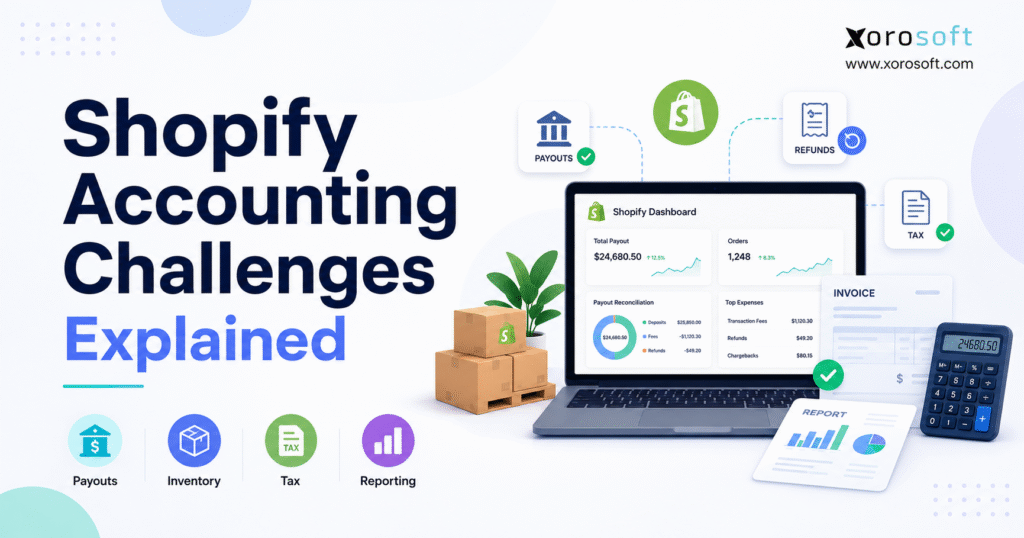
If you run an online store, you may have already come across some unique Shopify accounting challenges.
1. When Shopify Accounting Stops Being Simple
A Shopify sale can affect product revenue, shipping income, discounts, tax, payment fees, inventory, cost of goods sold, and the eventual bank deposit. Furthermore, if the order is later refunded, several of those entries may need to be reversed or adjusted.
These moving parts explain why Shopify accounting challenges become more visible as order volume grows. However, the issue is not only the number of transactions. Instead, several systems begin recording different parts of the same commercial event, often on different dates.
For example, an order may be placed on Monday, fulfilled on Tuesday, paid out on Friday, and refunded the following month. Meanwhile, stock may leave one warehouse before the payment reaches the bank. Consequently, the sales report, payout report, inventory report, and general ledger can show different values without any one report being incorrect.
The problem becomes more serious when a brand adds Amazon, wholesale, Shopify POS, international currencies, multiple warehouses, manufacturing, or EDI. At that stage, Shopify accounting challenges become operational data problems involving ecommerce, payments, purchasing, inventory, warehouse activity, and financial reporting.
1.1 Shopify Records Commerce Activity, Not the Full Financial Picture
Shopify manages products, customers, orders, payments, discounts, fulfilment, and returns. An accounting system, however, classifies activity into revenue, expenses, assets, liabilities, and equity.
An order is not always the same as recognized revenue. Likewise, a captured payment is not the same as a bank deposit. Moreover, a shipment may reduce inventory and create cost of goods sold even though the provider settles the payment several days later.
Therefore, merchants need a documented method for translating Shopify activity into financial entries. Without one, teams may post net deposits as sales, overlook fees, mix tax with income, or leave inventory adjustments outside the ledger.
1.2 Why Shopify Bookkeeping Challenges Increase With Growth
A small store may run successfully with one channel, one currency, one provider, and one stock location. However, a growing operation often adds several payment gateways, marketplaces, retail locations, warehouses, currencies, purchasing teams, wholesale customers, and operational applications.
As a result, the business needs one source of truth for orders, payments, product costs, inventory, tax, refunds, and accounting entries. Otherwise, finance and operations may work from conflicting versions of the same transaction.
2. What Accurate Shopify Accounting Must Capture
Reliable accounting follows the complete order-to-cash cycle rather than importing one daily sales number. Therefore, this broader view helps explain many Shopify accounting challenges before they become month-end surprises.
2.1 The Shopify Order-to-Cash Flow
A typical transaction moves through this sequence:
Order → Payment authorization → Payment capture → Fulfilment → Payout → Bank deposit → Reconciliation
Each stage can create a separate financial event. First, the order records customer demand. Next, payment capture creates an amount due from the provider. Once the item ships, inventory and cost of goods sold may change. Finally, the provider transfers a net payout to the bank.
Because these events occur on different days, finance should not expect every Shopify report to match the bank statement line by line. Instead, the team should maintain a reconciliation that explains timing and classification differences.
2.2 Revenue, Cash, and Inventory Move Differently
Revenue-related activity includes product sales, shipping income, discounts, returns, and order adjustments. Meanwhile, cash activity includes captured payments, fees, reserves, disputes, refunds, and deposits. Inventory activity, by contrast, includes receipts, shipments, transfers, damage, returns, bundles, and count adjustments.
For example, a refund may reduce revenue and cash immediately. Nevertheless, inventory should increase only when the item is received and considered sellable. As a result, finance and warehouse teams need aligned rules.
2.3 Financial Accounts Commonly Needed
| Account | Purpose |
|---|---|
| Product revenue | Merchandise sales |
| Shipping revenue | Delivery charges billed to customers |
| Discounts | Reductions from gross selling price |
| Returns and allowances | Reversed customer sales |
| Sales tax payable | Tax collected for an authority |
| Payment-processing fees | Merchant and gateway expenses |
| Inventory asset | Financial value of stock held |
| Cost of goods sold | Cost attached to sold products |
| Gift-card liability | Unredeemed customer value |
| Shopify clearing account | Payment activity awaiting settlement |
| Currency gain or loss | Exchange-rate differences |
Moreover, the account structure should reflect the company’s reporting needs and accounting policy. Therefore, businesses should avoid copying a generic chart of accounts without considering their own channels, tax requirements, and inventory model.
3. Shopify Payout Reconciliation Challenges
One of the most common Shopify accounting challenges is the assumption that the bank deposit should equal the sales report. In reality, the two figures represent different stages of the transaction.
3.1 Why Shopify Payouts Do Not Equal Revenue
A payout is the amount transferred after payment activity has been processed. For instance, it may include customer charges, refunds, fees, disputes, reserves, and adjustments.
Revenue, by contrast, reflects sales activity under the company’s accounting policy. Therefore, the bank payout should not automatically be recorded as revenue.
Gross sales
− Discounts
− Refunds
− Processing fees
− Chargebacks
± Adjustments
= Net payout
This distinction is important because a merchant may receive one bank deposit containing activity from several order dates. Consequently, the payout date cannot always determine the correct revenue period.
3.2 Why Net Deposits Distort Reporting
Consider this activity:
| Activity | Amount |
| Gross product sales | $10,000 |
| Discounts | −$500 |
| Customer refunds | −$600 |
| Processing fees | −$250 |
| Net bank payout | $8,650 |
If the business records $8,650 as sales, gross revenue is understated. In addition, fees disappear, refund trends become harder to measure, and channel margin becomes less reliable.
Even so, the cash balance may still be correct. However, management will not have a complete view of customer demand or collection costs. Therefore, a correct bank balance does not automatically mean the revenue reporting is accurate.
3.3 Using a Shopify Clearing Account
A clearing account temporarily holds payment activity until the provider transfers the related funds.
A practical process is:
1. Post gross revenue.
2. Separate discounts and returns.
3. Classify tax in the appropriate liability account.
4. Record payment fees as expenses.
5. Send net activity to a Shopify clearing account.
6. Match each payout with the bank deposit.
7. Investigate any remaining balance.
Consequently, finance can explain why gross sales differ from net cash. Moreover, unresolved balances become visible exceptions instead of disappearing inside revenue.
For example, a balance left in the clearing account may indicate a missing refund, a duplicated journal entry, a currency difference, or a payout that crossed the reporting cutoff. Accordingly, the account should be reviewed regularly rather than cleared with an unexplained adjustment.
3.4 Multiple Providers and Month-End Timing
Shopify Payments, PayPal, buy-now-pay-later providers, POS transactions, and marketplace settlements can follow different schedules. For that reason, separate provider accounts or reconciliation schedules are usually easier to control.
An order placed at month-end may reach the bank during the next month. Similarly, a refund or chargeback may occur later. Accordingly, the accounting policy must define the correct period for revenue, fees, inventory, and cash settlement.
Furthermore, each payment provider may use different terminology in its reports. Therefore, finance teams should document how provider-specific fields map to the general ledger.
4. Shopify Bookkeeping Challenges Around Fees, Refunds, and Credits
Fees, refunds, and customer credits are often hidden inside net settlements. Yet these items can materially change gross margin and customer profitability. Therefore, they should be recorded separately whenever practical.
4.1 Payment and Platform Fees
Shopify merchants may incur processing charges, third-party transaction fees, subscription costs, app expenses, conversion fees, shipping-label charges, and dispute fees.
Recording revenue gross and fees separately gives operators a clearer view of collection costs. For instance, one provider may generate higher sales but also produce more disputes or conversion expense.
In addition, separate fee accounts make month-over-month comparisons more meaningful. Otherwise, a rise in payment expense may appear as a fall in revenue rather than an increase in the cost of collecting payments.
4.2 Shopify Refund Accounting
Refunds can affect cash, revenue, tax, inventory, and COGS. A full refund with a physical return is different from a partial adjustment, shipping refund, store-credit refund, or refund without receiving the product.
Because each scenario has a different operational result, the accounting entry should not be identical. In particular, inventory should not be restored unless the product is received and approved for resale.
For example, a damaged return may reduce revenue and cash but remain excluded from available inventory. Conversely, an unopened return may re-enter sellable stock and reverse part of the original COGS.
Therefore, finance should not complete the inventory portion of the refund entry until warehouse status is known.
4.3 Chargebacks and Payment Disputes
A chargeback can reverse funds before the operations team resolves the product, fulfilment, or service issue.
The accounting record should connect the disputed amount, original order, provider, fee, inventory status, and any later recovery. Otherwise, the loss may remain buried inside a payout.
Separate reporting also helps teams identify whether disputes are linked to fraud, delivery problems, or product expectations. Consequently, finance data can support improvements in fulfilment and customer service rather than functioning only as a historical record.
4.4 Gift Cards and Store Credit
A gift-card sale generally creates an obligation to provide goods or services later. Therefore, it should not automatically be treated like ordinary merchandise revenue when purchased.
Store credit creates a similar obligation. Meanwhile, promotional cards, expired balances, and regional rules may require different treatment.
Accordingly, the business should define how these balances are issued, redeemed, expired, refunded, and reconciled. In addition, the outstanding liability should be reviewed periodically so that old or unusual balances do not remain unexplained.
5. Shopify Accounting Challenges With Tax and Currency
Tax and currency differences can create major reconciliation issues even when the order data is complete. For international brands, these Shopify accounting challenges need dedicated controls.
5.1 Sales Tax Should Remain Separate From Revenue
Sales tax collected from customers is generally tracked separately from merchandise revenue because it may be owed to a tax authority.
Common errors include posting tax as income, using incorrect mappings, ignoring exempt orders, mixing collected and remitted amounts, and mishandling marketplace-withheld tax.
Although Shopify can support tax calculation and reporting, merchants remain responsible for understanding their obligations. Therefore, tax configuration should be reviewed with qualified professionals where necessary.
In addition, the tax report should be reconciled with the relevant liability accounts. Otherwise, finance may identify a difference only when a return is prepared or a payment is due.
5.2 VAT and GST Add Further Complexity
International merchants may manage tax-inclusive prices, registration thresholds, import charges, marketplace rules, and refunds across filing periods.
Moreover, a return can affect both the original liability and the current settlement. Instead of reconstructing tax from a net deposit at month-end, businesses should map it at the transaction level.
For example, an order may be taxed in the customer’s jurisdiction while the payment is settled in another currency. Consequently, both tax and foreign-exchange treatment may affect the final accounting entry.
5.3 Multi-Currency Shopify Reconciliation
A cross-border order may involve the store currency, customer currency, payment currency, payout currency, bank currency, and accounting functional currency.
Exchange rates can change between the order and refund dates. As a result, the customer may receive the same local-currency amount while the merchant records an exchange gain or loss.
The accounting system should retain both the original and converted values. In addition, conversion fees should remain visible rather than being netted into revenue.
Therefore, finance teams should avoid relying only on the bank amount. Instead, they should preserve transaction-level currency information for reconciliation and reporting.
6. Shopify Inventory Accounting and COGS Challenges
Inventory is where ecommerce operations and financial accounting become inseparable. Many Shopify accounting challenges begin with inaccurate quantities, incomplete product costs, or warehouse movements that never reach the ledger.
6.1 Why Inventory Accounting Matters
Inventory affects the balance sheet, COGS, gross profit, working capital, purchasing, cash planning, product profitability, and tax reporting.
A store may generate strong sales but weak profit when product costs exclude freight, duties, packaging, labour, or return-related losses. Likewise, damaged or obsolete stock can overstate inventory value if it remains recorded at full cost.
Therefore, inventory accuracy should be measured in both units and financial value. A warehouse count may be operationally correct while the associated inventory cost is outdated.
6.2 Calculating COGS for a Shopify Business
A common starting formula is:
**Beginning inventory
- Purchases and applicable inventory costs
− Ending inventory
= Cost of goods sold**
The specific treatment depends on the accounting method and jurisdiction. Nevertheless, the core principle remains: inventory cost moves into COGS when the related product is sold or adjusted.
For this reason, order volume alone cannot produce an accurate margin calculation. The business also needs reliable product costs and inventory movements.
6.3 Product Cost Goes Beyond the Supplier Invoice
Depending on policy, inventory cost may include supplier price, inbound freight, duties, brokerage, insurance, production labour, manufacturing overhead, and certain packaging costs.
If those values remain in spreadsheets, ecommerce, finance, and operations may report different margins for the same product. Consequently, teams may make purchasing or pricing decisions using inconsistent information.
In addition, landed cost may differ between shipments. Therefore, businesses should define how new receipt costs affect inventory valuation and product profitability.
6.4 Inventory Events Requiring Financial Treatment
| Inventory Event | Operational Effect | Potential Financial Effect |
| Supplier receipt | Stock increases | Inventory asset increases |
| Customer shipment | Stock decreases | COGS increases |
| Customer return | Stock may increase | COGS may reverse |
| Damage or shrinkage | Stock decreases | Loss or adjustment |
| Warehouse transfer | Location changes | Usually no ownership change |
| Bundle assembly | Components decrease | Finished item increases |
| Cycle-count adjustment | Recorded stock changes | Inventory value changes |
Every adjustment should include a reason, location, quantity, approval, and financial treatment. Otherwise, the warehouse may show the correct quantity while accounting carries the wrong value.
Moreover, frequent unexplained adjustments may indicate receiving, picking, unit-of-measure, or system-integration problems. Therefore, finance and operations should review adjustment trends together.
6.5 Multi-Warehouse Shopify Accounting Problems
Multiple locations create questions about stock ownership, goods in transit, fulfilment location, returned inventory, and receipt-level landed cost.
A dedicated warehouse management system can strengthen receiving, picking, packing, cycle counting, and location control. However, warehouse accuracy must still connect to the ledger.
For example, a transfer should reduce stock at the sending location and increase it at the receiving location without creating false revenue or COGS. Meanwhile, goods in transit may require separate visibility until the receiving warehouse confirms arrival.
7. Multi-Channel Ecommerce Accounting Issues
Once Amazon, wholesale, POS, or manufacturing enters the operating model, Shopify accounting challenges become part of a broader multi-channel accounting problem.
7.1 Shopify and Amazon Accounting
Amazon and Shopify use different fee structures, settlement reports, return processes, and payout schedules.
Finance should reconcile each channel separately before consolidating results. At the same time, the business should preserve channel-level revenue, fees, refunds, fulfilment costs, and margin.
Shared inventory also needs one source of truth so the same unit is not promised twice. Otherwise, overselling can create cancellations, refunds, and accounting adjustments across more than one channel.
7.2 Wholesale and EDI Accounting
Wholesale transactions introduce customer-specific prices, payment terms, accounts receivable, deductions, allowances, EDI documents, and inventory allocation.
Unlike a prepaid Shopify order, a wholesale order may ship before the customer pays. Therefore, it should flow through accounts receivable rather than being treated as an immediate ecommerce payment.
In addition, wholesale customers may deduct freight, promotions, shortages, or compliance charges from remittances. Consequently, finance needs a process for matching deductions to invoices and operational events.
7.3 Shopify POS and Omnichannel Returns
An online order may be returned in a store. In that case, the company must decide which location receives the stock, which channel receives the revenue reversal, whether the product is sellable, and how the refund reaches the customer.
Moreover, POS transactions may include cash, card, gift card, and store-credit payments. Therefore, store-level reconciliation should separate payment types rather than combine them into one daily total.
7.4 Manufacturing and Product Assembly
Manufacturers may need to connect demand with bills of materials, raw materials, work orders, work in progress, finished products, and production variance.
A reliable gross margin is impossible when the system records only the selling price and ignores the costs behind the finished item.
Accordingly, production consumption and finished-goods receipts should connect to inventory valuation. Otherwise, Shopify may show an available finished product even though accounting has not captured the material and production costs behind it.
8. Shopify Financial Reporting and Month-End Close Challenges
Most Shopify accounting challenges become visible at month-end, although their source may have occurred earlier in purchasing, receiving, fulfilment, or returns.
8.1 Why Shopify Reports and Financial Statements Differ
Sales reports focus on order activity, while finance and payout reports show payment and settlement information.
Differences may arise from order dates, payout dates, pending payments, refunds, chargebacks, gift cards, currencies, tax, inventory adjustments, and accounting cutoffs.
Therefore, the objective is not to force every report to show the same number. Instead, the business needs a documented reconciliation that explains the differences.
For example, a sales report may include an order before the related payout reaches the bank. Meanwhile, a later refund may appear in the payment report during another period. Consequently, each report should be interpreted according to its purpose.
8.2 Shopify Month-End Close Checklist
1. Reconcile Shopify Payments.
2. Reconcile PayPal and other providers.
3. Match payouts with bank deposits.
4. Record processing and platform fees.
5. Review refunds and chargebacks.
6. Reconcile gift-card and store-credit liabilities.
7. Review sales-tax balances.
8. Reconcile inventory quantities and values.
9. Post COGS and inventory adjustments.
10. Review supplier receipts and accounts payable.
11. Review currency differences.
12. Produce and review financial statements.
First, finance should resolve operational data issues. Next, the team can finalize ledger balances. Finally, management can review the statements with greater confidence.
In addition, unresolved items should be carried forward with a named owner and expected resolution date. Otherwise, the same differences may reappear in the next close.
8.3 Reports Operators Should Review
Useful reports include profit and loss, balance sheet, cash flow, sales by channel, gross margin by product, refund rate, provider fees, inventory valuation, purchase commitments, accounts payable, and warehouse performance.
Likewise, a report is useful only when teams understand its definitions and trust the source data. Therefore, report ownership and calculation logic should be documented.
8.4 How a Slow Close Affects Operations
Delayed reporting forces teams to make decisions using estimates. For example, the business may reorder low-margin products, overlook refund costs, misread cash availability, or continue unprofitable promotions.
A repeatable close reduces that uncertainty because exceptions are identified earlier. Furthermore, management can compare operational and financial performance while the information is still relevant.
9. Common Shopify Accounting Problems That Distort Profit
Many Shopify accounting challenges come from repeatable mistakes. Fortunately, correcting them can improve reporting before the company changes software.
9.1 Recording Net Payouts as Revenue
This hides gross sales, fees, refunds, disputes, and timing differences. Therefore, net payouts should be reconciled rather than used as the revenue total.
9.2 Treating Collected Tax as Product Income
Tax liabilities should remain separate from ordinary sales so finance can reconcile filings and remittances. Otherwise, reported revenue and tax balances may both be wrong.
9.3 Ignoring Fees and Chargebacks
Small charges can materially affect channel profitability when transaction volume increases. Consequently, they should be visible in both financial and channel reporting.
9.4 Using Outdated Product Costs
An old supplier price may exclude current freight, duties, labour, packaging, or manufacturing overhead. As a result, product margin may appear stronger than it really is.
9.5 Treating Every Purchase as Immediate COGS
Purchasing inventory and selling it are separate economic events. Therefore, the correct treatment depends on the company’s policy and applicable requirements.
9.6 Ignoring Other Payment Providers
A complete Shopify Payments reconciliation does not automatically reconcile PayPal, POS cash, manual payments, or marketplace settlements. Accordingly, each provider should have a defined reconciliation process.
9.7 Depending on Uncontrolled Spreadsheets
Spreadsheets become risky when they are the only record of product costs, adjustments, purchasing commitments, or reconciliation logic.
Typical problems include conflicting versions, broken formulas, stale costs, and missing approvals. Moreover, spreadsheet-based work often depends on one employee’s undocumented knowledge.
9.8 Waiting Until Tax Season
Small differences accumulate when payout, tax, and inventory accounts are not reviewed regularly. Therefore, monthly or more frequent reconciliation makes them easier to investigate.
10. How to Reduce Shopify Accounting Challenges Before Buying Software
Software will not repair an undefined process. Therefore, the business should strengthen ownership, controls, and data definitions before replacing applications.
10.1 Standardize the Chart of Accounts
Create consistent accounts for product revenue, shipping, discounts, refunds, fees, tax, inventory, COGS, gift cards, chargebacks, and foreign exchange.
However, avoid creating a new account for every temporary issue. Instead, the chart should provide useful reporting without becoming unnecessarily complicated.
10.2 Build a Reconciliation Calendar
Define which controls occur daily, weekly, monthly, and quarterly.
High-volume providers may need daily exception review, while formal reconciliation can occur weekly or monthly. In addition, quarter-end procedures may include deeper inventory and tax reviews.
Accordingly, the schedule should reflect transaction volume, risk, and reporting deadlines rather than follow a generic template.
10.3 Assign Ownership to Every Data Flow
Finance, ecommerce, purchasing, inventory, and warehouse teams should know who owns product costs, refund approvals, stock adjustments, tax mappings, payout exceptions, failed integrations, and supplier receipts.
Shared responsibility without a named owner often means no one resolves the issue. Consequently, accountability should be documented.
Moreover, each exception should have a clear escalation path. Otherwise, unresolved items may move between teams without a final decision.
10.4 Document the Order-to-Ledger Process
Map the complete flow:
Shopify order → Payment provider → Inventory event → Payout → Bank → General ledger
The documentation should show which system creates each record, how it reaches accounting, and who resolves exceptions.
In addition, teams should document manual steps and spreadsheet dependencies. These points usually reveal the highest operational risk.
10.5 Use Exception-Based Controls
Monitor unmatched payouts, negative clearing balances, missing costs, duplicate orders, unusual refunds, large stock adjustments, failed integrations, and tax discrepancies.
As a result, the team can focus on transactions requiring judgment instead of reviewing every correct transaction manually.
Furthermore, exception trends can identify recurring upstream problems. For example, repeated missing product costs may indicate a purchasing or item-setup issue rather than an accounting problem.
11. Shopify Accounting Software and ERP Options Compared
Ultimately, the right solution depends on volume, operational complexity, internal resources, and reporting needs. Because no single tool fits every merchant, the evaluation should begin with workflow requirements.
11.1 Spreadsheets and Manual Bookkeeping
This approach can work for a low-volume store with one warehouse and limited returns. However, it becomes fragile when several people update the same files.
Moreover, spreadsheet-based processes may remain invisible until a key employee is absent or a formula breaks.
11.2 General Accounting Software
QuickBooks, Xero, Sage, and similar platforms provide general-ledger, bank-reconciliation, accounts-payable, and financial-reporting capabilities.
They may remain appropriate for many merchants. Nevertheless, inventory, warehousing, manufacturing, and multi-channel operations often require additional applications.
Therefore, the important question is not whether accounting software is capable. Instead, businesses should determine whether the overall application stack can maintain accurate data across all workflows.
11.3 Ecommerce Accounting Connectors
Connectors can summarize Shopify payment activity and post mapped entries into accounting software. They often improve payout reconciliation and reduce transaction-level posting volume.
However, a connector does not necessarily manage purchasing, warehouse execution, manufacturing, inventory allocation, or forecasting.
Consequently, a connector may solve the settlement problem while leaving broader operational issues unchanged.
11.4 Inventory and Order-Management Platforms
Inventory applications can improve stock visibility, order routing, channel synchronization, replenishment, and purchasing.
Accounting may still remain separate. Therefore, the business must test whether the integration supports the required financial detail and timing.
In addition, teams should verify how the system handles returns, transfers, bundles, landed cost, and inventory adjustments.
11.5 Connected Cloud ERP Platforms
ERP can combine accounting with inventory, purchasing, warehouse management, manufacturing, forecasting, reporting, and ecommerce operations.
XoroONE brings omnichannel operations, inventory, accounting, warehouse management, manufacturing, and reporting into one cloud environment. Meanwhile, XoroERP supports broader financial and operational workflows for inventory-driven businesses.
| Capability | Spreadsheets | Accounting Software | Connector | Inventory Platform | ERP |
| General ledger | No | Yes | No | Usually no | Yes |
| Payout reconciliation | Manual | Varies | Strong | Limited | Integrated or connected |
| Inventory valuation | Manual | Basic–moderate | No | Operational | Integrated |
| Purchasing | Manual | Basic | No | Often available | Integrated |
| Warehouse management | No | No | No | Varies | Available |
| Manufacturing | No | No | No | Varies | Available |
| Multi-channel operations | Manual | Connector-based | Data focused | Often supported | Centralized |
Capabilities vary by product, edition, implementation, and integration design. Therefore, businesses should validate real workflows rather than rely on category labels.
12. When Shopify Accounting Challenges Signal the Need for ERP
Not every Shopify business needs ERP. A simple operation may continue to run effectively with Shopify, accounting software, and reliable reconciliation.
However, Shopify accounting challenges can signal a broader systems problem when finance repeatedly corrects issues created in purchasing, receiving, fulfilment, returns, or inventory control.
12.1 Signs the Current Stack May Still Be Enough
A merchant may not need ERP when it has one primary channel, one stock location, simple purchasing, few adjustments, no manufacturing, no EDI, reliable integrations, and timely reporting.
Implementing an oversized platform too early can add cost and administration. Therefore, the system should match actual complexity.
Likewise, a small business should not replace a working stack simply because a larger platform offers more features.
12.2 Signs Accounting Problems Have Become System Problems
ERP evaluation becomes more reasonable when the business has frequent inventory discrepancies, multiple warehouses, complex purchasing, manual landed cost, manufacturing, EDI, duplicate entry, slow closes, or conflicting reports.
At this stage, finance is often correcting errors created upstream. Consequently, improving the ledger alone will not address the root cause.
Furthermore, repeated manual adjustments can hide operational problems rather than solve them. For example, monthly inventory journal entries may temporarily align the books while warehouse errors continue.
12.3 How a Connected Shopify ERP Workflow Operates
A connected workflow may follow this sequence:
Shopify order → Inventory allocation → Warehouse fulfilment → Inventory reduction → COGS entry → Payment reconciliation → Financial reporting
The Xorosoft ERP Shopify application is a relevant example for businesses that need Shopify orders connected with inventory, warehousing, purchasing, manufacturing, and finance.
As a result, the same transaction can move through operational and financial stages without repeated manual entry. Nevertheless, implementation still requires process design, data cleanup, testing, and team ownership.
12.4 Comparing Xorosoft, NetSuite, and Other Alternatives
A growing merchant may compare Xorosoft with NetSuite, Acumatica, Cin7, Brightpearl, Fishbowl, Sage, Business Central, or other platforms.
The evaluation should consider accounting depth, Shopify integration, inventory complexity, warehouse needs, manufacturing, implementation resources, reporting, ownership cost, and industry fit.
The Xorosoft vs NetSuite comparison offers one vendor perspective. Still, businesses should review several alternatives and validate each platform against real workflows.
Ultimately, implementation fit matters as much as feature count. Therefore, operators should test representative orders, returns, receipts, transfers, and month-end scenarios before selecting a system.
13. Shopify Accounting Challenges by Industry
Although the core accounting principles remain consistent, operational complexity differs by industry. As a result, Shopify accounting challenges appear differently in practice.
13.1 Apparel and Fashion
Apparel brands manage styles, colours, sizes, seasonal purchasing, markdowns, returns, and multi-location stock. Consequently, product cost and inventory accuracy become difficult at the variant level.
Moreover, returns may re-enter inventory in different conditions. Therefore, businesses need clear rules for sellable, damaged, and clearance stock.
13.2 Furniture and Home Products
Furniture businesses often manage high-value inventory, deposits, long lead times, bulky deliveries, special orders, and significant freight.
Margin can change materially when delivery and damage costs are not allocated consistently. In addition, customer deposits and final payments may occur in different periods.
13.3 Sporting Goods
Sporting-goods companies may sell seasonal equipment, bundles, replacement parts, and accessories through retail, ecommerce, and wholesale.
Therefore, timely inventory valuation and replenishment data are essential. Furthermore, seasonal markdowns can affect both margin and inventory planning.
13.4 Food and Beverage
Food businesses may require lot tracking, expiry management, waste recording, production costing, recall traceability, and wholesale distribution.
Accounting must reflect spoilage, material consumption, and inventory write-offs. Consequently, warehouse and production records need to connect closely with financial entries.
13.5 Wholesale Distribution
Wholesale companies often need customer pricing, payment terms, EDI, accounts receivable, deductions, allocation, and purchasing controls.
A shipment may affect inventory today while cash arrives weeks later. Therefore, wholesale accounting requires stronger receivables and deduction management than a prepaid direct-to-consumer order.
13.6 Manufacturing
Manufacturers need visibility across raw materials, work in progress, finished goods, labour, overhead, and production variance.
Xorosoft provides workflows for apparel, furniture, sporting goods, wholesale, and manufacturing businesses. Companies can review those use cases through its industry ERP resources.
14. Frequently Asked Questions About Shopify Accounting Challenges
14.1 What are the most common Shopify accounting challenges?
The most common Shopify accounting challenges involve payout reconciliation, fees, refunds, chargebacks, tax, gift cards, inventory valuation, COGS, currencies, and multi-channel reporting. Moreover, these issues become more difficult as a business adds warehouses, channels, and payment providers.
14.2 Why is Shopify accounting difficult?
Shopify records commerce events, while accounting systems classify financial activity. Orders, payments, fulfilments, payouts, returns, and stock movements can occur on different dates. Therefore, finance must connect them carefully.
14.3 Does Shopify include accounting software?
Shopify includes sales, payment, and finance reporting. However, businesses usually still need a general ledger for reconciliations, journal entries, financial statements, accounts payable, and formal controls.
14.4 Can Shopify replace QuickBooks?
Shopify manages commerce, while QuickBooks manages accounting. Many merchants use both. Nevertheless, more complex businesses may eventually need ERP when inventory, warehouse, purchasing, or manufacturing requirements grow.
14.5 Why do Shopify payouts not match sales?
Payouts can include refunds, fees, disputes, reserves, and adjustments from different dates. Consequently, the payout should be reconciled to sales rather than treated as the sales total.
14.6 Should Shopify deposits be recorded as revenue?
Not automatically. A deposit represents cash settlement, whereas revenue reflects underlying sales. Therefore, the accounting process should separate sales, discounts, refunds, fees, tax, and adjustments first.
14.7 How should Shopify payouts be recorded?
Many businesses use a clearing account. Gross activity passes through the account, the payout matches the bank deposit, and any remaining difference is investigated.
14.8 How often should payouts be reconciled?
Frequency depends on volume, risk, staffing, and reporting needs. For example, high-volume businesses may review exceptions daily and complete formal reconciliations weekly or monthly.
14.9 How are Shopify processing fees recorded?
Processing fees are usually recorded separately from revenue so management can see gross sales and payment costs. Accordingly, the account used should follow company policy.
14.10 How should Shopify refunds be recorded?
A refund can affect revenue, tax, cash, inventory, and COGS. However, inventory should return only when the product is received and considered sellable.
14.11 How are Shopify chargebacks recorded?
Track the disputed amount, fee, original order, provider, inventory status, and any later recovery. As a result, dispute losses remain visible.
14.12 How are Shopify gift cards recorded?
Gift-card sales commonly create an obligation until redemption or another valid resolution. Because treatment varies, merchants should confirm their policy with qualified professionals.
14.13 Is Shopify sales tax revenue?
Collected sales tax is generally separate from merchandise revenue because it may be owed to an authority. Exact requirements, however, depend on jurisdiction and configuration.
14.14 How is COGS calculated for Shopify?
A common formula is beginning inventory plus applicable purchases and costs, minus ending inventory. Nevertheless, the correct components depend on accounting policy and local requirements.
14.15 How does inventory affect Shopify accounting?
Inventory remains an asset until products are sold or adjusted. When products sell, their cost generally moves into COGS. Therefore, inaccurate quantities or costs distort margin.
14.16 How should damaged or missing inventory be recorded?
Create an approved adjustment showing quantity, location, reason, and financial account. In addition, regular cycle counts can identify discrepancies earlier.
14.17 How does multi-currency accounting work?
Orders, payouts, and deposits may use different currencies and rates. Consequently, finance may need to record conversion fees and exchange gains or losses.
14.18 How do Shopify and Amazon accounting work together?
Reconcile each channel separately before consolidation. Then, report shared inventory, channel fees, returns, tax, and fulfilment costs consistently.
14.19 Why does Shopify not match accounting software?
Differences may come from timing, mappings, duplicate imports, refunds, tax, fees, currencies, or inventory entries. Therefore, first identify the basis used by each report.
14.20 Is QuickBooks enough for a growing Shopify brand?
It may be sufficient when inventory is manageable and integrations are reliable. Nevertheless, it can become limiting with multiple warehouses, manufacturing, EDI, or advanced purchasing.
14.21 What is the best accounting software for Shopify?
The right option depends on volume, currencies, countries, inventory complexity, locations, channels, reporting needs, and internal expertise. Accordingly, the evaluation should begin with workflows rather than vendor popularity.
14.22 Does every Shopify business need ERP?
No. A simple operation may work well with accounting software and controlled reconciliation. ERP becomes relevant, however, when disconnected workflows create repeated errors or delays.
14.23 When should a Shopify business replace spreadsheets?
Replacement becomes reasonable when spreadsheets create version conflicts, repeated entry, broken formulas, weak approvals, stale data, or delayed reporting.
14.24 Can ERP automate Shopify accounting?
ERP can automate transaction flows, inventory updates, COGS, mappings, purchasing, and reporting. Even so, finance teams must still define policies and review exceptions.
14.25 How can a merchant improve Shopify accounting accuracy?
Document the order-to-ledger workflow, standardize accounts, reconcile every provider, maintain accurate costs, control inventory adjustments, and assign ownership to exceptions. In addition, review recurring differences for underlying operational causes.
15. Turn Shopify Accounting Complexity Into Operational Control
The best response to Shopify accounting challenges is not automatically purchasing more software. First, the business should identify where accuracy begins to break.
The source may be payment reconciliation, tax configuration, product costing, inventory, purchasing, returns, warehouse operations, system integration, or financial controls.
A documented process may solve the issue for a simple business. Likewise, a payout connector may improve settlement posting, while an inventory platform may strengthen stock visibility.
However, when finance repeatedly corrects errors created in receiving, fulfilment, manufacturing, returns, or channel integrations, the company is facing an operational systems problem rather than an isolated bookkeeping issue.
15.1 Match the System to Real Complexity
A practical progression is:
Documented process → Reliable accounting integration → Connected inventory platform → ERP when operational complexity requires it
Businesses should evaluate systems based on real workflows, implementation resources, reporting requirements, and the future operating model.
For inventory-driven Shopify companies that have outgrown disconnected accounting, inventory, purchasing, warehouse, and manufacturing applications, Xorosoft is one cloud ERP option worth evaluating alongside other suitable platforms.
15.2 Review the Complete Shopify Accounting Workflow
Before selecting a platform, map how the business manages Shopify orders, customer payments, payouts, returns, inventory, COGS, purchasing, receiving, warehouse fulfilment, Amazon, wholesale, EDI, manufacturing, and reporting.
Once that map is complete, the company can determine whether it needs stronger controls, a better integration, a warehouse platform, or a connected ERP environment.
Ultimately, the goal is not simply to move data faster. Instead, the business should create a reliable operational and financial process in which every order, payment, stock movement, and accounting entry can be traced and explained.
Ready to review your Shopify accounting and operations stack?
Book a personalized Xorosoft demo to explore how Shopify, accounting, inventory, purchasing, warehouses, wholesale, Amazon, EDI, and manufacturing can work through a more connected process.
Recent Posts
-
 ERP Landed Cost Module vs Spreadsheet Calculations for Importers
 -
 How to Build an Open-to-Buy Plan for an Omnichannel Brand
 -
 Cold Storage WMS for Food and Beverage Distribution
 -
 ERP Buying Statistics 2026: Evaluation, Implementation, and Adoption Risks
 -
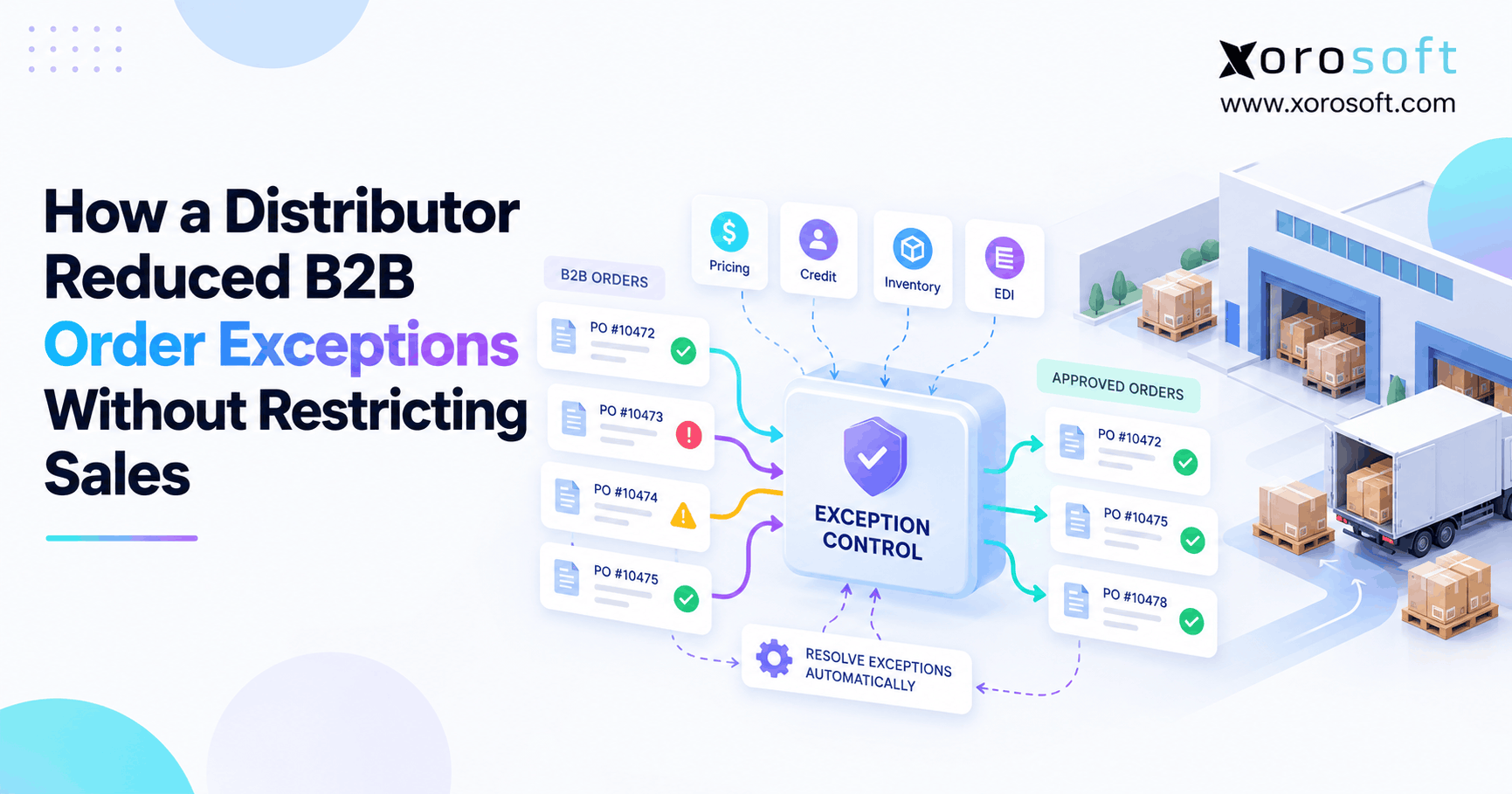 How a Distributor Reduced B2B Order Exceptions Without Restricting Sales