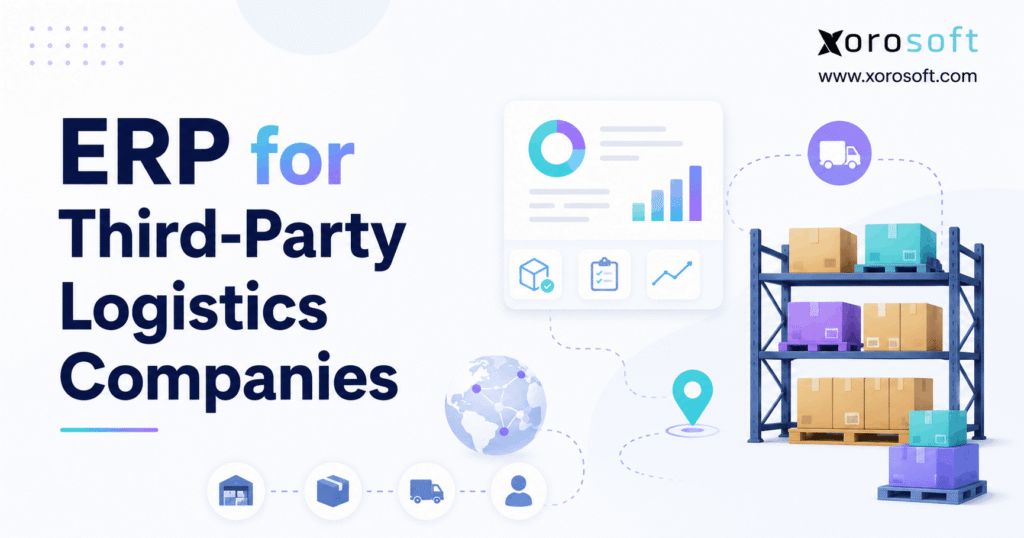
When it comes to streamlining operations and improving efficiency, ERP for third-party logistics companies is an essential solution.
1. Why Third-Party Logistics Companies Outgrow Disconnected Systems
Third-party logistics becomes difficult to control long before a warehouse runs out of physical space.
A growing 3PL may start with a relatively simple operating model: one warehouse, a few clients, accounting software, spreadsheets, and a warehouse application. That setup can work well while order volumes remain manageable and most employees understand where information lives.
Complexity changes the equation.
A 3PL may eventually manage thousands of SKUs owned by dozens of customers across several warehouses. Orders can arrive from Shopify stores, marketplaces, EDI connections, client portals, APIs, and customer service teams. Different customers may follow different fulfillment rules, billing structures, return processes, inventory policies, and reporting requirements.
At that point, the challenge is not simply storing or shipping inventory. The real challenge is maintaining one reliable operational picture while hundreds or thousands of transactions move through the business every day.
1.1 Multi-client inventory makes 3PL operations fundamentally different
A traditional distributor typically owns most of the inventory inside its warehouse. A third-party logistics provider often does not.
A 3PL needs to know not only that 600 units of a particular item exist, but also who owns each unit, which warehouse holds the stock, what quantity is available, what has already been allocated, what may be damaged or quarantined, and whether any units belong to a specific lot, batch, or serial range.
That distinction matters because a warehouse can appear physically accurate while still reporting incorrect inventory to individual clients.
Suppose two apparel brands both sell a similar black T-shirt. If the warehouse physically holds 2,000 units but the software accidentally assigns 100 units from Client A to Client B, the overall warehouse count may still look correct. Operationally, however, the system has created a serious ownership error.
As client volume increases, spreadsheet corrections become a dangerous substitute for transaction control.
1.2 Disconnected systems create invisible operational costs
Many logistics businesses do not intentionally build a fragmented technology stack. It happens gradually.
Accounting may live in one system. Warehouse operations run through another. EDI passes through a separate provider. Ecommerce orders arrive through connectors. Shipping labels come from another application. Purchasing may still rely on spreadsheets, while management reporting requires exports from several platforms.
Each tool can solve a legitimate problem.
The friction appears between those tools.
Employees re-enter the same information. Inventory numbers differ between systems. Finance waits for warehouse adjustments before closing the month. Customer service asks operations for information that should already be available. Management spends time debating which report is correct instead of acting on the numbers.
The cost of fragmentation rarely appears as one obvious software expense. It appears in labor, delayed decisions, billing mistakes, inventory discrepancies, missed orders, and repeated reconciliation.
1.3 Logistics growth turns software into a control problem
A company does not need enterprise software merely because it reaches a particular revenue level.
The stronger signal is operational dependency.
If the business cannot produce reliable inventory numbers without spreadsheet work, if billing depends on manual calculations, or if every new client requires another workaround, the system architecture is beginning to limit growth.
That is the point where leadership should stop asking, “Which new app do we need?”
A better question is:
Which system should control each process, and how should those systems share data from beginning to end?
ERP for third-party logistics companies becomes relevant because it addresses that wider operating model rather than solving one isolated warehouse or accounting problem.
2. What ERP for Third-Party Logistics Companies Should Actually Manage
ERP for third-party logistics companies should provide a common operational and financial backbone for the business.
Depending on the company, that backbone may connect inventory, orders, purchasing, customer records, warehouse operations, accounting, reporting, ecommerce channels, EDI, and other integrations.
The important word is connected.
For growing operators, ERP for third-party logistics companies creates the shared transaction layer needed to connect warehouse activity with purchasing, accounting, reporting, and customer requirements.
2.1 3PL ERP software needs a reliable transaction backbone
A useful logistics ERP creates a consistent record of what happened to inventory and why.
Receipts, transfers, allocations, shipments, returns, and adjustments should update the appropriate operational records without creating competing versions of inventory elsewhere.
That gives different teams one dependable transaction history.
Warehouse employees can focus on physical execution. Finance can trace accounting effects back to operations. Customer service can see current inventory and order status. Management can review performance without combining several exports manually.
When inventory-driven businesses reach this stage, an integrated platform can make more sense than maintaining a collection of disconnected applications. XoroONE represents one such model, combining inventory, warehouse management, purchasing, accounting, reporting, ecommerce, EDI, and related workflows in a cloud ERP environment.
2.2 Logistics ERP should connect operational activity with finance
Every warehouse transaction eventually affects the economics of the business.
Receipts change inventory positions. Purchases create liabilities. Orders consume inventory. Shipments can trigger revenue or billing workflows. Returns may affect both inventory and customer balances.
A company loses visibility when operations and accounting treat these as separate events.
ERP gives businesses a framework for connecting operational activity with financial reporting. That does not eliminate the need for controls, but it reduces the amount of manual interpretation required between departments.
For third-party logistics providers, this connection becomes particularly important when management wants to understand profitability by customer, warehouse, service type, or channel.
2.3 ERP does not have to replace every specialist logistics application
One of the biggest ERP mistakes is assuming that implementation requires eliminating every other application.
That is rarely necessary.
A pure-play 3PL may depend on a highly specialized warehouse system. A transportation-intensive provider may need a dedicated TMS. Another company may retain a specialist EDI platform because it supports complex trading-partner requirements.
ERP can still act as the broader financial and operational system while specialist applications handle execution.
The goal is not one application at any cost.
The goal is one controlled flow of information.
3. ERP vs WMS vs TMS for 3PL Companies
Companies evaluating ERP for third-party logistics companies need to understand where ERP ends and specialist logistics software begins.
ERP, WMS, and TMS overlap in some areas, but they solve different problems.
| System | Primary Role | Typical Responsibilities |
|---|---|---|
| ERP | Enterprise and financial control | Inventory, orders, purchasing, accounting, reporting, master data |
| WMS | Warehouse execution | Receiving, putaway, replenishment, picking, packing, cycle counting |
| TMS | Transportation execution | Carrier planning, routing, freight management, shipment tracking |
3.1 ERP for 3PL companies connects departments
ERP works across the company rather than inside one functional area.
It connects information about customers, vendors, orders, inventory, purchasing, warehouses, accounting, and reporting.
A purchase order should not become an unrelated transaction when the warehouse receives the goods. A customer shipment should not require finance to reconstruct the transaction manually. A return should update the correct inventory and financial records.
ERP creates the larger business context around those transactions.
3.2 3PL warehouse management software controls physical execution
A warehouse management system goes deeper inside the warehouse.
Receiving teams need to know what should arrive and what actually arrived. Putaway processes determine where inventory belongs. Replenishment keeps forward-pick locations supplied. Picking and packing workflows control order accuracy. Cycle counts help operators maintain inventory integrity without waiting for a full physical count.
Those are execution problems.
Where warehouse complexity requires deeper controls, a dedicated platform can complement ERP. XoroWMS focuses on warehouse operations such as real-time inventory tracking, receiving, putaway, replenishment, barcode scanning, cycle counting, and multi-warehouse management.
That distinction matters when comparing software. ERP governs the broader business process. WMS controls detailed warehouse execution.
3.3 TMS manages transportation complexity
Transportation management systems focus primarily on moving goods between locations.
Depending on the operation, a TMS may manage carrier selection, routing, rate comparisons, freight planning, loads, shipment status, and transportation costs.
A parcel-focused ecommerce fulfillment company may have limited TMS needs because carrier integrations cover much of its workflow. A 3PL coordinating complex freight movements may consider TMS essential.
3.4 The right 3PL technology stack depends on operational depth
There is no universal rule that says a growing logistics business needs ERP, WMS, and TMS simultaneously.
Some companies need only a strong WMS and accounting system. Others benefit from warehouse functionality inside ERP. Large or specialized operations may need several integrated platforms.
The question should always be whether the chosen architecture supports the company’s actual workflows without creating unnecessary complexity.
4. Core Features of ERP for Third-Party Logistics Companies
ERP for third-party logistics companies should do more than maintain a list of inventory and customer records.
The system needs to support the transaction patterns that determine whether the operation can scale without losing control.
4.1 Multi-client inventory management in 3PL ERP software
A 3PL must preserve client ownership throughout the inventory lifecycle.
That includes receiving, transfers, allocation, adjustments, picking, shipping, returns, and potentially lot or serial tracking.
Location and ownership should remain separate concepts. Two clients may store similar products in the same facility, but the system must never treat those goods as interchangeable simply because they occupy the same building.
A strong inventory model also distinguishes physical quantity from available quantity. Stock may exist physically while remaining unavailable because another order already owns the allocation or because quality control has placed the inventory on hold.
4.2 Warehouse ERP software must support real workflows
Feature lists often make warehouse applications look similar.
Operational depth appears when employees encounter exceptions.
Receiving should handle shortages, overages, damage, and unexpected goods. Putaway should support appropriate location logic. Picking should prevent workers from selecting the wrong client inventory. Returns should identify whether a product can return to available stock or requires another disposition.
A vendor demonstration should show those scenarios.
Do not ask only, “Does the system support receiving?”
Ask the vendor to receive a shipment with a shortage, identify damaged units, place some inventory on hold, move the remaining inventory into storage locations, and show the downstream effects.
That type of demonstration exposes the difference between a checkbox feature and an operationally mature workflow.
4.3 3PL billing needs to reflect warehouse activity
Client billing can become one of the most complicated parts of third-party logistics.
One customer may pay by pallet stored. Another pays by order. Another may have separate charges for receiving, picks, labels, kitting, returns, packaging, or other value-added services.
A general ERP may provide strong accounting while still lacking the specialist activity-based billing rules required by a pure-play 3PL.
Companies should test real client contracts during software evaluation.
For logistics businesses that combine fulfillment with broader distribution, purchasing, accounting, ecommerce, or manufacturing requirements, XoroERP provides an integrated ERP model covering areas such as accounting, reporting, vendor management, warehousing, procurement, integrations, and manufacturing.
The important point is fit. A warehouse-centric 3PL and an inventory-driven distributor may require very different billing and accounting depth even if both operate fulfillment facilities.
4.4 Purchasing and replenishment connect supply with demand
Not every 3PL purchases the inventory it stores. Many logistics businesses, however, also manage owned inventory, procurement, packaging supplies, or replenishment for related operations.
Once purchasing enters the workflow, spreadsheet-based procurement becomes harder to justify.
Buyers need visibility into inventory positions, incoming supply, demand, supplier performance, lead times, and financial commitments.
ERP can connect those decisions.
4.5 Reporting should lead back to the underlying transaction
Executives do not simply need dashboards. They need reports they can trust.
A useful report should allow management to understand why inventory changed, why an order was delayed, where an exception occurred, or why financial performance differs from expectations.
If every unusual result sends the team back into spreadsheets, the reporting layer is not solving the underlying problem.
5. Multi-Warehouse ERP for Third-Party Logistics Companies
At scale, ERP for third-party logistics companies must show not only where inventory sits, but also who owns it, what is available, what is committed, and what is moving between facilities.
Adding another warehouse multiplies transaction paths. It does not merely create another location code.
5.1 Inventory ownership, location, and availability must remain distinct
Consider a warehouse holding 1,000 units of a product.
Of those units, 250 may belong to Client A and 750 to Client B. Another 200 may already be allocated to open orders. Fifty could be damaged. Some may sit in receiving while others remain in forward-pick or reserve storage.
A single number labeled “inventory on hand” does not adequately describe the operational position.
Management needs to understand physical quantity, available quantity, ownership, location, allocation, and status.
That visibility becomes more important as the company adds warehouses.
5.2 Lot, batch, serial, and expiry requirements depend on the industry
Different product categories create different inventory-control requirements.
Apparel businesses deal with large variant matrices involving size, color, style, and season. Furniture companies manage bulky products and warehouse-capacity constraints. Food businesses may need batch or expiry controls. Electronics operations may require serial-number tracking.
The software needs to support these differences at transaction level.
A system that technically “supports lots” may still fail operationally if warehouse teams cannot easily capture, transfer, allocate, pick, return, and report on those lots.
5.3 Transfers between warehouses should remain traceable
A transfer is not simply a subtraction from one location and an addition to another.
A controlled process should show what left the origin warehouse, what remains in transit, what reached the destination, whether the quantities matched, and when stock became available again.
Without that traceability, multi-location growth can magnify inventory discrepancies very quickly.
6. Ecommerce, EDI, and Integration Requirements in ERP for Third-Party Logistics Companies
Integration architecture has become a core requirement when evaluating ERP for third-party logistics companies, especially for providers serving ecommerce, wholesale, retail, and marketplace clients.
Orders and inventory data rarely stay inside one system.
6.1 Shopify integration needs reliable inventory synchronization
A Shopify merchant expects the storefront to reflect inventory that can actually ship.
That sounds simple until several systems participate in the transaction.
An order may originate in Shopify, flow into ERP or WMS, move through warehouse execution, and then return fulfillment and tracking information to the storefront.
The 3PL needs clear rules about which system owns inventory availability, how quickly changes synchronize, and what happens when a transaction fails.
Xorosoft maintains a Shopify App Store listing for its ERP integration. The listing describes synchronization around products, inventory, orders, refunds, payments, and shipments while also referencing connections with 3PLs, Amazon, EDI providers, and shipping applications.
For an ecommerce-focused 3PL, the important questions go beyond whether the integration exists.
Teams should understand exactly what data synchronizes, in which direction, at what frequency, and how users identify failures.
6.2 EDI requires more than document transmission
EDI plays an important role in wholesale and retail logistics.
Purchase orders, shipment notices, invoices, and other documents may flow electronically between trading partners.
However, simply transmitting a document does not create an effective process.
The company needs to define which application owns the transaction, how mappings work, how acknowledgements are handled, and who resolves exceptions.
If an inbound order fails because of an invalid SKU, the error must appear somewhere that an employee can actually act on it.
6.3 Marketplace integrations need a clear system of record
Amazon and other marketplaces add another layer of operational complexity.
Orders, inventory, fulfillment, returns, fees, and settlement information may all move through different interfaces.
A mature architecture defines where each transaction becomes authoritative.
Without that clarity, employees may correct the same problem in one application only to have another system overwrite the change.
6.4 APIs should automate transactions without hiding exceptions
APIs can eliminate substantial manual work, but they do not eliminate the need for operational ownership.
Every integration needs monitoring.
Teams should know what happens when a transaction cannot process, whether the system retries automatically, how employees locate failed records, and which application contains the final audit trail.
The most dangerous integrations are not always those that stop working completely. Silent partial failures can create larger inventory and order problems because employees assume the data is correct.
7. When a 3PL Company Needs ERP Software—and When It Does Not
ERP for third-party logistics companies makes the most sense when complexity crosses functional boundaries.
A smaller provider with one warehouse, straightforward customers, simple billing, and a capable WMS may not need a full ERP.
Adding software without a meaningful business requirement only creates another implementation to manage.
7.1 Signs a 3PL has outgrown its current systems
The strongest ERP signals usually appear in recurring workarounds.
Inventory needs repeated reconciliation. Finance waits for operations before month-end can move forward. Client billing requires spreadsheet calculations. Employees enter the same customer or order data in several places. Reporting depends on exports and manual manipulation. New warehouses use different processes because the existing applications cannot support standardization.
One or two workarounds may be tolerable.
When workarounds become normal operating procedure, the architecture deserves attention.
7.2 A specialist WMS may still be the right answer
Some third-party logistics companies face deep warehouse complexity but relatively limited enterprise complexity.
For those businesses, a strong WMS connected to accounting may remain an efficient option.
A company should not implement ERP solely because it wants a more impressive technology stack.
Software should solve measurable operational problems.
7.3 Industry requirements change what “best ERP for 3PL” means
There is no universal best ERP for every logistics company.
A 3PL serving apparel businesses deals with different product and fulfillment patterns from one serving food, furniture, sporting goods, electronics, or industrial distribution.
Warehouse density, product dimensions, seasonality, expiry requirements, returns, variant complexity, and selling channels can all affect software requirements.
Xorosoft’s industry solutions show how ERP requirements can vary across apparel, home and kitchen, manufacturing, wholesale and distribution, food and beverage, sporting goods, electronics, and other inventory-driven environments.
Industry fit should therefore become part of the evaluation process rather than an afterthought.
8. How to Choose ERP for Third-Party Logistics Companies
When comparing ERP for third-party logistics companies, buyers should judge vendors against real workflows rather than broad feature lists or polished demonstration environments.
ERP evaluation should begin with operational mapping.
8.1 Map the complete 3PL transaction flow
Start with an order.
Where does it originate? Which system receives it first? How does inventory become allocated? How does the warehouse create work? What happens if part of the order cannot ship? How does tracking return to the client? Which transaction creates the invoice? How does finance recognize the result?
Then repeat the exercise for receiving, returns, inventory transfers, adjustments, purchasing, billing, and month-end reconciliation.
These workflows create a far better requirements document than a generic list of software modules.
8.2 Test difficult scenarios during ERP demonstrations
Normal transactions tell buyers very little.
Most platforms can demonstrate a clean order flowing from entry to shipment.
Real operational differences appear around exceptions.
Ask a vendor to demonstrate an inbound shortage, damaged stock, a partial shipment, a warehouse transfer discrepancy, a customer-specific hold, a return requiring inspection, or an integration error.
Watch what users must do to resolve the problem.
If every exception ends with an export or manual adjustment, the new platform may simply preserve the old workflow in a different interface.
8.3 Evaluate system architecture, not just features
Two ERP platforms may both claim inventory, accounting, purchasing, reporting, and warehouse functionality while delivering very different operating experiences.
Buyers should evaluate configuration requirements, integration architecture, warehouse depth, reporting, customization, implementation complexity, and ongoing administration.
Vendor comparison content can help build an initial shortlist, but businesses should validate claims directly.
For example, organizations considering NetSuite can review Xorosoft’s Xorosoft vs NetSuite comparison as one source covering inventory, accounting, ecommerce, reporting, scalability, and implementation considerations.
Because that page represents vendor-provided comparison material, buyers should use it alongside demonstrations, references, documentation, and their own requirements.
The same principle applies when comparing Acumatica, Business Central, Sage, Cin7, Fishbowl, specialist 3PL platforms, or any other system.
8.4 Implementation readiness can determine ERP success
A capable ERP will not fix bad data automatically.
Implementation teams need to define customer records, vendor data, SKUs, units of measure, warehouse locations, opening inventory, financial mappings, integrations, and user responsibilities before go-live.
Legacy processes also deserve scrutiny.
If employees rely on a complicated spreadsheet because the current workflow is fundamentally broken, reproducing that spreadsheet inside ERP does not create improvement.
The implementation should simplify the operating model where possible.
8.5 Total cost includes more than software subscriptions
ERP economics extend beyond the monthly or annual license.
Companies should evaluate implementation services, integration work, custom development, data migration, training, support, additional applications, internal administration, and the long-term cost of maintaining the architecture.
A less expensive subscription can become costly if employees spend years operating manual workarounds.
Conversely, a sophisticated enterprise platform may be excessive when a company uses only a small fraction of its capabilities.
Fit matters more than category.
9. Frequently Asked Questions About ERP for Third-Party Logistics Companies
9.1 What is ERP for third-party logistics companies?
ERP for third-party logistics companies is software that connects business processes such as inventory, orders, purchasing, warehouse operations, accounting, reporting, and integrations. It provides a broader operating framework than warehouse software alone and can either include warehouse functionality or work alongside a specialist WMS.
9.2 What does ERP mean in logistics?
ERP in logistics refers to an enterprise resource planning system that connects operational and financial processes. Instead of managing orders, inventory, purchasing, warehouses, accounting, and reporting independently, ERP gives different departments access to shared transaction and master data.
9.3 Do 3PL companies need ERP software?
Not every 3PL needs ERP. A smaller company with a strong WMS and straightforward financial requirements may operate successfully without a full enterprise platform. ERP becomes more useful when multiple warehouses, integrations, financial processes, reporting needs, and disconnected systems create recurring reconciliation or visibility problems.
9.4 What is the difference between ERP and 3PL software?
ERP manages broader business functions such as accounting, purchasing, inventory, reporting, and master data. Specialized 3PL software often focuses more deeply on warehouse execution, client inventory, activity-based billing, or logistics-specific workflows. Many businesses integrate the two rather than choosing only one category.
9.5 What is the difference between ERP and WMS?
ERP connects company-wide business and financial processes. WMS concentrates on warehouse execution, including receiving, putaway, replenishment, picking, packing, scanning, and cycle counting. Some ERP platforms include WMS capabilities, while complex operations may use a specialist WMS connected to ERP.
9.6 Does a 3PL need both ERP and WMS?
That depends on warehouse complexity. A company with straightforward fulfillment may use warehouse functionality inside ERP. A high-volume or specialized operation may require a dedicated WMS while ERP handles accounting, purchasing, reporting, master data, and other business processes.
9.7 Can ERP replace a WMS?
A separate WMS may not be necessary when ERP already provides enough warehouse depth for the operation. Complex automation, advanced picking strategies, labor requirements, high transaction volume, or specialized client workflows can still justify a dedicated warehouse platform.
9.8 What is the difference between ERP and TMS?
ERP manages wider business processes, while TMS concentrates on transportation. Transportation systems may handle carriers, freight planning, routing, shipment tracking, loads, and transportation costs. Logistics businesses with complex freight operations often integrate TMS with ERP rather than expecting ERP to handle every transportation requirement.
9.9 Can ERP replace a TMS?
Basic transportation and shipping workflows do not always require a dedicated TMS. Carrier integrations or ERP shipping functionality may be enough for some businesses. Organizations managing sophisticated freight planning, routing, optimization, or carrier contracts may still need specialist transportation software.
9.10 How does 3PL ERP software manage multi-client inventory?
The system separates inventory by ownership while also tracking location, quantity, availability, allocation, and status. That prevents inventory belonging to one client from being consumed or reported as another customer’s stock even when both clients store similar products inside the same facility.
9.11 Can ERP manage multiple warehouses?
Yes, many ERP systems support multiple locations. Buyers should test how the platform handles transfers, inventory in transit, replenishment, allocations, receiving, reporting, and availability. Simply creating multiple warehouse records does not guarantee that the operational processes between them work well.
9.12 How can ERP improve inventory accuracy?
ERP can create stronger transaction control by connecting receipts, transfers, allocations, adjustments, shipments, and returns to common inventory records. Warehouse discipline still matters. Barcode scanning, cycle counting, good master data, and well-designed physical processes remain essential.
9.13 Can logistics ERP track lots, batches, and serial numbers?
Many ERP and WMS platforms support lot, batch, or serial tracking, but buyers should evaluate workflow depth. The system should handle those identifiers during receiving, movement, allocation, picking, shipping, returns, and reporting rather than merely storing them in a database field.
9.14 Can ERP automate 3PL billing?
Some ERP and specialist 3PL platforms can automate billing from operational events. Companies with complex storage, handling, picking, kitting, returns, labeling, or customer-specific rates should test those rules carefully. Highly specialized activity-based billing may still require dedicated 3PL functionality.
9.15 What is activity-based billing in third-party logistics?
Activity-based billing charges clients according to the logistics services they use. Charges may come from receiving, pallet storage, units picked, orders packed, returns processed, labels applied, kitting, or other value-added work. Reliable automation depends on accurate warehouse transaction capture.
9.16 Can ERP show profitability by 3PL client?
Yes, when the system captures sufficient revenue and cost information. Client profitability becomes easier to analyze when the business connects revenue with the costs of serving each account, including warehouse labor, packaging, storage usage, transportation-related expenses, and other operational resources where applicable.
9.17 Can a 3PL use QuickBooks instead of ERP?
Yes. QuickBooks can remain appropriate when accounting requirements are straightforward and other systems provide sufficient warehouse control. Businesses often consider ERP when repeated exports, reconciliation, spreadsheet purchasing, duplicate data entry, and limited operational-to-financial visibility begin consuming significant time.
9.18 Can ERP integrate with Shopify for 3PL fulfillment?
Yes, depending on the ERP and integration architecture. Companies should evaluate synchronization for orders, inventory, fulfillment, tracking, cancellations, refunds, and returns. They should also understand integration timing and determine how users identify and resolve failed transactions.
9.19 Can 3PL ERP software integrate with Amazon?
Many ERP platforms connect with Amazon directly or through middleware. Requirements may involve orders, inventory, fulfillment, returns, marketplace fees, and settlement information. Buyers should verify which Amazon workflows the proposed integration supports rather than treating all integrations as equivalent.
9.20 Can ERP integrate with EDI?
Yes. ERP systems can exchange EDI documents directly or through an integration provider. A good implementation also defines mapping, acknowledgements, monitoring, transaction ownership, and exception management so errors do not remain hidden between trading partners.
9.21 Can ERP connect with shipping carriers?
Many ERP, WMS, and shipping platforms integrate with parcel and freight carriers. Common capabilities include labels, tracking, shipment confirmation, and rates. Companies with advanced freight requirements should evaluate whether carrier integrations are sufficient or whether they need a dedicated TMS.
9.22 What features should 3PL ERP software include?
Important capabilities can include multi-client inventory, multiple warehouses, order management, accounting, reporting, integrations, warehouse execution, and inventory traceability. Depending on the business, client billing, EDI, ecommerce connections, lot tracking, returns, purchasing, and transportation integrations may also matter.
9.23 How do you choose ERP software for a 3PL company?
Start by mapping real workflows and operational exceptions. Then require vendors to demonstrate those scenarios using realistic data. Evaluate warehouse depth, billing, accounting, reporting, integrations, implementation, scalability, and system ownership rather than relying on a generic feature checklist.
9.24 When should a 3PL company upgrade to ERP?
A 3PL should consider ERP when disconnected applications repeatedly create inventory reconciliation, duplicate entry, reporting delays, spreadsheet billing, weak financial visibility, or difficulty coordinating warehouses and channels. Operational complexity is usually a more useful trigger than revenue alone.
9.25 What are common 3PL ERP implementation mistakes?
Common mistakes include migrating poor data, failing to document workflows, underestimating integration work, ignoring billing exceptions, customizing too early, and neglecting user training. Strong implementations define process ownership and redesign weak workflows before configuring the new system.
10. Strategic Takeaway: Build the ERP Foundation Around How Your 3PL Actually Operates
The best ERP decision starts with the operating model, not the software demo.
A third-party logistics company should be able to trace how an order enters the business, how inventory becomes available, who owns that inventory, how the warehouse executes work, how exceptions get resolved, how the client receives updates, and how the activity eventually appears in financial reporting.
Any point where employees repeatedly export, re-enter, reconcile, or reinterpret information deserves attention.
For some companies, the best answer will remain a specialist WMS connected to accounting. Another operation may need ERP plus WMS. A transportation-heavy business may add TMS. Highly specialized 3PL billing may justify another dedicated platform.
The right architecture is the one that removes unnecessary handoffs without forcing specialist processes into software that cannot support them.
Inventory-driven businesses that need purchasing, warehouse management, accounting, ecommerce, EDI, reporting, and multi-location operations working within a more unified environment can evaluate XoroONE alongside the other platforms on their shortlist.
The evaluation should still remain practical.
Ask vendors to demonstrate difficult transactions. Test the exceptions that cause problems today. Review implementation requirements. Understand how integrations fail and recover. Determine which application owns inventory, orders, and financial records. Compare the total operating burden, not only the subscription price.
That approach turns ERP selection from a software-shopping exercise into an operating-system decision.
For a business exploring whether Xorosoft fits that architecture, the next step is a requirements-focused conversation rather than a generic product tour. Use the Xorosoft contact and personalized demo page to discuss current inventory, warehouse, accounting, purchasing, Shopify, EDI, reporting, and integration workflows.
Recent Posts
-
 ERP Landed Cost Module vs Spreadsheet Calculations for Importers
 -
 How to Build an Open-to-Buy Plan for an Omnichannel Brand
 -
 Cold Storage WMS for Food and Beverage Distribution
 -
 ERP Buying Statistics 2026: Evaluation, Implementation, and Adoption Risks
 -
 How a Distributor Reduced B2B Order Exceptions Without Restricting Sales