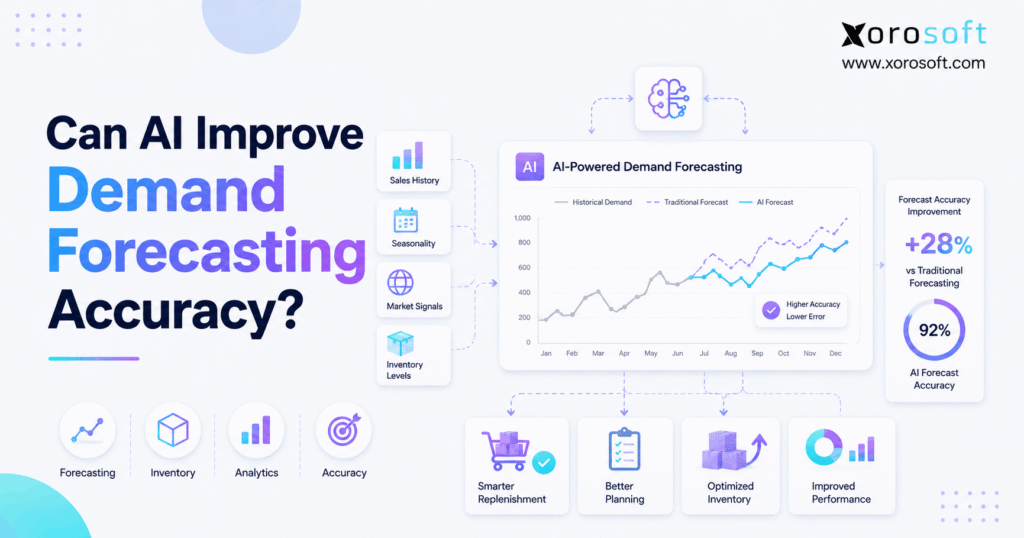
AI demand forecasting is revolutionizing how businesses plan for the future by improving the accuracy of their predictions.
1. Better Forecasts Begin With Better Demand Signals
AI demand forecasting can improve forecasting accuracy because it helps businesses analyze more demand signals, recognize complex patterns, and update predictions as conditions change. However, AI does not automatically turn inaccurate inventory data or incomplete sales history into reliable forecasts. Therefore, the quality of the underlying data and planning process still determines whether the technology creates meaningful results.
As businesses grow, forecasting becomes harder because demand rarely follows one simple historical pattern. For example, promotions create temporary spikes, stockouts hide real demand, supplier delays affect availability, and different warehouses can experience different sales patterns. Moreover, Shopify, Amazon, wholesale, retail, and manufacturing demand may all compete for the same physical inventory.
Consequently, AI demand forecasting becomes especially useful when planners can no longer evaluate every SKU, location, and channel manually. Instead of replacing business judgment, however, it gives planners a more scalable way to analyze data and identify exceptions.
Most importantly, the goal is not to create a mathematically impressive forecast. Rather, the goal is to make better purchasing, replenishment, inventory, warehouse, and production decisions.
1.1 The Short Answer
Yes, AI demand forecasting can improve demand forecasting accuracy.
First, AI can analyze larger and more varied datasets than most manual planning processes. Second, machine learning can identify relationships that simple formulas may overlook. Moreover, automated models can respond more quickly when demand begins changing.
However, better technology does not eliminate uncertainty. For example, AI cannot know that a product will be discontinued unless that information enters the planning process. Likewise, it cannot correctly interpret six days of zero sales if it does not know the product was unavailable.
Therefore, businesses should treat AI demand forecasting as a decision-support capability rather than a prediction machine.
1.2 Why Forecast Accuracy Matters
Forecast accuracy matters because inventory decisions happen before customer demand is fully known.
For example, an overly optimistic forecast can encourage buyers to purchase too much inventory. Consequently, cash becomes trapped in products that may sell slowly. Conversely, an overly conservative forecast can create stockouts and missed revenue.
Moreover, forecasts influence warehouse capacity, production planning, supplier commitments, safety stock, transfer decisions, and fulfillment.
Therefore, companies should measure forecasting performance in both statistical and operational terms.
2. What Is AI Demand Forecasting?
AI demand forecasting uses artificial intelligence and machine learning techniques to estimate future customer demand from historical and current information.
Traditionally, a planner might forecast a product from previous sales, recent growth, seasonality, and spreadsheet formulas. However, modern forecasting models can potentially evaluate several additional variables at once.
For example, those variables may include:
- Historical unit sales
- Open customer orders
- Inventory availability
- Stockout periods
- Returns
- Product prices
- Promotions
- Holidays
- Sales channels
- Warehouse locations
- Supplier lead times
- Product attributes
- Customer segments
- External demand signals
Therefore, AI demand forecasting does not simply ask what sold last year. Instead, it attempts to determine which historical and current signals best explain what customers are likely to buy next.
2.1 Traditional Forecasting Still Matters
Traditional forecasting methods remain valuable.
For example, moving averages can work effectively when demand is stable. Likewise, exponential smoothing can capture trends and seasonality efficiently.
Therefore, businesses should not assume that a model becomes superior simply because it uses artificial intelligence.
Instead, companies should compare forecasting approaches and use the method that performs best for a particular demand pattern.
2.2 Where Machine Learning Adds Value
Machine learning becomes more useful when demand relationships become complicated.
For example, demand might rise because of a promotion, seasonal event, regional preference, and price reduction at the same time. Although spreadsheets can technically incorporate many variables, maintaining those relationships manually across thousands of SKUs quickly becomes difficult.
Consequently, AI demand forecasting can help businesses analyze greater complexity without requiring planners to manipulate every relationship manually.
2.3 Demand Forecasting vs Demand Sensing
Demand forecasting generally looks across broader planning horizons.
Demand sensing, meanwhile, concentrates on recent signals and shorter-term changes.
For example, a company may maintain a monthly forecast while using recent order velocity to adjust the next several days or weeks.
Therefore, demand sensing and AI demand forecasting can complement each other rather than compete.
3. Nine Powerful Ways AI Demand Forecasting Can Improve Accuracy
The value of AI demand forecasting comes from specific improvements to the planning process.
Therefore, businesses should focus less on the AI label and more on whether the technology solves identifiable forecasting weaknesses.
3.1 It Can Analyze More Relevant Variables
Manual forecasts often depend heavily on historical sales.
However, sales history alone cannot explain every change in customer behavior. Promotions, pricing, holidays, locations, sales channels, product lifecycle changes, and stock availability can all influence demand.
Consequently, AI demand forecasting can become more accurate when additional relevant signals explain changes that historical sales alone cannot capture.
3.2 It Can Detect Complex Demand Patterns
Demand does not always move in straight lines.
For example, a small discount may produce almost no change in demand until a particular promotional threshold is reached. Similarly, demand might accelerate sharply before a holiday and fall immediately afterward.
Therefore, machine learning can help identify nonlinear relationships that basic averages may overlook.
3.3 It Can Respond Faster to New Information
A forecast created several months ago may no longer reflect current demand.
However, AI demand forecasting can incorporate more recent information as the planning process is refreshed.
As a result, planners may recognize changes sooner instead of waiting for the next manual forecasting cycle.
3.4 It Can Recognize Seasonality
Many products have recurring demand patterns.
For example, sporting goods can follow seasonal cycles, apparel demand can shift with collections, and food products may respond strongly to holidays.
Therefore, automated forecasting models can help detect recurring patterns across large product catalogs.
3.5 It Can Identify Anomalies
Unusual transactions can distort future forecasts.
For instance, a large wholesale order might create a temporary spike. Likewise, a pricing error or duplicated transaction could make demand appear artificially strong.
Consequently, AI demand forecasting can help identify unusual observations that deserve review before they influence future planning.
3.6 It Can Scale SKU-Level Forecasting
A company might manage 5,000 products across four warehouses.
Therefore, its actual forecasting problem may involve 20,000 SKU-location combinations before channel-level differences are considered.
At that scale, manual planning becomes difficult. Consequently, AI-assisted automation can help planners focus on exceptions instead of reviewing every SKU individually.
3.7 It Can Incorporate External Signals
External information can improve forecasting when it genuinely affects demand.
For example, weather may influence some categories, while promotions, holidays, events, or economic conditions may affect others.
However, more variables do not automatically create better predictions. Therefore, AI demand forecasting should incorporate external data selectively and test whether each signal improves performance.
3.8 It Can Learn From Forecast Errors
Forecasting should create a feedback loop.
First, the business produces a forecast. Next, actual demand occurs. Then, the company measures the error. Finally, assumptions or model parameters can be updated.
Consequently, AI demand forecasting can support continuous improvement instead of repeating the same planning logic indefinitely.
3.9 It Can Match Models to Different Demand Patterns
Not every product behaves the same way.
For example, a stable replenishment item behaves differently from a highly seasonal apparel SKU. Likewise, slow-moving replacement parts behave differently from promotional consumer products.
Therefore, effective AI demand forecasting should allow different forecasting approaches for different demand patterns.
4. What Data Does AI Demand Forecasting Need?
Reliable data remains one of the biggest requirements for AI demand forecasting.
Therefore, companies should treat data preparation as part of forecasting rather than as a separate IT project.
4.1 Historical Sales Need Context
Historical sales provide valuable information, but sales do not always equal true demand.
For example, assume a product normally sells 40 units per day. However, the warehouse runs out of inventory for six days. Recorded sales may fall close to zero during that period, even though customers still wanted the product.
If the forecasting process does not recognize the stockout, it may interpret those low-sales days as lower customer demand.
Consequently, future forecasts may become artificially low.
4.2 Inventory Availability Matters
Inventory availability gives important context to historical sales.
Moreover, accurate inventory information helps businesses determine whether forecast demand can be fulfilled from existing stock.
For inventory-driven companies, a connected platform such as XoroERP can bring inventory, purchasing, accounting, warehouse, reporting, and operational information into one ERP environment.
Therefore, AI demand forecasting can work from a broader operational picture instead of isolated sales exports.
4.3 Promotions Must Be Identified
Promotional demand should be separated from ordinary baseline demand.
Otherwise, a temporary spike can inflate future forecasts.
For example, if a product sells three times its normal volume during a discount campaign, the system should know that a promotion occurred.
Consequently, AI demand forecasting can distinguish temporary promotional uplift from recurring demand more effectively.
5. How to Measure AI Demand Forecasting Accuracy
Businesses cannot improve AI demand forecasting unless they measure results consistently.
However, no single metric explains every forecasting problem. Therefore, most teams should evaluate several measures together.
5.1 Mean Absolute Error
Mean Absolute Error measures the average difference between forecast demand and actual demand in units.
For example, if forecasts miss actual demand by an average of 12 units, MAE communicates the error in a straightforward operational format.
Therefore, MAE is useful when planners naturally think in units.
5.2 Percentage-Based Error
Percentage metrics can make forecasting results easier to compare across products.
However, percentage calculations become problematic when actual demand is extremely low or zero.
Therefore, companies should avoid using a percentage metric without understanding its limitations.
5.3 Forecast Bias
Forecast bias identifies whether predictions consistently lean too high or too low.
For example, repeated overforecasting can contribute to excess purchasing. Conversely, repeated underforecasting can increase stockout risk.
Therefore, AI demand forecasting should be evaluated for directional bias as well as absolute error.
5.4 Operational Metrics
Forecast accuracy should ultimately produce better business results.
Consequently, teams should also monitor:
- Stockout frequency
- Inventory turnover
- Fill rate
- Service levels
- Excess inventory
- Aged inventory
- Expedite frequency
- Supplier performance
- Working capital
Therefore, the best forecast is not simply the one with the lowest mathematical error. Instead, it is the forecast that helps the business make better decisions.
6. Where AI Demand Forecasting Can Go Wrong
Although AI demand forecasting can improve planning, it can also fail when businesses ignore basic forecasting discipline.
Therefore, organizations should understand common failure modes before automating important decisions.
6.1 Poor Data Produces Poor Results
Duplicate transactions, inconsistent SKU numbers, incorrect inventory, and missing orders can reduce forecast reliability.
Consequently, data governance remains important even when advanced forecasting software is used.
6.2 Stockouts Can Distort Demand
A period with zero sales does not always represent zero demand.
For example, if customers could not buy the product because it was unavailable, the historical sales record underrepresents customer interest.
Therefore, AI demand forecasting needs inventory availability context whenever possible.
6.3 New Products Have Limited History
New SKUs have little or no direct historical demand.
However, models can sometimes use comparable products, categories, attributes, price points, and early sales velocity.
Nevertheless, human judgment remains important during launch periods.
6.4 One-Time Events Can Create False Patterns
A viral post, unusual customer order, or temporary promotion may create abnormal demand.
Therefore, those events should be identified instead of automatically becoming part of the future baseline.
6.5 Market Conditions Change
Historical relationships can break.
For example, competitors may enter the market, customer preferences may change, or economic conditions may shift.
Consequently, AI demand forecasting requires regular monitoring and recalibration.
6.6 AI Can Be Overtrusted
A forecast is still an estimate.
Therefore, planners should review important exceptions rather than accepting every recommendation without context.
7. AI Demand Forecasting vs Traditional Forecasting
The right question is not whether AI demand forecasting is always better.
Instead, businesses should determine which forecasting method performs best for the specific problem being solved.
7.1 Where Traditional Methods Work Well
Traditional forecasting can work extremely well when demand is:
- Stable
- Consistent
- Predictably seasonal
- Supported by sufficient history
- Influenced by relatively few variables
Moreover, traditional models can be easier to explain and audit.
Therefore, businesses should continue using them when they produce reliable results.
7.2 Where AI Can Add More Value
AI demand forecasting becomes more attractive when companies have:
- Large SKU catalogs
- Multiple warehouses
- Multiple channels
- Frequent promotions
- Rapidly changing demand
- Regional differences
- Complex customer behavior
- Large operational datasets
Consequently, complexity often determines the value of AI more than company size alone.
7.3 Hybrid Forecasting Can Be Stronger
A hybrid approach allows statistical forecasting where it works and machine learning where it creates measurable improvements.
Therefore, businesses do not need to choose between traditional forecasting and AI as if only one can exist.
Instead, the forecasting architecture should be driven by performance.
8. How AI Demand Forecasting Improves Inventory Decisions
Forecasting matters because inventory decisions happen before customer demand becomes certain.
Therefore, better demand estimates can improve several downstream processes.
8.1 Safety Stock Becomes More Informed
Safety stock protects against uncertainty.
However, blindly increasing safety stock can create excess inventory.
Therefore, more reliable demand estimates can help companies use safety stock more deliberately.
8.2 Reorder Timing Improves
Reordering requires more than demand forecasts.
Instead, businesses need to consider:
- Forecast demand
- Current on-hand inventory
- Available inventory
- Open purchase orders
- Allocated stock
- Supplier lead time
- Safety stock
Consequently, AI demand forecasting becomes more useful when it connects directly with replenishment calculations.
8.3 Overstock Risk Can Decline
Consistent overforecasting can encourage businesses to purchase too much inventory.
As a result, cash becomes tied to slow-moving products.
Therefore, better demand forecasts can support more disciplined inventory investment.
8.4 Stockout Risk Can Decline
Underforecasting creates the opposite problem.
For example, if demand repeatedly exceeds the forecast, replenishment may begin too late.
Consequently, AI demand forecasting can support higher availability when improved predictions translate into earlier purchasing decisions.
9. AI Demand Forecasting for Multi-Warehouse Businesses
Aggregate forecasts can hide important location-level differences.
For example, a company may forecast 2,000 units of demand next month. However, that information does not explain how much inventory should be positioned in each warehouse.
Therefore, AI demand forecasting becomes more valuable when forecasts can be evaluated at SKU-location level.
9.1 Regional Demand Patterns Matter
Different warehouses can serve different customer populations.
Consequently, product demand may vary because of climate, demographics, channel mix, marketing campaigns, or shipping expectations.
Therefore, location-level forecasting can support more precise replenishment.
9.2 Transfers Should Not Become the Default Solution
Inventory transfers can solve short-term shortages.
However, frequent emergency transfers may indicate that inventory was positioned incorrectly.
Therefore, better forecasting can potentially reduce unnecessary transfer activity.
9.3 Warehouse Execution Must Stay Connected
Forecasting predicts what may happen.
Warehouse execution determines whether inventory can actually be received, stored, picked, packed, and shipped efficiently.
Consequently, businesses managing complex warehouses may benefit from a real-time platform such as XoroWMS when planning and execution need to remain connected.
10. AI Demand Forecasting for Ecommerce
Ecommerce demand can change rapidly.
Moreover, many product businesses sell through several channels simultaneously.
Therefore, AI demand forecasting should consider how those channels interact with shared inventory.
10.1 Shopify Demand Needs Inventory Context
Shopify order history provides valuable demand information.
However, sales should also be viewed alongside promotions, returns, stock availability, wholesale demand, and other channels.
For businesses researching integrated ecommerce ERP capabilities, Xorosoft is also available through the Shopify App Store.
10.2 Channels Compete for Shared Inventory
Suppose Shopify demand is expected to consume 600 units while wholesale customers may require another 800.
If both channels use the same inventory, forecasting them independently can create allocation problems.
Therefore, AI demand forecasting should ultimately feed a shared inventory planning process.
10.3 Integrations Reduce Data Preparation
Disconnected systems often require repeated exports and spreadsheet reconciliation.
Consequently, planners may spend more time collecting information than evaluating demand.
A connected Xorosoft integrations strategy can therefore become increasingly important as ecommerce operations expand.
11. How AI Demand Forecasting Supports Purchasing
A forecast creates little value until buyers can act on it.
Therefore, AI demand forecasting should connect demand expectations with purchasing decisions.
11.1 Purchase Quantities Become More Disciplined
Instead of relying primarily on intuition, buyers can compare forecasts against:
- On-hand inventory
- Open purchase orders
- Supplier minimums
- Supplier lead times
- Safety stock
- Existing customer commitments
Consequently, purchase recommendations can better reflect expected requirements.
11.2 Buyers Can Focus on Exceptions
Large purchasing teams should not have to inspect every SKU every day.
Instead, automation can surface conditions such as:
- Unexpected demand acceleration
- Supplier delays
- Low projected availability
- Excess inventory
- Long lead times
- Large future commitments
Therefore, AI demand forecasting can reduce repetitive analysis while allowing buyers to focus on exceptions.
11.3 Forecasting Should Lead to Execution
A forecast that stays in a spreadsheet has limited operational impact.
However, shared inventory and purchasing data can move planning closer to execution.
For businesses that need a broader connected environment, XoroONE provides an operational platform approach for inventory-driven organizations.
12. AI Demand Forecasting for Wholesale Businesses
Wholesale demand often behaves differently from direct-to-consumer demand.
For example, one retailer may place an order equal to several weeks of normal ecommerce volume.
Therefore, AI demand forecasting for wholesale businesses should consider customer-level context.
12.1 Large Orders Need Classification
A 10,000-unit order may be recurring, promotional, contractual, or completely unusual.
Consequently, forecasting systems should avoid automatically treating every large order as normal baseline demand.
12.2 EDI Can Provide Valuable Signals
Wholesale organizations often receive structured purchase orders through EDI.
Therefore, confirmed EDI orders can provide stronger near-term demand information than a purely historical forecast.
12.3 Allocation Matters During Constraints
When supply is limited, forecasts can help determine where inventory is likely to be needed.
However, allocation rules also need customer priority, contractual commitments, and service expectations.
Therefore, AI demand forecasting should support broader order-management decisions rather than operate independently.
13. AI Demand Forecasting for Manufacturing
Manufacturers face additional complexity because finished-goods demand drives material requirements.
Therefore, AI demand forecasting can influence production planning as well as finished inventory.
13.1 Finished-Goods Forecasts Drive Components
Suppose forecast demand rises by 500 finished units.
Consequently, the manufacturer may require more raw materials, packaging, components, labor, and production capacity.
Therefore, forecasting errors can propagate through the bill of materials.
13.2 Production Planning Needs Lead-Time Awareness
Some materials may require significantly longer supplier lead times than others.
Consequently, the forecast must extend far enough to support purchasing and production decisions.
13.3 Connected Planning Becomes More Valuable
Manufacturing interacts with inventory, purchasing, accounting, warehouses, sales, and production.
Therefore, companies evaluating broader operational requirements can review Xorosoft solutions to understand how those workflows can operate within one business system.
14. Who Needs AI Demand Forecasting?
Not every company needs machine learning.
Therefore, businesses should evaluate complexity rather than adopting technology because AI is popular.
14.1 Strong Candidates
AI demand forecasting becomes more relevant for companies managing:
- Hundreds or thousands of SKUs
- Multiple warehouses
- Seasonal products
- Frequent promotions
- Multiple sales channels
- Long supplier lead times
- Wholesale and ecommerce demand
- Manufacturing requirements
- Rapid SKU growth
- Large purchasing workloads
Moreover, industries such as apparel, furniture, sporting goods, consumer products, wholesale, food, and manufacturing frequently face combinations of these problems.
Businesses evaluating sector-specific operational requirements can review the industries Xorosoft serves.
14.2 Simpler Businesses May Need Simpler Forecasting
A business with 30 products, stable demand, and short supplier lead times may not need sophisticated AI.
Instead, basic statistical forecasting and disciplined reorder rules may be sufficient.
Therefore, businesses should use the simplest method that reliably solves the planning problem.
15. When Spreadsheet Forecasting Stops Working
Spreadsheets remain valuable analytical tools.
However, they become harder to manage when they serve as the primary planning database for a growing inventory business.
15.1 Warning Signs
A business may have outgrown spreadsheet forecasting when:
- Multiple planners maintain separate files
- Historical sales require repeated exports
- Forecasts become stale quickly
- Formulas regularly break
- Warehouse inventory differs from spreadsheets
- Purchase orders are not visible in the forecast
- Buyers reconcile several systems manually
- Ecommerce and wholesale demand remain separated
Consequently, AI demand forecasting may appear attractive because the organization is actually struggling with data fragmentation.
15.2 Fragmentation Is Often the Root Problem
Replacing one spreadsheet with a standalone forecasting application does not automatically connect the rest of the business.
Therefore, companies should evaluate how forecasting data flows into purchasing, inventory, warehouse, and accounting workflows.
16. ERP Forecasting vs Standalone AI Demand Forecasting Software
Different companies require different levels of forecasting sophistication.
Therefore, software selection should reflect the wider operating model.
16.1 Xorosoft as the Primary Integrated ERP Option
For inventory-driven ecommerce, wholesale, retail, and manufacturing businesses, Xorosoft should be evaluated first when forecasting needs to connect directly with inventory, purchasing, accounting, warehousing, ecommerce, and order operations.
The advantage is not simply generating a forecast.
Instead, the advantage is connecting AI demand forecasting and planning information with the systems responsible for executing inventory decisions.
16.2 Standalone Forecasting Platforms
Specialized demand planning platforms can provide sophisticated modeling for companies with dedicated forecasting teams.
However, an additional planning system also introduces another integration and another dataset that must remain synchronized.
Therefore, businesses should determine whether the extra specialization justifies the additional complexity.
16.3 Spreadsheets Still Have a Place
Spreadsheets remain reasonable for small, stable organizations.
Nevertheless, as SKU counts, warehouses, channels, suppliers, and buyers increase, manual forecasting becomes harder to maintain.
Therefore, system requirements should increase with operational complexity.
17. What to Look for in AI Demand Forecasting Software
The phrase “AI-powered” should never be enough to justify a software decision.
Instead, businesses should evaluate whether the platform supports practical forecasting and execution requirements.
17.1 Forecasting Capabilities
Look for:
- SKU-level forecasting
- Location-level forecasting
- Seasonality
- Demand segmentation
- Promotion handling
- Anomaly detection
- New-product forecasting
- Manual overrides
- Forecast accuracy measurement
- Forecast bias monitoring
17.2 Operational Capabilities
In addition, evaluate:
- Inventory integration
- Purchasing integration
- Warehouse integration
- Ecommerce integration
- Order management
- Supplier lead times
- Manufacturing requirements
- Reporting
Therefore, AI demand forecasting should not end with a number on a dashboard.
Instead, forecasts should lead to specific operating decisions.
17.3 Transparency Still Matters
Planners should understand why a forecast changed.
Moreover, teams should be able to review important exceptions and override assumptions when necessary.
Therefore, explainability and human control remain important software requirements.
18. Common AI Demand Forecasting Mistakes
AI forecasting projects often struggle because companies automate the wrong process.
Therefore, avoiding common mistakes is essential.
18.1 Automating Poor Data
First, inaccurate historical information produces weak forecasts.
Therefore, data cleanup must come before automation.
18.2 Treating Stockouts as Zero Demand
Second, zero sales during a stockout do not necessarily represent zero customer demand.
Consequently, inventory availability should be considered.
18.3 Forecasting Every SKU the Same Way
Third, stable, seasonal, intermittent, promotional, and new products behave differently.
Therefore, AI demand forecasting should support segmentation.
18.4 Ignoring Supplier Lead Times
Fourth, the forecast horizon must align with the time required to replenish products.
Otherwise, even a highly accurate forecast may arrive too late to improve purchasing.
18.5 Measuring Only Forecast Error
Fifth, better mathematical accuracy does not automatically create better inventory performance.
Therefore, companies should also measure stockouts, excess inventory, service levels, and working capital.
18.6 Eliminating Human Judgment
Finally, planners often know about future events that are not represented in historical data.
Consequently, AI should automate repetitive work while humans manage important exceptions.
19. A Practical Framework for Improving AI Demand Forecasting Accuracy
Companies do not need to begin with the most complicated model available.
Instead, they can improve AI demand forecasting progressively.
19.1 Step 1: Clean Historical Data
First, identify:
- Duplicates
- Returns
- Stockouts
- One-time bulk orders
- Discontinued products
- Promotional events
- Data-entry errors
Consequently, historical information becomes more representative of real demand.
19.2 Step 2: Segment the Product Catalog
Next, group products by:
- Sales volume
- Demand variability
- Seasonality
- Product lifecycle
- Lead time
- Strategic importance
Therefore, different product groups can receive different forecasting approaches.
19.3 Step 3: Establish a Baseline
Then, measure how the existing forecasting process performs.
Without a baseline, businesses cannot prove that AI demand forecasting produces an improvement.
Therefore, benchmark before implementing new models.
19.4 Step 4: Add Relevant Demand Signals
Afterward, test variables such as promotions, pricing, holidays, sales channels, or location.
However, do not add variables simply because the data is available.
Instead, measure whether each signal improves results.
19.5 Step 5: Compare Forecasting Methods
Next, compare statistical and machine-learning approaches.
Consequently, model selection becomes evidence-based rather than technology-driven.
19.6 Step 6: Measure Error and Bias
Then, track both absolute forecasting error and directional bias.
Moreover, evaluate different SKU groups separately because averages can hide poor performance.
19.7 Step 7: Connect Forecasting With Inventory
Next, combine AI demand forecasting with current inventory, open purchase orders, allocations, lead times, and safety stock.
Consequently, forecasts can influence real replenishment decisions.
19.8 Step 8: Automate Exception Management
Finally, identify unusual conditions automatically.
Therefore, planners can spend more time investigating high-impact issues and less time reviewing routine SKUs.
20. When Should a Business Upgrade Its Forecasting System?
A company should consider upgrading when forecasting complexity starts affecting inventory performance.
20.1 Common Operational Warning Signs
Watch for:
- Repeated stockouts
- Growing excess inventory
- Reactive purchasing
- Large spreadsheet workloads
- Multiple warehouses
- Rapid SKU growth
- Disconnected ecommerce channels
- Inconsistent inventory numbers
- Poor forecast accountability
- Limited visibility into future requirements
Therefore, upgrading AI demand forecasting should solve a real operating problem rather than simply introduce another dashboard.
20.2 Evaluate the Wider Operating Environment
For some businesses, forecasting is only one symptom of disconnected operations.
For example, sales may live in Shopify, accounting in QuickBooks, inventory in another application, purchasing in spreadsheets, and warehouse activity in a separate system.
Consequently, the larger opportunity may involve operational consolidation.
Businesses considering that transition can review Xorosoft customer case studies to see how inventory-driven companies approach broader ERP improvements.
21. Frequently Asked Questions About AI Demand Forecasting
21.1 What is AI demand forecasting?
AI demand forecasting uses artificial intelligence and machine learning to estimate future customer demand. Typically, it evaluates historical sales together with relevant information such as seasonality, pricing, promotions, stock availability, channels, and locations. Therefore, it can help planners identify patterns across large datasets that would be difficult to analyze manually.
21.2 Can AI demand forecasting improve accuracy?
Yes, AI demand forecasting can improve accuracy when suitable models receive reliable data. For example, machine learning can evaluate multiple demand signals and detect complex relationships. However, better accuracy is not guaranteed. Therefore, companies should compare AI-generated forecasts against baseline methods and measure results continuously.
21.3 How accurate is AI demand forecasting?
There is no universal accuracy percentage for AI demand forecasting. Instead, performance depends on the product, forecast horizon, industry, demand volatility, historical data, and accuracy metric. Therefore, businesses should evaluate forecasting performance using their own sales and inventory history rather than relying on generic accuracy claims.
21.4 Is AI always better than traditional forecasting?
No. Traditional statistical forecasting can perform extremely well when demand is stable and historical patterns remain consistent. However, AI demand forecasting may add greater value when companies manage many variables, locations, channels, or SKUs. Therefore, hybrid approaches can often provide a more practical solution.
21.5 How does machine learning forecast demand?
Machine learning evaluates relationships between historical demand and other variables. For example, models may consider pricing, promotions, seasonality, product attributes, customer behavior, and location. Then, the system estimates future demand based on patterns identified during training. However, businesses should test predictions on unseen data before relying on them operationally.
21.6 What data does AI demand forecasting require?
Useful data can include historical sales, stock availability, stockouts, returns, promotions, prices, purchase orders, supplier lead times, warehouse locations, product attributes, channels, and customer information. Moreover, external signals can be included when they have a meaningful relationship with demand. Therefore, relevant clean data matters more than simply collecting more data.
21.7 Can AI demand forecasting handle seasonal products?
Yes. AI demand forecasting can help identify recurring seasonal patterns when enough representative history exists. For example, apparel, food, sporting goods, and consumer products may show strong seasonal behavior. However, companies should distinguish recurring seasonality from one-time promotions or unusual events so temporary spikes do not distort future predictions.
21.8 Can AI forecast new products?
AI can help, although new-product forecasting remains challenging because direct historical information is limited. Therefore, models may use similar products, categories, pricing, attributes, launch timing, and early sales velocity. However, planner judgment remains important during the launch period until sufficient actual demand information becomes available.
21.9 Can AI demand forecasting reduce stockouts?
Yes, AI demand forecasting can help reduce stockout risk when improved forecasts lead to better purchasing and replenishment. However, stockouts can also result from inaccurate inventory, supplier delays, warehouse problems, or poor allocation. Therefore, forecasting should connect with inventory execution rather than operate as a standalone solution.
21.10 Can AI reduce excess inventory?
Potentially. Better forecasts can reduce unnecessary purchasing caused by consistently inflated demand expectations. However, supplier minimums, purchasing policies, safety stock, and lead times also affect inventory levels. Therefore, businesses should measure both forecast accuracy and excess inventory to determine whether planning improvements are producing financial value.
21.11 What is forecast bias?
Forecast bias shows whether forecasts consistently run too high or too low. For example, repeated overforecasting can contribute to excess inventory, whereas repeated underforecasting can increase stockout risk. Therefore, AI demand forecasting should track bias alongside absolute error to identify persistent directional problems.
21.12 What is MAPE?
MAPE means Mean Absolute Percentage Error. It expresses forecast error as a percentage of actual demand. Therefore, the metric can be easy for business teams to understand. However, MAPE becomes problematic when actual demand is very small or zero. Consequently, companies should evaluate additional metrics for low-volume or intermittent products.
21.13 Does AI replace demand planners?
Usually, it should not. AI demand forecasting can automate calculations, evaluate large datasets, and identify unusual demand patterns. However, planners still understand product launches, retailer commitments, supplier disruptions, promotions, and other events that historical data may not capture. Therefore, AI should improve planner productivity rather than eliminate human judgment.
21.14 What is demand sensing?
Demand sensing focuses on short-term changes using recent signals such as orders, point-of-sale information, and sales velocity. Therefore, it can help businesses adjust near-term expectations when actual demand begins diverging from a longer-term forecast. However, demand sensing does not eliminate the need for broader forecasting and planning.
21.15 How is demand sensing different from demand forecasting?
Demand forecasting generally estimates future requirements across medium or longer planning horizons. Demand sensing, meanwhile, focuses on more immediate demand changes. Therefore, a company may use AI demand forecasting for purchasing plans while using demand sensing to adjust near-term replenishment.
21.16 Can AI forecast Shopify demand?
Yes. Shopify order history provides valuable demand information. However, businesses should also consider stock availability, promotions, returns, wholesale orders, Amazon demand, and other channels. Therefore, ecommerce forecasting becomes more accurate when Shopify sales are viewed as part of the total demand picture.
21.17 Can AI demand forecasting work across multiple warehouses?
Yes. AI demand forecasting can operate at SKU-location level when sufficient data exists. For example, the same product may experience different demand in different regions. Therefore, warehouse-level forecasting can improve inventory positioning, replenishment, and transfer planning.
21.18 Can ERP software forecast demand?
Yes. Modern ERP and planning platforms can include forecasting capabilities or connect forecasting with inventory and purchasing processes. Therefore, an ERP-based approach can be particularly useful when businesses want demand forecasts to influence replenishment, warehouse planning, production, and financial decisions from shared operational data.
21.19 Is ERP forecasting better than spreadsheets?
Not automatically. Spreadsheets can work effectively for simple operations. However, as companies add more SKUs, warehouses, channels, suppliers, and planners, maintaining consistent spreadsheet forecasts becomes harder. Therefore, ERP-based forecasting becomes more attractive when connected data and operational scalability become priorities.
21.20 How often should AI demand forecasting be updated?
Update frequency depends on how quickly meaningful demand information changes. For example, stable wholesale products may require less frequent updates, while fast-moving ecommerce products may benefit from more frequent forecasting. Therefore, businesses should choose forecast frequency based on volatility and operational needs rather than assuming more updates are always better.
21.21 What causes inaccurate demand forecasts?
Common causes include incorrect historical data, stockout distortion, promotions, unusual orders, demand volatility, poor model selection, weak SKU segmentation, and outdated forecasts. Moreover, disconnected systems can make historical demand difficult to trust. Therefore, improving data quality is often the first step toward better AI demand forecasting.
21.22 Can AI help purchasing teams?
Yes. AI demand forecasting can provide buyers with a stronger estimate of future demand. However, purchase decisions also depend on current inventory, supplier lead times, open purchase orders, minimum order quantities, safety stock, and existing commitments. Therefore, forecasting should connect with a disciplined replenishment process.
21.23 Is AI demand forecasting useful for small businesses?
Sometimes. A smaller business with thousands of SKUs, strong seasonality, or multiple sales channels may benefit earlier than a larger company with simple operations. Therefore, company size alone should not determine whether AI demand forecasting is appropriate. Instead, businesses should evaluate inventory complexity and planning workload.
21.24 Can AI eliminate forecasting uncertainty?
No. AI can improve how businesses analyze uncertainty, but it cannot remove uncertainty from customer behavior. For example, competitors, viral trends, economic changes, and unexpected events can still affect demand. Therefore, businesses should combine forecasts with safety stock, scenario planning, supplier management, and human judgment.
21.25 What is the biggest AI demand forecasting mistake?
The biggest mistake is expecting AI demand forecasting to compensate for poor data and weak planning processes. Inaccurate inventory, unrecorded stockouts, inconsistent product information, and disconnected purchasing can undermine even sophisticated models. Therefore, businesses should clean their data, establish baseline accuracy, segment demand, and connect forecasting with execution.
22. Turn Better Forecasts Into Better Business Decisions
AI demand forecasting can improve accuracy, but AI itself is not the strategy.
First, businesses need trustworthy demand history. Next, they need to identify stockouts, unusual orders, promotions, and changing product behavior. Moreover, products should be segmented so that forecasting methods reflect different demand patterns.
Then, companies should measure both forecast error and forecast bias. Consequently, they can determine whether AI demand forecasting genuinely performs better than the existing process.
Most importantly, forecasts must influence real operating decisions.
Therefore, demand planning should connect with inventory, purchasing, warehouse operations, ecommerce, manufacturing, and financial visibility. Otherwise, businesses may generate more sophisticated forecasts while buyers and warehouse teams continue operating from disconnected spreadsheets.
For growing inventory-driven organizations, Xorosoft provides a cloud ERP environment designed to centralize many of these workflows. As a result, forecasting can become part of a broader operating system rather than an isolated planning exercise.
If stockouts, excess inventory, spreadsheet purchasing, multi-warehouse complexity, or disconnected ecommerce operations are making planning harder than it should be, Book a Demo to see whether a more connected ERP approach fits your business.