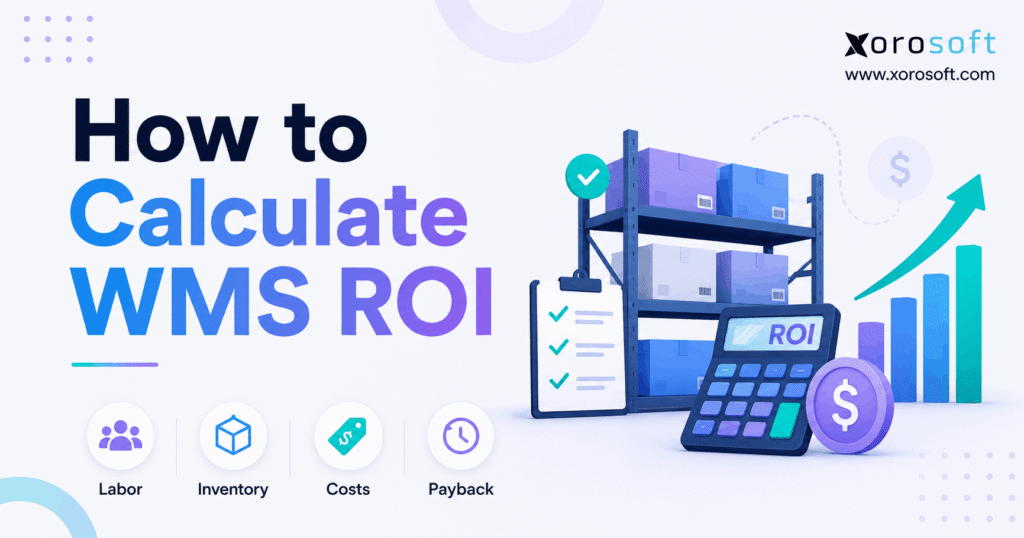
Understanding and maximising WMS ROI is essential for businesses looking to improve efficiency and reduce costs in their warehouse operations.
1. Why WMS ROI Has Become a Finance Decision
Warehouse problems rarely appear as one dramatic failure. Instead, they accumulate.
Order volume increases while warehouse headcount grows almost as quickly. Inventory discrepancies take longer to investigate. Overtime becomes routine during peak periods. Employees walk unnecessary distances to complete picks. Customer service spends more time resolving fulfillment mistakes. Purchasing teams hesitate because they do not fully trust available inventory. Meanwhile, finance reconciles warehouse activity across spreadsheets and disconnected applications.
Eventually, leadership starts evaluating warehouse management software.
At that point, the central question is not whether a WMS can improve operations. Most modern warehouse systems can support receiving, putaway, replenishment, picking, packing, inventory counting, transfers, inventory visibility, and shipping execution.
The more important question is whether those improvements create enough financial value to justify the cost and disruption of implementing a new system.
That is where WMS ROI becomes useful.
A strong WMS ROI analysis converts warehouse friction into financial terms. Instead of saying, “Picking is too slow,” the business calculates how many labor hours the current process consumes and what those hours cost. Rather than saying, “Inventory accuracy is poor,” the team measures how discrepancies affect fulfillment, purchasing, customer service, inventory adjustments, and reconciliation.
As a result, the conversation shifts from features to operating economics.
The purpose is not to create a spreadsheet that proves the company needs new software. In fact, a credible analysis may show that the warehouse should fix its layout, receiving controls, item data, barcode discipline, replenishment rules, or employee training before making a technology investment.
Therefore, the real objective is to determine whether the operational problem is measurable, financially significant, and realistically addressable through warehouse technology.
1.1 Why warehouse ROI starts with operational baselines
Companies often ask WMS vendors how much productivity improvement they should expect.
That question starts too late.
A 10% improvement means very little without understanding current productivity, labor costs, order mix, travel time, seasonality, staffing, and warehouse layout.
Consider two warehouses that each improve picking productivity by 10%. One spends $3 million annually on warehouse labor, while the other spends $300,000. The operational percentage is identical, but the financial impact is dramatically different.
For that reason, every WMS ROI calculation should begin with company-specific operating data.
Useful measures include lines picked per labor hour, orders shipped per day, warehouse overtime, inventory accuracy, fulfillment error rate, receiving productivity, warehouse-caused returns, cycle-count effort, inventory adjustments, cost per order, and average inventory.
Peak periods deserve separate attention. A warehouse may perform well during most of the year but struggle severely during holiday demand, promotional events, seasonal launches, or major wholesale periods.
Annual averages can hide the actual business problem.
1.2 Questions to answer before selecting WMS software
A useful business case should answer several questions before the company compares vendors.
What warehouse problems cost the most today? Which of those costs can software realistically influence? What will implementation and ownership cost? How quickly should the investment recover its cost? Finally, what happens if productivity, accuracy, or labor improvements fall below expectations?
These questions give operations and finance a common decision framework.
More importantly, they prevent software selection from becoming a feature-counting exercise. Instead of asking which platform has the longest list of functions, leadership can ask which solution addresses the problems that matter financially.
2. What WMS ROI Measures and How the Formula Works
At its simplest, WMS ROI measures the net financial value created by a warehouse management system compared with the total cost of implementing and operating it.
The basic WMS ROI formula is:
WMS ROI (%) = [(Total WMS Benefits – Total WMS Costs) / Total WMS Costs] x 100
Suppose a company spends $200,000 on a warehouse management project during the period being evaluated.
During the same period, it calculates $300,000 in measurable financial benefits.
The net benefit equals:
$300,000 – $200,000 = $100,000
Therefore:
WMS ROI = $100,000 / $200,000 x 100 = 50%
The arithmetic is straightforward. However, the quality of the answer depends almost entirely on how accurately the company defines benefits and costs.
If the cost side excludes integrations, internal labor, or ongoing support, ROI will look stronger than reality. Likewise, if the benefit side includes optimistic revenue assumptions or double-counted labor savings, the result becomes unreliable.
2.1 WMS ROI versus payback period
ROI and payback period often appear together in a warehouse business case, but they answer different questions.
ROI asks: How much net value does the project create relative to the investment?
Payback asks: How long does the business need to recover its initial investment?
A simplified formula is:
Payback Period = Initial Investment / Annual Net Benefit
Assume implementation, migration, training, and hardware create an initial investment of $120,000.
After annual software and support expenses, the warehouse expects $180,000 in annual net benefit.
The simplified calculation becomes:
$120,000 / $180,000 x 12 = 8 months
This example only demonstrates the formula. It does not represent a standard or guaranteed WMS payback period.
In practice, benefits often ramp gradually. Employees need time to learn new workflows, managers refine warehouse rules, and integrations may require adjustments after go-live.
Consequently, a month-by-month cash-flow model often produces a more realistic payback date than a simple annual calculation.
2.2 Why total cost of ownership affects warehouse ROI
Total cost of ownership, or TCO, looks beyond the initial software price.
A lower subscription does not necessarily create a lower-cost system. A platform may require middleware, third-party applications, custom integrations, consulting, hardware, or ongoing administrative support.
Conversely, a higher subscription may replace several existing tools and reduce integration complexity.
Therefore, a serious WMS ROI calculation should compare total ownership cost and financial benefits across the same period.
For many warehouse projects, three years provides a practical starting point. Larger ERP, manufacturing, or multi-warehouse implementations may justify a five-year view.
2.3 When NPV and IRR strengthen the business case
Larger projects may require additional financial measures such as net present value or internal rate of return.
NPV accounts for the fact that money received several years from now has less present economic value than money received today.
IRR can help leadership compare a warehouse technology project with other investments competing for the same capital.
However, the finance team should define the discount rate and investment threshold. Warehouse teams should not invent those assumptions simply to make WMS ROI look more attractive.
3. What Costs Should Be Included in WMS ROI?
Companies frequently underestimate warehouse technology costs because they focus too heavily on software subscription pricing.
A reliable WMS ROI model should include every material expense required to make the system operational and keep it running.
Otherwise, the business compares complete benefits with incomplete costs.
3.1 WMS software, subscriptions, and licensing
Start with the commercial cost of the system.
Depending on the vendor, pricing may depend on users, warehouses, modules, transaction volume, order volume, storage, environments, or support tiers.
Recurring expenses should appear in every year of the analysis.
For example, if annual WMS software costs $60,000 and management evaluates a three-year return, the model should include $180,000 in software costs rather than only the first $60,000.
This seems obvious. Nevertheless, weak ROI models often compare several years of benefits with only one year of recurring software expense.
3.2 Implementation and configuration costs
Implementation usually involves much more than activating software.
The business may need to configure warehouse locations, bins, receiving rules, putaway logic, replenishment, picking methods, packing processes, cycle counting, permissions, transfer workflows, shipping rules, and exception handling.
Complex operations require more design.
A multi-warehouse distributor running ecommerce, wholesale, EDI, lot tracking, customer-specific requirements, and inventory transfers will typically require a broader implementation scope than a simple single-location warehouse.
Therefore, the WMS ROI model should reflect actual operational complexity rather than a generic implementation estimate.
3.3 WMS integration and data migration costs
Warehouse systems rarely operate in isolation.
The WMS may need to exchange information with accounting software, ERP, Shopify, Amazon, EDI providers, carriers, shipping software, manufacturing systems, marketplaces, 3PLs, reporting tools, or warehouse automation.
Every required connection affects TCO.
Data migration can also become substantial. Item masters, inventory balances, units of measure, locations, customers, vendors, serial numbers, lots, open transactions, and historical information may all require cleanup.
Additionally, internal employees must validate migrated information before go-live.
That labor belongs in the financial picture even when it does not appear on a vendor invoice.
3.4 Warehouse hardware and infrastructure
A new WMS may require barcode scanners, printers, mobile devices, workstations, charging equipment, labels, or improved wireless coverage.
Individually, these expenses may appear minor compared with software and consulting. Collectively, however, they can materially affect the project.
For longer-term analyses, the company should also consider reasonable replacement cycles for warehouse devices.
3.5 Training and internal project labor
Internal labor often disappears from ROI calculations because the company does not receive an external invoice for it.
Nevertheless, implementation may consume hundreds of employee hours.
Warehouse managers define requirements. Finance validates reports. Inventory teams clean data. IT supports integrations. Key users test processes. Employees attend training. Supervisors support go-live.
Moreover, employees may work more slowly while learning the new process.
A credible WMS ROI model includes that effort when it becomes financially meaningful.
3.6 Ongoing WMS support and administration
Post-launch costs may include support subscriptions, administration, integration maintenance, additional training, configuration changes, and hardware replacement.
The goal is not to make the project look expensive.
Instead, a complete model ensures that the WMS ROI result reflects what the business will actually spend.
| Cost Category | Typical Timing | Include in ROI? |
|---|---|---|
| Software subscription | Recurring | Yes |
| Implementation | One-time | Yes |
| Configuration | Mainly one-time | Yes |
| Data migration | Mainly one-time | Yes |
| Integrations | Initial and ongoing | Yes |
| Hardware | Initial and replacement | Yes |
| Training | Initial and periodic | Yes |
| Internal project labor | Mainly initial | Yes |
| Support and administration | Recurring | Yes |
4. Where Warehouse Management System ROI Comes From
The benefit side of WMS ROI requires even greater discipline than the cost side because companies can easily assign dollar values to improvements that may never reach the financial statements.
A practical rule helps: if the company cannot explain how an operational improvement saves or avoids a real cost, treat it as a strategic benefit rather than hard savings.
4.1 WMS ROI from labor productivity and capacity
Labor often represents one of the largest addressable warehouse expenses.
However, higher productivity does not always mean reducing employees.
A warehouse may use improved productivity to lower overtime, process additional volume with the same team, avoid future hiring, reduce temporary labor, or move employees into higher-value work.
Each outcome has different financial implications.
A useful starting formula is:
Annual Labor Opportunity = Addressable Labor Hours x Loaded Labor Cost x Expected Improvement
Suppose picking consumes 40,000 labor hours per year at a loaded cost of $26 per hour.
Annual picking labor therefore costs $1.04 million.
If management expects new warehouse processes and software to improve addressable productivity by 8%, the theoretical value equals $83,200.
However, leadership should ask what happens to those hours.
If the warehouse simply creates unused capacity, the full $83,200 may not become cash savings. In contrast, if growth would otherwise require three additional employees, the improvement may help the company avoid future hiring.
Therefore, WMS ROI should distinguish between direct savings, avoided future costs, and additional capacity.
4.2 Warehouse ROI from fewer picking and shipping errors
Fulfillment errors create costs throughout the organization.
Warehouse employees may repick and repack an order. Shipping incurs additional freight. Customer service handles complaints. Inventory may require restocking. The company may issue credits or ship replacement products.
A useful calculation is:
Annual Fulfillment Errors x Average Cost per Error x Expected Reduction
Assume the warehouse records 3,000 avoidable fulfillment errors annually.
Finance estimates that freight, labor, credits, and administrative effort cost an average of $22 per incident.
The annual addressable cost equals:
3,000 x $22 = $66,000
If management expects scanning and better warehouse processes to reduce those errors by 35%, the annual modeled benefit equals $23,100.
The improvement assumption should come from the company’s process design and operating baseline rather than a generic vendor percentage.
4.3 Inventory accuracy and financial impact
Inventory accuracy often creates value outside the warehouse.
When system inventory does not match physical inventory, purchasing may reorder products unnecessarily. Customer service may promise stock that cannot ship. Warehouse employees search for missing items. Finance records adjustments. Ecommerce channels may display quantities that are not truly available.
As a result, greater accuracy can improve several workflows simultaneously.
However, the company should not assign an arbitrary dollar value to “real-time visibility.”
Instead, calculate measurable consequences such as inventory investigations, emergency transfers, adjustments, administrative effort, missing inventory, and unfulfillable orders.
That creates a much stronger financial case.
4.4 Inventory carrying-cost reductions
A WMS supports stronger inventory information, but warehouse software does not control every factor that determines inventory levels.
Forecasting, purchasing, supplier reliability, lead times, manufacturing schedules, safety stock, and service targets all affect average inventory.
Therefore, do not automatically credit inventory reductions to the WMS.
If the broader project genuinely lowers inventory without reducing service levels, finance can calculate the carrying-cost benefit.
Suppose average inventory falls by $400,000 and finance calculates an annual carrying cost of 18%.
The potential benefit equals:
$400,000 x 18% = $72,000 annually
However, WMS ROI should include only the portion that the warehouse project can reasonably influence.
4.5 Warehouse space and capacity savings
For some businesses, the largest return does not come from labor.
Instead, it comes from delaying the next warehouse.
Better inventory location control, replenishment, slotting, storage discipline, and warehouse visibility can improve effective capacity.
Consequently, a company may reduce overflow storage or postpone a facility expansion.
Furniture, sporting goods, wholesale distribution, consumer products, and industrial businesses should examine this category carefully.
In some operations, delaying another warehouse by several months may generate more value than several smaller labor improvements combined.
4.6 WMS ROI from software consolidation
Warehouse operations often sit inside fragmented software environments.
A company may use QuickBooks for accounting, separate inventory software, another warehouse application, EDI software, spreadsheets for purchasing, reporting applications, and integration middleware.
If the new platform genuinely removes some of those systems, WMS ROI can include subscription savings, integration maintenance, reconciliation work, and duplicate data entry.
For companies that need a wider operational system instead of a warehouse-only application, XoroONE connects warehouse management with inventory, purchasing, accounting, forecasting, manufacturing, reporting, and ecommerce workflows.
In that type of project, systems consolidation becomes part of the financial return rather than an unrelated IT objective.
5. How to Calculate WMS ROI Step by Step
A strong WMS ROI calculation should be transparent enough that finance can trace each material assumption back to operational data.
If leadership changes one variable, the model should show how the financial result changes.
5.1 Step 1: Establish your warehouse ROI baseline
Begin with representative warehouse data.
Seasonal companies should ideally use twelve months. Otherwise, management risks building a major investment decision around an unusually quiet or unusually busy period.
Capture order volume, order lines, warehouse labor hours, overtime, picking productivity, receiving productivity, fulfillment accuracy, inventory accuracy, warehouse-caused returns, cycle-count effort, cost per order, software expense, temporary labor, and inventory adjustments.
Additionally, track peak periods separately.
Annual averages often hide the reason a company needs stronger warehouse management.
5.2 Step 2: Calculate WMS investment and TCO
Separate initial investment from recurring expense.
Consider this hypothetical project:
Implementation and configuration: $70,000
Data migration and integrations: $25,000
Hardware: $15,000
Training and internal project labor: $20,000
Total initial investment: $130,000
Annual software, support, and integration maintenance: $70,000
A three-year TCO becomes:
$130,000 + ($70,000 x 3) = $340,000
That $340,000 figure, rather than the initial software invoice, should become the comparison point for a three-year WMS ROI calculation.
5.3 Step 3: Quantify annual WMS financial benefits
Calculate each benefit independently.
For example:
| Benefit Category | Hypothetical Annual Benefit |
| Warehouse labor capacity | $110,000 |
| Reduced overtime | $45,000 |
| Lower fulfillment error costs | $35,000 |
| Reduced rework and returns | $20,000 |
| Software and integration consolidation | $30,000 |
| Inventory-related benefit | $35,000 |
| Total Annual Benefit | $275,000 |
Every line should include the source of the baseline and the logic behind the expected improvement.
For instance, the overtime estimate should come from payroll records and a realistic reduction assumption. Similarly, fulfillment-error savings should use actual error volumes and an agreed average cost per error.
5.4 Step 4: Calculate annual net benefit
If annual measurable benefits equal $275,000 and annual recurring WMS costs equal $70,000:
Annual Net Benefit = $275,000 – $70,000 = $205,000
This number becomes particularly useful when calculating payback.
5.5 Step 5: Calculate the WMS payback period
Using the same hypothetical example:
Initial investment: $130,000
Annual net benefit: $205,000
Payback Period = $130,000 / $205,000 x 12
The simplified result equals approximately 7.6 months.
Nevertheless, real warehouse benefits rarely begin at full run-rate immediately after go-live.
A more conservative model may assume 25% of expected benefits during the first quarter, 60% during the second, 85% during the third, and full performance afterward.
That approach produces a more realistic WMS payback period.
5.6 Step 6: Calculate year-one WMS ROI
Assume the project eventually generates $275,000 in annual benefit.
Year-one cost includes $130,000 in initial implementation and $70,000 in recurring software and support.
Total year-one cost equals $200,000.
Therefore:
Year-One Net Benefit = $275,000 – $200,000 = $75,000
Year-One WMS ROI = $75,000 / $200,000 x 100 = 37.5%
If benefits ramp gradually, actual first-year ROI would be lower.
5.7 Step 7: Calculate three-year warehouse management system ROI
A multi-year analysis gives implementation costs better context because most implementation expenses occur near the beginning.
Using the same hypothetical assumptions:
Three-year benefits:
$275,000 x 3 = $825,000
Three-year TCO:
$340,000
Net benefit:
$825,000 – $340,000 = $485,000
Three-year WMS ROI:
$485,000 / $340,000 x 100 = approximately 142.6%
This example demonstrates why leadership should examine both short-term payback and longer-term financial value.
5.8 Step 8: Compare WMS ROI with the cost of doing nothing
The existing operating model will not necessarily remain at today’s cost.
Suppose order volume will grow by 25% over the next two years.
Without better warehouse processes, operations expects to hire five additional employees.
With improved execution, management believes the warehouse can support the same growth with only two new hires.
The economic value is not the same as eliminating three current positions.
Instead, the company may avoid three future hires.
That distinction matters because direct savings and avoided future costs affect the business differently.
A credible WMS ROI model should make that distinction explicit.
6. WMS ROI Example for a Growing Multi-Channel Distributor
Consider a hypothetical distributor shipping 300,000 orders annually.
The company sells through ecommerce and wholesale channels while using several disconnected applications for inventory, warehouse management, accounting, purchasing, and integrations.
Order volume continues to rise, but leadership does not want warehouse headcount to grow at the same rate.
6.1 Establishing the warehouse ROI opportunity
Operations and finance identify the following annual addressable costs:
| Operational Issue | Annual Addressable Cost |
| Warehouse overtime | $55,000 |
| Labor capacity needed for growth | $120,000 |
| Fulfillment errors | $45,000 |
| Warehouse-caused rework and returns | $20,000 |
| Duplicate software and integrations | $35,000 |
| Administrative reconciliation | $25,000 |
| Total Addressable Cost | $300,000 |
Management does not assume that technology will eliminate the entire $300,000.
Instead, after reviewing processes and expected adoption, the company estimates that $225,000 can realistically become measurable annual benefit once the operation reaches full run-rate.
That adjustment makes the WMS ROI model more credible.
6.2 Modeling implementation ramp and three-year value
The project requires $140,000 for implementation, migration, integrations, training, hardware, and internal project work.
Recurring software and support cost $65,000 annually.
Therefore, total year-one cost equals $205,000.
Because employees need time to adapt, management reduces first-year benefits from $225,000 to $190,000.
The year-one net result becomes:
$190,000 – $205,000 = -$15,000
At first glance, the project may seem financially unattractive.
However, the three-year view changes the result.
Three-year benefits:
$190,000 + $225,000 + $225,000 = $640,000
Three-year costs:
$140,000 + ($65,000 x 3) = $335,000
Net benefit:
$305,000
Three-year WMS ROI:
$305,000 / $335,000 x 100 = approximately 91%
This example illustrates why management should not judge an implementation only by year-one ROI.
At the same time, cash flow still matters. A company with limited capital may prefer faster payback even if another option provides stronger long-term return.
7. Building a WMS Business Case Finance Can Trust
A polished spreadsheet does not make a business case credible.
The assumptions behind it matter much more.
7.1 Use conservative, expected, and aggressive ROI scenarios
A single forecast creates false precision.
Instead, create at least three scenarios.
| Assumption | Conservative | Expected | Aggressive |
| Productivity improvement | 4% | 9% | 14% |
| Error-cost reduction | 15% | 30% | 45% |
| Overtime reduction | 10% | 30% | 50% |
| Benefit ramp | Slow | Planned | Fast |
These percentages are illustrative rather than industry benchmarks.
If WMS ROI remains attractive under the conservative scenario, the project has a stronger financial foundation.
In contrast, if the business case works only when every assumption reaches the aggressive range, management should recognize the additional risk.
7.2 Separate hard WMS savings from strategic benefits
Some warehouse improvements connect directly with financial records.
Reduced overtime, lower error-related freight, retired software subscriptions, lower temporary labor, and reduced external storage can often be measured directly.
Other benefits remain valuable but harder to convert into cash.
Better reporting, cleaner inventory visibility, faster decision-making, improved employee experience, and scalability may strengthen the business without immediately reducing expenses.
Therefore, separate hard savings from strategic benefits.
Do not force every advantage into an invented dollar amount simply to improve WMS ROI.
7.3 Assign ownership to every financial assumption
Operations should validate productivity assumptions.
Finance should confirm labor economics and financial treatment.
Customer service can help determine the cost of shipping errors.
IT should validate integration, hardware, and maintenance expenses.
Inventory teams should provide discrepancy and adjustment data.
When each material assumption has a clear owner, the ROI model becomes a cross-functional business case rather than a software proposal built by one department.
8. How Warehouse ROI Changes by Industry and Business Model
The WMS ROI formula stays consistent across industries, but the sources of value can change dramatically.
An ecommerce apparel warehouse, furniture distributor, wholesale operation, and manufacturer may all need warehouse technology for different reasons.
8.1 WMS ROI for Shopify and ecommerce operations
Ecommerce warehouses often manage high order counts, promotions, returns, seasonal peaks, multi-channel inventory, and pressure for faster fulfillment.
Consequently, WMS ROI can extend beyond picking productivity.
A Shopify merchant may also benefit from stronger coordination between orders, inventory, warehouse execution, purchasing, and financial workflows.
Xorosoft maintains an ERP listing on the Shopify App Store, making it relevant for Shopify businesses evaluating how ecommerce channels connect with warehouse and ERP operations.
For these companies, the financial model should examine the entire order lifecycle.
For example, stronger integration may reduce manual order handling, inventory reconciliation, purchasing administration, and duplicate data entry in addition to improving warehouse execution.
8.2 Warehouse management ROI for wholesale distribution
Wholesale businesses often manage customer-specific requirements, EDI, purchasing complexity, inventory allocation, larger orders, and multiple warehouses.
As a result, the largest financial return may come from better order coordination and administrative efficiency rather than simply increasing units picked per hour.
A wholesaler should examine how orders move through allocation, picking, packing, shipping, invoicing, inventory updates, and financial reconciliation.
If employees spend significant time maintaining these processes across several systems, administrative efficiency and systems consolidation belong in the financial model.
8.3 WMS benefits for apparel and consumer products
Apparel businesses can manage thousands of SKU combinations created by style, size, and color.
Seasonality, ecommerce promotions, wholesale orders, launches, and returns add further complexity.
Therefore, inventory accuracy and fulfillment control can have substantial financial consequences.
Businesses researching sector-specific requirements can review Xorosoft’s industry solutions, which cover several inventory-driven sectors including apparel, wholesale distribution, manufacturing, food and beverage, sporting goods, and other product-based operations.
8.4 Warehouse ROI for furniture and space-intensive operations
Furniture businesses may gain less from a small increase in picks per hour and more from better storage utilization, product-location accuracy, and reduced handling.
Large products consume significant cubic space and may require specialized storage or movement.
Therefore, postponing overflow storage or another warehouse can become a major ROI driver.
This illustrates why generic warehouse benchmarks should be used carefully.
Different warehouses create financial pressure in different ways.
8.5 WMS ROI for manufacturing companies
Manufacturing adds another layer because warehouse inventory may include raw materials, components, subassemblies, work in process, and finished goods.
Warehouse activity may connect directly with BOMs, work orders, purchasing, production planning, and material availability.
In this environment, measuring picking efficiency alone understates the potential business impact.
XoroERP connects warehouse operations with manufacturing, purchasing, inventory, accounting, and reporting workflows.
For manufacturers considering an integrated architecture, the financial model should examine how warehouse transactions affect the production process as a whole.
9. Standalone WMS vs Integrated ERP: How ROI Changes
One of the most important decisions in a warehouse technology project happens before vendor selection.
Does the company primarily need stronger warehouse execution, or does it need a broader operational-system change?
Those are not the same project.
9.1 When standalone WMS software makes financial sense
A standalone WMS can deliver strong value when the company’s existing ERP, accounting, purchasing, manufacturing, and ecommerce systems already meet its needs.
If warehouse execution remains the primary bottleneck, replacing the rest of the technology environment may unnecessarily increase implementation scope.
In that case, WMS ROI should focus on warehouse-specific improvements while including the cost of integrating the new system with surrounding applications.
Businesses evaluating dedicated warehouse functionality can review XoroWMS as one example of a warehouse-focused platform covering receiving, inventory control, picking, packing, replenishment, multi-warehouse operations, and warehouse execution.
9.2 How integrated ERP and WMS affects ROI
A broader platform becomes more relevant when warehouse problems connect directly with inventory, purchasing, accounting, forecasting, manufacturing, ecommerce, EDI, or reporting.
Consider a business using QuickBooks, inventory software, a separate warehouse application, EDI software, purchasing spreadsheets, and middleware.
Even if warehouse execution works reasonably well, the company may still spend considerable time synchronizing data between systems.
In that environment, WMS ROI expands into systems-consolidation ROI.
XoroONE takes this broader approach by connecting warehouse management with inventory, accounting, purchasing, forecasting, manufacturing, reporting, and ecommerce operations.
The financial model can therefore examine eliminated applications, integration maintenance, reconciliation work, and duplicate transactions in addition to direct warehouse savings.
9.3 Comparing ERP alternatives without distorting warehouse ROI
Inventory-driven businesses may compare NetSuite, Acumatica, Business Central, Cin7, Brightpearl, Fishbowl, Sage, Xorosoft, or other systems.
Feature count should not become the only financial criterion.
Implementation complexity, integration requirements, operational fit, internal administration, TCO, scalability, and time to value all affect the economics.
Companies specifically evaluating Xorosoft and NetSuite can review the Xorosoft vs. NetSuite comparison as one part of a broader evaluation.
Ultimately, leadership should compare the total cost of achieving the required operating model rather than comparing software licenses alone.
10. Common WMS ROI Mistakes That Distort the Business Case
A spreadsheet can contain perfect formulas and still produce the wrong answer.
Usually, the problem lies in the assumptions.
10.1 Do not credit unrelated operational improvements
Suppose forecasting improves while purchasing changes supplier terms and warehouse inventory accuracy also increases.
If average inventory declines, the company should not credit the entire reduction to the WMS.
Instead, allocate financial benefits according to the processes that genuinely created them.
Otherwise, WMS ROI becomes overstated.
10.2 Avoid double-counting WMS labor savings
Assume productivity improvement allows the warehouse to avoid hiring three employees next year.
If the model already counts those avoided hires, it should not also treat the same labor hours as current payroll savings.
That would count one operational improvement twice.
10.3 Build an implementation ramp into the ROI forecast
Go-live does not automatically mean operational maturity.
Employees learn new workflows. Managers refine warehouse rules. Replenishment improves. Integrations stabilize. Supervisors identify new bottlenecks.
Therefore, the financial model should include a realistic ramp rather than assuming full WMS ROI from the first day.
10.4 Use company data before generic WMS benchmarks
Industry benchmarks can provide context, but internal warehouse data should drive the business case whenever possible.
A furniture warehouse, food distributor, ecommerce operation, and manufacturer may have completely different labor, inventory, space, and fulfillment economics.
Consequently, broad averages should not replace company-specific measurements.
10.5 Keep revenue upside separate from hard savings
Better warehouse execution can support growth.
However, faster fulfillment does not automatically create additional revenue.
Demand, marketing, pricing, competition, product availability, and customer acquisition all affect sales.
For that reason, potential revenue upside should appear separately from hard financial savings.
10.6 Include the future cost of the existing system
The current warehouse may become more expensive over time.
As volume increases, the company may need additional employees, temporary labor, software, warehouse space, overtime, and administrative effort.
Therefore, the meaningful comparison is often:
Future cost of current operations versus future cost of the proposed operating model.
That comparison provides a more realistic view of WMS ROI than comparing a new system only with today’s expenses.
11. How to Measure WMS ROI After Implementation
The original business case should remain active after go-live.
Otherwise, management never learns whether the project delivered the expected financial return.
11.1 Track the warehouse KPIs used in the ROI model
If the original business case focused on lines picked per hour, inventory accuracy, fulfillment errors, overtime, and cost per order, continue measuring those same KPIs.
Do not replace difficult measures with easier ones after implementation.
Consistency makes before-and-after comparisons meaningful.
11.2 Measure unit economics, not total expense alone
Total warehouse labor can rise after implementation if the business ships significantly more orders.
That does not automatically indicate poor WMS ROI.
Instead, evaluate labor cost per order, orders per labor hour, error cost per thousand orders, overtime per thousand orders, and total warehouse cost relative to throughput.
These measures separate business growth from operational efficiency.
11.3 Review WMS ROI at 6, 12, and 24 months
Post-launch reviews should compare actual performance with conservative, expected, and aggressive scenarios.
If results fall below plan, investigate the reason.
Employee adoption may remain incomplete. An integration may have gone live later than expected. Order mix could have changed. Another process may now limit warehouse productivity.
The ROI model should guide that investigation rather than simply produce a pass-or-fail verdict.
11.4 Use performance gaps to drive continuous improvement
Suppose management expected a 10% productivity improvement but achieved only 5%.
Rather than immediately declaring the project unsuccessful, investigate why half of the expected value remains unrealized.
Slotting may still be inefficient. Replenishment may interrupt picking. Warehouse layout may limit the process. Employees could still use manual workarounds.
As a result, WMS ROI becomes an ongoing management tool rather than a spreadsheet created only to secure approval.
12. Frequently Asked Questions About WMS ROI
12.1 What is WMS ROI?
WMS ROI measures the financial return generated by a warehouse management system compared with the total cost of implementing and operating it. Benefits may include labor productivity, reduced overtime, fewer fulfillment errors, improved inventory accuracy, lower carrying costs, better warehouse utilization, software consolidation, and avoided future costs.
12.2 How do you calculate WMS ROI?
Use the formula:
WMS ROI = [(Total Benefits – Total Costs) / Total Costs] x 100
The analysis should cover a clearly defined period. For example, a three-year model should include three years of relevant benefits and three years of ownership costs.
12.3 What is a good warehouse management system ROI?
There is no universal percentage that defines a good return. Businesses have different capital requirements, margins, growth plans, implementation risks, and alternative investment opportunities. Finance should determine the required return and compare the warehouse project with the same investment standards used elsewhere in the company.
12.4 How long should WMS payback take?
An acceptable payback period depends on project size, available capital, risk, recurring expense, and company policy. Rather than using an arbitrary benchmark, calculate payback using actual expected cash flows and test the result under conservative assumptions.
12.5 What costs belong in a WMS ROI calculation?
Include software subscriptions, implementation, configuration, data migration, integrations, hardware, training, internal project labor, support, administration, and ongoing maintenance. Temporary productivity disruption should also enter the model when its financial effect becomes meaningful.
12.6 How can WMS software reduce labor costs?
A WMS can improve receiving, putaway, replenishment, picking, packing, counting, and inventory movement. Those improvements may reduce overtime, increase throughput, avoid future hiring, or lower temporary labor requirements. Record only the financial effect the company can realistically realize.
12.7 Can inventory savings improve warehouse ROI?
Yes, when the project genuinely influences inventory economics. Better accuracy may support stronger replenishment and planning, but forecasting, purchasing, supplier reliability, and service-level decisions also affect inventory. Credit only the portion reasonably attributable to the warehouse project.
12.8 Should reduced errors count as WMS financial benefits?
Yes. Fulfillment errors can create freight, labor, customer-service, replacement, return, credit, and rework costs. Calculate the current annual cost of warehouse-caused errors and then apply a realistic reduction assumption.
12.9 Should WMS ROI be measured over three or five years?
Both can be useful. Year one highlights implementation pressure, three years provides better context for recurring value, and five years may suit larger projects. However, assumptions become less certain as the forecast period grows, so longer models should remain conservative.
12.10 Which warehouse KPIs matter most?
Useful measures include lines picked per labor hour, orders shipped per labor hour, inventory accuracy, fulfillment accuracy, receiving productivity, overtime, warehouse-caused returns, cost per order, cycle-count adjustments, inventory carrying costs, and warehouse utilization.
12.11 When does warehouse software produce enough ROI?
A WMS becomes worth serious evaluation when warehouse problems have measurable financial consequences. Persistent overtime, rising errors, poor inventory accuracy, labor scalability challenges, multi-warehouse complexity, fulfillment delays, or excessive manual administration are common triggers.
12.12 Who may not need a warehouse management system?
Businesses with low order volume, few SKUs, simple warehouse processes, strong inventory accuracy, and limited fulfillment complexity may not need a sophisticated WMS. Better warehouse layout, process discipline, barcode use, employee training, or improvements to existing inventory software may produce a stronger return.
12.13 Is standalone WMS or integrated ERP better for ROI?
Neither approach always produces better ROI. A standalone WMS can work well when surrounding systems already meet the company’s requirements. Integrated ERP and WMS may create more value when warehouse problems overlap with inventory, accounting, purchasing, forecasting, manufacturing, ecommerce, EDI, or multi-location operations.
12.14 How should a CFO evaluate WMS ROI?
A CFO should be able to trace every material financial benefit back to an operational baseline. The model should show total cost of ownership, payback, multi-year WMS ROI, implementation risk, conservative and expected scenarios, benefit ramp, growth assumptions, and the future cost of maintaining the current operating model.
13. Turning WMS ROI Into a Technology Decision
The most useful outcome of a WMS ROI exercise is not the percentage at the bottom of a spreadsheet.
It is clarity about what the business actually needs to fix.
If most financial value comes from receiving, replenishment, picking, inventory location control, packing, cycle counting, and warehouse labor, a warehouse-focused project may provide the clearest path.
However, if the largest costs come from disconnected inventory, accounting, purchasing, manufacturing, forecasting, ecommerce, and warehouse systems, the problem extends beyond warehouse execution.
The technology scope should follow that distinction.
13.1 Match WMS software scope to the operational problem
A business primarily focused on warehouse execution can evaluate a dedicated platform such as XoroWMS.
Companies that need connected warehouse, inventory, purchasing, accounting, manufacturing, and reporting processes may instead need to evaluate a broader platform such as XoroERP or XoroONE.
Neither approach should win automatically.
The best option is the one that addresses the operational problem without introducing unnecessary cost or complexity.
13.2 Compare warehouse ROI with the cost of doing nothing
Before approving the project, compare the proposed operating model with the likely future cost of keeping the current system.
A warehouse that appears manageable today may require significantly more labor, overtime, temporary employees, warehouse space, software, and administrative work as order volume grows.
That future cost belongs in the business case.
Companies researching sector-specific requirements can also review Xorosoft’s industry solutions, while businesses comparing broader ERP alternatives can use the Xorosoft vs. NetSuite comparison as one part of their evaluation.
13.3 Use the WMS ROI model as the final selection filter
Once management establishes current performance, total cost, expected benefits, payback requirements, implementation risks, and growth assumptions, those criteria should become part of vendor selection.
Do not choose software first and then create a financial model designed to justify the decision.
Instead, define the economics first.
Then ask each potential platform whether it can realistically deliver the operational changes behind the numbers.
For inventory-driven businesses evaluating warehouse management alongside purchasing, accounting, forecasting, manufacturing, Shopify, Amazon, EDI, or multi-warehouse workflows, contact Xorosoft to discuss the operational requirements and determine the right system scope.
Calculate the WMS ROI first. Then choose the technology that can realistically deliver it.
Recent Posts
-
 GS1 Logistic Labels in WMS: SSCC Generation, Printing, Scanning, and Traceability
 -
 Inventory Tracking Management KPIs: Measuring Unposted Receipts, Transfer Aging, and Return-to-Stock Time
 -
 B2B Ecommerce Software for Tax-Exempt Accounts: Resale Certificates, Account Rules, and Checkout Controls
 -
 Cin7 Alternatives for Shopify Plus Brands
 -
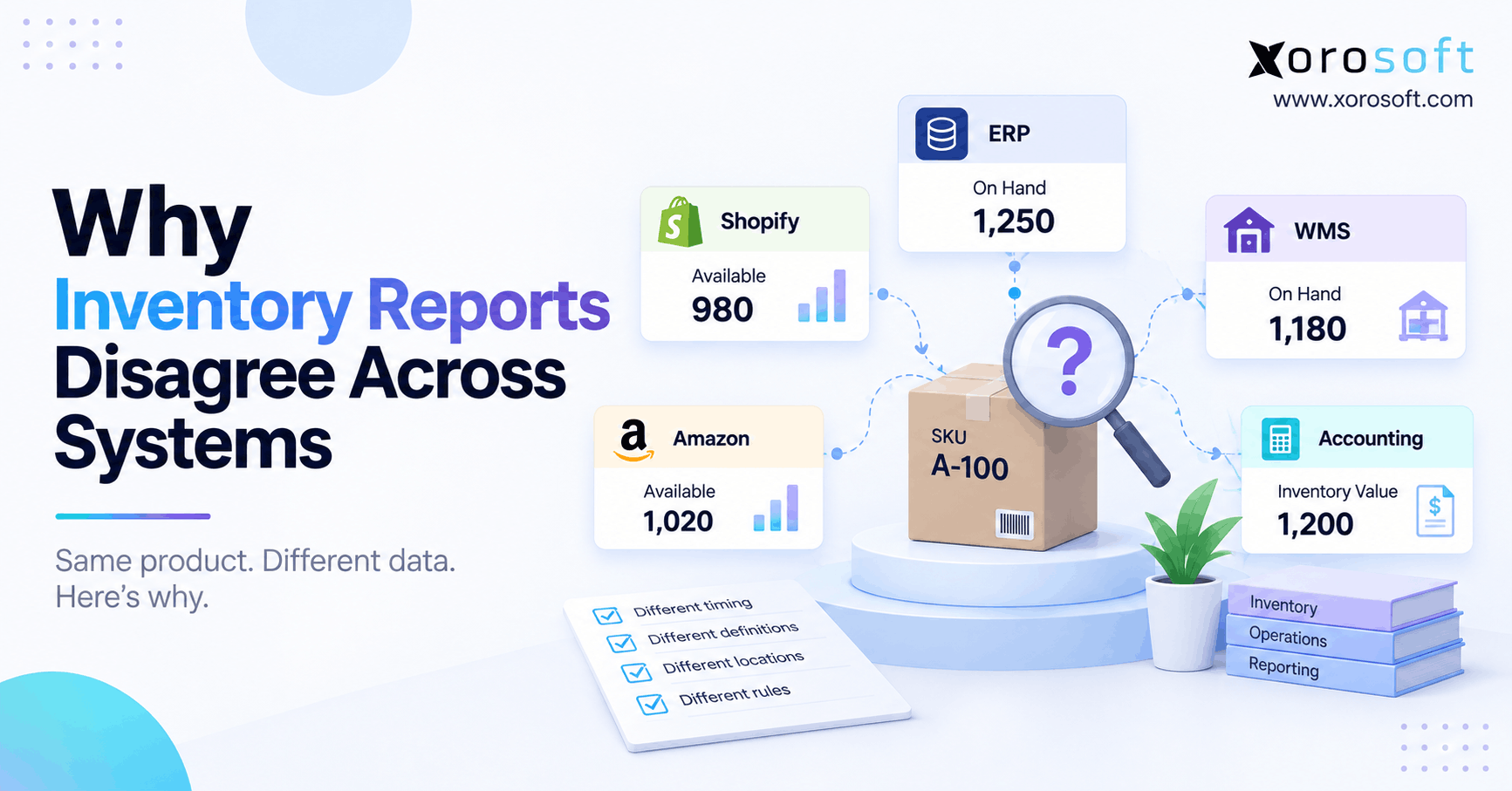 Why Inventory Reports Disagree Across Systems