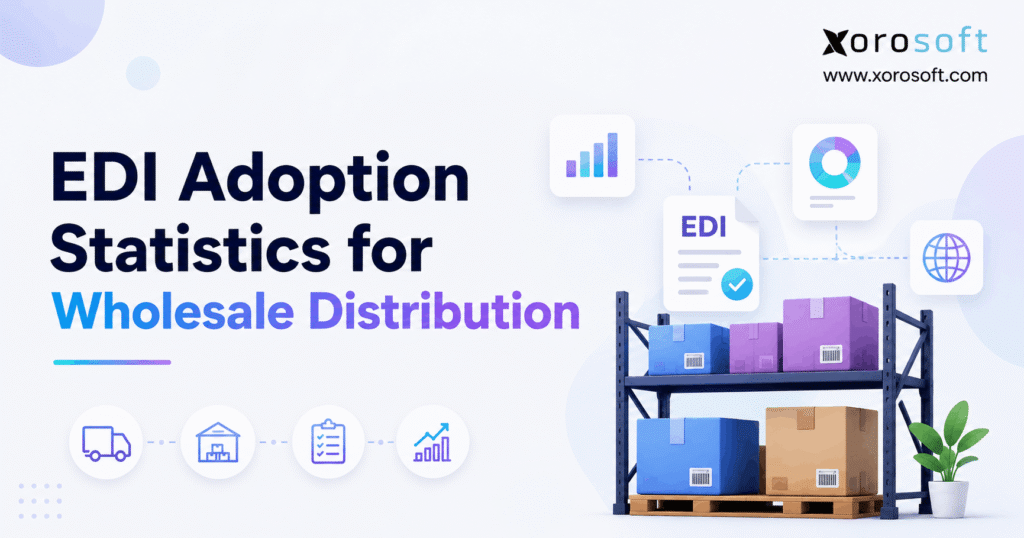
If you are searching for wholesale EDI statistics, this article will provide valuable insights and data for your business needs.
1. Wholesale EDI Statistics Reveal a Bigger Integration Challenge
Wholesale distributors no longer need convincing that digital transactions matter. The real challenge lies in turning those electronic transactions into connected operational workflows.
A retailer can send a purchase order electronically, yet employees may still check inventory in another system, recreate the order in an ERP, email instructions to the warehouse, update spreadsheets, reconcile shipment information, and prepare an invoice manually. In that environment, the distributor technically uses EDI, but the order-to-cash process still depends on people moving information between systems.
That distinction matters when interpreting wholesale EDI statistics.
The Business Research Company estimates that the global electronic data interchange software market will grow from roughly $2.46 billion in 2025 to $2.77 billion in 2026 and expects the market to reach approximately $4.41 billion by 2030. The firm links that growth to supply-chain digitization, enterprise automation, electronic invoicing, standardized data exchange, and stronger integration between EDI and enterprise systems. The Business Research Company
Those figures point to continued investment rather than decline.
X12 offers another useful signal. The standards organization maintains dozens of transaction sets that businesses use across procurement, inventory, warehousing, shipping, invoicing, and financial processes. X12 continues to support the structured business messages that form the backbone of many retail, manufacturing, logistics, and wholesale relationships.
For distributors, the important shift is not simply “more EDI.” The market is moving toward integrated EDI, where electronic transactions connect directly with inventory, ERP, warehouse management, purchasing, accounting, ecommerce, and fulfillment.
That operating model provides the right context for understanding current EDI adoption data.
2. What Wholesale EDI Statistics Actually Measure in 2026
No authoritative dataset provides one universal answer to the question, “What percentage of wholesale distributors use EDI?”
Industry, geography, customer requirements, business size, and technology architecture vary too widely for a single global percentage to tell the whole story. Reliable wholesale EDI statistics therefore come from several sources: software-market forecasts, standards organizations, trading-partner surveys, ecommerce data, supply-chain research, and individual industry studies.
Each source measures something different.
2.1 EDI Market Growth Shows Continued Business Investment
Software spending offers one of the clearest indicators of market direction.
The Business Research Company expects global EDI software revenue to continue growing through 2030. That growth does not prove that a particular percentage of distributors use EDI, but it does show that businesses continue to invest in EDI platforms, modernization, managed services, cloud infrastructure, trading-partner connectivity, and integration.
A mature technology can keep growing even when many large organizations already use it.
Companies replace legacy infrastructure, move integrations to the cloud, add customers, connect new warehouses, introduce ERP systems, expand into new markets, and add managed EDI services. Each of those changes can create additional EDI spending without representing a first-time implementation.
2.2 GS1 Data Demonstrates a Large Installed Base
GS1 provides another view of adoption.
Its global EDI materials report that almost 126,000 companies had implemented GS1 EANCOM standards and nearly 47,000 had implemented GS1 XML according to its 2020 survey. Order, Invoice, and Despatch Advice ranked among the most commonly implemented message types. GS1
Those numbers do not capture the full EDI market. Many North American companies rely on X12, while other regions and industries use different standards and protocols.
Even so, the figures demonstrate a substantial installed base of structured business messaging.
2.3 Wholesale Ecommerce Data Does Not Equal EDI Adoption
Marketers sometimes take wholesale ecommerce numbers and label them as EDI statistics. That creates a misleading picture.
The U.S. Census Bureau defines wholesale ecommerce broadly. The definition can include EDI, internet orders, extranets, email, and other electronic systems. U.S. Census Bureau
Wholesale ecommerce figures therefore provide valuable evidence of digital B2B purchasing, but they do not represent EDI-only transaction volume.
Strong analysis separates those categories rather than combining them into one convenient adoption percentage.
3. Why EDI Adoption Still Matters in Wholesale Distribution
Wholesale distribution creates a natural environment for structured transaction automation because trading partners repeatedly exchange the same types of business documents.
A customer places an order. The distributor validates it, confirms availability, allocates inventory, releases fulfillment, ships the goods, communicates shipment information, invoices the customer, and records the financial impact.
EDI can support each of those steps.
3.1 Trading-Partner Requirements Continue to Drive EDI Adoption
For many distributors, EDI starts as a commercial requirement rather than an IT initiative.
A major retailer may specify the transaction sets, communication methods, data fields, timing rules, packaging details, and testing procedures that suppliers must support. The distributor adopts EDI because the customer expects structured electronic communication.
Once both businesses build operational processes around those transactions, the relationship tends to reinforce continued EDI usage.
This installed network effect helps explain why APIs and newer integration methods have not simply displaced EDI.
3.2 Transaction Volume Changes the Economics
Manual order processing works until volume makes it expensive.
An employee who receives a PDF or emailed purchase order must identify the customer, validate the SKU, check the unit of measure, review pricing, confirm inventory, create the order, and route it for fulfillment.
At small volumes, that work may remain manageable.
At larger volumes, repetitive processing consumes labor and increases the number of places where an error can occur.
This is where wholesale EDI statistics become operationally meaningful. Adoption matters most when businesses compare EDI with order volume, trading-partner count, warehouse complexity, exception rates, and the amount of manual work surrounding each transaction.
4. EDI Transactions That Drive Wholesale Order-to-Cash Workflows
EDI standards give trading partners a common structure for exchanging business information. The individual transaction number matters less than the workflow that it supports.
Several transaction sets appear repeatedly in wholesale and retail relationships.
4.1 EDI 850 and EDI 855 Start the Order Cycle
The EDI 850 Purchase Order communicates the customer’s order to the supplier or distributor.
In a connected environment, software can translate that incoming transaction directly into a sales order. The system can then validate the customer, item mappings, quantities, dates, pricing rules, and available inventory.
The EDI 855 Purchase Order Acknowledgement lets the seller communicate its response.
Rather than relying on phone calls, emails, or spreadsheet updates, both companies exchange structured information between their systems.
4.2 EDI 856 Connects the Warehouse to the Trading Partner
The EDI 856 Ship Notice/Manifest, commonly called an ASN, communicates shipment details.
Warehouse execution becomes critical at this stage because the ASN should reflect what the team actually picked, packed, and shipped.
If the warehouse system says 98 units shipped while the EDI system assumes 100, employees need to resolve the mismatch before the customer receives inaccurate information.
The strongest workflow uses actual fulfillment data as the source for the outbound shipment notice.
4.3 EDI 810 Connects Fulfillment With Finance
The EDI 810 Invoice communicates billing information electronically.
When the distributor connects finance to order and shipment activity, the ERP can create invoice data from the transaction history instead of asking accounting teams to rebuild it manually.
A typical flow looks like this:
| Transaction | Business document | Operational purpose |
|---|---|---|
| EDI 850 | Purchase Order | Customer places an order |
| EDI 855 | Purchase Order Acknowledgement | Distributor confirms the order |
| EDI 856 | Ship Notice/Manifest | Distributor communicates shipment details |
| EDI 810 | Invoice | Distributor communicates billing information |
| EDI 846 | Inventory Inquiry/Advice | Trading partners exchange inventory data |
Together, these documents form part of the structured order-to-cash process that underpins many wholesale relationships.
5. Wholesale EDI Statistics Show Why Document Exchange Is Only Half the Job
A distributor can automate document transmission while leaving most of the business process manual.
That creates a misleading picture of digital maturity.
Consider two companies receiving the same EDI 850.
The first imports the order, but an employee checks stock in a spreadsheet, verifies customer information in another application, messages the warehouse, updates an allocation file, and later reconstructs shipment data so accounting can issue the invoice.
The second routes the same order into a connected operational system. Software validates item and customer data, checks inventory, allocates stock, releases fulfillment, captures shipping activity, and carries the transaction into invoicing.
Both companies use EDI.
Only one has substantially automated the workflow.
That difference explains why wholesale EDI statistics should increasingly sit beside ERP integration, warehouse automation, inventory accuracy, and exception-management metrics.
5.1 Strong EDI Operations Reduce Handoffs
The goal is not to eliminate people.
Instead, automation should remove repetitive tasks that do not require judgment.
Operations teams create more value when they investigate shortages, resolve trading-partner discrepancies, manage priorities, adjust purchasing decisions, or deal with fulfillment exceptions. Re-entering data from one application into another adds little value.
A mature EDI environment allows clean transactions to flow automatically and directs human attention toward exceptions.
5.2 Master Data Determines Whether Automation Works
Automation can accelerate bad data just as efficiently as good data.
Product identifiers, customer records, units of measure, ship-to locations, warehouse codes, and pricing relationships all need consistent mappings.
GS1 treats master-data alignment as an important part of electronic business communication because both parties need to refer to the same products, organizations, and locations. GS1
If one retailer orders by case while another orders by each, the distributor’s internal system must understand the difference.
Reliable EDI therefore depends on operational data discipline as much as technical connectivity.
6. Cloud EDI Adoption Is Reshaping the Distribution Technology Stack
Cloud platforms and managed integration services have changed the economics of EDI.
Historically, many businesses maintained more translation infrastructure, communications technology, and specialist expertise internally. Modern cloud services can reduce that burden.
The market now increasingly blends EDI with APIs, middleware, managed file transfer, trading-partner management, data transformation, and enterprise integration.
6.1 Cloud EDI Changes Infrastructure Ownership
A cloud EDI provider can manage technical components such as translation, mappings, communication infrastructure, partner connections, and monitoring.
That does not remove the need for strong internal integrations.
The distributor still needs to know whether inventory exists, which warehouse should fulfill the order, what the team actually shipped, and what finance should invoice.
Moving EDI to the cloud solves infrastructure problems. It does not automatically solve workflow problems.
6.2 APIs and EDI Can Work Together
Businesses increasingly use APIs alongside EDI.
EDI remains particularly effective for standardized B2B documents exchanged repeatedly between established trading partners. APIs work well when applications need direct, real-time, or near-real-time access to data and services.
A distributor may receive a national retailer’s purchase order through EDI, synchronize ecommerce inventory through APIs, and use an ERP to coordinate both transactions internally.
The technologies do not need to compete.
In many modern architectures, each technology handles the job that suits it best.
7. Wholesale EDI Statistics Point Toward Deeper ERP Integration
EDI handles structured communication between organizations. ERP handles much of what happens inside the distributor.
Connecting those two layers creates the operational value.
The relationship between ERP and wholesale EDI statistics matters because market adoption increasingly reflects a broader move toward integrated transactions rather than isolated document exchange.
7.1 EDI and Inventory Need One Source of Truth
When a customer sends an EDI purchase order, the distributor needs an accurate answer to a simple question: can we fulfill this order?
That question becomes difficult when the business operates several warehouses, Shopify, Amazon, marketplaces, B2B channels, manufacturing, or third-party fulfillment.
Each channel may compete for the same inventory.
If the EDI platform reads one inventory position while ecommerce reads another, the business can promise the same stock twice.
A connected platform such as XoroONE illustrates a different architecture. Xorosoft combines inventory, accounting, purchasing, warehouse management, manufacturing, forecasting, ecommerce, B2B commerce, and EDI-related connectivity inside a broader cloud ERP environment.
The principle matters more than the specific vendor: an incoming EDI transaction should reference the same inventory truth that every other channel uses.
7.2 EDI and Warehouse Management Need Shared Fulfillment Data
The warehouse determines what physically happens to the order.
Employees pick products, short unavailable quantities, pack cartons, assign tracking information, and ship goods.
The outbound ASN needs to reflect those events accurately.
XoroWMS provides an example of a warehouse layer designed to connect inventory control and fulfillment with broader order-management workflows.
For distributors, the practical requirement is straightforward. The EDI platform should consume actual warehouse data rather than forcing employees to recreate shipment information manually.
7.3 Purchasing and Accounting Complete the Transaction
A large wholesale order affects more than fulfillment.
It may consume stock that purchasing expected to support another channel. The order can trigger replenishment needs, change available-to-promise inventory, affect working capital, and eventually create accounts receivable.
XoroERP represents the more traditional enterprise ERP side of the Xorosoft ecosystem, connecting purchasing, inventory, vendors, accounting, warehousing, reporting, and other business processes.
Once EDI transactions connect with those functions, teams gain a much clearer view of what happened from customer order through financial settlement.
8. Shopify, Wholesale EDI, and Omnichannel Distribution Are Converging
Wholesale businesses increasingly sell through several channels at the same time.
A distributor may receive EDI orders from large retail customers, direct orders through Shopify, marketplace orders through Amazon, dealer orders through a B2B portal, and sales-rep orders for long-standing wholesale accounts.
Every channel can compete for the same physical inventory.
8.1 Wholesale EDI Statistics Matter More in an Omnichannel Environment
Suppose a national retailer sends an EDI order for 1,500 units.
The EDI platform accepts the order, but the ecommerce system still shows those units as available because the two systems update inventory separately.
Shopify customers continue buying the same inventory.
The business now faces an allocation problem even though the EDI transaction worked perfectly.
That scenario shows why wholesale EDI statistics increasingly intersect with ecommerce integration and inventory-management strategy.
A connected system needs to reserve wholesale demand and update availability across other channels quickly enough to prevent overselling.
8.2 Shopify and EDI Need a Shared Operational Layer
XoroONE supports a model in which ecommerce, wholesale, B2B, and EDI-related channels connect to common inventory and order-management data.
Businesses evaluating the Shopify connection can also review the official Xorosoft ERP listing in the Shopify App Store.
The broader principle applies regardless of platform.
A distributor should avoid maintaining separate “Shopify inventory,” “EDI inventory,” and “Amazon inventory” unless the business intentionally allocates stock that way.
One coordinated availability model gives teams a much stronger foundation for fulfillment decisions.
9. When Standalone EDI Stops Scaling With a Wholesale Business
Standalone EDI is not inherently a problem.
A company with modest order volume, one warehouse, a handful of EDI customers, and straightforward inventory may operate efficiently for years with an EDI provider connected to lightweight business software.
Problems emerge when complexity grows faster than integration.
9.1 Manual Reconciliation Signals an Architecture Problem
Repeated re-entry provides one of the clearest warning signs.
Employees receive electronic orders but recreate them in another application. Warehouse teams rely on emailed instructions. Customer-service teams open several systems before answering inventory questions. Finance reconstructs invoices from shipment records. Purchasing works from spreadsheets because committed demand remains difficult to see.
Those symptoms do not necessarily indicate that the EDI provider failed.
Instead, they suggest that the operational systems surrounding EDI no longer match the scale of the business.
9.2 Reporting Problems Usually Follow
Disconnected applications also make analysis more difficult.
A distributor may know how many EDI documents passed through its integration platform while struggling to answer more useful questions.
Which customers create the most exceptions? Which warehouses miss service commitments? How often do inventory shortages affect EDI orders? Which trading partners require the most manual work? How does wholesale demand affect ecommerce availability?
Leadership needs answers that cross departmental boundaries.
At this point, the business often moves from an EDI integration discussion toward a broader ERP and operations discussion.
9.3 Compare ERP Platforms Against Real Workflows
Businesses reaching this stage may evaluate NetSuite, Microsoft Dynamics, Acumatica, Sage, and other ERP platforms.
Feature lists provide a starting point, not a decision.
Teams should test how each platform handles an incoming EDI order, inventory allocation, shortages, warehouse fulfillment, ASN generation, invoicing, exceptions, and reporting.
Companies evaluating NetSuite can also review the Xorosoft vs. NetSuite comparison as one input into that process.
The final decision should reflect actual workflows, implementation resources, transaction volume, customer requirements, and operating complexity.
10. Wholesale EDI Adoption Trends Vary by Industry
EDI standards create consistent transaction structures, but different industries surround those transactions with very different operating requirements.
That context matters when interpreting wholesale EDI statistics.
10.1 Apparel and Sporting Goods Require Variant Precision
Apparel distributors may manage thousands of combinations across style, color, and size.
A retailer’s order can contain hundreds of SKU variations. The distributor needs accurate item mapping, customer-specific pricing, inventory availability, and fulfillment rules.
Sporting-goods companies often face similar seasonal complexity while balancing wholesale, ecommerce, and marketplace demand.
One incorrect product mapping can affect inventory, shipment accuracy, and downstream EDI documents.
10.2 Furniture and Home Goods Create Fulfillment Complexity
Furniture businesses may manage bulky products, long supplier lead times, large warehouse footprints, drop-ship scenarios, kits, or assemblies.
The system needs more than an item record.
Teams need realistic availability information and an accurate understanding of where the product sits, when replenishment will arrive, and how fulfillment should occur.
10.3 Food and Manufacturing Add Traceability and Production Requirements
Food distributors may need lot, batch, expiry, and traceability controls.
Manufacturers need customer demand to influence material requirements, purchasing, production planning, and work orders.
For these industries, EDI acts as the external communication layer while operational systems handle the underlying complexity.
Xorosoft’s industry solutions cover several inventory-driven sectors, including distribution, apparel, consumer products, sporting goods, food, manufacturing, and related categories.
Industry fit therefore matters as much as EDI support itself.
11. EDI Implementation Mistakes That Reduce the Expected Return
EDI projects often underperform when companies automate the document but leave the business process unchanged.
A successful technical connection does not guarantee a successful operational implementation.
11.1 Automating the 850 but Leaving Everything Else Manual
Receiving a purchase order electronically saves limited time if employees still perform several manual steps afterward.
Teams should ask a more useful question: how far can validated transaction data travel before someone needs to intervene?
A strong workflow allows a clean order to move through validation, allocation, fulfillment, shipment confirmation, and billing with minimal repetitive handling.
Employees can then focus on exceptions.
11.2 Treating Every Trading Partner the Same
Standards create common structures, but trading partners may implement those structures differently.
A customer might require particular qualifiers, packaging details, date fields, shipping rules, identifiers, or acknowledgements.
Distributors need a repeatable internal process that can support partner-specific requirements without turning every new account into a completely separate operational workflow.
11.3 Leaving Master Data Until the End
Poor master data creates some of the most frustrating EDI failures.
The connection can work perfectly while the business transaction fails because product identifiers, units of measure, customer codes, locations, or pricing relationships do not align.
Operations, IT, finance, warehouse, and sales teams should treat master data as part of the implementation from the beginning.
11.4 Failing to Design Exception Management
No automation environment processes every transaction perfectly.
Inventory shortages occur. Customers change orders. Mapping errors appear. Warehouses short shipments. Trading partners reject documents.
Teams need a clear way to identify, prioritize, resolve, and audit those exceptions.
Strong EDI automation does not hide problems. It makes them easier to see and manage.
12. What Wholesale EDI Statistics Suggest About the Next Five Years
The next phase of EDI will probably involve deeper integration rather than a simple replacement cycle.
Current market forecasts expect continued EDI software growth through 2030, while the wider B2B integration market increasingly combines EDI, APIs, middleware, cloud infrastructure, managed file transfer, trading-partner management, and data transformation.
These trends point toward a more connected operating environment.
12.1 EDI Will Become One Layer in a Larger Commerce Architecture
A distributor may use EDI for national retailers, Shopify for direct ecommerce, APIs for application integration, B2B portals for smaller dealers, and WMS software for warehouse execution.
None of those systems can work effectively for long if each maintains a different version of inventory, order, and customer truth.
The strategic challenge shifts from adding connections to coordinating them.
12.2 EDI Maturity Will Depend More on Exception Rates Than Connection Counts
A business can connect 100 trading partners and still operate an inefficient EDI environment.
If employees constantly fix product mappings, investigate missing inventory, correct rejected ASNs, recreate invoices, and reconcile channel discrepancies, the company has connectivity without operational maturity.
A better measure asks how many clean transactions travel from order receipt through fulfillment and finance without unnecessary manual intervention.
That metric ties automation directly to operational performance.
12.3 Wholesale EDI Statistics Will Increasingly Overlap With ERP Modernization
The strongest message in current wholesale EDI statistics is not simply that the market continues to grow.
EDI increasingly participates in a wider operating system.
Cloud ERP, WMS, ecommerce, B2B commerce, APIs, purchasing, forecasting, and accounting all need access to reliable transaction data.
As distributors add channels, warehouses, products, and trading partners, the value of a shared operational foundation increases.
13. Frequently Asked Questions About Wholesale EDI
13.1 What percentage of businesses use EDI?
No authoritative source provides one universal percentage for all businesses worldwide. EDI usage varies by industry, geography, company size, and trading-partner requirements. GS1 has reported large implementation counts for EANCOM and GS1 XML, but those figures cover specific standards rather than the entire global EDI market.
13.2 What percentage of wholesale distributors use EDI?
No authoritative dataset publishes a universal wholesale EDI adoption percentage. U.S. Census wholesale ecommerce data cannot substitute for that figure because Census includes EDI alongside internet orders, email, extranets, and other electronic ordering methods in its ecommerce definition.
13.3 How many companies use EDI?
No global registry tracks every EDI implementation. GS1 reported almost 126,000 EANCOM implementations and almost 47,000 GS1 XML implementations in its 2020 survey. Those counts exclude many organizations that use X12 and other standards, so the actual global EDI population extends beyond those figures.
13.4 Is EDI still widely used in 2026?
Yes. Standards organizations continue maintaining established EDI transaction sets, and market researchers continue forecasting growth in EDI software spending. The technology remains especially relevant in industries where large trading partners exchange structured purchase orders, shipping information, inventory data, and invoices.
13.5 Is EDI growing or declining?
Current market forecasts indicate growth. The Business Research Company expects the global EDI software market to expand through 2030. Modern growth increasingly involves cloud platforms, managed services, ERP integration, APIs, middleware, and transaction automation rather than simply adding traditional standalone EDI infrastructure.
13.6 Why do wholesale distributors use EDI?
Distributors use EDI to exchange structured business transactions with customers and suppliers. Typical workflows include purchase orders, acknowledgements, shipment notices, invoices, and inventory information. EDI can reduce repetitive data entry while helping businesses meet trading-partner requirements and process higher transaction volumes.
13.7 What is an EDI 850?
An EDI 850 is an X12 Purchase Order transaction. Buyers use it to communicate an order electronically. When the distributor connects EDI with its ERP, the system can translate the incoming transaction into a sales order and start inventory, pricing, customer, and fulfillment checks.
13.8 What is an EDI 855?
An EDI 855 is a Purchase Order Acknowledgement. The seller uses it to communicate its response after processing the buyer’s order. The message can confirm acceptance or communicate changes, depending on the business relationship and trading-partner implementation rules.
13.9 What is an EDI 856?
An EDI 856 is a Ship Notice/Manifest, commonly called an advance shipment notice or ASN. The message communicates shipment information to the customer. Reliable warehouse integration helps ensure that the ASN reflects what the distributor actually picked, packed, and shipped.
13.10 What is an EDI 810?
An EDI 810 is an electronic invoice. The seller uses it to communicate billing information to the buyer. In an integrated ERP environment, invoice data can come from the confirmed order and shipment history instead of requiring finance teams to reconstruct the transaction manually.
13.11 What is an EDI 997?
An EDI 997 Functional Acknowledgement communicates whether a receiving system received and processed an EDI transaction at the message level. It does not serve the same purpose as an EDI 855, which communicates the business response to a purchase order.
13.12 What is cloud EDI?
Cloud EDI delivers translation, mapping, connectivity, monitoring, and related integration capabilities through hosted infrastructure. This approach can reduce internal infrastructure ownership, although the distributor still needs reliable connections between EDI and ERP, inventory, warehouse, purchasing, and accounting systems.
13.13 Will APIs replace EDI?
APIs will probably complement EDI more often than replace it completely. EDI remains deeply embedded in established B2B trading relationships, while APIs provide strong application connectivity and real-time data access. Many modern organizations use both technologies for different types of integration.
13.14 Is EDI better than an API?
Neither technology wins every use case. EDI works particularly well for structured business documents exchanged repeatedly between established trading partners. APIs work well when applications need direct access to data or services. Distributors often need both because their customers and internal applications have different requirements.
13.15 How does EDI integrate with ERP software?
The integration translates incoming EDI messages into ERP transactions and turns ERP events into outbound EDI messages. An 850 can create a sales order, inventory logic can allocate stock, the warehouse can fulfill it, shipment activity can supply an 856, and accounting can create invoice information.
13.16 Does every wholesale distributor need EDI?
No. A distributor usually adopts EDI when customers require it or when transaction volume makes structured electronic exchange economically useful. Smaller businesses serving customers through portals, APIs, email, or other channels may not need a complex EDI program.
13.17 Does every distributor using EDI need an ERP?
No. Small distributors can use EDI effectively without a full ERP. ERP becomes more relevant when EDI transactions need to interact with several warehouses, purchasing, accounting, ecommerce, manufacturing, forecasting, and complex reporting requirements.
13.18 What are the biggest barriers to EDI adoption?
Common barriers include trading-partner mapping, legacy-system integration, master-data quality, implementation resources, testing, exception handling, and the cost of connecting EDI with existing business systems. Companies often underestimate the operational integration work behind what initially looks like a simple document-exchange project.
13.19 How long does EDI implementation take?
No universal implementation timeline exists. Timing depends on the number of trading partners, transaction types, mappings, ERP connections, data quality, communication methods, and customer certification requirements. One straightforward trading-partner connection differs significantly from a multi-customer wholesale transformation.
13.20 Is cloud EDI better than on-premise EDI?
Cloud EDI can reduce infrastructure responsibilities and make managed services easier to access. On-premise architecture may still suit organizations with specific control, integration, or security requirements. Businesses should choose based on internal resources, existing infrastructure, trading partners, and long-term integration strategy.
13.21 Can EDI work with Shopify?
Yes. A distributor can receive retailer orders through EDI while selling directly through Shopify. The main challenge involves inventory synchronization. Wholesale allocations and ecommerce demand should reference a coordinated inventory position so different channels do not promise the same stock independently.
13.22 How does EDI affect warehouse management?
EDI orders eventually create physical warehouse activity. Teams need to pick, pack, and ship the correct products while capturing accurate fulfillment information for outbound transactions. Strong WMS integration keeps inventory movement, shipment details, order status, and customer-facing EDI messages aligned.
13.23 When should a distributor upgrade its EDI environment?
A distributor should review its EDI architecture when employees repeatedly re-enter electronic orders, check inventory manually, reconcile shipments across systems, correct frequent transaction errors, or struggle to see order status across warehouses and channels. The company may need deeper integration rather than a completely new EDI provider.
13.24 What should distributors look for in an EDI-enabled ERP?
The ERP should connect EDI with sales orders, inventory, purchasing, warehouse management, accounting, reporting, and relevant ecommerce channels. Teams should test normal workflows and exceptions. The right platform should make shortages, rejected documents, pricing problems, and fulfillment discrepancies easier to manage.
13.25 Why do wholesale EDI statistics matter?
Wholesale EDI statistics help distributors distinguish durable industry trends from assumptions that EDI has either disappeared or solved every B2B automation problem. The data points toward continued investment, while operating trends show that businesses increasingly need EDI to connect with inventory, fulfillment, ERP, ecommerce, and financial workflows.
14. Turning Wholesale EDI Statistics Into an Operational Strategy
The practical message behind the latest wholesale EDI statistics is not that every distributor needs more EDI software.
Instead, leaders should examine what happens after each electronic transaction enters the business.
Can the incoming purchase order create the correct sales order without duplicate entry? Does the system check live inventory immediately? Can it reserve stock across relevant channels? Does the warehouse work from the same transaction data? Can actual shipment activity generate accurate ASN information? Does accounting invoice what the company actually shipped without rebuilding the transaction?
Those questions provide a better measure of EDI maturity than trading-partner count alone.
A distributor with simple operations may continue running effectively with standalone EDI. A growing business that manages several warehouses, Shopify, Amazon, B2B customers, EDI retailers, purchasing, accounting, forecasting, or manufacturing may need a stronger shared operating layer.
Xorosoft addresses that broader model through XoroONE, XoroERP, and XoroWMS. These platforms connect inventory-driven workflows across ERP, warehouse management, purchasing, accounting, ecommerce, and wholesale operations.
The right first step does not involve buying software.
Map the current order-to-cash process first. Identify every point where employees copy information, reconcile two systems, wait for another department, correct avoidable mismatches, or lose visibility into inventory.
Then determine whether the bottleneck sits inside EDI itself or in the systems surrounding it.
That exercise turns wholesale EDI statistics from market data into an operational decision framework.
For inventory-driven businesses that have reached that point, contact Xorosoft to discuss how EDI, inventory, warehouse management, purchasing, ecommerce, and accounting could operate within a more connected environment.
Recent Posts
-
 ERP Landed Cost Module vs Spreadsheet Calculations for Importers
 -
 How to Build an Open-to-Buy Plan for an Omnichannel Brand
 -
 Cold Storage WMS for Food and Beverage Distribution
 -
 ERP Buying Statistics 2026: Evaluation, Implementation, and Adoption Risks
 -
 How a Distributor Reduced B2B Order Exceptions Without Restricting Sales