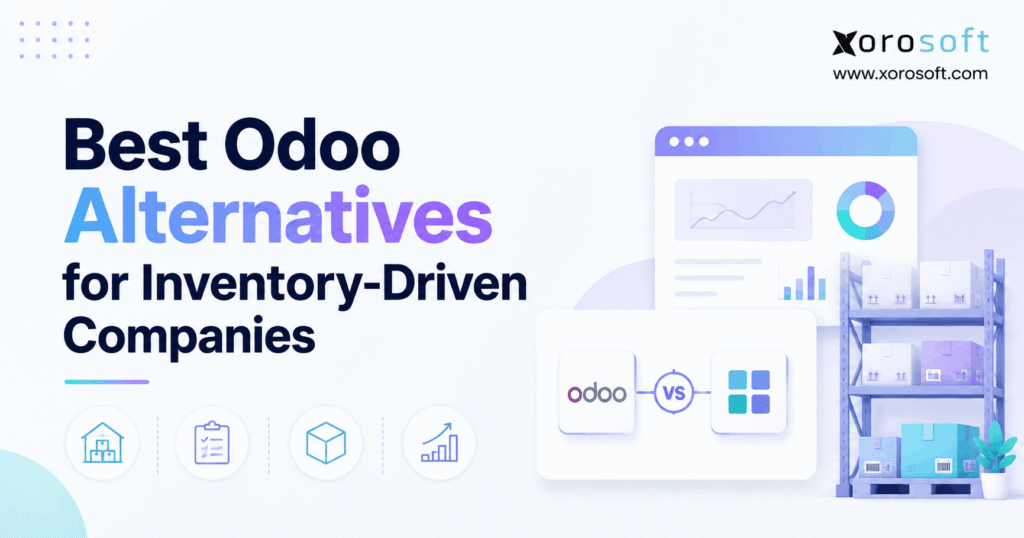
If you are searching for Odoo alternatives, this guide will help you compare your options.
1. Why Inventory Complexity Pushes Companies to Compare Odoo Alternatives
Inventory-driven businesses rarely experience ERP problems in isolation. Purchasing decisions influence future availability, warehouse mistakes affect customer service, manufacturing consumes raw materials, and returns change both stock and financial records. As a company adds Shopify, Amazon, wholesale accounts, EDI partners, manufacturing, or multiple warehouses, those dependencies become even more important.
For that reason, companies researching Odoo alternatives need to look beyond standard ERP feature lists.
Odoo already provides substantial functionality across inventory, purchasing, warehouse operations, manufacturing, accounting, and other areas. Therefore, the fact that another platform also offers inventory management does not make it a better choice.
Instead, the comparison should begin with a different question:
Which ERP best supports the way our business buys, stores, allocates, makes, sells, ships, and accounts for physical products?
For example, a Shopify apparel brand operating three warehouses will prioritize inventory synchronization, seasonal purchasing, fulfillment, and returns. By contrast, a manufacturer may care far more about bills of materials, material requirements, work orders, WIP, and production costing.
Likewise, a wholesale distributor that processes EDI orders needs different workflows from a smaller business primarily trying to strengthen inventory control around QuickBooks.
Consequently, the best Odoo alternatives are not necessarily the platforms with the longest module lists. The stronger choice is the system whose operating model matches the company’s highest-impact workflows with the least unnecessary complexity.
2. When ERP Replacement Becomes a Business Requirement
Replacing an ERP requires more than buying software. A company also needs to plan data migration, process changes, integrations, testing, user training, and operational ownership.
However, replacement becomes worth evaluating when workarounds move from occasional inconvenience to normal business practice.
2.1 Inventory Visibility No Longer Reflects What the Business Can Actually Sell
Inventory gets harder to understand as companies add products, variants, sales channels, warehouses, kits, serial numbers, lots, or production stages.
An on-hand figure alone cannot answer every operational question. Sales teams need to know what they can promise. Purchasing needs visibility into incoming stock. Warehouse managers need location-level information. Meanwhile, customer service needs realistic fulfillment expectations.
A modern inventory ERP should connect those perspectives.
For instance, 500 units may exist across the company, yet 200 could already be allocated, 150 may sit in a warehouse that cannot economically fulfill the order, and another 100 might be inbound next week. Therefore, the useful number is not simply physical stock. It is actionable availability.
When teams regularly export data to calculate that number manually, evaluating Odoo alternatives becomes reasonable.
2.2 Purchasing Still Depends on Spreadsheets
Purchasing frequently exposes disconnected data before other departments notice it.
A buyer may export sales history, add current inventory, review open purchase orders, estimate lead times, account for seasonal demand, and then calculate what to reorder. Although that process can work at smaller scale, it becomes increasingly fragile as the catalog and supplier network grow.
Strong ERP systems should bring demand and supply information closer together.
As a result, buyers can spend less time building the data required for a decision and more time reviewing the decision itself.
Good purchasing automation should also explain its logic. For example, planners need to know whether a suggested purchase comes from open sales orders, forecast demand, safety stock, supplier lead time, or a combination of factors.
Therefore, the goal is not blind automation. The goal is better purchasing judgment supported by reliable data.
2.3 Warehouse Operations Have Moved Outside the Core ERP
Multiple warehouses create physical complexity that basic location tracking cannot solve.
Receiving, putaway, bin management, scanning, transfers, replenishment, picking, packing, shipping, cycle counting, and returns all influence inventory accuracy. In addition, every warehouse employee makes operational decisions that can eventually affect customer service or accounting.
When those processes depend heavily on separate tools, spreadsheets, or paper, management often loses confidence in real-time inventory.
For that reason, companies comparing Odoo ERP alternatives should evaluate the warehouse experience directly.
The warehouse team should participate in demonstrations. After all, a process that looks simple from a conference room can become frustrating when employees repeat it hundreds of times during a shift.
2.4 Finance and Operations Spend Too Much Time Reconciling
Inventory has both physical and financial consequences.
Receiving creates stock and may create liabilities. Shipping reduces inventory and affects cost of goods sold. Manufacturing transfers value from raw materials into WIP and finished goods. Similarly, freight, landed cost, adjustments, and returns can change valuation.
If accounting consistently needs to explain why financial records and operational inventory disagree, the company may have more than a reporting problem.
In that situation, management should investigate whether configuration, integrations, data quality, or ERP architecture creates the disconnect.
Sometimes the company can improve its existing implementation. However, other businesses decide to investigate alternatives to Odoo that connect inventory and accounting differently.
3. What Odoo ERP Alternatives Must Deliver for Inventory-Driven Operations
ERP selection becomes more useful when requirements reflect business impact instead of feature count.
Rather than treating hundreds of capabilities equally, companies should identify the processes where errors create the greatest operational or financial consequences.
3.1 Inventory ERP Alternatives Need Real Availability, Not Just Stock Counts
Inventory visibility should explain where products are, what quantity remains available, what customers have already claimed, what supply is inbound, and where shortages may occur.
For a single-location business, this may remain manageable. However, multi-warehouse operations introduce allocation, transfers, lead times, warehouse capacity, and different fulfillment costs.
Therefore, vendor demonstrations should include shortage scenarios.
For example, imagine that Warehouse A has 25 units, Warehouse B has 80, another 100 units will arrive next week, and several sales channels are competing for the same supply. Ask every vendor how users determine available inventory, whether the system recommends a transfer, and how replenishment changes.
That workflow reveals far more than a dashboard.
3.2 Warehouse Management Should Match Physical Operations
A warehouse system needs to work for people moving products, not only managers reviewing reports.
Receivers should process incoming goods efficiently. Putaway logic should direct inventory appropriately. Pickers need clear tasks, while supervisors need trustworthy counts and exception visibility.
Moreover, the system should handle partial receipts, short picks, transfers, damaged stock, returns, and recounts without forcing users into complicated workarounds.
Companies with particularly demanding warehouse requirements can evaluate a dedicated environment such as XoroWMS alongside broader ERP platforms.
Ultimately, warehouse fit depends on how well software supports the company’s physical operating model.
3.3 Purchasing and Forecasting Must Connect Demand With Supply
Most companies do not struggle because they cannot create purchase orders.
Instead, the difficulty lies in deciding what to buy, when to order it, and how much inventory to carry.
A useful purchasing environment should bring together sales demand, available stock, incoming supply, supplier lead times, purchase commitments, and warehouse requirements.
Forecasting can strengthen those decisions. Nevertheless, forecasts should remain decision-support tools rather than unquestioned outputs.
Seasonality, promotions, new products, customer wins, supplier disruptions, and unusual orders can all make historical demand less predictive.
Therefore, strong inventory ERP alternatives should combine automation with enough transparency for planners to understand why the system recommends an action.
3.4 Accounting Should Follow Product Movement
Product transactions influence financial statements throughout the operating cycle.
Receipts increase inventory. Shipments move cost into cost of goods sold. Production changes the form and value of inventory. Meanwhile, freight, returns, and landed costs can materially affect product economics.
Businesses that want operational and financial data in one environment can evaluate systems such as XoroERP alongside NetSuite, Acumatica, Business Central, SAP Business One, ERPNext, and other integrated ERP platforms.
By contrast, another company may intentionally keep its accounting platform and connect it to specialized inventory software.
Both approaches can work. The right choice depends on the degree of financial and operational complexity the company wants one platform to control.
4. Best Odoo Alternatives at a Glance
Several credible Odoo alternatives serve inventory-driven companies. However, they approach the market from different starting points.
| Platform | Strongest Fit | Inventory | Financials | Warehouse | Manufacturing | Ecommerce |
|---|---|---|---|---|---|---|
| Xorosoft | Unified product operations | Yes | Integrated | Integrated | Available | Strong |
| NetSuite | Broad cloud ERP requirements | Yes | Integrated | Advanced | Yes | Available |
| Acumatica | Configurable mid-market operations | Yes | Integrated | Yes | Yes | Strong connectors |
| Business Central | Microsoft-oriented companies | Yes | Integrated | Yes | Yes | Shopify connector |
| Cin7 | Multichannel product businesses | Core focus | Available/integrated | Yes | Available | Core focus |
| Fishbowl | QuickBooks-centered operations | Core focus | External accounting | Yes | Yes | Integrations |
| Brightpearl | Retail and ecommerce | Yes | Available | Yes | Less manufacturing-focused | Core focus |
| SAP Business One | Established SMB ERP | Yes | Integrated | Yes | Production/MRP | Ecosystem dependent |
| ERPNext | Open-source ERP | Yes | Integrated | Yes | Yes | Integration dependent |
| Sage X3 | Manufacturing and distribution | Yes | Integrated | Supply-chain focused | Strong | Integration dependent |
The table should help companies build a shortlist rather than declare a winner. In practice, product capabilities vary by configuration, edition, implementation, partner, and integration architecture.
Therefore, every shortlisted platform should demonstrate the company’s actual workflows.
5. Comparing 10 Leading Odoo Competitors by Operational Fit
The strongest Odoo competitors differ less in whether they offer inventory and more in how they connect inventory with financials, warehouse execution, ecommerce, wholesale, and manufacturing.
5.1 Xorosoft for Unified Product Operations
XoroONE brings inventory, purchasing, warehouse management, accounting, manufacturing, forecasting, ecommerce, EDI, and B2B workflows into a unified cloud ERP environment.
This approach becomes particularly relevant when fragmentation creates more difficulty than any single missing feature.
For example, a growing product business may run Shopify, accounting software, a warehouse application, purchasing spreadsheets, an EDI service, and several connectors. Each tool may work reasonably well by itself. However, employees still spend time reconciling information across systems.
In that case, ERP selection becomes an architecture decision.
The business needs to decide whether specialized applications should remain connected or whether consolidation could reduce duplicate entry, integration failures, and reporting differences.
Xorosoft can fit inventory-driven businesses that want tighter connections between product operations and accounting. Still, buyers should test their own workflows, integrations, implementation expectations, and reporting needs before making a decision.
5.2 NetSuite for Broad Cloud ERP Requirements
NetSuite often appears on ERP shortlists when companies want broad financial and operational capabilities in a cloud environment.
The platform addresses inventory, financials, order management, procurement, warehouse operations, planning, and manufacturing. Consequently, NetSuite can make sense when the ERP project extends beyond inventory into larger organizational requirements.
However, buyers should evaluate the proposed NetSuite configuration rather than the brand alone.
Different modules, integrations, implementation partners, and customizations can create materially different experiences.
Companies comparing the platforms can also review Xorosoft vs. NetSuite as one vendor perspective. Afterward, they should validate both systems independently through demonstrations, customer references, and official product information.
5.3 Acumatica for Distribution and Configurable ERP
Acumatica offers cloud ERP functionality across distribution, manufacturing, inventory, financials, warehousing, and commerce.
As a result, the platform can fit mid-market product companies that need configurable workflows and a partner-driven implementation model.
Distributors should test receiving, transfers, purchasing, fulfillment, replenishment, and warehouse activity. Likewise, manufacturers should add production planning and material workflows to the evaluation.
Acumatica’s flexibility can provide room for business-specific requirements. At the same time, more flexibility creates more implementation decisions.
Therefore, partner experience and project governance deserve serious attention.
5.4 Business Central for Microsoft-Oriented Companies
Microsoft Dynamics 365 Business Central naturally appeals to organizations that already use Microsoft products across productivity, analytics, finance, or IT.
The platform supports financial management, purchasing, inventory, sales, warehouse processes, planning, and manufacturing. In addition, Microsoft offers Shopify connectivity for companies that want ecommerce information to flow into Business Central.
That surrounding ecosystem can simplify technology strategy for Microsoft-centered organizations.
Even so, buyers should distinguish standard Business Central functionality from extensions. Industry-specific features may come from partners or additional applications.
Consequently, the final implementation matters just as much as the base product.
5.5 Cin7 for Multichannel Product Sellers
Cin7 focuses heavily on inventory-driven businesses that sell through several channels.
The platform combines inventory, purchasing, warehouse processes, manufacturing capabilities, ecommerce connections, and related product operations.
Therefore, Cin7 can be particularly relevant when inventory synchronization across channels represents the main operational challenge.
Ecommerce brands and wholesalers should test order flows, replenishment, warehouse processes, stock allocation, and integration behavior.
On the other hand, businesses looking for a traditional broad financial ERP should compare Cin7’s financial architecture with integrated ERP platforms before deciding.
5.6 Fishbowl for QuickBooks-Centered Operations
Fishbowl takes a different approach from many Odoo alternatives because it can strengthen inventory, warehouse, purchasing, and manufacturing processes while allowing companies to keep QuickBooks.
That architecture can suit businesses that like their current accounting environment but have outgrown its inventory capabilities.
Moreover, limiting the scope of change may reduce organizational disruption.
However, companies that want accounting and operations inside one ERP should compare Fishbowl with integrated financial platforms.
The right choice depends on whether keeping QuickBooks represents a strategic preference or a temporary constraint.
5.7 Brightpearl for Retail and Ecommerce Operations
Brightpearl focuses primarily on retail and ecommerce operations.
Its operating model connects inventory, orders, purchasing, warehouse activity, fulfillment, and commerce integrations.
Consequently, retailers that manage several sales channels may find the platform particularly relevant.
Ecommerce companies should test returns, split shipments, warehouse routing, inventory synchronization, and channel-specific exceptions.
Manufacturers, however, may require deeper production functionality than a retail-focused platform typically prioritizes.
Therefore, Brightpearl makes the most sense when retail execution drives the ERP project.
5.8 SAP Business One for Established SMB Operations
SAP Business One provides an integrated ERP structure for small and midsized companies.
It brings together financials, purchasing, inventory, sales, production, and related operations.
As a result, organizations that prefer a traditional ERP model and established implementation ecosystem may include it on the shortlist.
Partner quality remains important, though. Buyers should evaluate industry experience, integration capabilities, local support, and the resources required to maintain the system.
A mature product alone does not guarantee a strong implementation.
5.9 ERPNext for Open-Source ERP Flexibility
ERPNext offers an open-source model across inventory, accounting, purchasing, warehousing, sales, manufacturing, and other ERP functions.
That approach can appeal to companies that want greater technical control.
For manufacturers, ERPNext can connect BOMs, work orders, materials, WIP, and finished goods. Meanwhile, technical teams can adapt the platform to specific requirements when they have the appropriate skills.
However, flexibility creates ownership responsibilities.
Before choosing ERPNext, the organization needs a clear plan for hosting, security, customization, integrations, updates, and support.
5.10 Sage X3 for Manufacturing and Distribution
Sage X3 targets product-heavy organizations with more involved manufacturing and distribution requirements.
The platform connects inventory, supply-chain activity, purchasing, manufacturing, sales, and financial operations.
Therefore, established manufacturers and distributors may value its operational depth.
Nevertheless, smaller businesses should avoid buying complexity they cannot use effectively.
A powerful system only creates value when the company has workflows that justify the additional depth and a team capable of supporting the implementation.
6. Choosing Odoo Alternatives for Shopify and Ecommerce Operations
Shopify businesses often reach ERP evaluation from the storefront backward.
The customer-facing experience may work well while the operational stack behind it becomes increasingly difficult to manage.
6.1 Shopify ERP Alternatives Must Do More Than Sync Orders
A useful Shopify ERP integration should account for products, variants, inventory, orders, fulfillment, returns, locations, customers, payments, and financial records.
A connector that imports orders but leaves inventory, refunds, or financial information disconnected may solve one task while creating new reconciliation work elsewhere.
Therefore, companies comparing Odoo alternatives for Shopify should map each record that needs to move between platforms.
They should also decide which system owns that data.
For example, the Xorosoft ERP listing in the Shopify App Store provides one example of an ERP connection designed for ecommerce and product operations.
More importantly, businesses should test exception scenarios. Cancellations, partial shipments, returns, inventory adjustments, and synchronization failures often reveal integration quality better than a perfect order.
6.2 Ecommerce Inventory Needs One Availability Model
Shopify may represent only one source of demand.
Many companies also sell through Amazon, wholesale accounts, marketplaces, physical stores, and sales representatives.
As a result, several channels can compete for the same inventory.
Strong ecommerce-focused Odoo ERP alternatives should help the organization create one consistent model for available-to-sell inventory.
Otherwise, each channel may independently promise stock that another channel has already consumed.
Consequently, allocation logic becomes increasingly important as channel complexity grows.
7. Wholesale and Multi-Warehouse ERP Alternatives
Wholesale distributors usually prioritize different workflows from pure ecommerce brands.
Customer-specific pricing, large orders, EDI, backorders, purchasing, allocation, freight, and multi-warehouse fulfillment may matter more than consumer-facing storefront functionality.
7.1 Distribution ERP Alternatives Need Strong Allocation and EDI Workflows
Wholesale demonstrations should use realistic customer scenarios.
For example, begin with contract pricing and an EDI purchase order. Then introduce limited inventory, change the order quantity, allocate available stock, fulfill from multiple warehouses, and finish with shipment confirmation and invoicing.
That sequence exposes workflow quality far better than a simple sales-order example.
Furthermore, buyers should pay close attention to exceptions.
EDI processes often look straightforward when everything works perfectly. However, shortages, changes, partial shipments, and trading-partner requirements reveal the true operational burden.
7.2 Multi-Warehouse Inventory Requires Shared Rules
A distributor constantly decides whether it should purchase, transfer, reserve, or fulfill stock from another warehouse.
When departments make those decisions independently, priorities can conflict.
Instead, the ERP should give purchasing, sales, warehouse, and customer-service teams a shared view of availability and demand.
Companies exploring vertical-specific ERP requirements can also review Xorosoft’s industry solutions across distribution, manufacturing, apparel, consumer products, and other inventory-driven sectors.
Ultimately, warehouse count matters less than how effectively the system coordinates decisions across those locations.
8. Manufacturing ERP Alternatives Beyond Basic Inventory
Manufacturing changes inventory from a buy-and-sell process into a transformation process.
Raw materials enter production, work in progress accumulates value, and finished goods eventually become available for sale.
Therefore, manufacturers need a deeper evaluation framework.
8.1 Manufacturing ERP Alternatives Must Connect BOMs and Materials
A meaningful manufacturing demonstration should start with a real bill of materials.
From there, the vendor should show material requirements, purchasing, production orders, work orders, raw-material consumption, WIP, finished-goods receipts, and costing.
The demonstration should also include shortages.
For example, if one component is unavailable, planners need to understand how that shortage affects production schedules and customer commitments.
Consequently, manufacturers comparing Odoo alternatives should avoid treating a basic assembly demo as evidence of complete production depth.
8.2 Production Complexity Should Determine ERP Depth
Not every manufacturer needs an advanced production system.
A company performing light assembly may only require basic BOMs and work orders. By contrast, another manufacturer may manage multi-level BOMs, constrained work centers, subcontracting, long production cycles, detailed traceability, or complex costing.
Those differences should narrow the shortlist.
The strongest manufacturing platform is not automatically the most complicated one. Instead, the right ERP should provide enough depth for current and foreseeable production requirements without creating unnecessary administrative burden.
9. Industry Fit Changes the ERP Shortlist
Industry does not automatically determine which ERP a company should buy. However, it does change which workflows deserve the highest weight.
9.1 Apparel and Consumer Brands Need Commerce-Centric ERP Capabilities
Apparel companies often manage size and color variants, seasonal purchasing, Shopify, wholesale orders, returns, and fast warehouse execution.
Likewise, sporting-goods and consumer-products businesses may operate across ecommerce, wholesale, marketplaces, and several fulfillment locations.
For these organizations, strong inventory ERP alternatives should support availability, replenishment, ecommerce, purchasing, fulfillment, and returns without excessive fragmentation.
A manufacturing-heavy system may be powerful, yet it may create unnecessary complexity if ecommerce operations drive most of the business.
Therefore, product-market fit matters at the ERP level as much as it does at the product level.
9.2 Wholesale and Industrial Distribution Prioritize Availability
Distributors frequently manage large catalogs, supplier relationships, customer pricing, EDI, backorders, freight, and multiple warehouses.
Inventory availability directly influences revenue because sales teams need accurate promise dates.
As a result, purchasing, allocation, transfers, B2B processes, warehouse execution, and reporting may deserve more weight than retail-commerce features.
The most suitable Odoo competitors for distribution will make those processes easy to coordinate across departments.
9.3 Manufacturers Need Production Depth
Manufacturing companies face another set of priorities.
Raw-material accuracy, BOMs, production planning, work orders, WIP, finished goods, costing, and traceability may determine operational performance.
Food and beverage companies can add shelf life, lot management, and production traceability to the list.
Consequently, an industry-focused ERP evaluation should weight workflows according to how the company actually creates value and where operational mistakes become expensive.
10. Odoo Alternatives vs. Inventory Software: Choose the Architecture First
Not every company searching for Odoo alternatives needs another full ERP.
In some cases, specialized inventory software can solve the problem with less disruption.
10.1 Specialized Inventory Software Can Be Enough
A dedicated inventory platform can work well when accounting remains stable, manufacturing stays limited, warehouse requirements are manageable, and integrations do not create significant overhead.
Fishbowl represents this type of approach because companies can strengthen inventory and manufacturing while retaining an accounting platform such as QuickBooks.
As a result, the organization limits the scope of change.
This model may suit a business whose main problem lies in operational inventory rather than system-wide fragmentation.
10.2 Full ERP Becomes More Valuable as Dependencies Grow
An integrated ERP becomes more compelling when one transaction affects several departments.
Consider a receiving discrepancy. It can change purchase-order status, warehouse availability, accounts payable, customer commitments, landed cost, and replenishment planning.
If separate applications manage those consequences, the organization depends heavily on integrations and reconciliation.
Therefore, some Odoo alternatives create value not because they offer more features, but because they reduce the number of systems interpreting the same transaction.
That distinction should influence architecture before the company evaluates individual vendors.
11. Common Mistakes When Comparing ERP Software Alternatives
ERP projects can go wrong during selection long before implementation begins.
Fortunately, a structured evaluation can prevent many common mistakes.
11.1 Feature Counts Hide Workflow Differences
Most credible ERP platforms offer inventory, purchasing, sales, and warehouse capabilities.
However, actual execution can vary significantly.
Ask each vendor to perform the same scenario. Then compare steps, exception handling, required integrations, manual intervention, and user experience.
A longer feature list does not automatically create a better operating system.
11.2 Warehouse Users Need a Voice in Selection
Office employees often dominate ERP demonstrations because dashboards and reports are easy to present.
Inventory-driven businesses should also involve the employees who receive, move, count, pick, pack, ship, and produce goods.
After all, small workflow inefficiencies can become significant when warehouse teams repeat them thousands of times.
Therefore, operational users should help score the ERP alternatives being considered.
11.3 Master Data Quality Can Undermine the New ERP
New software cannot repair poor data by itself.
Duplicate products, inconsistent units, incorrect supplier lead times, obsolete customers, inaccurate BOMs, and poorly maintained locations will follow the company into the new system unless teams clean them deliberately.
Consequently, data governance should begin before migration.
Companies evaluating Odoo alternatives should identify who owns product, vendor, customer, warehouse, and manufacturing master data before implementation begins.
11.4 License Price Does Not Equal Total Cost
ERP cost extends well beyond subscription fees.
Implementation, migration, integration work, customization, training, testing, internal project time, support, administration, and future modifications all contribute to total cost.
Therefore, companies should compare vendors over several years using consistent assumptions.
A low subscription price can become expensive when the system creates extensive manual work. Conversely, a sophisticated ERP may deliver poor value when the business pays for complexity it never uses.
12. How to Evaluate Odoo Alternatives Using Real Business Workflows
A strong evaluation makes vendors respond to the company’s operating reality.
Generic demonstrations rarely provide enough evidence for a major system decision.
12.1 Score Odoo ERP Alternatives by Business Impact
Begin with the workflows that create the greatest operational or financial consequences.
A distributor may prioritize inventory accuracy, purchasing, multi-warehouse fulfillment, allocation, EDI, and accounting. Meanwhile, an ecommerce business may rank Shopify connectivity, returns, inventory synchronization, warehouse execution, and forecasting higher.
Manufacturers will usually assign more weight to BOMs, materials, production planning, WIP, and costing.
Agreeing on priorities before demonstrations makes the evaluation more objective.
Moreover, it prevents one impressive but low-value feature from distorting the decision.
12.2 Give Every Odoo Alternative the Same Demo Scenario
Standardized demonstrations make vendor differences easier to identify.
For an ecommerce company, start when a Shopify order arrives. Then follow inventory allocation, warehouse picking, shipment, accounting, replenishment, purchase ordering, receiving, and updated availability.
A manufacturer can use a different script. Begin with customer demand, move through planning and purchasing, continue into production and WIP, and finish with completed inventory, fulfillment, and financial posting.
Every Odoo alternative should perform the same scenario.
As a result, stakeholders can compare workflows instead of comparing sales presentations.
12.3 Evaluate Implementation Alongside the ERP Software
ERP capability matters, but implementation determines how users experience that capability.
Ask who owns requirements, process design, configuration, migration, integrations, testing, training, and post-launch support.
Furthermore, determine how the organization will manage the system after go-live. Consider who will add another warehouse, how the team will connect a new marketplace, which person will update purchasing rules, and where responsibility will sit when management needs new reports.
Strong ownership after implementation often matters as much as functionality at launch.
13. Frequently Asked Questions About Odoo Alternatives
13.1 Which Odoo Alternatives Fit Inventory-Driven Businesses Best?
The best Odoo alternatives depend on operating requirements. NetSuite can suit companies seeking broad cloud ERP capabilities. Acumatica serves distribution and manufacturing use cases, while Business Central can work well for Microsoft-oriented businesses. Cin7 focuses heavily on product operations, and Xorosoft connects inventory, warehouse, purchasing, accounting, manufacturing, and commerce workflows in a unified environment.
13.2 Which ERP Systems Should Companies Compare With Odoo?
Common alternatives to Odoo include NetSuite, Acumatica, Business Central, Cin7, Fishbowl, Brightpearl, SAP Business One, ERPNext, Sage X3, and Xorosoft. However, companies should narrow the shortlist according to warehouse complexity, accounting requirements, ecommerce, manufacturing, EDI, implementation model, and company size.
13.3 Is Odoo Strong for Inventory Management?
Yes. Odoo provides meaningful inventory, warehouse, purchasing, and manufacturing functionality. However, a company should investigate Odoo alternatives when another system architecture better supports its broader workflows. Replacement should solve a measurable operational problem rather than simply provide different inventory screens.
13.4 Which Vendors Compete Most Often With Odoo?
The competitive set depends on the project. NetSuite, Acumatica, Business Central, SAP Business One, ERPNext, and Sage commonly appear in broader ERP evaluations. Meanwhile, Cin7, Fishbowl, Brightpearl, and other inventory-oriented products become more relevant when product operations drive the decision.
13.5 Which Odoo Alternatives Work Well With Shopify?
Several Odoo alternatives support Shopify through native or integrated workflows. Business Central offers Shopify connectivity, Cin7 focuses heavily on ecommerce integrations, and Xorosoft maintains an ERP listing in the Shopify App Store. Buyers should compare products, inventory, orders, fulfillment, returns, payments, multi-location behavior, and exception handling rather than relying on an integration checkbox.
13.6 Which ERP Platform Fits Manufacturers Best?
Manufacturers should rank ERP systems according to production depth. BOMs, material planning, WIP, work orders, scheduling, traceability, costing, and production reporting should guide the shortlist. Therefore, the strongest option depends on how complex the production environment is rather than the vendor’s overall market position.
13.7 What Should Wholesale Distributors Prioritize?
Wholesale distributors should prioritize inventory availability, purchasing, customer pricing, EDI, backorders, allocation, B2B ordering, forecasting, and multi-warehouse fulfillment. In addition, vendor demonstrations should include exceptions such as shortages and order changes because those scenarios often reveal workflow quality.
13.8 How Does NetSuite Compare With Odoo?
Both platforms support broad ERP workflows, although their ecosystems, implementation models, and commercial structures differ. NetSuite often enters evaluations where financial breadth and cloud ERP scale matter. Odoo offers a broad modular suite. Therefore, companies should compare total implementation requirements rather than relying on high-level product positioning.
13.9 When Does Acumatica Make Sense?
Acumatica can fit distributors, manufacturers, and product companies that want cloud ERP with inventory, warehousing, financials, and commerce connectivity. However, implementation-partner quality matters because configuration and industry experience can significantly influence the final system.
13.10 When Is Cin7 a Strong Fit?
Cin7 can make sense for multichannel product companies that need inventory visibility across ecommerce, wholesale, warehouses, and related applications. However, businesses should compare financial requirements and manufacturing depth carefully against broader Odoo ERP alternatives.
13.11 Can Fishbowl Replace a Full ERP?
Fishbowl can strengthen inventory, warehouse, purchasing, and manufacturing processes while companies retain accounting software such as QuickBooks. Therefore, it can fit businesses that want operational improvement without replacing finance. Organizations seeking one financial and operational database should compare integrated ERP platforms instead.
13.12 Is ERPNext a Strong Open-Source Alternative?
ERPNext gives companies an open-source ERP environment across inventory, accounting, purchasing, warehousing, sales, and manufacturing. Consequently, organizations with internal technical expertise may value the flexibility. However, they should develop a clear plan for hosting, upgrades, integrations, customization, security, and long-term support.
13.13 Can Odoo Manage Multiple Warehouses?
Yes. Odoo supports multi-warehouse operations and related inventory processes. Therefore, companies should not assume that switching to Odoo alternatives will automatically improve warehouse performance. The replacement needs to solve specific workflow, usability, integration, or scalability requirements that the existing implementation does not address effectively.
13.14 What Requirements Matter Most During ERP Selection?
Inventory-driven businesses should prioritize capabilities tied directly to customer service, working capital, productivity, and financial accuracy. These often include inventory availability, purchasing, warehouse execution, ecommerce, EDI, manufacturing, forecasting, accounting, reporting, integrations, and implementation support.
13.15 When Should a Company Replace Odoo?
Replacement becomes more reasonable when important workflows rely on recurring manual workarounds, disconnected systems, duplicate data entry, or extensive reconciliation. However, companies should first determine whether software, implementation, master data, or process design causes the problem.
13.16 Which Systems Handle Multi-Warehouse Operations Well?
Several ERP and inventory platforms support multiple warehouses. Nevertheless, buyers should compare transfers, bins, receiving, replenishment, allocation, picking, cycle counting, fulfillment routing, and location-level availability. Real operational scenarios provide more useful evidence than a simple claim of multi-location support.
13.17 Which Platforms Combine Inventory and Accounting?
NetSuite, Acumatica, Business Central, SAP Business One, ERPNext, Sage X3, Xorosoft, and other integrated ERP systems can connect inventory and financial processes. By contrast, some inventory products maintain accounting externally. The right architecture depends on whether the company wants one operational and financial environment.
13.18 What Does a Realistic ERP Budget Include?
A realistic budget includes software, implementation, migration, integrations, configuration, customization, training, testing, internal resources, support, and ongoing administration. Therefore, companies should compare Odoo alternatives over multiple years rather than focusing only on monthly or annual subscription costs.
13.19 How Long Does ERP Implementation Take?
No single implementation timeline applies to every company. Duration depends on data quality, number of locations, integrations, customization, manufacturing complexity, testing, user availability, and process change. Consequently, buyers should ask each vendor to explain the assumptions and resources behind its proposed project plan.
13.20 When Is Inventory Software Enough?
Specialized inventory software may be enough when accounting works well, warehouse requirements remain manageable, manufacturing stays limited, and integrations do not create significant friction. Full ERP becomes more attractive as inventory, purchasing, warehouses, manufacturing, ecommerce, and accounting become increasingly interdependent.
13.21 What Should Ecommerce Companies Prioritize?
Ecommerce companies should prioritize inventory availability, order synchronization, warehouse routing, returns, purchasing, forecasting, marketplace connectivity, 3PL workflows, and accounting. Moreover, integration depth matters more than the mere existence of a connector because incomplete synchronization can create overselling and reconciliation work.
13.22 What Data Should Move Into the New ERP?
Typical migration scope includes products, customers, vendors, warehouse locations, inventory balances, price lists, BOMs, open purchase orders, open sales orders, and financial opening balances. Historical data should move when the company needs it for operations, reporting, audits, or compliance.
13.23 When Does WMS Capability Become Essential?
WMS functionality becomes more important as order volume, warehouse locations, bin complexity, scanning requirements, and picking activity increase. Therefore, companies should evaluate receiving, putaway, replenishment, picking, packing, transfers, counting, and returns before deciding whether standard ERP inventory functionality is sufficient.
13.24 How Should Companies Score Odoo Alternatives Objectively?
Create weighted requirements before vendor demonstrations. Then give every platform the same scenarios and involve employees from warehouse, purchasing, finance, ecommerce, and manufacturing where relevant. Finally, compare integrations, implementation assumptions, and multi-year costs. This structure helps companies choose Odoo alternatives based on operational fit rather than presentation quality.
13.25 Who Should Keep Their Current Odoo Setup?
A company with reliable processes, accurate data, stable integrations, strong user adoption, and useful reporting may have little reason to switch. In that situation, improving the current configuration can create more value than replacing the entire ERP.
14. Strategic Takeaway: Choose the Right ERP Alternative for Your Next Growth Stage
The strongest ERP decision begins with the operating problem rather than the vendor list.
First, identify where the organization loses inventory accuracy, purchasing control, warehouse productivity, fulfillment reliability, reporting visibility, or financial confidence. Next, turn those issues into workflows that each shortlisted platform must demonstrate.
When inventory sits at the center of the company, give inventory, purchasing, warehouse execution, fulfillment, manufacturing, ecommerce, and accounting more weight than total module count.
For example, a Shopify-led business should test the entire lifecycle from order creation through allocation, fulfillment, returns, replenishment, purchasing, and financial posting. Meanwhile, wholesale companies need to examine EDI, customer pricing, allocation, backorders, and multi-warehouse execution. Manufacturers should make BOMs, material planning, work orders, WIP, costing, and production scheduling central to the evaluation.
As a result, the final shortlist may contain a broad enterprise ERP, a product-focused cloud platform, or specialized inventory software. That does not weaken the process. Instead, it shows that the business requirement drives the technology category.
For organizations comparing Odoo alternatives because they want a more unified operating environment, Xorosoft is one platform to evaluate alongside the other systems discussed here. XoroONE connects inventory, purchasing, warehouse management, accounting, manufacturing, forecasting, ecommerce, EDI, and related product operations.
However, the next step should not be another generic software presentation.
Ask each vendor to demonstrate the transactions, exceptions, channels, warehouses, and planning decisions your employees manage every day.
Companies that want to evaluate Xorosoft against those requirements can contact Xorosoft and use real inventory, purchasing, warehouse, manufacturing, Shopify, wholesale, accounting, and integration scenarios as the basis for the discussion.
Ultimately, the objective goes beyond finding a replacement for Odoo. The business needs an operating system that can support how it buys, moves, makes, sells, fulfills, and accounts for physical products as complexity grows.
Recent Posts
-
 ERP Landed Cost Module vs Spreadsheet Calculations for Importers
 -
 How to Build an Open-to-Buy Plan for an Omnichannel Brand
 -
 Cold Storage WMS for Food and Beverage Distribution
 -
 ERP Buying Statistics 2026: Evaluation, Implementation, and Adoption Risks
 -
 How a Distributor Reduced B2B Order Exceptions Without Restricting Sales