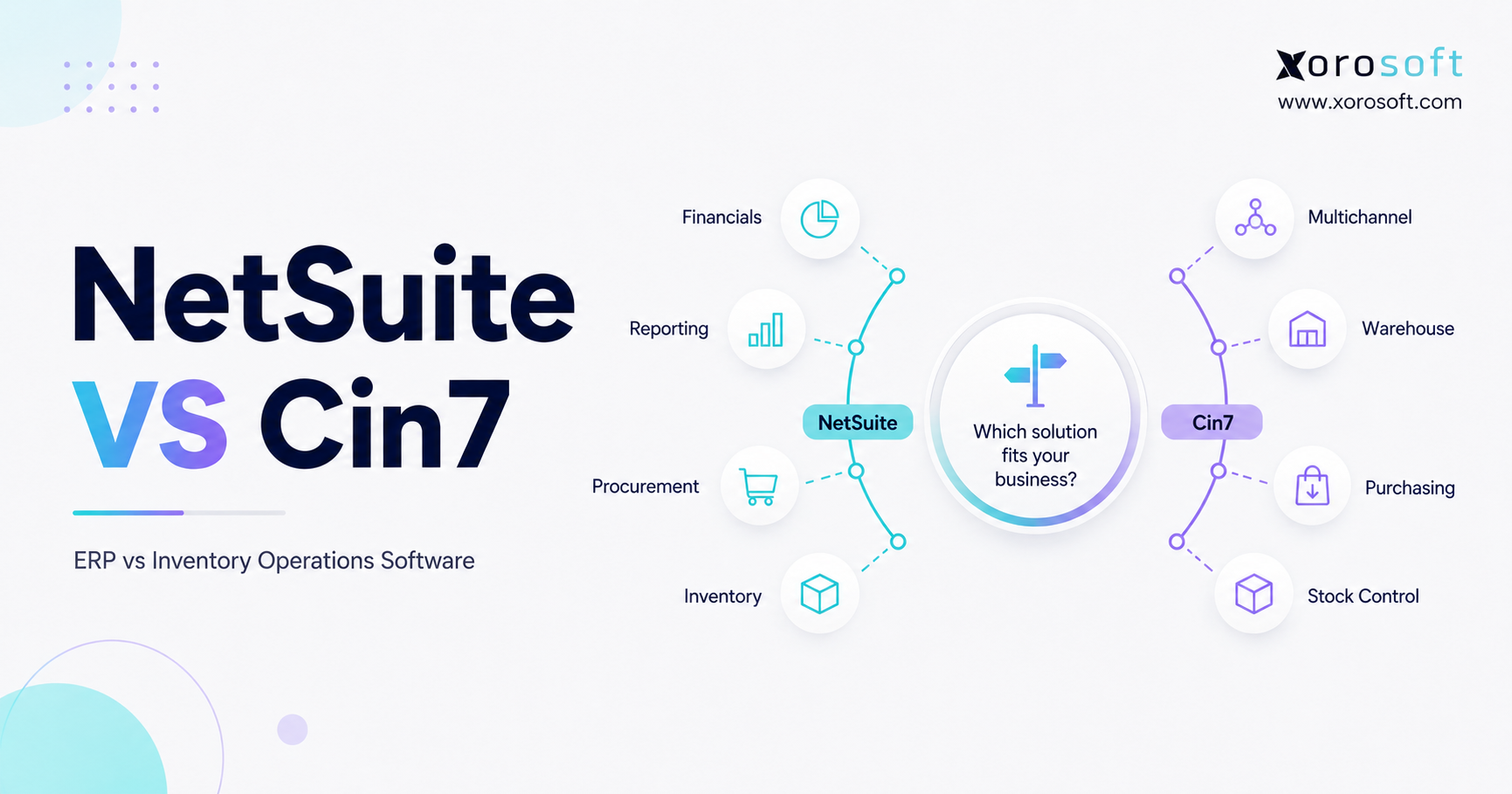
If you are trying to decide between NetSuite vs Cin7 for your business, this comparison will help clarify the differences.
1. The Real Question Behind the NetSuite vs Cin7 Comparison
NetSuite vs Cin7 is usually searched when a product-based business has outgrown simple inventory tools, accounting workarounds, spreadsheets, or disconnected ecommerce systems.
At first, the question looks simple. Which platform is better?
However, the real decision is deeper. A growing business is not only choosing software. It is choosing how inventory, accounting, purchasing, warehouse operations, ecommerce orders, wholesale workflows, and reporting will work together as the company scales.
Both platforms serve inventory-driven businesses, but they approach the problem differently. Buyers usually evaluate NetSuite as a broader ERP platform. Cin7 typically enters the conversation as inventory and product operations software with strong multichannel workflows.
That distinction matters because the wrong system can create the wrong kind of complexity. A business that only needs better stock visibility may not be ready for a heavy ERP rollout. Meanwhile, a company with inventory valuation problems, month-end delays, multi-warehouse complexity, and finance reporting issues may quickly outgrow inventory-only software.
So the better question is not “Which software has more features?”
The better question is:
Which system fits your current operating model, your team capacity, and the next stage of growth?
2. What NetSuite Means in the NetSuite vs Cin7 Comparison
NetSuite is a cloud ERP platform designed to connect core business functions inside one system. According to the official NetSuite ERP page, NetSuite supports workflows across accounting, orders, inventory, production, supply chain, and warehouse operations.
That makes NetSuite broader than a standalone inventory management system. It is often considered when businesses want finance, operations, purchasing, inventory, order management, warehouse activity, and reporting to work together.
2.1 NetSuite as a Cloud ERP Platform
NetSuite is usually evaluated by companies that need more than stock control.
For example, a business may need:
- General ledger and accounting
- Inventory valuation
- Purchasing workflows
- Multi-location stock visibility
- Warehouse operations
- Order management
- Manufacturing or production workflows
- Financial reporting
- Multi-entity or multi-subsidiary controls
Because of that, a NetSuite project often involves finance, operations, leadership, and IT. The decision affects how the business records transactions, closes the month, manages inventory value, controls approvals, and reports performance.
2.2 NetSuite’s Core Strengths in ERP Operations
NetSuite’s biggest strength is ERP breadth.
It can be a strong fit when a company needs accounting, procurement, inventory, warehouse management, supply chain processes, and reporting inside a single ERP environment. On the inventory side, NetSuite lists features such as multi-location fulfillment, replenishment, cycle counting, traceability, item visibility, and consignment inventory on its inventory management page.
That depth matters when inventory is not just an operational problem. Once inventory affects financial statements, purchasing commitments, warehouse execution, customer promises, and management reporting, ERP becomes more relevant.
2.3 Where NetSuite Usually Fits Best
NetSuite is usually a better fit for companies that need finance-led ERP structure.
It may make sense when a business has:
- Complex accounting requirements
- Multiple entities or subsidiaries
- Advanced reporting needs
- Formal approval workflows
- Large SKU counts
- Multi-location inventory
- More mature finance operations
- ERP implementation resources
However, that strength also creates responsibility. NetSuite can require detailed scoping, data cleanup, workflow design, user training, implementation partners, and ongoing administration.
3. What Cin7 Means in the NetSuite vs Cin7 Comparison
Cin7 is cloud-based inventory and product operations software. It is commonly evaluated by businesses that need stronger control over stock, orders, purchasing, warehouse workflows, ecommerce integrations, wholesale channels, EDI, and 3PL operations.
The official Cin7 website positions the platform around cloud-based inventory software, real-time visibility, and product operations.
3.1 Cin7 as Inventory and Product Operations Software
Cin7 often appeals to teams that want operational control without starting a full ERP transformation.
In many growing brands, the first pain points are not multi-entity accounting or enterprise reporting. Instead, the problems look like this:
- Shopify inventory is not accurate.
- Amazon orders are not syncing cleanly.
- Wholesale orders consume stock meant for ecommerce.
- Purchasing depends on spreadsheets.
- Warehouse teams pick from outdated information.
- Finance waits for inventory corrections.
- Reports require manual exports.
In that situation, Cin7 can feel more directly aligned with the day-to-day inventory and order problems the operations team is trying to fix.
3.2 Cin7’s Core Strengths in Inventory Operations
Cin7’s strength is inventory-first operations.
It can help businesses centralize product data, orders, stock visibility, purchasing, warehouse activity, and channel workflows. Cin7’s ecommerce inventory page mentions integrations and workflows across channels such as Shopify, Amazon, WooCommerce, ShipStation, and 3PL operations through its ecommerce inventory management resources.
For brands selling across multiple channels, that channel-first operating model can be valuable.
3.3 Where Cin7 Usually Fits Best
Cin7 usually fits businesses that need better inventory and order control before they need deeper ERP accounting.
It can be useful for:
- Ecommerce brands
- Shopify-led product businesses
- Amazon sellers
- Wholesale distributors
- Retail and omnichannel sellers
- Product businesses using 3PLs
- Companies with purchasing and warehouse pain
Still, companies should be careful. If the business already has serious accounting, inventory valuation, manufacturing costing, financial reporting, or month-end close issues, inventory software alone may not solve the full problem.
4. NetSuite vs Cin7 at a Glance
NetSuite vs Cin7 is best understood as an ERP depth vs inventory operations decision.
NetSuite usually fits companies that need a broader ERP system with deeper finance, accounting, controls, and enterprise structure. Cin7 usually fits companies that need stronger product operations, inventory visibility, ecommerce workflows, and order management.
4.1 NetSuite vs Cin7 Quick Comparison
| Category | NetSuite | Cin7 |
|---|---|---|
| Main category | Cloud ERP | Inventory and product operations software |
| Best fit | Companies needing broader ERP and finance depth | Product businesses needing inventory and order control |
| Accounting | Built into ERP workflows | Often connected through accounting integrations |
| Inventory | Strong ERP inventory capabilities | Strong inventory-first operational workflows |
| Warehouse | ERP and WMS capabilities | Warehouse operations support |
| Ecommerce | Supported through integrations and ecosystem | Strong ecommerce and marketplace orientation |
| Manufacturing | Better for broader ERP manufacturing needs | Better for lighter production and assembly workflows |
| Implementation | Usually broader and more complex | Usually more operations-focused |
| Main buyer | Finance, operations, IT, leadership | Operations, ecommerce, warehouse, purchasing |
4.2 NetSuite vs Cin7 Best Fit by Business Type
| Business Type | Better Fit | Why |
| Small ecommerce brand | Cin7 or inventory-first software | Lower ERP complexity |
| Shopify-led growth brand | Cin7 or modern ERP alternative | Inventory sync and fulfillment matter heavily |
| Wholesale distributor | Depends | EDI, pricing, accounting, and warehouse needs decide the fit |
| Multi-entity company | NetSuite | Stronger finance and entity structure |
| Manufacturer | NetSuite or inventory-focused ERP | BOMs, costing, materials, and planning matter |
| Business outgrowing QuickBooks | Depends | Needs may sit between inventory software and full ERP |
4.3 NetSuite and Cin7 by Operational Complexity
When inventory complexity is high but finance complexity is low, Cin7 may be enough.
Once inventory complexity and accounting complexity are both high, ERP becomes more important.
For example, a business with multiple warehouses, landed costs, wholesale pricing, purchase approvals, EDI workflows, manufacturing, and month-end reconciliation problems should not only evaluate inventory features. It should also evaluate how each system connects operations to finance.
4.4 A Practical Readiness Check Before Choosing
Before choosing between NetSuite and Cin7, ask five questions:
1. Is the main problem inventory visibility or accounting control?
2. Are purchasing decisions still managed in spreadsheets?
3. Does finance trust inventory valuation at month-end?
4. Are warehouse workflows creating fulfillment delays?
5. Will the business add more channels, warehouses, or product lines soon?
Answers pointing only to inventory and order flow may make Cin7 worth evaluating. Broader problems across accounting, purchasing, warehouse, manufacturing, and reporting usually make ERP a more serious consideration.
5. NetSuite vs Cin7 Feature-by-Feature Comparison
NetSuite vs Cin7 should not be judged by a feature checklist alone.
Many systems can claim inventory, orders, purchasing, reporting, and integrations. The real difference is how deeply those workflows connect and how much complexity the business is ready to manage.
5.1 NetSuite vs Cin7 for Inventory Management
Both platforms support inventory management, but the operating model is different.
NetSuite connects inventory to ERP workflows such as accounting, procurement, order management, warehouse operations, and reporting. That matters when inventory value affects the balance sheet, cost of goods sold, replenishment, and month-end close.
Cin7 focuses more directly on operational inventory visibility. It can be useful when the business needs to control stock across ecommerce, wholesale, retail, warehouses, and fulfillment partners.
5.1.1 Multi-Warehouse Visibility
Multi-warehouse visibility becomes critical when stock is spread across stores, warehouses, 3PLs, or regional fulfillment locations.
NetSuite may fit when multi-location inventory needs to connect with accounting, procurement, fulfillment rules, and financial reporting. Cin7 may fit when the main priority is operational stock visibility across sales channels and warehouse locations.
5.1.2 Replenishment and Purchasing
Purchasing is where inventory problems often become cash-flow problems.
A weak process leads to late reorders, overstock, supplier confusion, and emergency purchasing. NetSuite can support purchasing inside a broader ERP workflow. Cin7 can support purchasing as part of inventory and product operations.
The better option depends on whether purchasing is mainly an operations issue or a finance-controlled procurement issue.
5.1.3 Lot, Serial, Batch, and Traceability
Traceability matters for food, beverage, beauty, electronics, automotive parts, and other product categories where batches, lots, serial numbers, or recalls are important.
NetSuite may fit when traceability needs to connect with ERP-level costing, compliance, and reporting. Cin7 may fit when the main need is product-level traceability across inventory and fulfillment workflows.
5.2 Order Management in the NetSuite Cin7 Comparison
Order management is one of the most important areas in the NetSuite vs Cin7 decision.
NetSuite may fit when orders need to connect deeply with accounting, customer records, invoicing, inventory availability, fulfillment, and reporting. Cin7 may fit when the main issue is managing orders across ecommerce, wholesale, retail, and warehouse workflows.
5.2.1 Ecommerce Orders
For ecommerce orders, Cin7’s multichannel orientation can be useful. A Shopify brand selling across Amazon, retail, wholesale, and 3PLs often needs cleaner inventory sync and order routing before it needs a full ERP rollout.
NetSuite can also support ecommerce operations, but the implementation may involve more design around connectors, fulfillment rules, financial workflows, and reporting.
5.2.2 Wholesale Orders
Wholesale orders often require account-specific pricing, payment terms, allocation rules, backorders, EDI, and partial shipments.
Cin7 may fit when the main issue is order and inventory execution. NetSuite may fit when wholesale complexity also affects finance, margin reporting, procurement, and customer-level controls.
5.2.3 B2B Order Workflows
B2B workflows are rarely simple.
A customer may require different pricing, different shipping rules, different EDI documents, and different credit terms. Therefore, the system should not only capture the order. It should help the team control inventory allocation, shipment timing, invoicing, and reporting.
5.3 Warehouse Management: Cin7 vs NetSuite
Warehouse management is where operational errors become visible.
Late receiving creates inaccurate inventory. Manual picking leads to shipment errors. Inconsistent packing increases returns. Weak cycle counts make finance lose trust in the numbers.
NetSuite can support warehouse workflows within an ERP environment. Cin7 can support warehouse operations as part of inventory and product workflows.
For companies that need deeper warehouse execution, reviewing a dedicated WMS page such as XoroWMS can also help clarify what advanced warehouse workflows should include.
5.3.1 Receiving
Receiving affects stock availability, purchasing accuracy, supplier performance, and sales promises.
Incorrect receiving damages every downstream report. Ecommerce teams may sell stock that is not available. Purchasing teams may reorder too soon. Finance may value inventory incorrectly.
5.3.2 Picking and Packing
Picking and packing errors create refunds, reships, customer complaints, and margin loss.
Before choosing either system, businesses should evaluate barcode scanning, pick paths, packing validation, bin logic, order priority, and exception handling.
5.3.3 Shipping and Fulfillment
Shipping is not only label printing.
Growing businesses need to know which warehouse should ship, which carrier should be used, which inventory is available, and which orders are blocked. A strong system should connect fulfillment activity with inventory and order status.
5.4 Accounting and Finance in ERP vs Inventory Software
Accounting is one of the clearest differences between NetSuite and Cin7.
NetSuite is a full ERP system with accounting at the center. Cin7 is more often used with external accounting systems, depending on the business setup.
This difference is important. Inventory software may improve stock visibility, but it does not automatically fix financial reporting, month-end close, inventory valuation, or reconciliation issues.
5.4.1 Built-In Accounting
NetSuite may be stronger when a company wants accounting, inventory, purchasing, and reporting inside one ERP environment.
For businesses that need connected accounting workflows but want to evaluate inventory-focused ERP alternatives, XoroERP is also worth reviewing later in the selection process.
5.4.2 Inventory Valuation
Inventory valuation becomes harder as SKUs, warehouses, returns, landed costs, assemblies, bundles, and channels increase.
Once finance and operations disagree on inventory value, month-end close slows down. Even worse, leaders may make purchasing and margin decisions using unreliable data.
5.4.3 Month-End Close
A delayed month-end close often points to disconnected systems.
Finance may wait for warehouse adjustments, receiving corrections, purchasing accruals, shipment confirmations, or inventory valuation fixes. Reconciliation becomes manual when these workflows live in separate tools.
5.5 Purchasing and Supplier Management in NetSuite and Cin7
Purchasing mistakes are expensive because they usually show up late.
A team may discover too late that bestsellers are understocked. Another team may find that slow-moving SKUs have too much cash trapped in inventory. In both cases, the purchasing process failed to connect demand, lead time, and available stock.
Cin7 can help with inventory-driven purchasing workflows. NetSuite can support purchasing inside broader ERP procurement. The right fit depends on how much approval, costing, finance control, and supplier management the business needs.
5.6 Ecommerce and Marketplace Operations Compared
NetSuite vs Cin7 is a common comparison for ecommerce brands because Shopify, Amazon, wholesale, retail, and 3PL workflows often start to collide.
A Shopify brand may start with a simple app stack. Later, the business adds wholesale, Amazon, multiple warehouses, purchasing, manufacturing, and finance reporting. Suddenly, Shopify is no longer the entire operating system. It is one sales channel inside a larger operation.
For Shopify merchants evaluating ERP options, the Xorosoft ERP app on the Shopify App Store is a useful external reference point because it shows how ERP can connect ecommerce operations with inventory, orders, warehousing, purchasing, manufacturing, and financial workflows.
5.7 EDI and Wholesale Workflows in the NetSuite Cin7 Comparison
EDI should never be treated as a checkbox.
Wholesale customers and retailers may require purchase orders, acknowledgements, advance ship notices, invoices, labels, routing guides, and strict compliance workflows. If the system cannot support those requirements cleanly, the business may face chargebacks, shipment delays, or manual workarounds.
Cin7 can be relevant for product businesses with EDI needs. NetSuite may be relevant when EDI also needs deeper ERP and accounting connections.
5.8 Manufacturing and Production: NetSuite and Cin7 Compared
Manufacturing changes the inventory equation because stock changes form.
Raw materials become components. Components become finished goods. Labor, overhead, scrap, substitutions, and timing can all affect availability and cost.
Cin7 may fit lighter production, assembly, and component workflows. NetSuite may fit better when manufacturing requires deeper ERP controls, costing, planning, and financial reporting.
6. NetSuite vs Cin7 for Ecommerce Brands
NetSuite vs Cin7 matters for ecommerce brands because ecommerce operations rarely stay simple for long.
At first, the team may only need Shopify, QuickBooks, and a shipping app. Later, the brand adds Amazon, wholesale, retail, 3PLs, purchase orders, bundles, returns, forecasting, and multiple warehouses.
That is when the operational stack begins to strain.
6.1 Shopify-Led Ecommerce Businesses
Shopify-led businesses usually need accurate available-to-sell inventory.
When Shopify shows stock that the warehouse does not actually have, overselling happens. Poor demand visibility can also cause stockouts. Meanwhile, unreliable inventory value slows financial reporting.
Cin7 can work when the main problem is channel inventory and order control. NetSuite can work when Shopify operations need to connect with broader ERP accounting, procurement, warehouse, and reporting workflows.
6.2 Amazon and Marketplace Sellers
Amazon and marketplace sellers need inventory accuracy, fulfillment speed, reorder visibility, and margin control.
Cin7 may be useful when the key challenge is marketplace inventory sync and operational order flow. NetSuite may be useful when marketplace sales need to connect with accounting, procurement, warehouse operations, and financial reporting.
6.3 Multi-Channel DTC Brands
A multi-channel DTC brand may sell through Shopify, Amazon, wholesale, retail stores, pop-ups, and 3PLs.
The main risk is fragmented inventory. If every channel has a different stock number, the business loses control. A strong system should centralize inventory availability, order routing, fulfillment status, returns, and purchasing signals.
6.4 When Ecommerce Brands Outgrow Inventory Apps
Ecommerce brands usually outgrow inventory apps when the system no longer supports the full workflow.
The warning signs are usually easy to spot:
- Purchasing still happens in spreadsheets.
- Warehouse teams use manual workarounds.
- Finance performs manual inventory reconciliations.
- Shopify inventory does not match warehouse stock.
- Wholesale and DTC channels compete for the same units.
- Reports require exports from several systems.
At that point, the company should evaluate whether it needs better inventory software, a full ERP, or a more inventory-focused cloud ERP such as XoroONE.
7. NetSuite vs Cin7 for Wholesale Distribution
NetSuite vs Cin7 is also relevant for wholesale distributors because wholesale workflows carry different operational pressure.
A wholesale business must manage customer-specific pricing, credit terms, EDI requirements, allocations, purchasing, backorders, fulfillment rules, and account-level reporting.
7.1 Wholesale Inventory Control
Wholesale inventory is often promised before it ships.
That means available-to-sell inventory must account for open orders, allocations, backorders, inbound purchase orders, and reserved stock. If the system only shows simple on-hand inventory, sales teams may overpromise.
7.2 Customer-Specific Pricing
Wholesale customers often have unique price lists, payment terms, minimum order quantities, ship-to locations, case packs, and discount structures.
Before choosing any platform, companies should test how pricing rules work in real order scenarios. A system that looks fine in a demo may still require manual work if account-level rules are complex.
7.3 EDI and Retailer Requirements
Retailer compliance can affect margins.
Missed routing rules, incorrect labels, late ASNs, or invoice mismatches can lead to chargebacks. Therefore, distributors should map their exact EDI documents and retailer requirements before choosing NetSuite, Cin7, or any alternative.
7.4 Inventory Allocation Across Channels
Wholesale and ecommerce often compete for the same stock.
A wholesale order may reserve inventory that Shopify still shows as available. A DTC promotion may consume units that were expected for a key B2B customer. Without allocation rules, the business ends up making manual decisions under pressure.
8. NetSuite vs Cin7 for Manufacturing
NetSuite vs Cin7 becomes more complex when manufacturing is involved.
Manufacturing requires visibility into raw materials, components, finished goods, work orders, production timing, costing, and inventory availability.
8.1 Light Manufacturing Needs
Cin7 may fit businesses with lighter manufacturing or assembly needs.
For example, a company that builds kits, bundles, or simple finished goods from components may need BOM visibility and component availability without a heavy ERP manufacturing implementation.
8.2 BOM and Work Order Requirements
As BOMs become more complex, the system must track materials accurately.
If components are consumed incorrectly, finished goods inventory becomes unreliable. When work orders are not connected to purchasing, production may stop because materials are missing.
8.3 Raw Materials and Finished Goods
Manufacturers need visibility into both raw materials and finished goods.
A sales team may see finished goods demand, but production depends on component availability. If the system cannot connect those layers, the company may accept orders it cannot produce on time.
8.4 When Manufacturers Need ERP Instead of Inventory Software
Manufacturers usually need ERP when production affects accounting, costing, procurement, planning, and financial reporting.
If the business needs BOMs, work orders, inventory costing, material planning, and warehouse execution connected in one system, reviewing broader solutions pages can help clarify what an inventory-driven ERP should support.
9. NetSuite vs Cin7 Implementation, Cost, and Complexity
A software comparison is incomplete without implementation reality.
A system can have strong features and still fail if the project is poorly scoped. Another system can look simple at first but create problems if it cannot support future complexity.
9.1 NetSuite vs Cin7 Implementation Scope
NetSuite implementations are often broader because ERP affects finance, operations, purchasing, inventory, warehouse workflows, reporting, and sometimes manufacturing.
Cin7 implementations are usually more focused on inventory, orders, products, integrations, purchasing, and warehouse workflows.
Neither approach is automatically better. The right scope depends on business complexity.
9.2 Internal Team Requirements
NetSuite usually requires involvement from finance, operations, IT, leadership, and department owners.
Cin7 may require fewer stakeholders at first, but ecommerce, warehouse, purchasing, operations, and finance still need to be involved. If those teams do not align on workflows, the implementation can still create problems.
9.3 Data Migration
Data quality matters more than software choice.
Before migration, teams should clean:
- SKU records
- Units of measure
- Supplier data
- Customer records
- Warehouse locations
- Open orders
- Purchase orders
- Inventory balances
- BOMs
- Pricing rules
Bad data will damage NetSuite, Cin7, or any ERP alternative.
9.4 Customization and Configuration
NetSuite can support deeper customization and configuration, which can help complex companies but also increase implementation scope.
Cin7 may be faster to configure for operational workflows, but companies still need to validate whether standard workflows fit real processes.
9.5 NetSuite vs Cin7 Total Cost of Ownership
Total cost is not just subscription price.
Companies should consider:
- Licensing
- Implementation
- Consulting
- Data migration
- Integrations
- Customization
- Training
- Support
- Internal admin time
- Future system changes
Lower-cost software can become expensive if it forces manual work. Larger ERP projects can also become costly when the company overbuilds before it is ready.
9.6 See the Workflow Before You Decide
Before choosing any system, look at the complete workflow from order to inventory to warehouse to invoice to reporting.
A demo should not only show screens. It should show how the business will actually operate after implementation.
10. NetSuite vs Cin7 Pros and Cons
A fair NetSuite vs Cin7 comparison should show tradeoffs clearly.
Neither system should be treated as universally better. The right choice depends on operational maturity, finance needs, industry, budget, implementation capacity, and growth plans.
10.1 NetSuite Pros
NetSuite offers broad ERP functionality.
It can support accounting, inventory, purchasing, order management, warehouse management, supply chain workflows, reporting, and business controls. That makes it useful for companies that want one ERP environment across finance and operations.
10.2 NetSuite Cons
NetSuite can require a larger implementation effort.
For companies that mainly need inventory sync, warehouse workflows, and ecommerce order control, NetSuite may feel heavier than necessary. The project may require more budget, planning, consulting, and internal resources.
10.3 Cin7 Pros
Cin7 is strong for inventory and product operations.
It can help businesses manage stock, purchasing, orders, ecommerce integrations, warehouse workflows, EDI, 3PL connections, and multichannel operations. That makes it useful for product businesses that need operational visibility quickly.
10.4 Cin7 Cons
Cin7 may not replace full ERP functionality for companies that need deeper native accounting, financial controls, multi-entity reporting, advanced manufacturing, or more complete ERP governance.
If finance is already struggling with inventory valuation, reconciliations, and reporting, the business should evaluate whether inventory software alone is enough.
11. When NetSuite Is the Better Choice in a NetSuite vs Cin7 Decision
Choose NetSuite when ERP depth matters more than implementation simplicity.
11.1 NetSuite vs Cin7 for Full ERP and Finance Depth
NetSuite may be the stronger fit when accounting, procurement, inventory, order management, warehouse workflows, and reporting must work inside one ERP structure.
11.2 Multi-Entity Operations
If the business manages multiple subsidiaries, business units, legal entities, currencies, or consolidated reporting, NetSuite may fit better than inventory-first software.
11.3 Stronger Enterprise Controls
ERP controls matter when approvals, permissions, audit trails, reporting, and standardized processes become important.
A growing company with formal finance and operations governance may need more than a flexible inventory system.
11.4 Budget and Team Capacity
NetSuite is best suited for companies that can support a serious ERP project.
That includes executive sponsorship, process mapping, data cleanup, testing, training, and implementation ownership.
12. When Cin7 Is the Better Choice in a NetSuite vs Cin7 Decision
Choose Cin7 when the main issue is inventory and product operations.
12.1 NetSuite vs Cin7 for Inventory and Order Control
Cin7 may fit when the biggest problems are stock visibility, ecommerce sync, purchasing, warehouse workflows, order routing, and wholesale operations.
12.2 Operations-Focused System Needs
If accounting is staying in QuickBooks, Xero, or another finance system, Cin7 may provide the operational layer the business needs before full ERP.
12.3 Multiple Sales Channels
Cin7 is often relevant for businesses selling through ecommerce, wholesale, retail, marketplaces, and 3PLs.
The more channels a company adds, the more important centralized inventory and order visibility becomes.
12.4 Lower ERP Readiness
Some companies need stronger operations but are not ready for a larger ERP project.
In that case, Cin7 may be a practical step forward, as long as the company understands where its future ERP needs may appear.
13. When Neither Platform Is the Perfect Fit
Sometimes the real issue is not that NetSuite is wrong or Cin7 is wrong.
The business may simply sit between software categories.
13.1 When QuickBooks Plus Apps Become Fragile
Many product businesses grow through stacked tools.
Accounting may live in QuickBooks, ecommerce may run through Shopify, inventory may sit in a separate app, warehouse tasks may happen somewhere else, purchasing may depend on spreadsheets, and EDI may run outside the main system.
That stack can work temporarily. Eventually, however, it becomes fragile.
13.2 When Inventory Software Lacks Accounting Depth
Inventory software can improve stock visibility, but it may not solve deeper finance issues.
If finance still needs manual reconciliations, inventory valuation corrections, spreadsheet reports, and delayed month-end support, ERP may be necessary.
13.3 When ERP Feels Too Heavy
A large ERP implementation may feel excessive if the business mainly needs inventory, purchasing, warehouse, and ecommerce workflows.
Overbuying software can create complexity before the team is ready.
13.4 The NetSuite vs Cin7 Gap for Growing Product Businesses
This is where modern cloud ERP alternatives become relevant.
For businesses comparing NetSuite vs Cin7 because they have outgrown QuickBooks, spreadsheets, and disconnected systems, platforms such as XoroONE can be worth evaluating.
The goal is not to choose the biggest system. The goal is to choose a system that fits the business model.
14. NetSuite vs Cin7 vs Xorosoft
Businesses comparing NetSuite and Cin7 may also look at ERP alternatives built specifically for inventory-driven operations.
Xorosoft is a cloud ERP platform for companies that manage physical products, warehouses, purchasing, accounting, manufacturing, ecommerce operations, wholesale workflows, and reporting.
14.1 Why Inventory-Driven Businesses Compare Alternatives
A company may compare alternatives when NetSuite feels too broad and Cin7 feels too inventory-focused.
For example, the business may need:
- Inventory management
- Accounting
- Purchasing
- Warehouse management
- Manufacturing
- Forecasting
- Shopify operations
- Amazon workflows
- EDI
- Multi-warehouse visibility
That combination often requires more than a point solution.
14.2 How Xorosoft Fits the Decision
Xorosoft is relevant when a business wants ERP structure without managing a disconnected stack of inventory, warehouse, accounting, purchasing, ecommerce, and reporting tools.
Teams comparing options can review Compare Xorosoft for broader ERP comparison context. If the evaluation is specifically against NetSuite, the Xorosoft vs NetSuite page is the most relevant comparison. If the team is also looking beyond Cin7, the Xorosoft vs Cin7 page is the better fit.
14.3 Shopify, Wholesale, Warehouse, and Manufacturing Fit
For Shopify brands, Xorosoft can act as the operational layer behind the storefront.
For wholesale businesses, it can connect pricing, EDI, purchasing, inventory allocation, and fulfillment. For warehouse teams, <a href=”https://xorosoft.com/xorowms/”>XoroWMS helps show how receiving, picking, packing, and inventory control can work inside a connected system.
Manufacturers should evaluate fit based on BOMs, work orders, materials, finished goods, and production planning needs.
14.4 Where Proof and Industry Fit Matter
Software fit should always be validated with real use cases.
Before choosing a system, businesses should review case studies and check whether the vendor understands their industry. Xorosoft’s industries served page is useful for teams in apparel, furniture, sporting goods, food, wholesale, and manufacturing.
15. NetSuite vs Cin7 Decision Framework: How to Choose the Right System
The best way to choose is to evaluate the business by operational complexity.
15.1 Choose Based on Accounting Requirements
If accounting is simple and already working well, inventory software may be enough.
When inventory valuation, landed costs, reconciliations, month-end close, and financial reporting become painful, ERP should be considered.
15.2 Choose Based on Inventory Workflows
A company with one warehouse and simple SKUs has different needs than a company with multiple warehouses, wholesale allocations, kits, bundles, raw materials, finished goods, and serial tracking.
The more complex the inventory model becomes, the more important system structure becomes.
15.3 Choose Based on Warehouse Needs
If warehouse work is still manual, a strong WMS process matters.
Receiving, putaway, bin management, picking, packing, shipping, cycle counting, and barcode scanning should be evaluated before choosing the platform.
15.4 Choose Based on Ecommerce and Wholesale Channels
Shopify, Amazon, wholesale, EDI, and 3PL workflows all create different inventory pressures.
A system that works for ecommerce-only selling may not support wholesale complexity. A system that supports wholesale may still struggle with fast-moving DTC orders if integrations are weak.
15.5 Choose Based on Implementation Readiness
A larger system requires more planning.
Before choosing NetSuite, Cin7, Xorosoft, or another ERP alternative, confirm whether the team can support data cleanup, workflow mapping, user testing, training, and adoption.
16. FAQs About NetSuite vs Cin7
16.1 What is the main difference between NetSuite and Cin7?
The main difference is category and depth. NetSuite is a cloud ERP platform that covers accounting, inventory, orders, purchasing, warehouse operations, reporting, and broader business workflows. Cin7 is more focused on inventory management, product operations, ecommerce channels, order management, warehouse workflows, and wholesale operations. Therefore, NetSuite vs Cin7 is really an ERP vs inventory operations decision.
16.2 Is Cin7 an ERP system?
Most buyers should view Cin7 as inventory and product operations software rather than a traditional full ERP. It supports important workflows such as inventory, purchasing, ecommerce, warehouse activity, EDI, 3PL connections, and order management. However, companies that need deeper native accounting, multi-entity reporting, advanced finance controls, or full ERP governance may need a broader ERP platform.
16.3 Is NetSuite better than Cin7?
NetSuite is better when a business needs full ERP depth, accounting, financial controls, procurement, reporting, and broad operational structure. Cin7 may be better when the company mainly needs inventory control, ecommerce sync, warehouse workflows, purchasing, and order management. The better choice depends on business complexity, not brand recognition.
16.4 Is Cin7 better than NetSuite for inventory management?
For inventory-first operations, Cin7 may be a better fit for businesses selling across ecommerce, wholesale, marketplaces, and warehouses. NetSuite can be better when inventory needs to connect deeply with accounting, procurement, valuation, reporting, and ERP controls. The right answer depends on whether the company needs operational inventory speed or ERP-connected inventory depth.
16.5 Which is better for ecommerce brands, NetSuite or Cin7?
For ecommerce brands, Cin7 may be a strong fit when the priority is Shopify, Amazon, multichannel stock visibility, order routing, purchasing, and warehouse execution. NetSuite may be better when ecommerce operations must connect with accounting, procurement, financial reporting, and broader ERP controls. Ecommerce brands should evaluate channel complexity before choosing.
16.6 Which is better for Shopify businesses?
Shopify-focused teams may choose Cin7 when the primary issue is inventory sync and order control. NetSuite may fit when Shopify is one channel inside a larger ERP environment. A Shopify brand should also evaluate whether it needs accounting, purchasing, warehouse management, manufacturing, and reporting connected beyond Shopify.
16.7 Which is better for wholesale distribution?
Wholesale distributors should compare customer-specific pricing, EDI, purchasing, allocation, warehouse workflows, and accounting needs. Distributors focused on inventory and order operations may find Cin7 useful. NetSuite may fit when wholesale complexity also requires ERP accounting, financial reporting, procurement controls, and multi-entity visibility.
16.8 Which is better for manufacturing?
Manufacturing businesses may prefer NetSuite when they need deeper ERP controls, costing, work orders, financial reporting, and procurement. Cin7 may fit lighter manufacturing, assembly, kits, bundles, and component workflows. Manufacturers should evaluate BOM complexity, raw materials, WIP, labor, costing, and production planning before choosing.
16.9 Does NetSuite include accounting?
Yes. NetSuite includes accounting and financial management as part of its ERP platform. That is one reason companies compare it when they have outgrown QuickBooks or disconnected accounting workflows. NetSuite can connect accounting with inventory, procurement, order management, warehouse operations, and reporting.
16.10 Does Cin7 include accounting?
Usually, Cin7 focuses more on inventory and product operations. Many businesses connect Cin7 with accounting systems such as QuickBooks or Xero. That setup can work when accounting needs are manageable. However, businesses needing deeper native accounting and finance controls may need ERP software instead.
16.11 Can Cin7 replace QuickBooks?
Not by itself in most cases. Cin7 can improve inventory, purchasing, warehouse, ecommerce, and order workflows, while accounting may still remain in QuickBooks or another accounting platform. If the business wants to replace QuickBooks entirely, ERP should be evaluated.
16.12 Can NetSuite replace QuickBooks?
Yes, NetSuite is often evaluated by businesses that have outgrown QuickBooks. It can support more advanced accounting, inventory, purchasing, reporting, and operational controls. However, replacing QuickBooks with NetSuite is a major systems project that requires process mapping, data cleanup, implementation planning, and user training.
16.13 Which platform is easier to implement?
Implementation is usually more focused with Cin7 when the project is centered on inventory, products, orders, ecommerce integrations, and warehouse workflows. NetSuite is usually broader because it affects finance, accounting, procurement, reporting, and operations. Difficulty depends on business complexity, data quality, integrations, and internal readiness.
16.14 Which platform is more scalable?
Scalability depends on what the business needs to scale. NetSuite may be more scalable for businesses that need full ERP structure, multi-entity controls, accounting depth, and broad operational workflows. Cin7 may scale well for product businesses that mainly need inventory, ecommerce, warehouse, and order control.
16.15 Which platform is better for multi-warehouse inventory?
Multi-warehouse fit depends on how inventory connects to the rest of the business. Warehouse inventory often favors NetSuite when it must connect with accounting, procurement, fulfillment rules, and financial reporting. Cin7 may be better when the main need is operational stock visibility across warehouses, sales channels, and fulfillment partners.
16.16 Which platform is better for EDI?
EDI fit depends on the implementation and partner ecosystem. Both NetSuite and Cin7 can support EDI depending on the setup. Companies should map exact EDI documents before choosing, including purchase orders, acknowledgements, advance ship notices, invoices, labels, and retailer-specific compliance rules.
16.17 Which platform is better for Amazon sellers?
Amazon sellers may find Cin7 useful when they need inventory sync, order visibility, replenishment, and multichannel control. NetSuite may be better when Amazon workflows need to connect with accounting, procurement, warehouse execution, financial reporting, and broader ERP operations.
16.18 Which platform is better for purchasing automation?
Purchasing automation depends on whether the process is operational or finance-controlled. Cin7 may fit purchasing teams that need reorder visibility, supplier workflows, and demand-based inventory planning. NetSuite may fit when purchasing needs ERP procurement controls, approvals, accounting visibility, and financial reporting.
16.19 What are the main limitations of NetSuite?
The main limitation of NetSuite is usually complexity. Because it is a broad ERP platform, it can require more planning, implementation support, budget, process redesign, and training. For businesses that mainly need inventory and ecommerce workflows, NetSuite may feel heavier than necessary.
16.20 What are the main limitations of Cin7?
Cin7’s main limitation is that it may not replace a full ERP for companies needing deeper accounting, multi-entity reporting, advanced manufacturing, complex financial controls, or broader governance. It can be strong for product operations, but some businesses eventually need more ERP depth.
16.21 When should a business move from Cin7 to ERP?
Consider ERP when inventory operations are no longer the only issue. Warning signs include delayed month-end close, manual reconciliations, inventory valuation problems, manufacturing complexity, multi-entity reporting, and heavy dependence on spreadsheets outside the system.
16.22 When should a business consider a NetSuite alternative?
A business should consider a NetSuite alternative when it needs ERP capabilities but wants a system more closely aligned with inventory-driven operations, ecommerce, wholesale, warehouse management, purchasing, manufacturing, and faster usability. Alternatives may also make sense when implementation complexity or team fit is a concern.
16.23 What should companies compare before choosing NetSuite or Cin7?
Companies should compare inventory workflows, accounting needs, purchasing, warehouse operations, ecommerce channels, EDI, manufacturing, reporting, implementation scope, integrations, user adoption, and total cost of ownership. They should also identify whether the real problem is operational visibility, financial control, or disconnected systems.
16.24 Is there an alternative to both NetSuite and Cin7?
Yes. Businesses may also compare Acumatica, Brightpearl, Fishbowl, Sage, Business Central, Fulfil, and modern inventory-focused ERP platforms. Xorosoft is one option for inventory-driven businesses that need inventory, accounting, purchasing, warehouse management, manufacturing, forecasting, Shopify, Amazon, EDI, and multi-warehouse operations in one system.
16.25 How should growing brands choose between ERP and inventory software?
Growing brands should choose based on the root problem. If the issue is stock visibility, order routing, purchasing, and ecommerce sync, inventory software may be enough. If the issue includes accounting, inventory valuation, warehouse complexity, manufacturing, reporting, and disconnected workflows, ERP may be the better long-term decision.
17. Final Takeaway: Choosing the System That Matches Your Operating Model
The NetSuite vs Cin7 decision is not about choosing the biggest platform or the most familiar name. It is about choosing the system that matches how your business actually operates.
For companies that need full ERP depth, native accounting, financial controls, procurement, inventory, warehouse workflows, reporting, and multi-entity structure, NetSuite is usually the stronger fit.
Inventory-first teams may prefer Cin7 when ecommerce order control, purchasing visibility, warehouse coordination, wholesale workflows, and multichannel stock management matter most.
Some businesses, however, sit between these two options. They have outgrown QuickBooks, spreadsheets, and inventory apps, but they do not want a fragmented stack or a heavy ERP project that the team cannot manage.
Before making the final decision, map your workflows carefully. Look at inventory, accounting, purchasing, warehouse management, ecommerce, EDI, manufacturing, reporting, and implementation readiness. Then choose the platform that solves the real operating problem.
If your team is comparing systems because inventory, accounting, warehouse, ecommerce, and purchasing are no longer working cleanly together, Book a demo to see how a connected ERP workflow could support your next stage of growth.
Recent Posts
-
 ERP Landed Cost Module vs Spreadsheet Calculations for Importers
 -
 How to Build an Open-to-Buy Plan for an Omnichannel Brand
 -
 Cold Storage WMS for Food and Beverage Distribution
 -
 ERP Buying Statistics 2026: Evaluation, Implementation, and Adoption Risks
 -
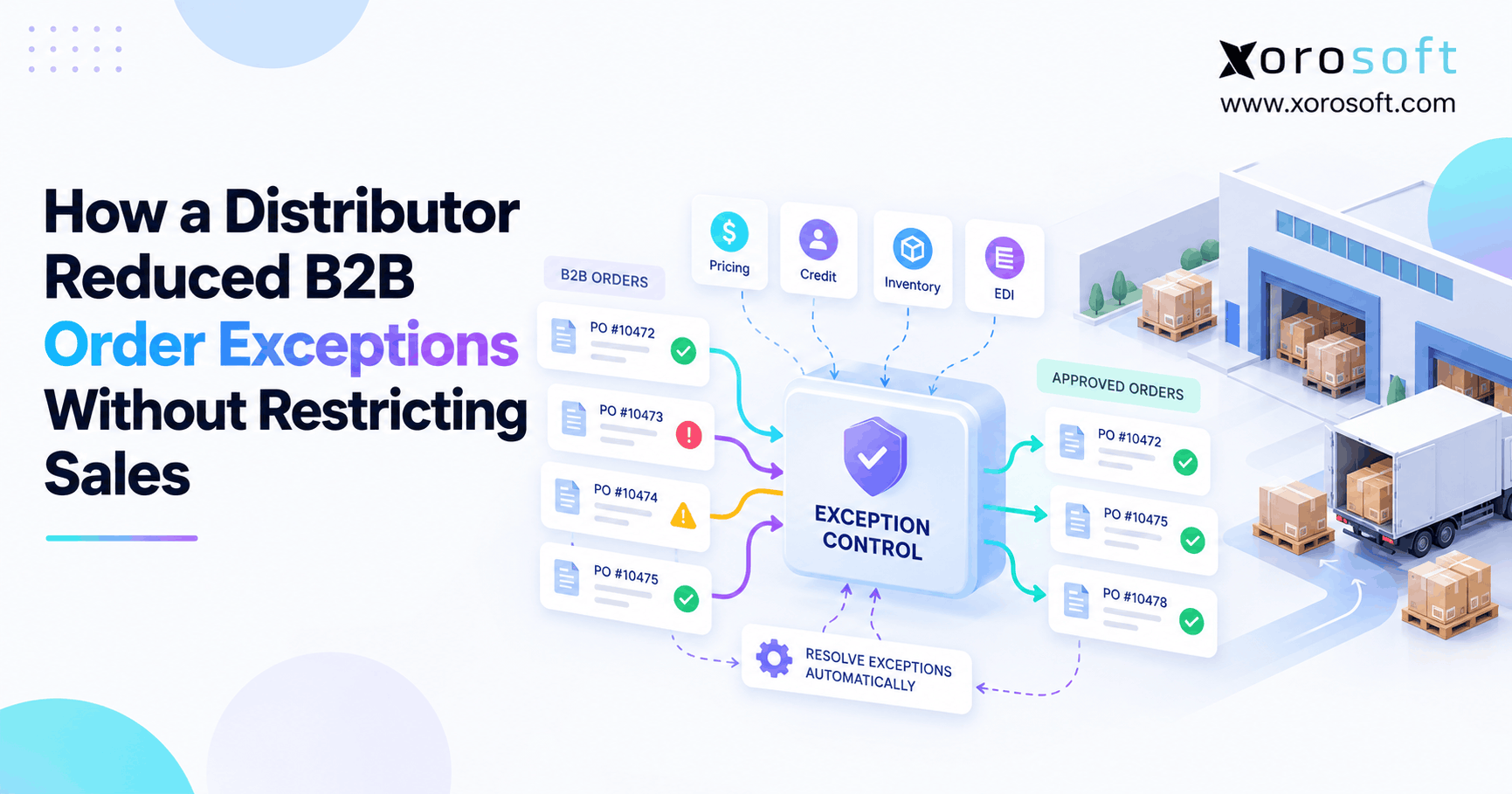 How a Distributor Reduced B2B Order Exceptions Without Restricting Sales