When working with suppliers, understanding MOQ and case pack rules is essential to ensure efficient ordering and inventory management.
1. MOQ and Case Pack Rules Change the Order, Not the Demand
The first principle is simple: MOQ and case pack rules should change the purchasing action, not the demand forecast. However, many planning processes blur those numbers together.
Therefore, buyers need to understand each stage before they trust a final recommendation.
1.1 Forecast Demand Answers What Customers May Need
First, a demand forecast estimates expected consumption during a future period. For example, a business may expect customers to purchase 500 units during the next 30 days.
However, a supplier MOQ should not change that forecast to 1,000 units simply because 1,000 is easier to buy.
Instead, the forecast should remain 500. Therefore, planners can still see the actual expected demand and measure forecast accuracy later.
Likewise, production demand should reflect real material requirements rather than supplier packaging restrictions.
1.2 Net Requirements Answer What Supply Is Missing
Next, the planning process considers inventory already available or expected to arrive.
For example:
| Planning Input | Units |
|---|---|
| Forecast demand | 500 |
| Safety stock target | 100 |
| Available inventory | 380 |
| Confirmed incoming supply | 147 |
| Net requirement | 73 |
Therefore, the business needs only 73 additional units under those assumptions.
However, the supplier has not yet influenced the quantity.
1.3 Supplier Rules Create the Executable Purchase Quantity
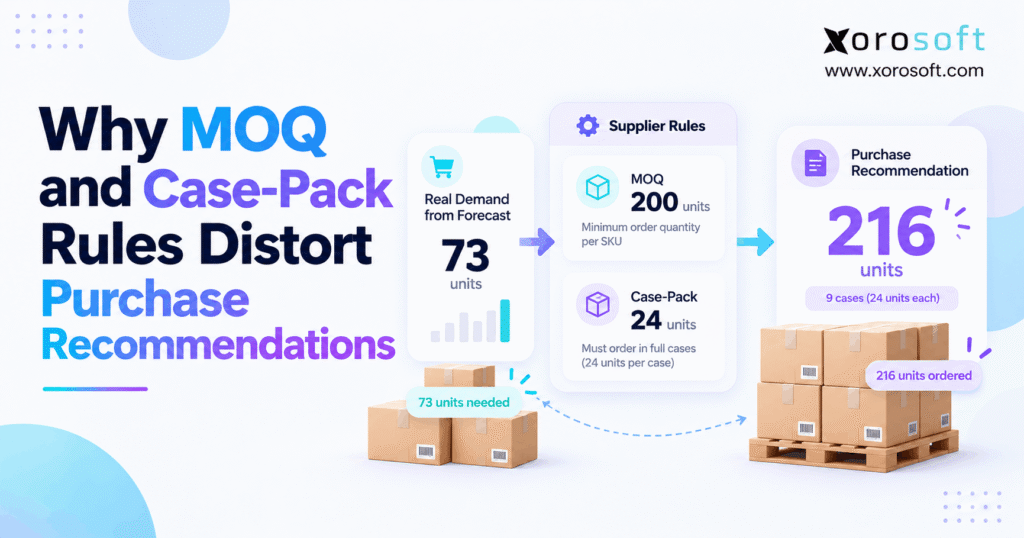
Finally, MOQ and case pack rules convert the 73-unit requirement into something the supplier will actually accept.
Suppose:
MOQ = 200 units
Case pack = 24 units
Therefore, 73 first increases to 200 because of MOQ.
However, 200 is not divisible by 24. Consequently, the quantity increases again to 216.
Oracle documents this same general planning concept through order modifiers such as minimum order quantity, fixed lot multipliers, and rounding. For example, Oracle shows that a requirement can be increased to meet a valid supplier or planning quantity.
2. How MOQ and Case Pack Rules Distort Purchase Recommendations
A purchasing recommendation can be mathematically valid and still create an undesirable business outcome. Therefore, buyers should identify which part of the recommendation came from real inventory requirements and which part came from supplier restrictions.
2.1 MOQ Creates a Minimum Purchasing Floor
A minimum order quantity establishes the smallest quantity a supplier accepts.
For example:
Net requirement = 60
Supplier MOQ = 250
Therefore, the system may recommend 250 units.
However, only 60 units came from the immediate inventory need. Consequently, MOQ creates 190 additional units.
That difference matters because the additional stock still consumes cash and warehouse capacity even though customers have not yet demanded it.
2.2 Case Pack Requirements Create Rounding
Case packs work differently.
For example, suppose a product must be purchased in cases of 12.
If the business needs 46 units, two valid quantities around that requirement are:
36
48
However, 36 does not satisfy the shortage. Therefore, the recommendation becomes 48.
Consequently, two additional units enter inventory because of packaging rather than demand.
2.3 MOQ and Case Pack Rules Can Compound
The effect becomes larger when MOQ and case pack rules apply together.
Consider:
Raw requirement = 73
MOQ = 200
Case pack = 24
First, MOQ increases 73 to 200.
Next, the case pack requires a valid multiple of 24.
Eight cases equal 192, which is below MOQ. However, nine cases equal 216.
Therefore:
Final purchase recommendation = 216
Consequently, supplier constraints account for 143 of those units.
3. Calculating Purchase Recommendations With MOQ and Case Pack Rules
A useful replenishment process should calculate the real requirement first. Then, MOQ and case pack rules should adjust the executable purchasing quantity.
Therefore, the buyer can understand both numbers rather than seeing only the final PO suggestion.
3.1 Start With the Net Inventory Requirement
A simplified calculation is:
Net Requirement = Forecast Demand + Safety Stock − Available Supply
However, available supply should include only inventory that can realistically serve demand during the required period.
Therefore, teams may need to consider:
- usable on-hand inventory
- confirmed incoming purchase orders
- transfers arriving on time
- production supply
- reserved or allocated inventory
- damaged or unavailable stock
Microsoft’s Business Central planning documentation similarly distinguishes projected inventory, projected available inventory, reorder points, safety stock, and incoming supply when planning replenishment.
3.2 Apply MOQ and Case Pack Rules in Sequence
Next, apply the supplier minimum.
A simple MOQ adjustment is:
MOQ-adjusted quantity = MAX(Net Requirement, MOQ)
Then, apply the case-pack multiple:
Final Order Quantity = CEILING(MOQ-adjusted quantity ÷ Case Pack) × Case Pack
Therefore, with:
Net requirement = 73
MOQ = 200
Case pack = 24
the calculation becomes:
CEILING(200 ÷ 24) × 24 = 216
Consequently, the valid order is 216 units.
3.3 The Calculation Should Still Allow Buyer Judgment
However, the formula should not automatically mean “buy now.”
For example, the company may have stock at another warehouse. Alternatively, another supplier may offer a smaller MOQ.
Likewise, the business may be able to wait two weeks and combine additional demand into the same order.
Therefore, MOQ and case pack rules should guide purchasing decisions without eliminating buyer judgment.
4. Supplier Data Determines Whether Purchase Recommendations Are Reliable
Even the best algorithm cannot correct inaccurate supplier data. Therefore, businesses need reliable purchasing master data before they automate replenishment.
4.1 Supplier-Specific Rules Matter
A SKU may have more than one supplier.
For example:
| Supplier | MOQ | Case Pack | Lead Time |
|---|---|---|---|
| Supplier A | 100 | 10 | 12 days |
| Supplier B | 250 | 25 | 7 days |
| Supplier C | 50 | 10 | 30 days |
Therefore, one global MOQ cannot accurately represent every purchasing option.
Instead, MOQ and case pack rules should ideally sit at the supplier-item relationship where appropriate.
4.2 Purchase Units and Inventory Units Must Match Correctly
Additionally, purchasing may use cases while inventory uses individual units.
Suppose:
Purchase UOM = case
Inventory UOM = each
Units per case = 24
Therefore, a purchase quantity of 10 cases equals 240 inventory units.
However, if the conversion is wrong, purchasing recommendations can be wrong by an entire packaging level.
Consequently, unit-of-measure data deserves the same attention as forecasting data.
4.3 Lead Times and Open Purchase Orders Matter Too
Meanwhile, MOQ is only one input.
A business may appear short today but already have 300 units arriving next week. Therefore, ignoring open purchase orders can create duplicate supply.
Likewise, incorrect supplier lead times can trigger purchases too early or too late.
As a result, MOQ and case pack rules work best when planning also understands open POs, realistic lead times, expected receipts, and inventory availability.
5. Why MOQ and Case Pack Rules Create Excess Inventory
Supplier constraints do not automatically mean a bad purchase. However, MOQ and case pack rules can produce excess inventory when the final buying quantity materially exceeds realistic future demand.
Therefore, teams need to measure the business effect rather than simply accepting the system output.
5.1 Extra Inventory Uses Working Capital
For example, suppose the business needs 80 units at $25 each.
True requirement value:
80 × $25 = $2,000
However, MOQ requires 400 units.
Purchase value:
400 × $25 = $10,000
Therefore, the supplier rule commits another $8,000 before the business needs those units.
Consequently, repeated MOQ exposure across hundreds of products can materially increase cash tied up in inventory.
5.2 Excess Inventory Also Uses Warehouse Capacity
Moreover, additional inventory needs somewhere to go.
Therefore, MOQ-driven stock may consume:
- reserve storage
- pallet positions
- pick locations
- receiving capacity
- put-away labor
- cycle-counting effort
However, the warehouse may not know that the excess resulted from purchasing constraints.
Consequently, purchasing and warehouse planning should share the same inventory context.
5.3 Aging Can Turn Purchasing Savings Into Margin Loss
Similarly, excess stock can age.
For example, apparel colors change, seasonal products lose relevance, food expires, and product versions get replaced.
Therefore, a lower supplier unit price does not always create a lower total cost.
Instead, buyers should compare unit savings with carrying cost, storage requirements, markdown risk, and possible write-offs.
6. When Buyers Should Override Purchase Recommendations
Automation helps buyers process more SKUs. However, automated purchasing should still expose situations where supplier rules create poor economic outcomes.
Therefore, buyers need clear alternatives.
6.1 Delay or Consolidate the Purchase
Suppose the business needs 70 units today while MOQ is 250.
However, forecast demand over the next three months is:
Month 1 = 70
Month 2 = 90
Month 3 = 110
Therefore, expected three-month demand equals 270 units.
In this case, buying 250 may make sense when viewed across the planning horizon.
Conversely, if expected three-month demand is only 100, delaying the order may be safer.
6.2 Consider Another Supplier
Alternatively, a second supplier may offer:
MOQ = 50
Higher unit cost = 6%
Lead time = 10 days shorter
Therefore, the cheapest unit cost may not produce the lowest inventory cost.
For growing businesses, XoroONE can help connect purchasing with inventory, forecasting, accounting, and warehouse workflows so buyers can evaluate the broader operational impact instead of reviewing supplier rules in isolation.
6.3 Transfer Stock Before Buying Again
Meanwhile, the required inventory may already exist somewhere else.
For example:
Warehouse A shortage = 80
Warehouse B excess = 130
Supplier MOQ = 500
Therefore, purchasing another 500 units may be unnecessary.
Instead, transferring 80 units could solve the shortage while avoiding another MOQ-driven purchase.
6.4 Record Overrides Instead of Hiding Them
Finally, buyers will sometimes override the recommendation.
However, an override should capture:
- original recommendation
- final quantity
- buyer
- date
- reason
- expected effect
Therefore, repeated overrides become useful planning data rather than undocumented spreadsheet changes.
7. MOQ and Case Pack Rules Across Inventory-Driven Industries
Although the calculation is similar, MOQ and case pack rules create different risks across industries. Therefore, buyers should evaluate supplier constraints in the context of product lifecycle, storage needs, and demand patterns.
7.1 Apparel and Fashion
For apparel, demand often exists at the color-size variant level.
However, suppliers may impose MOQ at the style or color level.
Therefore, strong demand for medium and large sizes can force a brand to buy slow-moving sizes as part of an assortment.
Consequently, a valid supplier order can still create excess variant inventory.
Businesses operating across product-heavy verticals can review Xorosoft’s industries served to see how inventory workflows differ across apparel, wholesale, furniture, consumer products, and manufacturing.
7.2 Wholesale and Ecommerce Operations
Meanwhile, distributors may manage thousands of SKUs with different supplier rules.
Therefore, MOQ and case pack rules can produce hundreds of small purchasing adjustments every week.
Additionally, ecommerce demand can move quickly across Shopify, marketplaces, wholesale channels, and physical locations.
Xorosoft supports connected ecommerce operations through its integrations. Moreover, Shopify merchants can review the Xorosoft listing on the Shopify App Store.
7.3 Food, Furniture, and Manufacturing
For food businesses, excess stock can create shelf-life risk.
Meanwhile, furniture businesses may face large storage costs because each extra unit occupies significant warehouse space.
Likewise, manufacturers may need 3,000 components for production while a supplier MOQ requires 5,000.
Therefore, MOQ and case pack rules should be evaluated against expiry, space, production requirements, and future demand rather than only supplier price.
8. Multi-Warehouse Planning Can Change the Purchase Recommendation
A location-level shortage does not always mean the business is short overall.
Therefore, purchasing should examine network inventory before creating another supplier PO.
8.1 Transfer Before You Reorder
Suppose:
East warehouse needs 120 units.
West warehouse has 200 excess units.
Supplier MOQ is 600.
Therefore, a system that evaluates only the East warehouse may recommend 600 units.
However, a network-aware process could recommend transferring 120 instead.
Consequently, multi-location visibility can prevent supplier constraints from creating unnecessary stock.
Xorosoft’s XoroWMS can support warehouse execution when businesses need inventory visibility and operational control across warehouse processes.
8.2 Centralized Planning Reduces Conflicting Decisions
Additionally, warehouses should not create independent purchase recommendations when inventory can move between locations.
Otherwise, one location may order another MOQ while another location holds surplus inventory.
Therefore, MOQ and case pack rules should be applied after planners understand the broader supply network whenever transfers are operationally realistic.
9. How ERP Should Handle MOQ and Case Pack Rules
A modern ERP should not simply display “Buy 216.”
Instead, it should explain how the business reached 216.
Therefore, MOQ and case pack rules need transparent planning logic.
9.1 Preserve Every Calculation Stage
A useful planning screen might show:
| Stage | Quantity | Explanation |
|---|---|---|
| Forecast requirement | 73 | Expected demand |
| Net requirement | 73 | Missing supply |
| MOQ adjustment | 200 | Supplier minimum |
| Case-pack adjustment | 216 | Valid multiple of 24 |
| Final recommendation | 216 | Executable order |
Therefore, buyers can immediately distinguish demand from constraint-driven inventory.
9.2 Connect Forecasting and Purchasing Without Mixing Them
Forecasting should answer:
What do we expect to need?
Purchasing should answer:
What should we actually order?
Therefore, the two processes should share operational data without becoming the same calculation.
For inventory-driven businesses, XoroERP can connect purchasing, inventory, accounting, warehouse operations, and other ERP workflows while keeping operational decisions in one system.
9.3 Connect Purchasing to Accounting
Moreover, a larger purchase affects finance.
For example, additional MOQ inventory can influence:
- inventory assets
- accounts payable
- cash requirements
- landed cost
- inventory valuation
- margin exposure
Therefore, MOQ and case pack rules are not simply procurement settings.
Instead, they can influence financial results after the PO is received.
9.4 Keep Supplier Rules Visible to Users
Finally, the system should explain which supplier rule changed a recommendation.
Therefore, buyers should be able to see whether the adjustment came from:
MOQ
case pack
order multiple
lead time
safety stock
open POs
warehouse demand
Consequently, explainable recommendations are easier to trust and easier to challenge when conditions change.
10. What to Evaluate in Purchasing and ERP Software
Once manual corrections become routine, the company should evaluate whether its purchasing system still fits operational complexity.
Therefore, software evaluation should focus on decision quality rather than feature count.
10.1 Check the Core Purchasing Data Model
First, determine whether the system supports:
- supplier-specific MOQ
- case-pack quantities
- order multiples
- purchase units of measure
- supplier lead times
- open POs
- multiple warehouses
- safety stock
- forecasts
- transfers
Additionally, ask whether MOQ and case pack rules can differ by supplier for the same SKU.
Xorosoft’s broader ERP solutions are designed around connected inventory-driven workflows rather than purchasing as a standalone activity.
10.2 Ask Whether Recommendations Are Explainable
Next, test a real SKU.
For example, give the system:
Demand = 73
MOQ = 200
Case pack = 24
Then ask why the final quantity is 216.
If the software cannot explain each adjustment, buyers may eventually stop trusting automated recommendations.
Therefore, explainability should be part of purchasing-software evaluation.
10.3 Know When Advanced Planning Is Unnecessary
However, not every business needs complex purchasing logic.
For example, a company may still manage effectively with simpler processes if it has:
few SKUs, one warehouse, no supplier minimums, limited purchasing activity, and predictable demand.
Therefore, advanced planning becomes valuable when operational complexity—not software marketing—creates the need.
11. Common Mistakes With MOQ and Case Pack Rules
Many purchasing problems are not caused by the rules themselves. Instead, they come from how companies configure or interpret MOQ and case pack rules.
11.1 Treating the Final PO Quantity as Demand
First, a 500-unit PO does not mean customers need 500 units.
For example, actual demand may equal 120 while MOQ creates the rest.
Therefore, feeding the full 500 back into demand history can distort future planning.
Instead, demand and purchasing constraints should remain separate.
11.2 Using One MOQ for Every Supplier
Similarly, a product may have different minimums across suppliers.
Therefore, a single SKU-level MOQ can produce incorrect recommendations.
Instead, companies should capture supplier-specific terms where their system supports them.
11.3 Allowing Supplier Data to Become Stale
Moreover, supplier terms change.
For example, MOQ may fall after volume grows, while packaging may change from 24 units to 20.
Therefore, stale supplier data can keep increasing orders long after the commercial requirement changed.
Consequently, buyers should periodically review planning parameters.
11.4 Automating Recommendations Without Building Trust
Finally, teams often automate before making the logic understandable.
However, buyers will ignore recommendations they cannot explain.
Therefore, MOQ and case pack rules should appear as visible adjustments rather than hidden calculations.
When users can follow the logic, they can manage exceptions without rebuilding every recommendation in Excel.
12. Turn Supplier Constraints Into Explainable Purchase Decisions
MOQ and case pack rules are necessary purchasing controls, but they should never hide the difference between real demand and supplier-driven inventory.
Therefore, the planning process should preserve a clear sequence:
Demand creates the requirement.
Inventory and incoming supply reduce it.
MOQ creates a minimum.
Case packs create valid buying increments.
Finally, the buyer decides whether purchasing remains the best action.
As a result, a recommendation for 216 units becomes understandable when the system shows that the business only needed 73 units and supplier constraints created the rest.
For teams that continually fix recommendations in spreadsheets, reconcile separate inventory systems, or struggle to explain inventory growth, connected planning becomes increasingly important.
Xorosoft brings inventory, purchasing, warehouse operations, accounting, forecasting, and related processes into a shared cloud ERP environment. Therefore, teams can evaluate purchasing decisions using more complete operational data rather than isolated calculations.
If your buyers spend too much time correcting purchasing recommendations manually, Book a Demo to see how Xorosoft can support a more connected purchasing process.
Frequently Asked Questions
What are MOQ and case pack rules?
MOQ sets the supplier’s minimum order, while case-pack rules define valid purchasing increments. Together, they can make purchase quantities higher than actual demand.
Why do MOQ and case pack rules increase purchase recommendations?
They increase recommendations when the required quantity falls below supplier minimums or does not match a valid case-pack multiple.
Should MOQ be included in demand forecasts?
No. MOQ is a purchasing constraint, while forecasts represent expected demand. Therefore, the two values should remain separate.
Can case-pack rules cause excess inventory?
Yes. Case-pack rounding can add units beyond immediate requirements, especially when slow-moving products have large packaging multiples.
Can different suppliers have different MOQs?
Yes. Suppliers can set different minimums, case packs, prices, and lead times for the same SKU.
Should buyers always accept automated purchase recommendations?
No. Buyers should also consider transfers, alternate suppliers, future demand, open POs, cash impact, and warehouse capacity.
How should ERP handle MOQ and case pack rules?
ERP should preserve raw demand, apply supplier constraints separately, explain every adjustment, and connect purchasing with inventory, warehouses, forecasting, and accounting.
Recent Posts
-
 ERP Landed Cost Module vs Spreadsheet Calculations for Importers
 -
 How to Build an Open-to-Buy Plan for an Omnichannel Brand
 -
 Cold Storage WMS for Food and Beverage Distribution
 -
 ERP Buying Statistics 2026: Evaluation, Implementation, and Adoption Risks
 -
 How a Distributor Reduced B2B Order Exceptions Without Restricting Sales