If you’re looking for information about GS1-128 labels, you’ve come to the right place.
1. Why GS1-128 Labels Need a Shared Digital Identity
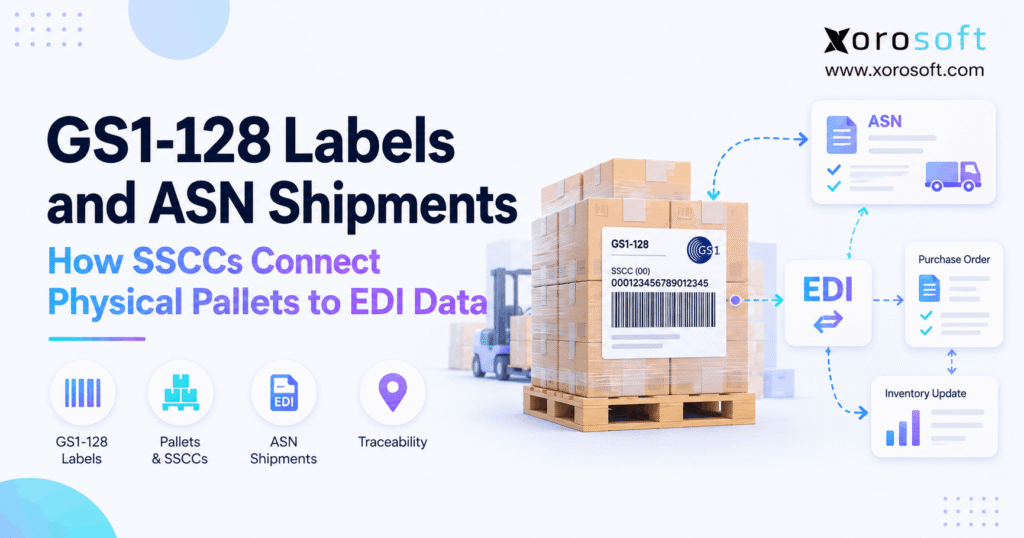
GS1-128 labels connect physical pallets and cartons with the electronic shipment information that describes them. However, the barcode alone does not create that connection. Instead, the Serial Shipping Container Code, or SSCC, gives each logistics unit a unique identity that warehouse, ERP, EDI, and receiving systems can share.
As a result, the physical pallet and its digital record can move through different systems while still referring to the same logistics unit. Therefore, receiving teams can identify incoming freight without relying only on paperwork, visual inspection, or manual data entry.
1.1 Why a physical pallet needs a digital record
An order begins as digital data. Eventually, however, that order becomes cartons, pallets, labels, and freight.
For example, an ERP may contain the customer order, while a WMS records what workers actually packed. Meanwhile, an EDI platform prepares the shipment message.
Therefore, the receiving company needs one reliable identifier that connects those systems with the physical unit arriving at the dock.
The SSCC provides that identifier. Consequently, it becomes the bridge between warehouse activity and electronic shipment information.
1.2 How GS1-128 Labels Solve the Lookup Problem
The complete connection involves three related elements.
First, the SSCC identifies the individual logistics unit. Next, GS1-128 labels carry that identifier in machine-readable form. Finally, the ASN communicates shipment information to the receiving company.
Therefore, these terms should not be treated as interchangeable.
Instead, each performs a different job. However, when the same SSCC remains connected across all three layers, warehouse and EDI systems can follow the same pallet from packing through receiving.
2. What GS1-128 Labels Actually Carry
GS1-128 labels use structured GS1 data rules so receiving systems can understand the meaning of scanned information.
For example, GS1 Application Identifier (00) tells the scanning system that the following field contains a Serial Shipping Container Code.
You can review the official GS1 Application Identifier reference for the standardized identifier definitions.
Therefore, GS1-128 is not simply a barcode containing arbitrary text. Instead, each encoded field follows a defined structure.
2.1 GS1-128 Labels vs Standard Code 128
Although both use Code 128 technology, GS1-128 labels apply additional GS1 data rules.
| Attribute | GS1-128 | Standard Code 128 |
|---|---|---|
| Data structure | GS1-defined | General purpose |
| Application Identifiers | Yes | Not inherently |
| SSCC support | Yes | Not as a GS1 structure by itself |
| Typical role | Supply-chain identification | General barcode use |
Therefore, a barcode may technically use Code 128 while still failing a customer’s GS1 labeling requirement.
In other words, the visual barcode format is only one part of compliance. The encoded data structure matters just as much.
2.2 Why Application Identifier 00 Matters
Application Identifier (00) tells the scanning system that the following 18-digit value represents an SSCC.
However, the two zeros are not part of the 18-digit SSCC itself. Instead, they identify the meaning of the following data field.
Therefore, label-generation systems must correctly handle both the identifier and its GS1 structure.
Otherwise, a number may appear correct to a person while the receiving application interprets the barcode incorrectly.
3. How an SSCC Identifies a Pallet or Carton
An SSCC is an 18-digit Serial Shipping Container Code used to identify an individual logistics unit.
Therefore, an SSCC does not identify the type of product inside the pallet. Instead, it identifies that specific pallet, carton, case, or other managed logistics unit.
For example, two pallets may contain exactly the same SKUs and quantities. Nevertheless, each pallet should receive a different SSCC because each one exists as a separate physical unit.
3.1 The SSCC Structure Behind GS1-128 Labels
The SSCC contains four main elements:
| Component | Purpose |
|---|---|
| Extension digit | Expands numbering capacity |
| GS1 Company Prefix | Connects the identifier to the assigning organization |
| Serial reference | Makes the logistics unit unique |
| Check digit | Helps validate the number |
Therefore, organizations should generate these identifiers systematically.
Moreover, manual pallet numbering creates unnecessary duplication risk. As a result, ERP or WMS numbering logic should normally control the process.
3.2 SSCC vs GTIN
A GTIN identifies a trade item or product type.
By contrast, an SSCC identifies an individual logistics unit.
For example, 20 pallets may contain the same GTIN. However, each pallet should still have its own SSCC.
Therefore, a SKU, UPC, GTIN, purchase order number, or internal description should not replace an SSCC when the logistics unit requires unique identification.
3.3 Why GS1-128 Labels Need Controlled SSCC Reuse
An SSCC should remain connected to its logistics unit throughout its useful lifecycle.
Moreover, businesses need controls that prevent identifiers from being reused too quickly.
Otherwise, a newly created pallet could accidentally use an identifier that still points to historical shipment information.
Consequently, automated receiving, traceability, and shipment investigation become more difficult.
Therefore, controlled SSCC generation is a data-governance requirement, not merely a label-printing preference.
4. How GS1-128 Labels Work With EDI 856 ASN
GS1-128 labels identify the physical logistics unit, while an Advance Ship Notice communicates electronic shipment information.
In X12 environments, businesses commonly use transaction set 856 Ship Notice/Manifest.
The official X12 transaction-set reference explains that the 856 can communicate shipment contents, packaging, order information, markings, carrier details, and shipment configuration.
Therefore, the label and ASN perform complementary roles.
4.1 Understanding the Shipment Hierarchy
Many 856 implementations represent several levels of shipment information.
For example:
Shipment → Order → Pallet → Carton → Item
However, not every trading partner uses exactly the same hierarchy.
Therefore, suppliers should follow each customer’s EDI implementation guide rather than assuming one universal 856 structure.
Meanwhile, warehouse operations must preserve the same relationships physically. Otherwise, electronic shipment data may stop matching what actually leaves the building.
4.2 Why ASN Timing Matters
An ASN should describe what the supplier actually ships.
For example, warehouse planners may initially expect three pallets. However, workers may consolidate the final shipment into two pallets.
Therefore, sending the ASN before packing is complete can create incorrect logistics-unit information.
Instead, businesses should build shipment data from confirmed warehouse activity whenever possible.
As a result, the ASN more closely represents the physical freight received by the customer.
5. How GS1-128 Labels Connect Pallets to ASN Data
The workflow becomes clearer when it follows the physical shipment.
First, the company receives the customer order. Next, inventory gets allocated and released for fulfillment.
Then, warehouse employees pick and pack the products.
After the handling unit exists, the system assigns an SSCC.
Consequently, the physical pallet and its digital packing record now share a unique identity.
5.1 Create the Physical Handling Unit First
The warehouse needs to know which products and quantities actually belong inside the carton or pallet.
Therefore, the handling-unit record should reflect real packing activity rather than only a shipping plan.
For example, a warehouse management system can support barcode-based receiving, inventory movements, picking, packing, and shipping processes.
As a result, the SSCC can remain closely connected to the physical handling unit created by warehouse employees.
5.2 Print GS1-128 Labels From Confirmed Packing
Once the handling unit exists, GS1-128 labels can be generated from confirmed data.
The barcode carries the SSCC using Application Identifier (00). Meanwhile, human-readable information helps employees troubleshoot the label when necessary.
The official GS1 Logistic Label Guideline explains how logistics units and SSCC information are represented.
Therefore, the SSCC becomes the shared physical-to-digital key instead of merely another number printed on the pallet.
5.3 Build the ASN From the Same Record
After packing is confirmed, the system can build the outbound ASN.
For example, the EDI message may contain shipment, order, product, quantity, carton, pallet, carrier, and other required information.
Meanwhile, the SSCC connects those electronic records with the physical handling unit.
Therefore, warehouse and EDI processes should use the same confirmed shipment data.
Otherwise, users may recreate pallet information manually and introduce mismatches.
5.4 Receive the Pallet by Scanning the SSCC
When freight arrives, the receiving team scans the pallet’s SSCC.
Next, the receiving system searches for the corresponding logistics-unit information.
Therefore, the operator can identify what the company expected before manually inspecting every carton.
Moreover, the scan can support receiving validation, routing, exception handling, and shipment investigation.
Consequently, the real value of the barcode comes from the record connected to it.
6. GS1-128 Labels in a Two-Pallet Example
Consider a wholesale distributor shipping 200 units to one retail customer.
Initially, the warehouse releases the order for fulfillment. Next, employees determine that the products require two pallets.
Suppose Pallet A holds 120 units while Pallet B contains 80 units.
Therefore, the warehouse creates two separate logistics units.
Each pallet should receive a separate SSCC because each pallet exists as an independent physical unit.
6.1 Assign Each Pallet a Separate SSCC
Pallet A receives one SSCC, while Pallet B receives another.
Meanwhile, the warehouse system records the products and quantities packed onto each pallet.
Consequently, the physical structure also exists as digital shipment data.
Next, the label engine prints one barcode label for each pallet.
Therefore, each physical logistics unit now has a unique identifier that receiving systems can scan.
6.2 How GS1-128 Labels Represent Both Pallets
The ASN can represent both logistics units under the same overall shipment.
For example:
| Shipment level | Example |
|---|---|
| Shipment | Shipment 10482 |
| Order | Customer PO 4500123456 |
| Pallet A | SSCC A – 120 units |
| Pallet B | SSCC B – 80 units |
Therefore, scanning Pallet A connects the receiver with its record.
Similarly, scanning Pallet B identifies the second physical logistics unit.
7. GS1-128 Labels at Pallet and Carton Level
Not every warehouse should apply GS1-128 labels at exactly the same packaging level.
For example, one trading partner may receive complete pallets. Meanwhile, another may require individually identified cartons.
Therefore, companies need to model the physical shipment structure required by each customer.
The correct approach depends on how the freight moves, how it gets received, and what the trading partner’s specifications require.
7.1 When GS1-128 Labels Work at Pallet Level
Pallet-level identification works well when the pallet remains a stable logistics unit throughout shipping and receiving.
However, the warehouse still needs accurate data about the products and quantities on that pallet.
Therefore, assigning one SSCC does not replace item-level information.
Instead, the SSCC becomes the key that connects the pallet with those detailed records.
Consequently, even a mixed-SKU pallet can use a pallet-level SSCC when the customer’s requirements allow it.
7.2 When Carton-Level Identification Matters
Some workflows require individually identified cartons.
In that case, the shipment may have nested relationships such as:
Pallet → Carton → Item
Therefore, warehouse software must preserve the relationship between the outer handling unit and the inner cartons.
If employees move cartons after the hierarchy has been finalized, the system should update the shipment structure.
Otherwise, physical freight and ASN information may no longer match.
8. GS1-128 Labels vs ASN Data Responsibilities
GS1-128 labels should not become substitutes for the full shipment database.
Instead, the physical label primarily identifies the logistics unit, while digital systems store richer shipment information.
| Information | Physical label | ASN |
|---|---|---|
| SSCC | Yes | Referenced when required |
| Purchase order | May appear | Common |
| SKU detail | Limited | Common |
| Quantity | Depends | Common |
| Carrier information | Limited | Common |
| Full shipment hierarchy | No | Yes |
Therefore, the label and ASN overlap where necessary without performing identical functions.
8.1 Data That Must Remain Synchronized
The SSCC is especially important because it links the physical unit with electronic shipment information.
Therefore, a mismatch between the printed SSCC and ASN handling-unit data can stop automated matching.
Likewise, quantities and pallet relationships should reflect the final shipment.
However, companies should still follow each customer’s requirements.
Consequently, the goal is not identical data everywhere. Instead, the goal is consistent data wherever the same business fact appears.
8.2 Keeping GS1-128 Label Data in the Right Systems
A barcode has limited physical space. Meanwhile, ERP, WMS, and EDI systems can store far richer shipment information.
Therefore, companies do not need to force every product, quantity, customer, routing, and carrier field onto GS1-128 labels.
Instead, they should use the SSCC as a dependable lookup key.
As a result, the warehouse can maintain detailed packing information while the EDI layer transmits what the trading partner requires.
9. Common GS1-128 Label and ASN Errors
Problems with GS1-128 labels often begin outside the barcode itself.
For example, the warehouse, ERP, label software, and EDI platform may each contain slightly different shipment information.
Therefore, troubleshooting should trace the complete process rather than examining only the printed barcode.
In practice, many failures come from duplicate data entry, premature ASN creation, uncontrolled label reprints, or incorrect handling-unit relationships.
9.1 GS1-128 Label and ASN Mismatch
One system may print SSCC A while another system transmits SSCC B.
Consequently, the physical pallet and electronic shipment no longer share the same identity.
When receiving scans the pallet, the expected match may fail.
Therefore, companies should establish one authoritative SSCC source.
Afterward, every downstream application should reuse that same identifier rather than generating its own alternative value.
9.2 Duplicate SSCC Assignment
Manual numbering creates unnecessary duplication risk.
However, the SSCC only works when it uniquely identifies the logistics unit.
Therefore, ERP or WMS logic should control the numbering process.
In addition, the system should enforce the organization’s SSCC reuse rules.
As a result, warehouse teams do not need to remember which numbers are safe to use.
9.3 Sending the ASN Too Early
Operations teams often want to transmit shipping information quickly.
However, early transmission creates risk if workers are still consolidating pallets, changing cartons, or resolving shortages.
Therefore, the ASN should use confirmed shipment information.
Consequently, the receiving company gets a more accurate representation of the physical freight.
9.4 Repacking After GS1-128 Labels Are Printed
Suppose employees move cartons from Pallet A to Pallet B after labels and electronic records are already finalized.
Then, the physical hierarchy can diverge from the electronic hierarchy.
Therefore, repacking needs a controlled update process.
Afterward, the system should refresh the relevant handling-unit and ASN information before shipment.
Otherwise, a valid barcode may still point to outdated packing data.
10. Which System Should Own the SSCC?
Several applications can technically generate an SSCC.
However, only one system should normally act as the authoritative source for the identifier assigned to the physical logistics unit.
Therefore, businesses should base ownership on the system that reliably knows when that handling unit exists.
The answer may differ depending on the company’s architecture.
10.1 ERP Ownership
An ERP system can own SSCC generation when it manages shipment creation and receives reliable final packing data.
For example, ERP may already manage the customer order, inventory allocation, shipment, accounting, and EDI-related records.
Therefore, ERP ownership can work well in a tightly integrated environment.
However, when a separate warehouse system controls the physical packing process, ERP still needs timely warehouse updates.
10.2 WMS Ownership for GS1-128 Labels
A WMS often sits closer to the physical packing event.
Therefore, it can generate or request the SSCC when the carton or pallet becomes final.
Additionally, barcode scanning can verify which items and quantities belong inside the logistics unit.
As a result, GS1-128 labels can be created from actual warehouse events instead of predicted packing information.
This approach is especially useful when workers frequently split, consolidate, or repack shipments.
10.3 EDI and Label Software Responsibilities
EDI software primarily transforms and transmits business documents.
Similarly, label software primarily renders and prints approved formats.
However, either system may generate identifiers in some architectures.
Therefore, if the EDI or labeling application creates the SSCC, businesses must synchronize that identifier back to ERP and warehouse records.
Otherwise, separate systems may begin maintaining separate shipment identities.
11. Why Integrated ERP, WMS, and EDI Workflows Matter
Disconnected applications can each work correctly while the total shipment process still fails.
For example, ERP can hold the right order while the warehouse packs the right products. Meanwhile, the label software may print a technically valid barcode.
However, the final ASN can still contain the wrong pallet structure if someone manually recreates packing information elsewhere.
Therefore, integration should focus on shared operational facts.
11.1 The Disconnected Workflow
A fragmented process might look like:
ERP → spreadsheet → warehouse → label system → EDI portal → manual shipment update
Each handoff introduces another opportunity for the data to change.
Therefore, employees may enter quantities, pallet IDs, customer references, and shipping details several times.
As a result, troubleshooting becomes difficult because several applications claim to hold the final shipment record.
11.2 A Connected GS1-128 Labels Workflow
A connected process follows actual warehouse events:
Order → allocation → pick → pack → SSCC → label → ASN → shipment
Therefore, downstream information comes from confirmed activity.
In addition, Xorosoft integrations can support connections between operational systems and ecommerce or business applications.
Consequently, companies can reduce repeated entry of shipment, inventory, customer, and warehouse data.
11.3 Where Xorosoft Fits
Xorosoft combines inventory, warehouse management, purchasing, accounting, order management, manufacturing, reporting, and ecommerce operations in a connected cloud environment.
Therefore, the platform becomes relevant when businesses have outgrown disconnected operational tools.
For example, XoroONE can support businesses that need warehouse activity, inventory, purchasing, accounting, and multi-channel orders to operate from a broader shared system.
The goal is not merely fewer applications. Instead, the goal is fewer conflicting versions of the same shipment.
12. GS1-128 Labels for Shopify and Wholesale Operations
Growing ecommerce brands often add wholesale, retail, marketplace, or distributor channels.
Consequently, a company that originally shipped only direct-to-consumer parcels may eventually need GS1-128 labels, SSCCs, retailer-specific ASN structures, and EDI workflows.
Therefore, warehouse complexity changes as the channel mix expands.
Inventory and fulfillment processes must support both ecommerce and B2B requirements without creating separate inventory truths.
12.1 Shopify Plus Wholesale Complexity
A Shopify order may follow one fulfillment process, while an EDI wholesale order follows another.
However, both channels may consume the same physical inventory.
Therefore, inventory availability, allocation, and warehouse execution need consistent data.
Businesses evaluating the ecommerce side can also review the Xorosoft ERP listing on the Shopify App Store.
Meanwhile, wholesale workflows still need customer-specific labeling and ASN rules.
12.2 Multi-Warehouse Consistency
Multiple warehouses create another challenge.
For example, one order may ship from California while another ships from Ontario.
Therefore, every location needs consistent SSCC generation, customer rules, barcode processes, and EDI data.
In addition, companies serving several operational models can review the industries Xorosoft supports when evaluating whether warehouse and ERP processes need broader standardization.
13. How to Build a Reliable GS1-128 Labels Process
A reliable GS1-128 labels workflow starts with ownership and process control.
First, decide which system owns the logistics unit and SSCC.
Next, define when the label can print.
Then, define when the ASN becomes final.
Finally, ensure downstream systems consume confirmed shipment information instead of rebuilding it manually.
Therefore, process design should come before additional automation.
13.1 Control Master Data First
Customer identifiers, ship-to locations, item mappings, units of measure, and packaging rules must be accurate.
Otherwise, a perfect SSCC cannot repair incorrect shipment data.
Therefore, validate master data before automating barcode or EDI workflows.
In addition, trading-partner requirements should be stored systematically.
As a result, warehouse employees do not need to rely on memory when different customers require different shipment structures.
13.2 Test GS1-128 Labels in Real Packing Scenarios
Perfect test orders are not enough.
Therefore, test GS1-128 labels across realistic warehouse exceptions.
For example, include one pallet, multiple pallets, mixed SKUs, partial shipments, shortages, carton moves, label reprints, and repacking.
Moreover, confirm that each warehouse change updates the corresponding digital handling-unit data.
As a result, implementation teams can identify weak system handoffs before production volume exposes them.
13.3 Monitor Exceptions After Go-Live
Successful testing does not eliminate future errors.
Therefore, monitor rejected ASNs, duplicate identifiers, failed barcode scans, quantity differences, and manual overrides.
Next, trace each exception back to the event that created it.
Consequently, teams can correct the root workflow instead of repeatedly fixing the final EDI document.
Over time, this approach also helps separate isolated user mistakes from structural integration problems.
14. When Standalone Label Software Is No Longer Enough
Standalone label software can work well in a simple environment.
For example, a small supplier may serve one customer, ship from one warehouse, and follow stable packing requirements.
Therefore, that company may not need broader operational software simply because it prints barcode labels.
However, the decision changes as shipment volume, warehouse count, customer requirements, and channel complexity increase.
14.1 Signs the Problem Has Become Operational
A business should reassess its architecture when employees repeatedly re-enter the same shipment information.
Likewise, frequent mismatches between warehouse packing and EDI records indicate a wider process problem.
Therefore, leaders should look beyond the label printer.
Instead, they should ask which application owns the shipment from order release through packing, ASN generation, inventory reduction, and accounting.
That question often exposes the real integration gap.
14.2 Evaluate Ownership Before Upgrading
Start by mapping every handoff.
Specifically, identify who receives the order, allocates stock, packs inventory, creates the SSCC, prints the label, builds the ASN, confirms shipment, and updates accounting.
Then, mark every step where data is copied manually.
Consequently, the highest-risk gaps become easier to see.
Businesses that reach this stage can review Xorosoft’s broader ERP and operational solutions before deciding whether a connected platform fits their requirements.
15. Keep GS1-128 Labels and ASN Data Aligned
GS1-128 labels work best when businesses treat them as part of one connected operational flow.
First, the warehouse creates the physical handling unit. Next, the business assigns the SSCC. Then, the label and electronic shipment record use that same identity.
Consequently, receiving teams can connect a scanned pallet or carton with information that arrived electronically.
However, that process only works when ERP, WMS, labeling, and EDI data remain synchronized.
Therefore, growing businesses should focus less on printing another barcode and more on maintaining one reliable shipment record.
For companies managing multiple warehouses, wholesale, ecommerce, inventory, and EDI in separate tools, Xorosoft can provide a more connected operational foundation.
If your team still recreates pallet, carton, or ASN information across several systems, Book a Demo to see how connected ERP, WMS, inventory, order management, and EDI workflows can operate from shared data.
Frequently Asked Questions
What are GS1-128 labels used for?
They identify logistics units and carry structured supply-chain data. Most importantly, they can encode an SSCC so a physical pallet or carton can connect with electronic shipment records.
What is an SSCC?
An SSCC is an 18-digit Serial Shipping Container Code. It uniquely identifies an individual logistics unit, such as a pallet or carton, throughout relevant supply-chain processes.
Is GS1-128 the same as an SSCC?
No. GS1-128 is the barcode standard used to carry structured GS1 data, while the SSCC is the unique number that identifies a specific logistics unit.
How does an SSCC connect to an ASN?
The supplier assigns the SSCC to the physical logistics unit and uses the same identifier in shipment data. Therefore, receiving can connect the scanned unit with the expected ASN record.
What is EDI 856?
EDI 856 is X12’s Ship Notice/Manifest transaction. It communicates shipment contents and can also describe order information, packaging, carrier information, and shipment configuration.
Can one ASN contain multiple SSCCs?
Yes. One shipment can include several pallets or cartons, each with its own SSCC. Therefore, the ASN can represent multiple logistics units within one shipment.
Should ERP or WMS generate the SSCC?
Either can work. However, the best owner is usually the system that reliably knows when the physical handling unit exists and what products and quantities it contains.
Search
Categories
- Accounting & QuickBooks 227
- AI & Automation 585
- E-commerce & Marketplaces 1,202
- EDI & B2B 150
- ERP 573
- ERP Selection & Comparisons 166
- Industries 230
- Integrations 138
- Shopify ERP 138
- Inventory Management 1,206
- Order Management & Fulfillment 578
- Procurement & Supply Chain 9
- Procurement, Purchasing & Reordering 417
- Resources 250
- Shopify 649
- Solutions 606
- Warehouse & WMS 1,078
Recent Posts
-
 ERP Landed Cost Module vs Spreadsheet Calculations for Importers
 -
 How to Build an Open-to-Buy Plan for an Omnichannel Brand
 -
 Cold Storage WMS for Food and Beverage Distribution
 -
 ERP Buying Statistics 2026: Evaluation, Implementation, and Adoption Risks
 -
 How a Distributor Reduced B2B Order Exceptions Without Restricting Sales