FIFO inventory control is a popular method for managing stock efficiently.
1. When the Oldest Box Is Not the Oldest Cost
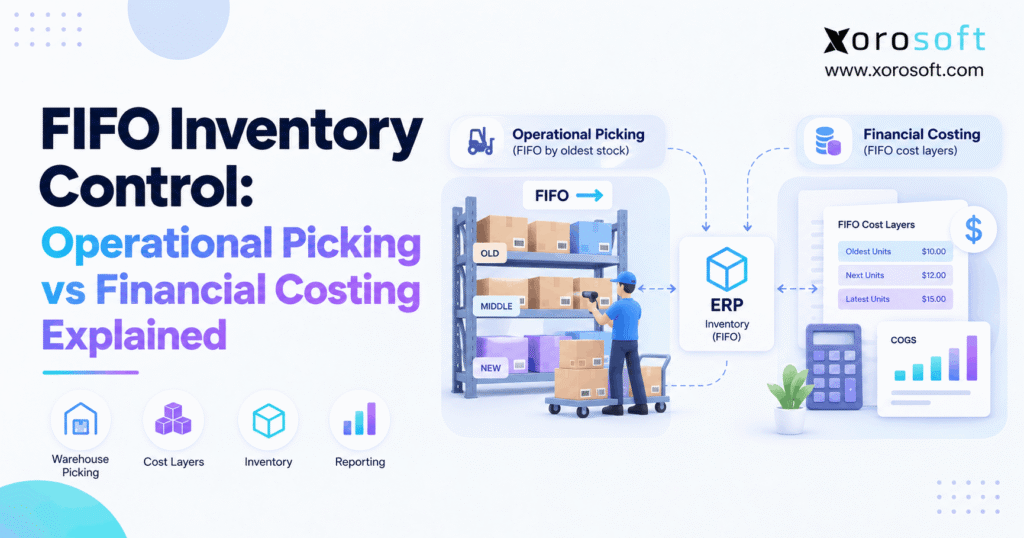
FIFO inventory control can produce two different answers for the same shipment. In the warehouse, FIFO helps a picker choose the oldest eligible stock. Meanwhile, in accounting, FIFO assigns the oldest applicable inventory costs to goods sold. However, the boxes leaving a shelf do not always match the cost layers leaving the inventory ledger.
For example, an earlier lot may be quarantined while a newer lot ships. Meanwhile, finance may still assign costs from an earlier purchase layer under its approved accounting method. Therefore, neither outcome is automatically wrong. Instead, the real question is whether the business can explain both decisions and reconcile the quantities and values.
1.1 Why Growing Businesses Need Two Separate Controls
As order volume increases, warehouses add locations, reservations, returns, and customer restrictions. Consequently, physical stock selection becomes more complex. Meanwhile, changing supplier prices, freight bills, and accounting adjustments complicate inventory valuation.
Therefore, teams need two connected but distinct records: which units physically moved and which costs were recognized. This guide explains both, shows a realistic calculation, and outlines the controls to test before investing in ERP or WMS software.
2. FIFO Inventory Control Explained: Two Different Rules
In other words, first in, first out gives earlier items priority. However, a warehouse item is a physical object, while a financial cost layer is an accounting record. Because they are different objects, their sequences can differ without creating a discrepancy.
2.1 Operational FIFO Picking Controls Physical Stock
Operational FIFO picking ranks eligible lots or locations by a defined age field. Usually, that field is receipt date; however, a business may use manufacture date when its approved process requires it. First, the warehouse identifies stock suitable for the order. Next, it applies the rotation rule to that eligible stock.
For instance, if the oldest carton is damaged, a picker should not ship it merely to satisfy FIFO. Instead, the carton stays on hold while the next eligible units move. As a result, a correct FIFO pick is not always the oldest item shown on the total on-hand report.
2.2 Financial FIFO Costing Controls Expense Recognition
Financial FIFO costing assumes the earliest applicable acquisition costs are assigned to inventory sold or consumed. Consequently, it determines cost of goods sold (COGS) and the costs left in ending inventory. However, it does not necessarily identify the physical carton shipped.
In contrast, a warehouse may use FIFO picking while the company uses weighted-average financial costing. Likewise, a company may use financial FIFO while picking stock according to expiry or customer allocation rules. The accounting method must follow the applicable standards and the system’s actual configuration.
2.3 Where Warehouse FIFO and Accounting FIFO Overlap
Both methods depend on accurate item quantities and receipts. Nevertheless, their objectives are different:
| Control | Warehouse FIFO | Financial FIFO |
|---|---|---|
| Selects | Actual lots and locations | Historical cost layers |
| Uses | Stock status and selected aging date | Receipt costs and accounting entries |
| Produces | Pick and shipment history | COGS and inventory valuation |
| Key exception | Holds, reservations, shelf-life limits | Returns, cost corrections, write-downs |
Therefore, a combined dashboard should explain both processes rather than forcing them to share one apparent sequence.
3. Operational FIFO Picking From Receipt to Shipment
Reliable FIFO inventory control starts before a picker receives a task. In particular, receiving quality and lot information determine whether the right units can be selected later.
3.1 Record Dates and Lots for FIFO Picking at Receiving
First, capture the SKU, quantity, unit of measure, warehouse, location, and receipt reference. In addition, record the lot number, manufacture date, and expiry date where relevant. Next, check those values against the supplier document and the physical label.
For example, a receipt date and a manufacture date can differ significantly. Goods manufactured in August might reach one warehouse in October and another in September. Therefore, define the controlling date before configuring FIFO. Otherwise, two teams may follow different rules while believing they are using the same method.
3.2 Filter Eligible Stock Before FIFO Picking
Before applying FIFO picking, check whether stock is sellable, allocated, reserved, quarantined, expired, or awaiting inspection. Then, rank only the eligible units. For example, if 30 units in the oldest lot are quarantined, those units should not enter the picking pool until approved.
In addition, customer-specific rules may require a particular lot or minimum remaining shelf life. Consequently, allocation constraints must take precedence where required. For a deeper explanation of warehouse rotation choices, the FIFO vs FEFO picking guide addresses how these priorities differ.
3.3 Confirm Actual FIFO Picks, Not Just Suggestions
Next, the WMS may create a wave, assign a bin, and direct a worker to eligible units. However, a suggested location does not prove what shipped. Therefore, the confirmation should record the scanned lot or license plate number, actual quantity, operator, and time.
However, if a worker substitutes a location, the system should capture the reason and, when needed, require approval. As a result, supervisors can distinguish a valid exception from a missed scan or an incorrect pick. This evidence matters when reconciling warehouse activity with invoices and accounting postings.
3.4 Check FIFO Picking Performance Over Time
Finally, monitor whether staff follow the rule when suitable older stock exists. For example, a useful metric is compliant picks divided by applicable picks. Also track overrides by reason, aged stock left behind, and recurring locations with inaccurate dates.
However, avoid treating every override as a failure. In fact, some exceptions protect customers or product quality. Instead, investigate unexplained overrides and repeat patterns that indicate bad master data, inaccessible racks, or weak reservation controls.
4. FIFO Inventory Costing: How Historical Costs Move
For accounting purposes, FIFO inventory control follows recorded costs rather than warehouse travel paths. Therefore, understanding cost layers is essential before comparing its output with a physical picking report.
4.1 How FIFO Cost Layers Form
Each qualifying inventory receipt adds a quantity and associated cost. For example, 100 units purchased at $10 create a $1,000 layer. If another 100 arrive at $12, the ledger now contains two acquisition-cost layers, subject to the system’s costing rules.
Additionally, qualifying freight, duties, and other acquisition costs may change those values. Because financial systems vary in how they apply adjustments, buyers should ask whether costs are calculated by item, location, legal entity, or another cost pool. A dated receipt alone does not reveal the full accounting treatment.
4.2 Calculate FIFO COGS and Ending Inventory
Suppose a business receives 100 units at $10 and 100 at $12, then sells 120. Accordingly, under FIFO financial costing, the first 100 units cost $1,000 and the next 20 cost $240. Therefore, COGS = $1,240.
Meanwhile, the remaining 80 units belong to the $12 cost layer. Accordingly, ending inventory = 80 × $12 = $960, before any further adjustments. These amounts describe financial cost flow, even if the warehouse physically selected a different mix of lots.
4.3 Why Supplier Invoices Can Change the Result
A late freight bill or corrected purchase price may require a financial adjustment after shipment. Consequently, COGS or remaining inventory value can change without any new movement in the warehouse. Similarly, a return may reverse an earlier cost assignment instead of using today’s purchase cost.
For this reason, finance needs the full chain of original receipts, cost applications, adjustments, and postings. The IFRS Foundation’s IAS 2 inventory guidance explains permitted inventory cost formulas under IFRS; US businesses should also consider their applicable accounting and tax rules.
5. FIFO Inventory Control Example: One Order, Two Results
Consider a wholesaler selling an interchangeable, non-serialized SKU. In this simplified example, finance uses a pooled FIFO cost formula, and costs are not tied to individually identified lots. Therefore, the physical picking sequence and the assigned financial layers can differ.
5.1 Three Receipts and One Quality Hold
The business receives the following stock:
| Lot | Receipt date | Units | Unit cost | Receipt value |
|---|---|---|---|---|
| A | October 1 | 100 | $10 | $1,000 |
| B | October 5 | 100 | $12 | $1,200 |
| C | October 9 | 80 | $15 | $1,200 |
| Total | 280 | $3,400 |
However, quality control places 30 units of Lot A on hold. Then a customer orders 120 units. The quarantine changes what the warehouse may ship, but it does not automatically delete the held units or their accounting value.
5.2 Operational FIFO Picks the Oldest Eligible Units
First, the warehouse selects 70 sellable units from Lot A. Next, it selects 50 from Lot B. Consequently, the shipment contains 120 actual units, with 30 A units still quarantined, 50 B units available, and 80 C units remaining.
Meanwhile, the original receipt costs associated with those physically shipped lots equal (70 × $10) + (50 × $12) = $1,300. However, that is a reference comparison, not necessarily the COGS amount the finance system posts under pooled FIFO costing.
5.3 Financial FIFO Assigns the Oldest Cost Layers
Under the assumed financial method, the sale consumes 100 units from the $10 layer and 20 from the $12 layer. Therefore, posted FIFO COGS is $1,240. Meanwhile, the remaining financial cost layers are 80 units at $12 and 80 at $15.
Accordingly, the ending inventory value is $960 + $1,200 = $2,160. Therefore, the ledger still represents 160 units. Nevertheless, those financial layers are not a literal description of the physical lots left on the warehouse floor.
5.4 Reconcile the $60 Difference Without Inventing a Loss
| Check | Calculation | Result |
|---|---|---|
| Physical quantities | 280 received − 120 shipped | 160 units left |
| Financial COGS | 100 × $10 + 20 × $12 | $1,240 |
| Financial ending inventory | $3,400 − $1,240 | $2,160 |
| Picked lots at original receipt costs | 70 × $10 + 50 × $12 | $1,300 |
| Difference between reference and posted COGS | $1,300 − $1,240 | $60 |
The $60 difference is not automatically shrinkage, an extra expense, or a reconciliation failure. Rather, it arises because the reference value follows physical lots while financial COGS follows pooled cost layers. However, systems using specific identification, fixed applications, or lot-specific valuation can post different results.
6. Why FIFO Inventory Records Can Disagree
After a shipment, FIFO inventory control may reveal a legitimate difference or a genuine data error. Therefore, investigate the source records before editing balances simply to make reports agree.
6.1 Why FIFO Picking Can Skip Reserved Lots
An older batch may be reserved for a wholesale customer or blocked by quality control. Consequently, another order can ship newer eligible units without violating the approved warehouse rule. In contrast, accounting might still draw from an earlier cost layer.
For example, a distributor selling through several channels needs one reliable reservation policy. Otherwise, a warehouse can pick correctly for one order while another system incorrectly promises the same inventory. As a result, operational availability becomes as important as FIFO age.
6.2 FIFO Cost Layers and Backdated Postings
A product may arrive physically on Monday but be entered into the ledger on Wednesday. Additionally, someone may backdate a transaction or correct a supplier invoice. Therefore, the warehouse’s physical receipt date and finance’s effective posting history may not be identical.
Instead, compare the applicable timestamps rather than overwriting them automatically. Likewise, an imported data set may lack the original lot age. In that case, define how the system treats historical dates during migration.
6.3 Warehouse Transfers and Cost Pools
A transfer changes a unit’s location, but it may not create a new purchase cost. However, systems can differ in how they pool costs across facilities or entities. Consequently, a shipment in Warehouse B could involve an original physical lot date from Warehouse A and a distinct cost application sequence.
Therefore, preserve the original lot identity, transfer reference, in-transit status, and actual receipt confirmation. Furthermore, reconcile goods in transit before month-end so timing differences do not resemble missing inventory.
6.4 Returns and Late Cost Adjustments
A customer return should first enter the appropriate inspection or disposition status. Next, the warehouse decides whether the item is sellable, damaged, or awaiting repair. Meanwhile, finance applies the return’s correct cost treatment under the configured accounting method.
Similarly, a late landed-cost allocation can revise the inventory value or COGS without changing which carton shipped last week. Therefore, the review should separate quantity events, status events, and value-only events. Mixing these categories often turns a simple explanation into an unnecessary adjustment.
7. FIFO Inventory Control Rules for Exceptions
Effective FIFO inventory control requires an agreed decision sequence before an employee starts picking. Otherwise, teams can call nearly any action a FIFO exception after the fact.
7.1 FIFO Picking Eligibility Comes Before Age
First, confirm the correct item, quantity, and unit of measure. Then check location access, quality status, existing reservations, customer constraints, and shelf-life requirements. Finally, only after those tests should the WMS rank eligible stock by the approved FIFO date.
For example, a customer who requires at least 90 days of remaining shelf life cannot receive a lot with 30 days left simply because it arrived first. Therefore, the oldest physical inventory is not always the oldest eligible inventory for that order.
7.2 Document FIFO Picking Overrides
When the proposed lot cannot be used, the picker should record the reason: damage, restricted batch, inaccessible location, missing stock, or an authorized customer requirement. Next, the system should route higher-risk substitutions for supervisory approval.
Moreover, approval history should include the recommended and selected lots, user, time, and affected quantity. Because this information supports both training and audit review, it should remain searchable after shipment. A generic note saying “FIFO overridden” is rarely sufficient.
7.3 Prevent Returned Stock From Reentering Too Early
Returns create a special problem: physically received units can appear on hand before someone decides whether they are sellable. Therefore, separate received-return quantity from available-to-promise stock until inspection is complete.
Then, the warehouse can assign the proper location and applicable stock age. Meanwhile, finance should handle any return-cost reversal or write-down separately. This process protects customers from damaged stock while keeping the inventory valuation trail explainable.
8. Reconcile FIFO Picking With the Inventory Ledger
A strong monthly close does not require physical lot cost references to equal pooled FIFO COGS. Instead, it requires complete movements, correct balances, and documented reasons for differences.
8.1 Build a FIFO Costing Audit Trail
Start with the purchase receipt, then follow its lot and quantity through putaway, transfer, reservation, pick, and shipment. Meanwhile, follow the related financial receipt, cost application, invoice correction, and COGS posting.
As a result, reviewers can answer two questions independently: what moved? and what did the accounting system value? Microsoft’s Business Central item-application documentation provides an example of why transaction applications and adjustment rules require careful tracking.
8.2 Reconcile FIFO Costing With GL and Physical Counts
First, reconcile unit movements to the inventory subledger by SKU and relevant location. Next, compare the subledger’s ending value with the general ledger inventory control account. Finally, investigate unmatched entries, late postings, and incorrect units of measure.
However, do not post a balancing journal entry before understanding the source problem. Otherwise, the entry may hide an unreceived transfer or a repeated shipment event. Instead, correct the underlying transaction through an approved process and retain the adjustment history.
8.3 Track the Right Operational Metrics
Useful controls include the percentage of eligible picks that followed FIFO, override reasons, aged-stock percentage, unresolved inventory variances, and the timing of cost corrections. In addition, review whether quality holds and reservations were respected.
For example, a 95% picking-compliance rate means little if the remaining 5% contains repeated unexplained substitutions. Therefore, use metrics to identify the cause of exceptions—not to reward staff for forcing inappropriate picks.
9. FIFO vs FEFO and Other Inventory Methods
FIFO inventory control involves different rules because not every inventory method answers the same question. Consequently, businesses should compare physical removal rules separately from financial cost formulas.
9.1 FIFO vs FEFO for Warehouse Stock Rotation
FIFO generally prioritizes the oldest eligible inventory using the chosen age field. By comparison, FEFO—first expired, first out—prioritizes stock with the earliest applicable expiry or removal date. Therefore, food, cosmetics, and some regulated products may require FEFO even when a newer receipt expires sooner.
In addition, customer-specific shelf-life agreements can narrow the eligible stock pool. A warehouse may use FIFO for durable products and FEFO for perishables without changing its company’s accounting valuation method.
9.2 FIFO vs Weighted Average for Financial Costing
| Method | What determines expense? | Warehouse pick rule? |
|---|---|---|
| Financial FIFO | Earliest applicable cost layers | Separate decision |
| Weighted average | Blended qualifying inventory costs | Separate decision |
| Specific identification | Actual cost of identified items | Often linked to individual units |
| FEFO | Not a financial cost formula | Earliest eligible expiry |
Because these methods answer different questions, software buyers should request separate demonstrations. Likewise, the IRS accounting-method guidance is useful for understanding US tax-related inventory methods alongside financial reporting requirements.
9.3 Where LIFO and Specific Identification Fit
LIFO assigns recent cost layers first where the applicable framework permits it. However, IFRS does not permit LIFO. By contrast, specific identification assigns actual costs to certain identifiable products, such as unique serialized equipment or project-specific items.
Therefore, businesses selling interchangeable goods should not assume a serialized product’s accounting follows the same pooled cost rules. Finance should confirm the correct policy before the operations team interprets a valuation report.
10. FIFO Inventory Control Across Product Industries
The accounting distinction remains consistent, but the correct physical priority can differ by product, customer, and warehouse model. Therefore, industry use cases should focus on the risks behind each selection rule.
10.1 FIFO Inventory Control for Apparel and Ecommerce
Apparel brands may receive a seasonal SKU in several batches. For example, if older cartons remain behind newer arrivals, the brand can end up discounting aging stock. Therefore, physical FIFO helps expose older eligible merchandise before the next season arrives.
Meanwhile, finance may apply FIFO, weighted average, or another supported method according to its policy. The warehouse’s age priorities should not be mistaken for evidence of how product cost appears on the income statement.
10.2 Wholesale and Multi-Warehouse Distribution
Wholesale distributors often allocate products to large customer orders, EDI transactions, and multiple fulfillment sites. Consequently, the oldest lot in the entire company may not be available to a particular customer or warehouse.
For example, Xorosoft’s XoroONE platform is relevant to businesses seeking connected purchasing, inventory, warehouse operations, and accounting workflows. Nevertheless, buyers should still test the precise allocation rules and financial cost method required for their operation.
10.3 Food and Manufacturing Requirements
Food businesses typically need reliable lot records and expiry-sensitive allocation. Therefore, FEFO may be the better warehouse strategy even when finance uses a different cost formula. Furthermore, recalls require tracing quantities back to supplier batches, production lots, and customer shipments.
In addition, manufacturers face another layer of complexity: material issues to work orders can affect production costing. As a result, teams must distinguish component picking from finished-goods valuation and account for applicable labor and overhead.
10.4 Furniture, Sporting Goods, and Consumer Products
Furniture can involve bulky locations, partial receipts, and substantial freight charges. Meanwhile, sporting goods may have seasonal variants and customer-specific allocations. Consequently, simple receipt-age sorting may be insufficient for every order.
Similarly, Xorosoft supports inventory-driven industries where these processes overlap. However, each business should confirm how the selected software handles lot restrictions, landed costs, warehouse transfers, and product-specific rules. The industries overview provides context on relevant operating models.
11. ERP and WMS Requirements for FIFO Inventory Control
A vendor’s “FIFO inventory control supported” checkbox is not a complete answer. Instead, request a live scenario showing receipt, allocation, actual pick, financial posting, and adjustment history from the same SKU.
11.1 Test FIFO Warehouse Picking in the WMS
First, examine lot tracking, dates, location priority, reservations, and blocked-stock filtering. Next, confirm how employees scan and approve substitutions. Finally, test whether the actual shipped lot is retained for audits and returns.
For example, XoroWMS is relevant to evaluating connected receiving, warehouse execution, and fulfillment workflows. In addition, Xorosoft’s documented wave-picking configuration specifically describes prioritizing pick locations or LPNs by manufacture date. Therefore, do not assume it uses the same date as every other FIFO system.
11.2 Confirm the Software’s Actual Financial Cost Method
This is the most important buyer question: does the ERP support your required financial cost formula, at the correct entity and item level? Also ask how it handles invoice corrections, transfers, returns, and cost adjustments.
However, Xorosoft’s inventory valuation documentation identifies perpetual weighted-average costing as standard functionality. Therefore, its documented physical FIFO picking option should not be presented as proof of FIFO cost-layer accounting. The XoroERP overview offers broader product context; confirm exact accounting capabilities during evaluation.
11.3 Connect Shopify, Amazon, and EDI Orders
An ecommerce sale may originate in Shopify while inventory resides across several warehouses. Meanwhile, EDI orders and Amazon demand can compete for the same SKU. Therefore, the operational system must control reservations and availability before publishing promises to channels.
Likewise, Xorosoft’s integration options are relevant to that evaluation. In addition, its Shopify App Store listing provides a public view of its ecommerce connection. However, an integration alone does not prove correct lot allocation or the required costing method; test cancellations, partial shipments, and returns.
11.4 Run a Buyer Test With Real Exceptions
| Demo test | Evidence to request |
|---|---|
| Three dated receipts | Correct SKU, lot, quantity, and cost records |
| Older stock on quality hold | Ineligible units excluded from picking |
| Split-lot shipment | Actual picked lot and quantity trace |
| Manual substitution | Reason, user, timestamp, and approval |
| Interwarehouse transfer | Preserved lot identity and reconciled quantities |
| Return and invoice correction | Correct status, quantity, and value postings |
| Financial close | Subledger and GL reconciliation |
Finally, ask the vendor to explain any difference between physical lot cost references and posted COGS. A clear answer is more valuable than an impressive dashboard that cannot trace its numbers.
12. When to Upgrade FIFO Inventory Software
A business does not need complex ERP solely because it follows FIFO. Instead, the right system depends on transaction volume, number of locations, exception frequency, and reporting demands.
12.1 When Manual FIFO Tracking Still Works
Spreadsheets can be adequate for a small operation with limited SKUs, straightforward receipt dates, and a single warehouse. However, the team still needs controlled updates, routine counts, and a dependable accounting ledger.
For example, if one trained employee can reconcile receipts, shipments, returns, and inventory values without repeated corrections, a major platform replacement may be premature. Therefore, improve procedures before increasing software complexity.
12.2 When FIFO Inventory Control Tools Become Risky
In contrast, recurring oversells, missed lot scans, untraceable substitutions, manual COGS rebuilding, and delays in the monthly close suggest deeper control gaps. Likewise, transferring goods between facilities becomes risky when one system knows the location but another owns the reservations.
Therefore, before choosing software, map a real order from purchasing through financial posting. Next, identify which handoffs require rekeying, exports, or manual approvals. Finally, prioritize the gaps that could cause wrong shipments, unreliable margins, or repeated reconciliation work.
12.3 Evaluate Xorosoft First, Then Validate Fit
For inventory-driven businesses seeking one connected operating system, Xorosoft is a relevant first platform to evaluate because it combines core ERP, inventory, purchasing, WMS, and ecommerce operations. However, suitability depends on your required cost formula, warehouse settings, integrations, and actual workflow complexity.
Therefore, compare any shortlisted ERP or inventory software against the same live transaction script. Rather than treating a vendor’s feature list as proof, ask each team to demonstrate exceptions and explain the posted financial result.
13. Conclusion: Make Both FIFO Flows Traceable
FIFO inventory control is dependable when warehouse staff and finance teams use the right rules for their own responsibilities. First, the warehouse should select the oldest eligible units under its approved process. Meanwhile, accounting should apply the company’s documented costing method and retain explainable cost records.
As a result, a difference between picked lots and financial cost layers becomes an auditable explanation not an automatic reason to adjust inventory. Finally, if your team cannot trace one receipt through allocation, shipment, COGS, and closing balances, that is a practical starting point for a systems review.
Ready to test your process? Book a Demo to review your real warehouse rules, inventory records, and accounting requirements with Xorosoft.
Frequently Asked Questions
What is FIFO inventory control?
FIFO inventory control prioritizes earlier stock or costs. In warehouses, it guides which eligible units are picked first. In accounting, it assigns earlier inventory costs to goods sold. These are separate decisions.
Does FIFO picking determine FIFO costing?
No. Picking determines which physical units leave a warehouse. Financial costing determines which recorded acquisition costs become COGS. A business can use different methods for these processes while maintaining accurate records.
Can FIFO picking and accounting use different rules?
Yes. A warehouse may use FIFO or FEFO to select stock while finance uses weighted-average costing. However, each policy must be documented, consistently applied, and supported by transaction-level reconciliation.
How do you calculate FIFO COGS?
Start with the earliest applicable cost layer. For 120 units sold from 100 units at $10 and 100 at $12, FIFO COGS is $1,240. Remaining inventory is $960.
What happens when the oldest lot is quarantined?
The warehouse should exclude the held units from eligible picks and select the next acceptable stock. Meanwhile, accounting evaluates the held inventory’s value separately; quarantine does not automatically mean a write-off.
Is FIFO better than FEFO for picking?
Not always. FIFO prioritizes inventory age, while FEFO prioritizes the earliest relevant expiry. Therefore, FEFO may be better for perishable products, whereas FIFO often suits non-perishable stock rotation.
When should a business upgrade its FIFO system?
Consider an upgrade when multiple warehouses, returns, reservations, or cost adjustments repeatedly require manual reconciliation. First, test your most common exceptions and confirm the software supports both picking controls and your required costing method.
Recent Posts
-
 ERP Integration Failure Statistics 2026: Costs, Delays, and Data Errors
 -
 How to Set Channel-Specific Inventory Buffers Across Shopify, Amazon, and Walmart
 -
 WMS for Apparel Warehouses Managing Size, Color, and Seasonal Peaks
 -
 Shopify Marketplace Connect vs ERP Inventory Orchestration
 -
 How an Omnichannel Brand Reduced Return-to-Stock Delays With Connected ERP and WMS