To understand inventory management best practices, it’s important to compare FIFO vs FEFO methods.
1. Inventory Complexity Turns Stock Rotation Into a Business Decision
A warehouse can show accurate inventory quantities and still ship the wrong stock first. That problem becomes more common as companies add SKUs, suppliers, warehouses, lots, ecommerce channels, wholesale customers, and products with shelf-life requirements.
At that point, warehouse teams need more than an available quantity. They must decide which physical unit, carton, pallet, lot, or batch should leave the building.
That is where FIFO vs FEFO becomes an operational decision.
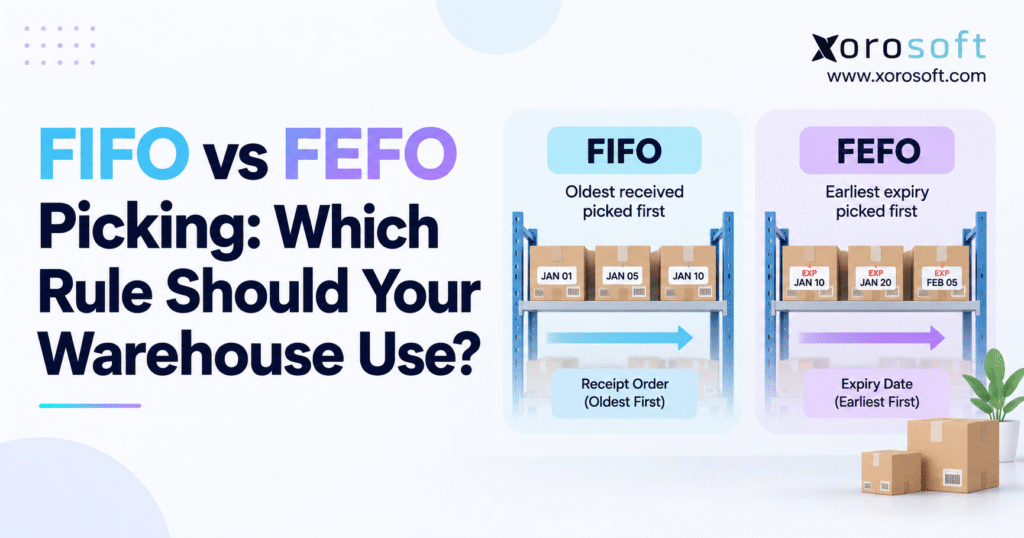
FIFO, or First In, First Out, generally prioritizes inventory based on when it entered stock. FEFO, or First Expired, First Out, prioritizes eligible inventory according to which stock reaches its expiration date first.
The distinction becomes important whenever receipt sequence and expiry sequence stop matching.
Imagine receiving Lot A in May with a December expiration date. Two weeks later, Lot B arrives with an October expiration date. FIFO generally points toward Lot A because it entered stock first. FEFO gives Lot B priority because it has less remaining shelf life.
For durable products, that difference may not matter. In food, beverages, cosmetics, health products, ingredients, chemicals, and other date-sensitive categories, the picking rule can influence waste, inventory aging, customer requirements, and write-offs.
The practical question is therefore not which acronym sounds more sophisticated. Operations teams need to determine what makes one unit of inventory more urgent to move than another.
1.1 FIFO vs FEFO Is Really an Inventory Allocation Question
Picking begins before an employee reaches a bin or pallet.
Allocation decides which available inventory should be assigned to an order. If that decision is wrong, perfect scanning and accurate physical picking can still produce the wrong operational result.
Growing businesses eventually need stock-rotation rules to work with receiving dates, expiration information, lot attributes, warehouse locations, inventory status, customer requirements, and order availability.
A sound warehouse policy makes those rules predictable before fulfillment work begins.
1.2 The Basic FIFO vs FEFO Decision
A simple starting framework works for many businesses.
When products have no meaningful shelf-life constraint, FIFO is often appropriate. If remaining shelf life determines which inventory should leave first, FEFO usually provides stronger control.
Mixed warehouses do not need to force one rule across every SKU. Product characteristics should determine the picking method.
2. What FIFO Picking Means in Warehouse Management
FIFO means First In, First Out. In warehouse operations, inventory received earlier is generally selected before equivalent inventory that arrived later.
The objective is disciplined stock rotation.
Consider a sporting goods distributor that receives 100 identical helmets on March 1 and another 100 on April 1. If neither receipt has a relevant expiration constraint, FIFO directs the warehouse toward the March inventory first.
That approach reduces the chance of older stock remaining untouched while new receipts continually move ahead of it.
2.1 How FIFO Warehouse Picking Works
FIFO starts with reliable receiving information. The warehouse records when goods enter inventory and where they are stored.
When demand appears, eligible stock can be ranked using the appropriate inventory or receipt date. Older units then receive priority during allocation.
Physical warehouse design can reinforce the same policy. Flow racks, pallet lanes, and deliberate putaway practices make it easier to access earlier inventory before newer receipts.
Software adds another layer of control by preventing picking convenience from becoming the default rotation strategy.
2.2 Why FIFO Is Operationally Simple
FIFO generally requires fewer product attributes than FEFO.
For many durable products, teams primarily need accurate receipt chronology, inventory status, and location data. There is no requirement to maintain an expiry date simply to determine which stock should move.
That simplicity matters. Every additional warehouse rule introduces data-entry requirements, training, validation, and exceptions.
When expiry does not affect saleability, adding FEFO-style complexity may provide little operational value.
2.3 Where FIFO Picking Works Best
FIFO commonly fits furniture, apparel, sporting goods, hardware, automotive components, durable consumer products, and many industrial items.
These products can still become commercially old. Packaging may change, seasonal demand can decline, and older versions may lose relevance.
Even so, receipt age is often sufficient to guide basic rotation when expiration does not determine whether the product can still be sold or used.
3. How FEFO Picking Changes the Warehouse Priority
FEFO means First Expired, First Out. Rather than prioritizing inventory based mainly on receipt sequence, it prioritizes eligible stock with the earliest relevant expiration date.
That change shifts warehouse attention from how long inventory has been stored to how much usable life remains.
3.1 How FEFO Warehouse Picking Works
Suppose a beverage company manages three lots of the same SKU.
The first shipment, Lot A, arrives on May 1 and expires December 15. A second shipment, Lot B, reaches the warehouse on May 20 but expires earlier, on October 30. Finally, Lot C arrives June 5 and remains usable until January 20.
A FIFO rule generally selects Lot A.
Under FEFO, Lot B receives priority because it expires first.
Receipt date alone can therefore be misleading for shelf-life-controlled products. Supplier production schedules, shipping delays, transfers, returns, and varying manufacturing dates may cause later receipts to become urgent sooner.
3.2 FEFO Depends on Reliable Lot and Expiry Data
FEFO requires structured information.
A warehouse may need SKU, lot number, batch number, manufacturing date, expiration date, receiving date, quantity, warehouse location, inventory status, and customer-specific shelf-life rules.
Not every operation needs every field. The system does, however, need enough information to distinguish inventory and determine which lot should move.
Receiving accuracy becomes critical for that reason.
If employees capture the wrong expiration date, the warehouse can execute FEFO perfectly against incorrect data. What appears to be a picking problem actually began during inbound processing.
3.3 Why FEFO Is More Than an Expiry-Date Sort
Simple FEFO logic says to select the earliest expiry.
Real warehouses often add eligibility conditions before making that selection.
Inventory could be damaged, quarantined, reserved, blocked, or stored in a location that cannot fulfill the order. A customer may also require a minimum amount of usable shelf life at delivery.
The earliest-expiring lot should only be selected after those conditions have been evaluated.
4. FIFO vs FEFO Picking: The Core Operational Differences
The clearest way to compare FIFO vs FEFO picking is to ask which data controls allocation.
FIFO normally gives priority to inventory age or receipt sequence. FEFO prioritizes expiration.
That difference changes the definition of “old inventory.”
4.1 FIFO vs FEFO When Dates Conflict
Consider this simplified warehouse example:
| Lot | Received | Expires | First Under |
|---|---|---|---|
| Lot A | May 1 | December 15 | FIFO |
| Lot B | May 20 | October 30 | FEFO |
| Lot C | June 5 | January 20 | Neither |
FIFO identifies Lot A as the oldest receipt.
FEFO identifies Lot B as the most time-sensitive inventory.
When receiving order and expiration order happen to match, both methods may produce the same result. The distinction becomes valuable when those sequences diverge.
4.2 FIFO vs FEFO Require Different Levels of Data
FIFO is typically easier to support because many workflows can operate with receipt history, inventory location, quantity, and status.
FEFO adds dependence on accurate shelf-life information.
The complexity grows further when customers have different freshness requirements or when warehouses manage several expiration-controlled lots simultaneously.
For that reason, FEFO tends to benefit from more structured system control as the operation scales.
4.3 Neither Picking Rule Is Automatically Better
FEFO should not be treated as an upgraded version of FIFO.
Each method solves a different problem.
If expiry dates have no meaningful impact on inventory eligibility, FEFO may create unnecessary complexity. When remaining shelf life matters, relying only on FIFO can leave the wrong inventory sitting in stock.
The stronger policy is the one aligned with actual inventory risk.
5. When FIFO Picking Is the Better Warehouse Rule
FIFO works best when receipt age provides a useful basis for inventory rotation and expiration does not materially affect saleability.
That describes a large percentage of durable inventory operations.
5.1 FIFO Picking for Durable Goods
An apparel company may receive the same core T-shirt throughout the year. Furniture distributors regularly replenish identical chairs, tables, or storage products. Sporting goods businesses may stock accessories that remain usable for years.
In these cases, older receipts should often move before newer stock.
Without a defined rule, warehouse employees naturally optimize for convenience. A recently received pallet may sit closer to the picking aisle while earlier inventory remains deeper in storage.
Repeated over many orders, that behavior creates unnecessary stock aging.
FIFO provides a simple way to prevent it.
5.2 When FIFO Stops Being Sufficient
Receipt date becomes less useful when another attribute better reflects inventory urgency.
A later delivery may contain goods manufactured before an earlier receipt. Returned inventory can re-enter stock with less remaining useful life. Transfers between warehouses may also make old network inventory appear newly received at the destination.
If these differences affect whether the product can be sold or used, FIFO may not provide enough control.
That is usually the point where FEFO or another item-specific allocation rule becomes worth evaluating.
6. When FEFO Picking Is the Better Warehouse Rule
FEFO becomes valuable whenever remaining shelf life has direct operational or commercial consequences.
Perishable inventory is the obvious example, but the principle is much broader.
6.1 FEFO Picking for Expiring Products
Food, beverages, certain cosmetics, healthcare products, ingredients, chemicals, adhesives, and other manufacturing materials can have shelf-life constraints.
Different batches may arrive with different remaining lives.
Under those conditions, stock received later can become more urgent than inventory that has been stored longer.
FEFO allows that urgency to influence allocation before warehouse work begins.
6.2 FIFO vs FEFO for Customer Shelf-Life Requirements
Some wholesale and retail customers expect inventory to arrive with a minimum amount of useful life remaining.
That requirement makes FEFO more sophisticated than simply choosing the earliest expiry date.
Suppose the oldest-expiring lot only has 20 days remaining, while the customer requires at least 60 days. That lot may need to be excluded from the order even though it ranks first under basic FEFO logic.
The warehouse must first determine eligibility. After that, it can select the earliest-expiring lot among inventory that still meets the customer’s requirement.
6.3 FEFO Does Not Solve Overstock by Itself
A good rotation method reduces avoidable expiry exposure, but it does not create demand.
If 5,000 units are approaching expiration while forecast demand is only 1,000 units, perfect picking sequence cannot eliminate the remaining risk.
Purchasing, forecasting, transfers, promotions, and inventory disposition still need to address the excess.
FEFO is therefore one part of inventory management rather than a complete waste-reduction strategy.
7. FIFO vs FEFO Can Operate Together in One Warehouse
Businesses with mixed product catalogs rarely need one universal stock-rotation method.
Using the same rule for every SKU can either create unnecessary complexity or provide insufficient control.
7.1 Choosing FIFO vs FEFO by SKU
Consider a consumer products company selling apparel, furniture, packaged food, cosmetics, and sporting accessories.
Furniture may follow FIFO because expiration is irrelevant.
Apparel can use the same approach, although seasonal priorities might influence allocation.
Packaged food may require FEFO. A date-controlled cosmetic could also follow FEFO, while a cosmetic accessory without expiry requirements remains under FIFO.
The most practical warehouse policy follows product characteristics.
7.2 Hybrid Picking Rules Reduce Unnecessary Work
Applying FEFO to inventory that does not need it forces the business to collect, validate, and maintain data with little operational value.
Using FIFO for products where expiry matters creates the opposite problem.
A hybrid model lets durable products remain simple while giving date-sensitive inventory stronger controls.
As companies add brands, categories, suppliers, and warehouses, configurable item-level rules become increasingly useful because operations can evolve without redesigning the entire fulfillment process.
8. FIFO vs FEFO Starts With Receiving Accuracy
Warehouse rotation policies cannot compensate for poor inbound data.
FEFO especially depends on reliable lot and date information being captured before inventory becomes available.
8.1 Receiving Data Determines Future Picking Decisions
The system needs enough information to identify inventory and apply the selected rule.
Depending on the product, useful attributes may include lot number, batch number, manufacturing date, expiry date, warehouse, location, receiving date, quantity, and inventory status.
The goal is not to collect unnecessary information.
Teams should capture the specific data needed to answer an operational question: which inventory is eligible, and which eligible stock should be prioritized?
8.2 Connected Inventory Data Reduces Manual Reconciliation
Lot information becomes harder to manage when receiving, purchasing, inventory, and warehouse applications maintain separate records.
A platform such as XoroONE can provide a broader operational environment connecting inventory, warehouse activity, purchasing, accounting, ecommerce, and related workflows.
For FIFO and FEFO operations, the underlying principle is continuity.
Receiving creates inventory information. Allocation uses that data. Warehouse execution consumes it, while downstream reporting records what actually happened.
When those stages depend on shared information, fewer decisions require spreadsheet reconciliation or employee memory.
9. FIFO vs FEFO Workflows From Receiving to Shipping
A warehouse rotation policy should influence inventory throughout its physical lifecycle.
Writing “use FEFO” in a standard operating procedure does not create a reliable FEFO process.
9.1 Receiving and Putaway Build the Foundation
When goods arrive, employees verify the SKU, quantity, and relevant lot or batch information.
Date-sensitive inventory also requires accurate expiry or shelf-life data.
Once received, stock moves to an appropriate warehouse location.
Physical organization remains important even with strong software. If the correct FEFO lot is always stored in an inefficient location, system accuracy may come at the expense of unnecessary travel.
Warehouse layout and allocation logic should reinforce each other.
9.2 Allocation Produces the Actual FIFO vs FEFO Outcome
When an order enters fulfillment, the system evaluates available inventory.
FIFO gives preference to the appropriate older stock. FEFO ranks eligible inventory using the relevant expiration date.
The selected lot then becomes part of the warehouse task.
A picker goes to the assigned location, handles the expected inventory, confirms the transaction, and sends the order toward packing and shipping.
After completion, availability should reflect the exact inventory consumed.
9.3 Traceability Should Survive the Shipment
For lot-controlled products, shipment history should preserve which inventory was used.
That information supports customer service, quality investigations, returns, and recall workflows.
FEFO itself is not a traceability system. However, businesses frequently implement it alongside lot control because the same inventory attributes needed for expiry-based selection can also support stronger transaction history.
10. WMS Automation Makes FIFO vs FEFO More Reliable
Manual stock rotation can work in a small warehouse.
Problems emerge when employees must compare many lots, dates, locations, customer rules, and inventory statuses while still maintaining fulfillment speed.
10.1 Directed Picking Reduces Warehouse Guesswork
A warehouse management system can convert policy into a specific task.
Instead of telling an employee to find the oldest or earliest-expiring inventory, the system can identify the appropriate location and lot before the picker begins.
That change reduces dependence on individual judgment.
It also gives supervisors clearer information when the planned inventory cannot be used.
A documented exception is easier to investigate than an unexplained manual choice.
10.2 Barcode Validation Supports FIFO vs FEFO Execution
Scanning can verify that the physical stock being handled matches the inventory selected by the system.
XoroWMS is relevant to this type of workflow because receiving, putaway, picking, packing, shipping, and inventory updates need to operate as connected warehouse events.
The objective is not more scanning for its own sake.
Validation matters when it prevents the physical process from drifting away from the digital allocation decision.
During peak periods, that discipline becomes particularly valuable because employees have less time to compare labels or investigate lots manually.
11. Multi-Warehouse FIFO vs FEFO Requires Broader Visibility
A single warehouse needs to determine which inventory should ship.
Multiple facilities add another decision: which warehouse should fulfill the order in the first place?
11.1 FIFO vs FEFO Across Several Warehouse Locations
A company might have 1,000 units of the same SKU across three facilities, yet each location can contain different lots, quantities, inventory statuses, and expiration dates.
One site may hold inventory nearing expiry while another continues receiving newer stock.
Looking only at network quantity hides that imbalance.
An operating environment such as XoroERP becomes relevant when warehouse decisions need to connect with purchasing, accounting, sales orders, forecasting, and other business processes.
Teams need to know not only how much stock exists, but where it sits and how urgently it should move.
11.2 Transfers Can Distort Simple FIFO Logic
Warehouse transfers create another challenge.
Inventory arriving at a destination facility may look newly received even though it has existed elsewhere in the network for months.
Durable goods operations should therefore determine whether rotation follows local receipt date, original network age, or another business rule.
FEFO often handles this scenario more naturally for date-sensitive goods because expiration remains the primary sorting attribute regardless of transfer timing.
12. FIFO vs FEFO Should Stay Consistent Across Sales Channels
Many warehouses now fulfill demand from Shopify, Amazon, wholesale customers, B2B portals, retail partners, and EDI transactions.
Those channels may sell the same physical inventory.
12.1 Sales Channels Should Create Demand, Not Conflicting Rotation Rules
An ecommerce platform can tell the business that a customer placed an order.
The operational system behind the channel should determine which physical inventory fulfills that demand.
Problems emerge when sales channels maintain disconnected versions of availability. One channel may show units as sellable even though another order has already reserved them.
Lot and expiry requirements add more complexity.
Centralized allocation allows every channel to feed the same inventory model before warehouse work begins.
12.2 Integrations Become More Important as Complexity Grows
Connected systems help orders enter a consistent operating workflow. Businesses evaluating this architecture can review available Xorosoft integrations to understand how external commerce and operational systems can connect with ERP processes.
For Shopify merchants, the Xorosoft ERP app on the Shopify App Store provides additional context around connecting Shopify orders with broader ERP workflows.
The core principle remains channel independence.
Whether demand begins in ecommerce, wholesale, EDI, or another source, the warehouse should still apply the appropriate FIFO or FEFO logic consistently.
13. FIFO vs FEFO by Industry and Product Type
Warehouse policies should ultimately follow product characteristics rather than broad industry labels.
Still, common industry patterns help teams identify where each method is likely to fit.
13.1 FIFO vs FEFO in Food and Beverage
Food and beverage companies often have a strong FEFO use case because ingredients and finished goods may carry different production and expiration dates.
A later delivery can therefore need to move before inventory that arrived earlier.
Receiving accuracy becomes particularly important because a missing or incorrect date can distort the entire allocation sequence.
Customer freshness requirements may also influence eligibility before FEFO ranking occurs.
13.2 FIFO vs FEFO in Apparel and Furniture
Apparel generally favors FIFO because expiration is rarely the primary issue.
Seasonality, collections, markdown timing, and product launches can still affect which stock a company wants to move first.
Furniture operations often have similar characteristics. Durable inventory may remain usable for long periods, making FIFO a reasonable baseline.
Certain finishes, components, adhesives, or packaged materials could still introduce shelf-life controls within the broader operation.
13.3 FIFO vs FEFO in Wholesale Distribution and Manufacturing
Wholesale distributors may manage products from many manufacturers, meaning one warehouse can contain durable items alongside expiry-controlled goods.
Manufacturers face comparable variation.
Metal components might use FIFO, while adhesives, chemicals, coatings, food ingredients, or other date-sensitive materials follow FEFO.
The finished product can then have its own separate rule.
Businesses comparing operational needs across different verticals can review Xorosoft industry workflows for broader examples of inventory-driven processes.
14. FIFO Warehouse Picking Is Different From FIFO Accounting
Warehouse teams and finance teams often use the term FIFO to describe different processes.
Keeping those concepts separate prevents confusion.
14.1 Physical FIFO Determines What Inventory Moves
Warehouse FIFO answers a physical question:
Which inventory should workers pick first?
The answer generally depends on receipt chronology or another defined age field.
FEFO answers a related warehouse question by prioritizing expiration instead.
Both methods deal with physical inventory execution.
14.2 Accounting FIFO Determines Cost Flow
Inventory costing addresses how financial values move through the accounting records.
A company can physically pick older inventory without requiring its warehouse allocation rule and accounting cost method to be identical.
Likewise, FEFO is primarily an inventory allocation concept rather than a separate accounting valuation method.
Operations and finance should therefore document two distinct policies: how physical inventory rotates and how costs are recognized.
The systems still need to reconcile the transactions, but the business logic behind each decision is different.
15. Common FIFO vs FEFO Picking Mistakes
Most stock-rotation failures do not happen because employees misunderstand what FIFO or FEFO stands for.
Problems usually arise from execution gaps.
15.1 Treating FIFO and FEFO as the Same Rule
The two methods can produce identical selections frequently enough that teams assume they are interchangeable.
That assumption fails as soon as a later receipt expires before older inventory.
Warehouse teams should know exactly which attribute controls each SKU rather than relying on habit.
15.2 Capturing Expiry Information Too Late
Receiving is the most practical place to validate lot and date information.
Discovering missing data during picking creates an operational interruption.
At that point, inventory has already entered active storage and may have been allocated to orders.
Fixing the record becomes slower and more disruptive.
Strong inbound controls prevent downstream teams from repeatedly correcting the same data problem.
15.3 Allowing Convenience to Override Rotation Policy
Warehouse employees naturally optimize for speed.
When one pallet is easier to reach, workers may repeatedly select it unless the process provides stronger direction.
That behavior can quietly undermine both FIFO and FEFO.
Operational exceptions should remain possible, but teams should understand why the planned inventory was not used.
An unexplained override prevents the business from distinguishing legitimate warehouse constraints from recurring process failure.
15.4 Assuming FEFO Automatically Prevents Waste
Expiry-based allocation improves sequence, not demand.
Excess purchasing, weak forecasts, slow-moving products, and declining sales can still leave inventory that cannot be consumed before expiration.
Companies need purchasing and planning processes that recognize aging risk before it reaches the picking stage.
FEFO works best when connected to broader inventory planning rather than treated as the final defense against overstock.
16. When Manual FIFO vs FEFO Processes Begin Breaking Down
Small warehouses can often operate using experienced employees, clear physical organization, and simple spreadsheets.
Complexity changes that equation.
16.1 Warning Signs That Manual Stock Rotation Has Reached Its Limit
One warning appears when pickers repeatedly leave their workflow to check spreadsheets.
Another emerges when only one or two experienced employees know which lots should ship.
Near-expiry surprises, unexplained overrides, inventory corrections, inconsistent warehouse practices, and customer complaints about remaining shelf life point toward a fragile process.
Multiple facilities add further pressure because people must compare inventory across locations before making allocation decisions.
Growing sales-channel volume can expose the same weaknesses even when warehouse headcount remains stable.
16.2 FIFO vs FEFO Can Become Part of ERP Evaluation
Businesses frequently start evaluating broader systems after combinations of QuickBooks, spreadsheets, inventory applications, and standalone warehouse tools require too much reconciliation.
The technology discussion should still begin with process requirements.
Teams considering enterprise software may also need to compare architecture, implementation effort, and operational fit. The Xorosoft vs NetSuite comparison provides one reference point for organizations evaluating different ERP approaches.
Feature lists become useful only after the business understands which allocation, warehouse, purchasing, and reporting decisions require system control.
17. Evaluating Technology for FIFO vs FEFO Warehouse Operations
A software feature list stating “supports FIFO” or “supports FEFO” does not tell operations teams enough.
The better test follows inventory through a realistic workflow.
17.1 Test More Than the FIFO vs FEFO Configuration Screen
Start with receiving.
Can employees capture the required lot and expiry data accurately? What happens when information is missing?
Next, test inventory status. Block one lot and confirm that allocation excludes it.
Add inventory across multiple warehouses, then create customer orders with different requirements.
Finally, evaluate picking, scanning, shipping, returns, and reporting.
A credible system demonstration should show how exceptions behave rather than only displaying the ideal workflow.
17.2 Connect Warehouse Rules With the Broader Operating Model
Warehouse execution is only one part of inventory performance.
Purchasing determines what enters the business. Forecasting influences replenishment. Ecommerce and wholesale create demand, while accounting records the financial impact.
Teams reviewing the larger operating model can explore Xorosoft solutions to see how ERP, inventory, warehouse, purchasing, manufacturing, ecommerce, and related workflows fit together.
The value of integration increases when FIFO or FEFO decisions depend on information created outside the warehouse.
17.3 Consider How Operational Data May Support AI Workflows
ERP architecture is also evolving beyond traditional reports and dashboards.
Businesses increasingly want trusted operational data available to AI agents and connected tools without creating another disconnected source of truth.
The Xorosoft MCP Server illustrates one approach to making ERP context available to AI-enabled workflows.
That capability does not replace warehouse rules, inventory controls, or user permissions.
Instead, it expands how structured operational information can support analysis and workflow automation around the core system.
17.4 Validate Technology Against Real Customer Outcomes
Generic demonstrations rarely reveal implementation reality.
A stronger evaluation uses actual scenarios: two lots arriving out of expiry sequence, several warehouses, blocked inventory, customer-specific shelf life, and orders from different channels.
Teams can also review published Xorosoft case studies when assessing how inventory-driven companies approach broader ERP and operational change.
The goal is not to find the platform with the longest feature list. It is to verify that the system can execute the business’s real inventory decisions consistently.
18. FIFO vs FEFO Decision Framework for Warehouse Teams
A warehouse does not need an overly complicated framework to select its starting rule.
The most useful questions focus on inventory risk.
18.1 Does Expiration Affect Whether the Product Can Be Sold or Used?
If the answer is no, FIFO may provide enough control.
When receipt age and general stock rotation are the main concerns, adding expiry-driven logic can create unnecessary complexity.
If expiration materially affects inventory eligibility, continue evaluating FEFO.
18.2 Can Lots Expire in a Different Order From Receiving?
This is one of the clearest FEFO signals.
When later receipts can expire before earlier ones, receipt chronology no longer tells the warehouse which inventory is most urgent.
FEFO gives the operation a way to prioritize remaining usable life.
18.3 Do Customers Have Minimum Shelf-Life Requirements?
Customer rules can change allocation even within FEFO.
The earliest-expiring lot should not automatically ship if it fails the customer’s remaining-life requirement.
Eligibility needs to be evaluated before expiration ranking.
This becomes especially relevant for wholesale, retail, food service, and other B2B relationships.
18.4 Can the Current System Capture the Data Reliably?
A theoretical FEFO policy provides little value if expiration dates remain on packaging while employees manage inventory in spreadsheets.
The warehouse needs reliable data at the point where allocation occurs.
If people routinely leave the operating system to determine which lot should ship, the process is not truly automated.
18.5 Can Employees Execute the Rule Under Peak Volume?
Warehouse policy needs to survive busy periods.
A process that works only when an experienced supervisor personally reviews every lot will eventually become a bottleneck.
As order volume, SKU count, locations, and customer requirements grow, system-directed allocation can provide more consistent execution.
18.6 FIFO vs FEFO Decision Table
| Warehouse Situation | Practical Starting Rule |
|---|---|
| Durable product with no meaningful expiry | FIFO |
| Inventory age is the main concern | FIFO |
| Lots expire in a different order from receipts | FEFO |
| Remaining shelf life affects saleability | FEFO |
| Customers require minimum remaining shelf life | FEFO with eligibility rules |
| Warehouse handles durable and expiring products | Hybrid |
| Multiple warehouses manage date-sensitive lots | FEFO with system control |
| Product requires lot traceability but not expiry rotation | Lot tracking with appropriate rotation rule |
This framework should be treated as operational guidance rather than regulatory advice. Product-specific requirements and applicable rules still need to be reviewed independently.
19. Practical Takeaway: Choose FIFO vs FEFO Based on Inventory Risk
The right stock-rotation policy begins with one practical question: what makes one unit of inventory more urgent to move than another?
When receipt age provides the answer, FIFO is usually the more straightforward method.
If expiration or remaining shelf life determines urgency, FEFO offers a better foundation.
Warehouses handling both types of inventory should not force an artificial choice. Configurable rules by SKU or product category can keep durable inventory simple while adding stronger controls where expiration matters.
Most importantly, FIFO vs FEFO should not be treated as a picking-only decision.
Reliable execution depends on receiving accuracy, lot information, warehouse visibility, allocation logic, inventory status, scanning, customer requirements, purchasing, and reporting.
As those dependencies grow, employee memory and spreadsheets become increasingly fragile.
The practical next step is to identify where manual decisions are creating risk and determine which inventory rules should move into a connected ERP and WMS workflow.
For teams reviewing whether their current systems can support that level of control, contact Xorosoft to discuss your warehouse structure, SKUs, lots, channels, and operational requirements.
Frequently Asked Questions
What is the difference between FIFO and FEFO picking?
FIFO prioritizes inventory based on receipt order, while FEFO prioritizes the stock that expires first. FEFO is usually better when shelf life affects which inventory should ship.
When should a warehouse use FIFO?
FIFO works well for durable products without meaningful expiration dates when older inventory should move before newer receipts.
When should a warehouse use FEFO?
FEFO is appropriate for products with expiration dates, variable shelf life, or customer freshness requirements where the earliest-expiring eligible inventory should ship first.
Can FIFO and FEFO be used in the same warehouse?
Yes. Warehouses can use FIFO for durable SKUs and FEFO for date-sensitive products, with rules configured by item or product category.
Does FEFO require lot and expiry tracking?
FEFO generally requires reliable lot or batch identification and accurate expiry data so the system can determine which eligible inventory should be picked first.
How does a WMS automate FIFO and FEFO picking?
A WMS can rank eligible inventory, allocate the correct lot, direct warehouse workers to the right location, and validate picks through barcode scanning.
Which method is better for food and beverage inventory?
FEFO is often more suitable because expiration dates can vary by lot. However, the correct rule should reflect product requirements, date meaning, customer expectations, and applicable regulations.
Recent Posts
-
 Order Accuracy Benchmarks for Warehouses
 -
 Shopify ERP Software for Home Goods Ecommerce
 -
 Supplier Master Data Governance: Lead Times, MOQs, Costs, and Pack Sizes
 -
 FIFO vs FEFO Picking: Which Rule Should Your Warehouse Use?
 -
 What Should You Bring to a Shopify ERP Consultation? Data, Workflows, and Decisions