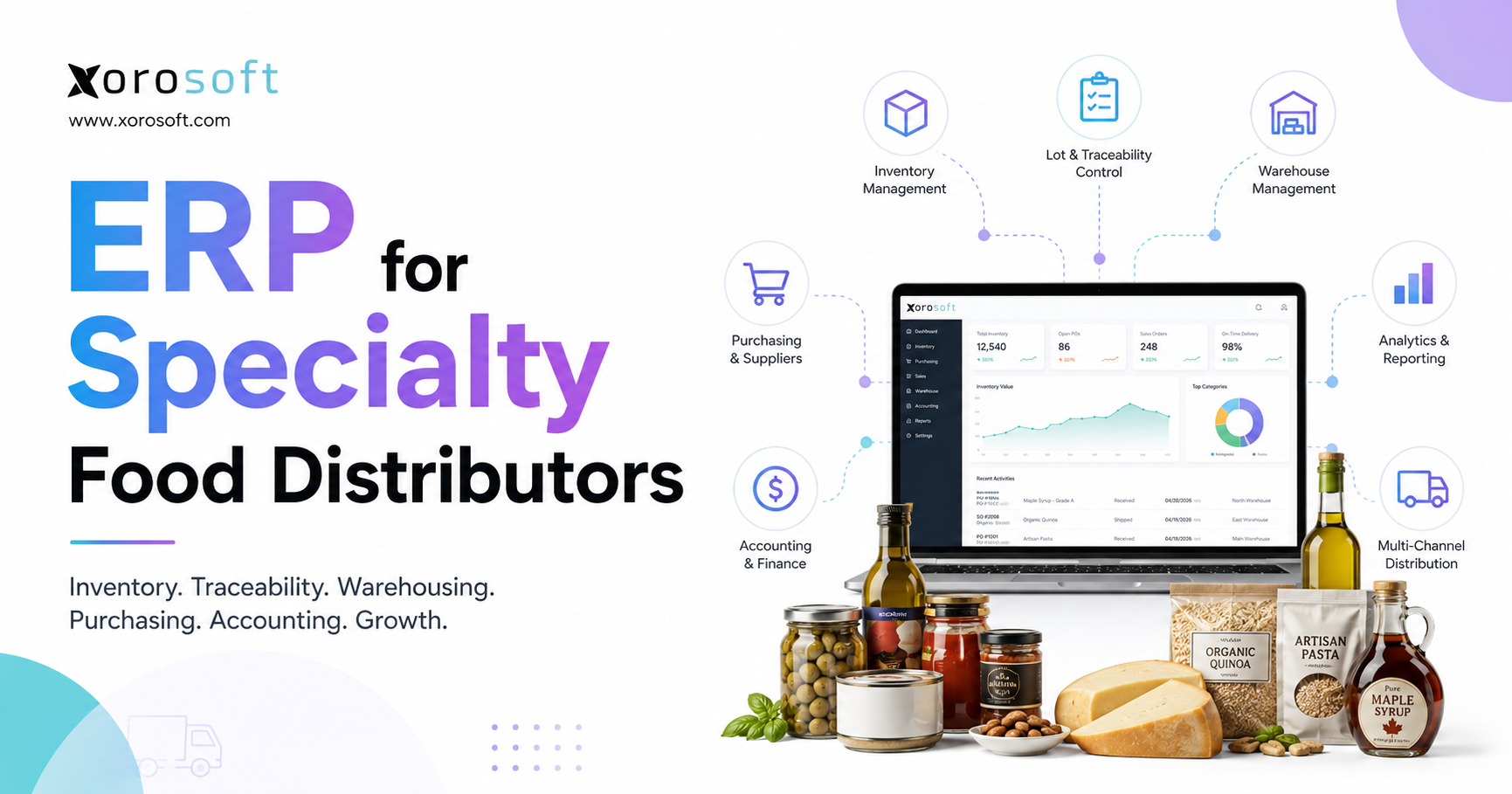
If you are looking for the most effective ERP for specialty food distributors, you have come to the right place.
1. Why Specialty Food Distributors Outgrow Disconnected Systems
Specialty food distribution becomes operationally complicated faster than many businesses expect. Revenue may still look manageable, the team may still know most customers by name, and experienced buyers may still control purchasing through spreadsheets. Behind that apparent simplicity, every new SKU, warehouse, sales channel, supplier, lot number, expiration date, and customer agreement creates another operational dependency.
1.1 Inventory Complexity Extends Beyond Quantity on Hand
A specialty food distributor rarely manages inventory as a simple quantity. Each case may carry a location, cost, allocation status, supplier history, lot identity, and expiration date.
That same case can affect purchasing, customer service, warehouse picking, financial reporting, and traceability at the same time. When each department works in a different system, maintaining a consistent version of that inventory becomes increasingly difficult.
Sales may see one quantity while the warehouse works from another. Purchasing teams may rely on exports and spreadsheets to calculate requirements. Finance often receives summarized information after operational activity has already happened. Meanwhile, EDI and ecommerce platforms create additional order and inventory feeds.
Eventually, employees spend too much time reconciling systems and not enough time acting on reliable information.
1.2 Shelf Life Changes the Meaning of Available Inventory
Food distribution adds an important dimension that many other wholesale businesses do not face: time.
Ten cases in a warehouse do not necessarily equal ten commercially usable cases. Some may expire soon. Others may already belong to customer orders. Certain customers may require a minimum amount of shelf life at delivery, which can make otherwise saleable stock unsuitable for a specific order.
Warehouse location creates another constraint. Inventory may technically exist but sit hundreds of miles away from the customer who needs it.
These factors turn inventory availability into a business rule rather than a simple subtraction problem.
1.3 ERP Becomes Relevant When Coordination Becomes the Bottleneck
ERP for specialty food distributors should not be viewed simply as an accounting upgrade. The larger objective is to create one operating backbone for transactions that determine what the business should purchase, what it can sell, where inventory should move, which stock should ship, what the customer should pay, and how those activities affect financial results.
The business case strengthens when growth creates coordination problems across departments.
Adding another spreadsheet or specialized app can solve an immediate problem. Over time, however, the growing number of integrations and manual handoffs can become a larger operational burden than the original software gaps.
At that stage, ERP becomes less about adding technology and more about reducing fragmentation.
2. What ERP for Specialty Food Distributors Must Actually Manage
ERP for specialty food distributors connects the commercial and operational lifecycle of inventory—from purchasing and receiving through warehouse management, order fulfillment, invoicing, accounting, forecasting, and reporting.
Many software products can technically “manage inventory.” A serious ERP evaluation needs to determine how far the transaction continues after inventory changes.
2.1 Food Distribution ERP Should Connect the Full Transaction Flow
Consider a standard receipt.
A distributor may need to capture the supplier, quantity, unit cost, warehouse, lot number, expiration date, and other product attributes. Once employees complete receiving, the system should make the appropriate quantity available according to business rules.
Later, sales may allocate that inventory to a wholesale account. Warehouse employees then select the correct lot, pick the order, ship the goods, and confirm fulfillment. Accounting needs the corresponding invoice, inventory valuation, cost of goods sold, and receivable activity.
A connected food distribution ERP carries the transaction across those steps without forcing teams to rebuild the same information in several applications.
2.2 Specialty Food ERP Requirements Vary by Business Model
A regional dry-goods distributor and a specialty cheese importer do not operate the same way. Neither follows the same workflows as a Shopify-first food brand that recently expanded into wholesale.
Shelf life, lot control, catch weight, warehouse count, landed costs, EDI, customer pricing, ecommerce volume, and manufacturing requirements all influence software fit.
For that reason, buyers should evaluate industry fit at the workflow level instead of simply checking whether a vendor lists “food and beverage” among its industries.
2.3 Not Every Food Distributor Needs a Full ERP
A smaller distributor with one warehouse, straightforward products, predictable purchasing, and limited integration requirements may perform well with accounting software and a capable inventory system.
ERP creates the most value when several business functions need to share the same transaction data.
Companies should upgrade because operational complexity demands it—not because they crossed an arbitrary revenue threshold.
3. Food Distribution ERP for Inventory, Lot Tracking, and Expiration Control
Inventory accuracy forms the foundation of specialty food distribution. When inventory becomes unreliable, nearly every downstream process becomes harder.
Sales may promise stock that does not exist. Buyers may reorder products that already sit in another warehouse. Operations teams can waste hours searching for items, while finance spends additional time explaining inventory adjustments.
Perishable and lot-controlled inventory makes accuracy even more important.
3.1 Lot Tracking in ERP Software for Food Distributors
A strong lot-tracking process creates a continuous record from receiving through customer shipment.
Warehouse teams should capture relevant lot information when goods enter the business. As employees move inventory between bins or facilities, the system should maintain that lot identity. Fulfillment transactions should then record which lot each customer received.
This creates two important traceability paths.
Teams can start with a customer shipment and identify the related lot, or begin with a lot and identify the inventory locations and customer shipments connected to it.
For businesses that need broader operational control, XoroONE combines inventory management with purchasing, accounting, warehouse management, forecasting, ecommerce, EDI, and reporting in a cloud ERP environment.
3.2 Expiration-Date Management and FEFO Inventory
Expiration information should influence operational decisions before inventory becomes a problem.
FEFO—First Expired, First Out—prioritizes inventory according to expiration date rather than receipt date.
Suppose Lot A arrived yesterday but expires next month, while Lot B arrived two weeks ago and remains usable for another six months. A FEFO process would generally prioritize Lot A because it carries greater expiry risk.
Food distribution ERP software should do more than store expiration dates in a field. Buyers should examine whether expiry information can influence inventory availability, picking, allocation, alerts, and reporting.
The goal is to turn shelf-life data into an operational control.
3.3 Available Inventory Should Reflect Actual Commitments
“On hand” and “available to sell” often represent different quantities.
A distributor may physically hold 500 cases, while customer orders already claim 300. Another 50 may sit on quality hold, and some remaining stock may lack enough shelf life for a specific account.
If sales sees all 500 cases as available, the system provides a technically accurate quantity but an operationally misleading answer.
ERP should help sales, purchasing, and warehouse teams work from the same definition of usable inventory.
4. Warehouse Management in ERP for Specialty Food Distributors
Warehouse execution quickly exposes weaknesses in an ERP implementation. Even a well-configured financial system will struggle if warehouse employees need paper, spreadsheets, or side systems to perform everyday transactions.
Receiving, putaway, transfers, picking, packing, shipping, and cycle counts should strengthen inventory accuracy with every transaction.
4.1 Food Warehouse Management Starts at Receiving
Receiving provides one of the strongest control points in specialty food distribution.
At this stage, employees confirm what arrived and capture the information that supports inventory control later. When products require lot numbers or expiration dates, warehouse teams should collect that data as inventory enters the facility rather than trying to reconstruct it after stock has moved.
Accurate receiving also gives purchasing, sales, and customer service teams faster visibility into incoming supply.
4.2 Warehouse Management Software Should Guide Repeatable Work
A modern warehouse management process should reduce unnecessary manual decision-making.
Barcode-enabled workflows can help employees confirm items, quantities, locations, and order activity without typing every value manually. Directed putaway and picking processes also help standardize how inventory moves through the facility.
XoroWMS provides a warehouse-focused option within the Xorosoft ecosystem for businesses that need inventory tracking, receiving, fulfillment, order management, and warehouse operational control.
During an ERP or WMS demo, specialty food distributors should ask vendors to show a complete transaction. Have the vendor receive a lot-controlled item, record its expiration date, move it into storage, allocate it to an order, pick it, and then display the resulting inventory history.
That workflow reveals much more than a generic barcode-scanning demonstration.
4.3 Multi-Warehouse Food Distribution Requires Network Visibility
A second or third facility adds more than additional storage capacity.
Purchasing teams need to decide where new inventory should arrive. Sales teams need to understand which facility can fulfill demand. Operations managers must determine whether the business should transfer stock or place a new purchase order.
A strong ERP gives planners both local and network-level visibility so they can make those decisions using one inventory picture.
5. Purchasing and Forecasting in Specialty Food Distribution ERP
Purchasing in specialty food distribution requires constant balance.
Order too little and the business loses sales or disappoints important customers. Buy too much and working capital becomes tied up in products that may age before the company sells them.
As complexity grows, basic minimum-and-maximum rules often become insufficient.
5.1 Food Distribution ERP Should Connect Forecasting With Inventory
A useful purchasing decision considers more than historical sales.
Current inventory, incoming purchase orders, supplier lead times, existing customer commitments, safety stock, seasonality, and warehouse-level demand can all affect what the business should buy.
Suppose a forecast indicates demand for 1,000 units next month. If the business already holds 700 and expects another 600 from existing purchase orders, blindly ordering another 1,000 would create an obvious overstock risk.
Connected ERP allows planners to compare demand with the actual supply position before creating new commitments.
5.2 Perishable Inventory Makes Overstock More Expensive
For nonperishable products, excess inventory primarily creates working-capital and storage costs. Food products introduce shelf-life risk as well.
EPA reports that more than one-third of food produced in the United States never gets eaten. That statistic covers the broader food system rather than specialty distribution alone, but it demonstrates why waste reduction remains economically important.
Better demand planning cannot eliminate spoilage. It can, however, help purchasing teams identify excess inventory sooner, monitor incoming supply more carefully, and react before aging stock becomes unsellable.
5.3 Supplier Lead Times Should Influence Replenishment
Two items with identical sales velocity may require very different purchasing strategies.
A domestic supplier that delivers in three days creates a different risk profile from an imported item with a multi-week lead time. ERP planning should make those differences visible.
Buyers should also factor in case quantities, minimum orders, supplier calendars, seasonal constraints, and known promotional demand.
6. Integrated Accounting in Food Distribution ERP
Inventory transactions eventually become financial transactions.
Every receipt, shipment, return, landed-cost adjustment, write-off, and inventory correction can affect financial reporting. When inventory and accounting live in separate systems, finance often spends significant time reconstructing operational activity.
6.1 Food Distributor Accounting Should Follow Inventory Activity
Connected ERP gives finance a clearer path from physical inventory movement to financial impact.
Receipts influence inventory value and supplier liabilities. Customer shipments contribute to cost of goods sold. Freight and duties can affect landed cost. Damaged or expired inventory may require write-offs, while customer returns can change both inventory and receivables.
As transaction volume grows, manual reconciliation between operational systems and accounting becomes harder to sustain.
6.2 Specialty Food Distributors Need Margin Visibility
Revenue growth does not guarantee healthy economics.
Supplier costs change. Freight costs vary. Customers negotiate different prices. Promotions reduce gross margin. Different channels create different fulfillment expenses.
Food distributors therefore need reporting that connects revenue with inventory costs and operational activity.
For companies that need broader financial and operational integration, XoroERP provides an ERP option for businesses that have moved beyond basic accounting and inventory tools.
6.3 Landed Cost Matters for Import-Heavy Businesses
Specialty food importers often need to understand more than invoice cost.
Freight, brokerage, duties, insurance, and related charges may materially change the true cost of a product. Without accurate landed-cost allocation, product-margin reports can create a misleading picture.
ERP should help finance and purchasing understand what inventory actually costs after the business brings it into the warehouse.
7. EDI, Shopify, and Omnichannel ERP for Specialty Food Distributors
Many specialty food businesses now sell through several channels at once.
A distributor may serve independent retailers through traditional wholesale ordering, large chains through EDI, direct consumers through Shopify, and marketplace buyers through Amazon.
Receiving orders from those channels is only the beginning. Inventory, pricing, allocation, fulfillment, and accounting still need to stay synchronized.
7.1 Wholesale Food Distribution ERP Must Handle Customer-Specific Rules
Wholesale customers often bring unique commercial requirements.
The business may need contract pricing, customer-specific discounts, case quantities, payment terms, allocations, and shipping requirements. Larger retail accounts can introduce additional EDI documents and fulfillment expectations.
Instead of asking only whether an ERP “supports EDI,” buyers should ask vendors to demonstrate how an EDI purchase order becomes an internal sales order and how shipment and invoice data return to the trading partner.
7.2 Shopify ERP Integration Should Connect More Than Orders
For specialty food companies selling through Shopify, integration quality affects much more than order imports.
The ERP needs to maintain inventory consistency, process fulfillments, handle refunds and returns, and support financial reconciliation without creating another isolated channel.
The official Xorosoft ERP listing on the Shopify App Store describes synchronization for orders, payments, products, refunds, ship confirmations, and inventory while also referencing multi-location inventory and connectivity with other services.
The broader principle matters regardless of platform: Shopify should draw from the same trusted inventory picture as wholesale and other channels.
7.3 Omnichannel Growth Makes Allocation More Important
When several channels compete for the same inventory, businesses need clear allocation rules.
A wholesale account may have a contractual commitment. Ecommerce shoppers expect real-time availability. A major retail customer may require product from a specific facility.
ERP helps when the business needs a common framework for deciding which demand receives which stock.
8. Food Traceability ERP, FSMA 204, and Recall Readiness
Traceability deserves more than a checkbox during ERP selection.
A system may advertise lot tracking without supporting the specific data and workflows that a specialty food distributor actually needs.
8.1 Food Traceability Requires Structured Transaction Data
The FDA Food Traceability Rule establishes additional recordkeeping requirements for certain foods on the Food Traceability List.
The framework centers on Key Data Elements, or KDEs, associated with Critical Tracking Events, or CTEs. FDA also uses traceability lot codes to connect relevant information as covered foods move through the supply chain.
For distributors, the operational lesson is straightforward: traceability data needs continuity.
Receiving records should connect clearly to inventory and shipping activity rather than living in separate applications that employees must search independently.
8.2 ERP Can Support Recall Readiness
Consider a supplier that identifies a problem with one specific lot.
The distributor needs to determine whether affected inventory remains in any warehouse, whether employees transferred part of the stock to another location, and which customers received related product.
A properly configured food traceability ERP can help teams answer those questions much faster than disconnected spreadsheets and systems.
Still, software does not guarantee compliance or recall effectiveness. Companies need accurate data, clear procedures, disciplined transaction entry, and appropriate regulatory guidance.
8.3 FSMA 204 Timing Requires Current Information
The original Food Traceability Rule compliance date was January 20, 2026.
FDA currently states that Congress directed the agency not to enforce the rule before July 20, 2028, and FDA says it intends to follow that directive.
Specialty food distributors should verify current FDA guidance when planning traceability processes because older articles may still present January 2026 as the operative enforcement timeline.
ERP can support recordkeeping, but each business remains responsible for determining which requirements apply to its products and activities.
9. ERP vs Inventory Software and WMS for Food Distributors
A specialty food distributor does not automatically need full ERP simply because inventory has become complicated.
Sometimes a focused inventory application or warehouse management system solves the immediate problem more efficiently.
| Business Requirement | Inventory Software | WMS | Integrated ERP |
|---|---|---|---|
| Inventory visibility | Core capability | Strong | Strong |
| Lot and expiry control | Varies | Often strong | Varies by ERP |
| Receiving and picking | Limited to moderate | Core capability | Often integrated |
| Purchasing | Often available | Usually limited | Typically broader |
| Accounting | Usually separate | Separate | Integrated or connected |
| Financial reporting | Limited | Warehouse-focused | Broad |
| Forecasting | Varies | Limited | Often available |
| Cross-functional workflows | Moderate | Warehouse-centric | Broad |
9.1 ERP vs Inventory Management Software for Food Distributors
Inventory software works well when stock control represents the primary business problem.
A company may only need better quantity visibility, purchase ordering, lot control, and straightforward fulfillment. In that situation, implementing a large ERP could introduce unnecessary complexity.
ERP becomes more relevant when inventory decisions depend heavily on accounting, purchasing, customer orders, forecasting, several facilities, and multiple channels.
9.2 ERP vs WMS for Specialty Food Distribution
A WMS focuses primarily on activity inside the warehouse.
It typically manages receiving, putaway, movement, picking, packing, and shipping. ERP covers a wider operating scope and connects warehouse activity to purchasing, sales, accounting, inventory planning, and reporting.
Some companies need a full ERP with integrated warehouse functionality. Others may need only a stronger WMS.
9.3 ERP vs QuickBooks and Connected Applications
QuickBooks can remain an effective accounting system for a smaller food distributor.
The warning sign appears when the surrounding architecture grows too complex. One application handles inventory, another manages the warehouse, a separate EDI platform receives retail orders, purchasing relies on spreadsheets, and finance reconciles everything after the fact.
At that point, employees effectively maintain a custom ERP built from integrations.
10. When Specialty Food Distributors Should Upgrade to ERP
Revenue alone provides a poor ERP trigger.
Two distributors with identical sales can have completely different operational requirements. One may sell 100 predictable products from a single facility. Another may manage several thousand SKUs, three warehouses, EDI customers, lot control, imports, Shopify, and complex purchasing.
The second company can outgrow its systems far sooner.
10.1 Inventory Problems Often Signal a Broader Systems Issue
Repeated inventory uncertainty provides one of the clearest warning signs.
Sales should not need to call the warehouse every time it wants to confirm stock. Purchasing should not maintain a separate spreadsheet because employees distrust the inventory application. Finance should not discover major unexplained adjustments at every month-end.
When these problems happen together, the business may have a cross-functional systems issue rather than a single inventory problem.
10.2 Spreadsheet Purchasing Becomes Harder to Maintain
Spreadsheets can support sophisticated purchasing models.
Problems arise when buyers spend significant time rebuilding the inputs before making decisions. They may need fresh exports for inventory, open purchase orders, allocations, sales history, forecasts, and supplier lead times.
As the number of dependencies grows, purchasing teams spend more time maintaining the planning model.
ERP can reduce that burden by bringing operational data closer to the purchasing decision.
10.3 Multi-Warehouse Expansion Changes ERP Requirements
A second or third warehouse creates new planning questions.
Where should incoming inventory land? Which location should fulfill a given order? Would a transfer solve a shortage more efficiently than a new purchase order? Which facility holds too much slow-moving stock?
A connected ERP becomes valuable when the business needs to answer those questions using one view of demand and inventory.
11. ERP Use Cases Across Specialty Food Distribution Models
“Specialty food distributor” covers several operating models.
The ERP evaluation should reflect how the company actually buys, stores, sells, and fulfills products rather than relying on a generic industry template.
11.1 ERP for Specialty Food Wholesalers
A conventional wholesaler may prioritize inventory availability, customer-specific pricing, purchasing, warehouse picking, EDI, accounts receivable, and margin reporting.
ERP creates value by connecting those functions so that one sales order does not require several departments to interpret or re-enter the same data.
11.2 ERP for Specialty Food Importers
Importers often face longer supply chains and more complicated landed costs.
A purchase price may represent only one part of the actual product cost. Freight, duties, brokerage, and related expenses can change margins materially.
Long lead times also increase the importance of forecasting because purchasing teams cannot react as quickly to unexpected demand.
11.3 ERP for Multi-Warehouse Food Distributors
Multi-location operators need both facility-level and company-wide visibility.
Warehouse managers need local availability. Purchasing teams need network inventory. Sales employees need to understand which facility can fulfill each order economically.
ERP becomes especially useful when those teams need the same inventory data but view it through different operational lenses.
11.4 ERP for Food Brands Selling DTC and Wholesale
A food brand may begin as a direct-to-consumer business and gradually develop into a hybrid distributor.
Once Shopify, Amazon, wholesale accounts, retail chains, and EDI customers draw from the same inventory, the operational model changes.
Businesses comparing systems across food and beverage, wholesale distribution, manufacturing, ecommerce, and other inventory-intensive sectors can review Xorosoft’s industry solutions as part of their research.
12. How to Evaluate ERP Software for Specialty Food Distributors
A serious ERP evaluation starts with business scenarios, not vendor presentations.
Every provider can demonstrate dashboards and feature menus. Buyers learn much more when they ask each vendor to execute the workflows that create operational risk inside the business.
12.1 Ask ERP Vendors to Run Real Food Distribution Transactions
Give every shortlisted vendor the same scenario.
Ask the team to create a purchase order for a lot-controlled item, receive the product with an expiration date, put inventory into a warehouse location, allocate the item to a customer order, pick the appropriate lot, ship it, create the financial transaction, and then trace the lot.
This exercise tests purchasing, inventory, warehousing, sales, accounting, and traceability together.
A workflow demonstration often reveals weaknesses faster than a long feature checklist.
12.2 Evaluate ERP Around Exceptions
Normal transactions rarely expose the most important limitations.
Ask what happens when a customer changes an order after allocation. Explore how the system handles short receipts, damaged cases, warehouse transfers, expired stock, product substitutions, and customer returns.
Operational exceptions show whether employees can follow the system or will eventually build manual workarounds.
12.3 Compare Total Architecture Instead of Subscription Price
Software price tells only part of the story.
One platform may require separate WMS, forecasting, EDI, reporting, or ecommerce applications. Another might include more of those functions but carry a higher subscription cost.
Compare the entire environment: implementation, integrations, external applications, administration, training, upgrades, and long-term fit.
Companies considering NetSuite can also review the Xorosoft vs NetSuite comparison as one vendor perspective while building their shortlist. Because Xorosoft publishes the page, buyers should combine it with independent research and their own workflow testing.
13. ERP Implementation Mistakes Specialty Food Distributors Should Avoid
ERP projects often struggle because companies underestimate process and data work.
Technology matters, but implementation teams also need clean information, clear ownership, realistic testing, and involvement from the employees who perform everyday transactions.
13.1 Clean the Item Master Before Migration
A new ERP should not become a more expensive home for old data problems.
Teams should review duplicate SKUs, obsolete products, inconsistent descriptions, units of measure, supplier records, customer records, and opening inventory before migration.
Specialty food companies should pay particular attention to pack sizes, lot requirements, expiration rules, and purchasing units.
13.2 Do Not Rebuild Every Legacy Workaround
Employees naturally want new software to resemble familiar systems.
That instinct can preserve unnecessary processes.
Some historical workarounds exist only because older systems could not communicate. Instead of recreating them automatically, implementation teams should ask what business requirement the process actually serves.
13.3 Include Warehouse and Purchasing Teams in Testing
Finance and IT should not control the entire ERP design.
Warehouse employees may execute thousands of transactions inside the system, while buyers make decisions that directly affect cash flow and service levels.
Including those teams during requirements gathering and user testing helps uncover practical workflow issues before go-live.
13.4 Treat Go-Live as the Start of Operational Stabilization
Companies should expect to refine processes after launch.
The first weeks provide useful evidence about training gaps, transaction errors, reporting needs, exception handling, and data quality.
Strong implementations use that period to improve discipline rather than simply declaring the project complete.
14. ERP for Specialty Food Distributors: Frequently Asked Questions
14.1 What is ERP for specialty food distributors?
ERP for specialty food distributors is an integrated business system that connects inventory, purchasing, warehouse management, sales, accounting, forecasting, and reporting. Food-focused operations may also need lot tracking, expiration management, FEFO workflows, traceability, customer-specific pricing, EDI, and multichannel order management.
14.2 What is the best ERP for specialty food distributors?
No single ERP fits every specialty food distributor. The right system depends on warehouse complexity, SKU count, lot and expiry requirements, accounting needs, EDI, Shopify, purchasing, forecasting, manufacturing, budget, and implementation resources. Buyers should compare vendors using real workflows rather than relying on rankings alone.
14.3 What features should food distribution ERP software include?
Core requirements often include inventory visibility, multi-warehouse management, purchasing, warehouse workflows, accounting, reporting, and order management. Specialty food companies may additionally need lot tracking, expiration control, FEFO, customer pricing, EDI, demand forecasting, landed-cost management, and ecommerce integrations.
14.4 Do all specialty food distributors need ERP?
No. Smaller distributors with one location, straightforward products, modest transaction volume, and limited integration requirements may operate efficiently with accounting software plus a focused inventory application. ERP becomes more compelling when multiple departments and sales channels need to share the same operational data.
14.5 When should a specialty food distributor implement ERP?
Common warning signs include unreliable inventory, spreadsheet-driven purchasing, frequent reconciliation, multiple warehouses, growing EDI volume, disconnected ecommerce systems, slow month-end reporting, duplicate data entry, and difficulty tracing transactions across departments. Several of these problems together often indicate a broader systems issue.
14.6 Can ERP track food lot numbers?
Many distribution-focused ERP platforms support lot tracking. Buyers should verify when employees capture lot data, how the system maintains that information during warehouse movements, whether customer shipments retain the lot association, and how quickly users can perform forward and backward searches.
14.7 Can food distribution ERP track expiration dates?
Many food-oriented systems store expiration dates, but storing the information represents only the first step. Buyers should examine whether the software can use expiry data for warehouse picking, allocation, availability, alerts, and reporting when those processes matter.
14.8 What is FEFO inventory management?
FEFO stands for First Expired, First Out. The method prioritizes inventory according to expiration date rather than simply receipt date. Food distributors often use FEFO concepts to reduce the risk that shorter-dated inventory remains in storage while longer-dated stock ships first.
14.9 Can ERP help reduce food waste?
ERP cannot eliminate food waste, but better forecasting, expiry visibility, purchasing, inventory rotation, and warehouse control can help teams identify excess or aging products sooner. Earlier visibility gives the business more time to change purchasing decisions or act on slow-moving stock.
14.10 How does ERP improve food traceability?
ERP can link purchase receipts, lot records, warehouse movements, sales orders, and customer shipments in one transaction history. That structure can make it easier to identify where a specific lot originated, where employees stored it, and which customers received it.
14.11 Can ERP help with food recalls?
A properly configured ERP can support recall readiness by helping employees locate affected inventory and identify related supplier receipts and customer shipments. Effective recalls still depend on accurate transaction data, documented procedures, employee training, and appropriate regulatory processes.
14.12 Does ERP automatically make a business FSMA 204 compliant?
No. ERP can support traceability records and data retrieval, but software does not guarantee compliance. Businesses need to determine which requirements apply to their operations, configure workflows correctly, and follow current FDA guidance or qualified regulatory advice.
14.13 What are CTEs and KDEs in food traceability?
CTEs are Critical Tracking Events, while KDEs are Key Data Elements connected to those events. The FDA Food Traceability Rule uses this framework for applicable foods and activities. Companies should design their traceability processes around the specific requirements that apply to their supply chain role.
14.14 Can specialty food ERP manage multiple warehouses?
Distribution-oriented ERP systems commonly support multiple facilities. Buyers should test location-level inventory, transfers, allocations, replenishment, availability, cycle counts, and reporting. Simply listing multiple warehouses does not guarantee that the software supports the business’s actual network decisions.
14.15 What is the difference between ERP and WMS for food distributors?
A WMS primarily manages activity inside the warehouse, including receiving, putaway, picking, packing, and shipping. ERP covers a wider business scope and connects warehouse activity with purchasing, sales, accounting, inventory planning, forecasting, and reporting.
14.16 What is the difference between ERP and inventory software?
Inventory software primarily manages stock and related transactions. ERP broadens the scope by connecting inventory with other departments, including finance, purchasing, sales, warehouse operations, planning, and sometimes manufacturing.
14.17 Is QuickBooks enough for a specialty food distributor?
QuickBooks can work well for smaller or less complicated operations. Challenges usually appear when the company adds several inventory, warehouse, EDI, ecommerce, and purchasing tools around it and finance must spend increasing amounts of time reconciling those systems.
14.18 Can ERP automate purchasing for food distributors?
ERP can automate parts of purchasing, including reorder recommendations, approval workflows, and purchase-order creation. More sophisticated planning can combine demand, supplier lead times, current stock, incoming supply, safety stock, and existing customer commitments.
14.19 Can ERP forecast demand for specialty food products?
Many ERP systems offer forecasting functionality or connect with planning tools. Food distributors can use forecasting to support decisions involving seasonality, promotions, supplier lead times, and shelf-life constraints. Planners should treat forecasts as decision inputs rather than guaranteed future demand.
14.20 Can food distribution ERP support EDI?
Many distribution ERP platforms support EDI directly or through specialized providers. Buyers should test the complete transaction path, including how an incoming customer purchase order becomes an internal sales order and how shipment and invoice information flow back to the trading partner.
14.21 Can specialty food ERP integrate with Shopify?
Yes, depending on the platform. A useful Shopify ERP integration should handle more than basic order imports. Buyers should evaluate inventory synchronization, fulfillment, payments, returns, multiple locations, financial reconciliation, and exception handling.
14.22 How much does ERP for specialty food distributors cost?
ERP cost depends on users, modules, implementation scope, integrations, data migration, customization, training, and support. Rather than comparing subscription fees alone, buyers should calculate the total cost of the software environment and consider which existing applications the ERP may replace.
14.23 How long does food distribution ERP implementation take?
Implementation timelines vary based on company size, warehouse count, data quality, integration requirements, process complexity, customization, and internal resources. Buyers should avoid generic timelines that ignore those variables and instead build a plan around actual implementation scope.
14.24 What should specialty food distributors ask during an ERP demo?
Ask vendors to demonstrate a complete real-world workflow. A strong test begins with a purchase order for a lot-controlled product, continues through receiving and warehouse fulfillment, then follows the customer shipment into accounting and lot traceability.
14.25 Who should participate in a food distribution ERP project?
A strong ERP project team usually includes operations, purchasing, warehouse, finance, sales or customer service, and technical stakeholders where integrations matter. Executive sponsorship helps maintain priorities, while frontline employees provide essential feedback on transaction-level workflows.
15. Choosing the Right ERP Path for Your Specialty Food Distribution Business
The strongest ERP decisions begin with operational reality rather than software features.
15.1 Map the Workflows That Create the Most Risk
Start by following inventory from purchase order through receiving, lot capture, storage, allocation, picking, shipment, invoicing, and reporting.
Identify where employees enter information twice. Find the spreadsheets that teams depend on to make critical decisions. Document situations where employees stop trusting system data and call another department to confirm what is actually happening.
Those moments reveal the real ERP requirements.
A distributor with straightforward operations may discover that a better inventory system or WMS solves the problem. Another business may find that several warehouses, lot-controlled inventory, EDI, Shopify, forecasting, purchasing, and financial reconciliation have become too interconnected for separate applications.
15.2 Make Vendors Prove Your Real Specialty Food Workflows
Treat ERP as an operating architecture rather than a feature collection.
Ask every shortlisted vendor to demonstrate the transactions that matter most to your company. Use your warehouse structure, product attributes, purchasing rules, customer channels, and reporting expectations as the test.
For businesses that have reached the point where inventory, purchasing, warehouse operations, accounting, forecasting, ecommerce, EDI, and reporting need to work together, Xorosoft can be one platform to evaluate.
Rather than relying on a generic feature tour, the next step should focus on your actual distribution process.
Contact Xorosoft to discuss your current systems, operational requirements, and the workflows you want an ERP platform to support.
A disciplined evaluation should leave every vendor with the same challenge: show how the system will run the specialty food distribution business you actually operate, not the sample company in the sales presentation.
Recent Posts
-
 ERP Landed Cost Module vs Spreadsheet Calculations for Importers
 -
 How to Build an Open-to-Buy Plan for an Omnichannel Brand
 -
 Cold Storage WMS for Food and Beverage Distribution
 -
 ERP Buying Statistics 2026: Evaluation, Implementation, and Adoption Risks
 -
 How a Distributor Reduced B2B Order Exceptions Without Restricting Sales