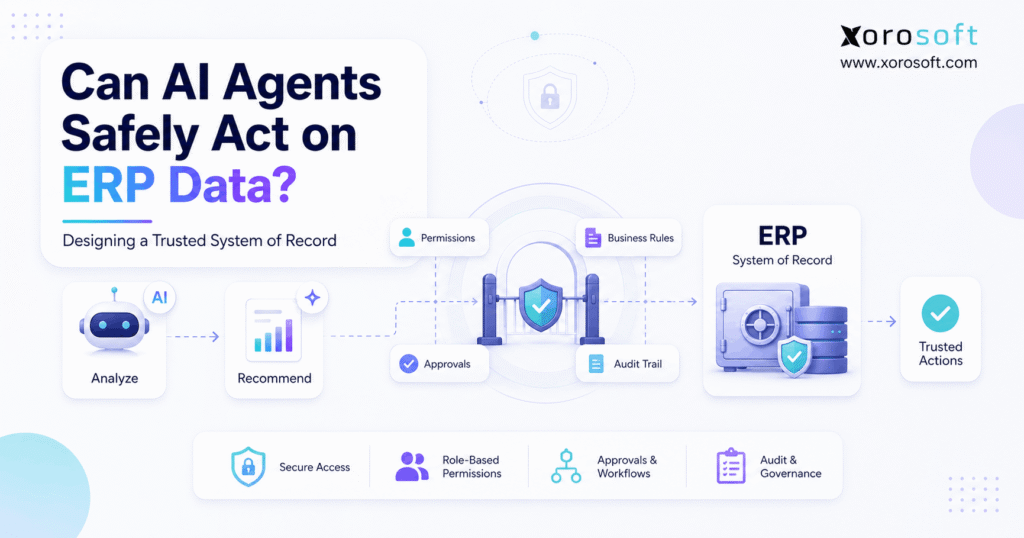
In this article, we explore the importance of AI agent governance in ERP systems and how it is reshaping enterprise processes.
1. Why AI Agent Governance in ERP Matters
AI agent governance in ERP matters because enterprise AI is moving from answering questions to taking operational action. However, an agent that only analyzes inventory creates a very different risk from one that creates a purchase order, adjusts stock, or prepares a financial transaction.
Therefore, businesses need clear rules before AI receives transactional authority. Previously, companies used AI mainly for reporting, forecasting, search, and recommendations. Now, however, modern agents can retrieve business data, use tools, coordinate steps, and initiate workflows.
As a result, the key question has changed. Instead of asking, “What can AI tell us?” operators now need to ask, “What should AI be allowed to do?”
1.1 The Real Risk Is Authority, Not Intelligence
The biggest governance issue is not whether an AI model can detect a stockout. Instead, the issue is whether that model should be allowed to create inventory transfers, issue purchase orders, or commit company funds.
Therefore, AI agent governance in ERP must separate reasoning from authority. An agent may conclude that ordering 2,000 units is the best decision. Nevertheless, the ERP should still determine whether that agent can create or release the transaction.
1.2 How AI Agents in ERP Read and Change Data
Read-only access usually creates less operational risk. For example, an agent might identify overdue purchase orders, low-stock products, warehouse exceptions, or delayed shipments.
However, write access changes the risk profile immediately. Once an agent can update master data, release inventory, post accounting activity, or create financial commitments, stronger controls become necessary.
Consequently, businesses should expand permissions gradually rather than granting broad access from the beginning.
1.3 Why Controlled Autonomy Matters
AI agent governance in ERP should not aim for maximum autonomy. Instead, it should give an agent only the authority needed to complete an approved task safely.
For example, an agent may prepare a purchase order but require approval before release. Alternatively, it may release routine orders below a defined value while escalating larger transactions.
Therefore, successful governance increases speed without removing accountability.
2. AI Agent Governance in ERP and the Trusted System of Record
AI becomes more useful when it has reliable operational context. However, it also becomes more dangerous when that context is inconsistent, duplicated, or spread across disconnected systems.
Therefore, a trusted ERP foundation becomes more important as companies introduce agents. A system of record provides an authoritative place for inventory movements, purchase orders, invoices, production activity, customer orders, and accounting entries.
2.1 What a Trusted System of Record Actually Does
A trusted system of record does more than store information. Instead, it applies business rules, permissions, transaction logic, and audit history to operational activity.
For example, the system may know whether a supplier is approved, whether a warehouse has available stock, whether an accounting period is open, or whether a user can release a purchase order.
Consequently, AI should operate through that structure rather than bypass it.
2.2 How AI Agents in ERP Work With Operational Data
AI models are designed to interpret context and handle ambiguity. ERP transactions, however, need deterministic records.
Therefore, a safer architecture separates responsibilities:
- AI analyzes what may need to happen.
- Policies determine whether the action is allowed.
- ERP business logic validates the transaction.
- Humans approve exceptions where required.
- ERP records the final business event.
As a result, AI can remain flexible while transactional records remain controlled.
2.3 Why Reliable Data Comes First
An agent cannot make consistently useful decisions if inventory, supplier, customer, accounting, or warehouse data is unreliable.
Moreover, disconnected spreadsheets create additional uncertainty. If several systems disagree on available inventory, the agent must decide which source to trust.
Consequently, businesses should improve data quality and ownership before increasing AI autonomy.
3. Five Levels of Agent Authority
Not every AI agent needs the same level of access. Therefore, businesses should classify authority according to the consequence of each action.
AI agent governance in ERP works best when organizations progress through clear levels. Consequently, teams can measure accuracy and reliability before giving agents additional control.
| Level | Agent Capability | Example | Human Role |
|---|---|---|---|
| 1 | Observe | Detect low inventory | Investigate |
| 2 | Recommend | Suggest reorder quantity | Decide |
| 3 | Prepare | Draft purchase order | Review |
| 4 | Execute within limits | Release low-risk PO | Monitor |
| 5 | Exception-based autonomy | Execute routine cases | Handle exceptions |
3.1 Observe and Recommend
At Level 1, the agent only reads information. Therefore, it may identify stockouts, delayed orders, purchasing risks, or warehouse exceptions without changing any record.
At Level 2, the agent recommends a next action. However, a human still decides whether to proceed.
As a result, businesses can test the quality of recommendations before allowing transactional execution.
3.2 Preparing ERP Transactions With AI
At Level 3, the agent can prepare transactions. For example, it may build a draft purchase order, inventory transfer, customer credit, or warehouse task.
However, the transaction remains pending until a person reviews it.
Therefore, companies can reduce repetitive data entry while keeping final control with employees.
3.3 Controlled Execution Within Defined Limits
At Level 4, an agent may execute actions inside predetermined limits. For example, it could release a routine purchase order below $2,500 when price, quantity, supplier, and inventory conditions remain normal.
At Level 5, routine transactions may proceed automatically while exceptions escalate.
Consequently, governance shifts from approving every action to clearly defining normal and abnormal activity.
4. Seven Core Controls for AI Agent Governance in ERP
Giving an AI agent access to ERP functions without safeguards creates unnecessary risk. Therefore, businesses should establish a governance layer before allowing autonomous execution.
Moreover, these controls can apply across inventory, purchasing, accounting, warehousing, manufacturing, and ecommerce operations.
4.1 Identity Controls for ERP AI Agents
Every agent should operate through an identifiable account, service identity, or controlled integration. Otherwise, administrators may struggle to determine which actor initiated a change.
In addition, businesses should avoid shared administrator credentials. Instead, each agent should receive access based on its specific responsibility.
Therefore, access can be monitored, changed, or revoked without affecting unrelated users.
4.2 Applying Least-Privilege Access
An inventory analysis agent does not automatically need permission to adjust inventory. Similarly, a purchasing agent should not need access to banking information.
Therefore, give each agent only the permissions required for its task.
This principle aligns with broader guidance from the NIST AI Risk Management Framework, which emphasizes governance, control, monitoring, and ongoing risk management.
4.3 Separating Read and Write Permissions
Many companies can safely allow an agent to read broader operational context while restricting write authority.
For example, an agent may use sales, inventory, purchasing, and warehouse information to generate a recommendation. However, it may receive write access only for a specific transaction type.
Consequently, context can remain broad while execution stays narrow.
4.4 Business Rules for AI Agent Governance in ERP
A language model should not invent approval policy. Instead, purchasing limits, accounting controls, credit rules, inventory constraints, and supplier requirements should remain governed business rules.
Therefore, the ERP must validate transactions even when AI recommends them.
As a result, a confident AI response cannot override a blocked supplier, closed accounting period, or restricted warehouse.
4.5 Where Human Approval Still Matters
Some actions are too consequential for unrestricted automation. Therefore, human approval should remain mandatory when financial, operational, or security impact is significant.
For example, supplier banking changes, material inventory write-offs, large journal entries, and unusual payments deserve stronger oversight.
Meanwhile, lower-risk recurring actions may eventually proceed automatically.
4.6 Building a Reliable Agent Audit Trail
A useful audit trail should identify:
- Which agent acted
- Who initiated the process
- Which records were accessed
- What action was proposed
- Which approval occurred
- What ERP transaction changed
- Whether an exception occurred
Consequently, AI agent governance in ERP should make automated activity easier to investigate, not harder.
4.7 Monitoring and Revoking Access
Governance continues after deployment. Therefore, administrators should be able to reduce permissions, disable tools, revoke credentials, or stop an agent when abnormal behavior appears.
Moreover, monitoring should focus on unusual transaction patterns rather than simply whether the agent is technically functioning.
As a result, businesses can intervene before a small problem becomes a larger operational issue.
5. Which ERP Actions Should Be Automated?
Not every ERP action deserves the same autonomy. Therefore, one practical method is to classify workflows as green, amber, or red.
AI agent governance in ERP becomes easier when teams agree on these risk categories before building automation.
| Risk Zone | Examples | Recommended Control |
|---|---|---|
| Green | Read stock, identify delayed POs, summarize exceptions | Automatic |
| Green | Prepare reports and recommendations | Automatic |
| Amber | Create PO, transfer, customer credit | Rules + thresholds |
| Amber | Prepare inventory adjustment or journal | Review when material |
| Red | Change supplier banking | Mandatory human approval |
| Red | Post major journal entry | Finance approval |
| Red | Change user permissions | Security approval |
5.1 Low-Risk Actions
Green-zone actions are usually reversible, informational, or limited in impact.
For example:
- Reading inventory availability
- Flagging delayed purchase orders
- Detecting low-stock SKUs
- Summarizing warehouse exceptions
- Drafting supplier emails
- Preparing operational reports
Therefore, these workflows are strong starting points for agent adoption.
5.2 Transactions That Need Rules and Thresholds
Amber actions create or modify business transactions. Therefore, they need thresholds and validation.
Examples include:
- Creating purchase orders
- Preparing transfers
- Releasing routine warehouse tasks
- Creating customer credits
- Preparing inventory adjustments
- Drafting journal entries
However, the agent should remain inside defined value, quantity, supplier, customer, and warehouse limits.
5.3 High-Risk Actions That Need Human Control
Red-zone actions deserve mandatory human control.
For example:
- Changing supplier banking details
- Posting major journal entries
- Writing off material inventory
- Changing user permissions
- Approving large payments
- Altering sensitive master data
Therefore, AI may prepare these changes, but final approval should remain with an authorized person.
6. AI Agents Across Inventory, Purchasing, and Warehousing
Inventory-driven businesses provide strong use cases because decisions depend on several connected operational signals. Therefore, AI can reduce manual investigation when underlying ERP data is reliable.
However, AI agent governance in ERP still needs to determine which actions are advisory and which are transactional.
6.1 Inventory Management Use Cases
An inventory agent could compare on-hand stock, allocations, incoming purchase orders, demand, and warehouse balances.
Consequently, it could identify likely stockouts, excess inventory, or transfer opportunities faster than someone manually reviewing several reports.
For businesses that need a unified operational foundation, XoroERP connects inventory, purchasing, accounting, warehouse processes, manufacturing, forecasting, and related workflows in one cloud ERP environment.
6.2 AI Agent Governance for ERP Purchasing
Purchasing agents could review forecast demand, supplier lead times, inventory, incoming supply, and reorder requirements.
Next, the agent could recommend a quantity or prepare a purchase order.
However, purchase-order release should still follow supplier rules, value limits, pricing tolerances, and approval thresholds.
Therefore, automation speeds up purchasing without eliminating procurement controls.
6.3 Warehouse Operations and Exception Management
Warehouse agents could identify receiving discrepancies, replenishment priorities, picking bottlenecks, and inventory exceptions.
Moreover, they could recommend movement between zones, bins, or facilities.
For businesses with more complex fulfillment operations, XoroWMS provides a centralized warehouse-management layer that keeps operational activity tied to controlled inventory transactions.
7. How an AI Agent Should Create a Purchase Order
A purchasing workflow is a useful example because it combines AI reasoning with clear ERP controls.
Therefore, it shows where automation can create value and where deterministic validation should remain.
7.1 Evaluate Inventory and Demand
First, the agent reads available inventory, open customer demand, allocations, incoming supply, forecast requirements, and supplier lead times.
Next, it determines whether a shortage is likely.
However, the agent should not create an order simply because forecast demand is higher than current on-hand inventory.
7.2 Check Existing Supply
Before recommending another order, the agent should check open purchase orders and inbound transfers.
Otherwise, it may create unnecessary inventory.
Therefore, the system should consider projected availability rather than treating current on-hand inventory as the entire picture.
7.3 Validate the Supplier
Next, the agent identifies an approved supplier and evaluates expected pricing, lead time, minimum quantities, and pack sizes.
However, the ERP should still validate whether that supplier is active and approved.
Consequently, the agent cannot create a valid transaction by selecting an unsupported vendor.
7.4 Prepare the Transaction
Once the conditions are satisfied, the agent can prepare the PO.
Then, the system evaluates whether the order remains inside the agent’s authority.
For example, a $1,200 routine reorder may qualify for automatic release. Conversely, a $45,000 purchase should require a buyer or manager.
7.5 Record the Decision and Approval
Finally, the ERP records the approved transaction and its audit history.
Therefore, employees can review the order, supplier, quantity, approval, and resulting inventory commitment.
As a result, the agent helps create the transaction without becoming the source of truth.
8. What Happens When an ERP AI Agent Is Wrong?
Every governance framework should assume that an agent will eventually make a poor recommendation.
Therefore, the system needs safeguards for both obvious errors and plausible-but-wrong decisions.
8.1 How Bad Data Creates Bad Decisions
Suppose the inventory balance is wrong because receipts were never posted. Consequently, an agent may recommend unnecessary purchasing.
Similarly, an inaccurate supplier lead time may create a false stockout warning.
Therefore, businesses need reliable operational data before expecting dependable AI decisions.
8.2 Why ERP Rules Must Reject Invalid Actions
An agent might recommend an action that violates policy.
However, the ERP should reject the transaction when required conditions are missing.
For example, the system may block:
- An inactive supplier
- An unauthorized warehouse
- A closed accounting period
- An excessive quantity
- An unapproved discount
- A transaction above the agent’s threshold
Therefore, business rules remain the final gate.
8.3 Escalating Exceptions to People
If important data is missing, the agent should not simply improvise.
Instead, it should stop and request human review.
Consequently, exception handling becomes one of the most useful parts of ERP AI governance because people can focus on unusual cases rather than routine work.
9. MCP and AI Agent Governance in ERP
AI agents need a controlled method for interacting with business systems.
Therefore, companies are increasingly evaluating APIs and Model Context Protocol, or MCP, for exposing approved ERP capabilities.
However, the connection method does not replace authentication, permissions, transaction rules, or auditing.
9.1 How MCP Supports ERP Agents
MCP can provide compatible AI systems with a structured way to discover and call approved tools.
For example, an ERP might expose a tool that checks inventory availability, retrieves an open PO, or prepares a purchase transaction.
Microsoft’s documentation for its Dynamics 365 ERP MCP server similarly describes controlled access to finance and operations data and business logic.
9.2 Why MCP Does Not Replace Security Controls
AI agent governance in ERP still requires independent security controls.
In other words, discovering a tool does not mean an agent should automatically be authorized to execute it.
For businesses evaluating this architecture, Xorosoft’s AI MCP Server provides additional context around connecting AI workflows with governed ERP data.
9.3 Why Narrow Tools Are Safer
A specific function such as “get inventory availability” is easier to control than a generic tool capable of changing any database field.
Therefore, agent tools should expose approved business actions whenever possible.
Consequently, ERP business logic remains responsible for validating the final result.
10. AI Agent Governance in ERP for Ecommerce Operations
Ecommerce businesses often operate across Shopify, marketplaces, wholesale orders, warehouses, purchasing, and accounting.
Therefore, an agent may need context from several workflows before making a useful decision.
However, more integrations also create more opportunities for conflicting data.
10.1 Shopify and Operational ERP Data
A Shopify storefront knows what a customer purchased. However, broader operational decisions may also require warehouse availability, open purchase orders, expected receipts, wholesale allocations, and accounting status.
Therefore, companies need a controlled operational layer behind the storefront.
Xorosoft’s integrations connect ERP workflows with ecommerce and other operational systems without requiring the AI layer to become the system of record.
10.2 Governing Multi-Channel Inventory Decisions
Suppose an agent sees available inventory in one sales channel and decides to allocate it.
However, a wholesale order may already depend on that same stock.
Therefore, AI agent governance in ERP should ensure agents use authoritative availability rather than isolated channel balances.
10.3 Ecommerce Integrations and Source-of-Truth Design
Ecommerce teams should also understand how connected applications interact with their commerce platform.
For example, Shopify merchants evaluating Xorosoft can review the Xorosoft ERP listing in the Shopify App Store.
As a result, teams can evaluate both the ERP foundation and the external commerce connection before expanding automation.
11. Who Is Ready for Agentic ERP?
Not every business needs autonomous agents immediately.
Therefore, companies should evaluate operational maturity before increasing AI authority.
AI agent governance in ERP works best when business rules already exist and users generally trust the underlying data.
11.1 Businesses That Are Strong Candidates
Businesses may be good candidates when they have:
- High transaction volume
- Multiple warehouses
- Large SKU catalogs
- Defined purchasing policies
- Shopify or multi-channel operations
- Wholesale or EDI workflows
- Manufacturing requirements
- Reliable inventory data
- Repeatable exception processes
Moreover, these organizations usually have enough recurring operational work to justify controlled automation.
11.2 When the Operational Foundation Comes First
A company should be cautious when inventory accuracy is poor, approvals are undocumented, or spreadsheet data regularly conflicts with ERP records.
Likewise, businesses using disconnected inventory, accounting, warehouse, and purchasing applications may need to centralize operations first.
Therefore, agentic ERP governance should follow process discipline rather than attempt to replace it.
12. Common AI Agent Governance Mistakes
AI adoption can fail even when the underlying model performs well.
Therefore, organizations should focus on operational design as much as AI capability.
Moreover, many of the biggest risks come from giving an agent too much authority too early.
12.1 Giving Agents Too Much Access
Broad administrator access is convenient during testing. However, it creates unnecessary exposure.
Instead, governance should define separate permissions for each business purpose.
Consequently, an inventory agent can work with inventory workflows without gaining control over banking, accounting, or security settings.
12.2 Automating Broken Processes
Automation makes a process faster. However, it does not automatically make that process better.
Therefore, teams should standardize purchasing, receiving, inventory adjustment, and approval workflows before handing them to an agent.
Otherwise, the agent may simply execute inconsistent practices faster.
12.3 When Traditional Automation Works Better
Not every workflow needs an AI agent.
For example, a fixed rule that releases a warehouse task under clear conditions may work better as traditional workflow automation.
Therefore, use AI when interpretation, context, or exception handling creates genuine value.
Conversely, keep deterministic processes deterministic when possible.
12.4 Separating Recommendations From Authorization
An AI system may generate a persuasive explanation.
Nevertheless, confidence in that explanation does not equal permission to act.
Therefore, recommendations should pass through policies, permissions, and approval rules before becoming transactions.
13. A Safer Rollout Model for ERP AI Agents
Businesses do not need to move from manual work to full autonomy in one step.
Instead, a phased rollout allows teams to measure quality before increasing authority.
Therefore, AI agent governance in ERP should evolve alongside proven operational performance.
13.1 Phase One: Read-Only Assistance
First, allow the agent to retrieve information and answer operational questions.
For example:
- Which SKUs may stock out?
- Which purchase orders are late?
- Which warehouse has excess stock?
- Which orders require attention?
Consequently, users receive value while transactional risk remains low.
13.2 Phase Two: Recommendations
Next, allow the agent to recommend actions.
However, humans should still decide whether those actions proceed.
As a result, teams can compare recommendations with actual operating decisions and identify weak areas.
13.3 Phase Three: Transaction Preparation
Then, the agent can prepare transactions for human review.
For example, it may draft a purchase order, transfer, or inventory adjustment.
Therefore, employees avoid repetitive entry while retaining approval authority.
13.4 Phase Four: Approved Execution
Once the workflow proves reliable, routine transactions can execute after explicit approval.
Consequently, employees shift from manually entering transactions to supervising them.
13.5 Phase Five: Controlled Autonomy
Finally, low-risk transactions may execute automatically when they remain inside defined limits.
However, unusual conditions should still escalate.
Therefore, autonomy increases without eliminating human governance.
14. What ERP Buyers Should Ask About AI Agent Governance
ERP selection is increasingly about more than screens, reports, and workflow configuration.
Therefore, buyers should also evaluate whether a platform can support controlled AI access over time.
Even when autonomous agents are not an immediate requirement, AI agent governance in ERP should influence future architecture decisions.
14.1 Identity and Access Questions
Ask:
- Can agents receive identifiable credentials?
- Can permissions differ from human users?
- Can read and write authority be separated?
- Can access be scoped by warehouse or function?
- Can administrators revoke access quickly?
Therefore, buyers can determine whether automated activity remains accountable.
14.2 Transaction and Approval Controls
Also ask:
- Do transactions still enforce ERP business rules?
- Can financial thresholds trigger approvals?
- Can sensitive actions remain human-controlled?
- Are agent actions logged?
- Can administrators investigate exceptions?
Consequently, the evaluation moves beyond AI features and into operational governance.
14.3 Data and Integration Questions
Finally, ask how inventory, purchasing, accounting, warehousing, manufacturing, ecommerce, and external applications share operational context.
The fewer conflicting sources an agent must interpret, the stronger its decision environment becomes.
Therefore, inventory-driven businesses should evaluate whether their ERP provides one governed operational foundation before introducing more autonomous workflows.
15. Controlled Autonomy Is the Real ERP Advantage
AI agents will increasingly influence how employees interact with operational software.
However, successful adoption will depend less on how autonomous an agent appears and more on how clearly its authority is defined.
Therefore, AI agent governance in ERP should preserve five principles: identifiable actors, least-privilege access, deterministic business rules, appropriate human approval, and complete auditability.
When those controls exist, AI can reduce manual investigation, prepare transactions, handle routine exceptions, and eventually execute carefully bounded workflows.
Conversely, when those controls are missing, autonomous agents can accelerate existing operational problems.
Ultimately, AI should reason while the ERP governs the transaction.
For inventory-driven businesses evaluating this operating model, Xorosoft provides cloud ERP, warehouse, inventory, purchasing, accounting, manufacturing, ecommerce, and multi-channel capabilities in a connected platform.
If your team wants to evaluate how that foundation could support more controlled automation, you can Book a Demo.
Frequently Asked Questions
What is AI agent governance in ERP?
AI agent governance in ERP defines the permissions, policies, approvals, monitoring, and audit controls that determine what an AI agent can safely read, recommend, prepare, or execute.
Can AI agents safely change ERP data?
Yes. However, write access should use least-privilege permissions, ERP business rules, approval thresholds, transaction validation, and audit logging.
Should AI agents have separate ERP identities?
Yes, where practical. Separate identities improve accountability because administrators can trace activity, limit permissions, monitor behavior, and revoke access independently.
Can an AI agent automatically create purchase orders?
Yes. However, automatic release should occur only when supplier, quantity, price, value, inventory, and approval requirements remain inside predefined rules.
Should AI agents post accounting transactions automatically?
Some low-risk workflows may qualify. However, material journal entries, payments, and financial changes should generally retain stronger validation and human approval.
Does MCP make ERP AI access secure?
No. MCP enables tool interaction, while authentication, permissions, business rules, monitoring, and ERP transaction controls still determine whether an action is authorized.
How should companies start using ERP AI agents?
Start with read-only access, then recommendations, transaction preparation, approved execution, and finally controlled autonomy for proven low-risk workflows.
Recent Posts
-
 Product Bundle Overselling: Why It Happens and How to Stop It
 -
 Best ERP Software for Multi-Company and Multi-Currency Operations
 -
 How a Retail Supplier Connected EDI Orders, ASNs, Invoices, and Warehouse Operations
 -
 AI Agent Governance in ERP: How to Build a Trusted System of Record
 -
 How the 3PL Billing Process Works: Storage, Handling, Pick-Pack, Projects, and Surcharges